
Busy Bee Maze
97.4K playsBuzz through a garden maze as a busy bee! Visit every apple, cherry or strawberry flower to carry pollen, then fly home to the hive and watch each flower you visited burst into fruit, while the ones you missed wilt. Big kids skip the wildflowers whose pollen can't help, watch their nectar and steer clear of spider webs. Every garden ends with a fun fact about how bees help our food grow.
Busy Bee Maze for kids is a free garden maze where you fly a bee 🐝 to every fruit flower, then home to its hive. It mixes a real maze puzzle with real science: when the bee gets home, every flower it visited bursts into fruit, and every flower it missed wilts. That is pollination, and you can watch it happen.
The game plays right in your browser on a computer, tablet or phone, with no download and no sign-up. There are four levels, from little 6×6 gardens for toddlers to big 15×15 gardens for tweens, where wildflowers try to trick you, spider webs block shortcuts, and the bee has to watch its nectar. Every garden ends with a short, true fact about how bees help our food grow.
🌸 Why a Bee Needs a Maze: Pollen, Flowers and Fruit
Many fruits start out as flowers. Inside each flower is a fine yellow dust called pollen. When pollen moves from one flower to another flower of the same kind, the flower can start to grow a fruit. Moving pollen like this is called pollination.
Flowers can't walk, so they need helpers. Bees are some of the best. A bee lands on a flower to drink its sweet juice, called nectar, and pollen sticks to its fuzzy body. At the next flower, some of that pollen rubs off. Buzz, and the job is done!
In Busy Bee Maze, each garden is one kind of fruit. You might fly through an 🍎 Apple Orchard, a 🍒 Cherry Orchard, a 🍓 Strawberry Patch, a 🍐 Pear Orchard, 🫐 Blueberry Bushes, a 🍅 Tomato Garden or a 🍋 Lemon Grove. Each flower is drawn with its own shape, too. Blueberry flowers hang down like little bells, tomato flowers are yellow stars, and strawberry flowers are white with a big yellow middle.
The garden itself is a maze of green hedges. The bee starts in one corner, and the straw beehive sits at a dead end far away. A new maze is made every time you play, so no two gardens are ever the same.
🕹️ Flying the Bee: Playing Busy Bee Maze on KidWorld
Pick your level. The Choose Your Level screen shows four cards: Toddlers (6×6 gardens), Preschool (9×9), Elementary (12×12, with wildflowers) and Tweens (15×15, with wildflowers, nectar and webs). You can change it later with the Change Level button.
Read your goal. At the top you see the garden's name, like 🍎 Apple Orchard. The message box says what to do, for example "Help the bee visit all 4 apple flowers, then fly home to the hive!" Tap the 🔊 button to hear it read out loud.
Fly the bee. On a computer, use the arrow keys or W A S D. On a phone or tablet, swipe the garden, or press the big green arrow pad (hold an arrow to keep flying). You can also drag from the bee along the path, or tap a spot in a straight, open line from the bee. A swipe zooms the bee along a hallway until it reaches a turn, a dead end or something new.
Watch the chips. Above the maze, a flower chip counts your flowers (like 1/4), and the 👣 chip counts your steps against a goal (like 4/68). On the older levels, a Skip chip shows which wildflowers to stay away from, and on Tweens a 🍯 bar shows your nectar.
Use a hint if you're stuck. The 💡 Hint button (or the H key) draws a dotted line showing the next steps, like "This way to the next apple flower!" On most levels, if you wait a while without moving, the Hint button wiggles to remind you it's there.
Fly home. When the bee reaches the hive, the garden ends. One by one, the flowers you visited pop into fruit, and the ones you missed droop and wilt.
Read your garden card. It shows up to three stars, a fruit basket (🍓🍓🥀 means one flower was missed), a fun fact with its own 🔊 button, and a dotted line on the maze showing the smartest route and its number of steps. Tap Next Garden to keep going.
See your final score. After the last garden you get a title, from Keep Buzzing! all the way up to Queen Bee!, plus your stars for each garden. Then pick Play Again or Choose Another Level.
Around the game you also have the page's fullscreen, reload and music buttons. Reload starts a brand-new set of gardens.
⭐ Three Stars in Every Garden
Every garden can earn three stars, and each star is worth 10 points:
🏠 Home to the hive. The bee flies all the way home.
🌼 Every fruit flower, and no wildflowers. Every flower of the garden's fruit got pollen, and the bee never landed on a wildflower.
👣 Smart flying. You finished within the step goal on the 👣 chip, and you didn't fly into any spider webs.
Hints cost a few points on most levels, but a garden's score never drops below zero. Toddlers and preschoolers play 3 gardens (up to 90 points), and elementary kids and tweens play 4 gardens (up to 120 points).
🏆 How to Win Busy Bee Maze: Tips From a Smart Bee
Getting home is easy. Getting all three stars in every garden takes a little planning. Here is how to fly like a pro, from first tips to clever tricks.
🐝 Tip 1: Never fly home too early
This is the most important rule in the game. The moment the bee touches the hive, the garden is over. If you still had one flower left, it wilts, and you lose the flower star.
Before you head home, look at the flower chip. Does it say 4/4? Then go home. Does it say 3/4? Then turn around and find the last flower first. The message box helps too: it says "All 4 apple flowers have pollen now! Fly home to the hive." only when you're really done.
👀 Tip 2: Look before you fly
A maze is much easier when you plan first. Before you press a single key, take a few seconds to find three things: where the bee is, where every flower is, and where the hive is. Then trace a path with your eyes or your finger.
A good trick is to start at the hive and work backward. The hive sits at the end of a dead end, so there is only one hallway into it. Follow that hallway back, and you'll see which part of the maze your trip must end in.
🔄 Tip 3: Visit side branches on the way past
On the older levels, many flowers hide down side branches. A side branch is a little hallway that ends in a dead end. To reach that flower, the bee has to fly in and then fly back out the same way, so every step in costs a step out too.
That is why order matters. Pick up a side-branch flower when you are passing right by its hallway. Don't skip it and come back later from the other side of the maze, or you'll fly the same long hallway twice and blow your step goal.
🌺 Tip 4: Know your flowers from the wildflowers
From the Elementary level on, the garden also grows wildflowers: red poppies, blue cornflowers, purple lavender or yellow dandelions. They look pretty, but their pollen can't help the fruit flowers. If the bee lands on one, the message says something like "Poppy pollen can't help apple flowers. Pollen only works on the same kind of flower." and you lose the flower star.
The good news is that the game is fair. Wildflowers always sit at the end of a dead end, never on the way to anything you need, so you can always fly around them. And a wildflower is always a different color from the garden's fruit flower, so check the Skip chip at the top to see which ones to avoid.
💨 Tip 5: Let swipes do the long hallways
Pressing an arrow moves one square. A swipe (or a click on the garden) zooms the bee along a whole hallway and stops by itself at the next turn, dead end, flower or hive. Swipes don't add extra steps, they just save you time. Use single key presses near flowers and tricky corners, and swipes for long straight runs.
🍯 Tip 6: Count your nectar (Tweens)
On the Tweens level, the bee carries a 🍯 nectar bar. Every step costs one sip. Every new flower the bee visits refills 6 sips. If the bar hits zero anywhere but the hive, the bee is too tired to go on: "Out of nectar! The bee has to rest."
The bar starts with enough for the best route plus some extra, so you have room for a few wrong turns, but not many. If it's getting low, stop wandering. Fly to the closest flower you still need, since each one fills you back up.
🕸️ Tip 7: Go around the spider webs (Tweens)
Tweens gardens also have extra loops, so there is often more than one way between two places. Four spider webs sit right on the shortest paths. Flying into a web costs 8 nectar and the smart-flying star.
Here's the clever part: the step goal is counted for a route that goes around the webs. So going the long way round is not a mistake. It's the smart way, and it still fits inside your step goal. A swipe also stops just before a web, so you won't zoom into one by accident.
💡 Tip 8: Save your hints for when you're really stuck
Hints show the best next steps from wherever the bee is right now, even if you've gone the wrong way. Toddlers get as many free hints as they like, and the dotted line shows the whole way. On the other levels, hints are limited in each garden (5 for preschool, 3 for elementary, 2 for tweens), cost a few points, and only show the next few steps.
So use a hint at the point where you can't find a path at all, not right at the start. On Tweens, a hint can also tell you "Not enough nectar for every flower. Head for the hive!" When you see that, flying home is the best you can do.
🔍 Four Gardens, Flown Together
Let's try some example gardens and think them through, the way a smart bee would.
Example 1: A toddler Strawberry Patch
The bee starts in the top-left corner. Three strawberry flowers sit right on the path to the hive. Just follow the one hallway, visit each flower as you pass it, and fly into the hive. The flower chip goes 1/3, 2/3, 3/3, then all three flowers turn into big red strawberries. That's three stars and 30 points!
Example 2: The flower you almost forgot
In a preschool Cherry Orchard, you have visited three cherry flowers and the hive is just two squares away. The chip says 3/4. It's tempting to fly in! Instead, look for the last flower. It's down a short side branch you passed earlier. Fly back, visit it, and then come home. You use more steps, but the 👣 goal has some room for that, and every flower grows a cherry.
Example 3: An Apple Orchard with lavender
On the Elementary level, an Apple Orchard has pink apple flowers and three purple lavender spikes. The Skip chip shows the lavender. One lavender sits at the end of a dead end right next to an apple flower's hallway. Fly in to the apple flower, then turn back out without going near the lavender. All four apple flowers, no lavender, and home within the goal gives three stars.
Example 4: A tweens Pear Orchard with a web shortcut
In a 15×15 Pear Orchard, you can see a pear flower just past a spider web. Going through the web is only 3 steps. Going around a loop is 9 steps. Which is smarter? Going around! The web would cost 8 nectar plus the smart-flying star, while the extra 6 steps cost only 6 sips and still fit inside your step goal, because that goal was counted for the web-free way.
🎒 Which Garden Fits Your Child? Busy Bee Maze for Kids by Age
Busy Bee Maze for toddlers (ages 2–4)
Busy Bee Maze for toddlers uses small 6×6 gardens and 3 short gardens a game. All three flowers sit right on the way to the hive, so a little one just has to follow the path. Hints are free and unlimited and show the whole way home, and the Hint button wiggles if they pause. When sound is on, the game reads the goal and the fruit message out loud, so a child who can't read yet can still play. A parent can sit beside them and say the directions together: "up, up, left!"
Busy Bee Maze for preschoolers (ages 4–6)
Busy Bee Maze for preschoolers grows to 9×9 gardens with four flowers, and two of them hide down side branches a few squares off the main path. Preschoolers get 5 hints in every garden, each costing 2 points, and the read-aloud keeps helping. This is a lovely age to talk about why the missed flower wilted: "The bee didn't bring it any pollen, so it can't grow a cherry."
Busy Bee Maze for elementary kids (ages 6–10)
Busy Bee Maze for elementary kids has 12×12 gardens and 4 gardens a game. Most flowers are down side branches, and three wildflowers of one kind hide on dead ends. Kids now have to tell flowers apart and plan an order, with 3 hints per garden and a tighter step goal. The facts get longer too, like how bumblebees shake pollen out of blueberry flowers. That's called buzz pollination.
Busy Bee Maze for tweens (ages 10–12)
Busy Bee Maze for tweens is the full challenge: 15×15 gardens with extra loops, two kinds of wildflowers, four spider webs and the nectar meter. The step goal leaves very little room for wrong turns, and there are only 2 hints per garden. There's no wiggling Hint button either, so the planning is all yours. It's a real planning puzzle, a bit like a delivery driver choosing a route. Tweens who love mazes can also try Maze Runner, a maze game where animal friends collect treats on the way home, with locked doors and keys on the harder levels.
🍎 What Kids Learn While They Buzz
Science they can see. Lots of kids hear that "bees help flowers." Here they watch it happen. The flowers the bee visited burst into apples or lemons, and the one it skipped droops. That picture sticks. The wildflower rule teaches a deeper idea too: pollen only works on the same kind of flower, which is why poppy pollen can't make an apple. The last card of every game adds one more big idea: about one out of every three bites of food we eat comes from plants that need pollinators like bees.
Planning ahead. Flying home too early, or forgetting a side branch, has a clear result: a wilted flower or a lost star. So kids learn to stop, look at the whole maze, and make a plan before they move. That is the same skill they use to pack a school bag or do the steps of a project in order.
Thinking about trade-offs. On the Tweens level, every choice has a cost. Is the shortcut through the web worth 8 nectar? Is that far flower worth the trip when nectar is low? Weighing two choices and picking the better one is a skill for life.
Calm, kind practice. There's no timer and no scary moment. Even running out of nectar just means the bee "has to rest," and every garden card shows the smartest route as a dotted line, so kids can see what they could try next time. If your young scientist wants to grow plants after this, Grow a Plant lets them water, feed and care for a garden day by day until it's ready to harvest.
A note for parents and teachers
Busy Bee Maze is free to play in the browser, with no download and no account needed. There is nothing scary in it: no monsters, no chasing and no timer. The spider webs just cost the bee some nectar, and nobody gets hurt. It practices maze solving, planning, visual scanning and counting, plus the science of pollination. The facts are written for kids and checked against how pollination really works. For example, the game says a pollinated flower "can grow into" a fruit, because not every one does. For a game about living things that belong together, try Habitat Crush, where kids line up animals and plants to fill ponds, farms and food chains.
So find your buzz, check your flower chip, and fly every flower home. Busy Bee Maze for kids is waiting with a brand-new garden every time you play. 🐝🌸🍓
🖼️ See the Game in Action
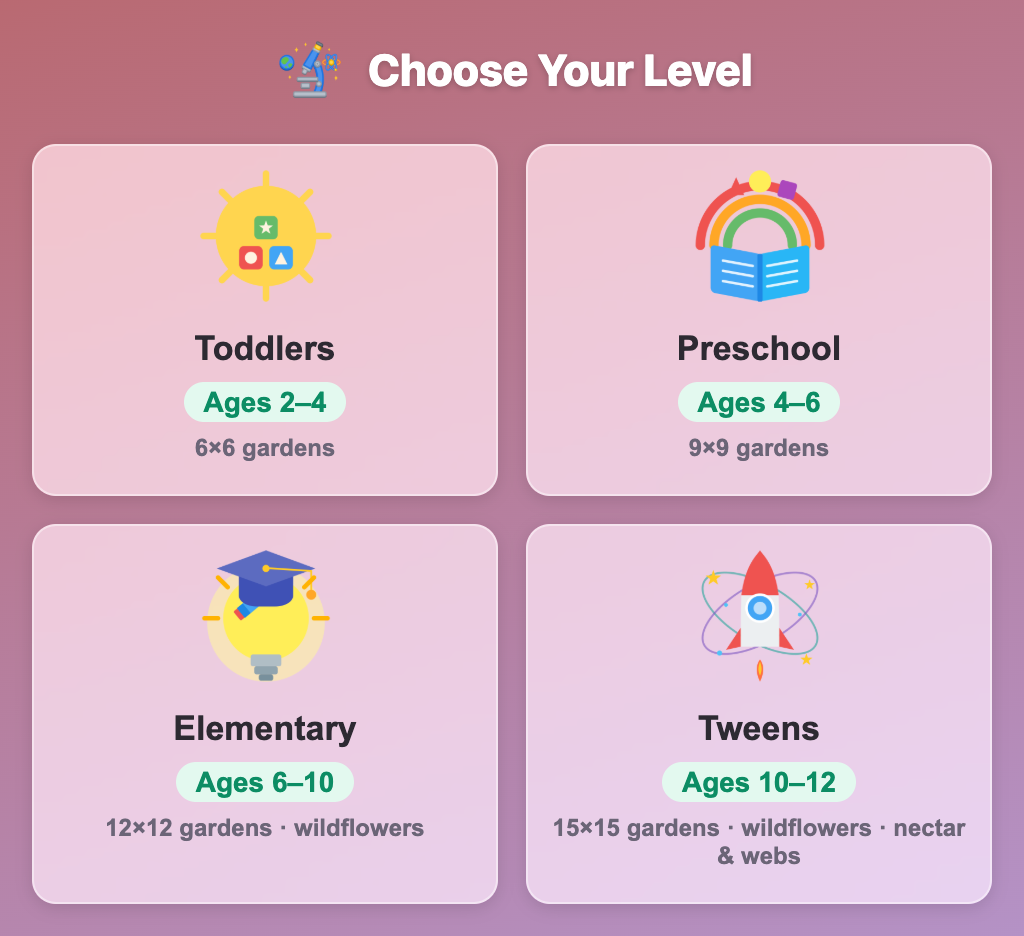
The Choose Your Level screen in Busy Bee Maze for kids, from 6x6 Toddlers gardens to 15x15 Tweens gardens
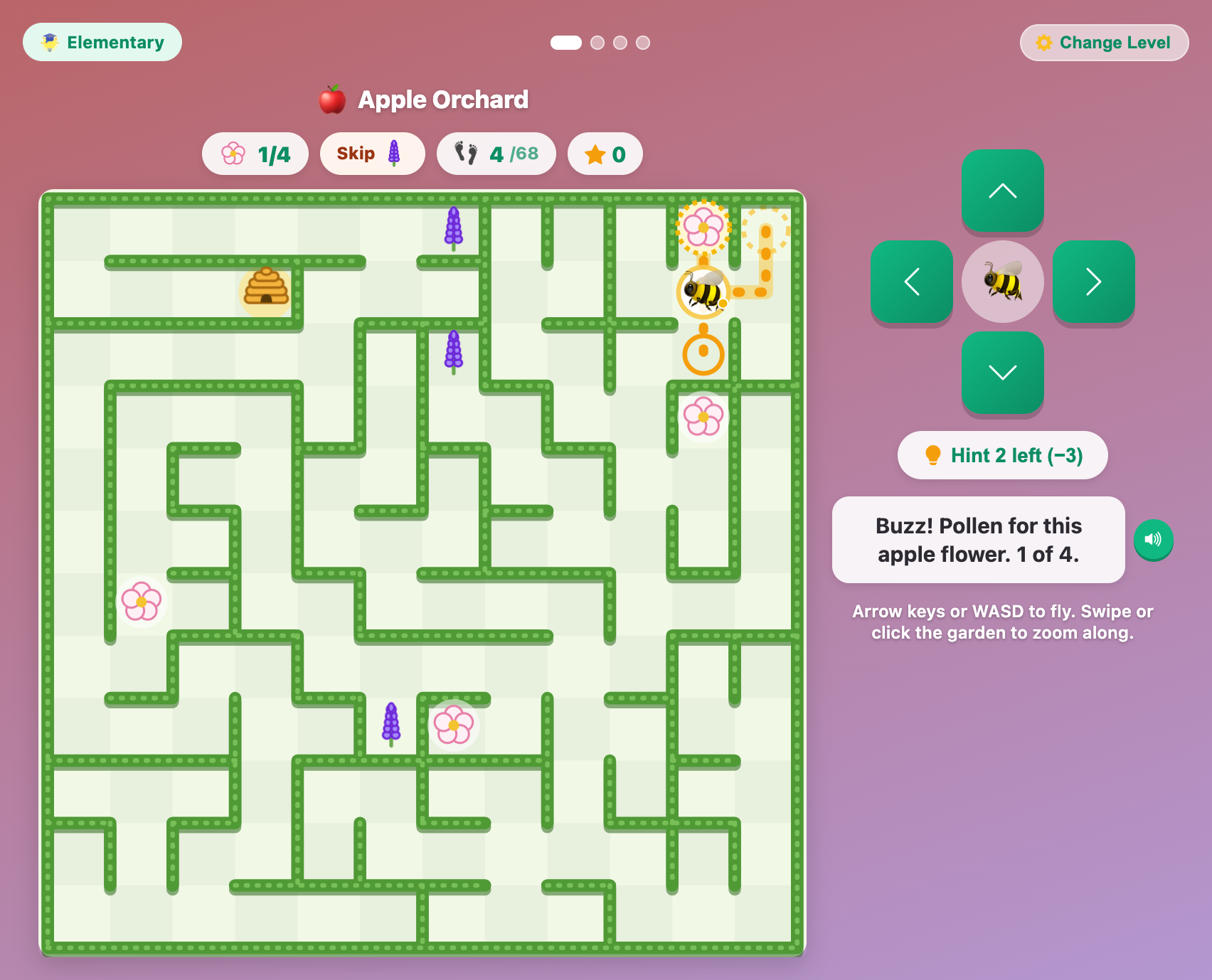
An Apple Orchard maze at the Elementary level with pink apple flowers, purple lavender to skip and a hive
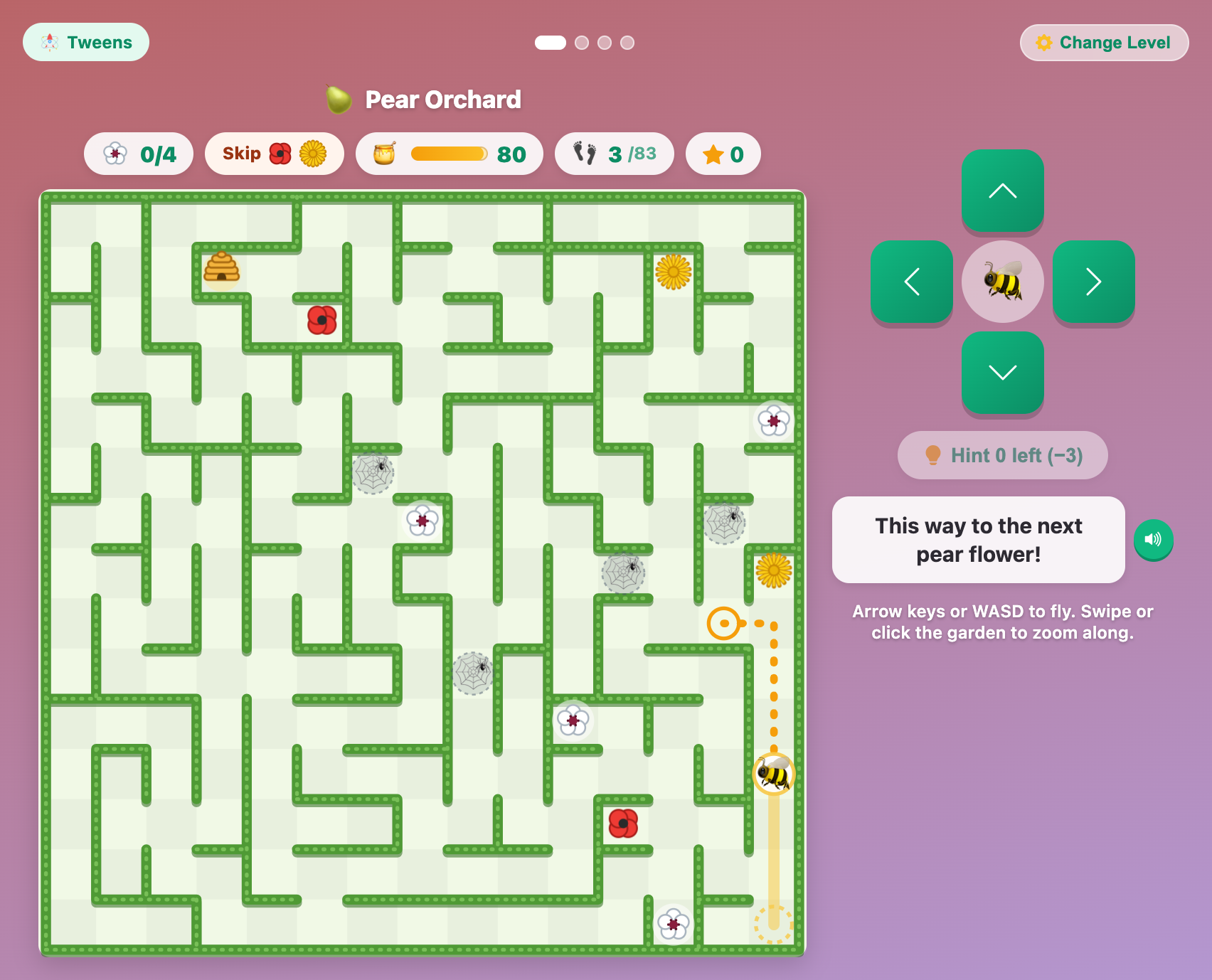
A Pear Orchard maze in Busy Bee Maze for tweens with a nectar meter, spider webs and a hint path
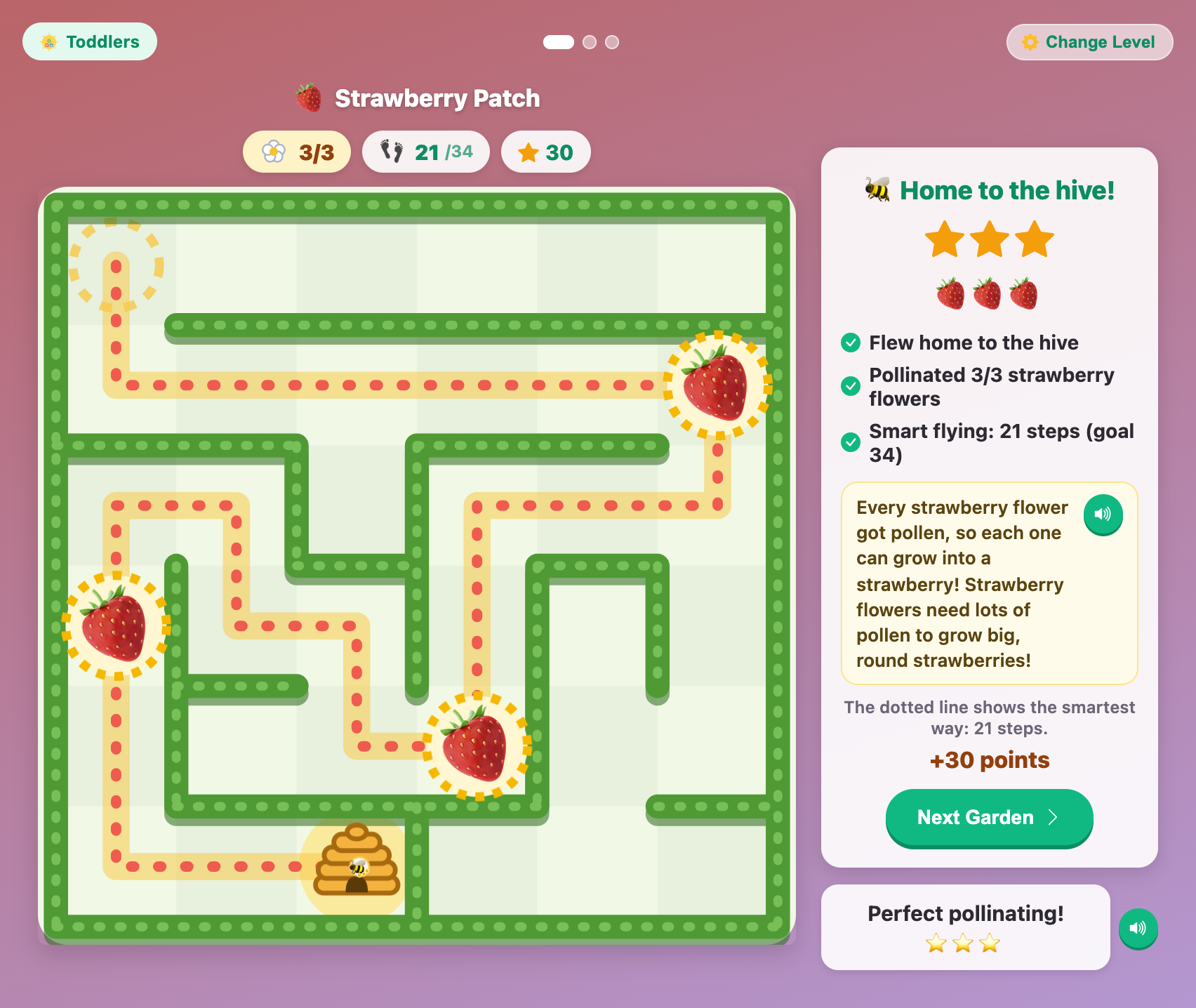
A finished Strawberry Patch at the Toddlers level where every visited flower has grown a strawberry
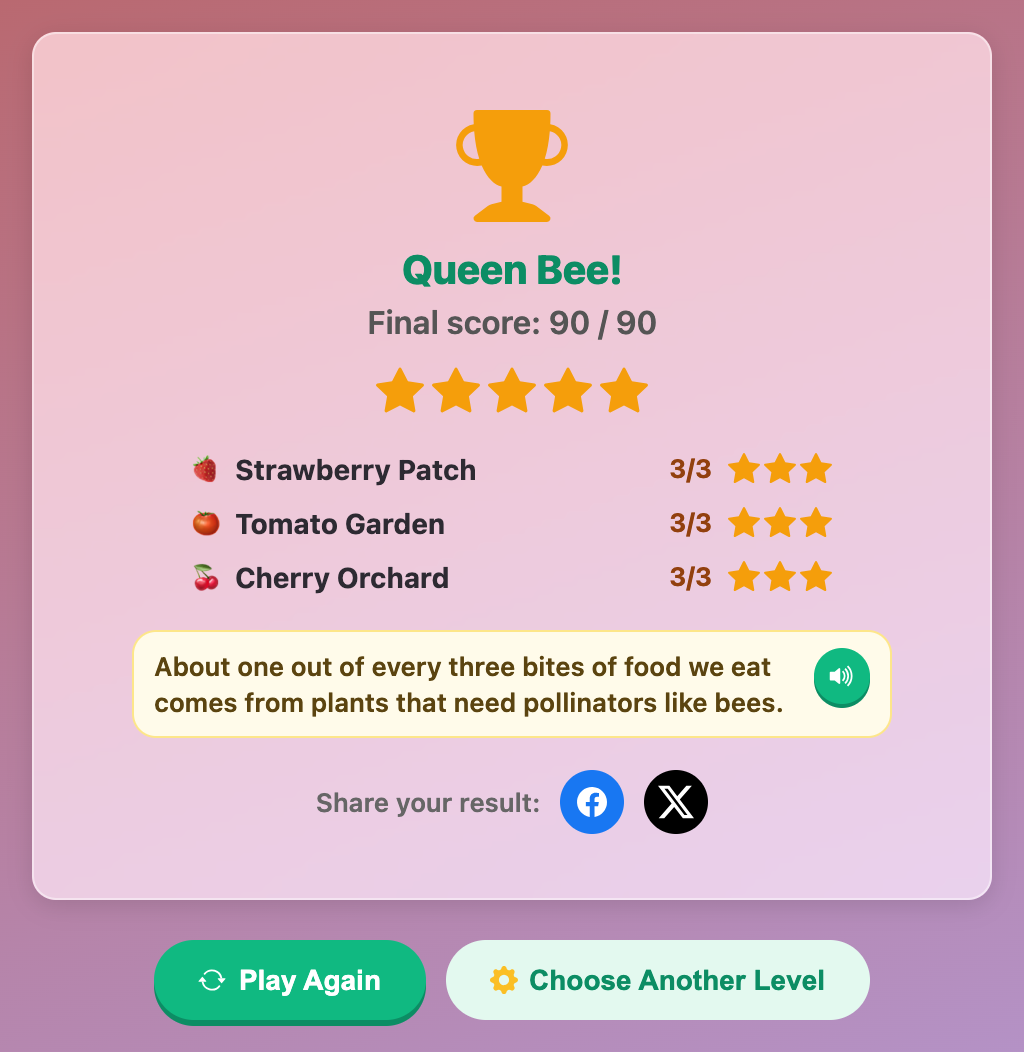
The Queen Bee results card in Busy Bee Maze with a perfect score of 90 and a bee fact
More Science Games
 59.5K plays
4.8
Recycling Sort
Sort everyday items into the Recycle, Compost, or Trash bin before time runs out!
 85.7K plays
4.9
Grow a Plant
Plant seeds in sunny and shady garden beds, then water, feed and protect them day by day. Watch the roots grow underground and harvest sunflowers, tomatoes, carrots and more!
 438.6K plays
4.9
Magnet Experiment
Guess which objects a magnet will pull, then drag the magnet to test every guess. Does gold stick? Does a battery?
 386.9K plays
4.9
Five Senses Match
Decide which of your five senses you would use for each everyday scene before time runs out.
Most Played Games
 1.8M plays
4.9
Color & Draw
A free-drawing canvas with colors and brush sizes to unleash your creativity.
59.5K plays
4.8
Recycling Sort
Sort everyday items into the Recycle, Compost, or Trash bin before time runs out!
 365.8K plays
5.0
Tic-Tac-Toe
Play a game of Tic-Tac-Toe against the computer and see if you can outsmart it.
 274.1K plays
5.0
Sentence Builder
Pick your age level, then tap the shuffled words in the right order to build the sentence.
Comments (20)