English Horse Derby
213.6K playsSaddle up for an English steeplechase! Every fence has a question: answer right to gallop and jump clean, get three in a row for Carrot Power, and race your horse past the pack to the finish. Find first letters, read picture words, spot rhymes, and pick the right spelling, opposite and grammar.
“And they’re off! Number 4, Daisy the palomino, bursts out of her starting stall. Here comes the first fence… but wait! Before Daisy can jump, her rider has to answer a question. Which word rhymes with 🦇 bat: balloon, hat or mouse?” Did you pick hat? Then Daisy gallops up and over! That is English Horse Derby for kids. It’s a jumping horse race where every fence has an English question, and the words you know are what make your horse fly.
You ride one of six cartoon horses against four others, over nine fences, all the way to the WIN post. Kids have raced it more than 200,000 times, and over 3,000 ratings give it 4.9 out of 5 stars. The questions grow with you. The littlest riders find first letters and picture words, preschoolers hunt for rhymes, and big kids pick the right spelling, opposite and grammar. A race lasts about a minute and a half, so there is always time for a rematch.
🏇 A Jumping Race Where Words Clear the Fences
In real life, a steeplechase is a horse race with jumps on the way to the finish. Horses must jump fences, and riders must stay steady and calm the whole time. The first steeplechase was run in Ireland almost 300 years ago, and it’s still exciting to watch, because anything can happen at a fence.
The KidWorld track is 1,000 meters long, with a sign on the back rail every 100 meters. Nine red-and-white fences stand along the grass, and a crowd cheers from striped grandstands. The very moment your horse lands one fence, the question for the next fence pops up under the track. Your answer decides how that next jump goes.
So this race is not about tapping fast. It’s about reading, listening and thinking about words, while your horse keeps running. The better you know your English, the cleaner your jumps.
📖 Horse Words Every Young Rider Should Know
Horse racing has its own special words. Learning them is English practice too! Here are the ones you will meet in this game.
Jockey: the rider who sits on the horse. In this game, that’s you.
Silks: the bright shirt and cap a jockey wears. Every horse’s jockey has their own two colors, so you can spot your horse in the pack.
Canter: a calm, bouncy run. Your horse canters while you think about the question.
Gallop: a horse’s fastest run, with all four hooves off the ground for a moment in every stride.
Clean jump: a jump that sails over the fence without touching the top rail.
Home stretch: the last straight part of the track before the finish line.
Bay, palomino, dapple gray, chestnut: names for horse colors. A bay is brown with a black mane and tail, like Thunder. A palomino is golden with a pale mane, like Daisy. A dapple gray has light spots, like Pepper. A chestnut is a reddish brown, like Rusty.
🎬 Your First Ride on KidWorld, Step by Step
Choose your level. The game starts on Elementary the first time. To change it, tap Change Level and pick Toddlers (ages 2–4), Preschool (ages 4–6), Elementary (ages 6–10) or Tweens (ages 10–12). The level decides which English questions you get.
Pick your horse. Meet Thunder, Daisy, Pepper, Midnight, Snowflake and Rusty. The horse you tap starts galloping on its card, while the others stand and paw the ground. All six run at the same speed, so choose the one you like best.
Pick your English. Under 2. Pick your English, tap 🎲 Mixed for a bit of everything, or one kind of question to practice it: 🔤 Letters, 🖼️ Words, 🎵 Rhymes, ✏️ Spelling, 🔄 Opposites or 📝 Grammar. Each level shows only the kinds that fit it. The game remembers your horse and your choice for next time.
Tap Start Race! The stalls count down 3, 2, 1, GO! Your horse runs in the front lane, under a YOU tag in your jockey’s colors.
Read the question card. It shows which fence you are heading for, like Fence 1 of 9, and a green bar with a tiny horse that creeps toward a little fence. That bar shows how close your horse is to the jump.
Answer. Tap a big green answer button, or press the number key that matches the small number in its corner. Tap the 🔊 button to hear the question read aloud.
Watch the race. The badge in the top left shows your place right now, and it turns gold when you lead. The oval map in the top right shows every horse as a colored dot. When a horse is off the screen, a tag such as ◀ Thunder 100m tells you how far behind you it is.
Pause when you need to. Tap Pause, or press P or Esc. The question hides while the race is paused, and the race also pauses by itself if you switch browser tabs. Setup takes you back to pick another horse or kind of English.
Gallop home. After fence 9 there are no more questions. It’s just the home stretch to the WIN post. Then your result card shows your place, stars, score and every horse’s time, with buttons to Race Again, Change Horse or Topic or Change Level.
Use the page buttons. The buttons around the game switch to fullscreen, reload the game for a fresh start, and turn the racing music and sounds on or off.
🚦 Green Light, Red Rail: How Your Answers Steer the Race
Your horse always canters between fences. What happens next is up to you.
✅ You answer right. Your horse speeds up to a gallop, more than twice as fast as its canter. Words like Giddy-up! pop up, and it sails over the fence with a clean jump.
🥕 Three right in a row. A 🥕 badge on the card counts your streak once you have two in a row. Your third right answer in a row switches on Carrot Power, an even faster gallop with sparkles and speed lines. In a perfect race, Carrot Power comes at fences 3, 6 and 9.
❌ You answer wrong. The card says Oops! The answer is “…”, and the right answer glows green while your pick turns red. Your horse canters a little slower, knocks the top rail off the fence with a Bump!, and lands with a Wobble! and dizzy stars. It nearly stops for about a second and a half. Your carrot streak starts again from zero. Nobody gets hurt. It’s just a silly stumble.
⏳ You haven’t answered yet. Your horse never jumps without an answer. It slows down, stops in front of the fence, paws the grass and shows an orange ? bubble. The card adds Your horse is waiting! The moment you answer, off it goes. Waiting costs a little time, but it never counts as a mistake.
The other four horses don’t answer questions. Each one gallops at its own speed. The fastest is about as quick as a rider who gets every question right in around 7 seconds. They knock a fence and wobble now and then too. A horse far ahead slows down a tiny bit, and one far behind speeds up a tiny bit, so the pack stays close and the race stays exciting until the very end.
🧩 Six Kinds of Fence Questions, Solved Like a Champion
The wrong answers in this game are not random. Each kind of question has its own sneaky trap, put there on purpose. Once you know the trap, you can ride right past it. Here is how to think through every kind, with real examples from the game.
🔤 Letters: “What letter does it start with?”
You see a picture and a word with its first letter missing, like 🐶 _og. Pick the letter that fills the gap.
Say the picture’s name out loud, slowly: “d-d-dog.”
Listen to the very first sound. It’s “d.”
Now look at the buttons. One of them is often a look-alike letter, such as b or q, which are shaped a lot like d. Check which way the round part faces before you tap.
Here’s a kind rule: the game never offers a wrong letter that can make the same starting sound. For ⭐ _tar, the letter c will never be a wrong choice, because c can sound like “s” too, as in city. So if you hear the sound right, you will be right.
🖼️ Words: “Which word is this?”
You see a picture, such as 🐱, and choose its word. The trap is words that look almost the same. You might see cat, car and hat together. Car starts like cat, and hat ends like cat.
Tip: read the whole word, start to end, before you tap. Check the first letter, then the last two. Only one word matches all the way through. The 🔊 button reads the question here but never says the word, because reading it is your job!
🎵 Rhymes: “Which word rhymes with it?”
Words rhyme when they end with the same sound, like bat and hat. In the race at the top of this article, the choices were balloon, hat and mouse. Did you notice the trap? Balloon starts with b, just like bat. Wrong answers often begin with the same letter as the word, to catch riders who look at the start instead of listening to the end.
Say the word: “bat.” Now say only its ending: “-at.”
Say each choice and listen to its ending: “-oon,” “-at,” “-ouse.”
The one that ends with “-at” wins. Hat it is!
Preschoolers get a little picture on every rhyme answer. Older riders see only the words, so they must read and hear the endings by themselves. Watch for rhymes that are spelled differently, too: ear and deer rhyme, even though their endings look different.
✏️ Spelling: “Which spelling is right?”
You see a sentence with a blank, like Running is good ___. Four spellings wait below: exercise, exersise, excercise and exercize. Only one is a real word. Here’s how a champion checks:
Tap 🔊. For spelling, the game reads it like a spelling test: it says the word, then the whole sentence.
Break the word into chunks: ex · er · cise.
Hunt for the extra or swapped letter in each wrong one. Excercise sneaks in a c. Exersise and exercize use the wrong letter in the last chunk.
A tweens example: The bake sale was very ___. The right spelling is successful. Here’s a handy rule. When “full” becomes an ending, it loses one l: success + full = successful, help + full = helpful. So successfull, with two l’s at the end, is a trap.
🔄 Opposites: “What is the opposite?”
An opposite means the very different thing, like up and down. The trap is words that mean something close to the word, not the opposite of it. For hot, you might see cold, warm, sunny and red. Warm and sunny go with hot. Cold is its opposite.
Tip: make a tiny sentence with “not.” If it’s not hot, it’s… cold! Tweens get harder pairs. For ancient, the choices could be modern, old, historic and broken. Old and historic mean almost the same as ancient, so they can’t be its opposite. Modern means “new and of today,” so that’s the one.
📝 Grammar: “Which word fits?”
You read a sentence with a gap and choose the word that makes it sound right. Try each choice in the gap and read the whole sentence quietly to yourself.
Look at those two little ___! The choices are mice, mouses, mouse and mices. Two means more than one, and more than one mouse is mice. Some words change inside instead of adding an s, like foot and feet.
I could ___ helped you with that. When people say “could’ve” fast, it sounds like “could of.” But the real word is have: I could have helped you. This one trips up lots of grown-ups too!
The dog wagged ___ tail. Try the “it is” test. The dog wagged it is tail sounds silly, so it’s is wrong. The answer is its, with no little mark.
🏆 Race Plans for a Faster Finish
Knowing the words is half the race. The other half is riding smart. These plans go from easy to clever.
1. Read while your horse canters
Each new question shows up right after a landing, while your horse still has a long stretch ahead. At a canter, it needs about 9 to 11 seconds to reach the next fence. Use that time! If you answer while the tiny horse on the card’s bar is still in the first half, your horse gallops most of the way.
2. Right first, fast second
A wrong answer costs you four ways at once: a slower canter, a wobble on landing, your carrot streak, and the points for that jump. A slower right answer still lets your horse gallop. So if you are not sure, take one more breath and check. Your horse will wait for you.
3. Guard your third carrot
When the badge says 🥕 2, your next right answer turns on Carrot Power. That’s the most valuable question in the race, so read it extra carefully.
4. Listen when a word looks tricky
The 🔊 button is always there. For Letters, it even says the picture’s word, so you can hear its first sound. For Spelling, hearing the word in a sentence tells you which word to look for before you check the letters.
5. Keep your eyes on the words
On a computer, put your fingers on the number keys 1 to 4. You can answer without looking away from the question, which saves a second at every fence.
6. Have a spelling-test week
Got a spelling test coming up? Pick ✏️ Spelling instead of Mixed, and every fence becomes spelling practice. It works the same way for 🔄 Opposites, 📝 Grammar and the other kinds.
7. Turn your practice list into a word list
At the end of a race, the result card lists up to six things you missed under Practice these again. A missed picture word shows up with its picture, like “🐶 dog.” A rhyme shows both words, like “bat · hat.” An opposite shows the pair, like “hot ↔ cold,” and a grammar miss shows the whole sentence done right. Copy them onto paper, say them out loud, then race again and see if they come back.
8. Never give up on the home stretch
Horses far ahead slow down a little, and a Carrot Power gallop covers ground fast. Watch the tags with meters on them. A horse 50 meters ahead is not out of reach, especially when your next answers bring Carrot Power.
🎯 English Horse Derby for Kids from Two to Twelve
🐣 Toddlers (ages 2–4)
English Horse Derby for toddlers uses only two kinds of questions: Letters and Words. Every question has a big picture and just three answer buttons. When the site’s sound is on, each new question is read aloud by itself. A grown-up can sit close, say the picture’s name together, and let the child tap. Because the horse waits at the fence, a little one never gets rushed into a mistake.
🖍️ Preschool (ages 4–6)
English Horse Derby for preschoolers adds Rhymes to Letters and Words. Every rhyme answer has a picture, so a child who can’t read yet can still play by listening. Questions are read aloud automatically here too, and there are still three answers. If rhymes become the favorite part, Rhyme Match is a card game where you flip cards to find words that rhyme.
🎒 Elementary (ages 6–10)
English Horse Derby for elementary kids switches to four answers and four kinds of questions: Rhymes (words only now), Spelling, Opposites and Grammar. Spelling words are ones kids use every day, like friend, because, said and people. Questions aren’t read automatically at this level, but the 🔊 button still reads any question you choose.
🚀 Tweens (ages 10–12)
English Horse Derby for tweens drops Rhymes and makes Spelling, Opposites and Grammar much harder. Expect tricky words like necessary, rhythm and embarrass, opposites such as transparent and opaque, and grammar puzzles with their, there and they’re, or whose and who’s. Answering all of these fast enough to beat the leading horse is a real challenge.
📊 How Your Race Score Adds Up
Your score is out of 100, and it comes from two places:
Your place: 40 points for 1st, 32 for 2nd, 25 for 3rd, 18 for 4th and 12 for 5th.
Your clean jumps: up to 60 more points, split across the nine fences. That’s about 7 points for every fence you clear without a bump.
Here’s a surprise: clean jumps can matter more than winning! In the race in our pictures, Midnight won 1st place but knocked 2 fences: 40 + 47 = 87 points and 4 stars. A rider who comes 2nd with all nine jumps clean gets 32 + 60 = 92 points and 5 stars. A perfect race, 1st place with every jump clean, scores the full 100.
Stars come from your score: 90 or more earns ⭐⭐⭐⭐⭐, 70 or more earns four, 50 or more earns three, and 25 or more earns two. Every point you score is also added to your KidWorld stars.
🌼 Little Riders, Big Reading Skills
Every fence is a tiny English lesson, and the race makes kids want the next one. When the first letter of 🐶 is missing, a toddler is practicing the sound at the start of a word, which is one of the first steps of reading. When a preschooler listens for the ending of “bat,” they are learning to hear the parts inside words. That helps them read and spell new words later.
Older kids practice the things that show up on real school tests: spelling tricky words, finding opposites and fixing grammar. The traps teach a habit that helps everywhere. Stop, check the whole word, then answer.
Mistakes turn into learning right away. The card shows the right answer the moment you miss, and the practice list keeps it for after the race. And since the horse waits instead of crashing, slower readers can still take their time and get it right.
If your child enjoys these questions, the same six kinds of English also power Dino English Dash, a race where cartoon dinosaurs dash ahead and roar on every right answer.
A word for parents and teachers
English Horse Derby is a gentle game. The horses are friendly cartoons, and the worst thing that happens is a silly wobble with dizzy stars. There is no timer that ends the game and no question that can’t be answered by waiting and thinking. It practices phonics, vocabulary, rhyming, spelling, opposites and grammar, plus focus and careful checking. Kids who love the horses can take the very same ride with numbers in Math Horse Derby, where every fence asks a math question instead.
So pick your horse, choose your English and listen for the countdown. Nine fences and nine questions stand between you and the WIN post. Ready for a ride in English Horse Derby for kids? Giddy-up, and may every jump be clean! 🏇🥕
🖼️ See the Game in Action
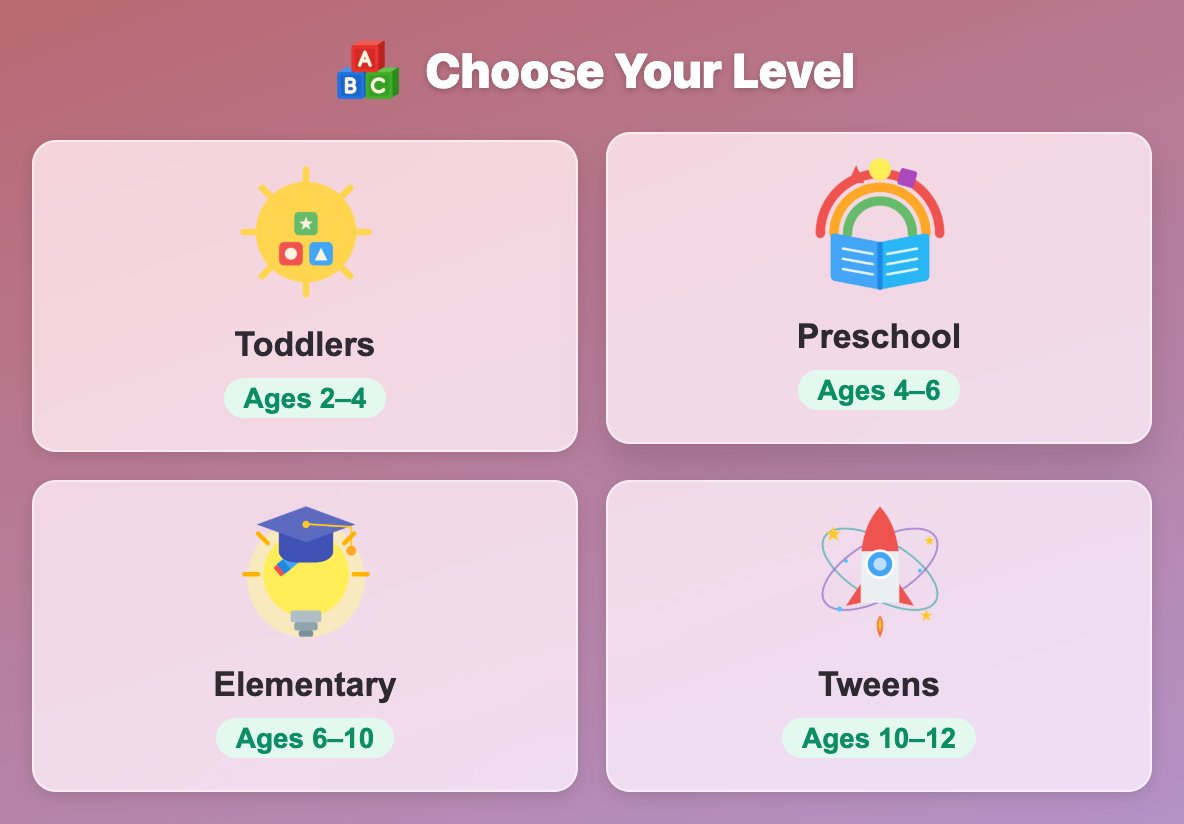
The Choose Your Level screen in English Horse Derby, with Toddlers, Preschool, Elementary and Tweens cards
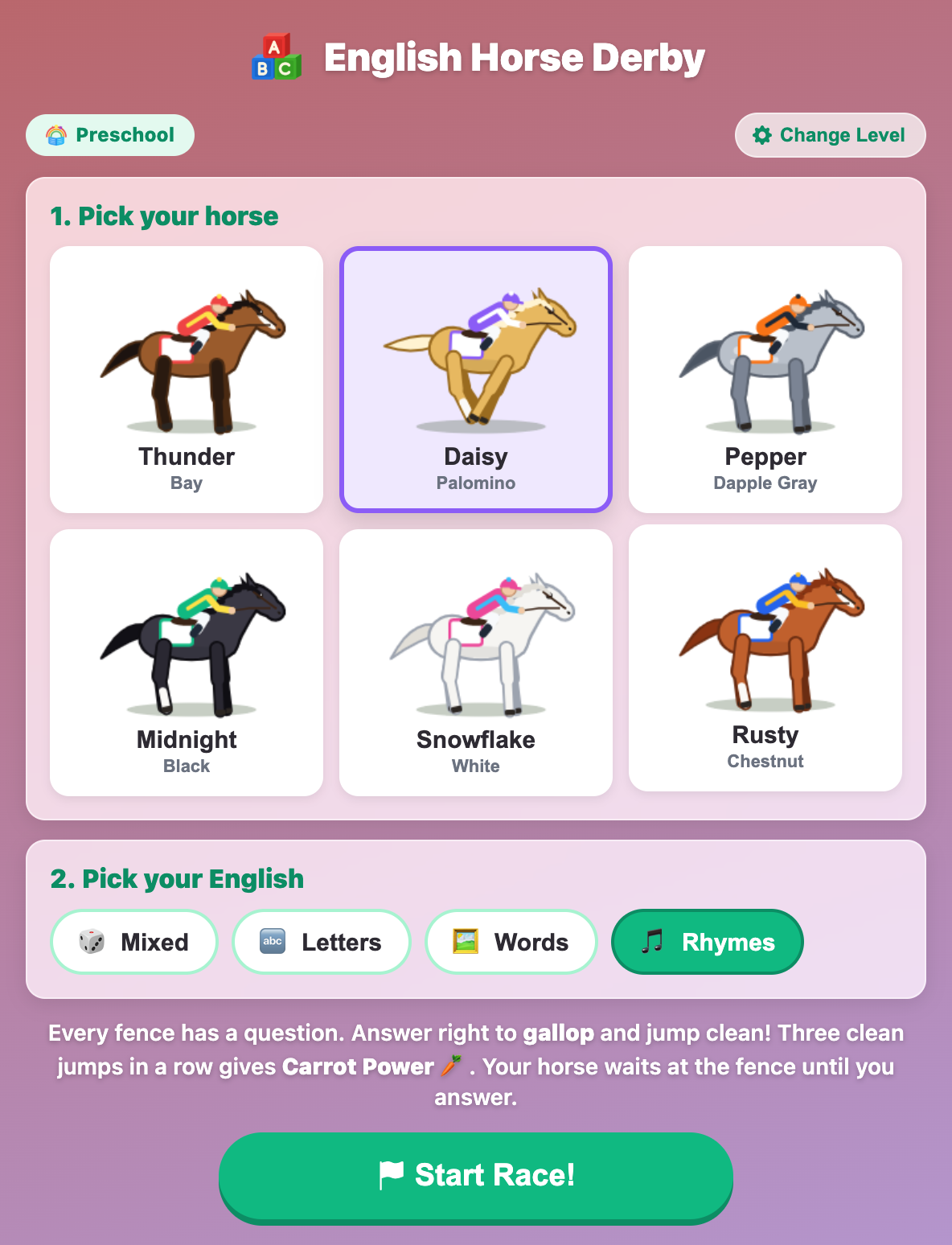
The English Horse Derby setup screen with Daisy the palomino picked and the Rhymes topic chosen for preschool
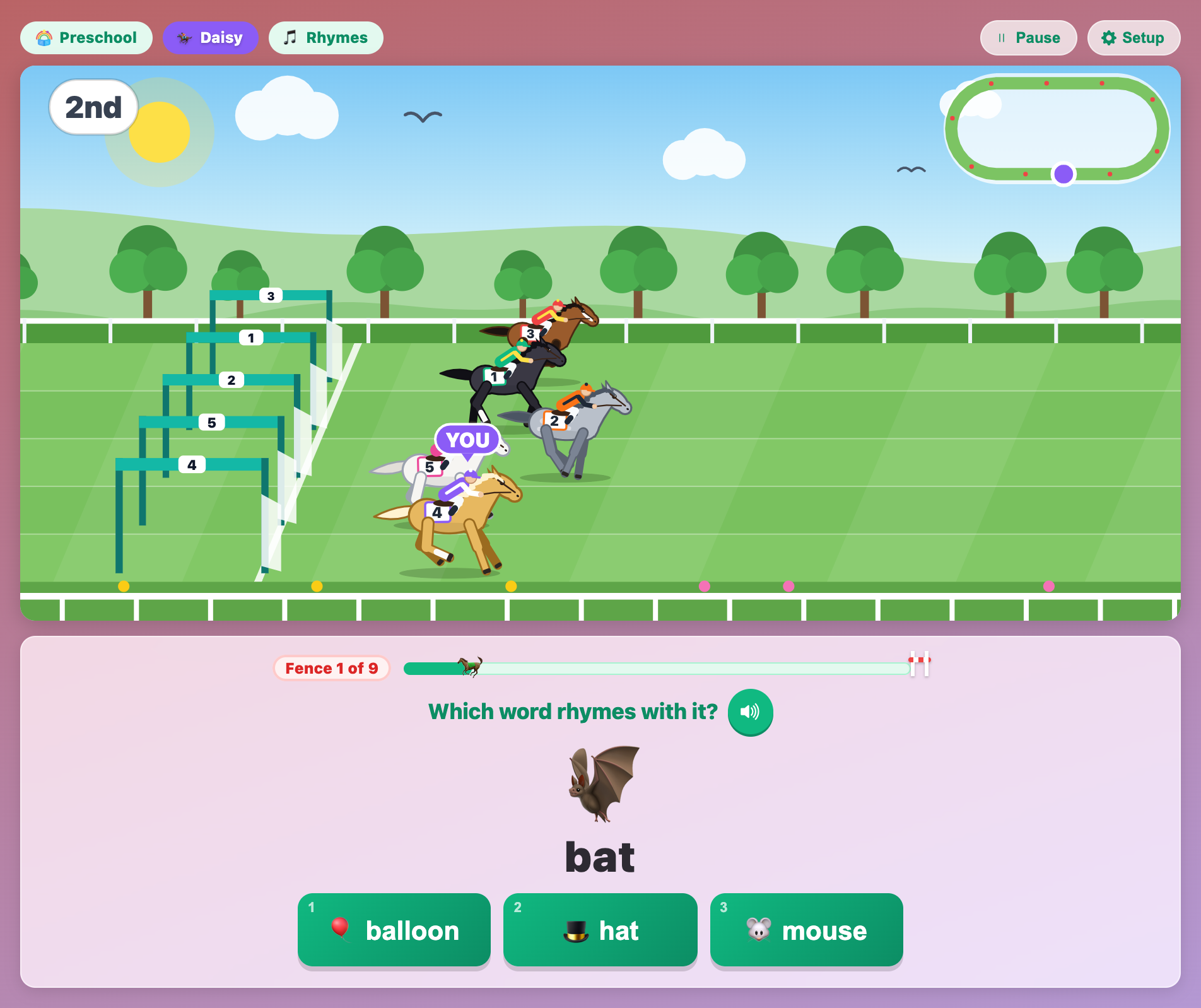
A rhyme question in English Horse Derby for kids asking which word rhymes with bat, with balloon, hat and mouse buttons
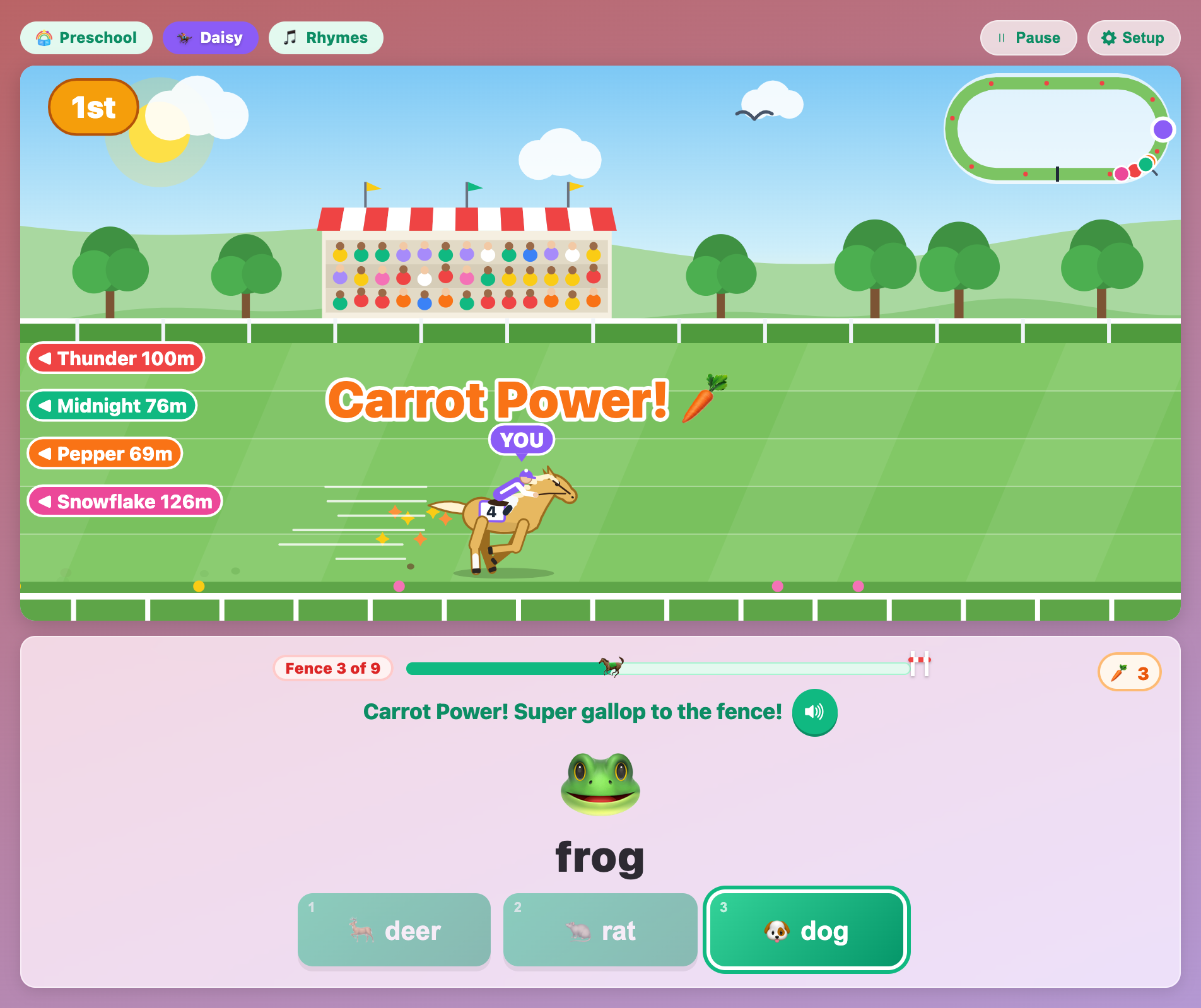
Daisy bursting into a Carrot Power gallop in 1st place after three right rhyme answers in English Horse Derby
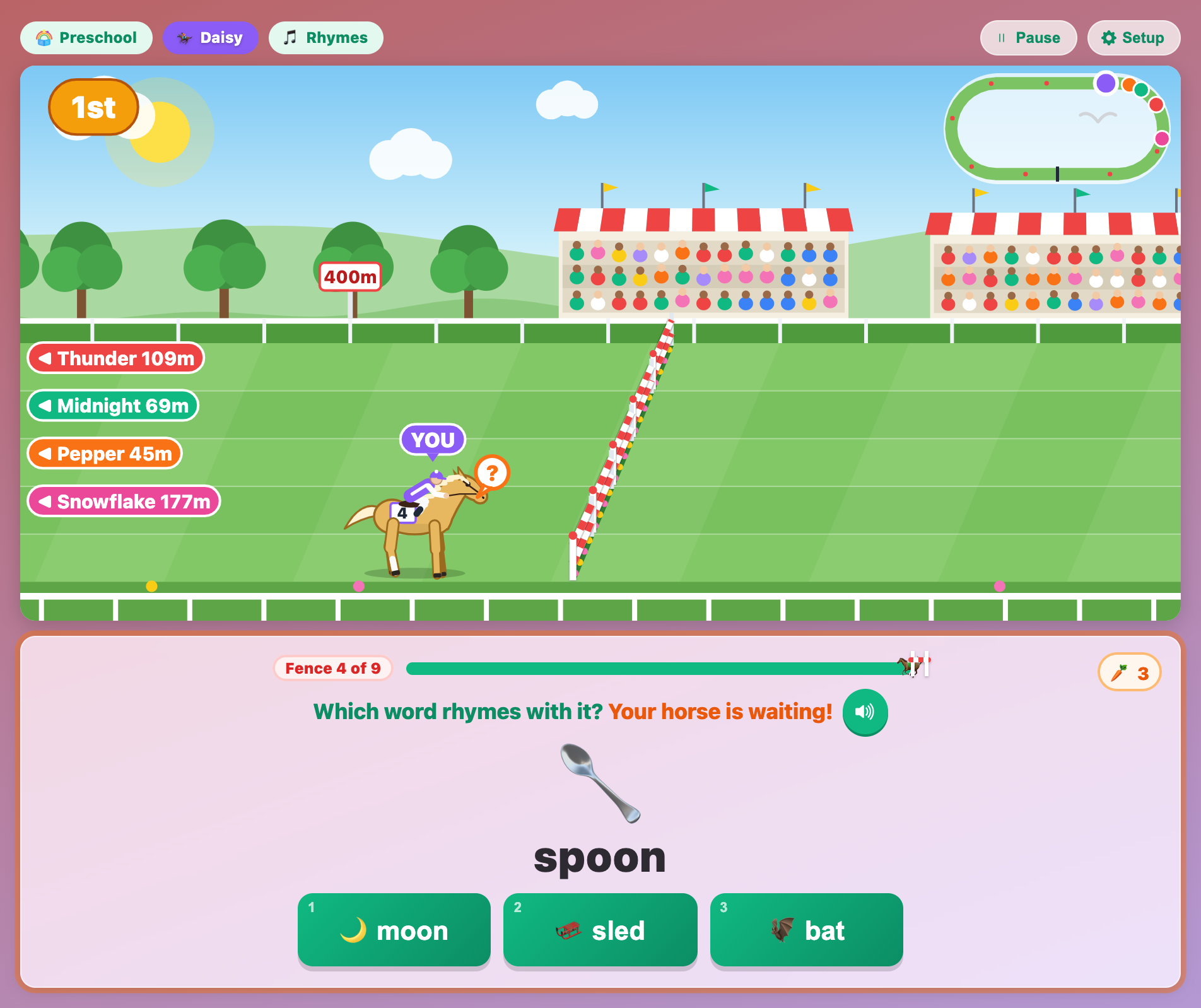
Daisy standing at fence 4 with a question mark bubble while the card says Your horse is waiting, in English Horse Derby for preschoolers
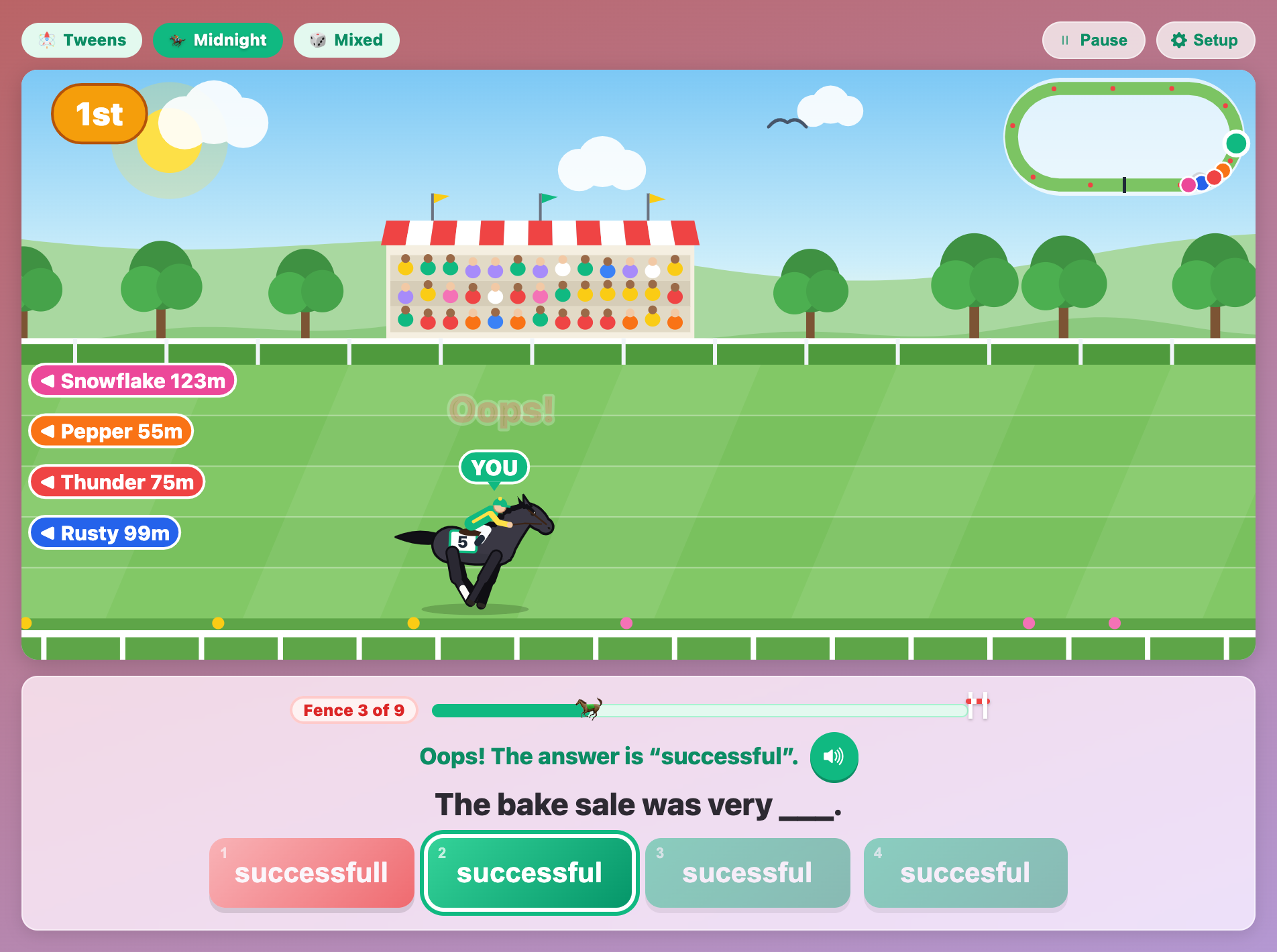
A spelling question in English Horse Derby for tweens where the wrong pick successfull turns red and successful glows green
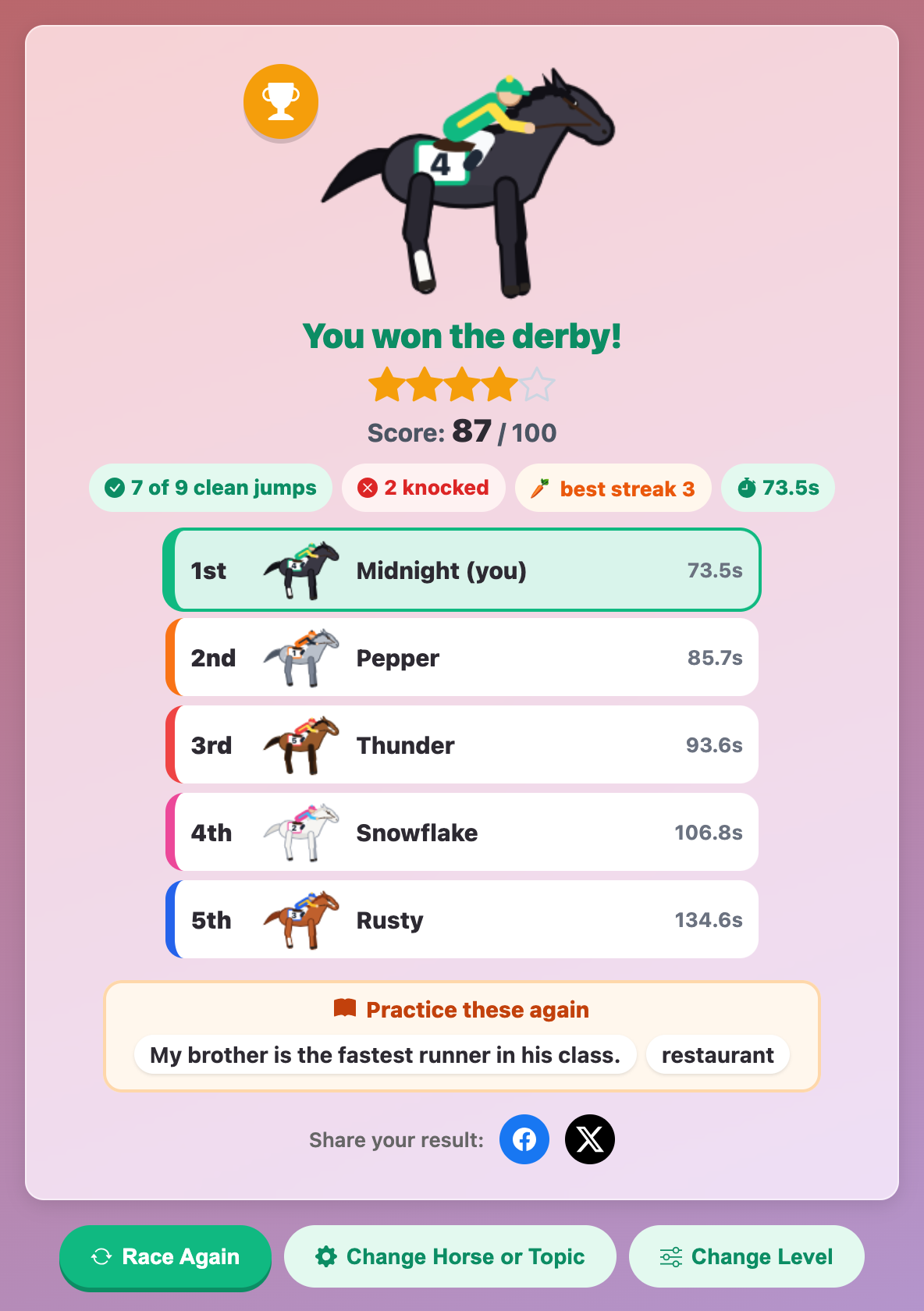
The English Horse Derby result card with a 1st place win, a score of 87 out of 100 and a Practice these again list
More English Games
 435.5K plays
4.9
435.5K plays
4.9
Sight Word Pop
Read the target word and pop the matching bubble before the timer runs out.
 273.8K plays
4.9
273.8K plays
4.9
Sentence Builder
Pick your age level, then tap the shuffled words in the right order to build the sentence.
 235.5K plays
5.0
235.5K plays
5.0
Alphabet Pop
Pop the bubble with the letter that a picture and word starts with.
 2.1M plays
5.0
2.1M plays
5.0
Word Search
Find all the hidden words in the letter grid before time runs out.
Most Played Games
 1.8M plays
5.0
1.8M plays
5.0
Color & Draw
A free-drawing canvas with colors and brush sizes to unleash your creativity.
 59.4K plays
5.0
59.4K plays
5.0
Recycling Sort
Sort everyday items into the Recycle, Compost, or Trash bin before time runs out!
 365.5K plays
4.9
365.5K plays
4.9
Tic-Tac-Toe
Play a game of Tic-Tac-Toe against the computer and see if you can outsmart it.
 1.1M plays
4.9
1.1M plays
4.9
Chess
Play the classic game of chess against the computer or a friend, with FIDE time controls, hints, and undo.
Comments (25)