
English Village Builder
314.8K playsBuild a village on a blocky island! Answer vocabulary, spelling, word-meaning and grammar questions to earn wood, stone, flowers and diamonds for every house, road, farm and school.
On this little island, nobody pays with coins. A house costs two pieces of wood. A road costs one stone. And the only way to get wood or stone is to answer an English question. Know that a 🧦 is a "sock"? That is wood in your pocket. Can you spot that "calendar" is spelled right and "calender" is not? That is stone. Welcome to English Village Builder for kids, where every word you know turns into a block for your village.
You start with an empty island of sand and a thin blue stream. Question by question, you earn the things you need to fill it with houses, farms, shops, a playground and a big brick school. Little blocky villagers walk down the roads you build, and smoke puffs from every chimney. Kids have played it more than 300,000 times on KidWorld, and it has a rating of 4.9 out of 5 from more than 1,700 ratings. It is a building game and a word game at the same time, and you never have to choose between them.
🪙 Words Are the Money on This Island
English Village Builder is a village-building game with an English twist. You finish 12 quests, one at a time. A quest is a small job, like "Plant 10 squares of grass on the sand" or "Build 3 houses for your villagers." Each finished quest unlocks a new piece to build with.
Here is the big idea. Most pieces cost a building material, and each material comes from its own kind of English question:
🪵 Wood comes from Vocabulary questions. You see a picture and pick the word that names it. Wood builds Houses, Fences and Bridges.
🪨 Stone comes from Spelling questions. You pick the word that is spelled the right way. Stone builds Rocks and Roads.
🌸 Flowers come from Word Meaning questions. You pick what a word means. Flowers grow Trees and Farms.
💎 Diamonds come from Grammar questions. You pick the word that fits in a sentence. Diamonds are the hardest to earn, and they build the Shop, the Playground and the School.
Two pieces are free: 🌱 Grass and 💧 Lake. That is why your very first quest, painting grass, has no questions at all. You learn how building works first. Then you unlock 🌳 Trees. The first time you try to plant one, your first question pops up, and the word game begins.
Every island is new. Its shape is made fresh each time, and the stream flows in from a different side. So no two villages ever look the same.
🧰 From Empty Sand to Busy Streets: Playing English Village Builder on KidWorld
Here is how a game goes, screen by screen:
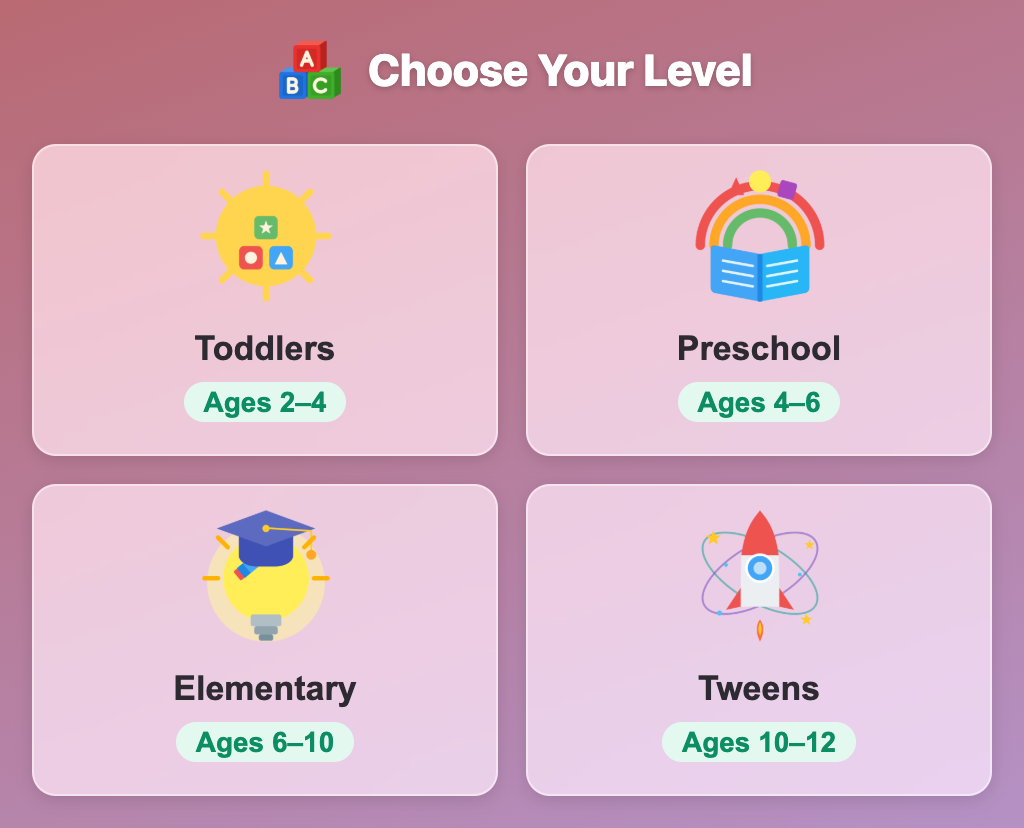
Pick your level. The "Choose Your Level" screen shows four cards: Toddlers, Preschool, Elementary and Tweens. Your level picks which English questions you get and how big your island is. The game remembers your choice. You can switch later with the ⚙️ Change Level button, and each level keeps its own island.
Read your quest. The pink card at the top says "Quest 1 of 12" and what to build. A bar fills up as you go, and a counter like "4 / 10" shows how close you are. A tiny picture on the right shows which piece you will unlock next.
Choose a piece. The row of blocks under the island is your toolbox. Locked pieces show a 🔒. A new piece gets a shiny "NEW" badge. Each piece also has a little price tag in its corner, like 🪵2 on the House or 💎2 on the School.
Watch your materials bar. Under the toolbox are four chips: Wood, Stone, Flowers and Diamonds. Each one shows how many you have, and a ✓ number shows how many questions of that kind you got right.
Tap or drag to build. Tap a square on the island to place your piece. Press and drag to paint a whole line, which is great for grass, roads and fences.
Answer a question when you run out. If you tap a spot but can't pay for the piece, a question card opens. Its label tells you the deal, like "Earn Wood · Vocabulary → House." The spot you tapped glows gold while you think. Get it right and the piece is built for you right there!
Earn ahead of time. Tap the green + on any material chip to answer a question before you need it. This is handy before you drag a long fence or road.
Use the 🔊 button. Every question card has a speaker button that reads the question and the choices out loud. On a keyboard, you can also press 1, 2, 3 or 4 to answer, and Esc to close the card.
Fix mistakes. ↩️ Undo takes back your last change. The 🧽 Eraser removes a piece or turns grass back into sand. Both of them give your materials back, so a mistake never wastes an answer.
Look around. The round arrow buttons turn the island. ➕ and ➖ zoom in and out, and ✋ Move lets you slide around when zoomed in. On a keyboard, Q and E turn the island.
Finish your village. When you are proud of it, tap 🏁 Finish Village. You get a picture of your island, your score out of 100, your stars, and a list of the English you got right.
Play again. Tap "Build a New Island" for a fresh start, or "Choose Another Level" to try a new set of questions.
Your island saves itself in your browser after every change, together with all the materials and answers you earned. Close the page, come back tomorrow, and your village is still there. The 🏝️ New Island button and the page's reload button both start over with an empty island. The play page also has buttons for fullscreen and for turning music and sounds on or off.
📝 Inside the Question Card: Four Kinds of English
The questions are the heart of this game, so let's look at real ones. Each one below comes straight from the game.
🪵 Vocabulary: "What is this?"
A big picture sits on the card, and you pick the word that names it. On the Toddlers level, a 🧦 might appear with three choices: shoe, pig and sock. The pig is easy to rule out, because it is not something you wear. Then look closely: a shoe has a hard bottom and laces, but this one is soft and stretchy. It is a sock!
Older levels use harder words. An Elementary card might show 🌋 with volcano, mountain, island and desert. A mountain and a volcano both look tall and pointy. The clue is the fire and smoke on top. Only a volcano has that.
🪨 Spelling: "Which spelling is right?"
You see a picture and a few ways to spell its word. Only one is correct. For Tweens, a 📅 might come with calendar, calender, calandar and callendar. These look almost the same! Here is a trick: say the word slowly, "cal-en-dar." It ends in -ar, like "car." And it has only one l. So the answer is calendar.
Some tricky spelling cards also give you a small hint line. For the 🏘️ picture, the hint says "someone who lives next door," so you know the word is neighbor before you even look at the spellings.
Fun fact: when you press 🔊 on a spelling question, the voice does not read out the wrong spellings. It asks "How do you spell calendar?" just like a spelling test at school.
🌸 Word Meaning: "What does this word mean?"
This time, the word is written big and green, and you pick what it means. An Elementary card might show 😩 exhausted with very hungry, full of energy, very, very tired and very excited. The face on the card is a great clue. It looks worn out, not hungry or excited. And "full of energy" is the exact opposite. So exhausted means very, very tired.
A good test: put your answer into a sentence. "After the long race, I was very, very tired." Now swap in the word: "After the long race, I was exhausted." It still makes sense!
💎 Grammar: "Which word fits?"
Now you see a sentence with a gap in it, and you choose the word that fills the gap. On Elementary you might get: "Tom ___ his sandwich before lunch," with eated, eaten, eat and ate.
Look for a time clue. "Before lunch" and the story feel tell you it already happened.
Cross out eated. It is not a real English word. "Eat" has its own special past word.
Try eaten: "Tom eaten his sandwich." It sounds wrong without "has" in front.
Try ate: "Tom ate his sandwich before lunch." Perfect! That is your diamond. 💎
Tweens get the sneaky ones grown-ups mix up too. "The dog wagged ___ tail" comes with its, it's, its' and it. Remember: it's always means "it is." "The dog wagged it is tail" makes no sense, so the answer is its.
When you answer right, the card cheers "✅ Correct!" and shows what you earned, like "You earned 💎 1 diamond." About one second later it closes and builds your piece. When you miss, the right answer lights up in green, and the card says "Not quite!" and shows the right answer. Then you can tap "Try another question" or "Not now."
🧠 Word Wizard Tricks for Every Question
Every right answer earns materials, and it also helps your score (you will see how later). These tricks help you get more right.
Read every choice before you tap. Two choices often look close, like mountain and volcano. The first one that "sort of" fits is not always the best one.
Cross out the silly ones first. Most cards have one or two choices that clearly don't belong, like a pig for a sock. Getting rid of them makes the real choice easier.
Use the picture. Even Word Meaning and Grammar cards have an emoji. For "exhausted," the tired face almost gives it away. For a sentence about school, look for a school word.
Say it out loud. For grammar, read the whole sentence with each choice in the gap. Your ears often know "She goes to school" sounds right and "She go to school" does not.
Hunt for time words. "Yesterday," "last night" and "before" mean the action is already over. Pick the past word, like went or did.
Break long words into chunks. For spelling, clap out the parts: "but-ter-fly." Then check each chunk. "Butterflie" has the wrong ending.
Let the 🔊 button help. Hearing the question can make it click, especially for younger players who are still learning to read.
Don't rush to close the card. If you close a question without answering, the same question waits for you next time. You can't skip a hard one by closing it, so take a breath and think it through.
🏗️ Smart Builder, Smart Spender
Anyone can answer questions. A great player also plans how to spend. Each level pays a different amount for one right answer:
Toddlers: 4 wood, 4 stone, 3 flowers or 2 diamonds per right answer.
Preschool: 3 wood, 3 stone, 3 flowers or 2 diamonds.
Elementary: 3 wood, 3 stone, 2 flowers or 1 diamond.
Tweens: 2 wood, 2 stone, 2 flowers or 1 diamond.
And each piece has a price: a House costs 🪵2, a Fence or Bridge 🪵1, a Rock or Road 🪨1, a Tree 🌸1, a Farm 🌸2, a Shop or Playground 💎1, and the School 💎2.
Example 1: Budget before you drag
On Tweens, the Fence quest asks for 8 pieces of fence. That is 8 wood. Each Vocabulary answer pays 2 wood, so you need 4 right answers. Tap the + on the Wood chip four times first. Then drag your fence in one smooth line. If you drag with too little wood, the fence stops where the wood runs out, a message says "Out of 🪵 wood!", and a question pops up to earn more. That works too, but earning first is smoother.
Example 2: The two-diamond School
The School is the most expensive piece, at 2 diamonds. On Toddlers and Preschool, one Grammar answer pays 2 diamonds, so one question is enough. On Elementary and Tweens, one answer pays only 1 diamond. So after your first right answer, the game says you need 1 more diamond and asks a second question right away. Get ready for two grammar questions in a row!
Example 3: Leftovers are never wasted
On Elementary, you need 4 houses. That is 8 wood. Three right Vocabulary answers give you 9 wood. You build all 4 houses and still have 1 wood left, which is exactly one Fence piece or one Bridge piece for later. Your stock always stays on the chip until you use it.
Example 4: The eraser is a refund button
Put a house in a bad spot? Erase it. Your 2 wood go straight back to the Wood chip. The game counts your stock as "everything you earned, minus what is standing on the map." So moving a building never costs you a new question. Undo works the same way.
Plan the village, not just the pieces
From Preschool up, buildings have wishes. A white thought bubble floats over a building that is missing something: a 🛣️ road, 💧 fresh water, or 🏠 neighbors. A house wants a road next door. A farm wants the stream or a lake within 2 squares (the salty sea does not count). A shop wants a road and 2 houses close by, and the School wants a road and 3 houses. On Elementary and Tweens, the farm, shop, playground and school quests only count buildings whose wishes are met. So a smart plan is:
Draw one long main road first.
Line your houses up along it, so every house touches the road.
Keep a free 2×2 patch of land beside the road for the School.
Plant farms on grass right next to the stream.
This saves materials, too. If you plan the spots first, you won't need to erase and rebuild, and every answer goes further.
One more money-saving trick: grass and lakes are free, and houses, roads, shops and the school can sit on plain sand. Only trees and farms need grass. So paint grass where plants will grow, and save your flowers for the trees.
🏅 How Your 100 Points Are Counted
Your score is split into two halves. Half is for building, and half is for English.
Quests (up to 35 points): split across all 12 quests.
Happy buildings (up to 10 points): the share of buildings with every wish met. (On Toddlers, where there are no wishes, any building earns all 10.)
Variety (up to 5 points): how many of the 12 kinds of pieces are on your island.
English (up to 50 points): the share of your questions you answered right.
Here is a real finished game on Elementary. The player finished 10 of 12 quests (29 points). 92% of the buildings were happy (9 points). 11 of the 12 kinds of pieces were on the island (5 points). And they got 16 of 19 questions right (42 points). That adds up to 85 out of 100, worth 4 stars.
Notice something important. The English points come from the share you got right, not how many you answered. Answering lots of questions is great, as long as you think each one through. Guessing fast can pull your share down. Careful answers keep it high.
The result card also names your village. Finish all 12 quests and it says "Word Master Village!" Finish 6 or more and it says "Growing Village!" Otherwise, it cheers "Great Start, Builder!" Below that are two lists: "⭐ English you got right" and "🔁 Practice these again," with the words and sentences you missed. That second list is a perfect little study sheet for next time.
🎯 English Village Builder for Kids of Every Age
All four levels use the same 12 quests and the same materials. What changes is the English, the island size, and how strict the village rules are.
🐣 Toddlers (ages 2–4)
English Village Builder for toddlers keeps things gentle. The island is the smallest, 16 squares across. Question cards have only 3 choices, with simple words like cat, dog and sock, and short sentences like "I ___ happy." When sound is on, each question is read out loud automatically. Buildings have no wishes here, so little ones can build anywhere. Right answers pay the most, too: 4 wood or stone per answer. A grown-up can read along and let the child tap.
🎨 Preschool (ages 4–6)
English Village Builder for preschoolers adds a fourth choice and new animal words like lion, tiger and bear. Meaning questions explain friendly words, like brave meaning "not afraid to do something hard." Questions are still read aloud automatically. Thought bubbles now appear over buildings, but only as friendly hints. A farm or shop with a bubble still counts for its quest.
📐 Elementary (ages 6–10)
English Village Builder for elementary kids brings bigger words (volcano, compass, ancient, curious) and past-tense grammar like "Yesterday I ___ to the park." The island grows to 20 squares across, and building wishes now really count for the farm, shop, playground and school quests. Questions are no longer read out automatically, but the 🔊 button is always there.
🚀 Tweens (ages 10–12)
English Village Builder for tweens is the big challenge. The island is 24 squares across, quests ask for more (like 24 squares of grass and 8 fences), and each right answer pays the least: 2 wood or 1 diamond. The English gets tricky, with words like reluctant and generous, spellings like calendar, and grammar puzzles such as its vs. it's and their vs. they're. Finishing every quest takes at least 24 right answers on Tweens, compared with at least 8 on Toddlers.
🌈 Why Building With Words Works So Well
Most word games end when the quiz ends. Here, every answer becomes something. That is the magic.
Words feel worth something. When "ate" instead of "eated" turns into a diamond for your school, you remember it. The word is tied to a real thing you built.
Mistakes turn into lessons, not losses. A wrong answer shows the right one right away, and nothing you already earned is taken back. The "Practice these again" list turns every miss into a next step.
Planning becomes a habit. Counting "8 fences, 2 wood each answer, so 4 answers" is real planning. So is saving room for a 2×2 school.
Four skills in one game. Naming things, spelling, knowing what words mean, and building sentences all get practice, each tied to its own material.
Reading and listening go together. The 🔊 button lets younger kids hear each question while they look at the words.
Patience pays. Because the English score is about the share you get right, kids learn that slowing down to think beats guessing fast.
A Note for Grown-Ups
English Village Builder is calm, friendly and safe. There is no timer on questions, no scary content, and no chatting with strangers. It practices vocabulary, spelling, word meaning and grammar, plus planning and simple adding. After a game, try asking your child about the "Practice these again" list. Reading those words together for a minute is a great way to lock them in. For toddlers and preschoolers, sitting side by side and reading each card together works best.
Your empty island is waiting, and every word you know is a building block. Pick your level, earn your first flowers, and watch your village grow one right answer at a time. English Village Builder for kids is ready to play right here on KidWorld. Happy building, word wizard! 🏝️📚
🖼️ See the Game in Action
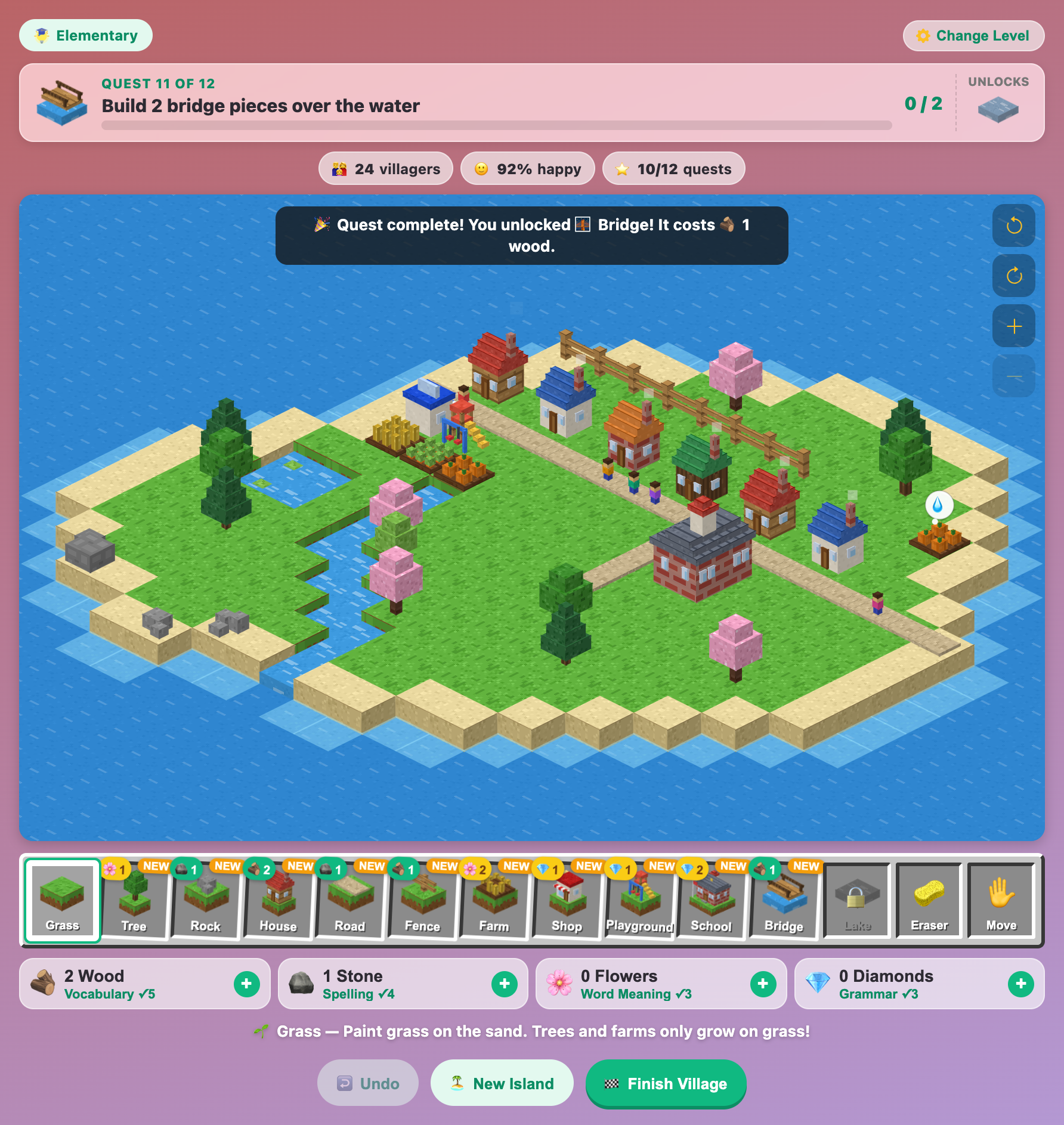
A blocky island village in English Village Builder for kids, with houses, a road, a school, farms and a thirsty farm bubble
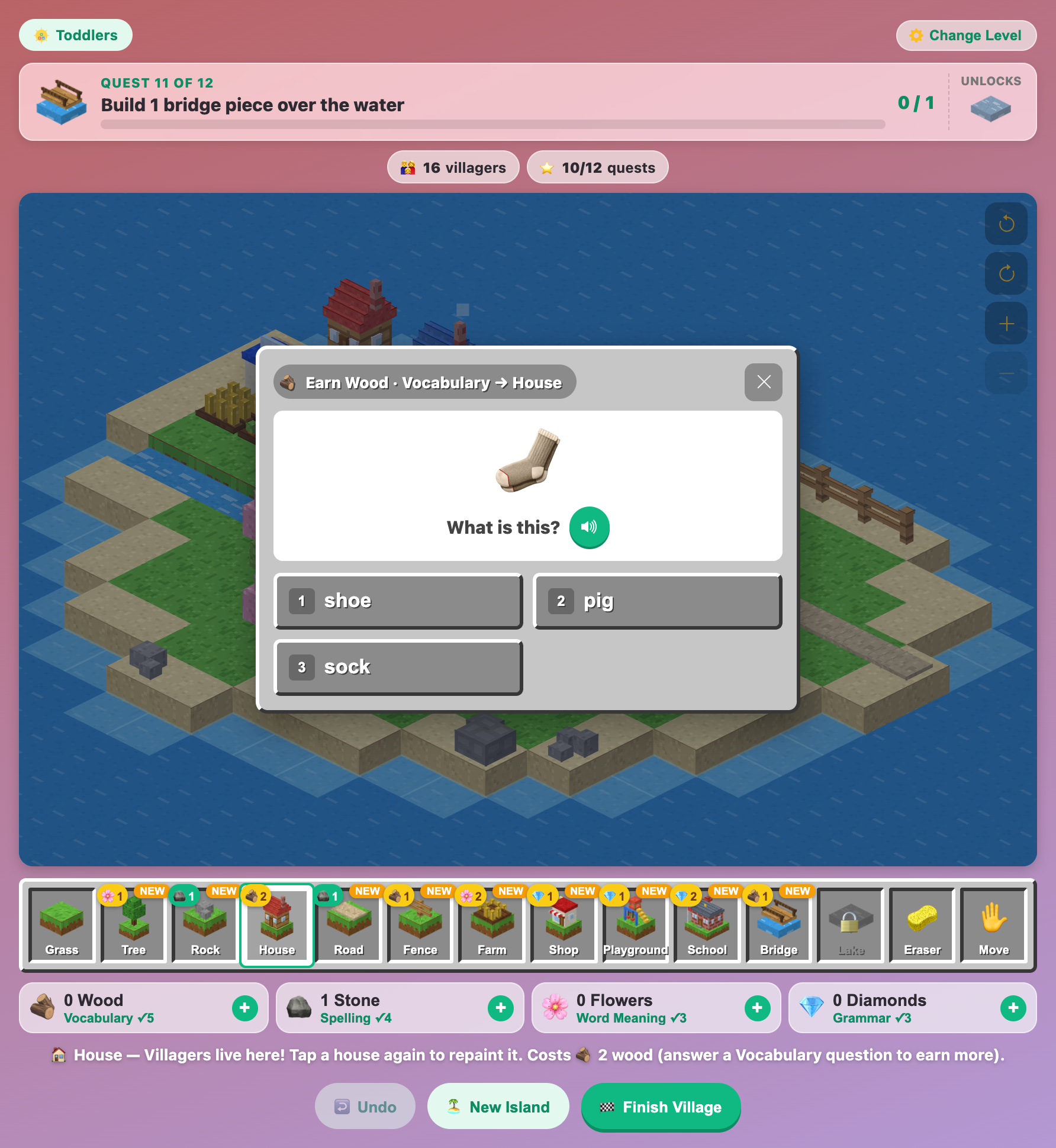
A Toddlers vocabulary question asking What is this? under a sock picture, to earn wood for a new house
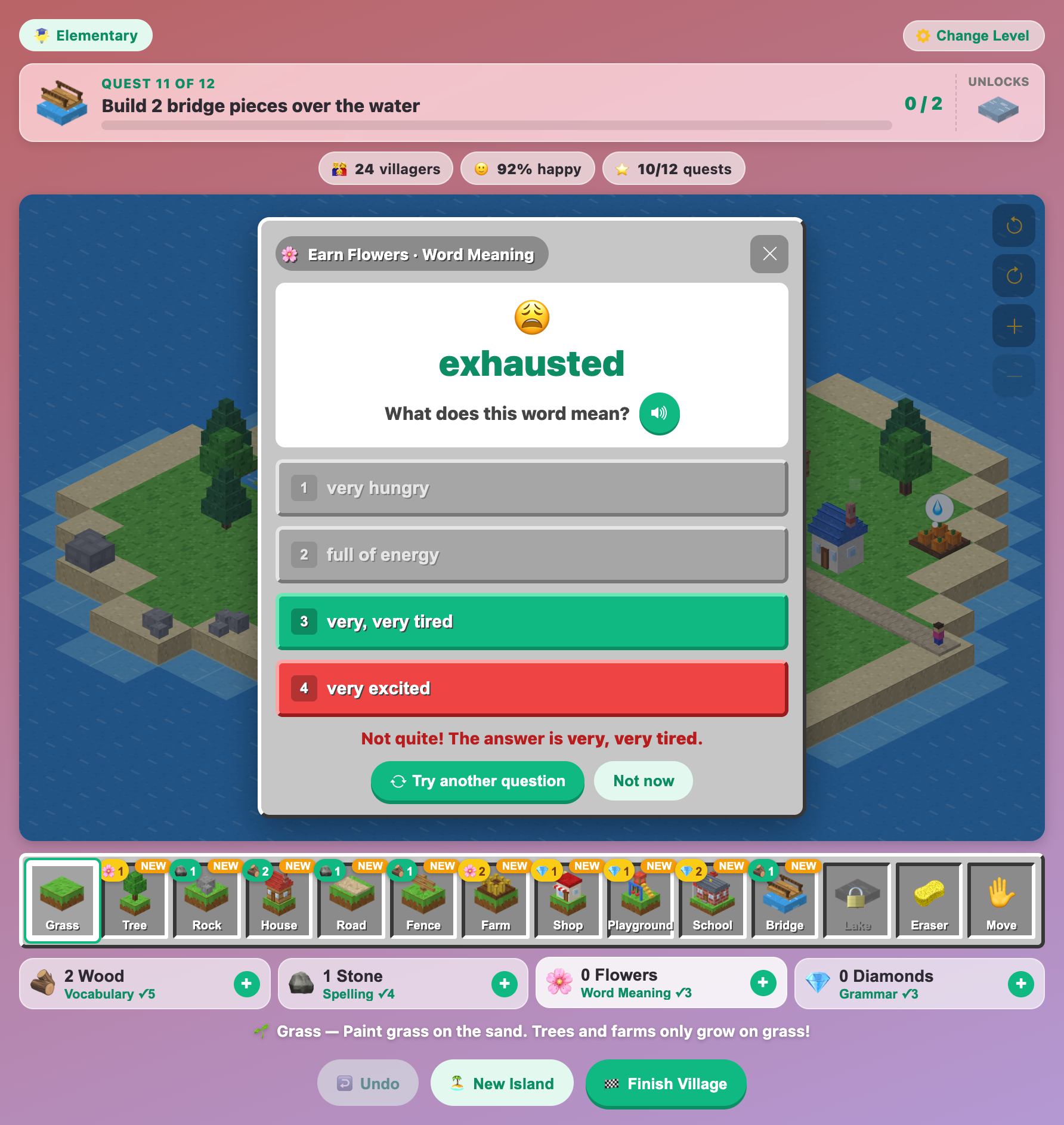
A Word Meaning question for the word exhausted, showing a wrong tap in red and the right answer in green
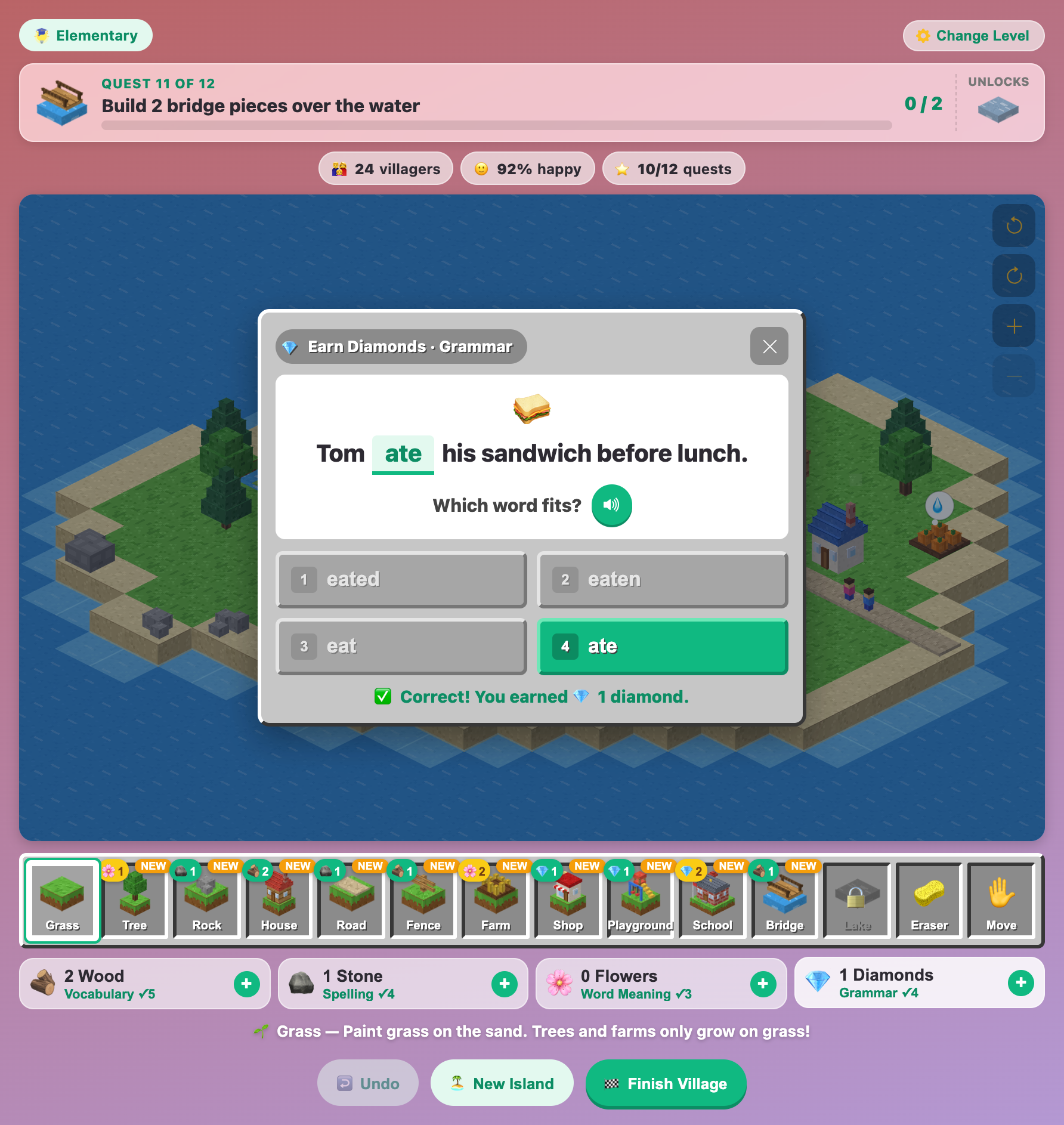
A grammar question in English Village Builder answered right with ate, earning one diamond for the village
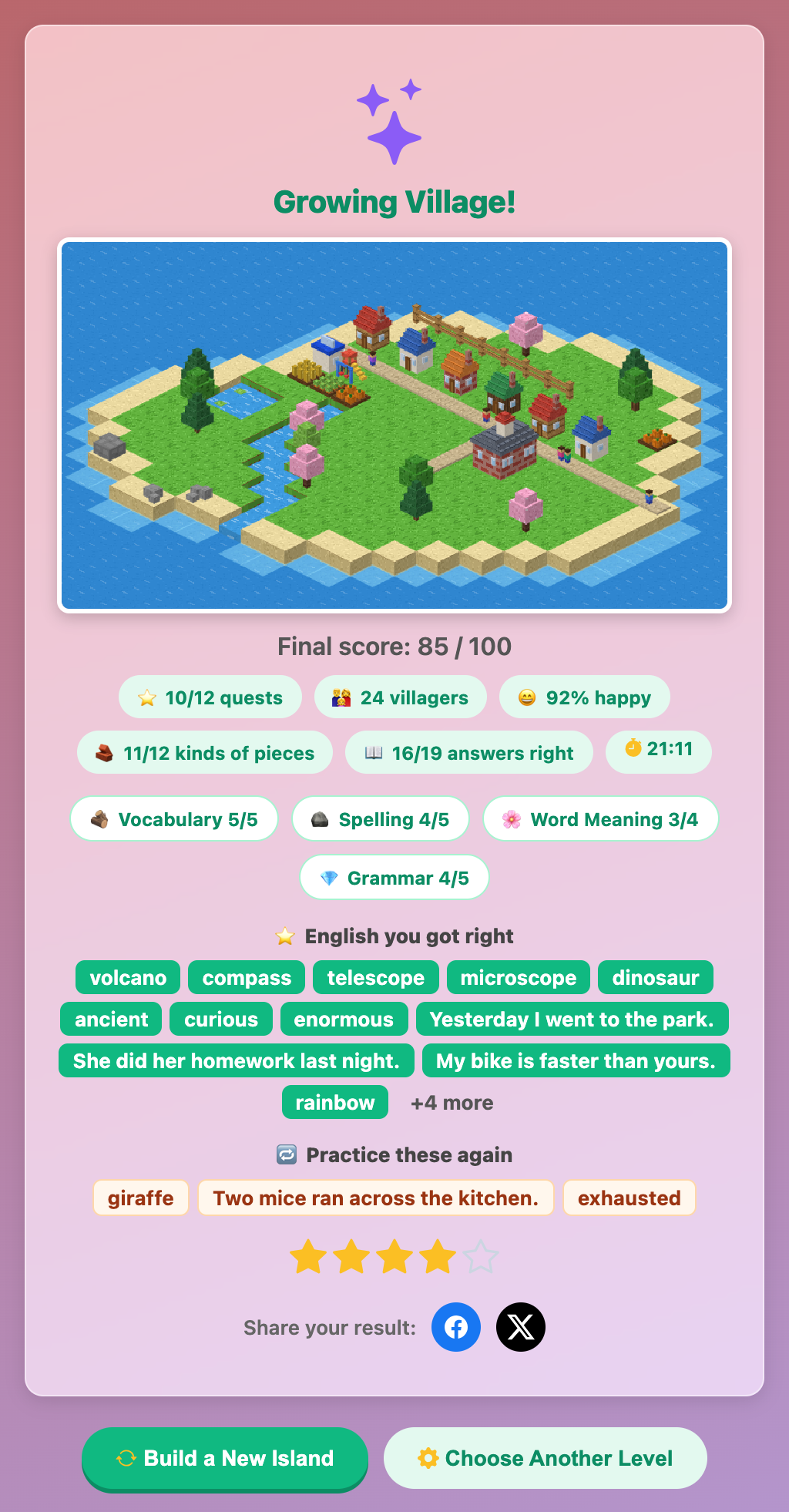
The English Village Builder result card with a picture of the village, a score of 85 out of 100 and practice words
More English Games
 435.5K plays
4.9
435.5K plays
4.9
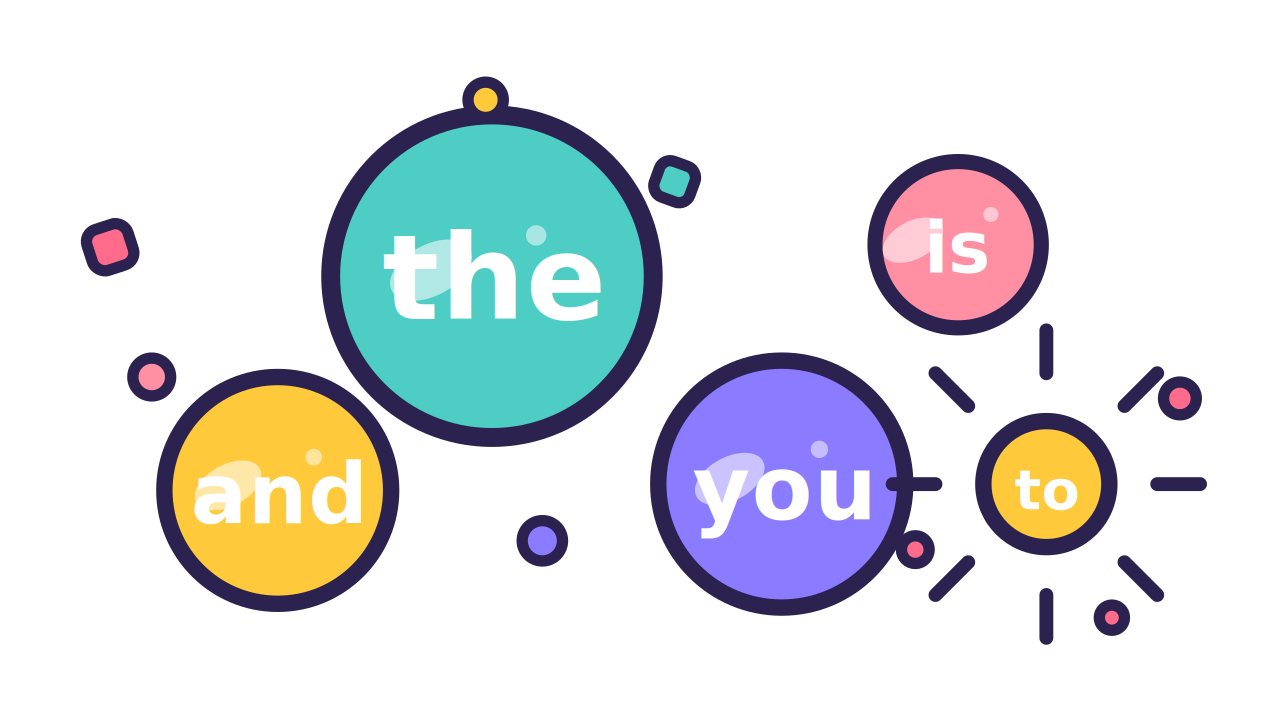
Sight Word Pop
Read the target word and pop the matching bubble before the timer runs out.
 273.8K plays
4.9
273.8K plays
4.9
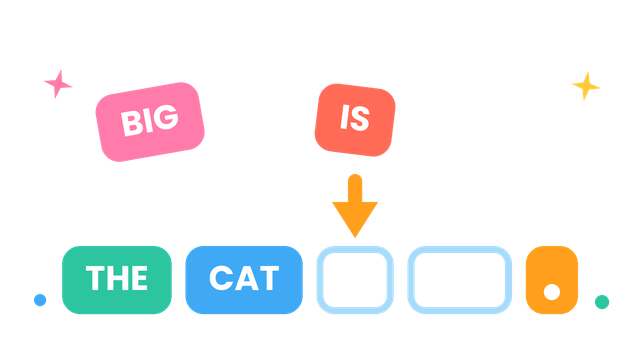
Sentence Builder
Pick your age level, then tap the shuffled words in the right order to build the sentence.
 235.5K plays
5.0
235.5K plays
5.0
Alphabet Pop
Pop the bubble with the letter that a picture and word starts with.
 2.1M plays
5.0
2.1M plays
5.0
Word Search
Find all the hidden words in the letter grid before time runs out.
Most Played Games
 1.8M plays
5.0
1.8M plays
5.0
Color & Draw
A free-drawing canvas with colors and brush sizes to unleash your creativity.
 59.4K plays
5.0
59.4K plays
5.0
Recycling Sort
Sort everyday items into the Recycle, Compost, or Trash bin before time runs out!
 365.5K plays
4.9
365.5K plays
4.9
Tic-Tac-Toe
Play a game of Tic-Tac-Toe against the computer and see if you can outsmart it.
 1.1M plays
4.9
1.1M plays
4.9
Chess
Play the classic game of chess against the computer or a friend, with FIDE time controls, hints, and undo.
Comments (40)