Listen & Tap
28.2K playsListen to the parrot and tap the picture you hear! No reading needed, so it is perfect for children learning English. Little ones choose between cat and sun, preschoolers pick out rhymes like hat and bat, and older kids train their ears on words that sound almost the same: ship or sheep, three or tree, pear or bear. Tap the turtle to hear a word slowly.
There isn’t a single word to read in this game. All you need is your ears and one finger. Listen & Tap for kids is a free English listening game on KidWorld: a friendly green parrot says a word, and you tap the picture of the word you heard. It plays right in your browser, with no download and no sign-up, and it has four levels for children from about 2 to 12.
Because nothing is written on the pictures until you answer, Listen & Tap is a great fit for children who are still learning English, and for little ones who can’t read yet. Toddlers choose between two words that sound nothing alike, like cake and bear. Preschoolers pick between rhymes, like log, dog and frog. Older kids train their ears on “sound twins”: words that are only one tiny sound apart, like ship and sheep, three and tree, or pear and bear. And when a word goes by too fast, a little turtle says it again, nice and slow. 🐢
🦜 Listen & Tap for Kids: One Parrot, a Few Pictures, Zero Reading
Every round happens in a sunny treetop. The parrot sits on a branch inside a big round Listen button. Next to it sits a turtle on a smaller Slow button. Under the branch is a row of picture cards: 2, 3 or 4 of them, depending on your level.
The parrot says one word. Your job is to find its picture. That’s the whole idea, and it sounds easy… until the pictures start to sound alike!
The pictures are friendly emoji: a cake 🎂, a sheep 🐑, a ship 🚢, a crown 👑, a clown 🤡. The game has 118 picture words, and each one gets its own picture. No word shows up twice in the same game, so every round brings something new to listen to.
The smartest part is how the game picks the wrong pictures. Every word in the game knows its own sounds. “Sheep” is sh, ee, p. “Ship” is sh, i, p. The game counts how many sounds are different between two words, and uses that to make each level harder in a fair way. Grown-up teachers call words like ship and sheep minimal pairs. In this article we’ll call them sound twins.
🌳 How Do You Play Listen & Tap on KidWorld?
Pick your level. The Choose Your Level screen shows four cards: Toddlers (ages 2–4), Preschool (ages 4–6), Elementary (ages 6–10) and Tweens (ages 10–12). If the game opens straight on a level, tap Change Level at the top right to choose a different one.
Turn your sound on. This game is all about hearing, so turn your volume up. If the site’s music button is on, the parrot says each word by itself a moment after the round starts. If the sound is off, the parrot pulses to say “tap me!” and waits for you. (Some browsers also wait for your very first tap before the parrot may talk.)
Listen to the parrot. While the parrot talks, it rocks and three green sound waves ripple next to it. On Toddlers and Preschool it says the word twice in a helpful sentence, like “Cake! Find the cake.” For numbers it says “Find number three.” On Elementary and Tweens it just says the word: “Sheep.”
Wait for the pictures to wake up. The picture cards look a little faded until the word has been said. If you tap one too early, the parrot gives a little shake and the tip says “Tap the parrot first to hear the word!” Nothing is lost; just listen and try again.
Tap the picture you heard. When the tip says “Which picture did you hear?”, tap one card. Each card has a small number in its corner, so on a keyboard you can press 1, 2, 3 or 4 instead. You get one answer per round.
Check your answer. Now every picture shows its word underneath. The right picture gets a green ring. If you picked a different one, it turns red and gives a shake, and the tip tells you what happened, like “That’s ‘ship’. The word was ‘sheep’.”
Tap pictures to hear them. After you answer, any picture says its own word when you tap it. This is the best moment to compare two sound twins side by side.
Use the extra buttons. The turtle’s Slow button says the word again, much more slowly. The small 🔊 button next to the tip reads the tip aloud, and another one reads the “How to play” box under the game.
Move on. A big Next button appears and counts down from 5. It fills up and moves on by itself, but it always waits until the parrot has finished talking. You can tap it sooner, or press Enter or the Space bar. On the last round it says See My Score.
See your score and play again. The finish card cheers “Super Listener!” and shows your score out of 100, your rounds, how many you got right, how many times you listened, and up to five stars. Tap Play Again for a fresh set of words, or Choose Another Level. The play page’s own buttons let you go fullscreen, reload the game, or turn the music on and off.
One more thing: the game needs a browser that can say words out loud. Most can. If yours can’t, you’ll see a sleepy parrot and the message “Oh no, the parrot can’t talk here!”, with a tip to try Chrome, Safari or Edge, or another phone, tablet or computer.
👯 Meet the Sound Twins: The Mix-Ups the Parrot Loves
On Elementary and Tweens, at least one wrong picture in every round is a sound twin of the right word. The two words are the same except for one sound. These are pairs that many people learning English mix up. Knowing where the difference hides is the big secret of Listen & Tap for kids. There are four places to listen.
1. The middle sound: ship or sheep?
Many twins change only the vowel, the open sound in the middle of the word. Ship has a short, quick “i”. Sheep has a long “ee”, and your mouth smiles wide when you say it. Other middle-sound twins in the game are bag and bug, key and car, and book and bike.
2. The first sound: pear or bear?
Some twins only change the first sound. Pear starts with a puff of air (put your hand in front of your mouth and you’ll feel it). Bear starts with a softer, buzzy b. Watch out for three and tree too: for “th”, the tip of your tongue peeks out between your teeth. In “tree”, it stays behind them. Other first-sound twins in the game include rock and lock (r or l?), goat and coat (g or k?) and, on Tweens, boat and vote (b with your lips together, or v with your top teeth on your lip?).
3. The last sound: bat or bath?
Endings are easy to miss, because a word can stop very quickly. Bat ends with a short “t”. Bath ends with a long, soft “th” you can stretch out. Ten and tent are trickier: tent has one extra tiny “t” tapped onto the end. Goat and goal are twins too: a t at the end, or an l? And eye and ice only differ because ice adds a hissing “s” at the end.
4. The hiding sound: lock or clock?
Sometimes one word has an extra sound squeezed in at the start. Clock is lock with a “k” in front. Train is rain with a “t” in front. Crown and clown are twins as well, and the only difference is the r or the l hiding after the k.
🏆 Ear Tricks for Getting Every Picture Right
Listen & Tap has no timer for answering and no lives to lose. That means the best players aren’t the fastest ones. They are the ones who listen most carefully. Here are tricks that really work in this game.
Look before you listen
When a new round starts, take one second to look at the pictures and say their names quietly in your head. If you see a ship and a sheep in the same row, you already know the battle is about the middle sound. Knowing what to listen for makes the parrot’s word much easier to catch.
Find the twins, then listen for their one difference
On Elementary and Tweens, two of the pictures are almost always sound twins. Find them first. Then ask yourself: is the difference at the start, in the middle or at the end? Now you only have to listen for one sound, not the whole word.
Ask the parrot again (it’s free!)
You can tap the parrot as many times as you like before you answer. Your score only counts right answers, so listening again never costs you a point. The finish card counts your “listens”, but that’s just for fun. A great listener often listens twice.
Call the turtle for tricky words
The 🐢 Slow button says the word much more slowly. Slow speech stretches the vowel and makes the last sound easier to hear. It’s the best button for endings like bat and bath, or ten and tent.
Copy the parrot out loud
Say the word back after the parrot, then say each picture’s name. Your mouth can feel things your ears miss. If you say “three” and your tongue peeks out, but the parrot’s word didn’t have that, the answer is probably tree.
Listen to the very first sound on Preschool
On Preschool, all the pictures rhyme, so their endings match. The only clue is at the start. Don’t wait for the end of the word: catch the first sound, and the answer is right there.
Don’t guess by place
The right picture is never in the same spot more than two rounds in a row. It keeps moving around. So if the answer was card 1 last time, that tells you nothing about this time. Trust your ears, not a pattern.
Turn a mistake into practice
When you pick the wrong twin, don’t rush to Next. Tap the right picture, then the one you picked, and hear them one after the other. On Elementary and Tweens, the parrot even says both words for you after a wrong pick, like “Sheep. Ship.” Hearing the pair side by side is how your ears learn the difference for next time.
📝 Five Rounds, Heard Out Loud
Here’s how a good listener thinks through real rounds from each level.
Example 1: Toddlers, cake or bear
Two pictures appear: a birthday cake 🎂 and a bear 🐻.
The parrot says “Cake! Find the cake.”
On Toddlers, the two words never share a single sound. Cake is k, ay, k. Bear is b, air. They sound completely different, so the youngest players can just match the word to the picture.
Tap the cake. It gets a green ring and the tip says “Yes! You heard ‘cake’.”
Example 2: Preschool, log, dog or frog
Three pictures: a pile of logs 🪵, a dog 🐶 and a frog 🐸.
Say them quietly: log, dog, frog. They all end in “og”, so the ending won’t help.
The parrot says “Dog! Find the dog.” Listen to the very start: “d”.
Log starts with “l”. Frog starts with two sounds, “f-r”. Only dog starts with “d”. Tap the dog!
Example 3: Elementary, key, bee or car
Three pictures: a key 🔑, a bee 🐝 and a car 🚗.
Find the twins. Key and bee rhyme, so they differ at the start. Key and car both start with “k”, so they differ in the middle.
The parrot says just one word: “Key.”
Did it start with a hard “k” or a buzzy “b”? A “k”. That rules out bee. Did it have a long smiley “ee” or an open “ar”? An “ee”. That rules out car.
Only the key fits both clues. If you tapped the bee by mistake, it turns red, the key turns green, and the tip says “That’s ‘bee’. The word was ‘key’.”
Example 4: Tweens, goat, coat, goal or vote
Four pictures: a goat 🐐, a coat 🧥, a goal net 🥅 and a ballot box 🗳️ for “vote”.
They all have the same long “oh” in the middle. So the vowel won’t help; the start and the end will.
The parrot says “Goat.”
The end was a quick “t”, not an “l”. Goal is out. The start was a soft “g”, not a “k” or a “v”. Coat and vote are out.
Tap the goat. This is why Tweens rounds are tough: all three wrong pictures were only one sound away from the answer.
Example 5: Tweens, pen, tent, ten or corn
Four pictures: a pen 🖊️, a tent ⛺, the number ten 🔟 and an ear of corn 🌽.
The parrot says “Ten.” The tricky twins are ten and tent, which only differ by the tiny “t” at the end of tent. Pen rhymes with ten, but starts with a puff of “p”.
Not sure about the ending? Tap the turtle. Said slowly, “ten” clearly stops on the humming “n”, with no little “t” after it.
Tap the 🔟 card. Corn was the easy one to rule out: it only shares the “n” at the end.
⭐ How Points Become Stars
You get one point for every round you answer right. The star next to the round counter shows your points as you play. At the end, your points become a score out of 100: the share of rounds you got right. The score is never lower than 10, so every finished game earns something.
90 or more: five stars and a golden trophy.
70 to 89: four stars.
50 to 69: three stars.
25 to 49: two stars.
Below 25: one star and a big smile, so you can try again.
For example, 5 right out of 6 on Toddlers gives a score of 83 and four stars. On Elementary or Tweens, you need 9 out of 10 to reach five stars, so one wrong twin is all you can afford!
🎂 Which Level Fits Your Child?
Each level changes how many pictures there are and, more importantly, how alike they sound.
Listen & Tap for toddlers (ages 2–4)
Six short rounds with two big pictures that sound nothing alike, such as cake and bear, or corn and heart. The parrot uses a sentence (“Cake! Find the cake.”), starts the first round with “Hello! Listen carefully.”, and reads the tips and the final score aloud. Listen & Tap for toddlers works best with a grown-up sitting close by to cheer and to say the word again together.
Listen & Tap for preschoolers (ages 4–6)
Eight rounds with three rhyming pictures, like cat, hat and bat, or train, rain and plane. Only the beginning of the word tells them apart, so Listen & Tap for preschoolers is gentle practice in hearing first sounds, an important step before reading. Tips and the score are still read aloud. If your child enjoys catching first sounds, Beginning Sound Fishing lets them hook fish whose pictures start with the sound on the boat’s flag.
Listen & Tap for elementary kids (ages 6–10)
Ten rounds with three pictures. One of the wrong pictures is always a sound twin of the answer, such as ship and sheep, three and tree, or lock and clock. The parrot says the word on its own, with no helper sentence, and tips are no longer read aloud by themselves. This level also brings in a few new words, like hook, bull, seal and goal. Listen & Tap for elementary kids is a strong fit for children learning English as a second language, who often find these exact pairs hard.
Listen & Tap for tweens (ages 10–12)
Ten rounds with four pictures, and two of the wrong ones are only one sound away from the answer. Every word in the game can show up here, including vote, the one word saved just for Tweens. Listen & Tap for tweens is a real ear workout, and a nice way for older English learners to fine-tune their listening before they speak.
🌱 Why Listening Games Like This Help Kids
It trains the ears that reading needs. Before children can sound out words on a page, they need to hear the separate sounds inside a word. Every round of Listen & Tap asks exactly that: is it “sh-i-p” or “sh-ee-p”? Kids who enjoy that kind of sound detective work can also try Vowel Sound Sort, where words drop in and you put each one in the bin with the same vowel sound.
It helps English learners hear what native speakers hear. Many languages don’t tell apart sounds like l and r, b and v, or short i and long ee. Hearing those sound twins again and again, and then comparing them side by side after each answer, slowly tunes the ear. Clear hearing leads to clearer speaking, too.
It teaches patience. The pictures stay faded until the whole word has been said, and the best tip is to listen twice. Children learn that slowing down and paying attention beats rushing.
It turns mistakes into learning. A wrong tap never ends the game. It shows both words, and lets the child tap and hear them one after the other. That turns “oops” into “oh, now I hear it!”
It builds word power. With 118 picture words, from crab and sled to tooth and crown, kids quietly learn new names for everyday things. Once they know which letters make sounds like sh and ch, Digraph Detectives lets them fill in those letter pairs in picture words.
A note for parents and teachers
Listen & Tap for kids is calm and kind. There’s no timer for answering, no lives to lose, and nothing scary, just a friendly parrot, a slow turtle and cheerful pictures. It plays in the browser on computers, phones and tablets, with no download and no account. Because nothing needs to be read, it works for pre-readers and for children whose first language isn’t English. The skills it practices are careful listening, hearing the separate sounds in words (phonemic awareness), rhyme, and English vocabulary. Just make sure the volume is up. If the parrot doesn’t speak by itself, the site’s sound is probably switched off: tap the parrot, or turn the music button on.
Ready to test your ears? Turn up the volume, pick a level, and see if the parrot can trick you with ship and sheep. Listen & Tap for kids is waiting in the treetop, and the parrot already has a word for you. 🦜
🖼️ See the Game in Action
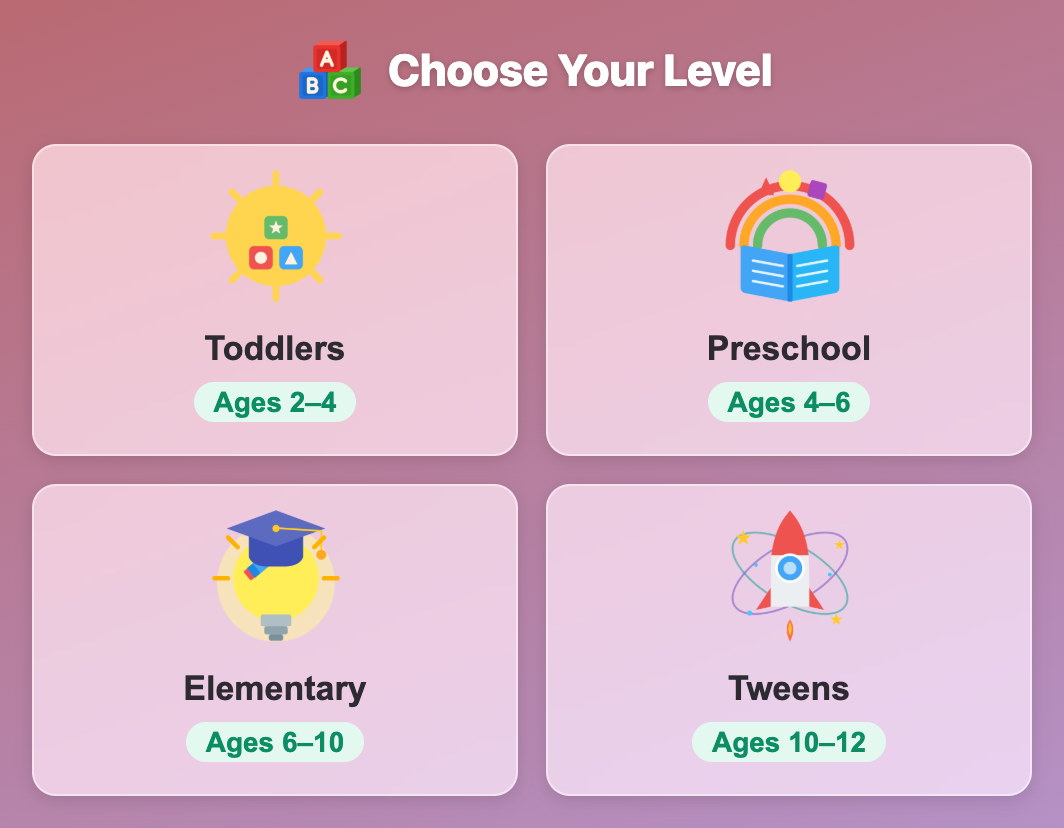
The Choose Your Level screen in Listen & Tap for kids, with Toddlers, Preschool, Elementary and Tweens cards
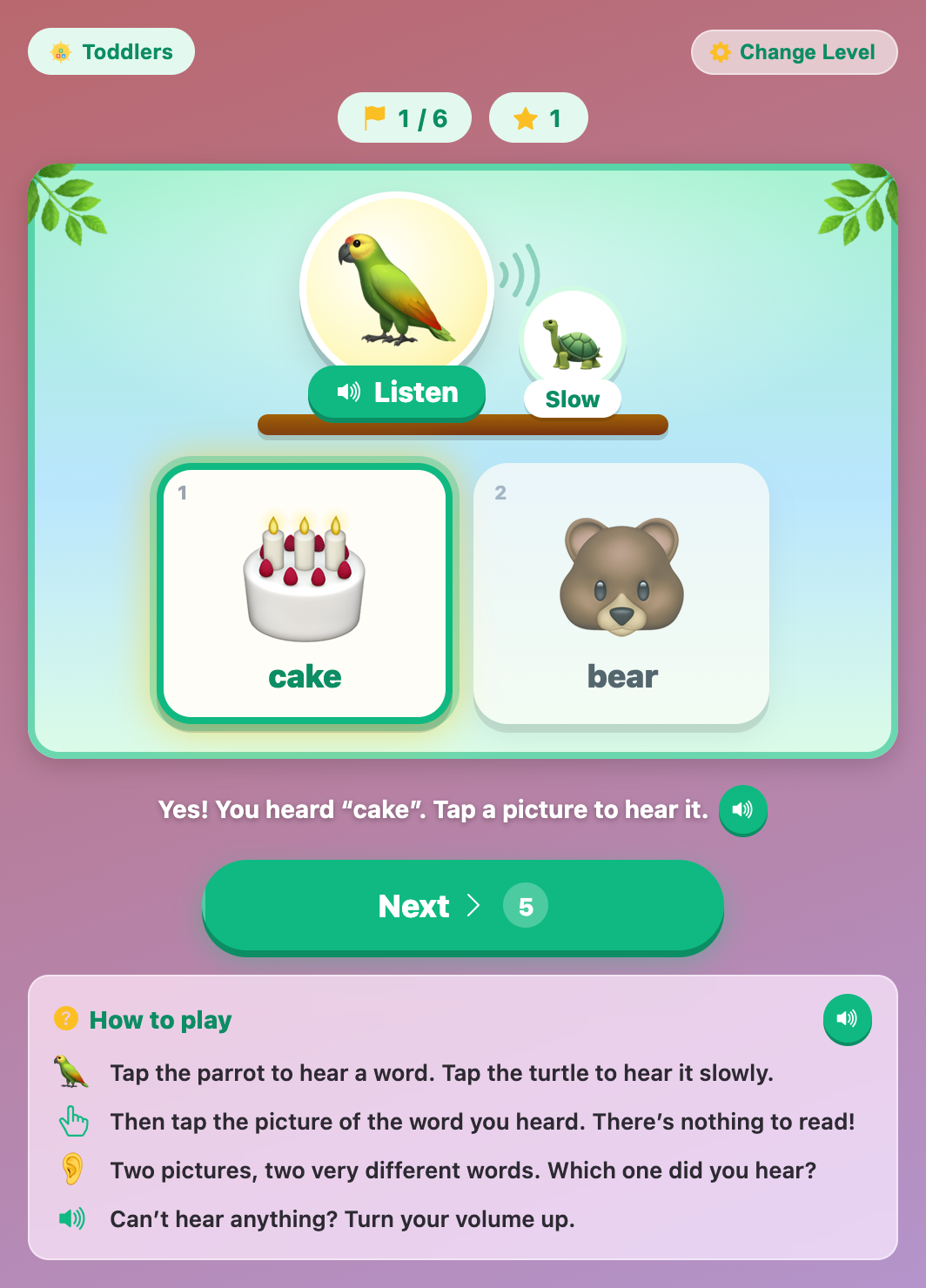
A Toddlers round of Listen & Tap with a cake and a bear, the cake ringed green after a right tap
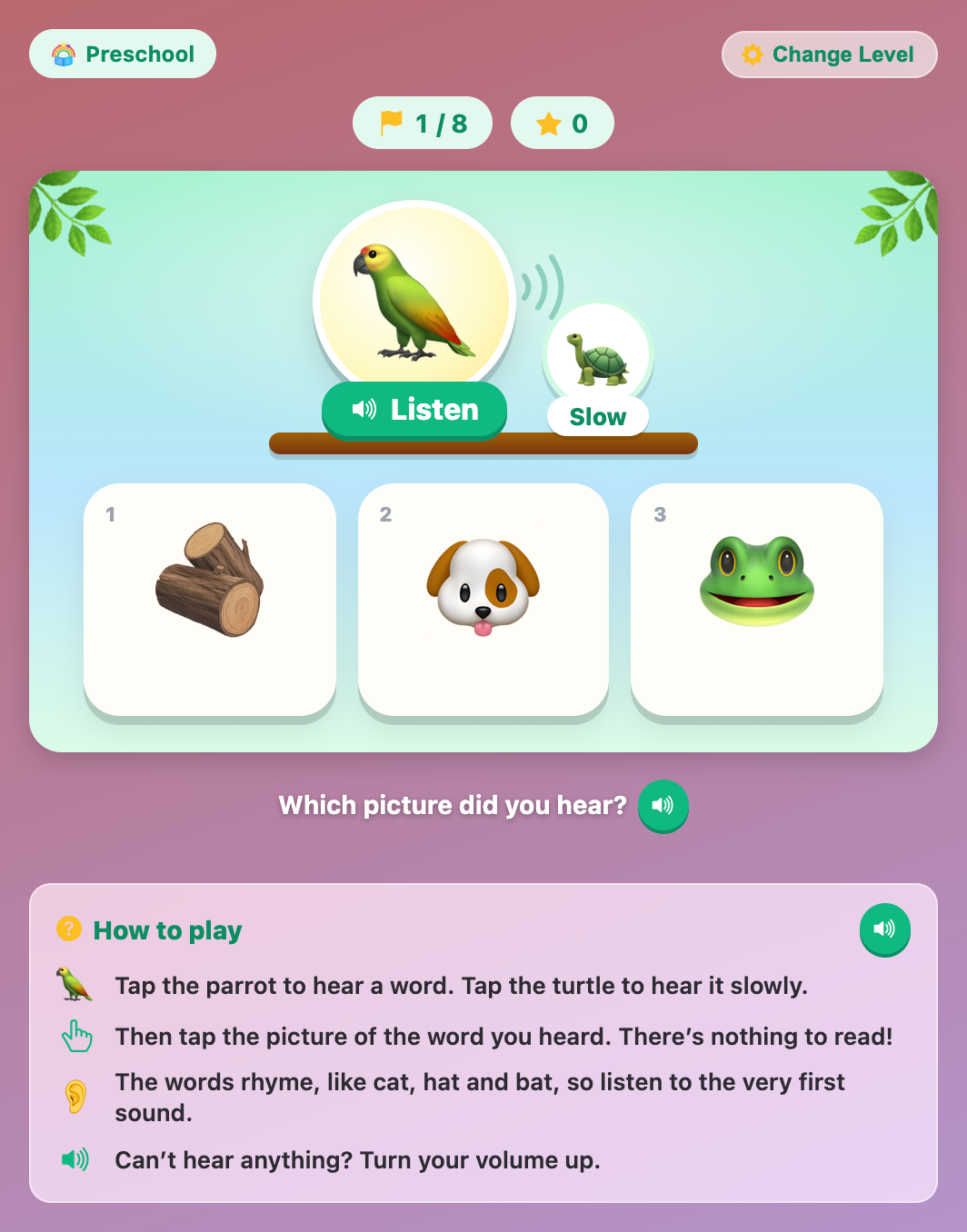
Listen & Tap for preschoolers with three rhyming pictures, a log, a dog and a frog, waiting for a tap
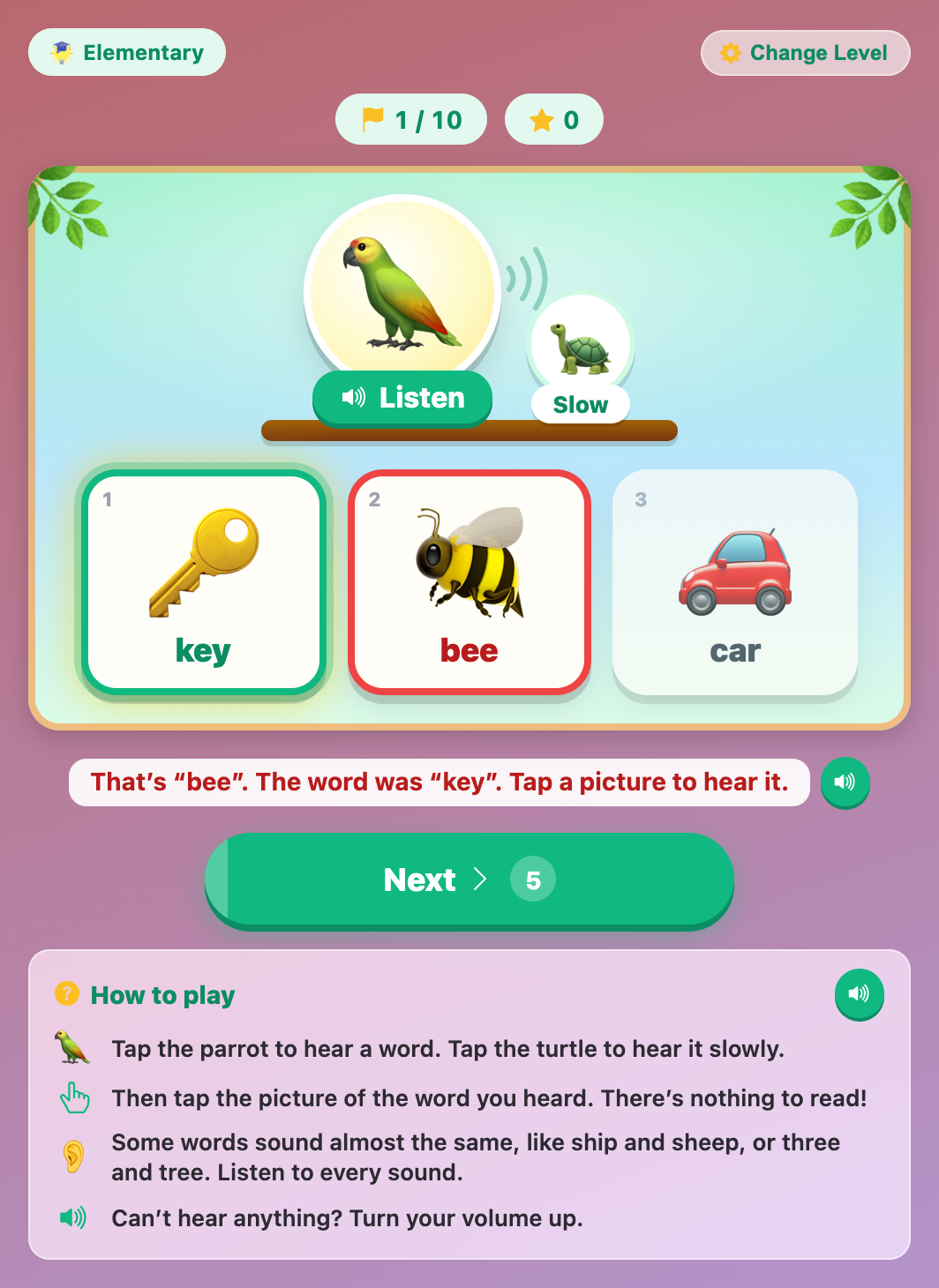
An Elementary round where the parrot said key, the bee picked by mistake in red and the key in green
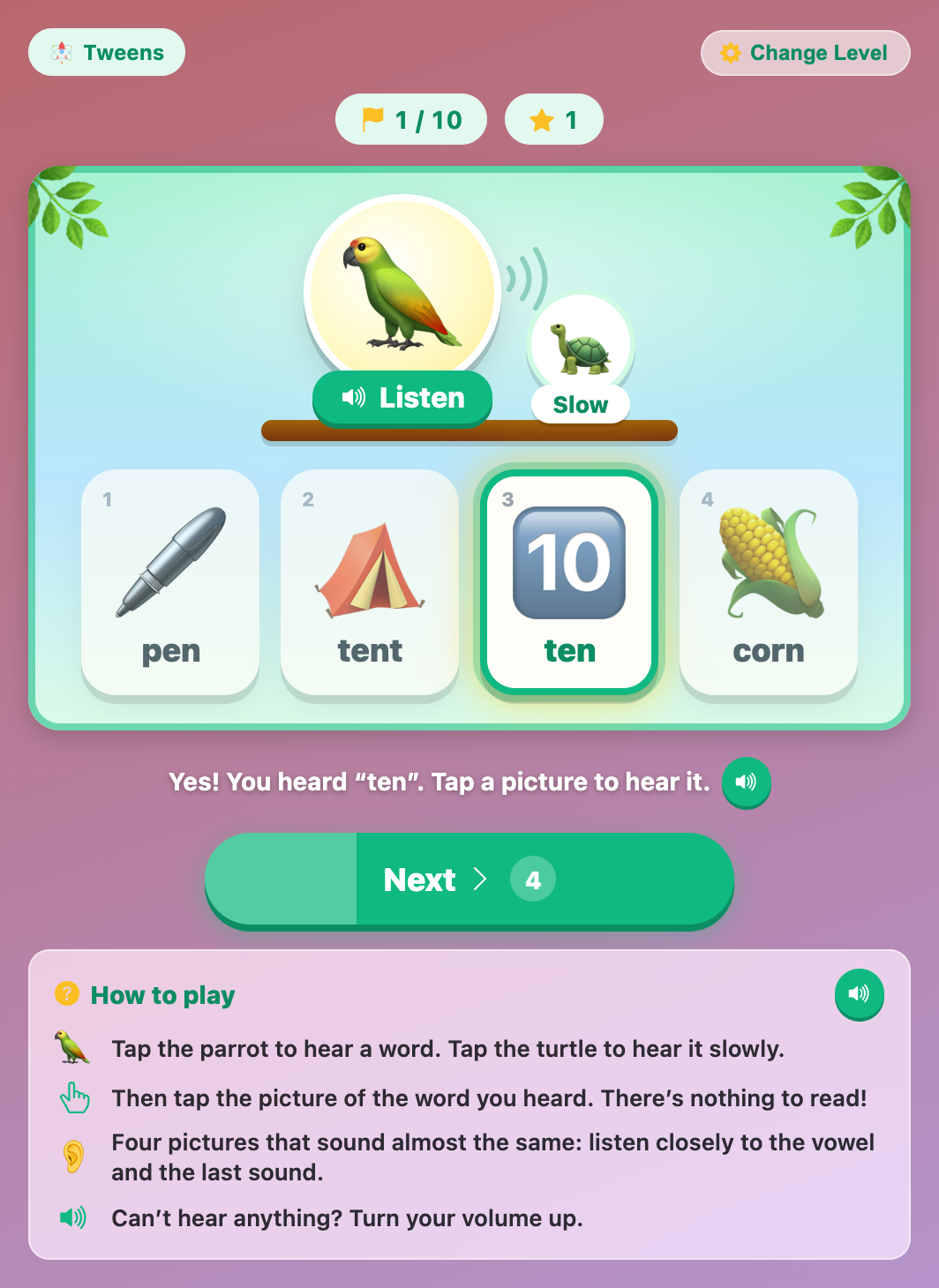
Listen & Tap for tweens with four pictures, pen, tent, ten and corn, and ten ringed green
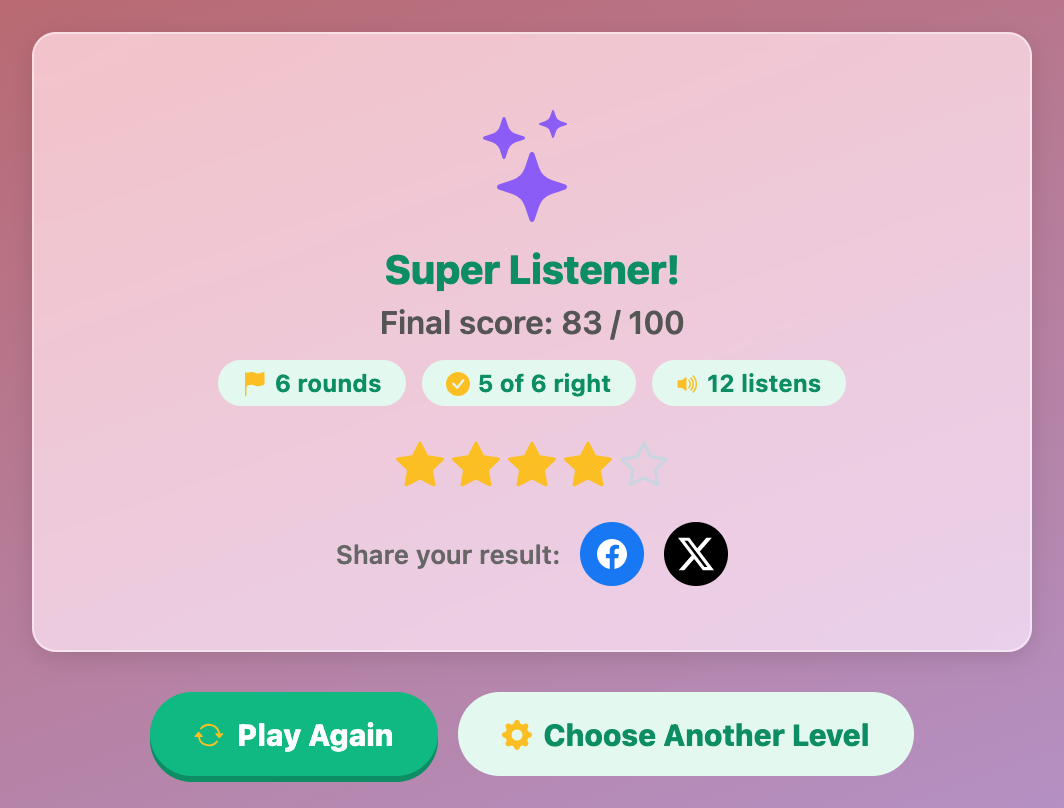
The Super Listener finish card in Listen & Tap with a score of 83, 5 of 6 right and four stars
More English Games
 87.2K plays
4.9
Blend-It Blocks
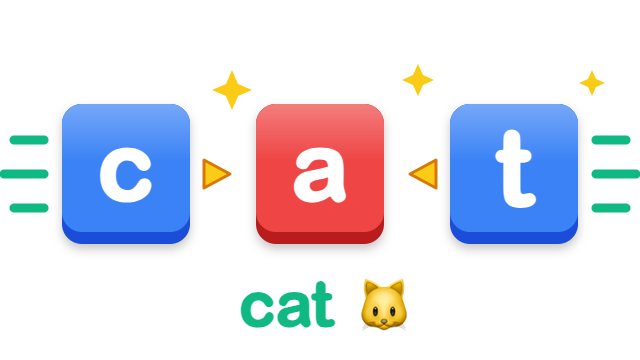
Every sound is a toy block! Tap the blocks to hear c, a and t, then slide them together until they click and hear them blend into a word: cat! Pick the picture that matches, then change one block to build a brand new word: cat, hat, hot! Little ones blend short words like dog and sun, older kids blend frog, ship and duck, and big kids read train, boat and shark.
 48.4K plays
4.9
Build a Story
Pick your age level, then tap the mixed-up story parts in the order they happen to build a whole story from beginning to end.
 2.1M plays
4.9
Word Search
Find all the hidden words in the letter grid before time runs out.
 105.4K plays
4.9
English Kart Circuit
Race a cute go-kart round a 3D track! Read the question at the top, steer into the lane with the right answer and drive under its sign for a Turbo boost; three in a row makes you a Super Star. Hold Boost to zoom or Brake for more time to read. Pick Puppy, Foxy, Bear or Chick, collect stars and dodge the mud. Letters and picture words for little ones, then rhymes, spelling, opposites and grammar.
Most Played Games
 274.1K plays
5.0
Sentence Builder
Pick your age level, then tap the shuffled words in the right order to build the sentence.
 435.6K plays
4.8
Sight Word Pop
Read the target word and pop the matching bubble before the timer runs out.
 717K plays
4.9
Word Crush
Swap the candy letters to line up 3 in a row and crush them! Every letter you crush fills in a word, like cat, hat and bat. Make rockets, bombs and rainbows, and spell every word before your moves run out.
 314.9K plays
4.9
English Village Builder
Build a village on a blocky island! Answer vocabulary, spelling, word-meaning and grammar questions to earn wood, stone, flowers and diamonds for every house, road, farm and school.
Comments (49)