Digraph Detectives
228.3K playsBecome a word detective! Every picture word is missing two letters that make one sound. Pick the right magnifying glass to fill the gap: sh for ship, ch for cheese, th for thumb, wh for whale, ph for phone. Older detectives find ck and ng at the end of words and search busy scenes for every picture with the sh, ch or th sound. Each solved case is stamped into your casebook.
Grab your magnifying glass! In Digraph Detectives for kids, every picture word has lost two letters, and your job is to find them. The game practices digraphs: pairs of letters like sh, ch and th that team up to make one sound. You look at a picture, such as a 🦈 above the letters _ _ark, and tap the magnifying glass that holds the missing team. Children from about 2 to 12 can play, and it runs free in your web browser with nothing to download and no sign-up.
Each right answer drops the two letters into the gap as one wide tile, and a red SOLVED stamp lands on the scene. Every finished case goes into your casebook, a little notebook under the game that fills up as you play. Older detectives also get spot scenes: a board of pictures with no words at all, where you hunt for every picture whose name has the sh, ch or th sound. There is no timer, so you can take all the time you need to listen.
🔤 What Is a Digraph? Meet the Seven Letter Teams
A digraph (say it DYE-graf) is two letters that make one sound together. Look at the word ship. It has four letters, but you only hear three sounds: sh, i, p. The s and the h stop working alone and become a team.
That is why digraphs can trip up new readers. If you sound out s and then h, you get s-huh-ip, which is not a word at all. The trick is to spot the team and say its one sound. Digraph Detectives uses seven letter teams:
sh says /sh/, the soft sound you make with a finger on your lips. You hear it in ship, shell, sheep and fish.
ch says /ch/, like a little sneeze: ah-CHOO! You hear it in cheese, chair, chick and peach.
th says /th/. The tip of your tongue peeks out between your teeth. You hear it in thumb, three, tooth and feather.
wh says /w/ in this game's words, like whale, wheel and wheat.
ph says /f/, even though there is no f in sight. You hear it in phone, photo, dolphin and trophy.
ck says /k/. It is a quick click at the end of short words like duck, sock and clock, and in the middle of rocket and jacket.
ng is a hum at the back of your mouth that comes out through your nose. You hear it at the end of ring, sing and strong.
Each time you answer, the game's tip says it again, for example: S and h team up to make one sound: /sh/. Hearing that line over and over is how the idea sticks.
🗂️ Opening Your First Case on KidWorld
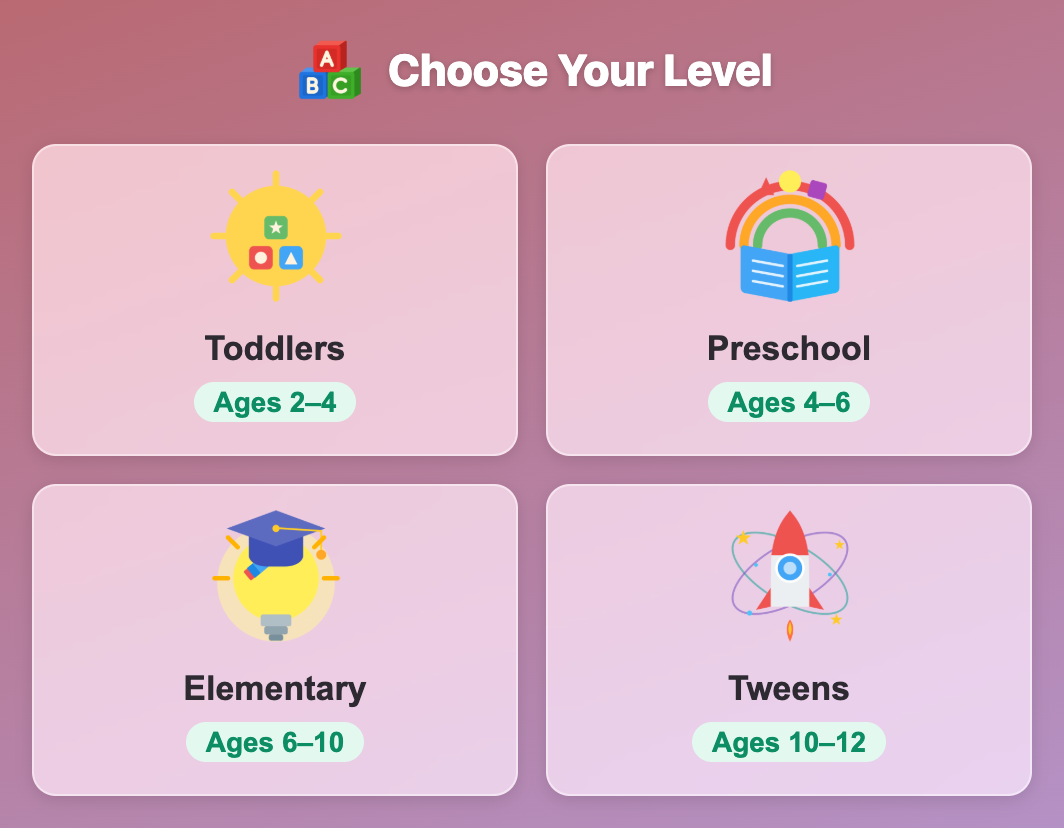
Choose your level. The Choose Your Level screen has four cards: Toddlers (ages 2–4), Preschool (ages 4–6), Elementary (ages 6–10) and Tweens (ages 10–12). If the game jumps straight into a case, tap Change Level at the top right to pick another one.
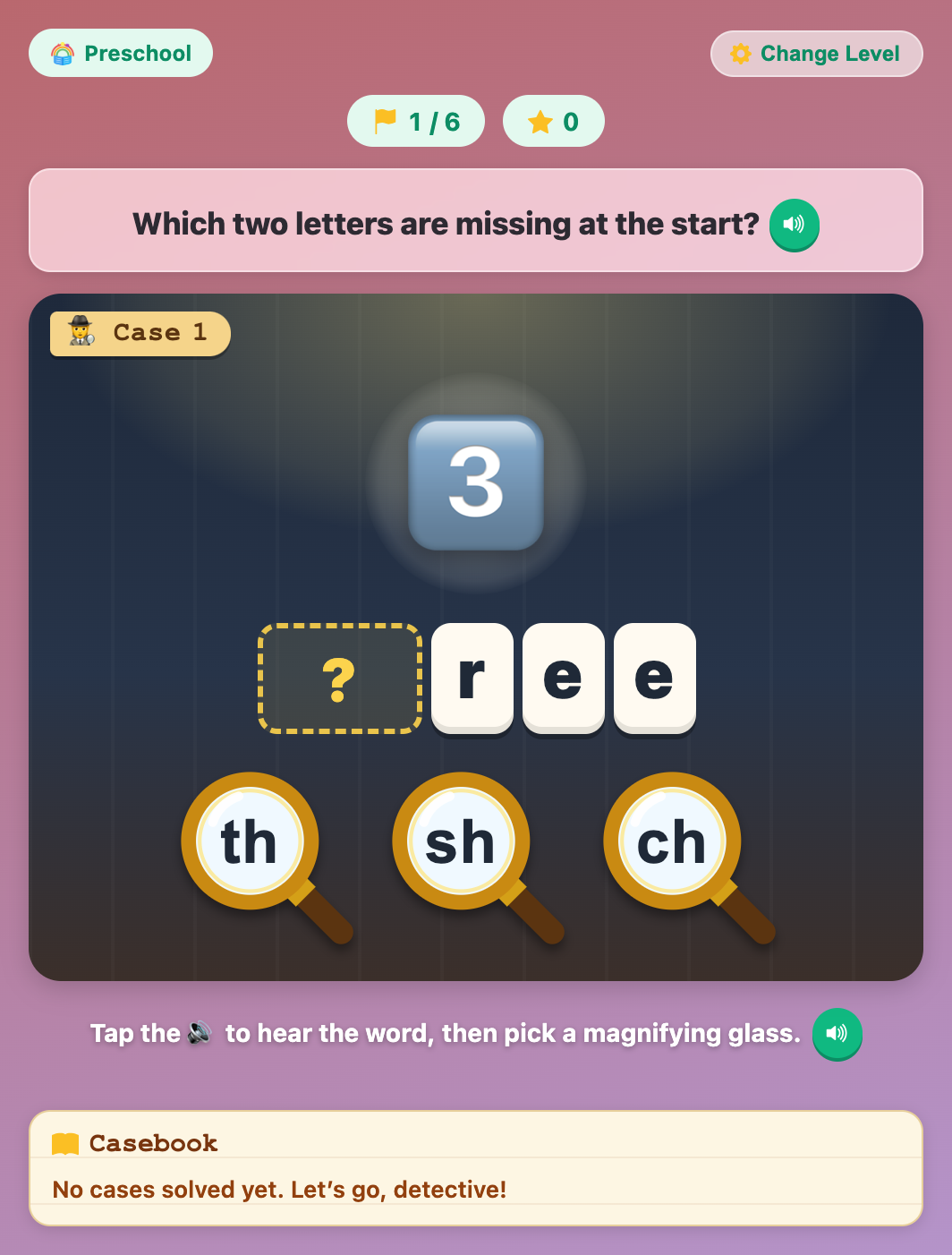
Read the question. The pink card at the top asks something like Which two letters are missing at the start? Two small badges show which case you are on (a 🚩 with 1 / 8, for example) and a ⭐ with your points so far.
Hear the word. Tap the green 🔊 button next to the question. The game says the picture's name and then the question, like Shark. Which two letters are missing at the start? That way a 🐑 is always a sheep and never a lamb.
Study the scene. The picture sits in a spotlight on a dark detective desk. Under it, the word is laid out as letter tiles, with a dashed box and a big yellow ? where the missing team goes. The gap can be at the start, at the end, or (on Tweens) in the middle of the word.
Tap a magnifying glass. Each glass has a letter team in its lens. Toddlers get 2 glasses, Preschool and Elementary get 3, and Tweens get 4. You get one tap per case, so think before you tap.
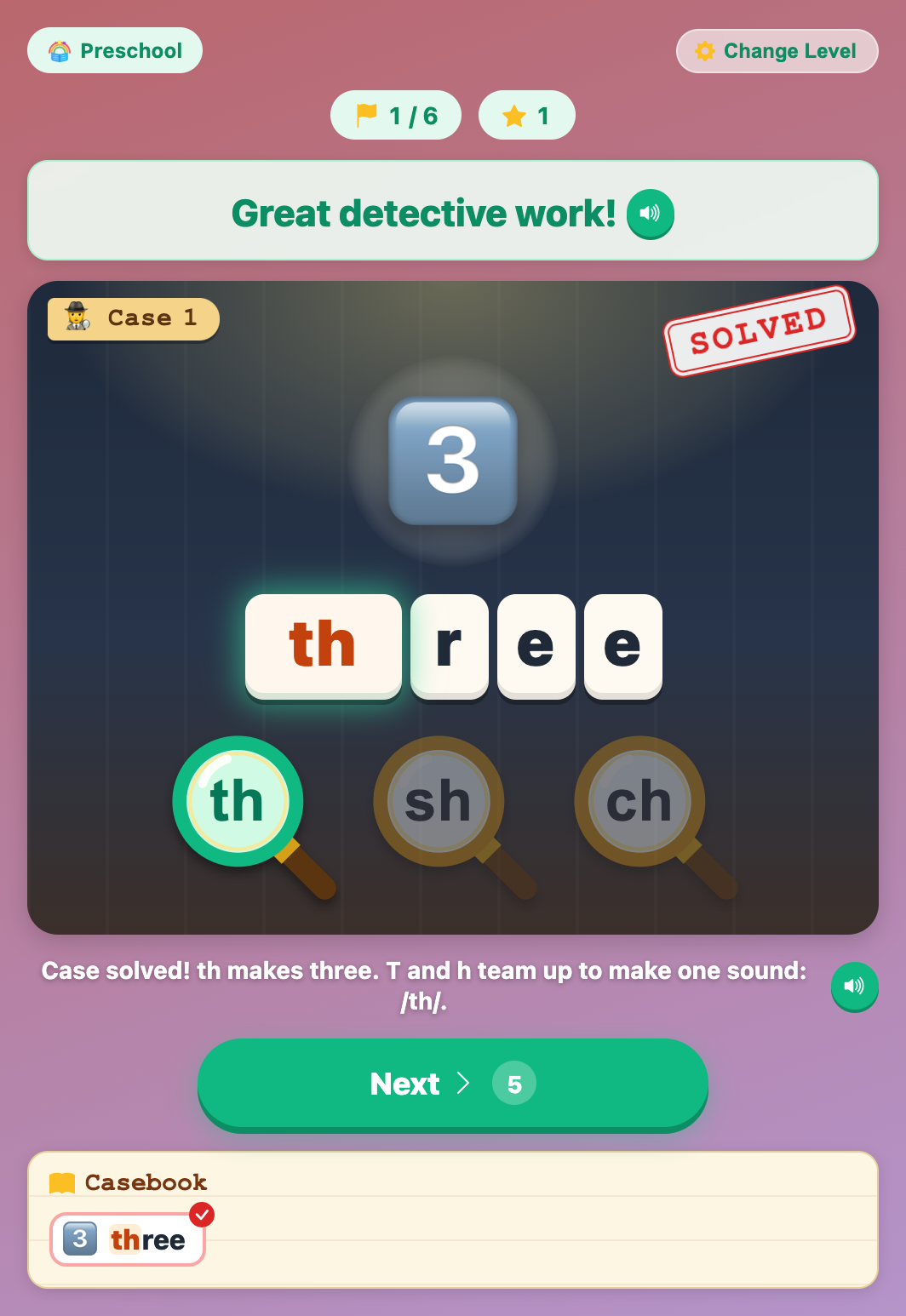
Watch the answer. If you are right, the team slides into the gap as one green tile, your glass turns green, and the SOLVED stamp lands. If you are wrong, your team pops into the gap crossed out in red, so you can see the silly word it makes (fish with ng becomes fing). Then the right team takes its place and its glass turns green, so you always see the real word.
Read the tip. Under the scene, a short tip explains the answer, such as Not ng: that makes fing. The word is fish, with sh. Tap the 🔊 beside it to hear it.
Search the spot scenes. On Elementary and Tweens, some rounds are spot scenes. A magnifying glass shows the target team, a counter shows how many you have found (like 2 / 4 found), and tilted picture cards cover the desk with no names on them. Tap every picture whose name has that sound. A right tap turns the card green with a tiny 🔍 and shows its name with the team marked. A wrong tap turns it red and shows its name. When you have found them all, the other cards show their names too.
Move on. A big green Next button appears. It counts down from 5 and goes on by itself, but it waits while the game is reading aloud. You can also tap it, or press Enter or Space on a keyboard.
Check your casebook. Every finished round adds an entry: the picture and its word with the team highlighted, plus a red check mark if you got it on the first try. A spot scene adds an entry like sh ×4. Tap any entry to hear its word again.
See your score. After the last round, the Top Detective card shows your score out of 100, how many cases you solved the first time, up to five stars, and your whole casebook. Tap Play Again for a new set of cases, or Choose Another Level.
Use the page buttons. The buttons around the game let you play in fullscreen, reload the game, and turn the background music on or off. You can play with a mouse or by tapping on a phone or tablet.
🧠 Detective Skills: How to Crack Every Case
A good detective doesn't guess. They look for clues, test each idea, and only then point at the answer. Every case in Digraph Detectives for kids has exactly one right team, and these skills will help you find it on the first tap.
👂 Say the whole word before you look at the glasses
Say the picture's name slowly, and stretch the part where the gap is. Under a 🐚 you see _ _ell. Say it like this: shhhh-ell. That long hush at the start tells you the team is sh. If you are not sure what the picture is, tap 🔊 and the game will say it for you.
🔁 Try every glass in your head
Put each team into the gap and read the word you get. Next to a 3️⃣ you see _ _ree with the glasses th, sh and ch. Try them all: three, shree, chree. Only one is a real word, and it matches the picture.
This trick works every time because the game plays fair. It never offers a wrong team that makes a different real word. For example, ship never comes with a ch or wh glass, because chip and whip are real words too. So when a team makes a real word that fits the picture, it is your answer.
📍 Notice where the gap is
The question tells you where to look: at the start, at the end or in the middle. Each place has its own set of teams. At the start of a word you can meet sh, ch, th, wh or ph. At the end you can meet sh, ch, th, ck or ng. In the middle (Tweens only) you can meet sh, ch, th, ph, ck or ng. Knowing the place makes the list of choices shorter.
🎧 Trust your ears, not the letter you expect
The glasses only ever hold letter teams, never single letters. So when you hear /f/ at the start of phone, don't look for an f. Look for ph. When you hear /w/ at the start of whale, look for wh. And when you hear a short /k/ click at the end of duck or sock, the team is ck.
🔔 Hum or click? Telling ng and ck apart
ng and ck both turn up at the ends of words, but they feel very different. ng is a hum you can hold for a long time: riiinnnggg. ck is a quick click that stops right away: ro-ck! If you can keep the sound going, it's ng. If it pops and stops, it's ck.
👅 Feel the sound in your mouth
sh, ch and th can blur together when you say a word fast. Slow down and feel what your mouth is doing. For th, your tongue peeks out between your teeth. For sh, your lips push forward and air rushes out softly, like a shushing librarian. For ch, your tongue taps the top of your mouth and the sound pops out, like a train going choo-choo.
🔍 Let the leftover letters solve a puzzling picture
Some pictures could have two names. 🌾 might look like rice, and 👄 could be lips. The letters around the gap settle it: _ _eat can only be wheat, and mou_ _ can only be mouth. If you are still stuck, the 🔊 button tells you the word.
🔦 From the Casebook: Five Mysteries We Cracked Together
Case 1: the shark (Toddlers)
A 🦈 swims in the spotlight above _ _ark. There are two glasses: sh and th.
Tap 🔊 and hear the game say Shark.
Say it slowly: shhh-ark. It starts with the soft hush sound.
Try the other glass: thark. That is not a word.
Tap sh. The tiles now spell shark, the stamp says SOLVED, and you get your first point.
Case 2: the whale (Preschool)
A 🐳 floats above _ _ale. The glasses hold wh, th and ph.
Say whale. The first sound is /w/.
No glass holds a plain w, so look for the team that says /w/. That is wh.
Check the others to be sure: thale and phale are not words.
Tap wh. The tip reminds you that w and h team up to make one sound.
Case 3: the duck (Elementary)
This time the gap is at the end. A 🦆 sits above du_ _, with the glasses ch, ck and th.
Say duck and freeze on the very last sound. It is a quick /k/ click.
Test the others: ch makes duch and th makes duth. Neither is a word.
Tap ck. Your casebook gets a new entry: 🦆 duck, with ck highlighted and a red check mark for a first-try solve.
Case 4: the dolphin (Tweens)
Tweens find gaps in the middle of longer words. A 🐬 leaps above dol_ _in, and there are four glasses: sh, ph, th and ng.
Clap the word into two beats: dol-phin.
The second beat starts with /f/. No glass holds an f, so the /f/ must be ph.
Test the rest in your head: dolshin, dolthin, dolngin. None of them is a word.
Tap ph and close the case.
Case 5: a sh spot scene (Tweens)
The target glass shows sh, the question says Find every picture with the sh sound (as in fish)!, and the counter reads 0 / 4 found. Nine cards lie on the desk: a ship, a ladybug, a shell, a thumbs-up, a dog, a shower, a sheep, a robot and an elephant.
Name each card quietly: ship, ladybug, shell, thumb, dog, shower, sheep, robot, elephant.
Listen for the hush. Ship, shell, shower and sheep all have it. That makes four, just like the counter says.
Watch out for the thumb. It starts with a letter team too, but its team is th, not sh.
Tap the four sh cards. If you tap the ladybug by mistake, it turns red and the hunt goes on, but you lose the point for a perfect scene.
🔎 Smart Moves for Spot Scenes
Spot scenes are the hardest rounds, because there are no letters to help you. You have to name each picture yourself and listen. The game's own tip says it best: say each picture's name quietly and ask yourself if you hear the sound.
Listen to the whole word, not just the start. The sound can hide anywhere. Fish has sh at the end, mushroom has it in the middle, and a 🪥 toothbrush has both th and sh, so it counts in a th scene and in a sh scene.
Don't worry about sneaky look-alikes. The game keeps sound-alike pictures out on purpose. A sh scene never has a picture that starts with s, like the sun. A ch scene never has words like drum. A th scene never has a tree, or words with an f or v sound. So when you clearly hear the target sound, tap with confidence.
Use the counter. The counter tells you how many pictures to find, and the round ends the moment you find the last one. If you have found three of four, look again at the cards you skipped.
Slow is smart. One wrong tap costs the point for that scene, but there is no clock. Name every card before you tap any of them. Tapping a card you already checked just says its name again, so it is a free way to listen twice.
Two spot scenes in a row never use the same sound, so after a sh hunt, get ready for ch or th.
⭐ Points, Stars and the Top Detective Card
Every round is worth one point. A case gives you the point only if your first tap is right. A spot scene gives you the point only if you find every picture with no wrong taps. Toddlers play 5 cases, Preschool plays 6, and Elementary and Tweens play 8 rounds each.
Your score is your points turned into a number out of 100. On Tweens, 6 points out of 8 makes a score of 75. Stars come from the score: 90 or more gives five stars, 70 or more gives four, 50 gives three and 25 gives two. Even a tricky game earns one star and at least 10 points, so every detective leaves with something to be proud of.
🎖️ Digraph Detectives for Kids at Every Age
🐣 Digraph Detectives for toddlers (ages 2–4)
The Toddlers level keeps things small: 5 cases, every gap at the start, and only two glasses. The only teams are sh, ch and th, and the words are simple pictures like ship, sheep, shoe, cheese, chair, cherry, chick, thumb and three. Most toddlers can't read yet, so this is a play-together level. Tap 🔊, say the word with your child, and make the sounds big and silly: a finger-on-lips shhh for sheep, a sneezy ch! for cheese.
Little ones who enjoy hearing first sounds can also try Beginning Sound Fishing, where they catch the fish whose pictures start with the sound on the boat's flag.
🌈 Digraph Detectives for preschoolers (ages 4–6)
Preschool has 6 start-of-word cases with three glasses each, and all five start teams join in, so wh and ph appear for the first time. New words include shirt, shower, chicken, chocolate, thread, whale, wheel and phone. This is a great age to learn that two letters can share one sound. After each case, ask your child to say the sound the two letters make together.
📖 Digraph Detectives for elementary kids (ages 6–10)
Elementary has 8 rounds. Gaps now show up at the end of words too, so ck and ng enter the game with words like duck, clock, truck, ring and sing, plus end words such as fish, peach, tooth and sloth. Two of the eight rounds are spot scenes with 8 pictures and 3 to find. Kids start to notice that one team can sit in different places: sh at the start of ship and at the end of fish.
🚀 Digraph Detectives for tweens (ages 10–12)
Tweens get gaps in the middle of longer words like dolphin, elephant, trophy, mushroom, feather, bathtub, rocket and jacket, plus big words such as thermometer and toothbrush. Each case has four glasses, so there are more teams to test, and the spot scenes grow to 9 pictures with 4 to find. The th sound is hard for many English learners, so this level is good practice for older kids who are new to English, too.
Tweens who like listening puzzles can move on to Vowel Sound Sort, where every word drops in and you sort it into the bin with the same vowel sound.
💡 Why Hunting for Letter Teams Makes Stronger Readers
When a child sees sh and says one sound instead of two, they have taken a big step in reading. Lots of everyday words have a letter team: she, that, with, when, think, much. A child who spots the team reads these words faster and stops sounding out t and h one at a time.
The game also builds careful thinking. On every case, you try a few teams, test each one, and throw out the ones that don't make a real word. That habit of checking before you answer helps in every subject, not just reading.
Wrong answers teach, too. When a child picks ch for three, they see chree crossed out in the gap before the real word appears. Seeing the silly word right next to the real one makes the right spelling easier to remember.
Spot scenes train the ears. With no words on the cards, a child has to name each picture and listen for a sound at the start, in the middle or at the end. Once that feels easy, Blend-It Blocks is a good next step: you push sound blocks together and hear them become a whole word.
👪 For grown-ups: safe, calm and focused on one skill
Digraph Detectives is free and plays in the browser. There is nothing to download, no sign-up, and no chat with other players. The pictures are friendly emoji like sheep, cheese and dolphins, and nothing in the game is scary. There is no timer, so children work at their own pace, and a wrong answer brings a kind Good try, detective! along with the right word.
The skill it practices is consonant digraphs: sh, ch, th, wh and ph at the start of words, sh, ch, th, ck and ng at the end, and, on the Tweens level, letter teams in the middle of longer words. It also practices hearing the separate sounds inside a spoken word, which teachers call phonemic awareness. The 🔊 buttons read every word, so children who can't read yet can still play.
Your magnifying glass is ready, and the first case is waiting right above this article. Pick a level, tap the 🔊, and see how many cases you can stamp SOLVED. Open Digraph Detectives for kids now and fill your casebook from the first page to the last!
🖼️ See the Game in Action
The Choose Your Level screen in Digraph Detectives for kids, with Toddlers, Preschool, Elementary and Tweens cards
A Preschool case in Digraph Detectives with a number 3 picture, the letters r e e and glasses for th, sh and ch
The word three finished with a green th tile, a red SOLVED stamp and the first casebook entry
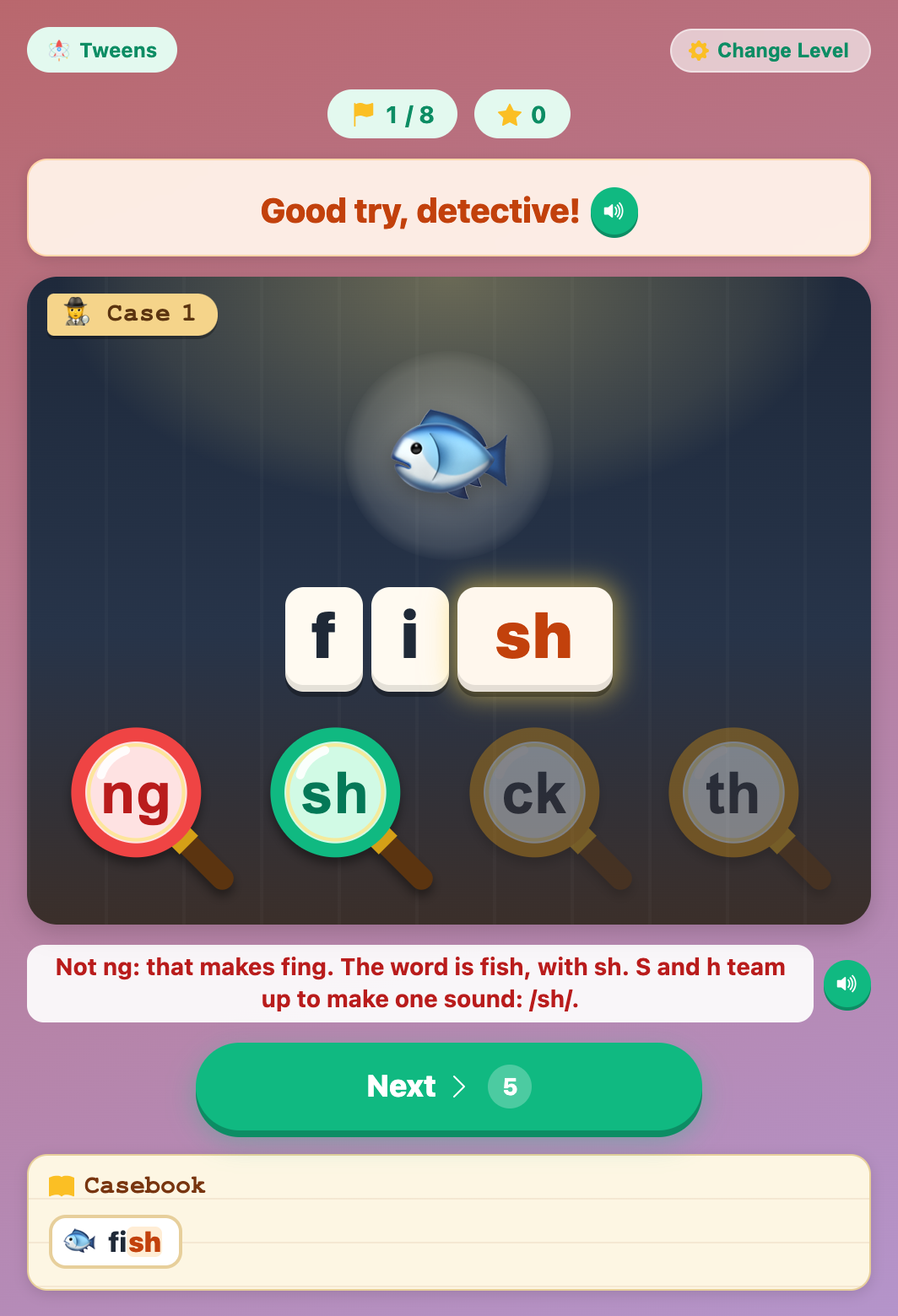
A wrong answer in Digraph Detectives for tweens, where ng was picked for fish and the green sh glass shows the right team
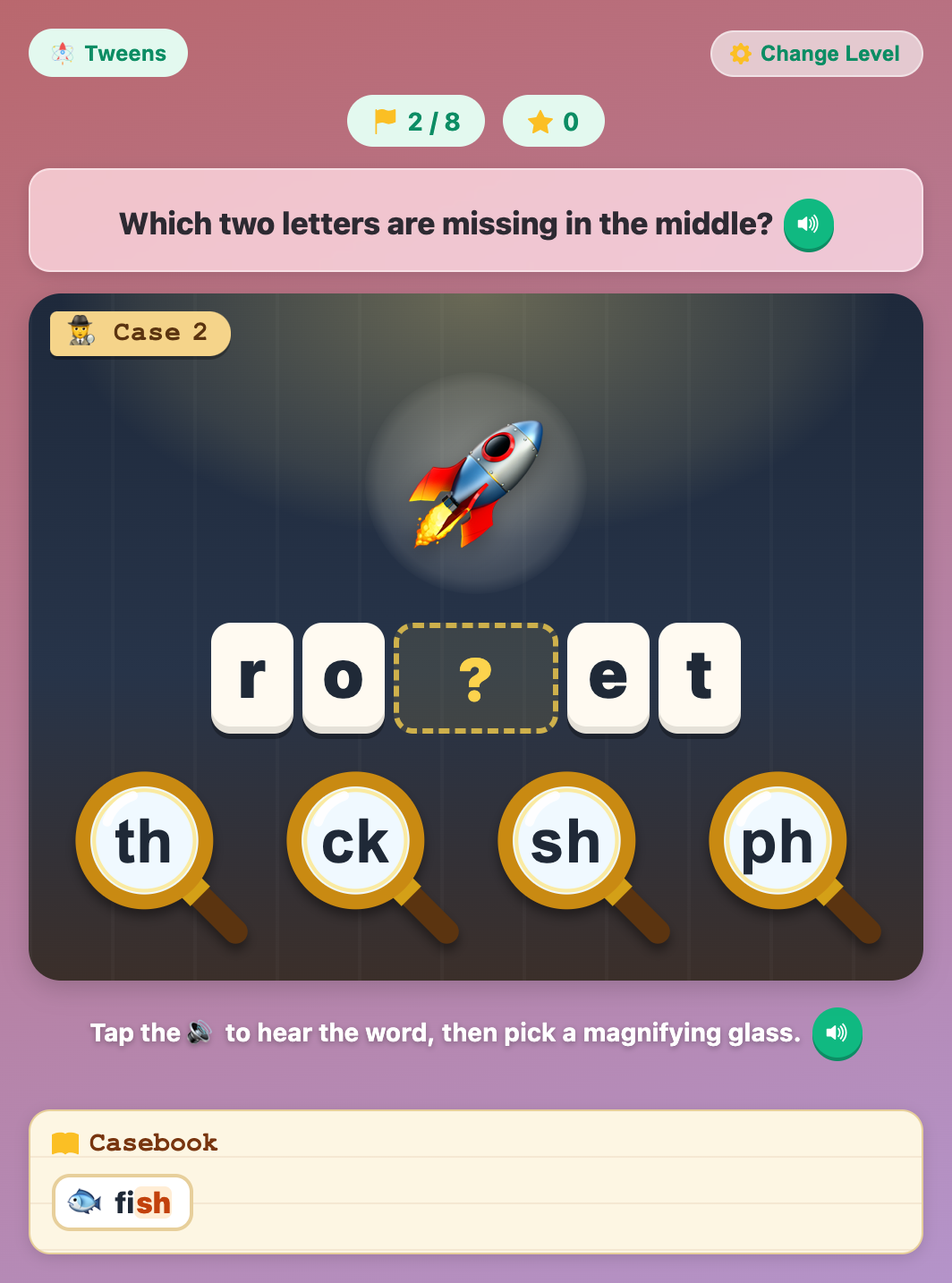
A middle-of-the-word case for rocket in Digraph Detectives, with four glasses for th, ck, sh and ph
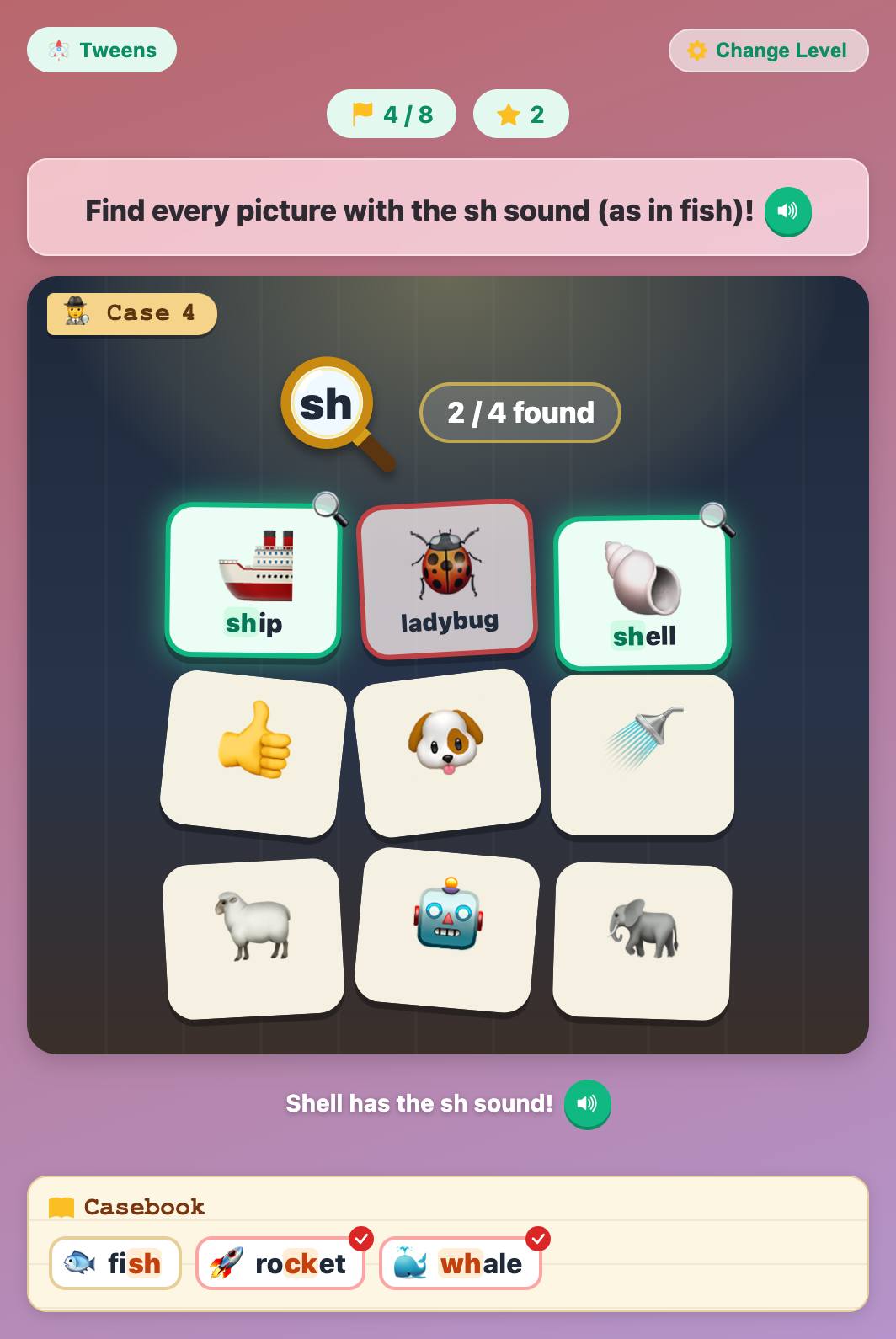
A spot scene with ship and shell found, ladybug marked wrong and 2 of 4 sh pictures found so far
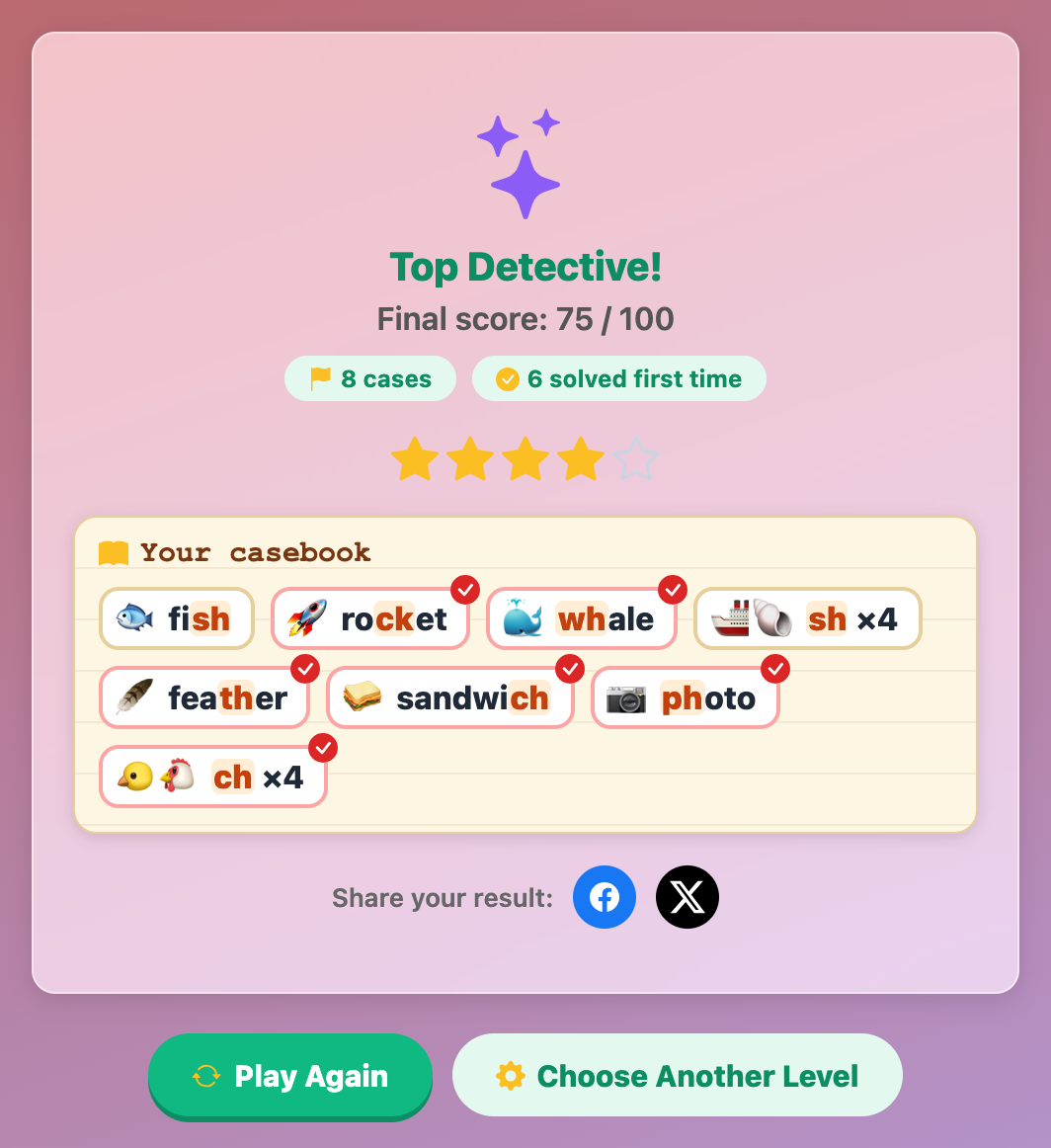
The Top Detective finish card with a score of 75, four stars and a casebook full of solved words
More English Games
 48.4K plays
4.9
Build a Story
Pick your age level, then tap the mixed-up story parts in the order they happen to build a whole story from beginning to end.
 213.7K plays
4.9
English Horse Derby
Saddle up for an English steeplechase! Every fence has a question: answer right to gallop and jump clean, get three in a row for Carrot Power, and race your horse past the pack to the finish. Find first letters, read picture words, spot rhymes, and pick the right spelling, opposite and grammar.
 28.2K plays
5.0
Listen & Tap
Listen to the parrot and tap the picture you hear! No reading needed, so it is perfect for children learning English. Little ones choose between cat and sun, preschoolers pick out rhymes like hat and bat, and older kids train their ears on words that sound almost the same: ship or sheep, three or tree, pear or bear. Tap the turtle to hear a word slowly.
 2.1M plays
4.9
Word Search
Find all the hidden words in the letter grid before time runs out.
Most Played Games
 274.1K plays
5.0
Sentence Builder
Pick your age level, then tap the shuffled words in the right order to build the sentence.
 435.6K plays
4.8
Sight Word Pop
Read the target word and pop the matching bubble before the timer runs out.
 717K plays
4.9
Word Crush
Swap the candy letters to line up 3 in a row and crush them! Every letter you crush fills in a word, like cat, hat and bat. Make rockets, bombs and rainbows, and spell every word before your moves run out.
 314.9K plays
4.9
English Village Builder
Build a village on a blocky island! Answer vocabulary, spelling, word-meaning and grammar questions to earn wood, stone, flowers and diamonds for every house, road, farm and school.
Comments (50)