Beginning Sound Fishing
118.3K playsGrab your fishing rod! The flag on the boat shows a sound, like M for moon. Fish swim by carrying pictures: a monkey, an apple, a mouse. Catch every fish whose picture starts with that sound, and leave the others to swim on. Little ones listen for first sounds, preschoolers also find the last sound and the middle sound, and older kids hunt for sh, ch and st, and for sounds spelled in tricky ways, like the ph in phone.
Say “moon.” Now say “monkey.” Hear how both words start with the same humming mmm? That first sound is what this whole game is about. Beginning Sound Fishing for kids is a free phonics game on KidWorld where you catch the fish whose pictures start with the sound on your boat’s flag. It helps children from about age 2 to 12 hear the sounds inside words, which is one of the first big steps in learning to read.
Little ones listen for first sounds, like the p in pear and pie. Preschoolers also hunt for last sounds and middle sounds. Older kids look for two-letter starts like sh and st, and for sounds spelled in sneaky ways, like the ph in phone. There is no timer, no lives to lose, and no download or sign-up. You play right in your web browser, by tapping with a finger on a phone or tablet or by clicking with a mouse.
🎣 Beginning Sound Fishing for Kids: A Pond Full of Sounds
At the top of the screen, a child sits in a little wooden boat with a fishing rod. The boat has a red flag, and the flag shows a sound, such as Mm. Up in the sky there is a bucket with empty dashed circles, one for each fish you need to catch.
Below the boat is a blue pond. Bright fish swim across it in three rows, some going left and some going right. Every fish carries a round picture on its side: a pineapple, a shirt, an ant, a kiwi. The name of the picture is written under each fish, so readers can read along and younger kids can ask a grown-up.
Above the pond is a card with the same sound as the flag, plus one keyword. A keyword is an example word that has the sound, like pear for Pp or shower for sh. The letters that make the sound are colored red in the keyword, so you can see exactly where the sound lives.
Your job is simple to say and fun to do. Find every fish whose word has the flag’s sound, and tap it. The fishing line drops down, hooks the fish, and pulls it up into the bucket. Leave the other fish alone and let them swim on by.
🛶 Casting Off: How to Play Beginning Sound Fishing on KidWorld
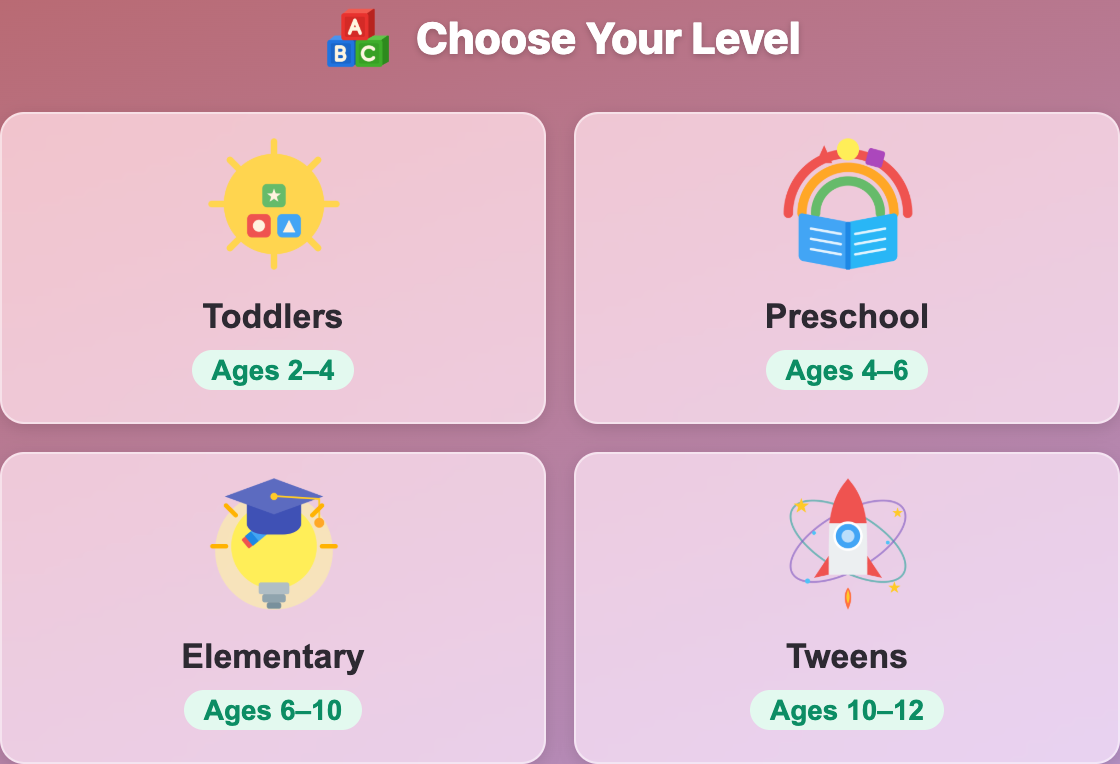
Pick your level. The Choose Your Level screen shows four cards: Toddlers (ages 2–4), Preschool (ages 4–6), Elementary (ages 6–10) and Tweens (ages 10–12). Tap the one that fits. KidWorld remembers your choice, so next time the game can start right away.
Check the flag and the card. The flag on the boat and the big box on the card show the sound for this round. Next to it is the keyword picture with its word. Read the line under them, such as “Catch the fish that start with p, like pear!”
Listen if you like. The green 🔊 button beside the card reads the question out loud. There is one beside the tip line too, and one beside the “How to play” box. When the site’s sound is on, the game also reads each new question and each tip by itself, a little slower for younger levels.
Tap a fish to catch it. Tap with your finger or click with a mouse. You can also press Tab to move from fish to fish and Enter to catch one. A fish with the sound gets hooked, flies up, and its picture fills the next circle in the bucket. The tip says why it was right, like “Shirt starts with sh!”
Oops, wrong fish? A fish without the sound shakes, gets a red ✕, and shows its word with its own first letter in red. The tip explains, like “That’s ant. Ant starts with a, not p.” Then it swims on, and you keep fishing.
Watch for a glowing fish. If you get stuck, one fish with the sound starts to glow to help you. On Toddlers this happens after one wrong fish or about 9 seconds with no taps. On Preschool it happens after two wrong fish or about 12 seconds with no taps. On Elementary and Tweens it happens after two wrong fish.
Fill the bucket. When the last right fish is caught, the other fish dash away. The card turns green and says “Perfect fishing!” (no wrong fish) or “Great catch!”, lists every word you caught, and shows the stars for that round.
Press Next. A big green Next button appears with a number counting down from 5. It moves on by itself when it reaches the end, and it waits while the game is still talking. You can also tap it, or press Enter or the Space bar.
See your score. After the last round, the button says “See My Score.” The “What a Catch!” card shows your final score out of 100, how many fish you caught, your stars, your perfect rounds and up to five trophy stars. Choose Play Again for new fish, or Choose Another Level.
Use the page buttons. “Change Level” at the top of the game takes you back to the level cards at any time. The buttons around the game let you go fullscreen, reload the game, and turn the music and sounds on or off.
🚩 Reading the Flag: Five Kinds of Fishing Trips
The flag does not always ask for the first sound. Its shape tells you which part of the word to listen to. Here is what each kind of flag means.
Mm: the first sound
A big letter and a small letter, like Mm or Pp, means “catch the words that start with this letter’s sound.” This is the beginning sound, the very first sound you make when you say a word. Toddlers play only these rounds. Preschoolers start with two of them.
_t: the last sound
A line and then a letter, like _t, means the sound comes at the end. The line stands for the rest of the word. So _t asks for words that end like cat, hat and goat. Preschool and Elementary both have these rounds.
_a_: the middle sound
A letter with a line on each side, like _a_, means the sound is in the middle. These are short words with one beat, like cat, bed, pig, fox and sun. The game asks you to catch the fish with “the same middle sound as cat.” You will find these rounds in Preschool.
sh, ch, st: two letters at the start
Two small letters, like sh or st, belong to Elementary. Some pairs, like sh and ch, are two letters that make one brand-new sound. Grown-ups call them digraphs. Other pairs, like st, sn, sp, fl, br and tr, are two sounds said quickly together. These are called blends.
/f/: one sound, many spellings
A letter between two slanted lines, like /f/ or /s/, means “listen to the sound, not the letters.” This is the Tweens challenge. Phone starts with the same sound as fox, even though it is spelled with ph. Circle starts like soap, even though it begins with c. Every Tweens round has at least one fish spelled in a sneaky way.
🏆 How to Catch Every Fish and Keep All Three Stars
Each round gives you three stars if you tap no wrong fish, two stars if you tap one, and one star if you tap more. These tips help you keep all three.
1. Say each name out loud
This game is about sounds, and sounds live in your mouth, not on the screen. Say the picture’s name before you tap. Saying “pie” out loud makes it much easier to hear the p at the front than just looking at a pie.
2. Stretch the first sound like gum
Make the sound longer: “mmmmoon,” “sssseal.” Stretching helps your ears catch it. Then stretch the fish’s word the same way and ask, “Do they start the same?”
3. Use the keyword as your measuring stick
The keyword card is there to help you compare. Say the keyword, then the fish’s word, side by side: “pear… potato.” Same start? Catch it! “Pear… juice.” Different start? Let it swim. This works for every flag, even the middle-sound ones: “cat… map” sound alike in the middle, but “cat… pig” do not.
4. Don’t chase the fish
There is no timer, and no fish can ever get away. Each row is a loop, so a fish that swims off one side comes back on the other. If a fish is near the edge, wait. It will come back into the middle, where it is easy to tap. Tapping a fast fish in a hurry is how wrong fish happen.
5. Read the word, but trust your ears
On the bigger levels, some fish are made to trick your eyes. In an sh round, a soap fish starts with s, but soap says s, not sh. In a Tweens /s/ round, candle starts with c, just like circle, but candle says a k sound. When a word looks right, say it before you tap.
6. For last sounds, freeze at the end
Say the word slowly and stop on the very last sound you make: “boo-t,” “bu-s.” Don’t look at the last letter. In Elementary, cake and snake both end with the k sound, even though the last letter is an e that makes no sound at all.
If listening to word endings is your favorite part, Magic Crossbow: Rhyme Hunt lets you shoot the one word whose ending doesn’t rhyme with the rest.
7. For middle sounds, cut the word into three
Short words like map have three parts: m, a, p. Say them one at a time, slowly. The middle part is the sound you need. Tapping your fingers once for each part can help.
8. Fair play: look-alike sounds are never traps
Some sounds are almost twins, like t and d, p and b, or f and v. The game never uses one of them to trick you about the other. So in a _t round you will not meet a bed fish, because the d at the end of bed sounds too much like t. The same goes for short vowels that sound close, like the e in bed and the i in pig. If you are sure a fish has a completely different sound, you can leave it alone without worry.
9. One wrong tap only counts once
If you tap a wrong fish, the round counts it one time. Tapping the same wrong fish again by accident won’t cost you another star. Use the red letter it shows you as a clue: “Ant starts with a” tells you to listen for p even harder.
📝 Five Fishing Trips, Worked Out Step by Step
Here is how to think through real rounds from the game. You can’t see the pond here, so picture the fish as you read.
Example 1: Toddlers, the Mm flag
The card shows a moon. The fish carry a monkey, a mouse, a mushroom, an apple, a pig and a sun.
Say the keyword: “mmmoon.” Your lips press together and hum.
Monkey: “mmmonkey.” Same hum! Catch it.
Apple: “aaapple.” Your mouth opens wide, no hum. Let it swim.
Mouse and mushroom both hum at the start. Catch them both.
Pig and sun start with a pop and a hiss. Leave them. The bucket is full, and you get three stars.
Example 2: Preschool, the _t flag
The card says “Catch the fish that end with the t sound, like cat!” The fish carry a hat, a boot, a goat, a bus, a drum and a pig.
Say “cat” and freeze at the end: a tiny t tap with your tongue.
Hat ends with that tap. So do boot and goat. Catch all three.
Bus ends with a hiss, drum ends with a hum, and pig ends with a g. None of them is a t.
Example 3: Preschool, the _a_ flag
The card asks for “the same middle sound as cat.” The fish carry a map, a hat, a flag, a pig, a bed and a fox.
Cut cat into three: c, a, t. The middle is the a in apple.
Map: m, a, p. Same middle! Hat and flag have it too.
Pig has an i in the middle, bed has an e, and fox has an o. Leave them.
Example 4: Elementary, the sh flag
The keyword is shower. The fish carry shirt, shrimp, shell, sheep, soap, house, tomato and kiwi. This is a four-fish bucket.
Say “shower.” The sh sound is the “be quiet” sound: shhh.
Shirt, shrimp, shell and sheep all start with shhh. Catch all four.
Soap starts with s, and house starts with h. Each has one of the two letters in sh, but neither one says shhh at the start. If you tap soap, the tip says “Soap starts with s, not sh.”
Blend rounds work the same way. In an st round, a snake fish and a sun fish both start with s. But snake says s-n and sun goes straight from s to u, so neither one starts like star.
Example 5: Tweens, the /s/ flag
The card says “Catch every fish that starts with the same sound as soap. That sound can be spelled in different ways!” The fish carry salt, stop, circle, sunflower, rice, candle, chopsticks, octopus and kangaroo.
Salt, stop and sunflower start with an s and say s. Catch them.
Circle starts with a c, but say it out loud: “sssircle.” Catch it! The tip says “Here c makes the s sound.”
Candle and chopsticks also start with c, but candle says k and chopsticks says ch. If you tap one, the tip adds “Same first letter, different sound!”
Rice, octopus and kangaroo don’t start with an s sound at all. Leave them.
Other Tweens flags hide other tricks. With /f/, phone belongs with fox, but pig and pear don’t, even though p is in ph. With /n/, knife and knot belong, because the k is silent. With /r/, rhino and wrench belong. With /w/, whale belongs. With /j/, giraffe belongs, because here the g says j.
⭐ How Stars and Your Score Add Up
Every round gives one, two or three stars. Toddlers play 5 rounds, so the most you can collect is 15 stars. The other levels play 6 rounds, for up to 18 stars. Your final score is your stars out of the most you could get, turned into a number out of 100.
For example, a toddler who taps one wrong fish in one round and no wrong fish in the others gets 14 of 15 stars. That is a score of 93. A perfect game is 100. Even a tricky game scores at least 10, so nobody leaves with nothing.
🧒 Which Fishing Spot Fits Your Child?
All four levels use the same pond, boat and bucket. What changes is which sound you listen for, how many fish swim by, and how fast they go.
Beginning Sound Fishing for toddlers (ages 2–4)
Every round is a first-sound round with an easy letter flag, like Mm, Ss or Pp. There are 5 rounds, with 3 fish to catch and 3 to leave. The fish swim slowest here. Every fish starts with just one sound, never two blended together like frog or star. The fish to catch always say their letter the plain way, so there is no ship in an s round and no city in a c round. A helper fish glows after just one wrong tap. At this age it works best with a grown-up nearby to say the picture names together.
Beginning Sound Fishing for preschoolers (ages 4–6)
Preschool mixes it up over 6 rounds: two first-sound rounds, two last-sound rounds (_t) and two middle-sound rounds (_a_). There are 3 fish to catch and 4 to leave. Beginning Sound Fishing for preschoolers is a playful way to practice what many kindergarten classes call “first, middle and last sounds.”
Beginning Sound Fishing for elementary kids (ages 6–10)
Elementary has 6 rounds: two-letter sounds like sh and ch, blends like st, sn and tr, and last sounds in any spelling. Most rounds have 4 fish to catch and 4 to leave, and some of the fish to leave start with the same letter on purpose. This level rewards careful listening and careful reading at the same time. If your child likes sliding sounds together, Blend-It Blocks turns each sound into a toy block that clicks into a word.
Beginning Sound Fishing for tweens (ages 10–12)
Tweens play 6 rounds of “one sound, many spellings” with up to 9 fish swimming fast. The flags are /f/, /n/, /s/, /k/, /j/, /g/, /w/ and /r/, and each round hides a spelling like ph, kn, wr or a soft c. It is a quick, fun check on spelling patterns that even strong readers mix up. For more spelling magic, Magic E Wand shows how one silent e turns cap into cape.
🌱 What Kids Learn on the Water
Ears that hear the parts of words. Before a child can sound out a word on a page, they need to hear that “moon” starts with m and ends with n. Every catch in this game practices exactly that skill.
Letters that match sounds. The red letters on the keyword and on each wrong fish connect what you hear to what you see. When pie and pear land in the bucket, the p on the flag starts to mean “that popping sound.”
Stop, then tap. Fish keep swimming and coming back, so the game gently teaches patience. Kids who wait for a fish to swim into the middle and say its name first make fewer mistakes, and they can see their stars go up.
Mistakes that teach. A wrong fish never ends the game. It shakes, shows its word, and the tip explains the sound in one short sentence. Kids learn from the mistake right away and keep going.
Spelling smarts for older kids. The Tweens rounds show that English letters don’t always follow the rules: ph can say f, k can be silent, and c can say s. Spotting these by ear helps with reading and spelling new words.
A note for parents and teachers
Beginning Sound Fishing is free and runs in the browser with no download or account. The pictures are everyday emoji: fruit, animals, toys, clothes and things around the house. Nothing chases the player, there is no timer and no game over, and a wrong tap just makes a fish wiggle, so children can take their time. The read-aloud buttons let pre-readers play with less help, and the game tells you right away why each answer was right or wrong. It practices phonemic awareness (hearing first, middle and last sounds), letter-sound matching, two-letter sounds and blends, and tricky spellings. Children who use a keyboard can play with Tab and Enter, and on devices set to reduce motion, the fish swim more slowly.
Ready to cast your line? Pick a level, say each picture’s name out loud, and see how many perfect rounds you can catch. Beginning Sound Fishing for kids is waiting on the pond, and the fish are already swimming by. 🐟
🖼️ See the Game in Action
The Choose Your Level screen in Beginning Sound Fishing, with Toddlers, Preschool, Elementary and Tweens cards
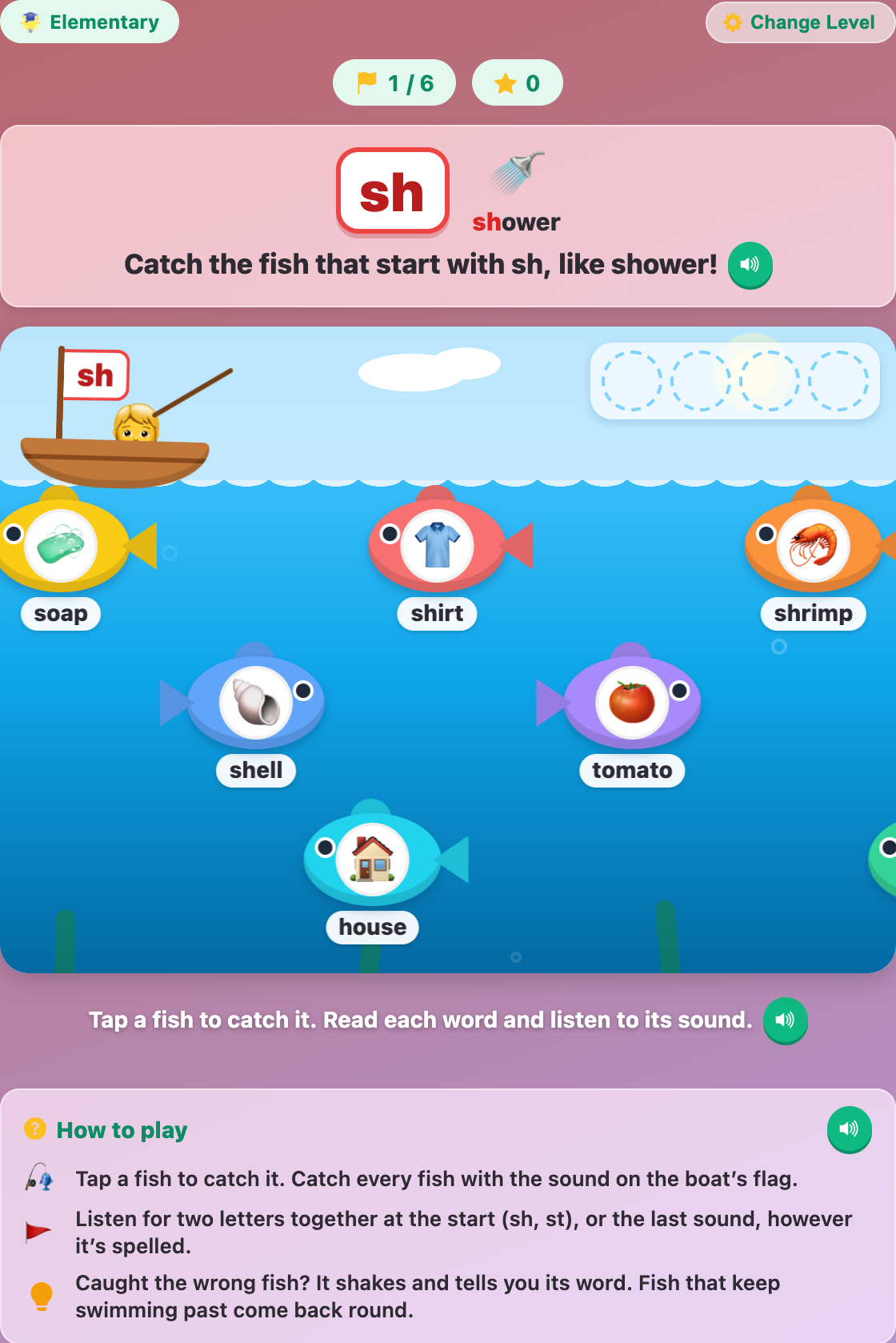
An Elementary round of Beginning Sound Fishing for kids, with the sh flag, a shower keyword card and fish carrying soap, shirt, shrimp and shell
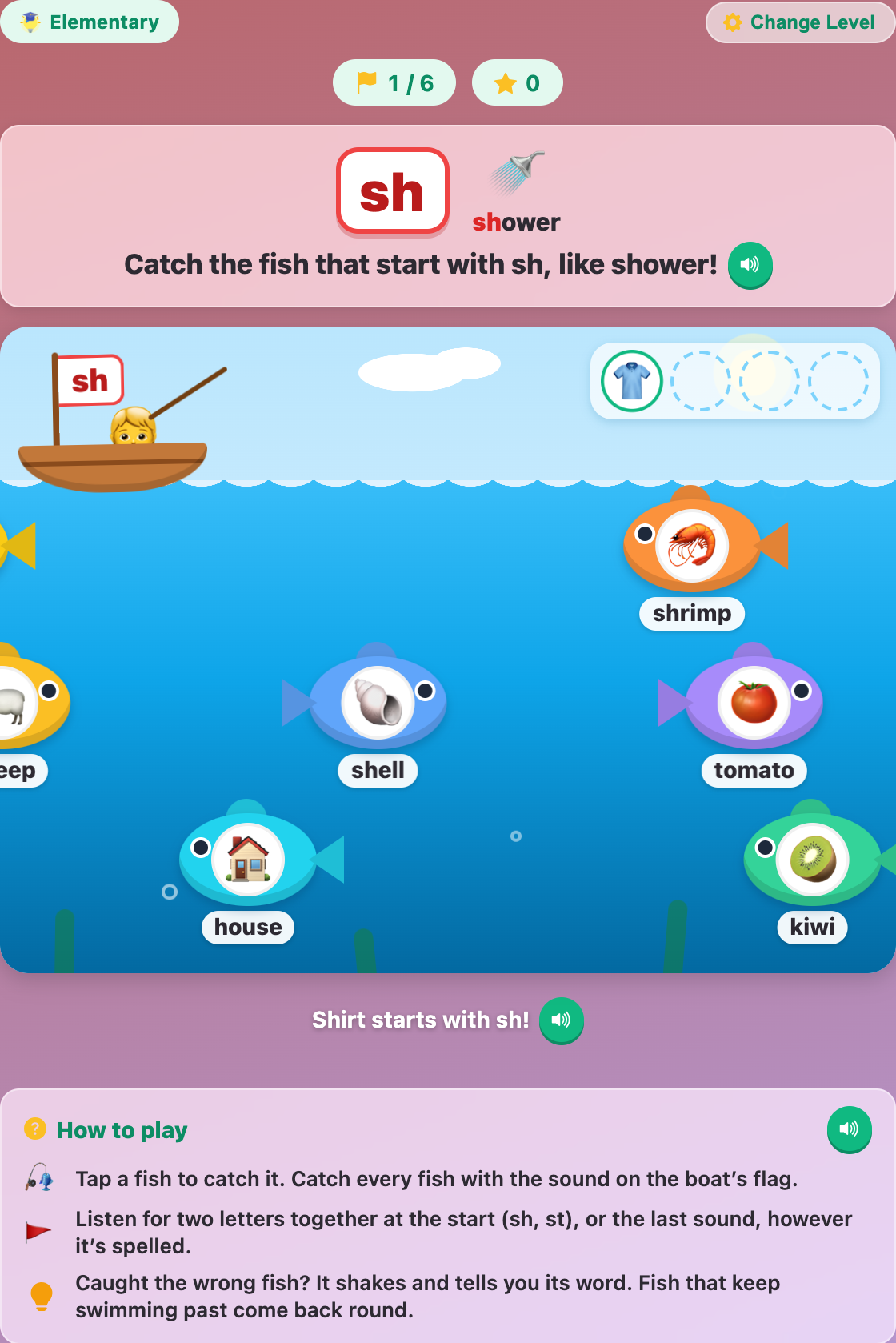
A shirt fish just caught in Beginning Sound Fishing for elementary kids, its picture landing in the first bucket slot
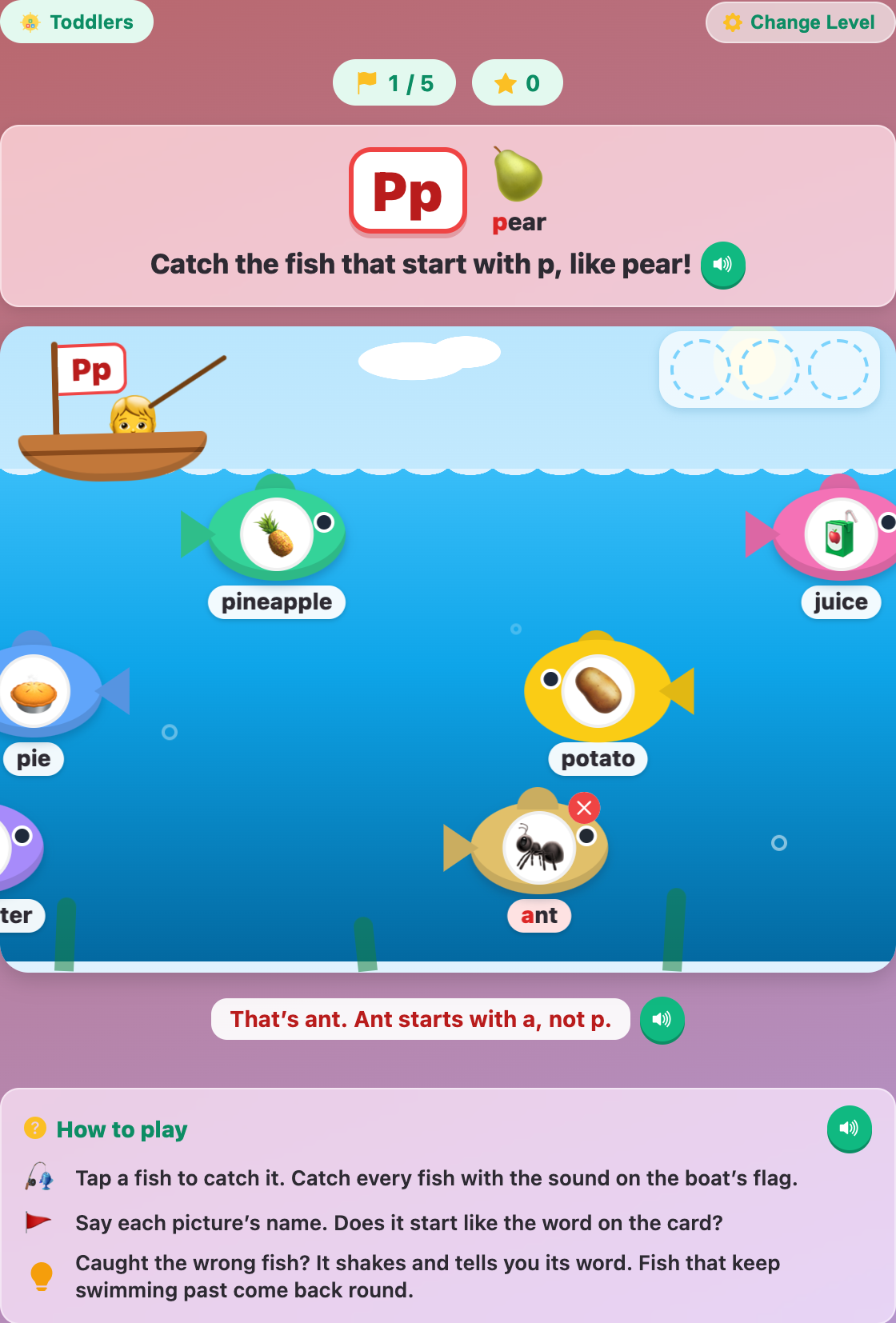
Beginning Sound Fishing for toddlers with a Pp flag, where a tapped ant fish shows a red cross and a tip about its first letter
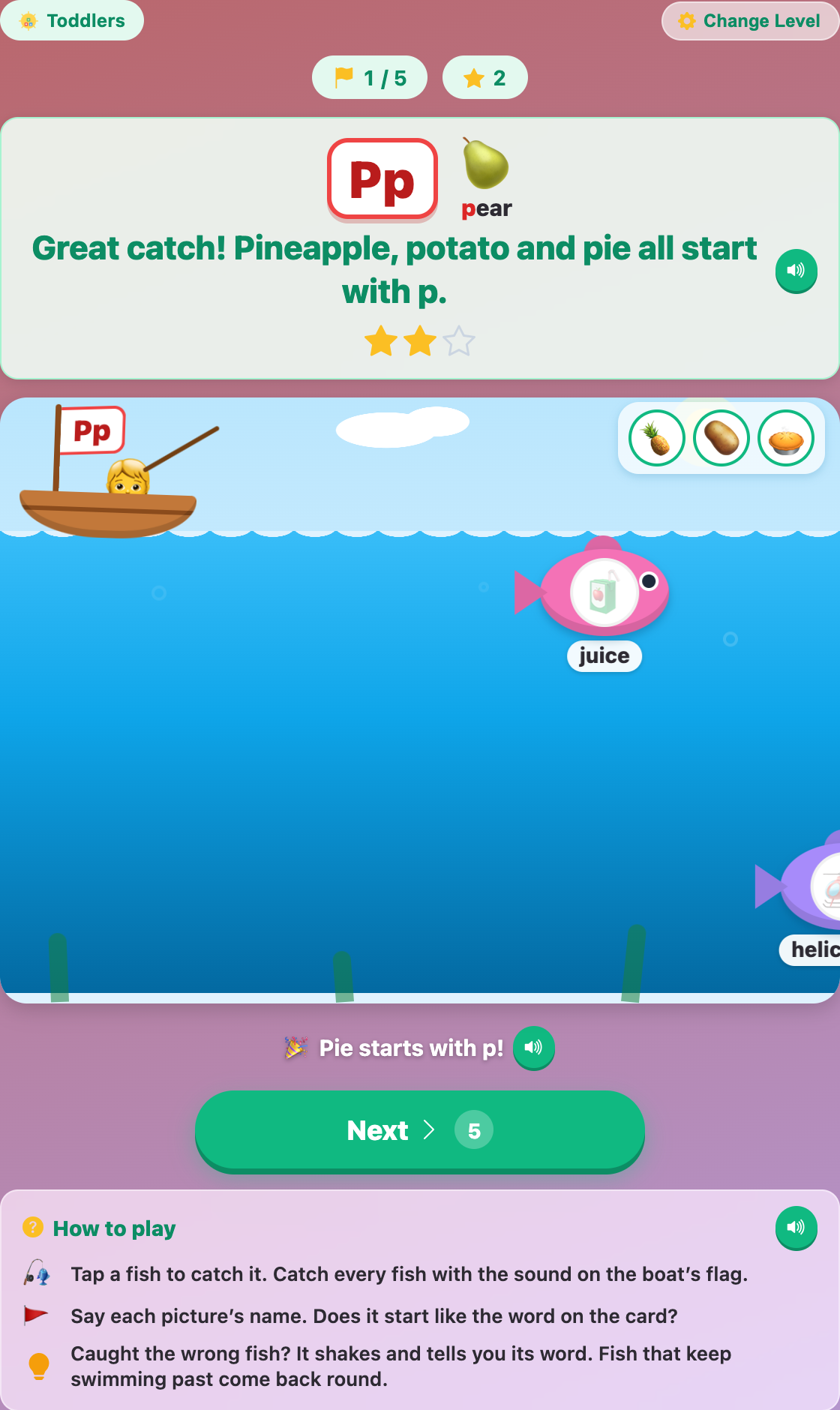
A finished toddler round with pineapple, potato and pie in the bucket, two stars and a green Next button
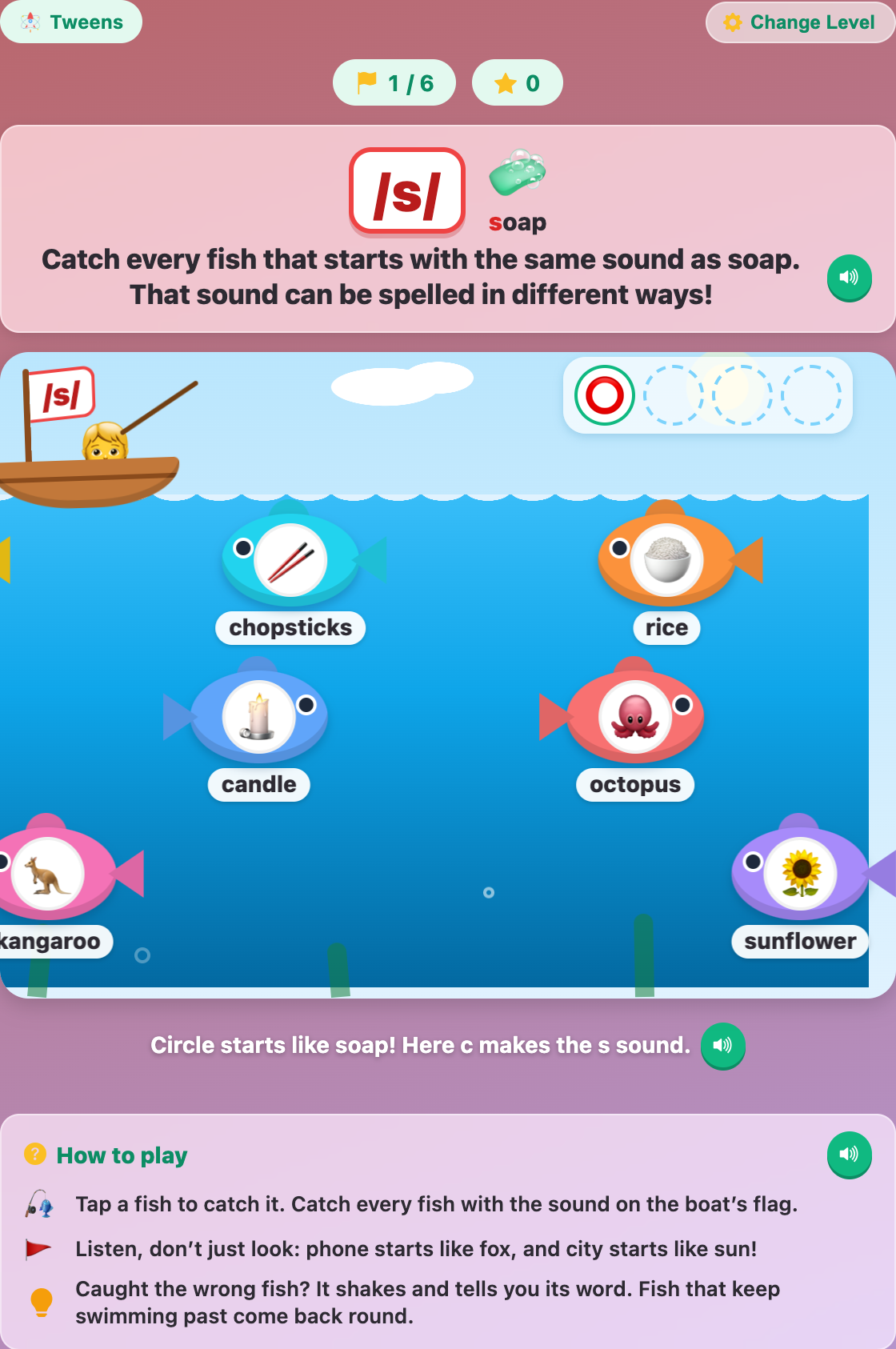
Beginning Sound Fishing for tweens with an s sound flag, a circle caught and a tip saying c makes the s sound here
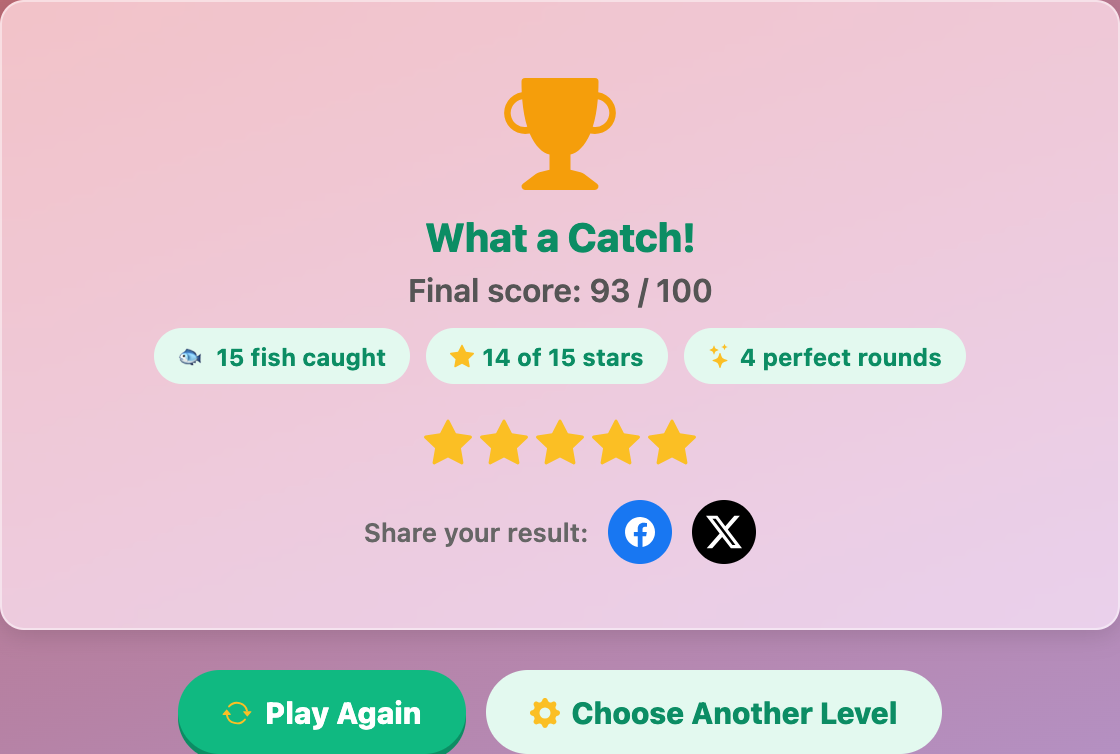
The What a Catch finish card showing 15 fish caught, 14 of 15 stars and 4 perfect rounds
More English Games
 102.9K plays
5.0
Dino English Dash
Pick your dinosaur and race to the finish! Every right answer makes your dino dash ahead, three in a row lets out a big ROAR, and a wrong answer makes it trip. Find first letters, read picture words, spot rhymes, and pick the right spelling, opposite and grammar to beat the pack.
 86.4K plays
5.0
Magic Crossbow: Rhyme Hunt
Cat, hat, dog, bat: which one doesn't rhyme? Listen to the ends of the words and shoot the odd one out with your magic crossbow! Picture rhymes for little ones, then sneaky words that look alike but sound different, like shoe and toe or love and stove.
 1.2M plays
4.9
Rhyme Match
Flip the cards and pair up the words that rhyme with each other.
 274.1K plays
5.0
Sentence Builder
Pick your age level, then tap the shuffled words in the right order to build the sentence.
Most Played Games
 435.6K plays
4.8
Sight Word Pop
Read the target word and pop the matching bubble before the timer runs out.
 717K plays
4.9
Word Crush
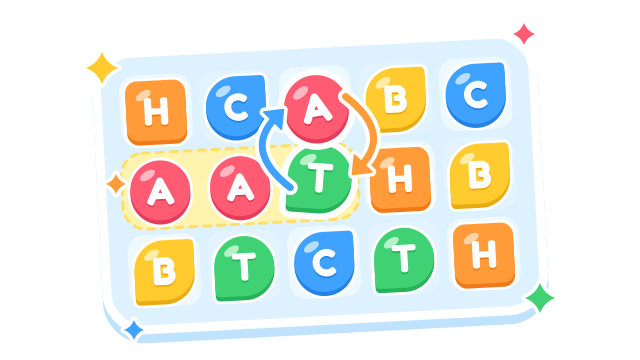
Swap the candy letters to line up 3 in a row and crush them! Every letter you crush fills in a word, like cat, hat and bat. Make rockets, bombs and rainbows, and spell every word before your moves run out.
 314.9K plays
4.9
English Village Builder
Build a village on a blocky island! Answer vocabulary, spelling, word-meaning and grammar questions to earn wood, stone, flowers and diamonds for every house, road, farm and school.
 105.4K plays
4.9
English Kart Circuit
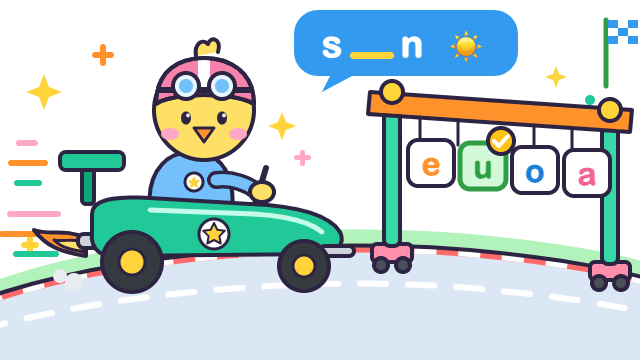
Race a cute go-kart round a 3D track! Read the question at the top, steer into the lane with the right answer and drive under its sign for a Turbo boost; three in a row makes you a Super Star. Hold Boost to zoom or Brake for more time to read. Pick Puppy, Foxy, Bear or Chick, collect stars and dodge the mud. Letters and picture words for little ones, then rhymes, spelling, opposites and grammar.
Comments (54)