Blend-It Blocks
87.2K playsEvery sound is a toy block! Tap the blocks to hear c, a and t, then slide them together until they click and hear them blend into a word: cat! Pick the picture that matches, then change one block to build a brand new word: cat, hat, hot! Little ones blend short words like dog and sun, older kids blend frog, ship and duck, and big kids read train, boat and shark.
Every word you read is made of little sounds stuck together. Blend-It Blocks for kids is a free phonics game on KidWorld that turns those sounds into toy blocks you can push. You tap each block to hear its sound, slide the blocks together until they click, and hear them melt into one word: cuh, ah, tuh... cat! Then you pick the picture that matches the word. It is made for children from about 2 to 12, and it plays right in your browser, with no download and no sign-up.
Grown-ups call this skill blending. It means saying the sounds of a word one after another, faster and faster, until you hear the whole word. It is one of the very first steps in learning to read. Here, it feels like building with blocks. Little ones blend short words like dog and sun. Older kids blend frog, ship and duck. Big kids read train, boat and shark. The last round of every game turns into a word puzzle: change just one block, and cat becomes hat!
🧱 Blend-It Blocks for Kids: Sounds You Can Push and Hear
At the start of a round, a word lies in pieces on a wooden track. Each piece is a block, and each block is one sound. The blocks for fox are f, o and x, with gaps between them. Under the track you see three dashed cards with a big ? on each. That is where three pictures will pop up later.
Your job has three parts. First, find out what each block says. Second, push the blocks together into one word. Third, find the picture of that word. After a few of those rounds comes a different kind of round, the word chain, where you change words one block at a time.
Some blocks hold two or three letters. That is not a mistake! In English, some letters team up to make just one sound. The letters s and h together say shh, so in ship they ride on one block: sh, i, p. The letters i, g and h together say eye, so night is just three blocks: n, igh, t. Pushing these team blocks around helps you see that one sound can need more than one letter.
🎨 What the Block Colors Tell You
The blocks are not colored at random. Each color is a kind of sound, and learning the colors is like getting a secret map of every word.
Blue blocks are single consonants, like b, c, m, s and t. A consonant is a letter that is not a, e, i, o or u.
Teal blocks (a blue-green color) are consonant teams: two consonants that make one sound, like sh, ch, th, ck, ng, ll and qu.
Red blocks are the short vowels a, e, i, o and u. Every word in the game has one.
Purple blocks are vowel teams and bossy-r sounds, like ai, ee, oa, oo, ar, or, ir, ow, ou and igh. A bossy r changes the vowel in front of it, so a and r together say ar, as in car.
Here is why the colors help. Look for the red or purple block first. That is the middle of the word, the part that changes the sound the most. The blue and teal blocks are the sounds around it.
🛤️ How Do You Play Blend-It Blocks?
Here is a whole game, screen by screen, the way it works on KidWorld.
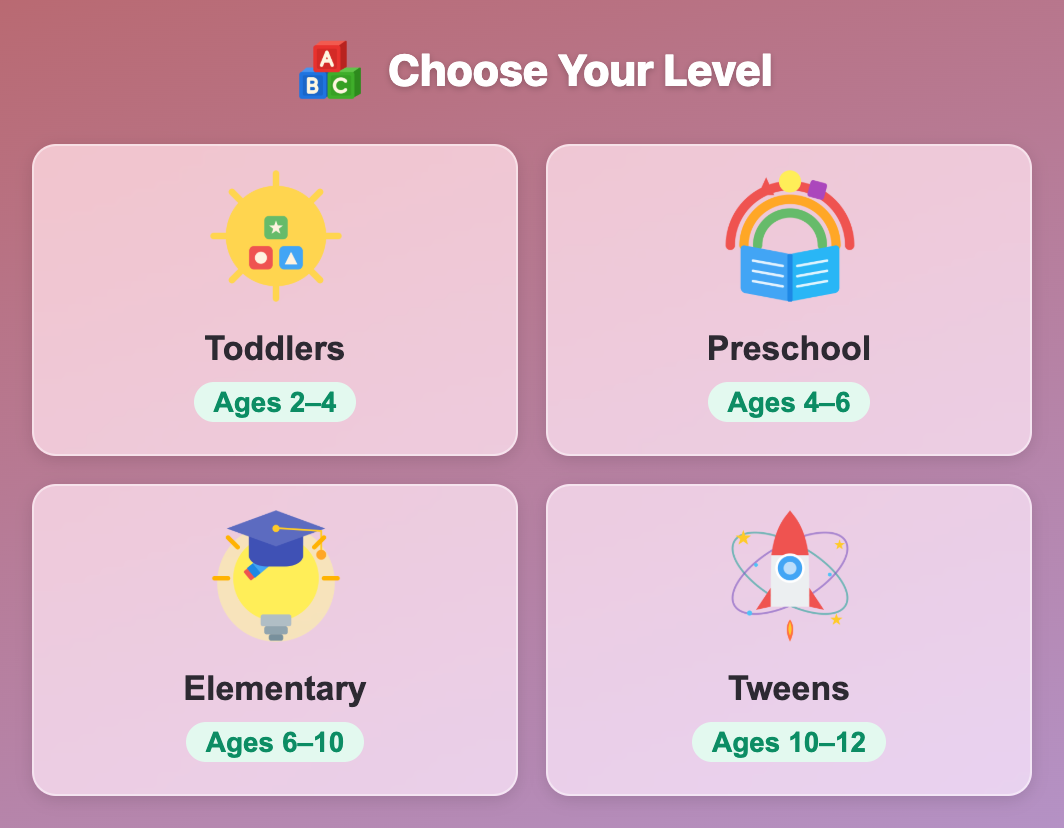
Pick your level. The first time you visit, the game starts you on Elementary. Tap Change Level at the top to see four cards: Toddlers (ages 2–4), Preschool (ages 4–6), Elementary (ages 6–10) and Tweens (ages 10–12). Tap one, and the game remembers it for next time.
Read the top of the screen. A pill shows your level. Below it, a flag shows the round, like 1 / 6, and a star shows your points so far.
Tap a block to hear it. Each block says its sound, not its letter name. The c block says cuh and the m block hums mmm. Vowels come with a helper word, so the a block says ah, as in apple. Short vowels are hard to hear alone, and the helper word makes them clear.
Slide the blocks together. Drag a block along the track with your finger or your mouse. When it touches its neighbor, they join with a little click. You can also push one block into the next and keep going, so one long push can build the whole word. If you let go when a block is very close to its friend, it snaps on by itself.
Use the keyboard if you like. Press Tab to reach a block, then the left or right arrow key slides it to the block on that side. Enter or Space on a block plays its sound.
Watch the word come alive. When the last block clicks on, the word glides to the middle, and each block lights up in turn as the sounds blend. The finished word appears under the track with its own 🔊 button, which reads the blend again, like fuh, aw, ecks... fox!
Pick the picture. Three pictures pop up in the dashed cards. Tap the one that shows the word, or press 1, 2 or 3. A right pick shows the word under every picture, and the tip says something like Yes! f + o + x = fox.
If you pick the wrong one, that card turns grey, and the block where the two words are different gives a wiggle. The tip tells you what you picked and blends the word again: That picture is hot. Listen again: f - o - x makes fox. Then you can try again.
Tap Next. A green Next button counts down from 5 and then moves on by itself. It waits while the game is still talking. You can also tap it, or press Enter or Space.
Play the word chain. The last round is always the chain. It gets its own section below, because it is the trickiest part.
See your score. The finish card says You Built Every Word! It shows your score out of 100, how many pictures and swaps you got on the first try, and up to 5 stars. Tap Play Again for new words, or Choose Another Level.
Every 🔊 button reads its text aloud: the question at the top, the tip, the word, and the How to play box under the game. When the site sound is on, the game also reads the questions, the blends and the tips by itself, so even a child who cannot read yet can play. Around the game you also have the site buttons for music, reload and fullscreen. Fullscreen gives the track more room on a small phone.
Stuck with blocks that will not join? Wait a few seconds. The next loose block gives a little nudge toward its friend, and the tip says which block to drag, like Drag the f block over to the o block.
🔁 The Word Chain: Change One Block, Make a New Word
In the last round, the word is already built for you. Above the track, a box shows its picture. An arrow points to a second picture in a dashed box: that is the word you have to make next. Little dots under the pictures show how many changes are left.
Below the track sits a tray called New blocks. One of them is the block you need. To use it, drag it out of the tray and drop it onto the block you want to replace. Or tap it first (it says its sound), and then tap the block to change. Changed your mind? Tap the new block again, or press Escape.
A right swap flips the old block over, the new word blends out loud, and the chain moves to the next picture. A wrong swap floats back to the tray, and the tip tells you what word you just made, so you can hear why it is wrong. Some examples of tips you might see:
That makes cot. Listen for the sound that changes! (on the younger levels, where the next word is a ? and you go by the picture)
That makes ken, not pen. Which block is different? (on Elementary and Tweens, where the next word is written under its picture)
Good block, wrong place: try it on another block! (when you had the right block but put it on the wrong spot)
Nobody gets stuck forever. After two misses on one step, the block you need to change starts to glow. After three, the right new block in the tray glows too.
⭐ How Your Points Turn Into Stars
You earn one point for every picture you pick on the first try, and one point for every chain swap you make on the first try. Toddlers can earn 6 points (4 pictures and 2 swaps). Every other level can earn 8 (5 pictures and 3 swaps).
At the end, your points become a score out of 100. All 8 points out of 8 gives 100. Missing two first tries out of 8 gives 75. The score never goes below 10, because you still finished. Then come the stars:
5 stars and a gold trophy for 90 or more
4 stars for 70 to 89
3 stars for 50 to 69
2 stars for 25 to 49
1 star below 25
Did you notice? Building the word itself never costs you points. You can tap blocks, listen, and slide them as slowly as you want. Only the guesses count, so careful listening pays off.
🧠 Sound-It-Out Tricks for a Perfect Score
A perfect game means every picture and every swap right on the first try. These tricks help you get there. Each one works because of how this game picks its words and pictures.
1. Tap every block before you push
It is tempting to slide the blocks together right away. But tapping is free, and it costs no points. Tap each block from left to right and say its sound with the game. When you push them together after that, your ears already know the pieces, and the whole word is easier to hear.
2. Say the sounds faster and faster
This is the real secret of blending. Say ssss... tttt... ar slowly. Now say it again, quicker: s-t-ar. One more time, quickest of all: star! Stretching sounds you can hold, like s, m and f, helps them flow into the next sound with no gap.
3. Do not guess from the first letter
From Preschool up, the game is sneaky in a good way. One of the wrong pictures is almost always a word that looks a lot like yours, like cap for cat or clap for clip. So if you only look at the first block, you will be tricked. Check every block, especially the middle one.
4. Find the vowel, then look at both ends
Look for the red or purple block. That is the vowel, the sound in the middle. Many look-alike words have the same ending and a different vowel (clip and clap), or the same vowel and a different end (fox and hot). Checking the vowel and then the last block catches almost every trick.
5. Treat a team block as one sound
A purple ar block is not ah plus rrr. It is one sound, ar, as in car. A teal ck block says one cuh, not two. Tap the team block and copy exactly what it says. Then blend it like any other block.
6. Use the wiggle and the grey card
If you pick a wrong picture, do not tap around fast. The greyed card cannot be picked again, so only two are left. And the block that wiggles shows where your word and the wrong word are different. Tap that block, listen, then choose.
7. In the chain, compare the words sound by sound
Say the word you have, then the word you need, slowly. Which sound is different? Is it the first, the middle or the last? Find that one block first, then find its new sound in the tray. Changing one block at a time is just like how word families work. If you notice that cat, hat and bat all end the same way, you can test your ears on Magic Crossbow: Rhyme Hunt, where you shoot the one word that does not rhyme.
8. Hear the target on the younger levels
On Toddlers and Preschool, the next word in the chain is hidden behind a ?. Tap the 🔊 next to its picture, and the game says Make hat. Now you know the word, and you only need to find which sound changes.
📝 Six Words, Worked Out Together
These examples come from real rounds of the game. Read along and think before you read the answer.
Example 1: f, o, x (Preschool)
The blocks f, o and x sit on the track. Tap them: fuh, aw, as in octopus, ecks. Slide them together and blend: fuh-aw-ecks... fox! The pictures are hot, a fox and a box.
Hot starts with h, but your word starts with f. Hot is out.
Box ends with o and x, just like fox. Tricky! But its first block would be b, not f.
So the answer is the fox. 🦊
Example 2: c, l, i, p (Elementary)
Four blue and red blocks: c, l, i, p. The pictures are a paper clip, two clapping hands and a sled. Sled is easy to rule out, because it starts with s. But clip and clap share c, l and p! The only different block is the red vowel. Tap it: ih, as in igloo. Clip has the ih sound, and clap has ah. Pick the paper clip. This is exactly why trick 4 says to check the vowel.
Example 3: s, t, ar (Tweens)
Only three blocks, but the last one is a purple ar. Blend suh, tuh, ar... star! The pictures are a storm cloud, a star and a coat. Storm also starts with s and t, so a fast reader might grab it. But storm would need an or block and an m block. Star it is. ⭐
Example 4: the chain sheep → shop → ship (Tweens)
The word on the track is sh, ee, p: sheep. The goal picture is a shopping bag, and Tweens can read the word under it: shop.
Say them both: sheep... shop. The start (sh) and the end (p) stay the same. Only the middle changes, from ee to o.
The tray holds ou, u, o and ai. Drag the red o onto the purple ee. Sheep becomes shop!
Next goal: ship. This time the o becomes an i. Two swaps, two new words, one block each time.
Example 5: the chain sock → lock → log → dog (Elementary)
Start with s, o, ck: sock. To make lock, change the first block from s to l. To make log, keep l and o, and change the teal ck at the end to g. To make dog, change the first block again, from l to d. Notice how the changing block jumps around: first, last, first. The game likes to change a different block each time, so you have to listen to the whole word every step.
Example 6: a toddler chain, cat → hat → bat
On Toddlers, the chain only ever changes the first block, and the tray holds just 2 new blocks. Cat is on the track, and the goal is a top hat. Tap 🔊 to hear Make hat. Cat and hat sound the same at the end, so the first block must change: c becomes h. Then h becomes b for bat. The game also keeps letters that look alike, like b and d, out of the same toddler tray, so little ones are not tricked by a mirror letter.
🎒 What Age Is Blend-It Blocks For?
Each level uses its own words and its own rules, so a 3-year-old and an 11-year-old both get a real challenge. Here is what changes.
🐣 Blend-It Blocks for toddlers (ages 2–4)
Blend-It Blocks for toddlers uses short three-sound words like cat, dog, sun, pig and bus, with words a little one might not know left out. There are 4 blending rounds and then a chain of 2 swaps that only changes the first block. The three pictures are always very different, like cat, pen and bus, so a child can win by listening, not by spotting tiny differences. With the site sound on, the game talks the whole way: it starts with Let’s build a word!, blends each word, and reads every tip. A parent can sit close, say the sounds along with the game, and help with the dragging.
🌈 Blend-It Blocks for preschoolers (ages 4–6)
Blend-It Blocks for preschoolers keeps the same three-sound words, but now one wrong picture always looks a lot like the answer, like cap next to cat. That means the child has to blend every sound, not just the first one. There are 5 blending rounds and a chain of 3 swaps that can change any block, such as van → pan → pen → hen. The game still reads the prompts and tips aloud.
📖 Blend-It Blocks for elementary kids (ages 6–10)
Blend-It Blocks for elementary kids moves on to longer words. Some have two consonants side by side that you still hear separately, like f-r in frog or s-t in stop. Others have consonant team blocks, like sh in ship and ck in duck. Each game mixes both kinds, with at least two words of each. The chain has 3 swaps, a tray of 4 blocks, and the next word written under its picture, so the child reads the target before changing it.
🚀 Blend-It Blocks for tweens (ages 10–12)
Blend-It Blocks for tweens is all about the purple blocks: vowel teams and bossy-r sounds in words like train, boat, shark, bird and night. Each game uses at least three different vowel teams. The chain can mix words from every level, so sheep can turn into shop. Tweens who already read well can use it as a quick, fun check of the trickiest spelling patterns, or help a younger brother or sister on an easier level. When they want another word-changing puzzle, Magic E Wand shows how one silent e turns cap into cape and kit into kite.
🌻 Why Blending Blocks Help Kids Read
It makes sounds something you can see. A sound is gone the moment you say it. Here, each sound sits on its own block that you can tap again and again. Pushing the blocks closer while you say the sounds faster shows, with your hands, what blending means.
It builds careful reading. Since one wrong picture usually looks a lot like the right word, children learn to check every sound, not just guess from the first letter. That habit helps with every book they read later.
It shows how spelling works. Team blocks like sh, ck and igh show that one sound can need two or three letters. The block colors teach the difference between vowels and consonants without a single lecture.
It teaches that words are made of parts. In the chain, cat becomes hat, then hot. Children see that changing one sound makes a brand new word. That is the idea behind word families and rhymes. If your child is still learning which sound a word starts with, Beginning Sound Fishing is a gentle step before blending whole words.
Mistakes become little lessons. A wrong pick never ends the round. The game blends the word again, wiggles the block to look at, and lets the child try once more. In the chain, the glowing hints make sure every child finishes.
A note for parents and teachers
Blend-It Blocks for kids practices the phonics skills that early reading is built on: hearing single sounds, blending them into words, short vowels, consonant blends, digraphs (two letters, one sound) and vowel teams. The pictures are friendly emoji like animals, food and toys, and there is nothing scary in the game. The word chain was built so a wrong swap never makes a rude word. It plays free in any web browser on a computer, tablet or phone, with touch, mouse or keyboard, and there is nothing to download and no account to make. A full game takes just a few minutes, which makes it a good warm-up before a reading session.
So tap a block, give it a push, and listen for that happy click. Every word you build makes the next book a little easier. Blend-It Blocks for kids is ready whenever you are, from cat all the way to cloud!
🖼️ See the Game in Action
Four level cards in Blend-It Blocks, from Toddlers for ages 2 to 4 up to Tweens for ages 10 to 12
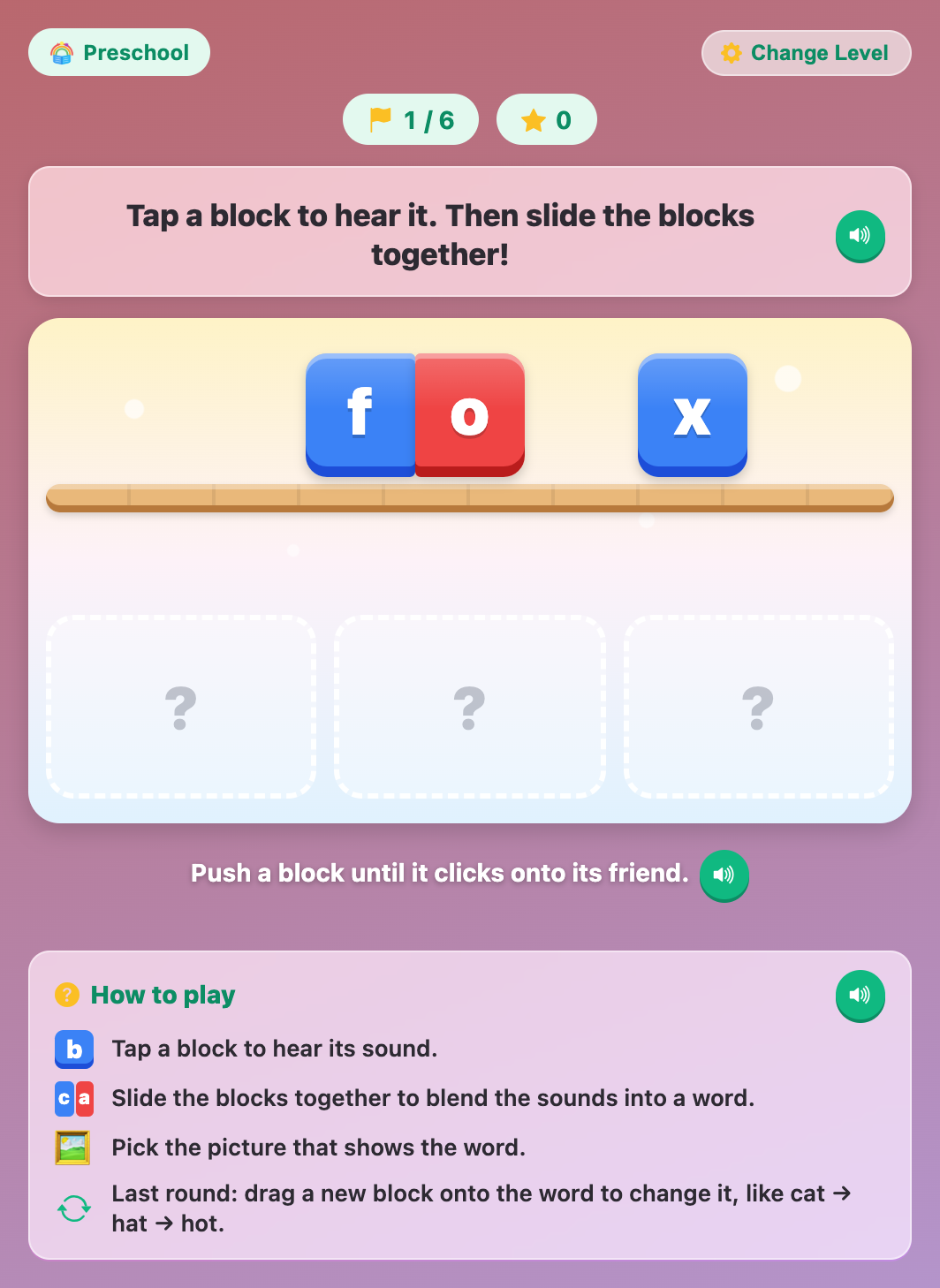
The f and o blocks clicked together on the wooden track while the x block still waits apart, at the Preschool level
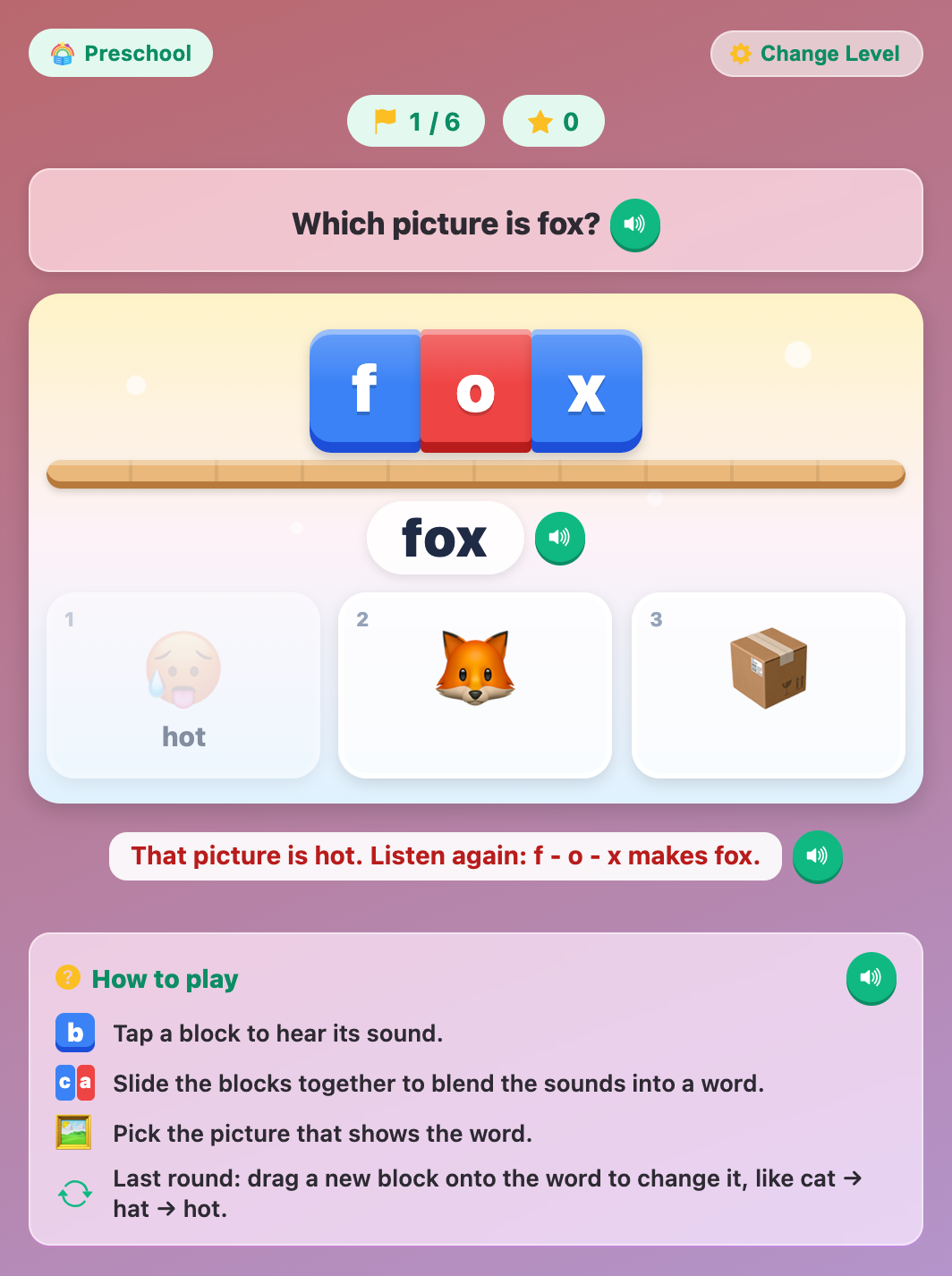
The word fox built from three blocks, with the wrong hot picture greyed out and a Listen again tip below
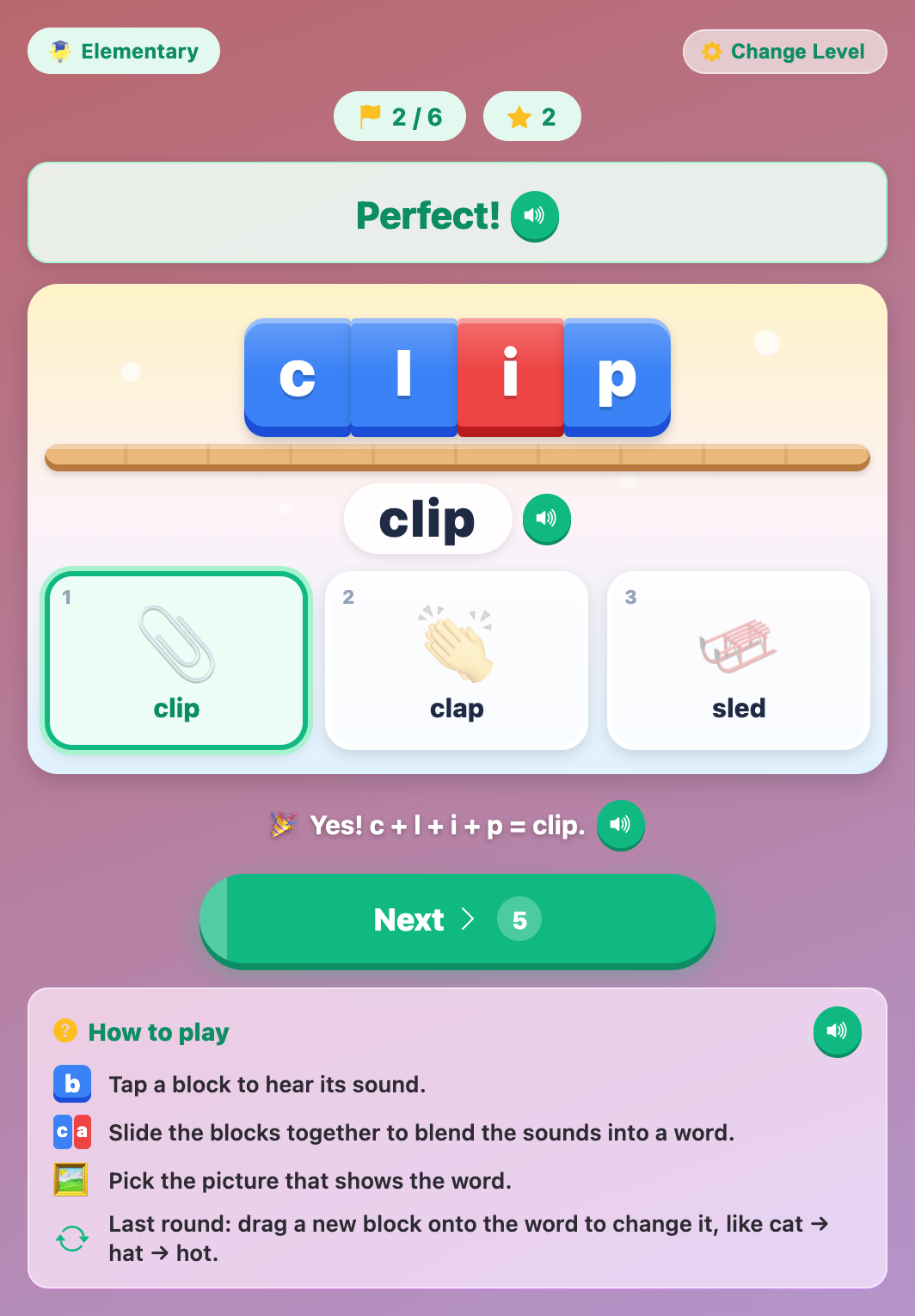
Blend-It Blocks for elementary kids: the c, l, i and p blocks make clip, and the paper clip picture is picked
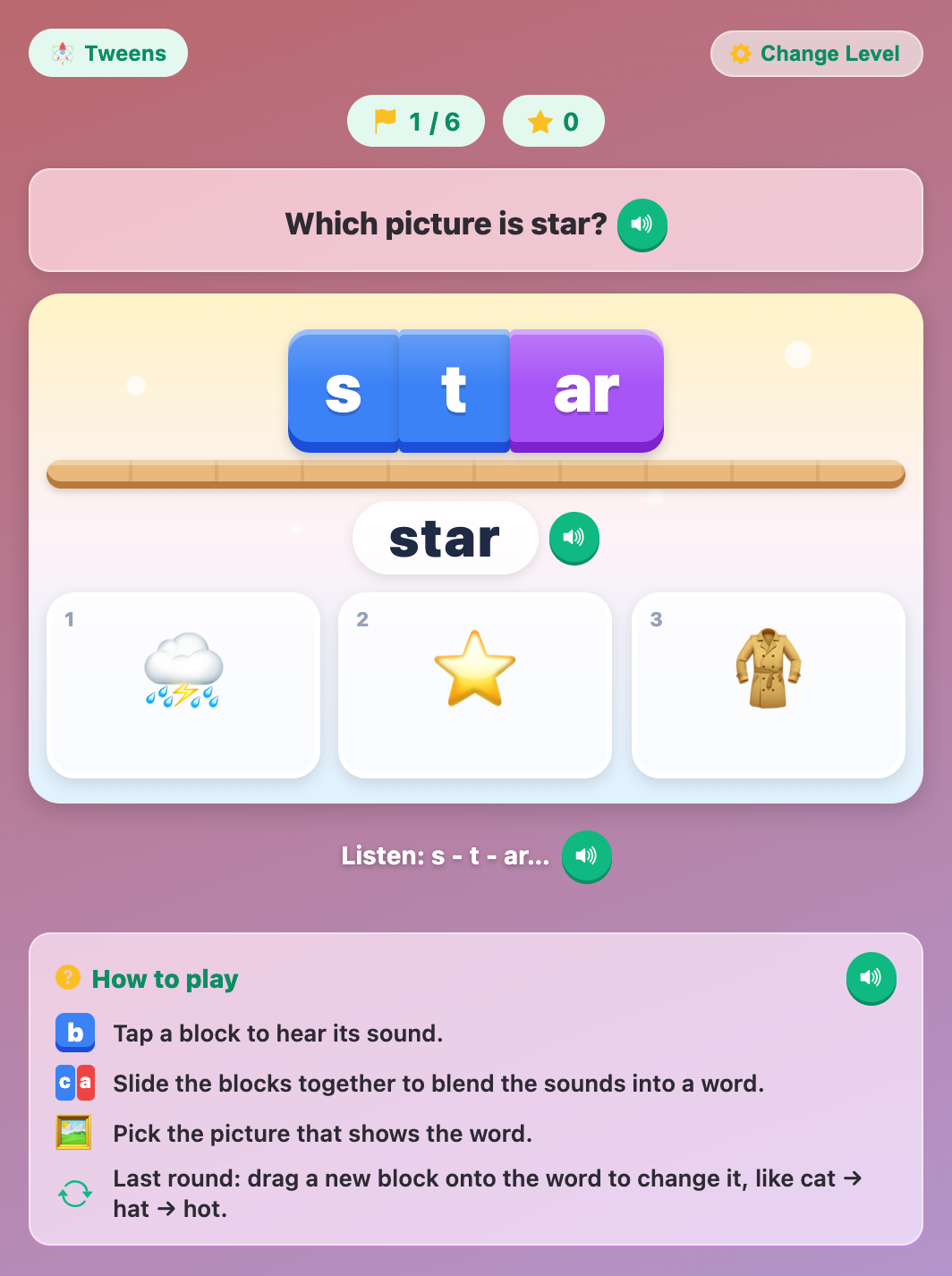
The s, t and purple ar blocks joined into star in Blend-It Blocks for tweens, with a storm, a star and a coat to choose from
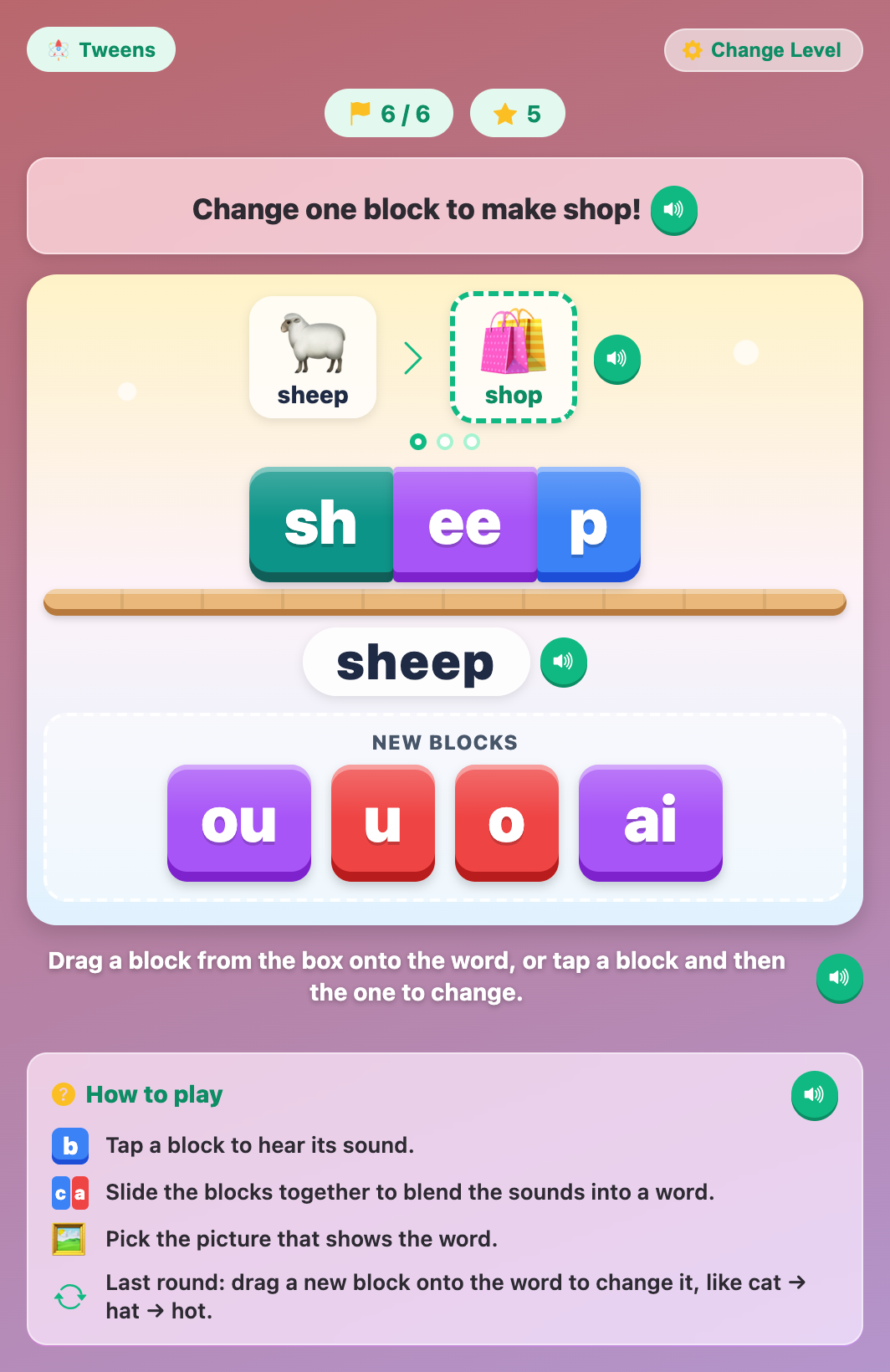
The change-one-block round, with sheep on the track, a shopping bag as the goal and a tray of four new blocks
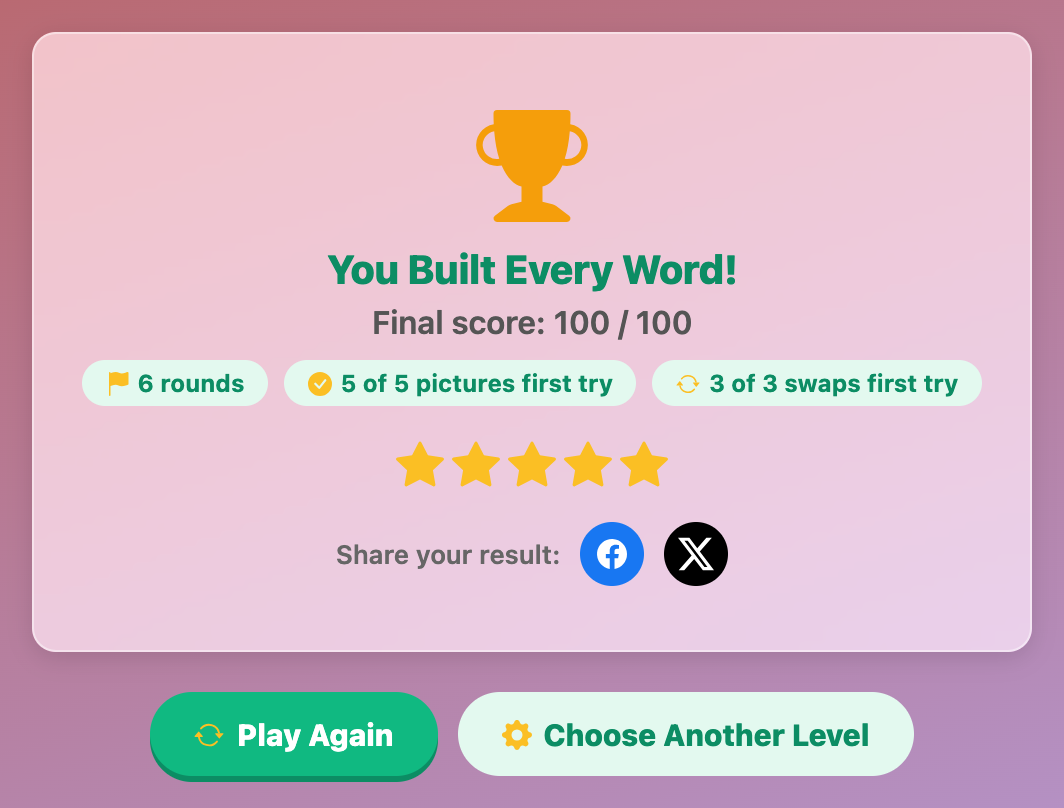
The You Built Every Word finish card with a gold trophy, a final score of 100 out of 100 and five stars
More English Games
 28.2K plays
5.0
Listen & Tap
Listen to the parrot and tap the picture you hear! No reading needed, so it is perfect for children learning English. Little ones choose between cat and sun, preschoolers pick out rhymes like hat and bat, and older kids train their ears on words that sound almost the same: ship or sheep, three or tree, pear or bear. Tap the turtle to hear a word slowly.
 98.4K plays
4.9
Letter Twins
Big B and little b are twins! The sleepy baby animals each have a big letter on their bed, and little letters float above as balloons. Drag each balloon to its twin's bed to wake the baby up, and hear the letter's sound: B is for ball! Watch out for look-alikes like b and d, or p and q. Little ones match three letters at a time, and older kids get more beds, turned-around boards and tricky balloons with no twin at all.
 102.9K plays
5.0
Dino English Dash
Pick your dinosaur and race to the finish! Every right answer makes your dino dash ahead, three in a row lets out a big ROAR, and a wrong answer makes it trip. Find first letters, read picture words, spot rhymes, and pick the right spelling, opposite and grammar to beat the pack.
 2.1M plays
4.9
Word Search
Find all the hidden words in the letter grid before time runs out.
Most Played Games
 274.1K plays
5.0
Sentence Builder
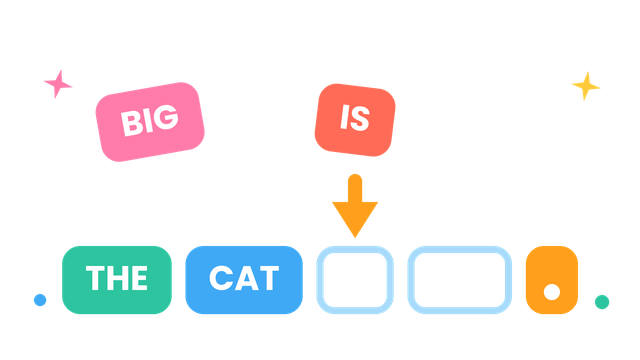
Pick your age level, then tap the shuffled words in the right order to build the sentence.
 435.6K plays
4.8
Sight Word Pop
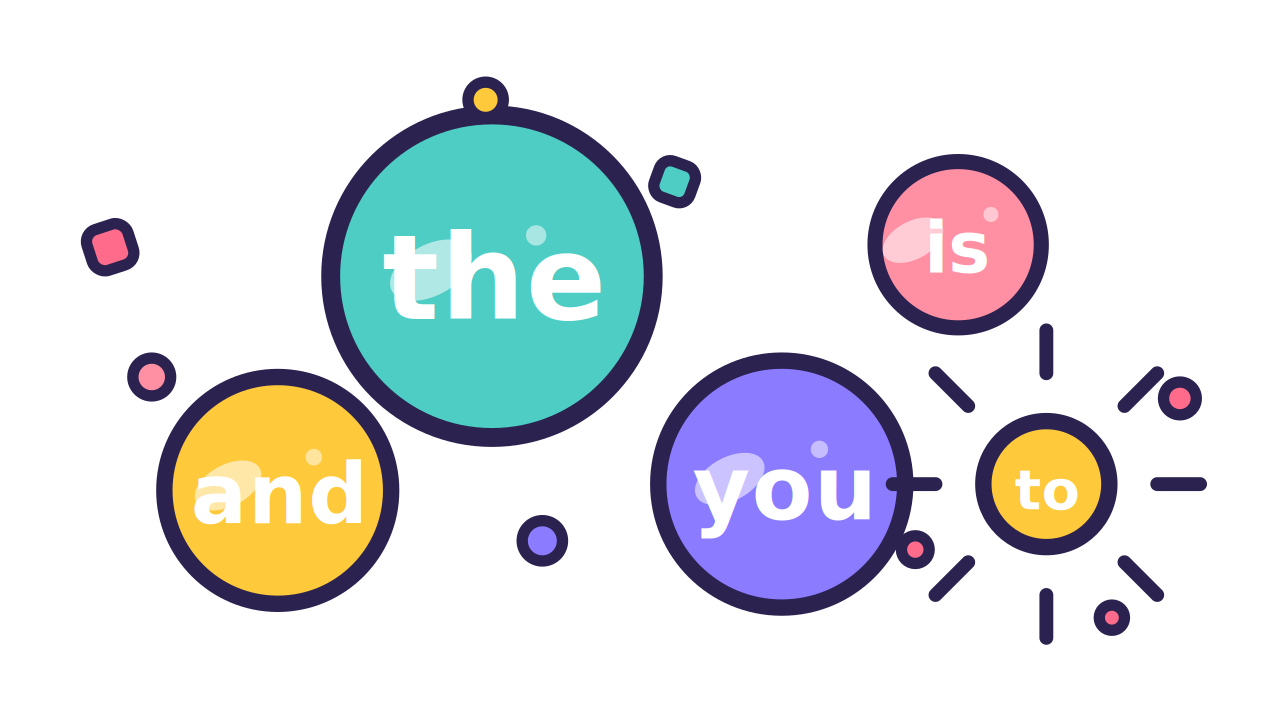
Read the target word and pop the matching bubble before the timer runs out.
 717K plays
4.9
Word Crush
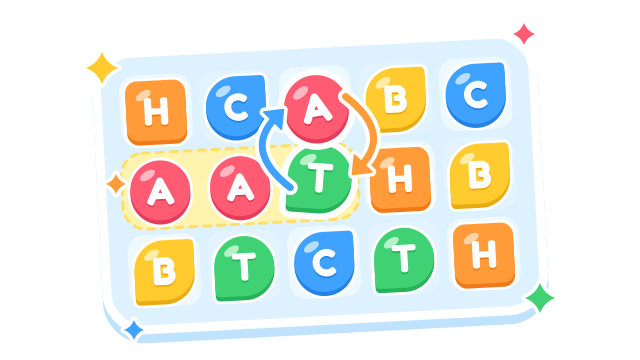
Swap the candy letters to line up 3 in a row and crush them! Every letter you crush fills in a word, like cat, hat and bat. Make rockets, bombs and rainbows, and spell every word before your moves run out.
 314.9K plays
4.9
English Village Builder
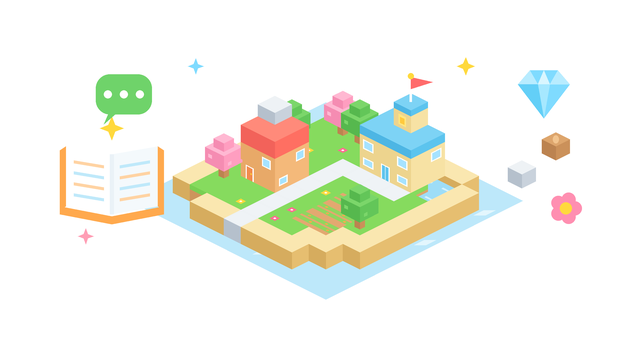
Build a village on a blocky island! Answer vocabulary, spelling, word-meaning and grammar questions to earn wood, stone, flowers and diamonds for every house, road, farm and school.
Comments (53)