
Build a Story
48.4K playsPick your age level, then tap the mixed-up story parts in the order they happen to build a whole story from beginning to end.
Every story you have ever loved was built out of pieces — a beginning, a middle, and an ending, stacked in exactly the right order. But what if somebody shook the box and all those pieces fell out mixed up? That is precisely what happens in Build a Story. A big emoji appears with a story title like 🐶 The Sleepy Puppy, and underneath it sit the parts of that story, jumbled up like socks in a drawer. Your mission is to tap them back into the order they truly happen, filling a numbered story board — 1st, 2nd, 3rd — one part at a time, until a real little story stands up and tells itself from beginning to end. Build a Story is one of the most-loved reading games on KidWorld.org, already played more than 40,000 times and given thousands of five-star ratings by happy young storytellers. There is no timer, no rush, and nothing to be scared of — just 200 tiny stories waiting for someone to put them back together. Shall we build one?
📖 What Is Build a Story?
Build a Story is a story-sequencing game. That is a fancy way of saying: you decide what happens first, what happens next, and what happens last. Every round hands you one short story that has been chopped into parts and shuffled. The parts sit in a card bank at the bottom of the screen, and an empty story board waits above them with a numbered slot for each part. Tap the card you think comes first and it snaps into the 1st slot. Tap the next one, and it slides into the 2nd slot. Keep going until the very last card lands and the whole story reads perfectly, top to bottom.
It is the only game in the KidWorld English family that works at whole-story size. Its cousins are wonderful too — Sentence Builder puts the words inside one sentence in order, Complete the Sentence fills a missing gap, and Grammar Fixer repairs a broken sentence — but Build a Story zooms all the way out and asks the biggest question a reader can ask: what happens next? That single question is the engine behind every book, every movie, and every story you will ever write yourself.
🕹️ How to Play Build a Story on KidWorld
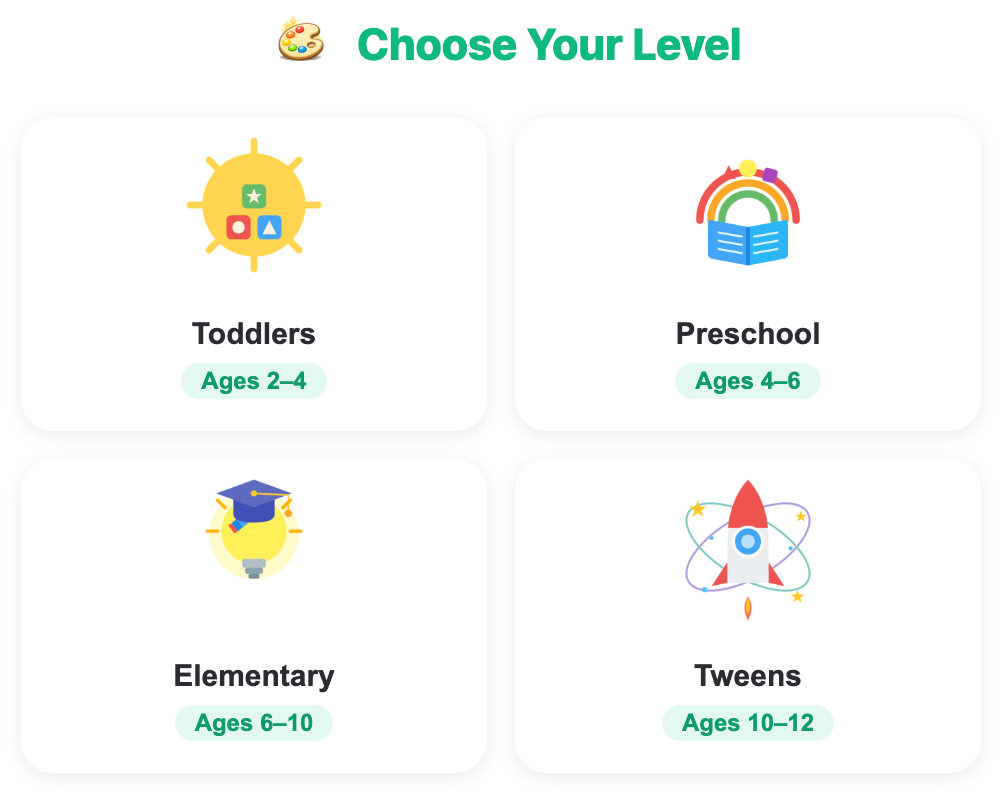
Choose your level first. The game opens with four cards — Toddlers, Preschool, Elementary, and Tweens — each showing its age range. Tap one and your story session begins straight away. KidWorld remembers your pick, so next time you drop right back into the same level, and you can hop out any time with the ⚙️ Change Level button at the top.
Read the story title and the emoji. Every round shows a big emoji and a title, like ⛺ The Camping Trip or 🦷 The Wiggly Tooth. That is your sneak peek at what the whole story is about — read it before you touch anything else.
Read all the parts before you tap. The cards at the bottom are shuffled on purpose, and the game even double-checks that they never accidentally start in the right order. Read every card once. There is no clock ticking, so take all the time you want.
Watch the empty slot ask you a question. The next slot to fill always says "What happens first?" or "What happens next?" — so you always know exactly which piece the story is waiting for. The slots below it show a quiet "…", keeping the future of the story a secret until you get there.
Tap the card you think comes next. Right answer? The card leaps up into its numbered slot with a happy sound and the story grows a line longer. Wrong answer? The card just gives a little red shake and stays where it is. Your story is never wiped out and the round never ends early — you simply try another card.
Tap 💡 Hint when you are truly stuck. The Hint button glows the correct next card for about a second and a half, so you can see the answer instead of guessing. The number in brackets tells you how many hints you have left for that story.
Finish the story, then move on. When the last card lands you will see "Your story is complete!" plus exactly how many points that story earned and why. Tap Next Story to keep going, or See My Score if that was the final one.
Collect your stars. At the end you get your total score, a star rating out of five, and buttons to play again, switch levels, or share your result with a friend.
Three helper buttons live just above the game, too: the fullscreen button makes the story cards big and easy to read, the reload button gives you a brand-new set of stories without leaving the page, and the music note button turns the background music on or off if you would rather read in total quiet.
🔍 The Secret Skill: How to Read a Story's Clues
Here is the best news about Build a Story — you never have to guess. Every single story is packed with clues that tell you exactly where each part belongs. Once you learn to spot them, you will feel like a detective who can read a story's mind. Here are the clues, from the easiest to the sneakiest.
Clue 1: Hunt for the cue words. This is the big one. Story parts wear little signposts at the front called cue words: First, Then, Next, and Finally. They always march in that same order, like steps on a ladder. So the moment you spot the card that starts with "Finally", you already know the ending — nothing can come after it. Spot "Then" and you know it belongs in the middle. Cue words turn a puzzle into a checklist.
Clue 2: The part with no cue word goes first. Look carefully and you will notice one card that has no signpost at all. It just calmly starts the scene: "Ella could not find her favorite teddy bear anywhere." That is your beginning, every single time. Storytellers do not say "First" until there is something to be first after.
Clue 3: Names come before nicknames. Read these two parts: "Noah felt his front tooth wiggle" and "Then he put it under his pillow." Which comes first? The one that says Noah. A story always introduces a person by name before switching to he, she, it, or they. If a card begins with one of those little words, it can almost never be the first card, because the reader would not know who it is talking about yet!
Clue 4: "A" comes before "the." This one is beautifully sneaky. When something appears for the very first time, English calls it a thing — "Mia sees a big red apple." Once we all know about it, it becomes the thing — "Finally Mia eats the sweet apple." So a card saying "a caterpillar" comes before a card saying "the caterpillar." New things get a. Old friends get the.
Clue 5: Follow the cause and the effect. Stories are chains, where each part causes the next one. Sam plays in the mud → so he needs a bath → so he ends up clean. You cannot be clean before the bath, and you would not need a bath without the mud. Ask yourself: could this part have happened without that one? If the answer is no, then that one comes first.
Clue 6: Look for the story shape. Nearly every story in the game follows the same friendly shape — something starts, somebody does something about it, and then something works out. Problem, try, finish. Once you know to look for those three jobs, you can sort the cards into "that's the setup," "that's the middle bit," and "that's the ending" before you even read them closely.
Clue 7: Feelings and changes point forward. Watch for parts where somebody feels nervous, shy, tired, or worried, and other parts where they feel proud, happy, or brave. Feelings usually travel from worried toward wonderful, so the nervous card is nearly always earlier than the proud card.
Clue 8: Time words tell time. Phrases like the night before, all week long, at midnight, the following week, or every Saturday are tiny clocks hidden in the sentences. Put them in clock order and the story sorts itself.
🧠 Smart Tricks for a Higher Score
Knowing the clues makes you a good storyteller. Knowing these tricks makes you a champion.
Build the story backwards in your head. Finding the ending is usually easier than finding the middle, because "Finally" gives it away. Lock the ending in mentally, lock the no-cue-word beginning in too, and suddenly you only have one or two middle cards left to think about. That is a five-card puzzle shrunk down to a two-card puzzle.
Never tap while you are unsure. There is no timer in Build a Story, and that is on purpose — this game measures how well you think, not how fast you read. Reading every card twice costs you exactly zero points. A hurried wrong tap costs you two.
Do the hint maths. A wrong tap costs 2 points, but a hint costs 3. So if only two cards are left and you have a decent feeling about one of them, a guess is the cheaper move — the worst case is a shake and 2 points. But if four cards are left and they all look the same to you, guessing could easily cost 4 or 6 points, and the hint is the smarter bargain. Guess when the odds are good; spend a hint when you are properly lost.
Whisper the story out loud. Read the parts you have already placed, then read the card you are about to tap right after them. If it sounds like a real story so far, it probably is. If it sounds like a hiccup, it is not the one.
Your score can never go below zero. A story that goes badly wrong just earns 0 points for that round — it never eats the points you already won. So on a tricky story, keep trying without any worry at all.
Play the same level twice. Each level holds 50 stories but only serves you 5 or 6 per session, freshly shuffled, so you can play again and again and keep meeting brand-new stories. Tap Play Again and you will almost certainly get a set you have never seen.
⭐ How Points and Stars Work
Each story is worth 10 points. Put a story together with no wrong taps and no hints, and you bank the full 10.
A wrong tap costs 2 points. It never ends the round or undoes your work — it just nudges the price of that story down a little.
A hint costs 3 points. Slightly pricier than one wrong tap, much cheaper than three of them.
A session is 5 or 6 stories. Toddlers play 5 stories for a top score of 50; Preschool, Elementary, and Tweens play 6 for a top score of 60.
Stars are earned by percentage. Score 90% or more of the points available and you get the golden 🏆 five stars. 70% earns four stars, 50% earns three, 25% earns two, and every finished session earns at least one star with a smile — because finishing counts.
So on a 60-point Elementary session, 54 points is trophy territory, 42 is four stars, and 30 is a solid three. Aim for zero hints on the short stories and save them for the long ones.
✨ Real Stories Pulled Straight from the Game
Here is one genuine story from each level, already in its correct order, so you can watch the clues doing their job:
Toddlers — 🦆 Duck Splash (3 parts): "The duck walks to the big pond." → "Then the duck jumps in the water." → "Finally the duck splashes and quacks." See it? The first part has no cue word, and the walking has to come before the jumping.
Preschool — 🐛 The Hungry Caterpillar (3 parts): "A tiny caterpillar hatched on a green leaf." → "Then it ate leaves all week long and grew fat." → "Finally it wrapped itself up in a cozy cocoon." Three clues at once here: "a" for a brand-new caterpillar, then "it" once we know who we mean, plus the cue words Then and Finally.
Elementary — 🥕 The Garden Patch (4 parts): "Nia begged her grandmother for a corner of the garden." → "First they turned over the soil and pulled out every weed." → "Then Nia planted rows of carrot seeds and watered them each morning." → "Finally she pulled up a bright orange carrot for the dinner salad." A perfect cause-and-effect chain — no soil, no seeds; no seeds, no carrot.
Tweens — 💻 The Coding Club (5 parts): "Riya noticed her school had a chess club and a choir but nothing for coders." → "First she wrote a proposal and handed it to the principal." → "Then only two students showed up to the very first meeting." → "Next the three of them built a simple game and demoed it at lunch." → "Finally twenty-five students crowded into the room the following week." Watch the numbers climb: two students, then three, then twenty-five. Numbers are a clue too!
🎯 Warm-Up Challenge: Try One Right Now
Before you open the real game, put these three parts in order in your head. They are shuffled, exactly the way Build a Story would show them:
"Finally the seed grew into a tall green plant." / "Ben plants a small seed in a pot." / "Then Ben waters it every single day."
Ready? Here is how a champion solves it: "Finally" is obviously the ending, so park it at the bottom. "Then" belongs in the middle. And the part with no cue word — "Ben plants a small seed" — must be the beginning. Answer: plants the seed → waters it every day → the plant grows tall. If you got that, you are officially ready to play.
🌱 Why Build a Story Is So Good for Kids
Tapping story cards feels like pure fun, but something rather brilliant is going on underneath:
It teaches the shape of every story ever told. Beginning, middle, end. Once that shape lives inside a child's head, it helps them retell their day at dinner, understand a chapter book, follow instructions in order, and — one day — write stories of their very own.
It is reading practice disguised as a puzzle. To solve a round you must actually read every sentence and understand it. That is real reading comprehension, but it never once feels like a reading test.
No timer means no reading anxiety. Slower readers are not punished here, not even a little. Build a Story deliberately has no countdown, because it wants to measure thinking, not speed — which makes it especially kind for children who are still gaining confidence with words.
Mistakes are gentle. A wrong tap gives a soft red shake and nothing else. Your story stays exactly where it was, the round carries on, and the score can never fall below zero. Kids learn fastest when trying is safe.
It quietly teaches grown-up grammar. Without ever using scary words, children absorb how transition words work, how pronouns refer back to names, and how "a" turns into "the" — the exact tools teachers ask for in writing lessons later on.
It builds patience and planning. Reading everything before acting, and deciding when to spend a hint, are small thinking habits that quietly help with homework, board games, and puzzles of every kind.
The stories are worth reading. They are about lost teddies, rescued owls, spelling bees, salty birthday cakes, and buried time capsules — little slices of real childhood, so kids finish a round genuinely wanting to know how the next one turns out.
🎮 Build a Story for Every Age
The tapping, the numbered slots and the happy ding stay exactly the same at every level — only the stories grow up alongside the reader. This is why the same Build a Story game for kid players can stay fun for years:
Build a Story for toddlers (ages 2–4): 3 short, cozy parts per story, 5 stories a session, and a generous 3 hints for every story. Sentences are tiny — "The little puppy plays with a red ball." — so this level is perfect to play snuggled up with a grown-up reading the cards aloud together. The magic here is simply hearing that a story has an order at all.
Build a Story for preschool (ages 4–6): still 3 parts, still 3 hints, but 6 stories a session and noticeably richer sentences with real feelings in them — a wiggly tooth, a lost teddy, a first day of school. It is the ideal level for a child who is beginning to read a little on their own and loves being asked "and then what happened?"
Build a Story for elementary (ages 6–10): stories stretch to 4 parts and hints drop to 2, so the full First → Then → Finally cue-word ladder appears and there is real thinking to do in the middle. Topics grow up too — camping trips, science fairs, spelling bees, garden patches — making this level a lovely match for classroom reading comprehension practice.
Build a Story for tweens (ages 10–12): the biggest challenge, with 5 parts per story, only 2 hints, and the whole First → Then → Next → Finally ladder in play. The stories become genuinely thoughtful — a coding club that almost failed, a debate you lose but learn from, a birthday cake made with salt instead of sugar — with longer sentences and richer vocabulary that quietly sharpen the essay and story-writing skills tweens need at school.
From a toddler's three-line tale about a very sleepy puppy to a tween's five-part story about a rescued owl learning to fly again, Build a Story turns the oldest idea in the world — and then what happened? — into a game kids actually beg to play. Pick your level, read your cards, hunt for that "Finally," and start building. Your next story is only a few taps away. 📚✨
🖼️ See the Game in Action
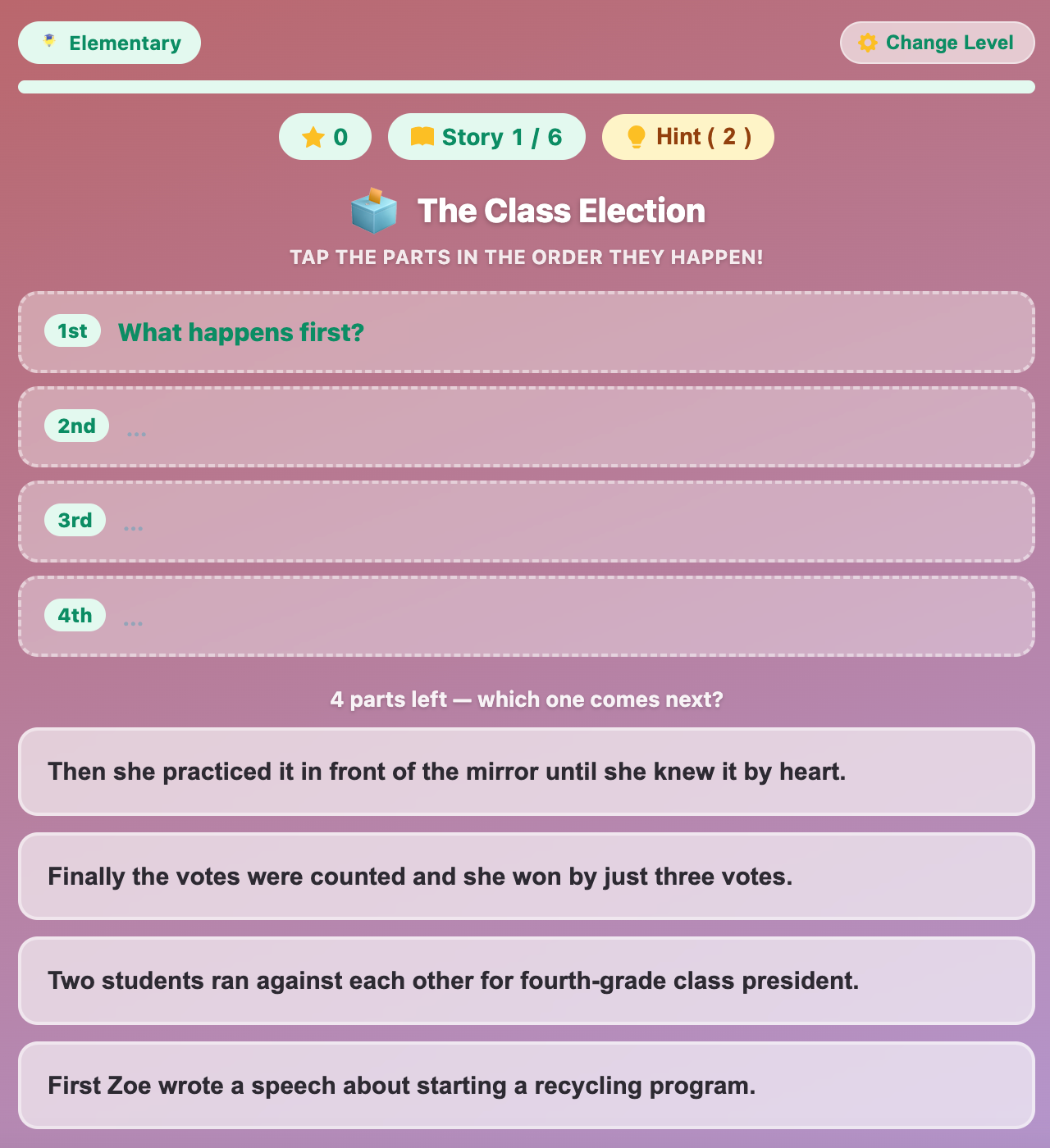
A screenshot when start a new Build a Story game for elementary
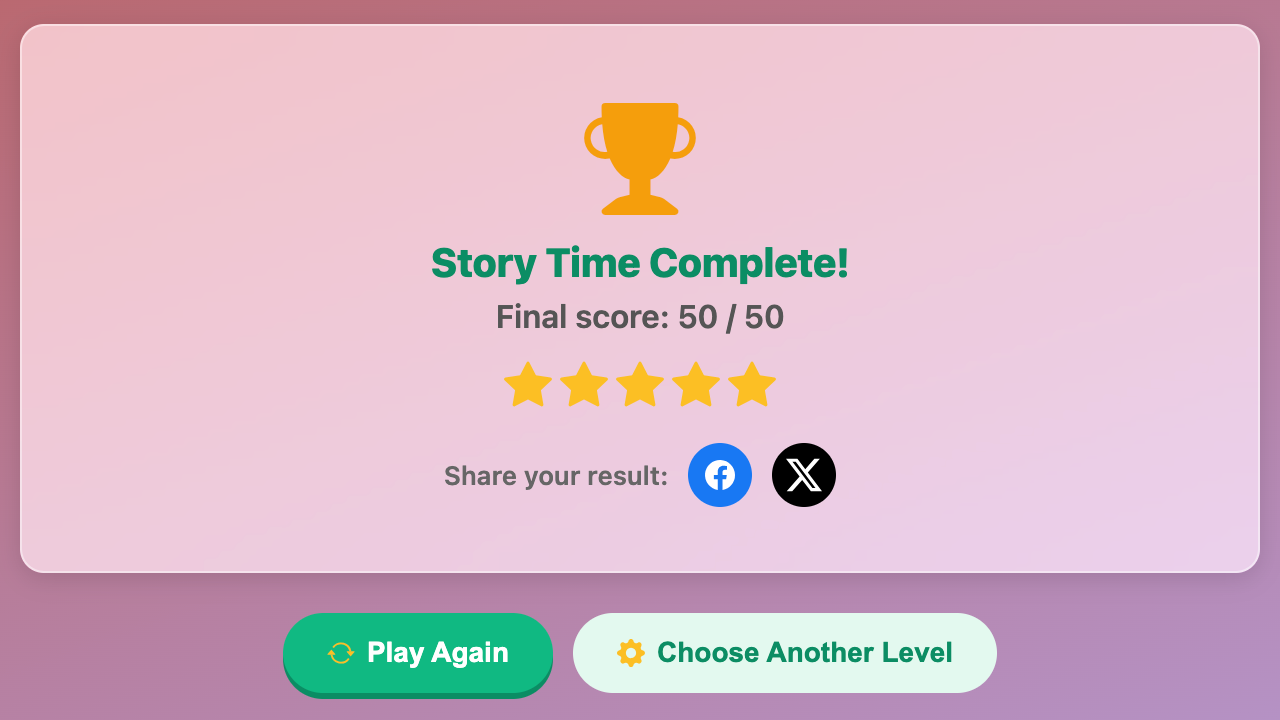
A screenshot when complete a Build a Story game
More English Games
 435.5K plays
4.9
435.5K plays
4.9
Sight Word Pop
Read the target word and pop the matching bubble before the timer runs out.
 2.1M plays
5.0
2.1M plays
5.0
Word Search
Find all the hidden words in the letter grid before time runs out.
 273.7K plays
4.9
273.7K plays
4.9
Sentence Builder
Pick your age level, then tap the shuffled words in the right order to build the sentence.
 235.4K plays
5.0
235.4K plays
5.0
Alphabet Pop
Pop the bubble with the letter that a picture and word starts with.
Most Played Games
 1.8M plays
5.0
1.8M plays
5.0
Color & Draw
A free-drawing canvas with colors and brush sizes to unleash your creativity.
 365.3K plays
4.9
365.3K plays
4.9
Tic-Tac-Toe
Play a game of Tic-Tac-Toe against the computer and see if you can outsmart it.
 1.1M plays
4.9
1.1M plays
4.9
Chess
Play the classic game of chess against the computer or a friend, with FIDE time controls, hints, and undo.
 154.5K plays
4.9
154.5K plays
4.9
Mood Palette
Decide which color best fits a mood or theme before time runs out.
Comments (25)