
Story Sequencing
85.8K playsPick your age level, then drag or tap the mixed-up picture cards into the order the story happens and check your answer.
Imagine somebody wrote a lovely little story, cut it into picture cards, and then dropped the whole pile down the stairs. The cards land in a muddle. The ending is sitting at the top. The beginning is hiding near the bottom. That mixed-up pile is exactly what waits for you in Story Sequencing, one of the most-played reading games on KidWorld. Down the left side of the screen you will see quiet little numbers — 1, 2, 3 — standing in a straight line like buckets waiting to be filled. Your job is to slide each picture card into the bucket where it truly belongs, until the muddle turns back into a real story that makes sense from top to bottom. Players have already put these cards in order more than 80,000 times, and Story Sequencing has collected thousands of five-star ratings from happy young readers. There is no clock, nothing to be scared of, and 200 tiny stories waiting inside. Ready to fix your first muddle?
🗂️ What Is Story Sequencing?
Story Sequencing is a game about order. Not tidy-your-room order — story order. It asks you one big question: what happened first, what happened after that, and what happened right at the end?
Every round gives you one short story. The story has been chopped into scene cards, and every card has two things on it: a picture (a big emoji) and a short sentence. The cards are shuffled and dropped into the numbered column all at once. Nothing is hidden. You can see the whole story straight away — you just cannot see it in the right order yet.
That is what makes this Story Sequencing game for kids different from its cousins on KidWorld. In Build a Story, the game hands you one slot at a time and checks every single tap. Here, the whole story is spread out in front of you and nobody checks anything until you say so. You are allowed to move cards around as much as you like, change your mind, move them back, and only press the button when you feel sure. It is less like answering questions and more like laying out photographs on a table until the day makes sense again.
🕹️ How to Play Story Sequencing on KidWorld
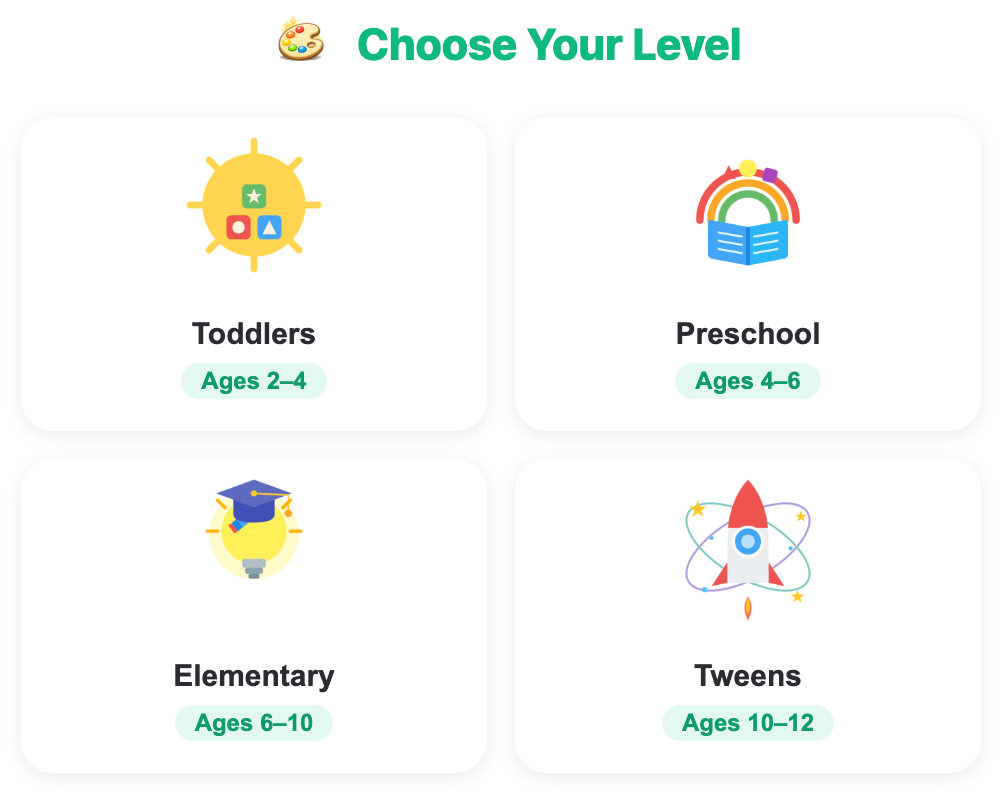
Pick your age level. The game opens with four cards: Toddlers, Preschool, Elementary, and Tweens. Tap the one that fits you and your stories begin right away. KidWorld remembers your choice for next time, and you can swap whenever you like with the ⚙️ Change Level button at the top.
Read the title first. Above the cards sits a big emoji and a story title, like 🌱 The Tiny Seed or 🎭 The Understudy. That title is a free clue. It tells you what the story is about before you read a single card.
Read every card, top to bottom. Do not touch anything yet! Just read. The cards were shuffled on purpose, and the game even double-checks that they never start out already solved by accident. So the order you see at the beginning is always wrong somewhere.
Move a card by dragging it. Press a card, hold on, and slide it up or down the column. A little copy of the card follows your finger. Let go on the row where you want it to live.
Or move a card by tapping twice. Tap a card once and it lights up with a green glow — that means "this one is picked". Now tap the row where it should go, and it hops there. Tap the same card a second time instead, and it just puts itself down again. Two taps, no dragging. This is the easy way on a phone or tablet.
Watch the other cards shuffle along. When you drop a card into row 1, the card that was already there does not vanish or swap places with yours. It politely shuffles down to make room, and so does everybody below it. Your card is squeezed in, not swapped. That is worth remembering, because it means moving one card gently pushes all the others.
Press ✅ Check Order when you are happy. The game now looks at every row. Cards sitting in the right place turn green and lock themselves down forever. Cards in the wrong place give a little red shake and stay where they are, still ready to be moved.
Keep fixing and checking until every card is green. A message under the button keeps count for you, saying something like "4 of 6 cards are in the right place." When the last card locks, your story is finished and you move on to the next one.
Three small buttons sit in the bar just above the play area, and each one earns its place in this game. The fullscreen button pushes the rest of the page out of the way so the numbered column fills your whole display — a real help on a phone, because taller rows make bigger targets and you are far less likely to drop a card on the wrong number. The reload button deals you a completely fresh set of stories at whatever level you are already on. It is cleverer than it looks: the page itself never refreshes, so if you are playing in fullscreen you simply stay there. One warning, though — reload begins a brand-new session, and your points only count once you finish the last story of a session. If you are three stories in, finish the run before you press it. The speaker button is your quiet switch, and in Story Sequencing it turns off everything you can hear at once: the soft background music, the friendly sound each time a card slides into a new row, and the little buzz when a check does not work out. KidWorld remembers your choice, so if you like playing in silence it will still be silent tomorrow.
🔢 The Numbers Stay Still — Only the Cards Move
This is the part that trips up brand-new players, so it is worth saying slowly.
The numbers down the left side — 1, 2, 3, 4 — are not part of the cards. They belong to the rows. They never move, never shuffle, and never come with you when you drag. Number 1 always means "the very first thing that happened", right up until the round ends.
So if you drag a card away from row 1, the number 1 stays exactly where it is, quietly waiting for a different card to move in. When you pick a card up, watch closely: the card lifts off and follows your finger, but the little number stays behind on the board. That is the game telling you something important — a number is a job, not a name tag. Row 3 is a job called "third". Any card can take that job. The card just has to be the right one.
There is a lovely bonus, too. When a card locks into place, its number turns solid green as well. So the column of numbers slowly fills up with green from the top, and you can tell how much of the story you have solved just by glancing at the left edge — without reading a single word.
🕵️ The Big Secret: There Are No "Then" and "Finally" Words
Here is the thing that makes Story Sequencing much cleverer than it looks, and it is hidden right inside the stories.
In lots of reading games, the sentences quietly help you by starting with words like Then, Next, and Finally. Those little words are like signposts. If a sentence starts with "Finally", you barely have to think — you already know it goes last.
Story Sequencing has none of those words. Not one. Every single caption in all 200 stories was written so that it never begins with Then, Next, Finally, First, Later, or Lastly. The signposts have all been taken away on purpose.
So how do you find the order? You have to look at what actually happens. You have to notice that a seed must go into the soil before a plant can pop out of it. That snow must fall before anybody can roll a snowball. That a bridge must be built before it can collapse, and it must collapse before anybody rebuilds it stronger.
That kind of thinking has a name: cause and effect. One thing makes the next thing possible. Once you start hunting for cause and effect, you are not really playing a game any more — you are doing what every reader, every scientist, and every detective does. And that is the real prize hiding inside this game.
🧠 Clue Hunting: Six Ways to Find the Right Order
Find the ending first, not the beginning. This surprises people! Endings are usually the easiest card to spot, because they feel finished. Somebody is happy, or clean, or asleep, or holding a trophy. Drop that card into the bottom row straight away and you have one job done.
Then hunt for the card that needs nothing. The first card is the one that could happen even if none of the others existed. Nobody has done anything yet. Something is just… starting. A seed, a cloud, a wish, an empty box.
Use the "could this happen yet?" test. Pick any two cards and ask: could card B happen if card A had never happened? If the answer is no, then A comes first. Try it on these two: "The tooth came out in his hand" and "He put it under his pillow." You cannot put a tooth under a pillow before it comes out. Solved.
Follow things as they change. Stories love to change things. Dirty turns clean. Empty turns full. Broken turns fixed. Small turns big. If two cards show the same object at different stages, the messier or smaller one almost always comes first.
Read the pictures on their own. Cover the words with your hand and look only at the emoji going down the column. 🌨️ then ⚪ then ⛄ tells the whole snowman story with no reading at all. This trick is brilliant for younger players, and it is why every scene in the game has its own picture.
Watch for problems and fixes. Longer stories usually follow a shape: somebody wants something, they try, something goes wrong, they fix it, and it works. The "something goes wrong" card almost never goes first or last — it hides in the middle. Spot it and you have found the heart of the story.
⭐ How Points, Checks, and Hints Really Work
Every story is worth 10 points if you get it perfect. Two things can take points away, and knowing the difference is the biggest scoring secret in the whole game.
A wrong Check Order costs 2 points. That is when you press the button but not every card is home yet.
A 💡 Hint costs 3 points. A hint takes the card that belongs in your highest empty row, puts it there for you, and locks it green.
Your score can never go below zero. Not ever. Even on a very wobbly round, the worst you can do is 0. Nothing you do can make your total go backwards, so there is never a reason to feel worried.
Now here is the clever bit. A hint costs more than a check (3 against 2), and a hint only ever fixes one card. But a check can lock lots of cards at once! If you have four cards right and two wrong, one check costs you 2 points and locks all four correct ones in green forever.
So the smart plan is: think hard, then check. A check is cheaper and can do far more work. Save hints for the moment when you truly cannot tell two cards apart and you are just guessing — because a hint is the only move that is guaranteed to make progress, while a check does nothing at all if none of your cards happen to be right.
Two more freebies worth knowing:
The last card is always free. If every other row is locked green, the one leftover card can only belong in the one leftover row. The game knows this and locks it for you automatically. You never have to spend a check to prove the obvious.
Two cards left and both wrong? Just swap them. There is nowhere else for them to go. Move one onto the other, check, and the round is done.
At the end of a session you earn stars: five stars for a brilliant round, then four, three, two, and a friendly smiley face for finishing at all. Every point also turns into KidWorld stars for your account, so your story reading builds up your streak and your badges too.
✨ Real Stories Straight from the Game
Here are four real stories from Story Sequencing, shown in their correct order. Read them and see if you can feel why each card has to sit where it does.
🌱 The Tiny Seed — a Toddlers story, 3 cards:
🫘 Nina puts a seed in the dirt.
💧 Nina waters the dirt every day.
🌱 A little green plant pops up.
No seed means nothing to water. No water means nothing grows. Each card unlocks the next one.
🧚 The Tooth Fairy — a Preschool story, 4 cards:
🦷 Emil's tooth fell out at dinner.
📦 He put it in a tiny box.
🛏️ He slid the box under his pillow.
🪙 A shiny coin was there at sunrise.
Notice there is no box to hide until the tooth falls out, and no coin until the box is hidden. Notice also the word sunrise in the last card — a quiet time clue telling you that the night has passed.
🌉 The Model Bridge — an Elementary story, 5 cards:
📚 The class studied how bridges carry weight.
🥢 Tia glued hundreds of craft sticks into a frame.
⚖️ Her first bridge collapsed under six textbooks.
🔺 She added triangles beneath the deck for strength.
🏆 The rebuilt bridge held twenty books.
Here is that story shape again: learn, build, it breaks, fix, succeed. Look for the word first inside "her first bridge" and the word rebuilt in the last card. Those two words tell you the order all by themselves.
🦾 The Robot Arm — a Tweens story, 6 cards:
🦾 Lena wanted a robot arm that could sort screws.
🖨️ She printed the joints over eleven hours.
⚙️ The servos jittered whenever the arm extended fully.
🔋 A separate power supply steadied them completely.
👁️ She added a camera and a simple color check.
📦 The arm sorted a whole jar without a mistake.
Six cards is the biggest puzzle in the game. The trick is still the same: the wanting comes before the building, the wobble comes before the fix, and the arm cannot do its job until everything else is done.
🎯 Try One Right Now: A Mixed-Up Challenge
Here is a real Preschool story, all jumbled up. Can you number these four cards 1 to 4 in your head before you scroll on?
🎉 Rosa rode the whole path alone.
🚲 Dad took the training wheels off.
😮 He let go without telling her.
🤲 He held the seat while Rosa pedaled.
Work it out with the "could this happen yet?" test. Could Dad let go of the seat before he was holding it? No. Could he hold the seat before the training wheels came off? Not really — that is the whole reason he needs to hold on.
The correct order is: 🚲 the training wheels come off, 🤲 Dad holds the seat, 😮 Dad lets go, 🎉 Rosa rides alone. If you got it, you have just done exactly what the game asks — and you did it with no signpost words at all.
🏆 Smart Habits That Push Your Score Higher
Read all the cards twice before you move anything. There is no timer in Story Sequencing at all. None. Nobody is counting your seconds, so reading slowly is completely free.
Place the cards you are sure about first. Get the beginning and the ending settled. The muddle in the middle is always smaller once the two ends are decided.
Do not check to "test" an idea. Every wrong check costs 2 points. Move all the cards you want — moving is completely free — and only press the button when the whole column reads like a real story.
Say the story out loud. Read your column top to bottom in your normal voice. Your ears will catch a wrong card much faster than your eyes will. If a sentence makes you go "wait, that's odd" — that is the card to move.
After a check, only think about the shaking cards. The green ones are finished and cannot move again. That means a 6-card puzzle can suddenly become a 2-card puzzle, and 2-card puzzles are easy.
Try a level up when you are winning easily. More cards means more points to earn, and the stories get more interesting as they get longer.
🌱 Why Story Sequencing Is So Good for Kids
Putting cards in order looks like a simple little game. It is really one of the most useful thinking skills a child can build, and here is why.
It builds real reading comprehension. Anyone can read words out loud. Understanding how a story fits together is the harder, deeper skill — and it is the one that decides whether a child truly understands the books they read.
It teaches cause and effect. Because there are no Then and Finally signposts, players must work out why one thing leads to another. That is the same thinking used in science, in maths word problems, and in figuring out why the biscuit tin is empty.
It grows working memory. Holding six scenes in your head at once and comparing them is proper brain exercise — and unlike Build a Story, this game never lets you take them one at a time.
It helps children write their own stories. A child who has rebuilt 50 stories starts to feel the shape of one: a beginning, a problem, a try, a fix, an ending. That shape shows up in their own writing later.
Mistakes are gentle here. A wrong card does not end the round, does not delete your work, and does not make a scary noise. It shakes politely and waits. Children experiment more bravely when being wrong is safe.
Pre-readers can join in. Every scene has its own picture, so a child who cannot read yet can still sequence a story from the emoji alone. That is a rare and lovely thing in a reading game.
There is no time pressure. Slower readers are never punished for being slow. The game measures how well you think, not how fast you read.
🎮 Story Sequencing for Every Age
The same game grows with the player. Each level has 50 different stories written just for that age, so nobody ever gets somebody else's puzzles.
Story Sequencing game for toddlers (ages 2–4) — 3 cards per story and 5 stories per session. The sentences are tiny and happy: a puppy, a bath, a balloon, a snowman. Toddlers get plenty of help, with 3 hints ready for every story. Perfect for playing together on a lap, pointing at the pictures and saying "what happened next?"
Story Sequencing game for preschool (ages 4–6) — 4 cards per story and 6 stories per session, still with 3 hints each. The stories become small adventures: a lost teddy, a first bike ride, a wobbly tooth. Four cards is the perfect step up, because it adds a proper middle to the story instead of just a beginning and an end.
Story Sequencing game for elementary (ages 6–10) — 5 cards per story, 6 stories per session, and 2 hints each. Now the stories have goals, setbacks, and real endings: a model bridge that collapses, a marble run that keeps failing, a class turtle who needs looking after. This is where cause-and-effect thinking really switches on.
Story Sequencing game for tweens (ages 10–12) — 6 cards per story, 6 stories per session, and 2 hints each. The longest and richest stories in the game, with genuine obstacles and satisfying endings: an understudy who gets her chance, a flooded basement, a robot arm that finally works. Six cards means 720 possible orders — and only one of them is right.
Whether you are three years old and putting a snowman together, or twelve and untangling six scenes of a science project, Story Sequencing on KidWorld is asking you the same brilliant question that every book on your shelf is asking: and what happened next? Pick a level, read your cards, slide them into place, and press Check. There are 200 muddled-up stories in there, and every single one of them is waiting for you to put it right. 🗂️✨
🖼️ See the Game in Action
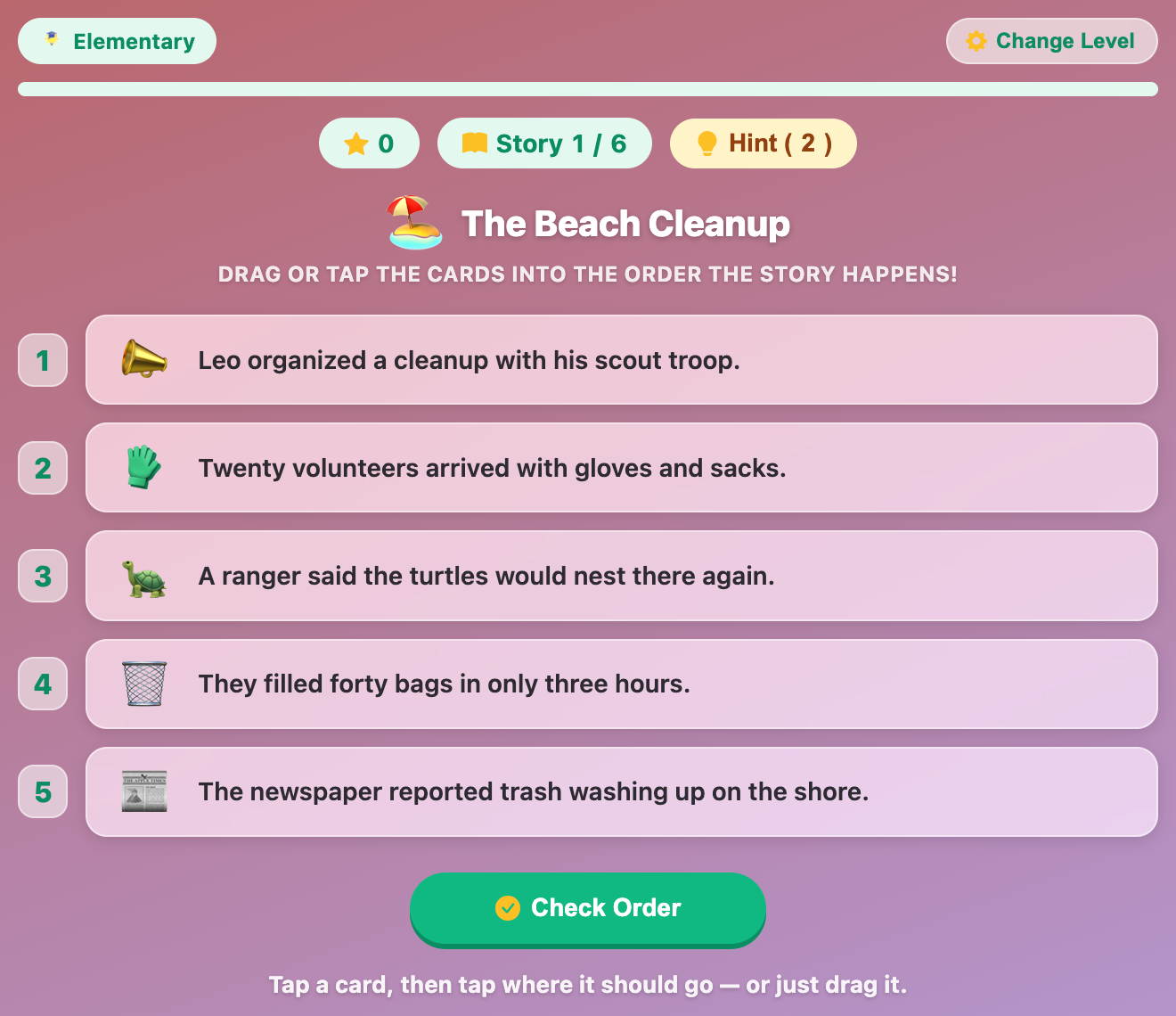
A screenshot when start a new Story Sequencing game for elementary
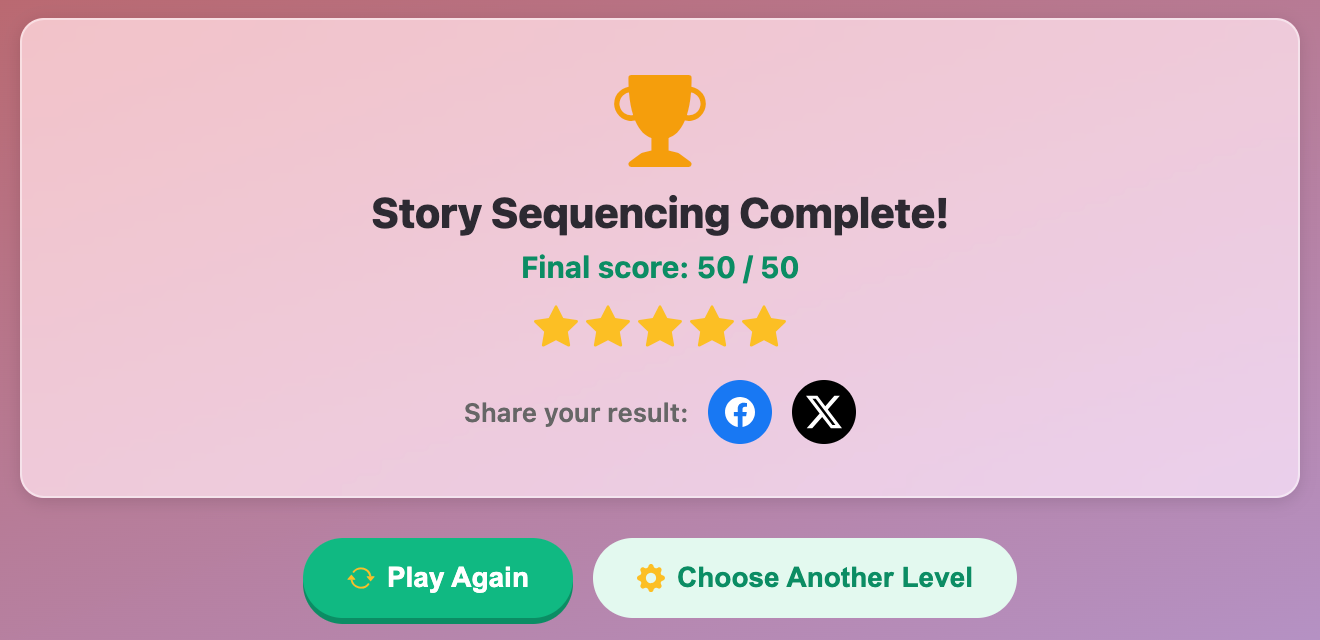
A screenshot when complete a Story Sequencing game
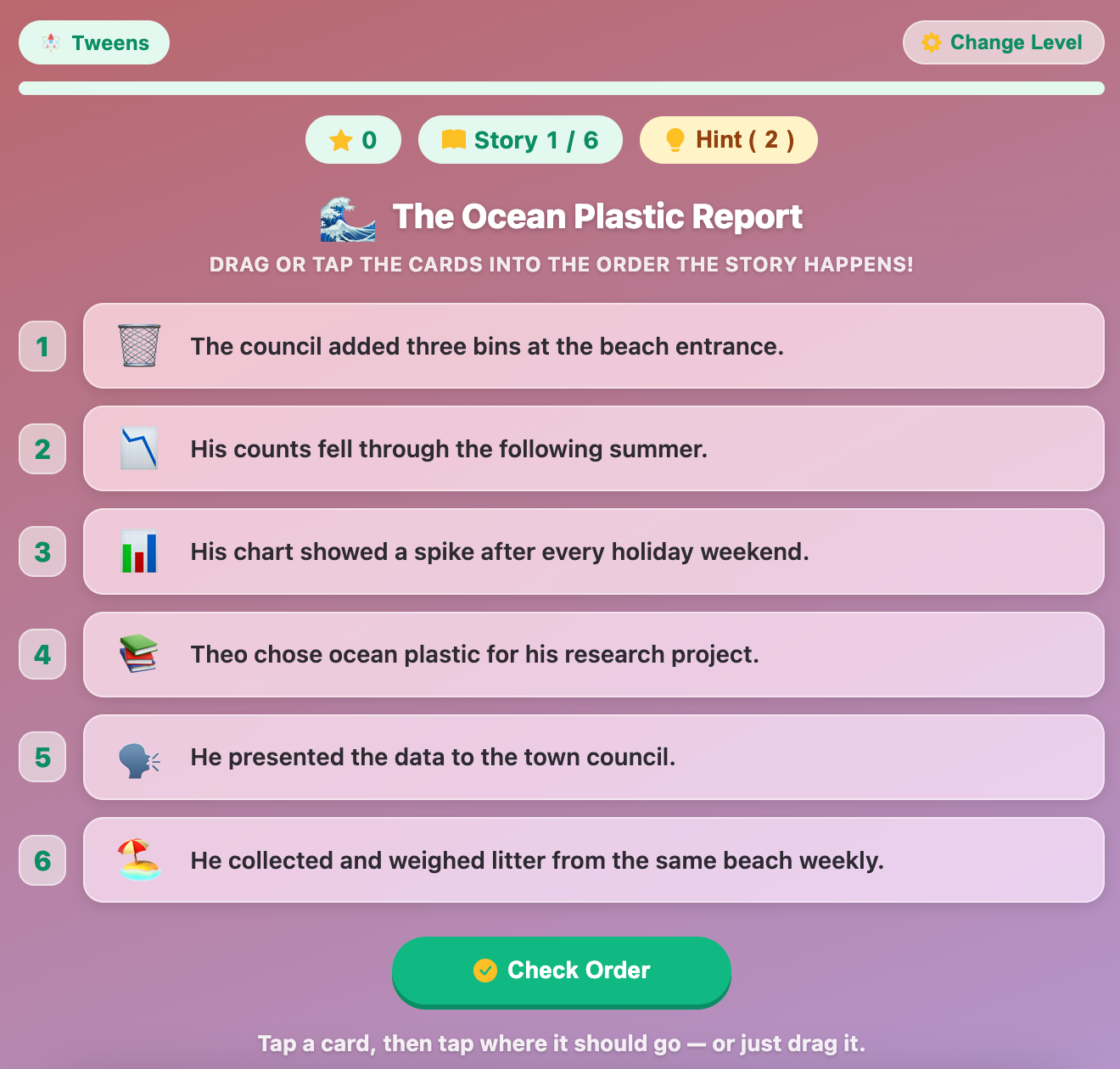
A screenshot when start a new Story Sequencing game for tweens
More English Games
 435.5K plays
4.9
435.5K plays
4.9
Sight Word Pop
Read the target word and pop the matching bubble before the timer runs out.
 2.1M plays
5.0
2.1M plays
5.0
Word Search
Find all the hidden words in the letter grid before time runs out.
 235.4K plays
5.0
235.4K plays
5.0
Alphabet Pop
Pop the bubble with the letter that a picture and word starts with.
 273.7K plays
4.9
273.7K plays
4.9
Sentence Builder
Pick your age level, then tap the shuffled words in the right order to build the sentence.
Most Played Games
 1.8M plays
5.0
1.8M plays
5.0
Color & Draw
A free-drawing canvas with colors and brush sizes to unleash your creativity.
 1.1M plays
4.9
1.1M plays
4.9
Chess
Play the classic game of chess against the computer or a friend, with FIDE time controls, hints, and undo.
 365.3K plays
4.9
365.3K plays
4.9
Tic-Tac-Toe
Play a game of Tic-Tac-Toe against the computer and see if you can outsmart it.
 154.5K plays
4.9
154.5K plays
4.9
Mood Palette
Decide which color best fits a mood or theme before time runs out.
Comments (32)