Color Connect
736.4K playsJoin the colors! Drag a path from each dot to the dot of the same color, but paths can't cross or share a square, and on most boards every square has to be filled. Little players help animals reach what they want, like a bunny to its carrot. Paths can be redrawn any time, a hint shows a whole path, and every game brings a brand-new board.
Can you join every pair of colors without a single crossing? Color Connect for kids is a free path-drawing puzzle where you drag a line from each colored dot to the dot of the same color. Paths can't cross or share a square, and on most boards every square has to be filled. It works for ages 2 to 12, and you play it right in your browser on a computer, tablet or phone, with nothing to download and no sign-up.
The youngest players don't see plain dots at all. They see a ladybug 🐞 that wants its rose 🌹, a monkey 🐵 looking for its banana 🍌 and a bunny 🐰 hopping to its carrot 🥕. Older kids get boards packed with up to twelve colors, where one wrong turn can leave a lonely empty square. Every puzzle is brand new, so the next board is always one you've never seen.
🌈 Two Dots, One Path, No Crossing
The idea fits in one breath. Every color has two dots. Draw a path that joins them. A path moves from square to square, up, down, left or right, never slanting across a corner.
There are only three rules to remember:
Join every pair. Each color's two dots must be linked by one path.
No crossing, no sharing. Two paths can never use the same square.
Fill the board. From the Preschool level up, every single square must end up on a path. On the Toddlers level, empty squares are OK.
Path-joining puzzles like this have been around for a long time. A well-known version from Japan, called Numberlink, joins matching numbers instead of colors. Color Connect for kids is the KidWorld take on it, with animals for little hands, a hint that always knows the way, and a fresh board every single time.
Here's a nice thing to know: on every board that must be filled, the game only keeps boards with exactly one answer. It checks this before you ever see the board. So when a board looks hard, it isn't a trick. There is always one clear way to solve it, and careful thinking will find it.
🖐️ Drawing Your First Path on KidWorld
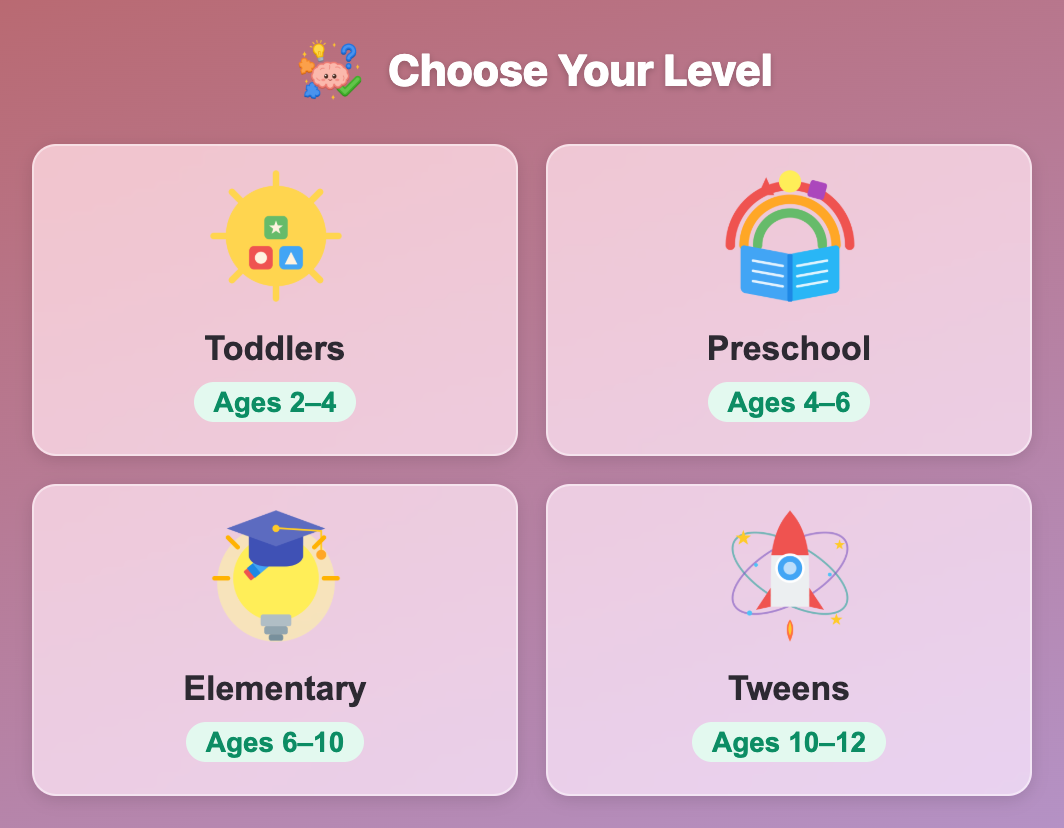
Pick your level. The Choose Your Level screen shows four cards: Toddlers (ages 2–4), Preschool (ages 4–6), Elementary (ages 6–10) and Tweens (ages 10–12). The game remembers your choice, so next time it jumps straight to a board. You can switch any time with the Change Level button above the board.
Read the top row. Little pills show how many pairs are joined (like 3 / 7), how many moves you've made, and a timer. On fill levels, one more pill shows how much of the board is filled, like 84%. The timer only starts when you first touch the board, and there's no time limit.
Press a dot and drag. Put your finger (or mouse) on a dot and slide to its partner. The path follows you, one square at a time. When it reaches the partner dot, both dots get a white ring, the squares under the path turn a brighter shade of its color, and (with the sound on) you hear a little click.
Back up by dragging back. Slide back over your own path and it gets shorter. Once a path reaches its partner, it stops growing, so it can't run past the dot by mistake.
Change a path any time. Press any square of a path to pick it up from there; the rest of it is cut away. Press one of its dots to start that color over from scratch. A quick tap on a dot clears that path.
Watch what happens when paths bump. Other colors' dots stop your path like a wall. But if you drag over another color's path, that path gets cut short where you crossed it. Change your mind before you lift your finger, and the cut path pops right back.
Tap instead of drag, if you like. After you start a path, you can tap one empty square next to its loose end, then the next, then the next, until you tap the partner dot. This is great for small hands that find dragging tricky.
Use the buttons under the board. Undo takes back your last drag, hint or Clear, one at a time. Clear empties the whole board. Hint shows how many hints you have left (3 per board).
Listen to the tips. A line under the board cheers you on, like “The red dots are joined! 3 pairs to go.” or “Yay! The bunny reached its carrot!” Press the 🔊 button next to it, or the one in the How to play box, and the game reads it out loud.
Finish the board. When every pair is joined (and every square is filled, on fill levels), the paths light up and you see the Color Connect Solved! card. It shows your score out of 100, your time, the board size, your moves, your hints and up to five ⭐ stars. Press New Puzzle for a fresh board, or Choose Another Level.
Use the page buttons. Around the game you'll find buttons to play fullscreen, reload the game, and turn the music on or off.
💡 Hints, Moves and Your Score
Every board gives you 3 hints. A hint never just points; it draws a whole path for you, and that path and its dots glow for a moment so you can see what changed.
If one of your paths is going the wrong way, the hint fixes that one first: “The red path went the wrong way. Here is where it really goes!”
If all your paths are fine so far, the hint draws the whole path of the unfinished color that still needs the most squares: “Here is the whole blue path!”
On the Toddlers level, the hint finds a short, free way for an animal to reach its picture.
Your score starts at 100. Two things take points away: hints and extra moves. A move is a drag of a new color. If you draw red and then fix red again right away, that's still one move. But if you draw red, then blue, then go back to red, that's three moves. A perfect game uses one move per color, and the finish card shows a special “Perfect: one move per color!” badge when you also used no hints.
Here is what each slip costs:
Toddlers: 8 points per hint. Extra moves are free.
Preschool: 8 points per hint and 1 point per extra move.
Elementary: 10 points per hint and 2 points per extra move.
Tweens: 12 points per hint and 2 points per extra move.
Extra moves can never take away more than 40 points, and a finished board always scores at least 10. A score of 90 or more earns all five stars. Time doesn't change your score at all, so there's never a reason to rush.
🧠 Color Connect for Kids: Smart Ways to Fill the Board
Drawing paths is easy. Drawing the right paths, so nothing is left empty, takes some clever looking. These tips start simple and get smarter as you go.
1. Start with the pairs that are close together
Two dots that sit near each other have only a few ways to join. Two dots on opposite sides of the board have hundreds. So join the close pairs first. Each short path you lock in becomes a wall that makes the long paths easier to figure out.
2. Let the walls guide you
The edge of the board is a wall that no path can cross. When a color has both dots near the same edge, its path often hugs that edge. Paths along the outside also stay out of everyone else's way, which leaves more room in the middle.
3. Every empty corner is a bend
A corner square only has two neighbors: one to the side and one above or below. If no dot sits in that corner, a path must come in through one neighbor and leave through the other. So the path there always makes an L-turn. Ask yourself, “Which color can reach both of those squares?” Often only one can.
4. Hunt for lonely squares
A square in the middle of a path needs a way in and a way out. If an empty square is boxed in on three sides by walls, dots or other paths, no path can pass through it. That means one of the paths around it is wrong. Fix the problem right away, before you draw more paths on top of a mistake.
5. Never wall in a dot
Before you finish a long path, check that it doesn't build a fence between another color's two dots. If a dot gets trapped in a little pocket and its partner is outside, that pair can never join. Look at the whole board, not just the path under your finger.
6. No hairpins on fill boards
On KidWorld's fill boards, the answer never has a path that folds back to run right next to itself, like a hairpin. If your green path goes three squares right, steps down one, and comes back three squares left just under itself, that can't be the answer. Some of those squares belong to another color. Pick the path up at the bend and look for the nearby color that needs that room.
7. Use the counters as clues
The filled pill tells you how close you are. If every pair is joined but the board isn't full, the tip says something like, “Every pair is joined, but 3 squares are still empty. Bend the paths to fill them!” Find the empty squares, then look at the paths around them. Usually one of those paths took a shortcut, and its real route runs through the empty squares.
8. Finish one color before switching
Because a move counts each time you switch colors, it pays to think first and draw second. Trace a path in your head, then draw it in one go. If you need to fix it, do it right away, while it's still the color you just drew.
9. Make every hint teach you something
When a hint draws a path, don't just keep going. Look at where it went and ask, “Why there?” Most of the time you'll spot a corner or a wall rule you missed. That makes the next board easier, without needing a hint.
Once these tricks feel easy, try Fence the Sheep. There you draw one big fence around a field, and a number in a square tells you how many of its four sides get a fence. It uses the same “what must go here?” kind of thinking.
🔍 Five Little Boards, Solved Step by Step
Board 1: The ladybug, the monkey and the turtle (Toddlers)
This is a 4 by 4 Toddlers board. The ladybug 🐞 sits in the top-right corner and its rose 🌹 is in the bottom-left corner. In the middle, the lettuce 🥬 is in the second row on the left, the banana 🍌 is in the second row on the right, and the monkey 🐵 and the turtle 🐢 sit side by side in the third row.
The ladybug goes the long way: all along the top row, then down the left side to the rose. That keeps it out of the middle.
The monkey is just below and left of the banana. It steps up one square, then right one square. Done!
Now the turtle can't go straight up, because the monkey's path is in the way. So it goes down, along the bottom row, and up to its lettuce.
Every animal is home, and look: all 16 squares got filled too, even though Toddlers don't have to fill them.
Board 2: The corner squeeze
Say the top-left corner square has no dot, and a red dot sits right beside it in the top row. The corner needs a path that comes in through one neighbor and goes out through the other. One of those neighbors is the red dot! Only red's own path can touch a red dot, so the corner's path must be red. Red leaves its dot, turns through the corner and heads down the left side. You know where red starts before you draw anything else.
Board 3: Pink, orange and the bottom-left corner (Elementary)
On a 7 by 7 Elementary board, red, blue, yellow and green are already joined. Two pink dots sit corner to corner on the left, and right under the top pink dot is an orange dot. The other orange dot is far away, in the bottom row.
Pink's quickest way bends around one square, and there are two squares it could use. But one of them is the orange dot itself, and pink can't pass through another color's dot. So pink takes the other square, by the wall.
Now look at the empty squares in the bottom left. They make one long strip: down the left wall and along the bottom row. The strip starts right under the orange dot and ends at the other orange dot!
So orange fills the strip. It goes down the left wall, turns at the corner, and runs along the bottom row to its partner.
The last empty squares make a short wiggly lane in the bottom right. Light blue fits it exactly, and the board is full.
Board 4: Where a hint helps the most
On the same 7 by 7 board, say you've drawn red and blue and then you're stuck. You press Hint, and the game draws the whole yellow path: 10 squares long, zigzagging from the lower left, up through the middle, and back down on the right. Why yellow? When none of your paths are wrong, a hint always picks the unfinished color with the most squares still to draw. That's usually the longest, twistiest path, the one that's hardest to guess. So one hint can do a lot of work, and the shorter paths around it get much easier to see.
Board 5: Counting moves
On an Elementary board with 6 colors, you draw red, blue and green. Then you notice red is wrong and fix it. That's 4 moves so far: red, blue, green, red. If you draw the other three colors cleanly, you finish with 7 moves for 6 colors, one extra. At 2 points per extra move, that's a score of 98. Had you fixed red right after drawing it, you'd have scored 100.
👧 Which Board Fits Your Child?
The four levels change the board size, the number of colors and the rules about empty squares. Here is what each one feels like.
Color Connect for toddlers (ages 2–4)
Color Connect for toddlers uses a small 4 by 4 board with just 2 or 3 pairs. Each pair is an animal and the thing it wants, so a child can say, “The puppy wants its bone!” The board doesn't have to be filled, any way of joining the pairs wins, and extra moves cost nothing. A grown-up can hold the child's finger for the first path, then let them try alone. If you have the sound on, the game reads the rules out loud. Little ones who love helping animals find their way may also enjoy Maze Runner, where they guide a little explorer through a maze, like a puppy heading home.
Color Connect for preschoolers (ages 4–6)
Color Connect for preschoolers keeps the animals but grows to a 5 by 5 board with 4 or 5 pairs, and now every square must be filled. This is where kids first meet the “squares still empty” tip and learn to bend paths. Tapping square by square is a great choice if dragging is still hard.
Color Connect for elementary kids (ages 6–10)
Color Connect for elementary kids switches to plain colored dots on a 6 by 6, 7 by 7 or 8 by 8 board, with 5 to 8 colors. Kids this age are ready for the corner and lonely-square tips above, and for trying to earn the “Perfect” badge. Seeing the logic of each path is what turns Color Connect for kids from guessing into real puzzle solving.
Color Connect for tweens (ages 10–12)
Color Connect for tweens brings the biggest boards: 8 by 8, 9 by 9 or 10 by 10, with up to 12 colors. The biggest boards add colors that look alike, like green and light green or white and gray, so careful eyes matter. Paths get long and twisty, and a single wrong turn early on can block three other colors.
💛 Big Brain Skills Hiding in Little Paths
Color Connect looks like coloring, but your child's brain is working hard the whole time.
Planning ahead. When the orange path has to save room for light blue, kids learn to think about what comes after the move they're making.
Seeing space. Spotting a corner that needs a bend, or a pocket where a dot gets trapped, trains the same eyes kids use for maps, mazes and building blocks.
Fixing mistakes calmly. A wrong path isn't a disaster. You pick it up and draw it again, or press Undo. Kids learn that mistakes are just steps on the way.
Logic you can see. “Only orange can reach that corner, so orange must go there” is real step-by-step thinking, the same kind used in math and science.
Words and listening. For younger kids, the read-aloud tips and the animal pairs (a squirrel and its acorn, a whale and the sea) build vocabulary while they play.
If your child enjoys joining things together, Island Bridges is a great next puzzle. Kids build bridges to link every island, using numbers that tell how many bridges each island needs.
A note for parents and teachers: Color Connect is calm and friendly, with no scary scenes, no time pressure and no chat inside the game. It practices planning, spatial thinking, logical reasoning and patience. It's free in any web browser, with no download or sign-up. Kids who log in can also save their stars and scores to their profile.
So grab a color, find its partner, and start drawing. Whether it's a bunny racing to its carrot or twelve colors twisting across a 10 by 10 board, Color Connect for kids always has a brand-new puzzle waiting. Can you join them all, fill every square, and earn that Perfect badge? 🌈
🖼️ See the Game in Action
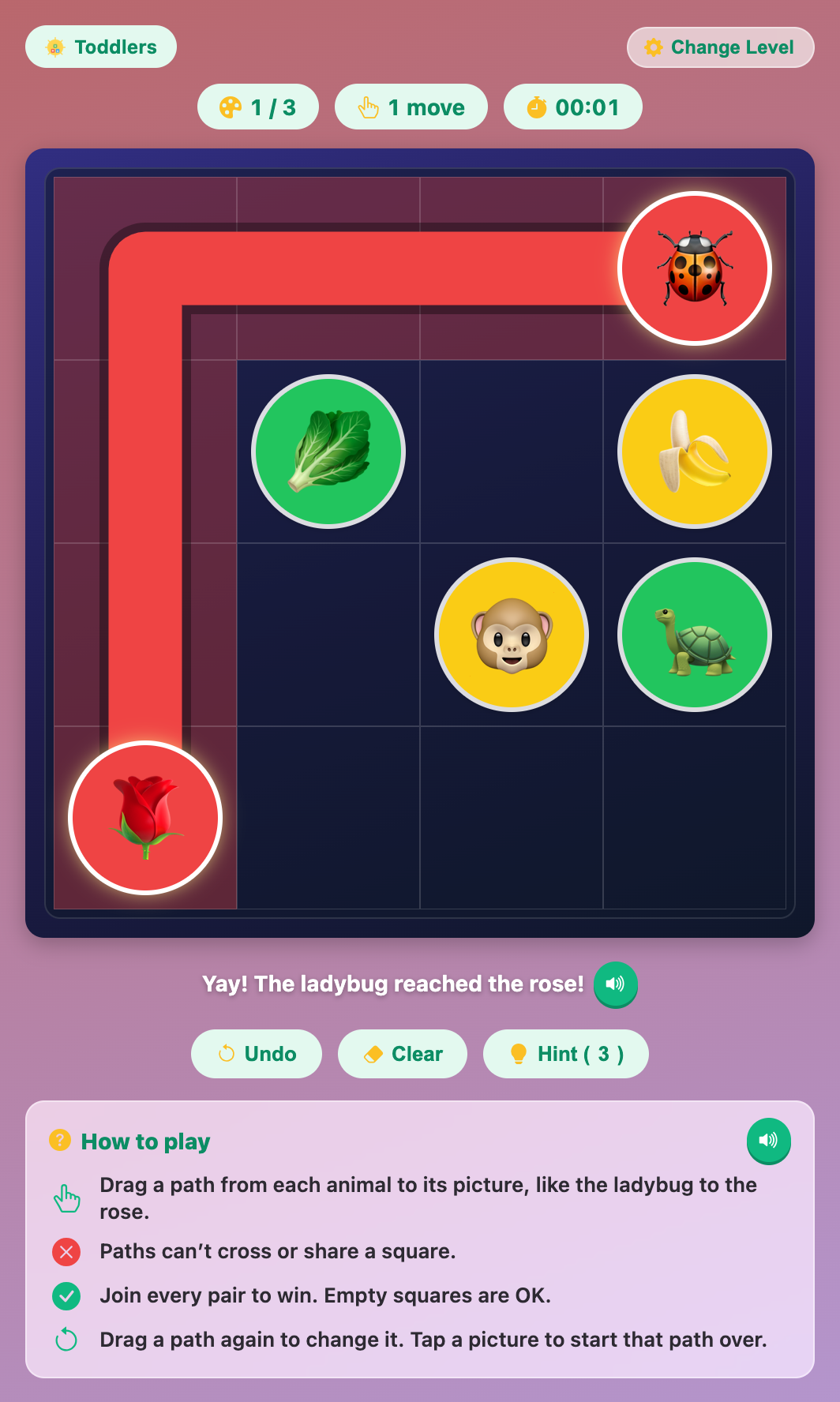
A 4 by 4 Color Connect board for toddlers where a red path joins the ladybug to the rose, with the turtle and monkey still waiting
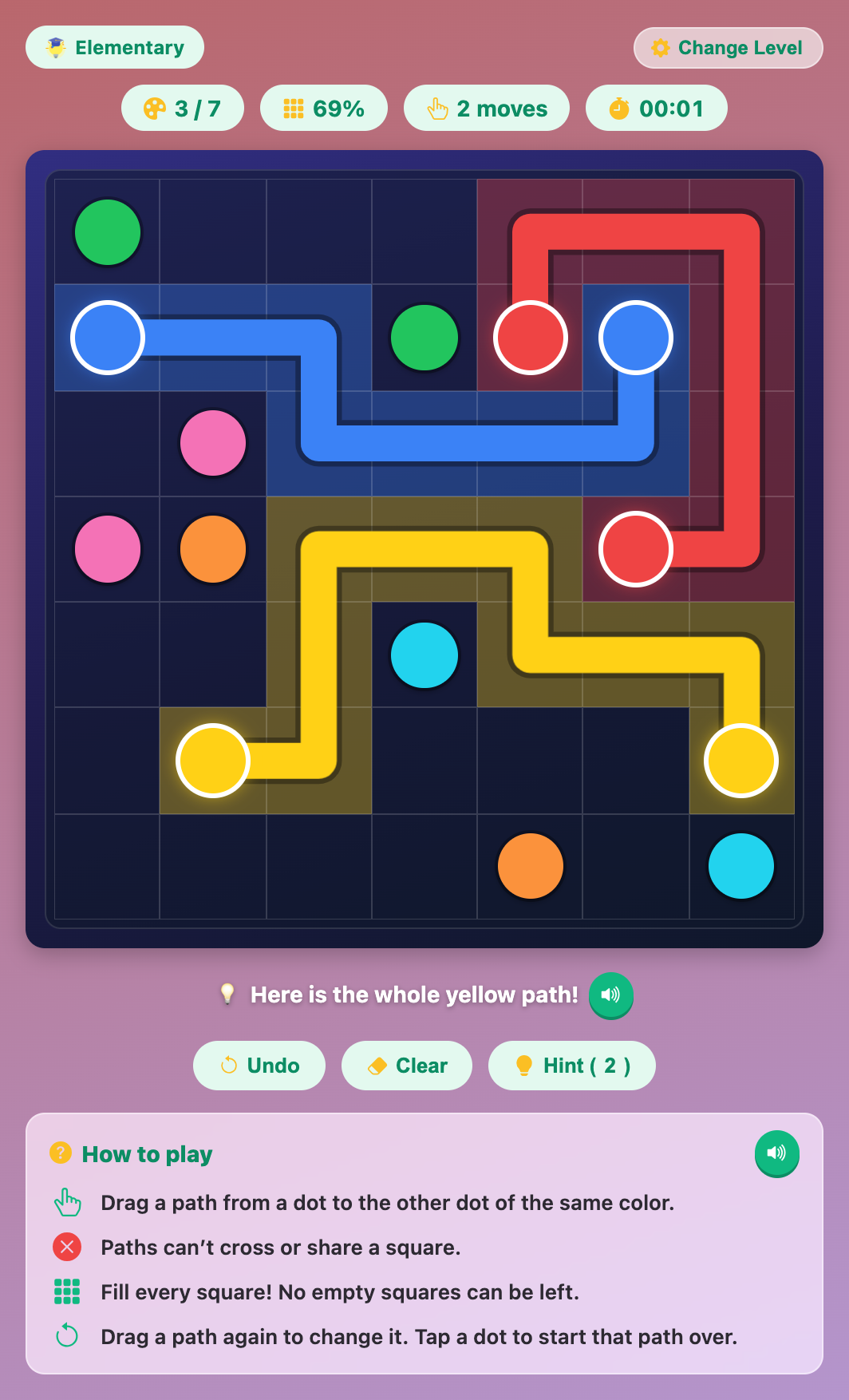
An Elementary 7 by 7 board with red and blue paths drawn and the whole yellow path just shown by a hint
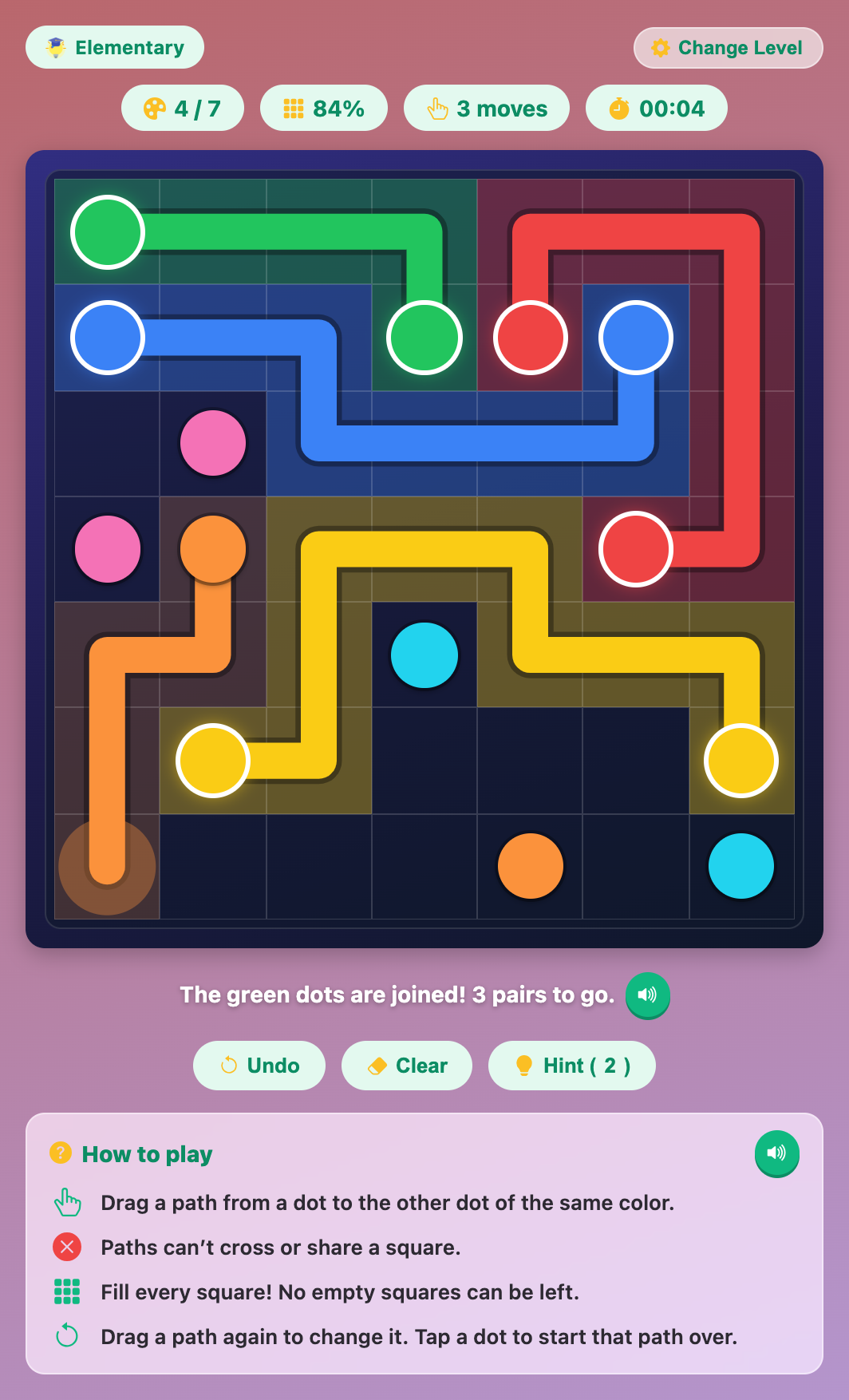
An orange path being dragged across an Elementary Color Connect board, with green, blue, red and yellow already joined
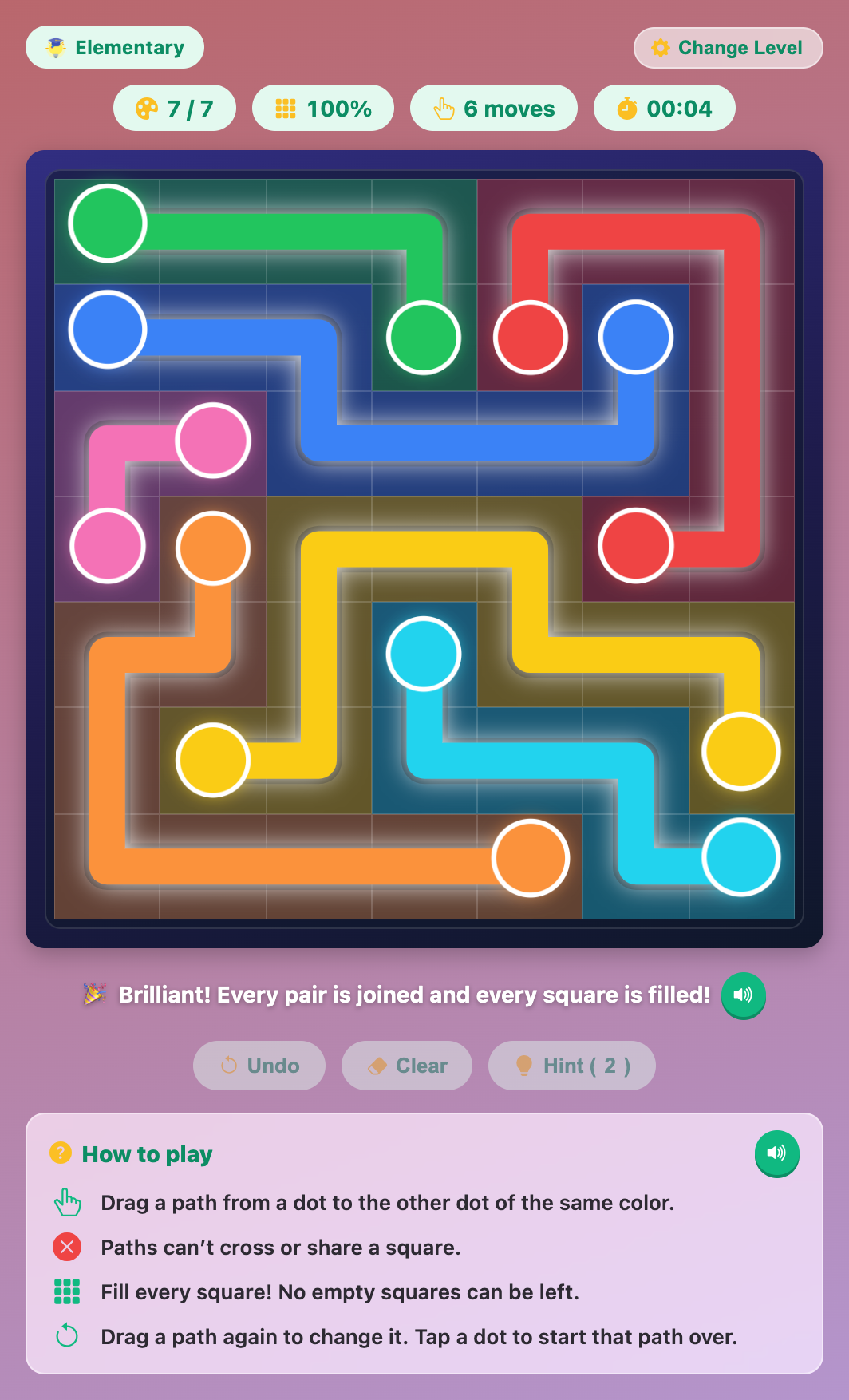
A solved Color Connect board with all seven colors joined and every square filled, glowing for the win
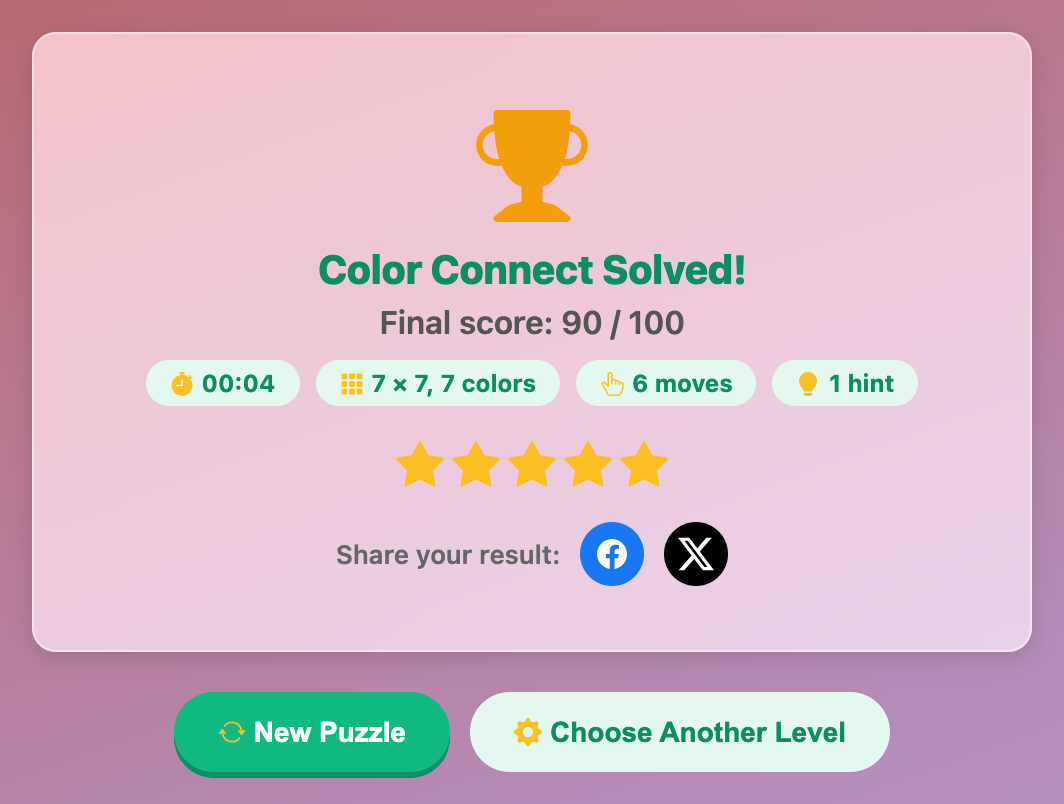
The Color Connect Solved finish card with a trophy, a score of 90 out of 100, one hint and five stars
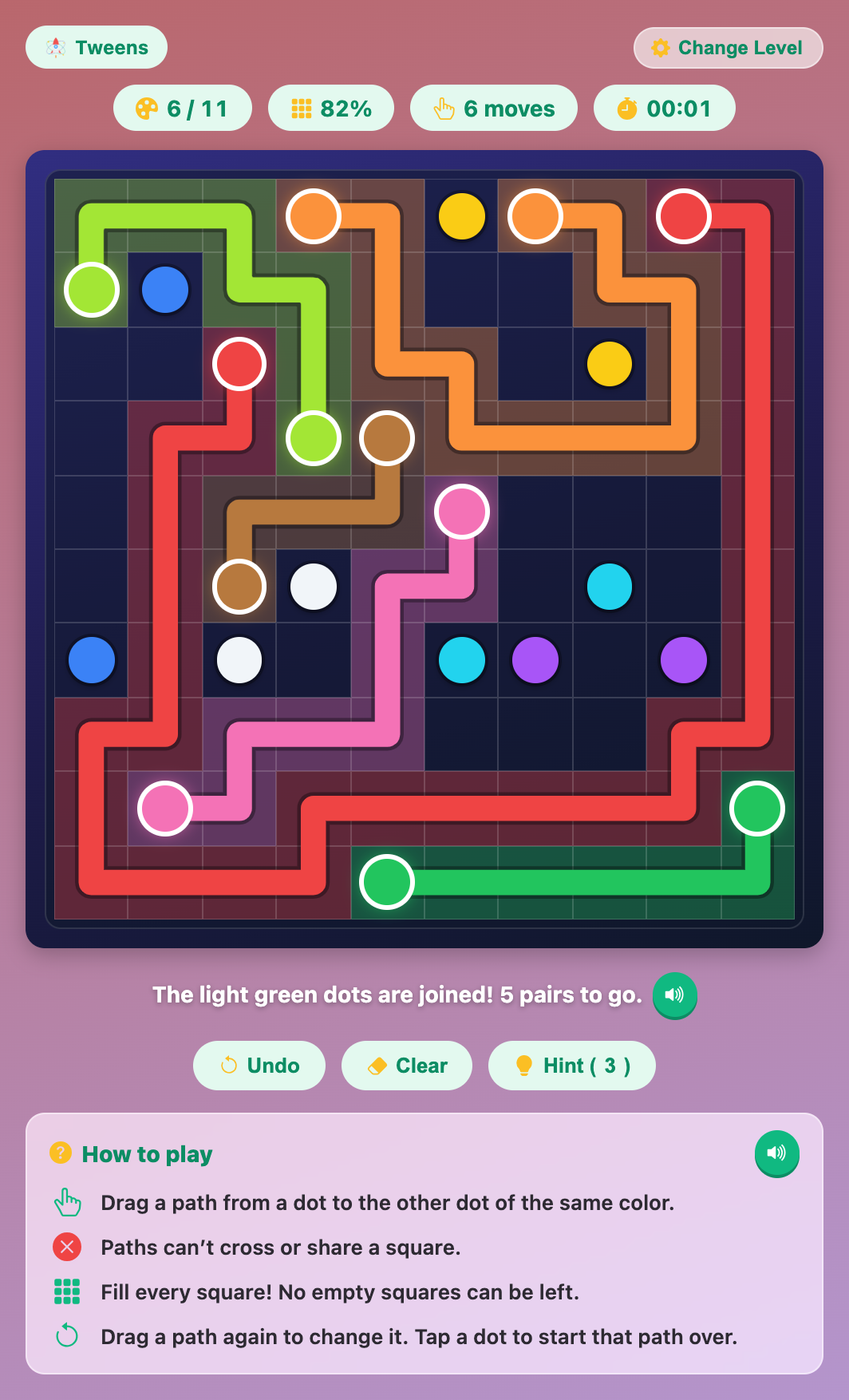
A 10 by 10 board in Color Connect for tweens with eleven colors, six of them joined by long winding paths
More Mind Games
 973.3K plays
4.9
Sliding Puzzle
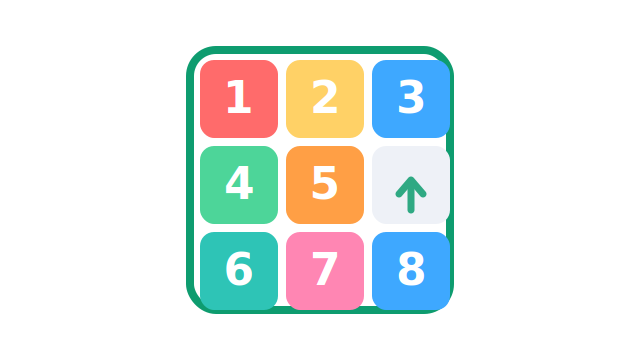
Slide the numbered tiles — or a fun picture! — one at a time until they line up in order, from a cozy 5-tile board all the way up to the classic 15 puzzle.
 122.4K plays
5.0
Island Bridges
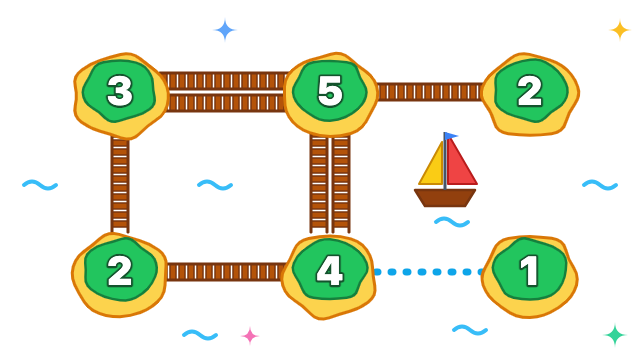
Build bridges to join every island! Each island shows a number that tells how many bridges must touch it. Drag from one island to another to build a bridge, and drag again for a double bridge. Bridges go straight and can't cross, and all the islands must end up joined together. Finish the map and watch the little boats sail. A clever logic puzzle with a brand-new map every game.
 137.3K plays
5.0
Gomoku – Five in a Row
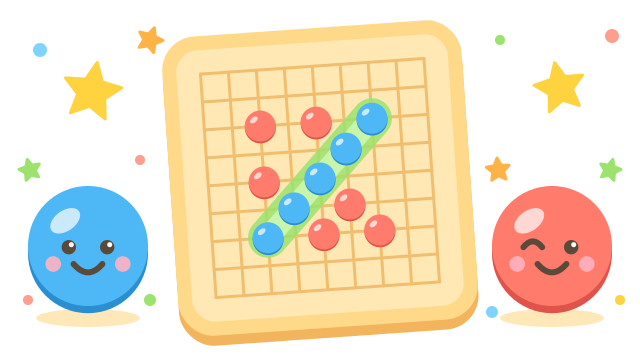
Place your stones on the board and be the first to get five in a row — across, down, or diagonal — against the computer or a friend.
 96.6K plays
4.9
Riddle Rush
Read the fun riddle and pick the correct answer before time runs out.
Most Played Games
 366.3K plays
5.0
Tic-Tac-Toe
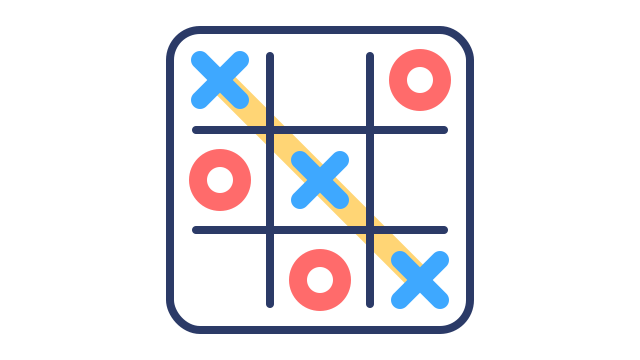
Play a game of Tic-Tac-Toe against the computer and see if you can outsmart it.
 1.1M plays
4.9
Chess
Play classic chess in 2D or 3D against the computer or a friend, with FIDE time controls, hints, and undo.
 263.7K plays
4.9
Category Sort
Decide whether each picture is an animal, food, toy, or vehicle before time runs out.
 568.7K plays
4.9
Connect Four
Drop your pieces and be the first to connect four in a row against the computer or a friend.
Comments (52)