
Fence the Sheep
83.7K playsBuild a fence to keep the sheep safe! Tap the lines between the posts to build fence pieces, or drag from post to post. The fence must be one closed loop with no branches, and each number tells how many sides of its square are fenced. When the loop closes, the field turns green and the sheep run inside. A tricky logic puzzle with a brand-new field every game, and every field has exactly one answer.
Every post in this field follows one tiny rule: it holds two fence pieces, or none at all. Fence the Sheep for kids is a free logic puzzle where you build one closed fence around a grassy field, using number clues to know where each piece goes. When the last piece clicks into place, the field turns green and the sheep come running in to hop around their new home.
You play it right here in your web browser, with no download and no sign-up. It works with a mouse or a finger on a phone or tablet. There are four levels for ages 2 to 12, from a tiny 3 by 3 field up to a big 7 by 7 one. Every game makes three brand-new fields, and each field has exactly one right answer, so every piece can be worked out.
🧶 Slitherlink: The Puzzle Made of One Long Fence
Fence the Sheep is the KidWorld version of a puzzle called Slitherlink. It was first printed in a Japanese puzzle magazine in 1989, and puzzle fans also call it “Fences” or “Loop the Loop”. A loop is a line that goes all the way around and comes back to where it started, like a rubber band.
The field is a grid of squares. At every corner of every square stands a brown fence post. You build fence pieces on the dotted lines between two posts that sit next to each other. Your job is to make one single loop of fence that follows these rules:
One loop only. All the pieces must join into one fence that closes up. Two small fences don’t count.
No branches, no loose ends. Each post has two fence pieces or none. A post with three pieces would make the fence split like a tree branch. A post with one piece would leave a gap the sheep could slip through.
Match the numbers. A number inside a square says how many of its four sides have a fence. A 0 means no fence touches that square at all. A 3 means three sides are fenced and one is open.
Blank squares are free. A square with no number can have any number of fenced sides.
The squares inside your loop become the sheep’s meadow. The squares outside stay plain. That’s the whole puzzle! The fun part is working out where the fence must go, one sure piece at a time.
🪵 Building Your Fence on KidWorld, Button by Button
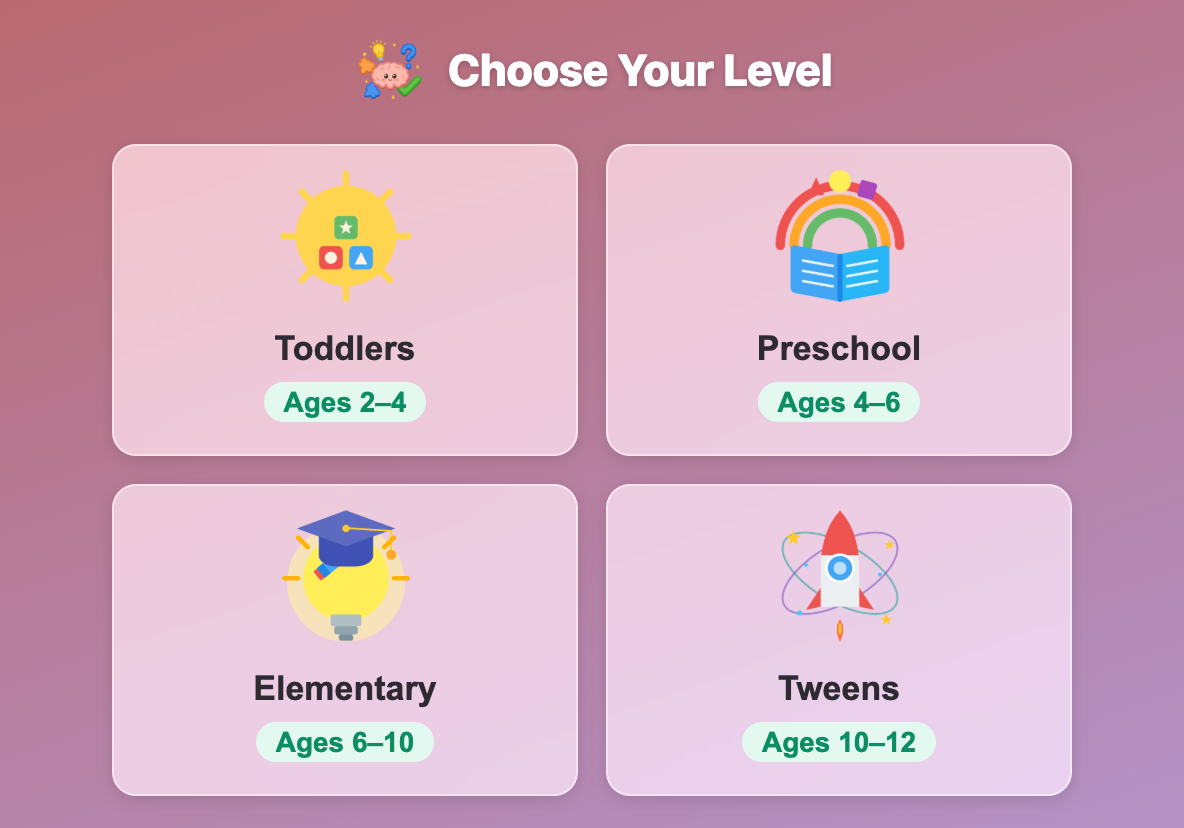
Pick your level. The game starts on Elementary. To change it, tap the Change Level button in the top corner. You’ll see four cards: Toddlers (ages 2–4), Preschool (ages 4–6), Elementary (ages 6–10) and Tweens (ages 10–12). The game remembers your choice for next time.
Read the pills at the top. 🌾 Field 1 / 3 shows which of your three fields you are on. 🔢 counts how many numbers are already right, like 2 / 9. The stopwatch shows your time.
Tap a line to build a fence piece. Tap the dotted line between two posts, and a wooden fence piece appears. On Toddlers and Preschool, tap it again to take it away.
Use the ✕ on bigger levels. On Elementary and Tweens, each tap moves one step: nothing → fence → ✕ → nothing. The red ✕ means “no fence here”. It’s your note to yourself, so you don’t try that line again.
Drag to build faster. Press on a post and slide to another post. Every line you pass gets a fence. If you start your drag on a fence piece, the drag takes pieces away instead. Slide back over the piece you just made, and it disappears again.
Listen to the message box. Under the field, a short message tells you what just happened, like “Fence piece built! 3 of 6 numbers are right.” Tap the green 🔊 button to hear it read aloud. On Toddlers and Preschool, the game reads the rules out loud when each field starts, if the site’s sound is on.
Fix mistakes with Undo and Start Over. Undo takes back your last tap or drag. Start Over clears the whole field, and even that can be undone.
Ask for a 💡 Hint when you’re stuck. Toddlers and Preschool get 3 hints per field. Elementary and Tweens get 2. Each hint costs points, so save them for when you really need them.
Close the loop and watch the sheep. When your fence is right, the squares inside turn green row by row, the posts bounce, and up to eight 🐑 sheep run in from the nearest side. Then the big Next Field button counts down from 5 and moves on by itself, or you can tap it right away.
See your score. After the third field, tap See My Score. The “All the Sheep Are Safe!” card shows your points out of 30, your time, your hints and your stars. Tap Play Again for three new fields, or Choose Another Level.
Use the page buttons too. On the play page you’ll also find the fullscreen button for a bigger field, the reload button to start fresh, and the music button to turn the background tune on or off.
🚦 What the Colors Are Telling You
The field talks to you with colors, so watch it closely while you build.
A green number has exactly the right number of fenced sides. You can stop worrying about it.
A red number has too many fences. The message box says something like “Too many fences around that 1! It needs just 1 fence piece.”
A 0 stays brown while it’s fine, and only turns red if you put a fence next to it. That’s why the 🔢 pill doesn’t count the 0s.
A red, blinking post has three or more fence pieces. That’s a branch, and the message says “A fence post can only join two fence pieces. No branches!”
A blue glowing piece was just added by a hint. A piece fading out in red was just taken away by a hint.
If you close a loop too early, the game tells you why it isn’t finished. You might see “The fence is closed, but not every number is right yet.” If you have two separate fences, it says “The fence must be one single loop. Join all the pieces into one!”
🧠 Fence the Sheep for Kids: Number Tricks That Always Work
You never need to guess blindly in this game. Every field can be solved by finding pieces you can be sure about. These tricks show you where to look first. Each one works on every field, at every level.
Trick 1: A 0 is a fence-free zone
A 0 means none of its four sides has a fence. So all four lines around a 0 are off limits. On Elementary and Tweens, tap each of those lines twice to mark them with a ✕. Now you can see the empty space clearly, and the fence must go around it.
Start every field by finding the 0s. They give you the most free information for the least work.
Trick 2: A 3 that sits beside a 0
Look for a 3 right next to a 0. The side they share can’t have a fence, because the 0 says so. A 3 needs three fenced sides, and it has only three sides left. So all three of its other sides get a fence!
Example: a 3 has a 0 on its right. You know right away: fence on the 3’s top, left and bottom. That’s three sure pieces from one quick look.
Trick 3: The corner post
The post in a corner of the whole field touches only two lines. Remember the post rule: two pieces or none. So those two lines are either both fenced or both empty. This helps a lot with the corner square:
A 1 in a corner: if one outside line had a fence, the other would need one too. That makes 2, but the 1 only allows 1. So both outside lines are empty, and the 1’s fence is on one of its two inside sides.
A 3 in a corner: if both outside lines were empty, the 3 would only have two lines left. It needs three! So both outside lines get a fence.
A 0 in a corner: easy, the corner post stays empty, and the fence stays away.
Trick 4: Two 3s side by side
When two 3s sit next to each other in a row, the line between them always has a fence. So do their two far-away sides: the left side of the left 3 and the right side of the right 3. That’s three pieces you can build at once.
Why it works: if the line between them were empty, each 3 would need fences on all its other sides. Then the fence would wrap around just those two squares as a tiny closed loop, and the rest of the field would get no fence. In this game, the fence always spreads across the field, so that can’t happen. And if the far side of the left 3 were empty, that 3 would need its top and bottom. Those pieces fill up the posts in the middle, so the right 3 could only get two fences. That breaks its number, so the far sides must be fenced too.
Trick 5: A loose end must keep going
A fence can’t just stop. If a post has one fence piece, it needs exactly one more. Look at the other lines on that post. If all of them but one are blocked (by a ✕, by a 0, or by the edge of the field), the last open line must be the next piece.
Example: your fence ends at a post on the bottom edge. The line going down doesn’t exist, and the line to the left is next to a 0. Only the line to the right is left, so the fence turns right. Following loose ends like this is how a few sure pieces quickly grow into a long fence.
Trick 6: A full post closes its other lines
As soon as a post has two fence pieces, it’s done. Every other line on that post must stay empty. On bigger levels, mark those lines with ✕ right away. This is the post rule working the other way, and it stops you from making branches.
Trick 7: Don’t close a tiny loop too soon
Sometimes two loose ends sit right next to each other, and it’s tempting to join them. Stop and check first! If other numbers on the field still need fences, closing this loop would leave them out, because the game allows only one loop. So that line must stay empty, and the fence has to go the long way around.
Counting clues like these are also the heart of other puzzles. If you enjoy reading numbers this way, Minesweeper uses number clues to find hidden mines.
Trick 8: On Tweens, ask “what if?”
On Tweens fields, there are fewer numbers, and the easy tricks sometimes run out. Then try a gentle “what if” test in your head. Pick one open line and imagine it has a fence. Follow the tricks from there. If that soon breaks a rule (a number gets too many fences, a post gets a branch, or a small loop closes too early), then your “what if” was wrong, and that line must be empty.
The Toddlers, Preschool and Elementary fields never need this. They can always be finished with Tricks 1 to 7. Tweens fields need a few “what if” steps, which makes them a real brain workout.
🔍 Let’s Solve a Real Toddlers Field Together
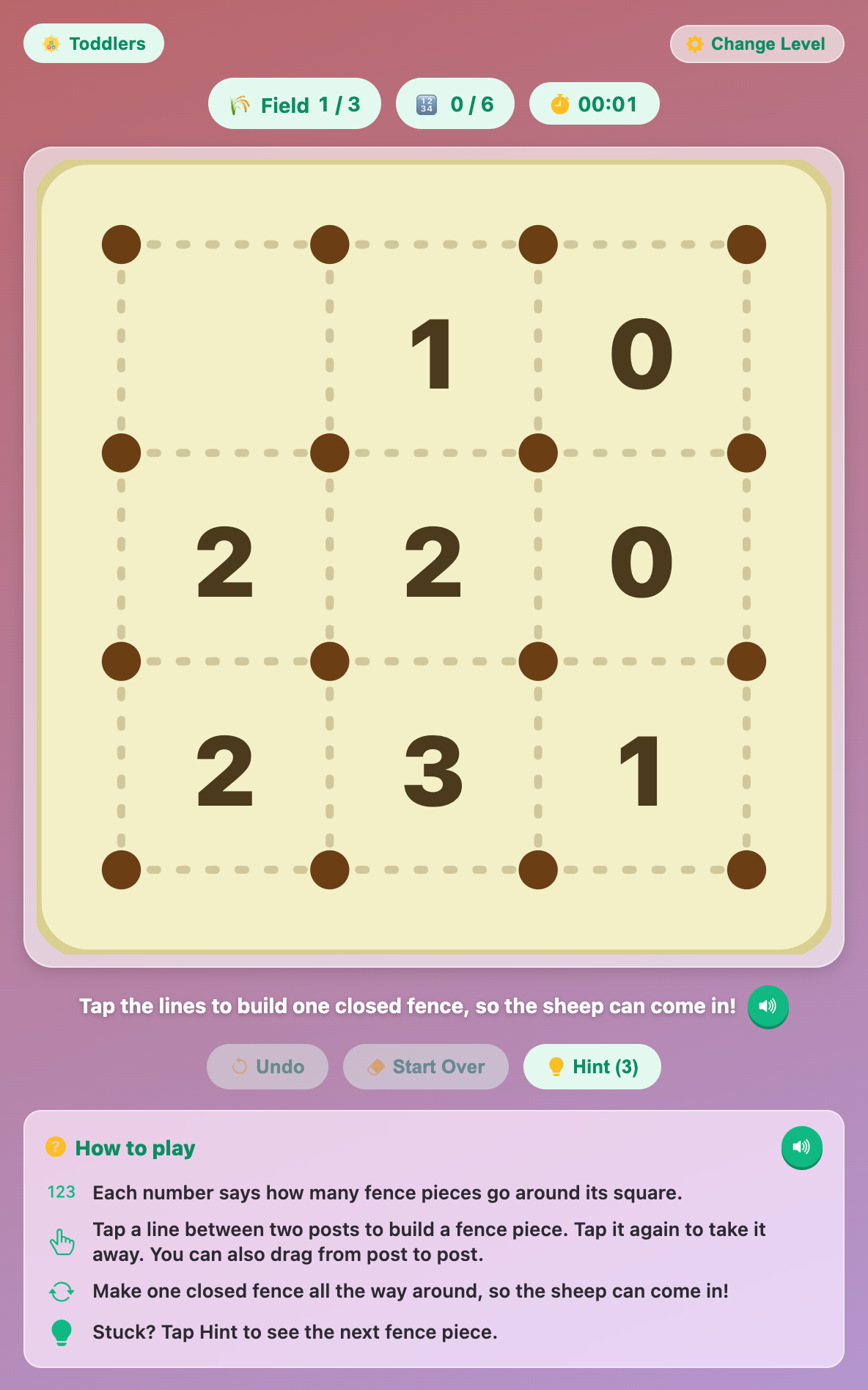
Here is a real 3 by 3 field from the game. The top row has a blank square, a 1 and a 0. The middle row has 2, 2, 0. The bottom row has 2, 3, 1.
Find the 0s. Both 0s are in the right column. No fence touches them at all.
Use the corner trick on the 1. The 1 in the bottom-right corner can’t have a fence on its top, because the 0 is up there. Its two outside lines meet at the corner post, so they’re both empty or both fenced. Both fenced would be 2, too many! So both are empty, and the 1’s fence goes on its left side.
Follow the loose end down. That piece ends at a post on the bottom edge. The line to its right is the 1’s bottom, which is empty. So the fence must turn left, along the bottom of the 3.
Follow the loose end up. The top of the same piece ends at a post next to the 0s. The lines going up and to the right both touch a 0, so the only way left is along the top of the 3. Now the 3 has its top, right and bottom. That’s three, so its left side stays open.
Keep going. Follow the bottom piece left. It runs along the bottom of the 2 in the corner, then up the left edge. Follow the top piece left too. The corner 2 already has its two fences, so the fence can’t run along its top. Instead it goes up the left side of the middle 2 and straight on up the left side of the top 1. Then it turns along the top of the blank square and down the left edge.
Close the loop. The two ends meet on the left edge, and the fence is closed! Ten fence pieces make an L shape around four squares. Check every number: the top 1 has one fence, each 2 has two, the 3 has three, and the corner 1 has one. 🎉
Notice how the whole field opened up from just two clues: the 0s and the corner 1. That’s how most fields work. Find one sure piece, then follow the loose ends.
A quick check before you press on
Here are two small moments you will meet often. Try to answer them before reading on.
A 2 has fences on its top and bottom. What about its left and right? Both must stay empty, because the 2 already has its two.
A 1 already has a fence on its left side. What about its top, right and bottom? All three stay empty, so on bigger levels you can mark them with ✕ right away.
🏆 How Points and Stars Are Counted
Each field is worth 10 points. Every hint you use on a field takes away 2 points, but a field never drops below 4 points. With three fields, the best score is 30 out of 30.
No hints at all: 30 out of 30, a gold trophy and five stars.
One hint in the whole game: 28 out of 30. That still gives five stars!
Two hints on every field: 6 points per field, 18 in total, and three stars.
Hints are clever. If you built a piece that doesn’t belong, the first hint takes that piece away. Only when your fence has no wrong pieces does a hint add a new one, and it tries to add it at a loose end so you can keep going. So when you’re not sure whether you made a mistake, a hint works like a checker. Your time is shown on the score card, but it never changes your points, so you can think as long as you like.
If you change the level in the middle of a game, that game simply ends without a score, and you start fresh at the new level.
🌾 From 3 by 3 to 7 by 7: A Field for Every Age
Each level makes three fields, and they grow a little bigger as you go.
Fence the Sheep for toddlers (ages 2–4)
Toddlers get two 3 by 3 fields and one 3 by 4 field. Most squares show a number, and a tap just builds or removes a fence, with no ✕ to worry about. The rules are read aloud when each field starts, and there are 3 hints per field. Little ones will need a grown-up beside them. A good way to play together is to let your child tap while you point to a number and count its fenced sides out loud.
If your little one mostly loves drawing lines with a finger, Color Connect is a gentle warm-up, where you drag a path from one colored dot to its matching dot.
Fence the Sheep for preschoolers (ages 4–6)
Preschool fields are 4 by 4, then 4 by 5. A few more squares are blank, so kids start to use the post rule, not just the numbers. There are still 3 hints per field, taps still toggle on and off, and the rules are read aloud at the start. Counting to 3 is all the math a preschooler needs here.
Fence the Sheep for elementary kids (ages 6–10)
Elementary brings two 5 by 5 fields and a 6 by 6 field. About half the squares have numbers, the ✕ mark appears, and there are 2 hints per field. Every field can still be solved with sure steps only, so this is the best level for learning the tricks above. Most kids who can read the How to play box can play alone.
Fence the Sheep for tweens (ages 10–12)
Tweens play a 5 by 5, a 6 by 6 and a 7 by 7 field, with far fewer numbers. Some steps need the “what if” thinking from Trick 8, and there are only 2 hints per field. A perfect 30 here is something to be proud of. Tweens who want another number-and-shape puzzle after this can try Island Maker, where each number has to become an island of exactly that many squares.
💚 Why Building Fences Is Great for Growing Minds
It teaches careful counting. Every number asks “how many sides?” Kids count, compare and check again. When a 2 turns green, they know they got it exactly right.
It shows that one fact leads to another. A single 0 crosses out four lines. Those crossed lines force a loose end to turn. That turn finishes a 3. Kids see how small, sure steps add up to a big answer, which is the heart of logical thinking.
It builds patience. When a loop closes too early and the message says not every number is right, children learn to stop, look back, and fix one piece instead of giving up.
It trains space and shape skills. Following a fence around corners, along edges and back to the start helps kids picture paths and shapes in their head.
It makes mistakes feel safe. Undo, Start Over and the hint that removes wrong pieces turn every mistake into a lesson. Nothing bad happens, and the sheep are always waiting.
A note for parents and teachers
Fence the Sheep is calm and gentle. There are no scary sounds, no enemies and no lives to lose, just a sunny field and some happy sheep. The game is free and runs in the browser with no download and no account. It practices counting to 4, logical reasoning, spatial thinking and patience. Because every game makes three new fields, the puzzles don’t repeat, so kids can play again and again at the same level until they feel ready to move up.
🙋 Questions Families Often Ask
Can a field have more than one answer?
No. Every field the game makes is checked to have exactly one answer. If you’re stuck, there is always a sure next step somewhere on the field.
Does it work on a phone or tablet?
Yes. You can tap each line or drag your finger from post to post, just like with a mouse.
Will I see the same field twice?
Very unlikely. The game builds a brand-new field every time, so even three games in a row will feel different.
Ready to help the sheep? Pick your level, find the 0s, follow the loose ends, and close that fence. Fence the Sheep for kids is waiting, and so are the sheep! 🐑
🖼️ See the Game in Action
The Choose Your Level screen in Fence the Sheep for kids, with Toddlers, Preschool, Elementary and Tweens cards
A fresh 3 by 3 field in Fence the Sheep for toddlers, with brown posts, dotted lines and the numbers 0 to 3
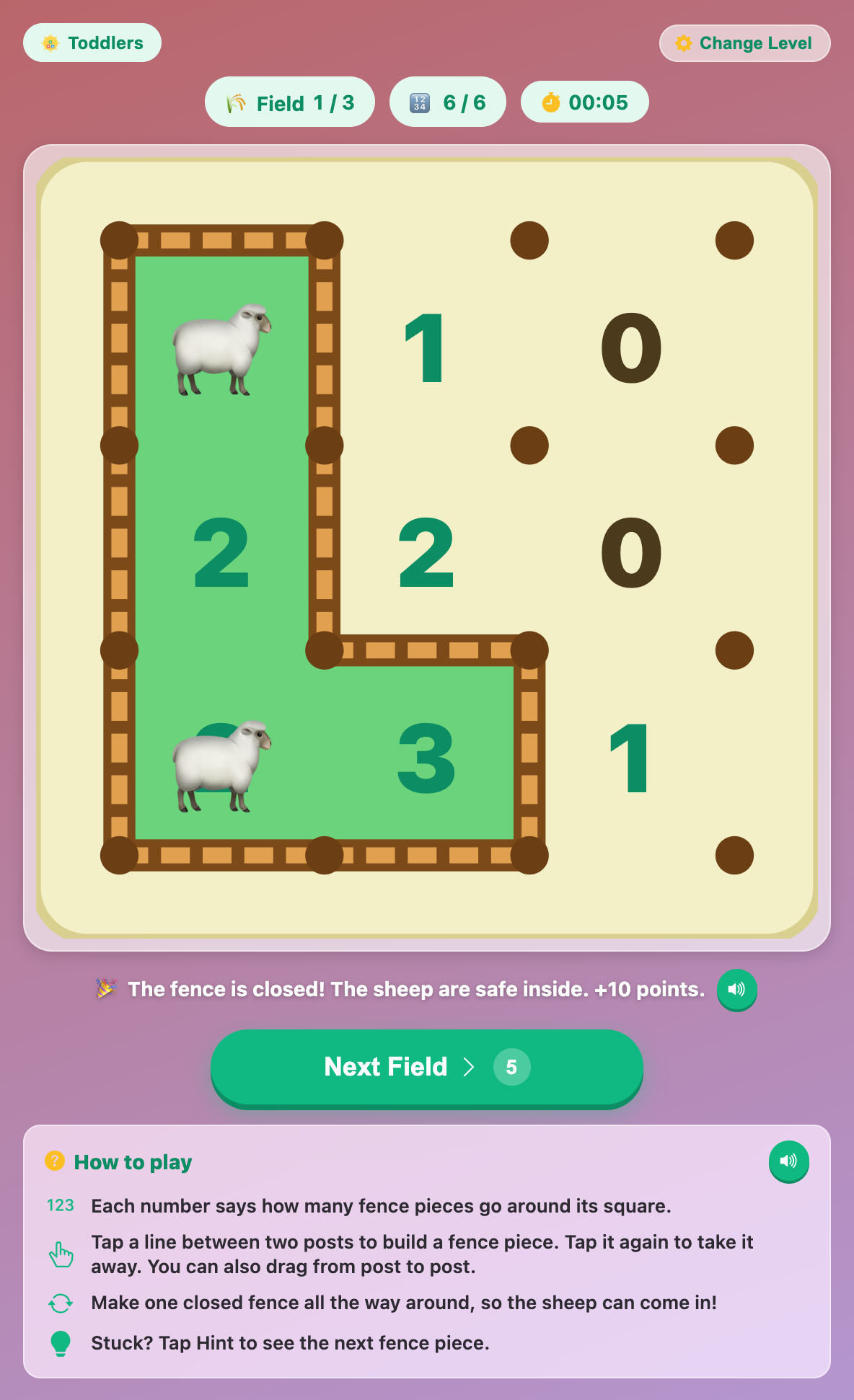
A closed wooden fence around four green squares with two sheep inside and the Next Field button counting down
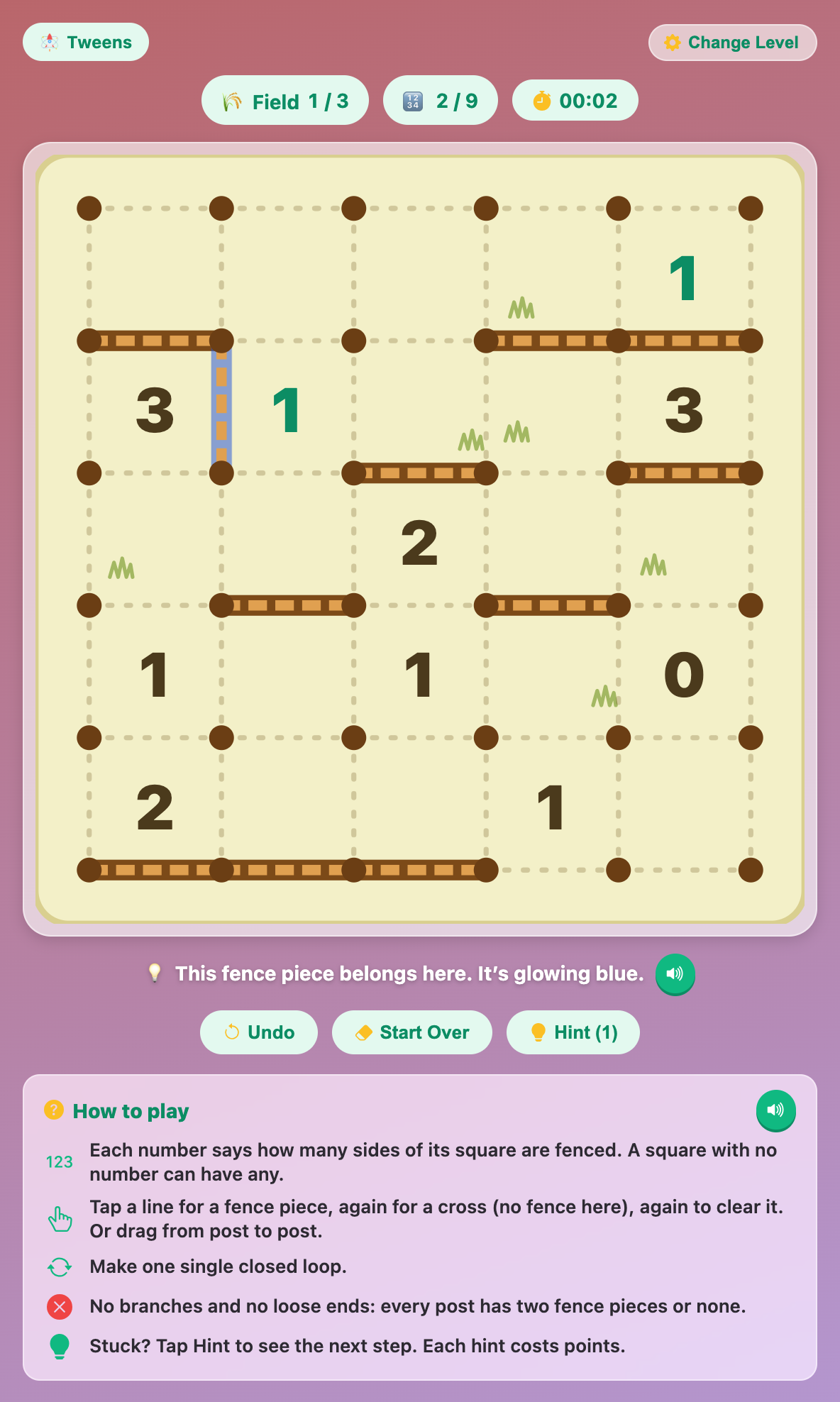
A 5 by 5 field in Fence the Sheep for tweens with some fence pieces built and one hint piece glowing blue
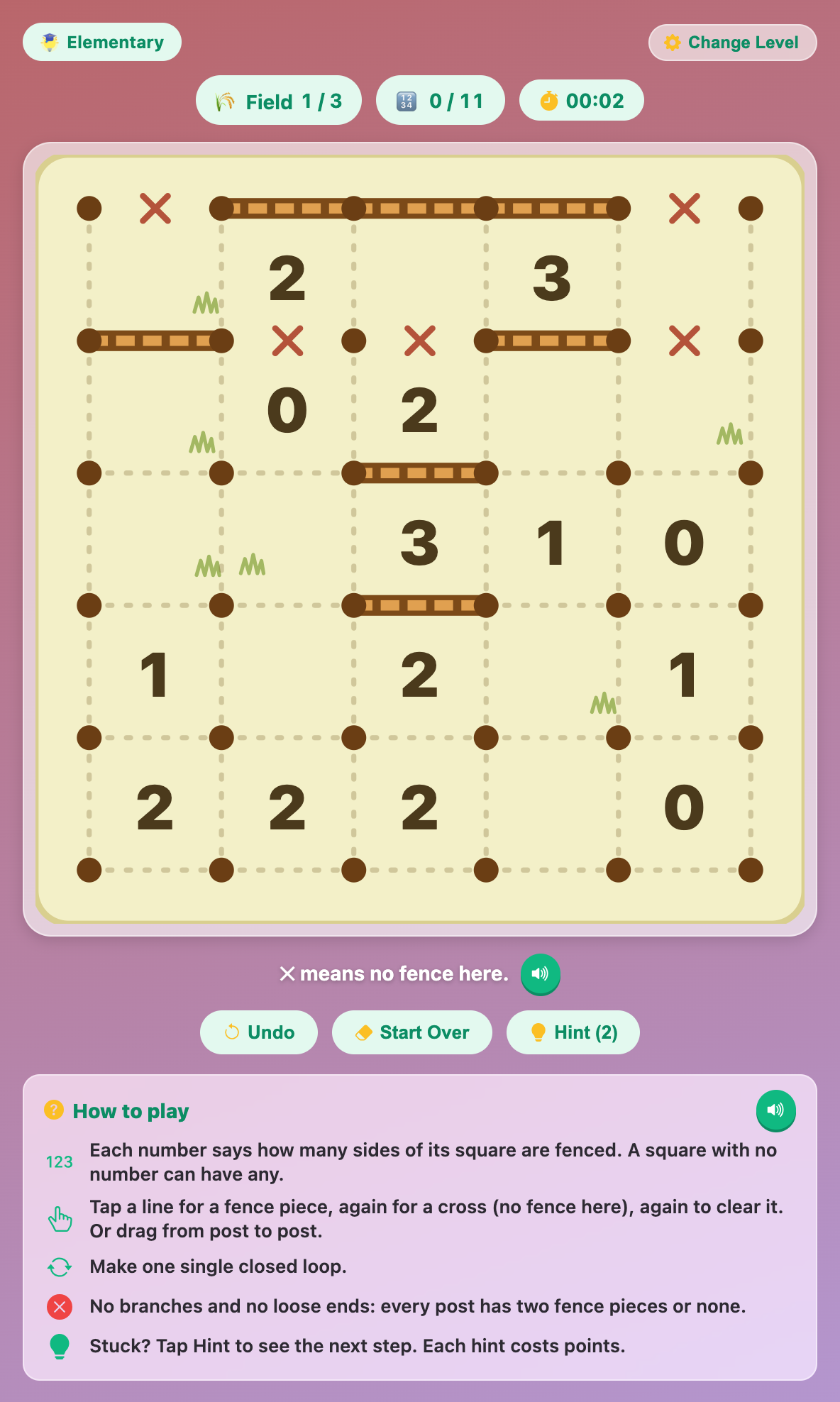
An Elementary field with red cross marks on the lines where no fence can go, next to a few fence pieces
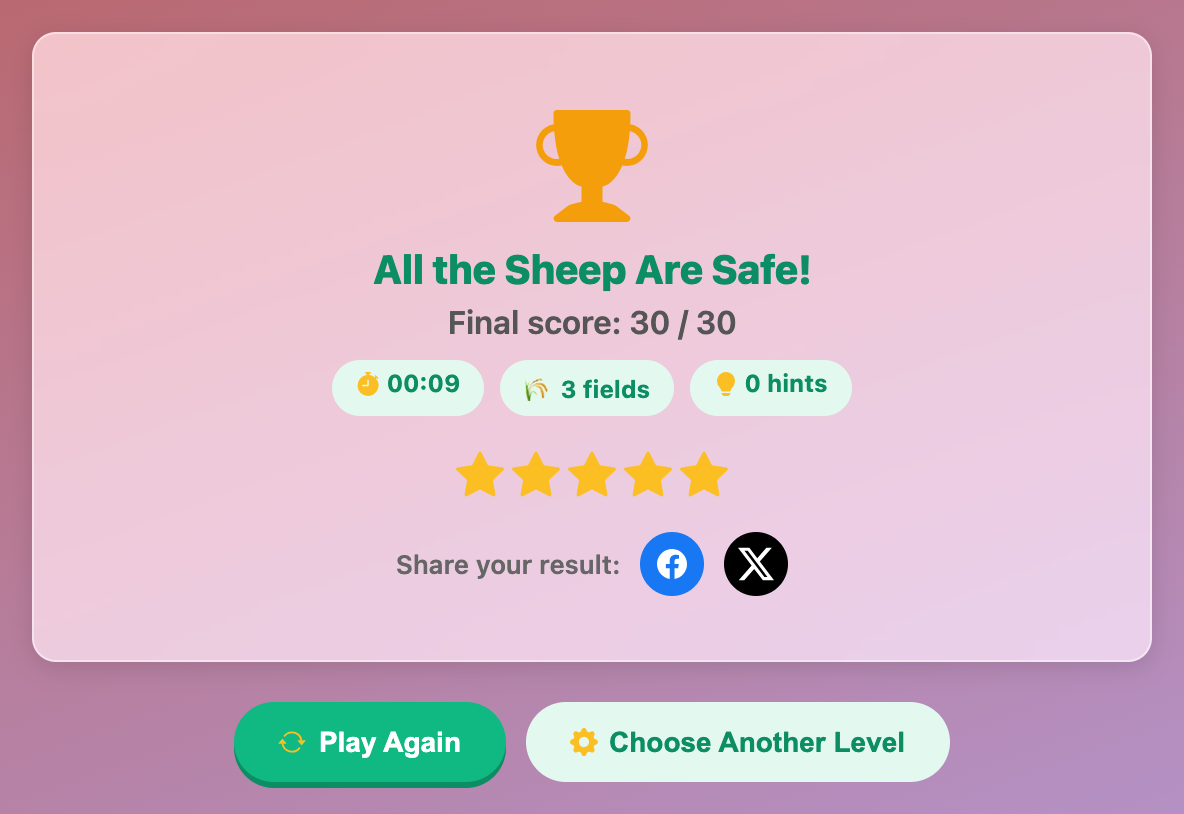
The All the Sheep Are Safe finish card with a gold trophy, a final score of 30 out of 30 and five stars
More Mind Games
 96.6K plays
4.9
Riddle Rush
Read the fun riddle and pick the correct answer before time runs out.
 786.5K plays
5.0
Tangram
Drag, rotate, and flip the seven tangram pieces to build silhouettes like a house, a boat, and a fish.
 736.4K plays
4.9
Color Connect
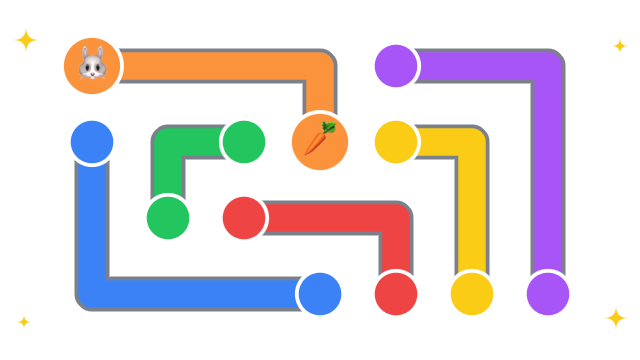
Join the colors! Drag a path from each dot to the dot of the same color, but paths can't cross or share a square, and on most boards every square has to be filled. Little players help animals reach what they want, like a bunny to its carrot. Paths can be redrawn any time, a hint shows a whole path, and every game brings a brand-new board.
 122.4K plays
5.0
Island Bridges
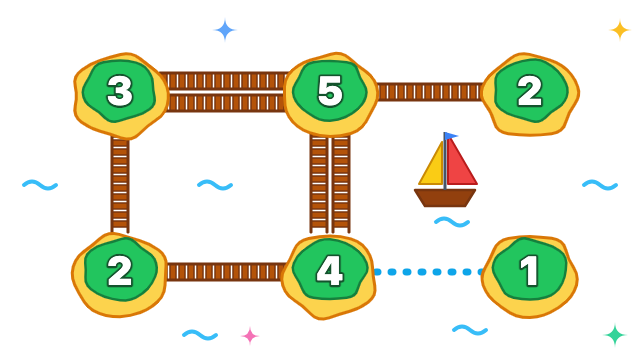
Build bridges to join every island! Each island shows a number that tells how many bridges must touch it. Drag from one island to another to build a bridge, and drag again for a double bridge. Bridges go straight and can't cross, and all the islands must end up joined together. Finish the map and watch the little boats sail. A clever logic puzzle with a brand-new map every game.
Most Played Games
 366.3K plays
5.0
Tic-Tac-Toe
Play a game of Tic-Tac-Toe against the computer and see if you can outsmart it.
 1.1M plays
4.9
Chess
Play classic chess in 2D or 3D against the computer or a friend, with FIDE time controls, hints, and undo.
 263.7K plays
4.9
Category Sort
Decide whether each picture is an animal, food, toy, or vehicle before time runs out.
 568.7K plays
4.9
Connect Four
Drop your pieces and be the first to connect four in a row against the computer or a friend.
Comments (31)