
Island Maker
52.6K playsMake the islands appear! Fill squares with sea so each number becomes an island with exactly that many squares. Every island has just one number, all the sea has to join up, and the sea can't make a 2x2 pool. Numbers turn green when their island is just right, and every map has exactly one answer you can find with logic alone. Solve it and palm trees grow while boats sail around your islands.
Most island games give you the land. Island Maker gives you the sea! Island Maker for kids is a free logic puzzle where you fill squares with blue sea until every number on the map sits on its own island of exactly that many squares. It plays in your web browser on a computer, tablet or phone, with nothing to download and no sign-up, and it has four levels for kids from 2 to 12.
Every map is brand new, made by the game while you play, and every map has exactly one right answer. You never need to guess, because there is always a reason why the next square is sea or land. When the last wave rolls in, the islands turn green, palm trees pop up, and boats and fish start swimming around the land you found. 🌴
🌊 Nurikabe: The Puzzle With a Wall in Its Name
Island Maker is the KidWorld version of a puzzle from Japan called Nurikabe (say “noo-ree-kah-beh”). It was made popular by Nikoli, the Japanese puzzle company that also helped make Sudoku famous. In old Japanese stories, a nurikabe is a big invisible wall that blocks a traveler’s path. In the puzzle, that “wall” is the sea, winding its way between the islands.
On KidWorld, the map is a grid of squares. A few squares show a number in a white circle on sandy ground. Your job is to decide which of the other squares become sea. These are the four rules, the same ones the How to play box under the map shows:
Each number is an island. A 3 needs exactly 3 squares of land, joined side by side. Squares that only touch at a corner don’t count as joined.
An island has just one number. Two numbers can never share the same island.
All the sea joins up. A little boat must be able to sail to every bit of sea without crossing land.
No 2x2 pools. The sea can never fill a block that is 2 squares wide and 2 squares tall. Every block like that needs some land.
Any square that isn’t sea is land. You don’t even have to mark the land: as soon as the sea is in the right place, the map is solved.
Island Maker has a cousin on KidWorld. In Island Bridges, the islands are already drawn, and you join them with wooden bridges instead of finding their shapes.
🕹️ Your First Map, One Tap at a Time
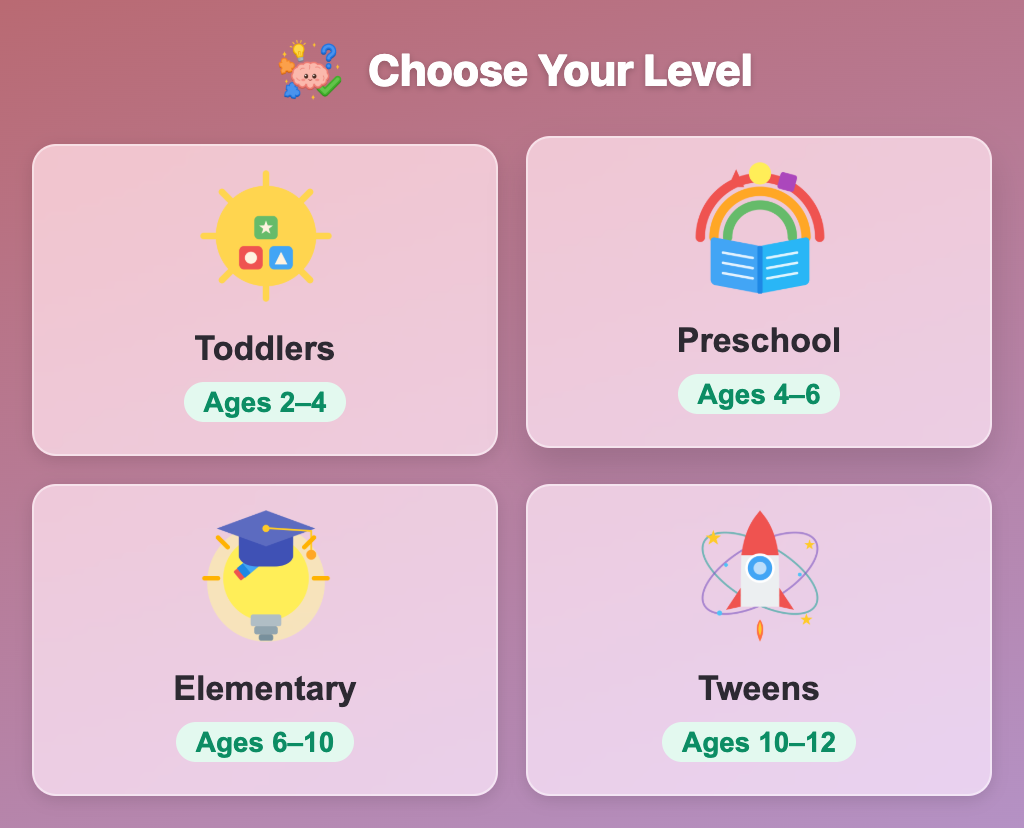
Pick your level. The game opens on the level you chose last time (Elementary on your very first visit). Tap Change Level at the top to see the Choose Your Level screen with Toddlers, Preschool, Elementary and Tweens.
Check the top bar. It shows which map you are on (like Map 1 / 3), your ⭐ points so far, and a stopwatch.
Tap a square for sea. One tap fills it with sea. A second tap turns it into sand, a square with a small dot that means “I think this is land.” A third tap empties it again. On the Toddlers level it is simpler: one tap makes sea, and the next tap takes it away.
Drag to paint. Press on a square and slide across the map. Every square you pass that looks like the one you started on changes the same way, so one long drag can pour a whole river of sea.
Leave the numbers alone. Number squares can’t change. If you tap one, the game reminds you to tap the squares around it instead.
Use the keyboard if you like. The arrow keys move from square to square, and Enter or Space presses the square you are on.
Fix things with Undo and Clear. Undo takes back your last move, and you can keep pressing it to go back many moves. Clear empties the whole map for a fresh start.
Tap Hint when you are stuck. If some sea is in the wrong place, the hint takes it away first. Otherwise it fills in the next right square and rings it in orange, and the message under the map explains why. Each hint costs 5 points.
Listen along. The 🔊 button next to the message reads it out loud, and the How to play box has its own 🔊 for the rules. On the younger levels, when the site’s sound is on, the game also reads the rules aloud as each map starts.
Finish the map. When the sea is just right, the message says “Land ho!” and the islands come to life. A panel shows your stars and points, and the Next Map button counts down from 5 and moves on by itself. Tap it if you want to go sooner.
See your score. After the last map, the Islands Made! card shows your final score, total time, hints and mistakes, plus a tiny picture of every map you solved with its stars. Tap Play Again for brand-new maps, or Choose Another Level.
Use the page buttons. Next to the game there are buttons to go fullscreen, reload a fresh game, and turn the music on or off.
🚦 Green Numbers, Red Numbers and Stripes
The map talks back while you play. It only tells you what it can see on the board, so it never gives the answer away.
A green number means its island is perfect. The squares that touch it and aren’t sea make an island of exactly the right size, with no other number. Those squares turn into grass.
A red number means trouble for that island. Its land joins another number, or it has grown too big, or the sea has boxed it in so tightly that it can’t reach its size.
Red stripes point at the problem squares: a 2x2 pool of sea, sand that joins two numbers or makes an island too big, sand that no number can reach, or a piece of sea that is cut off from the rest.
Only one thing counts as a mistake on your score: a 2x2 pool. Even then, the game waits a moment before counting it, because tapping a square to sand passes through sea on the way. So a quick double tap is safe. A sand slip gets an “Oops!” but costs no points, because sand is only a note. A cut-off sea or an island with no room gets an “Uh-oh!” warning. That means something needs to change, but it costs nothing.
🧭 Island Maker for Kids: Seven Tricks for Pouring the Sea
Good Island Maker players don’t guess. They look for squares that must be sea or must be land, fill those in, and let each one unlock the next. These seven tricks are the same ones the game’s hints use, from easiest to hardest.
Trick 1: A 1 is a finished island 🏝️
A 1 needs only one square, and the number already sits on it. So every square that touches a 1 side by side is sea. Do this first on every map. It’s free sea!
Trick 2: Fill the gap between two numbers
If an empty square touches two different islands, land there would glue them into one island with two numbers. That breaks a rule, so the square is sea. Look for two numbers with one square between them in a row or a column. Also look for two numbers that touch only at a corner: the two squares that touch both of them are sea.
Trick 3: Put a ring of sea around every finished island
Once an island has all its squares, it can’t grow any more. Every square that touches it is sea. The game’s hints say it like this: “The 3 island already has its 3 squares, so the squares around it are sea!” Each time a number turns green, check all around it.
Trick 4: Count steps to find squares nobody can reach
An island can only stretch so far. A 2 reaches just one step away from its number, a 3 reaches two steps, and a 5 reaches four. Walk your finger from each number, moving side by side only, never at a slant. A square that no number can reach must be sea. This trick fills big parts of the map, especially far corners.
Trick 5: Three sea squares in a block? The fourth is land
The sea can’t make a 2x2 pool. So when three squares of a 2-by-2 block are sea, the last one must be land. Mark it with sand. Then ask: which number can reach it? That island has to grow toward it.
Trick 6: Follow the only way out
An island that still needs squares, but has just one empty square next to it, must grow into that square. The sea follows the same idea. All the sea must join up, so a small patch of sea with only one open side has to flow through it. Sand works this way too: sand must belong to a numbered island, so if it has only one way to reach one, the island goes that way.
Trick 7: Ask “What if?” 🤔
On the bigger maps, some squares need a little test. Point at a square and imagine it is land. Would that join two numbers, or make an island too big? Then it must be sea. Now imagine it is sea. Would that make a pool, cut the sea in two, or squeeze an island so it has no room? Then it must be land.
Tweens maps sometimes need you to imagine a few moves ahead before the problem shows up. The hints show this kind of thinking too: “Sea here would, a few steps later, leave the 4 island without room for its 4 squares, so it’s land!”
Bonus check: count your sea
Add up all the numbers on the map. That total is how many land squares there are, and every other square is sea. On a 4x4 map with three 2s, there are 16 squares, 6 of land and 10 of sea. If you have poured 10 sea squares and the islands still look wrong, some sea is in the wrong place.
🗺️ Let’s Pour the Sea Together
Rows go from top to bottom, and columns go from left to right. Grab a finger and follow along!
Example 1: A whole Toddlers map, start to finish
This is the 4x4 Toddlers map in the second picture below. It has a 2 in row 1, column 2, a 2 in row 1, column 4, and a 2 in row 4, column 2.
Row 1, column 3 touches both top 2s. Land there would join them, so it is sea (trick 2).
Now the 2 in the top-right corner has only one way out: down into row 2, column 4. That is its second square (trick 6).
That island is finished, so row 2, column 3 and row 3, column 4 are sea (trick 3).
A 2 reaches only one step. Row 2, column 1, row 3, column 1, row 3, column 3 and row 4, column 4 are at least two steps from every number, so they are all sea (trick 4).
Look at the bottom-right block. Row 3, column 3, row 3, column 4 and row 4, column 4 are sea, so row 4, column 3 must be land (trick 5). It joins the bottom 2, which is now finished.
So row 3, column 2 and row 4, column 1 are sea (trick 3).
Now the block in rows 2 and 3, columns 1 and 2, has three sea squares. Row 2, column 2 must be land, and it finishes the first 2.
The last square, row 1, column 1, touches a finished island, so it is sea. That makes 10 sea squares, just like the counting check said. Land ho!
On the Toddlers level there is no sand, so the land squares simply stay empty. They turn into grass when their island is right.
Example 2: A 3 in the corner with a 1 nearby
A 3 sits in the top-left corner, and a 1 sits in row 1, column 3. The 1 is finished, so row 1, column 2 is sea (trick 1). Now the 3 has only one way out, down into row 2, column 1 (trick 6). It still needs one more square, and now there are two choices: row 2, column 2 or row 3, column 1.
Two choices means “not yet.” Don’t guess! Leave the 3 and work on another part of the map. Sea poured somewhere else will often settle the question later.
Example 3: The sea that has to escape
Say the bottom-left corner square is sea, the square to its right is land from a finished island, and the square above it is empty. That little bit of sea has just one open side, and all the sea has to join up. So the square above it is sea too (trick 6). Keep following it until it meets the rest of the sea.
Example 4: A “what if” for bigger maps
A 3 sits in the top-left corner. Row 2, column 1 is empty, but row 2, column 2 and row 3, column 1 are already sea. Now look at row 1, column 2, just right of the 3. What if it were sea? Then the 3 could only grow down into row 2, column 1, and from there sea blocks every way. That’s only 2 squares, and it needs 3. So row 1, column 2 can’t be sea. It’s land! Mark it with sand (trick 7).
Example 5: Stop before the pool
Three squares in a 2-by-2 block are sea, and you are about to tap the fourth. Stop! That would make a 2x2 pool, the one move that costs points if you leave it. If it happens, the game paints the pool with red stripes and says “Oops!” Tap Undo, and remember trick 5: that fourth square is land.
⭐ How Points and Stars Add Up
Every map is worth 30 points. Each hint takes away 5, and so does each 2x2 pool you leave on the map. A map never drops below 10 points, so you always earn something for finishing.
30 points on a map earns ⭐⭐⭐.
20 or 25 points earns ⭐⭐.
10 or 15 points earns ⭐.
Toddlers play 2 maps, for up to 60 points. Preschool, Elementary and Tweens play 3 maps, for up to 90. The timer is just for fun: a slow, careful map scores exactly the same as a fast one. Try all seven tricks before you tap Hint, and when you do use one, read its reason. Next time you can find that step yourself.
🎯 The Right Map for Every Age
Island Maker for toddlers (ages 2–4)
The Toddlers level uses two small 4x4 maps with islands of up to 3 squares. One tap makes sea and the next tap takes it away, so there is nothing tricky to learn. Hints only show sea, with short words like “Try here! This square is sea.” A grown-up can point at a number and count together: “This is a 2. Can you find two squares for it?”
Island Maker for preschoolers (ages 4–6)
Preschool brings three 5x5 maps with islands of up to 4 squares, and up to 5 on the last map. Sand notes join the game here. Every map can be solved with tricks 1 to 6, so no “what if” is needed. If your preschooler loves joining things up, Color Connect is another calm puzzle where you draw paths between dots of the same color.
Island Maker for elementary kids (ages 6–10)
On Elementary, the maps grow from a 5x5 map to a 6x6 and then a 7x7, with islands of up to 5 squares. The 7x7 map always needs at least one “what if” step, so this is where trick 7 begins. The hint messages explain each step, which makes them a great way to learn a new trick.
Island Maker for tweens (ages 10–12)
The Tweens level has the biggest maps: 7x7, 8x8 and 9x9, with islands of up to 6 squares. Every map needs at least one “what if” step, and most need you to think a few moves ahead. Tweens who want another puzzle of pure logic can try Fence the Sheep, where you build one closed fence loop that matches the number clues.
🌱 What Grows While the Sea Rolls In
Counting with a purpose. Every island is a counting job. “Does this 4 have four squares yet?” Kids count, compare and check again, over and over, without it ever feeling like a worksheet.
Thinking with “because.” Each step in Island Maker has a reason, and the hints say it out loud: this square is sea because no island can reach it. Kids learn to explain their moves, not just make them.
Seeing shapes and space. Side by side versus corner to corner, 2-by-2 blocks, paths of sea that must stay joined: the map trains young eyes to notice how squares fit together.
Planning ahead. The “what if” trick is real planning. You picture a move, follow what would happen, and only then decide.
Being brave about mistakes. Undo is always there, only pools cost points, and every red mark comes with a clear message. Kids learn that a mistake is just a clue to look again.
A note for parents and teachers
Island Maker is calm and friendly, with sunny islands, palm trees and smiling sea animals, and nothing scary. There is no chat inside the game, and the score never depends on speed, so nobody gets rushed. It practices counting, logical thinking and careful looking, and since every map is new, children can keep practicing without running out of puzzles. It is free to play in the browser on phones, tablets and computers. A free KidWorld account saves scores and stars, but it isn’t needed to play.
So grab your bucket of sea and start pouring! Every map hides islands waiting to be found, and Island Maker for kids gives you all the clues you need to find them. Pick your level, find your first 1, and watch the palm trees grow. 🏝️
🖼️ See the Game in Action
The Choose Your Level screen in Island Maker for kids, with Toddlers, Preschool, Elementary and Tweens cards
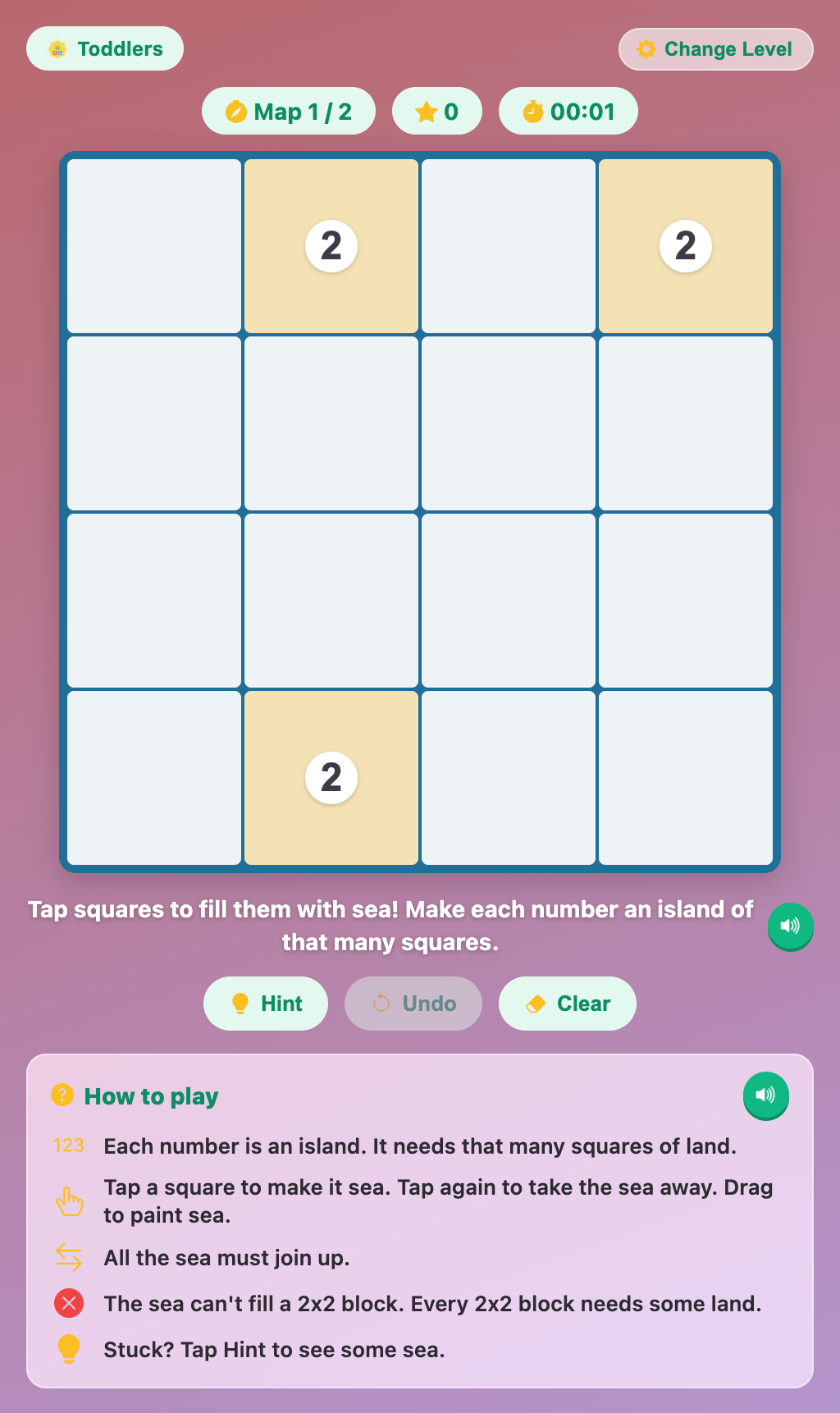
A fresh 4x4 Island Maker map for toddlers with three number 2 squares and the How to play box
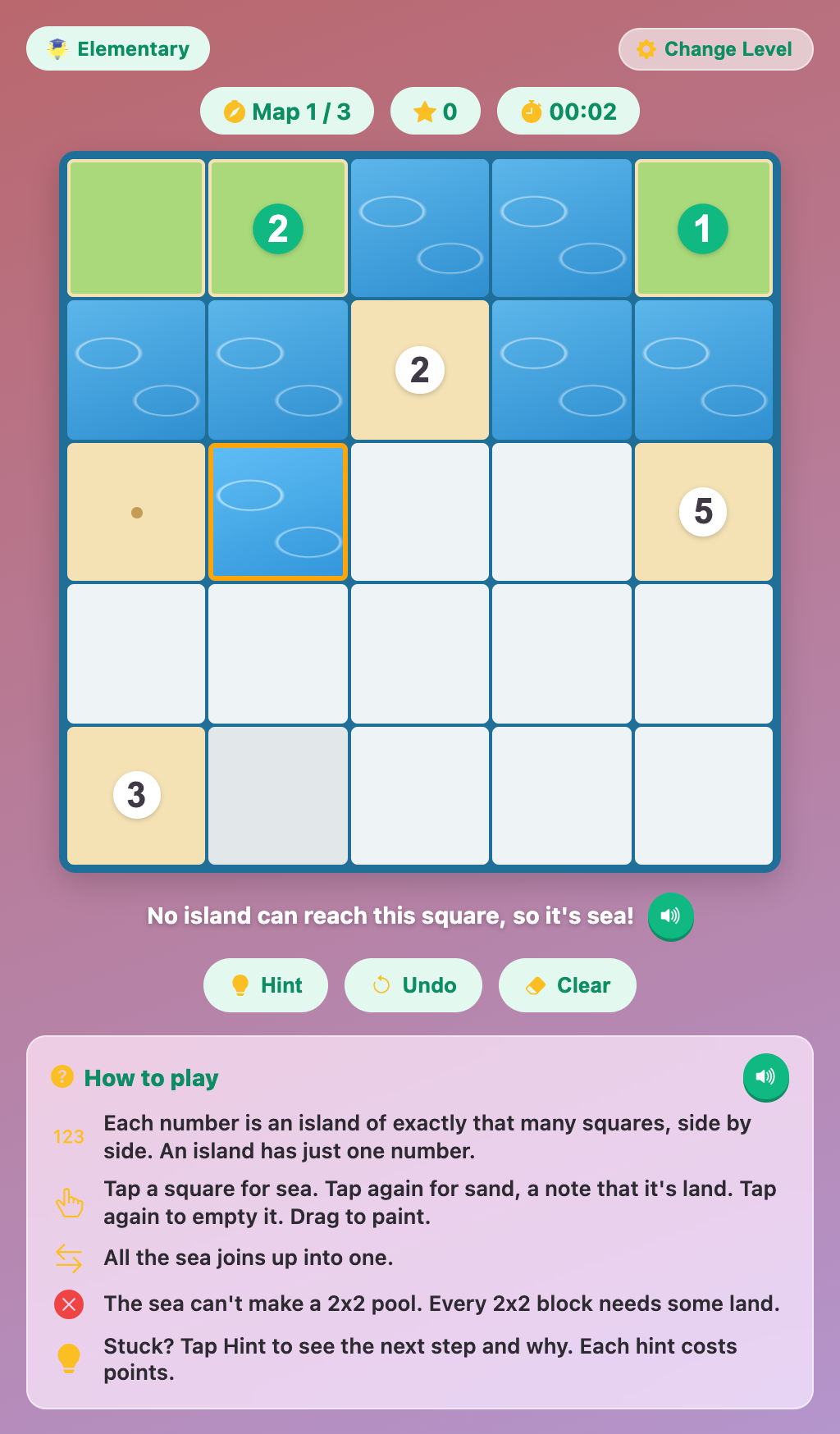
An Elementary Island Maker map with blue sea, two finished green islands, a sand note and a hinted square ringed in orange
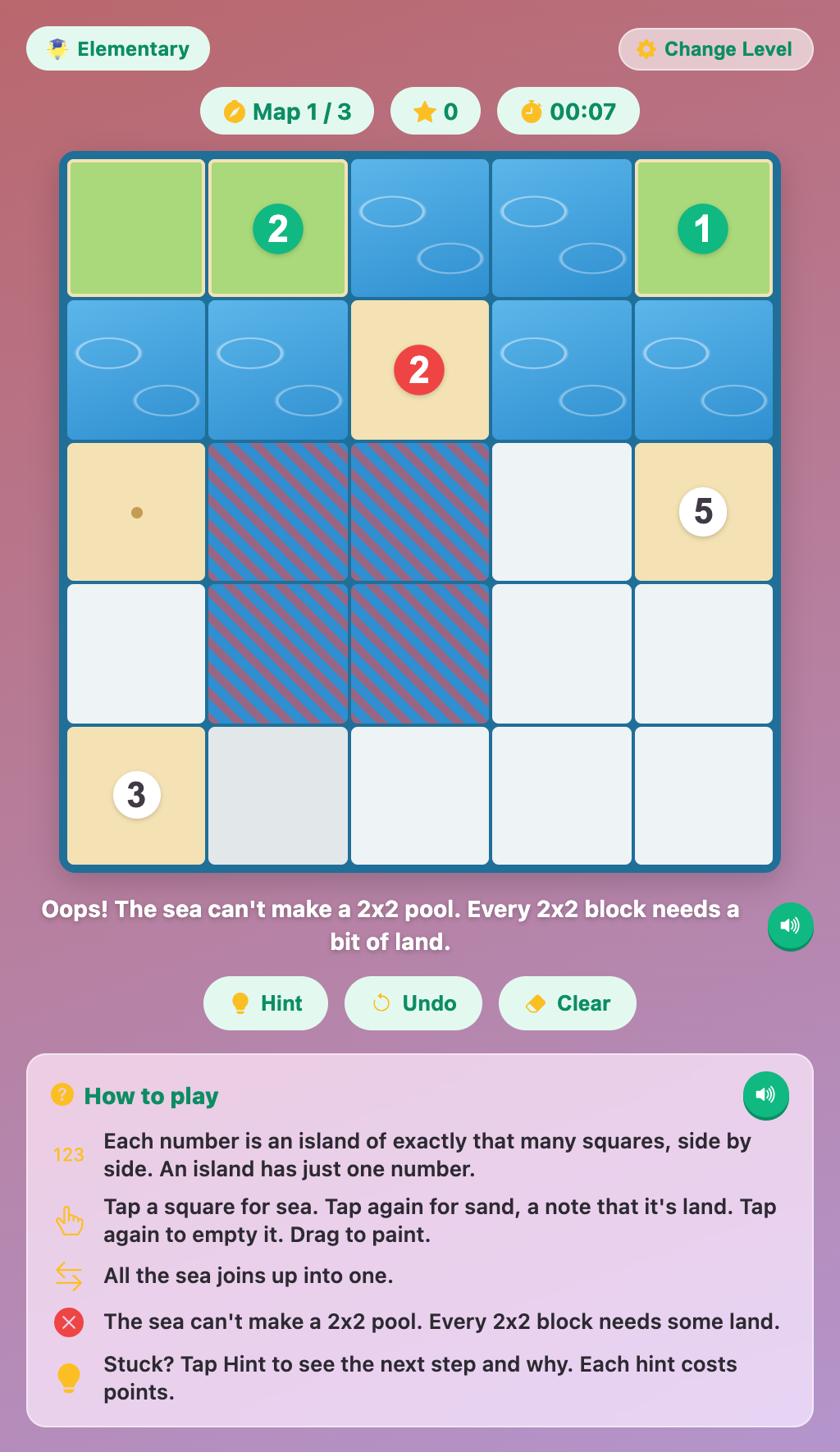
A 2x2 pool of sea striped in red on an Island Maker board, with the Oops message under the map
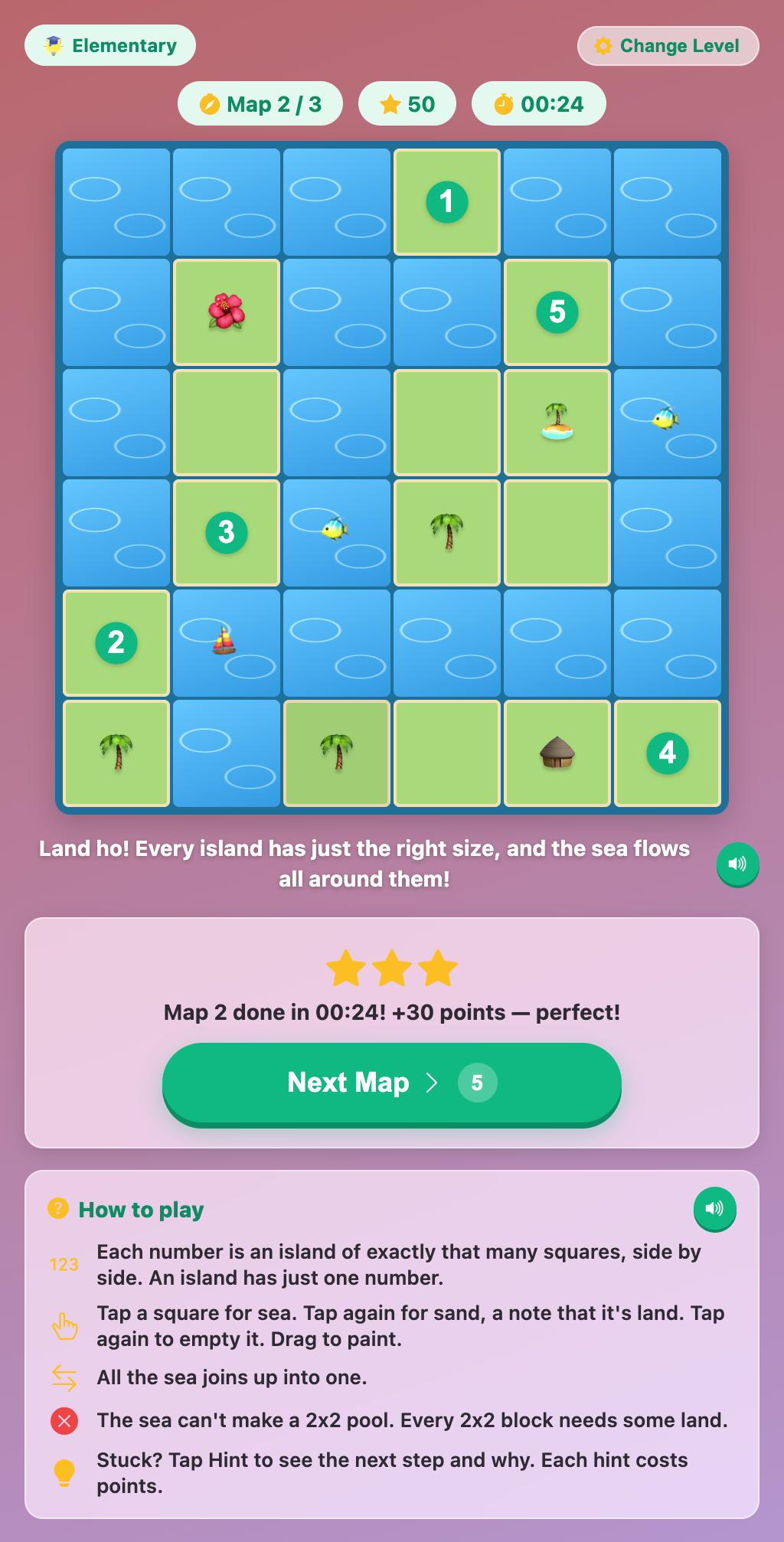
A solved Island Maker map with palm trees, a hut, fish and a sailboat, above a three-star Map done panel
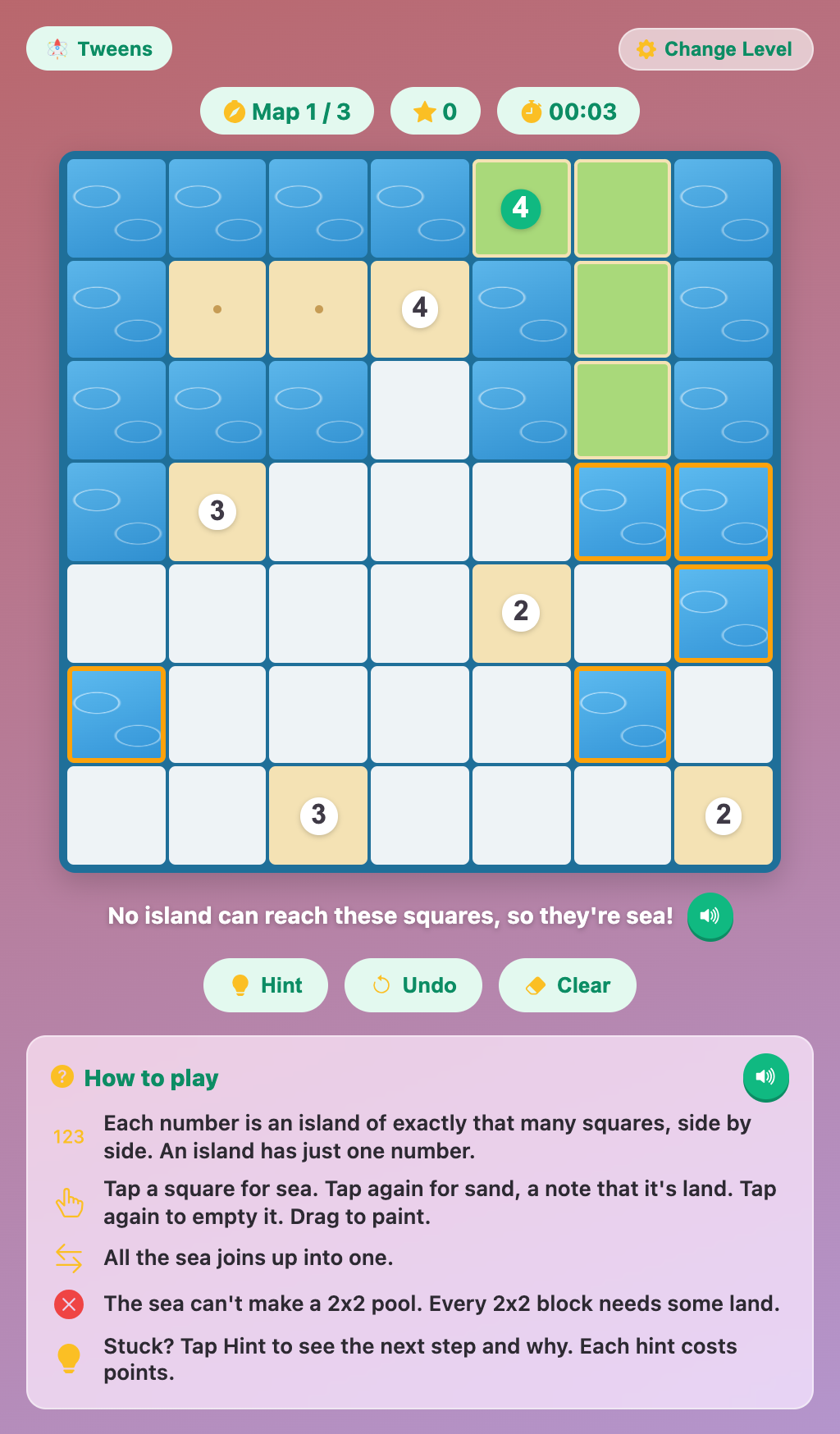
A 7x7 Tweens map in Island Maker, part filled with sea and sand, with four hinted squares ringed in orange
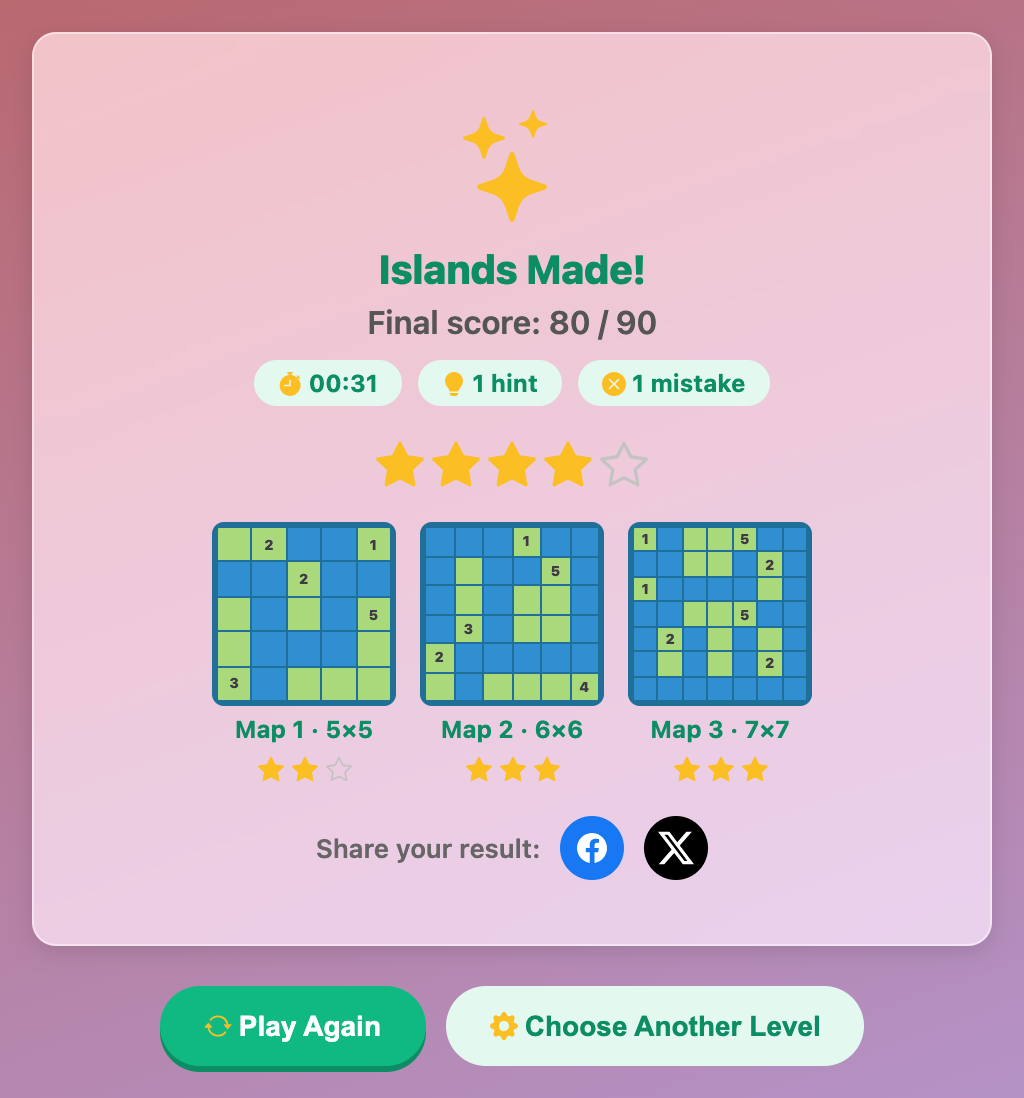
The Islands Made finish card with the final score, hints, mistakes and a small picture of each solved map
More Mind Games
 96.6K plays
4.9
Riddle Rush
Read the fun riddle and pick the correct answer before time runs out.
 38.5K plays
4.9
Crown Garden
Plant one crown in every row, every column and every colored flower bed, but crowns can't touch, not even at the corners! Tap once for an X, twice for a crown, and watch rows, columns and beds turn green as you get them right. Every garden has exactly one answer you can find with logic alone, and a hint always tells you why.
 324.6K plays
5.0
Odd One Out
Spot the one picture that doesn't belong in the group before time runs out.
 762.6K plays
5.0
City Skyline
Build a city of colorful towers! Every row and every column gets one tower of each height, and the clues around the edge tell you how many towers you can see from that side. Tall towers hide the short ones behind them, so tap a clue to look along its street. Every city has exactly one answer you can find with logic alone, and a hint always tells you why.
Most Played Games
 366.3K plays
5.0
Tic-Tac-Toe
Play a game of Tic-Tac-Toe against the computer and see if you can outsmart it.
 1.1M plays
4.9
Chess
Play classic chess in 2D or 3D against the computer or a friend, with FIDE time controls, hints, and undo.
 263.7K plays
4.9
Category Sort
Decide whether each picture is an animal, food, toy, or vehicle before time runs out.
 568.7K plays
4.9
Connect Four
Drop your pieces and be the first to connect four in a row against the computer or a friend.
Comments (38)