
Microscope Mystery
83.7K playsWhat is it? A picture starts super zoomed in and slowly zooms out: guess it early for more stars! Is it strawberry seeds, a butterfly wing, a cat's tongue or a fly's eye? Big kids also use a real-looking microscope: pick the right lens, turn the focus knob until the slide is sharp, then label onion skin, cheek cells, leaf cells, blood and pond water, and sort out what plant and animal cells have.
Brown and yellow stripes. Wiggly lines that bend like a river. A dark crack running through the middle. What could it be? In Microscope Mystery for kids, a picture starts super zoomed in and slowly zooms out, and you guess what it is before the whole thing shows. The sooner you guess right, the more stars you win. It's a free science game for ages 2 to 12 that you play right in your web browser, with no download and no sign-up.
Older players also get a real-looking microscope. You pick the right lens, turn the focus knob until a blurry slide goes sharp, and then put labels on the parts of real cells: onion skin, cheek cells, leaf cells, blood and pond water. On the Tweens level you also sort cell parts into the ones only plants have and the ones plants and animals share. Every picture and slide is drawn by the game itself, and each right answer comes with a true science fact.
🔬 Two Ways to Look Closely: Mystery Pictures and Real Slides
Microscope Mystery has two kinds of rounds. Which ones you get depends on your level.
Mystery rounds are for every age. A round window called an eyepiece (the part of a microscope you look into) shows a tiny piece of a picture, very close up. Then the view slowly pulls back. Is that red bumpy skin a strawberry or a watermelon? Are those six-sided shapes a honeycomb or a fly's eye? You pick from 3 or 4 answers, each with a picture and a name. There are 24 mystery pictures in all, from a ladybug and a snail to a snowflake, a spider web and a grain of salt.
Microscope rounds are for Elementary and Tweens. This is how scientists really look at cells. A cell is one of the tiny building blocks that every living thing is made of. You can't see one with your eyes alone, so you need a microscope and a thin slice of something, called a slide. In the game, you set up the microscope yourself and then label what you see.
The idea is the same in both: look carefully, notice small clues, and name what's really there. That's what a scientist does every day, and it's what Microscope Mystery for kids is all about.
🧭 Playing Microscope Mystery on KidWorld, Screen by Screen
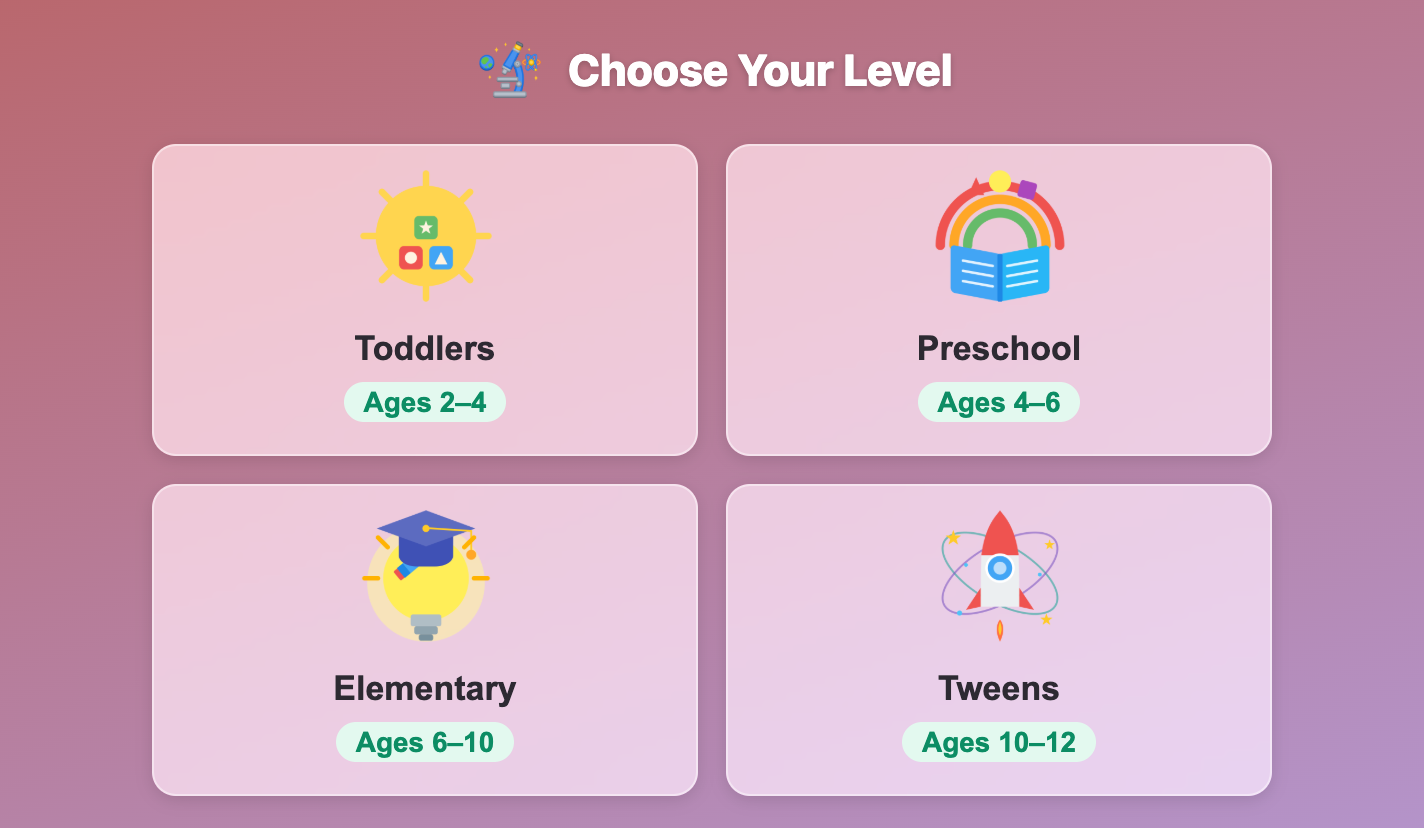
Pick your level. Choose Toddlers (ages 2–4), Preschool (ages 4–6), Elementary (ages 6–10) or Tweens (ages 10–12). If you're new, the game starts you on Elementary. Tap the Change Level button at the top to switch at any time.
Watch the eyepiece. In a mystery round, the question says "What is it?" for little kids and "What is under the magnifier?" for big kids. Under the eyepiece, a small badge shows how zoomed in you are (like ×7.0), and next to it are the stars you can still win.
Tap your answer. Click or tap an answer button, or press the keys 1 to 4. A wrong answer gets crossed out, the game says something like "It's not a fish. Keep looking!", and the zoom keeps going. A right answer zooms all the way out, shows the name on the picture, and gives you a fun fact.
Set up the microscope (Elementary and Tweens). The goal tells you which lens to use, for example "Look at onion skin with the 10x lens." The slide always starts on the weakest lens, 4x, and out of focus. Tap 4x, 10x or 40x to change the lens. Then turn the focus knob: drag the slider, tap the − and + buttons, or use the left and right arrow keys. When the badge under the eyepiece changes from "Blurry" to "Sharp", you're ready.
Label the parts. Name cards appear beside the eyepiece, each with a small hint, like "Nucleus: The dark control center". Numbered pins point at parts of the slide. Drag a card onto its pin, or tap a card and then tap the pin. It works with a mouse, and with your finger on a phone or tablet. Press Escape to put down a card you picked.
Sort the cell parts (Tweens only). Drag or tap each part into one of two boxes: "Only in plant cells" or "In plant AND animal cells".
Move on. After each round, a panel shows your stars and a fact. The Next button fills up and counts down from 5, then moves on by itself. Tap it, or press Enter or Space, to go sooner.
See your score. At the end, the "Super Scientist!" card shows your final score, a gallery of every picture and slide with its stars, and a "Look at these again" list of anything you got wrong first. Tap Play Again for new pictures, or Choose Another Level.
Use the page buttons. The 🔊 buttons read the question, the answers and the facts out loud. Around the game you'll also find buttons for fullscreen, reload (to start over) and background music.
⏱️ Beat the Zoom: How Stars and Points Work
Each round is worth up to 3 stars, and every star is worth 10 points.
In a mystery round, the zoom is split into three parts. Guess right in the first third and you get 3 stars. In the middle third you get 2 stars. After that, even once the whole picture shows, a right answer still gets 1 star. But each wrong guess takes one star away, and you can't go below 0.
In a microscope round, the lens and the focus knob are never scored, so take your time getting a sharp view. Only the labels count. With no mistakes you get 3 stars, with one or two mistakes you get 2 stars, and with three or more you get 1 star. The plant-or-animal round works the same way.
The best score is 120 points on Toddlers, 150 on Preschool and Elementary, and 180 on Tweens.
🕵️ Microscope Mystery for Kids: Detective Tricks for the Zoom Rounds
Guessing fast is good, but guessing wrong costs a star. The trick is to guess early and be sure. Here's how.
1. Read the answers before you look
The answers show up right away, while the picture is still very close. Read all of them first. Now you know what to look for. If the answers are Fish, Tree trunk, Fingerprint and Watermelon, ask yourself: which of these has wiggly stripes? That leaves only two.
2. Color is your first clue
Up close, shapes are hard to see, but color shows from the very start. Green bumps could be broccoli, a cactus or a kiwi. Red could be a strawberry, a watermelon or a ladybug. Cross out in your head every answer with the wrong color.
3. Then look at the pattern
Next, look at how the shapes repeat. Six-sided shapes in rows? Think honeycomb or fly's eye. Little dots spread over the surface? Think seeds. Lines that curve in rings? Think tree trunk or fingerprint. Spirals that curve both ways? That's a sunflower's seeds.
4. Watch out for lookalikes
On Elementary and Tweens, one wrong answer is often a picture that looks almost the same up close. These pairs are made to trick you, so check one small detail before you tap:
Strawberry or watermelon? A strawberry's seeds are tiny yellow dots on the outside. A watermelon's seeds are black and sit inside the red part.
Honeycomb or fly's eye? Both are made of six-sided shapes. A honeycomb is golden like honey. A fly's eye is red.
Tree trunk or fingerprint? Both have curvy lines. A tree trunk is yellow and brown like wood. A fingerprint has dark blue ink lines on white.
Leaf or feather? Both have a middle line with thinner lines coming off it. A leaf is green. The feather here is blue.
Pineapple or corn? Both are covered in bumps in neat rows. A pineapple's bumps are diamonds. Corn kernels are rounder and sit in straight rows.
5. Wait one more second when you're stuck
If two answers still fit, don't guess. A wrong guess takes away a star at once. Waiting a moment only takes one away when the zoom moves into the next third. So when you're truly unsure, let the picture zoom out a little more, then tap the answer you're sure of.
6. Use the keys for speed
On a computer, each answer has a number from 1 to 4. Rest your fingers on the number keys, and you can answer the very moment you know.
🧩 Cracking Four Close-Ups
Here's how a smart detective thinks through a few real rounds.
Close-up 1: the wiggly wood stripes
On Elementary, you see brown and yellow stripes at ×7.0. The answers are Fish, Tree trunk, Fingerprint and Watermelon. Fish scales overlap like tiles, and a watermelon is red and green, so those are out. A fingerprint has blue ink lines, but these lines are the colors of wood. Tap Tree trunk for 3 stars. Then you learn that in places with summer and winter, a tree grows one ring each year.
Close-up 2: white stars on green
You see green with white star shapes, each with a pale middle. The answers are Ladybug, Cat's tongue, Fingerprint and Cactus. Only one of those is green! It's a cactus, and the white stars are its spines. The fact says a cactus's spines are leaves that changed shape.
Close-up 3: the red bumps
On Tweens, the view starts 9 times zoomed in, so you see even less. Red with little dots, and the answers include Strawberry and Cat's tongue. Look at the dots. Yellow dots mean strawberry seeds. A cat's tongue is pink, with tiny hooks instead of seeds. If you can't tell yet, wait for the next part of the zoom instead of guessing.
Close-up 4: counting your stars
Say you tap Fish too early on a round. That's one mistake. Then you get it right in the middle third of the zoom. The middle third is worth 2 stars, minus 1 for the mistake, so you win 1 star. If you had waited and tapped only the right answer in that same moment, you'd have won 2 stars. That's why being sure beats being fast.
🔭 Getting a Slide Sharp Like a Lab Scientist
The microscope part isn't scored, but a sharp view makes labeling much easier.
Pick the lens the goal names
A lens is the glass that makes things look bigger. The number tells you how much bigger: 10x means ten times bigger. In the game, onion skin and pond water use the 10x lens, and cheek cells, leaf cells and blood use the 40x lens. If you pick the wrong one, the game tells you which way to go: "At 4x everything looks tiny. Try a stronger lens." or "At 40x you only see a small part. Try a weaker lens."
Turn the knob and watch the blur
The focus knob always starts a long way from sharp, and you don't know which way to turn it. Here's the trick: tap + a few times and watch. If the slide gets clearer, keep going. If it gets blurrier, turn the other way. The blur grows the further you are from sharp, so the picture always tells you if you're getting closer. When it's sharp, the badge says "Sharp" and the name cards appear.
Example: onion skin, step by step
The goal says "Look at onion skin with the 10x lens." The slide is blurry and yellow at 4x.
Tap 10x. The cells get bigger, but they're still fuzzy. The message says "Good lens! Now turn the focus knob until it's sharp."
Tap + three times. It's blurrier? Then tap − instead, and keep tapping until rows of brick-shaped cells snap into view.
Now the cards Cell wall, Nucleus and Cytoplasm appear, and you're ready to label.
🏷️ Putting Every Label on the Right Pin
A label on the wrong pin is a mistake, but the game is kind about it. It tells you what the right part looks like, never which part that pin is. Dropping a card on a pin that already has a label, or next to the pins, is not a mistake. It's only a reminder.
Start with the part you're sure of
Every slide has one part that's easy to spot. Label it first. Then there are fewer cards and fewer pins left, so the hard ones get easier.
Read the hint on each card
Each card has a tiny clue. "The dark control center" is the nucleus. "A stiff wall around a plant cell" is the cell wall. "The jelly that fills the cell" is the cytoplasm. Match the clue to what's under the pin.
What to look for on each slide
Onion skin 🧅: cells shaped like bricks. The cell wall is the thick line around each brick. The nucleus is the dark round spot at one end. The cytoplasm is the band of jelly beside the nucleus. On Tweens, the vacuole is the big clear space in the middle. Onion skin grows underground, so it has no green parts.
Cheek cells 👄: flat blue cells of all sorts of shapes. They have no cell wall, only a thin cell membrane around the edge. Find the dark nucleus, then the jelly around it.
Leaf cells 🌿: long cells with little green beans lined up along the walls. Those beans are chloroplasts, where the leaf uses sunlight to make food. Want to see what chloroplasts do with that light? Photosynthesis Factory lets you run a leaf like a food factory.
Blood 🩸: lots of red discs that are pale in the middle. Those are red blood cells, and they carry oxygen. The big one with a lumpy purple middle is a white blood cell, which fights germs. The tiny purple bits are platelets, which help stop bleeding.
Pond water 💧: a drop full of tiny living things. The amoeba is a blob with arms that stretch any way. The paramecium is shaped like a slipper and has tiny hairs all around. The algae is a long green chain of cells. On Tweens, the water flea is the tiny animal with legs and one dark eye.
🌱 The Tweens Puzzle: Plant Cell or Animal Cell?
On Tweens, one round asks "Which parts are only in plant cells?" You get six cards and two boxes. Three cards always belong in "Only in plant cells": Cell wall, Chloroplasts and Big vacuole. The other three go in "In plant AND animal cells". They come from the Nucleus, Cell membrane, Cytoplasm and Mitochondria.
Here's a handy way to think it through. Ask: "Does a plant need this because it's a plant?" Plants stand still and make food from sunlight, so they need a stiff wall to hold them up, chloroplasts to catch light, and a big bag of water to stay firm. Every living cell, plant or animal, needs a control center, a skin, and jelly inside.
Watch out for mitochondria! Lots of people think only animals have them. But plants need energy too, so plant cells have mitochondria as well. That card goes in the "plant AND animal" box. If you put a card in the wrong box, the game explains why, so even a mistake teaches you something.
👶 Which Level Fits Your Child?
Every level uses the same zoom idea, but the pictures, the number of answers and the speed change as kids grow.
Microscope Mystery for toddlers (ages 2–4)
Toddlers get 4 mystery rounds with friendly pictures, like a strawberry, a ladybug, an orange, a fish and a turtle. There are only 3 answers, the picture starts just 3.5 times zoomed in, and it takes 16 seconds to zoom out. With the site's sound on, the game reads the question and the answers out loud, and the zoom waits until the voice is done. A parent can sit beside them and ask, "What color do you see?"
Microscope Mystery for preschoolers (ages 4–6)
Preschoolers play 5 mystery rounds with 3 answers, starting 5 times zoomed in, over 14 seconds. New pictures join in, like a butterfly, a honeycomb, a feather, broccoli and a cactus. The facts are short and simple, like "Bees build honeycomb out of wax. Every little room has six sides!"
Microscope Mystery for elementary kids (ages 6–10)
Elementary kids play 3 mystery rounds and 2 microscope rounds. Mystery pictures start 7 times zoomed in, with 4 answers and often a tricky lookalike. New close-ups appear, like a spider web, a cat's tongue, a fly's eye, a snowflake and salt. In microscope rounds, they choose the lens, focus, and label 3 parts on each slide.
Microscope Mystery for tweens (ages 10–12)
Tweens get the biggest challenge: 2 mystery rounds starting 9 times zoomed in over just 12 seconds, 3 microscope rounds, and the plant-or-animal sort. There's always at least one plant slide (onion or leaf) and one animal slide (cheek or blood). Some slides get a fourth label too: the vacuole on plant cells and the water flea in pond water. It's a great match for kids learning about cells in school.
💡 Why Peering Through a Pretend Eyepiece Is Good for Kids
It trains sharp eyes. When the picture is only a few stripes, kids learn to notice color, shape and pattern before anything else. That's the same careful looking that helps with reading, puzzles and art.
It teaches thinking before tapping. A wrong guess costs a star, so kids learn to cross out answers in their head and only tap when they're sure. That small pause is a big life skill.
It makes cells real. "Nucleus" and "cell wall" are just words in a book until you put the label on one yourself. Seeing that onion cells line up like bricks, and cheek cells come in all shapes, makes the lesson stick. If your child loved meeting white blood cells on the blood slide, Germ Defender lets them line a path with hungry white blood cells to stop marching germs.
It shows how real tools work. Picking a lens and turning a focus knob is what kids will really do with a school microscope. Practicing here first makes that day less confusing and more fun.
Mistakes turn into lessons. Every wrong answer comes with a helpful message, and the "Look at these again" list at the end goes over anything that was tricky. Nothing is ever scary or mean.
👪 For grown-ups
Microscope Mystery is a calm, friendly science game with no scary pictures and no chat inside the game. Kids can play as guests with no sign-up. It practices careful looking, the names of cell parts, how plant and animal cells are different, and how to use a microscope's lens and focus. The read-aloud buttons help kids who are still learning to read. Every fact in the game is worded to be true as said, for example that onion skin has no chloroplasts because it grows underground.
So grab your detective's eyes and get ready to zoom! Whether you're naming a ladybug at age 3 or sorting mitochondria at age 11, Microscope Mystery for kids turns looking closely into a game. And if hunting for tiny clues is your favorite part, try Animal Tracks Detective next, where you follow footprints in the snow and mud to find out who walked by.
🖼️ See the Game in Action
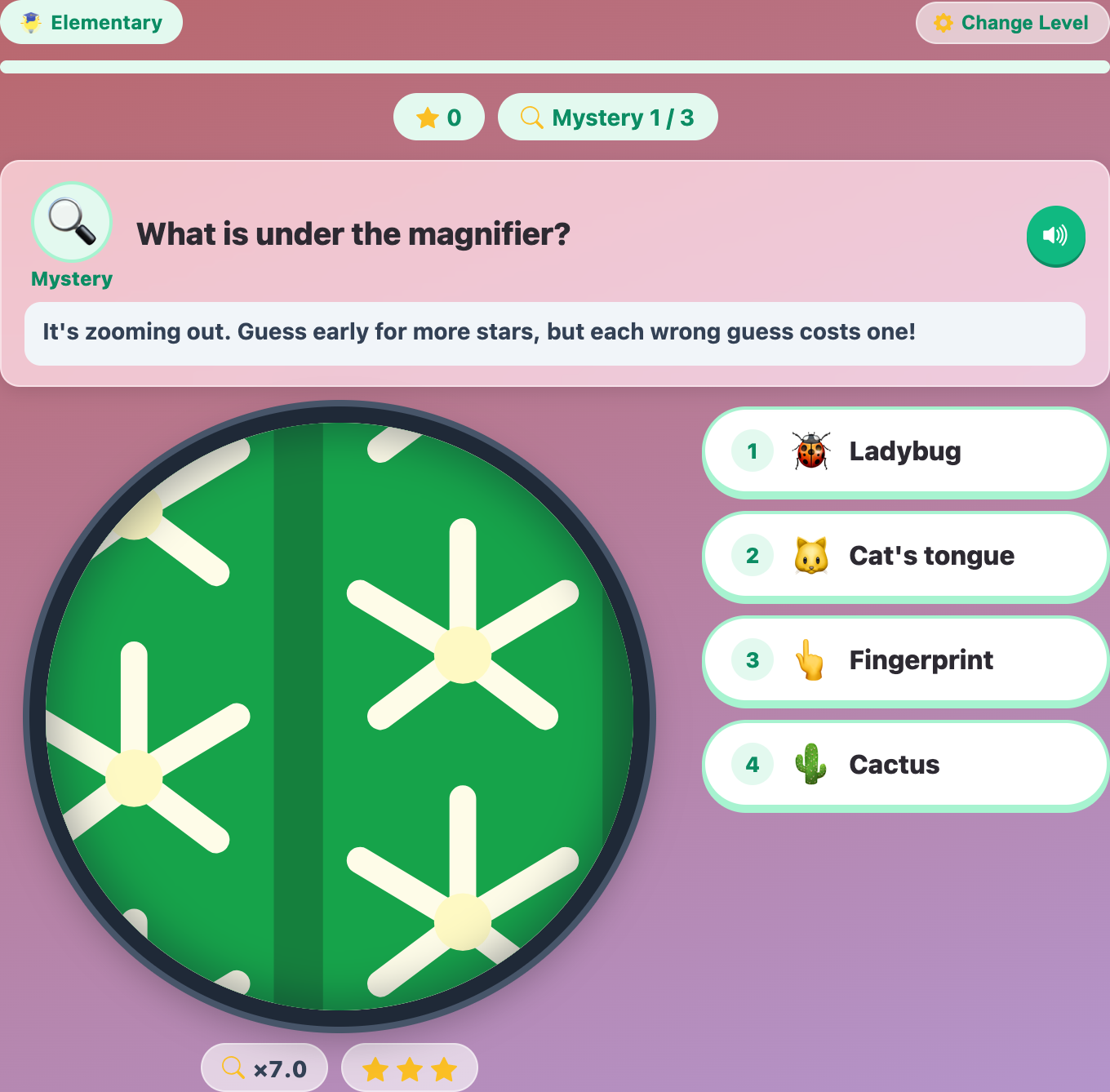
A green cactus seen 7 times zoomed in, with Ladybug, Cat's tongue, Fingerprint and Cactus answer buttons
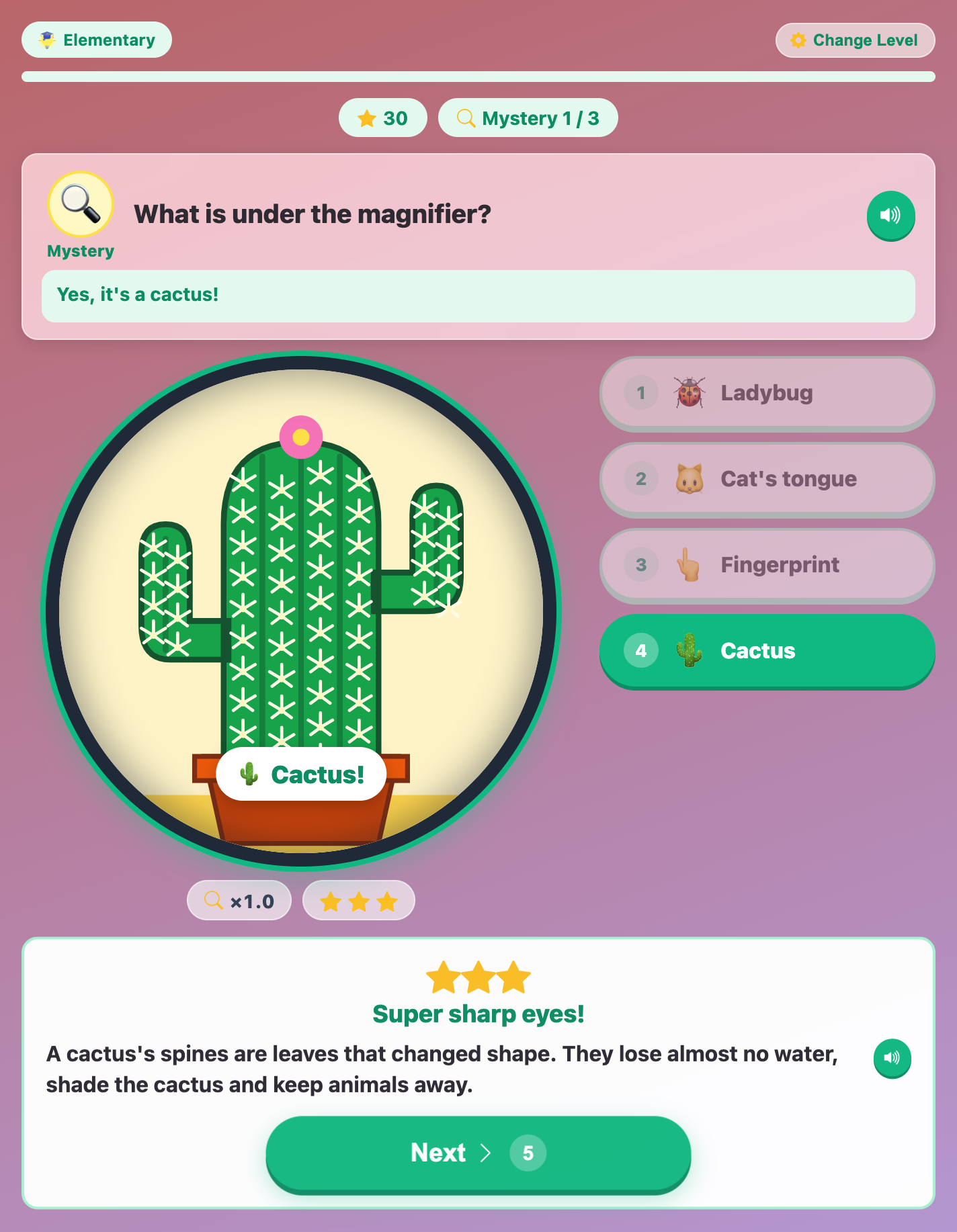
The whole cactus after a right guess, with three stars and a fact about cactus spines
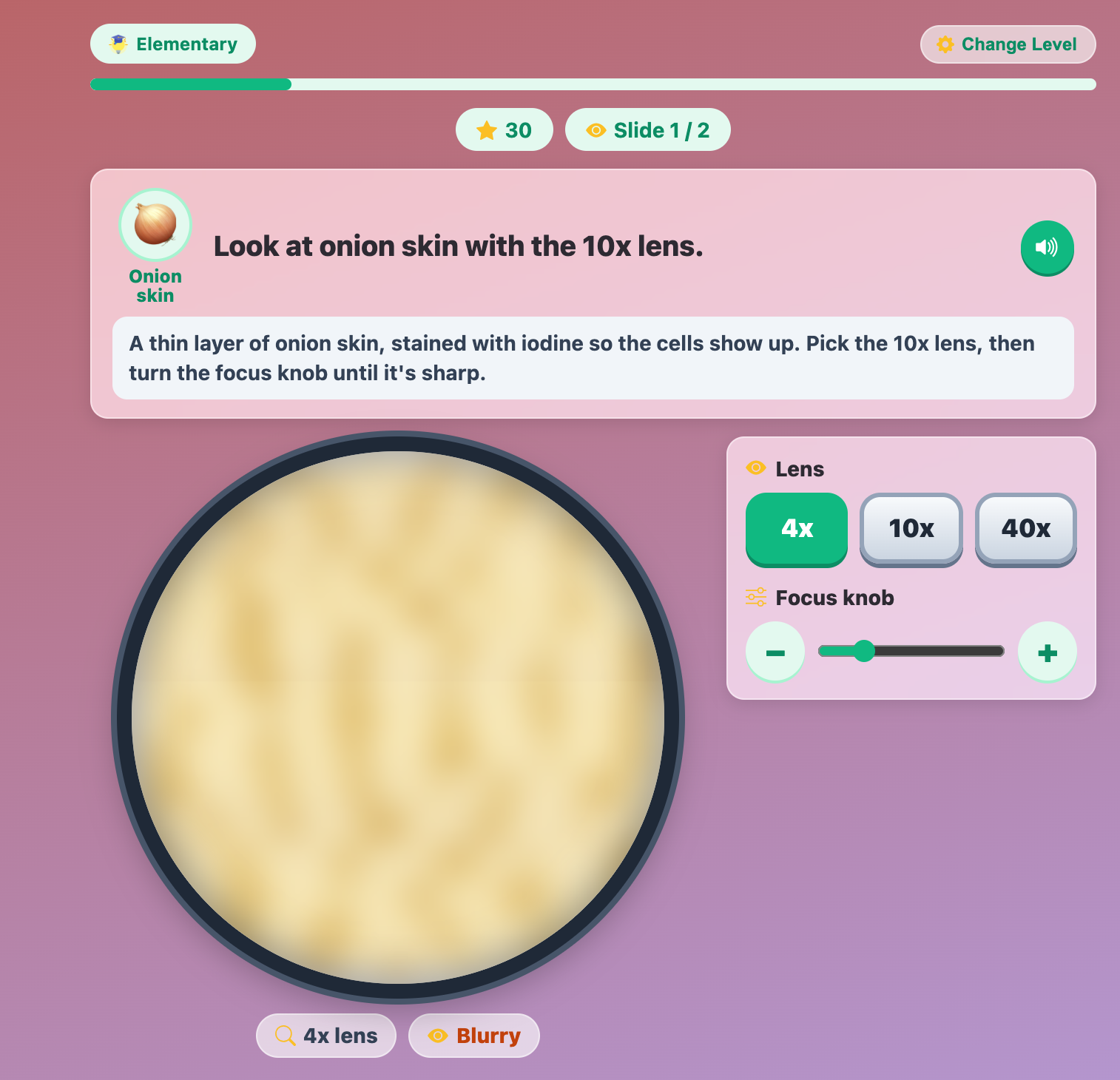
A blurry slide of onion skin at the 4x lens, with the lens buttons and the focus knob beside it
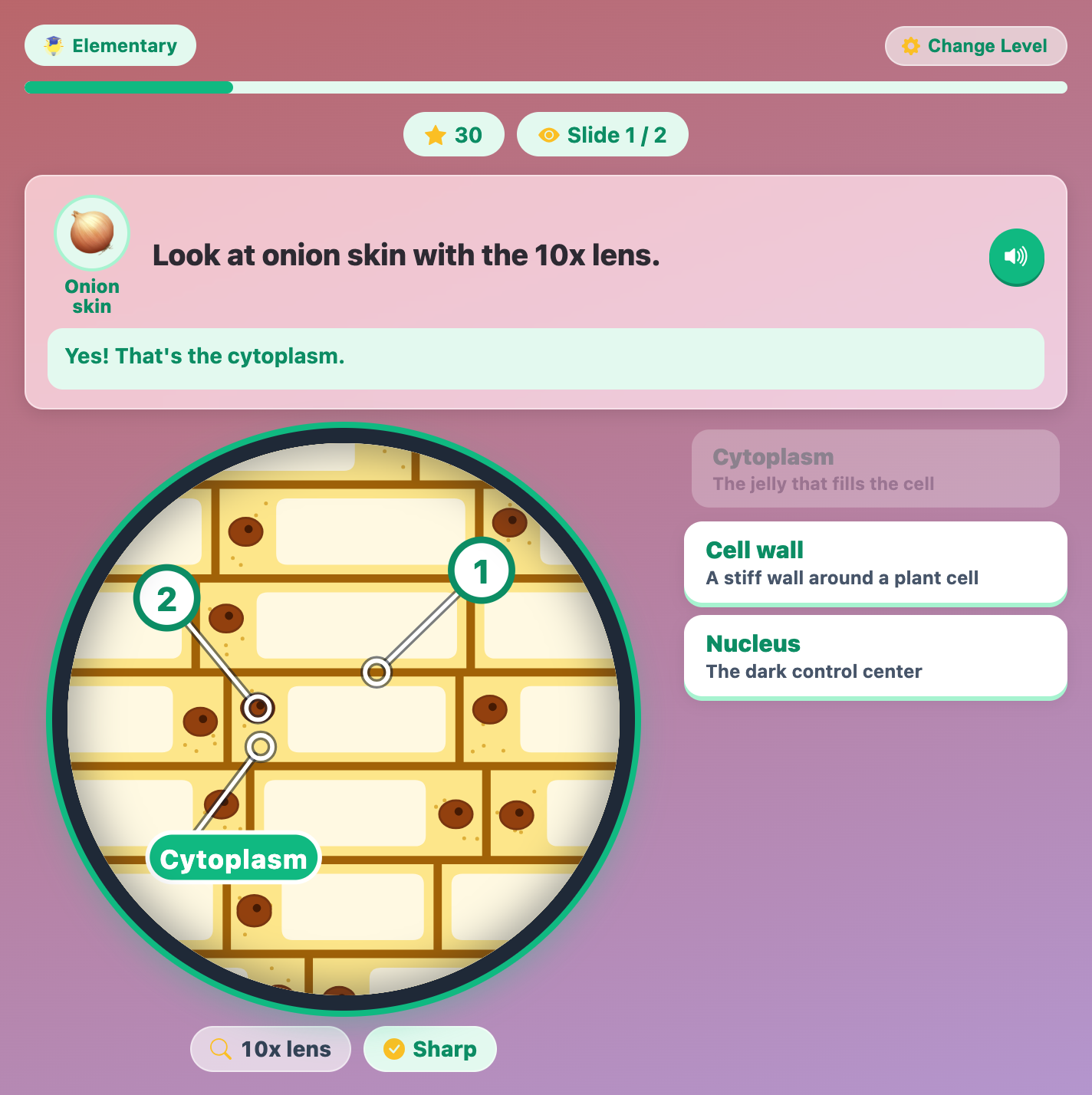
Sharp onion skin cells at the 10x lens in Microscope Mystery for elementary kids, with one label placed
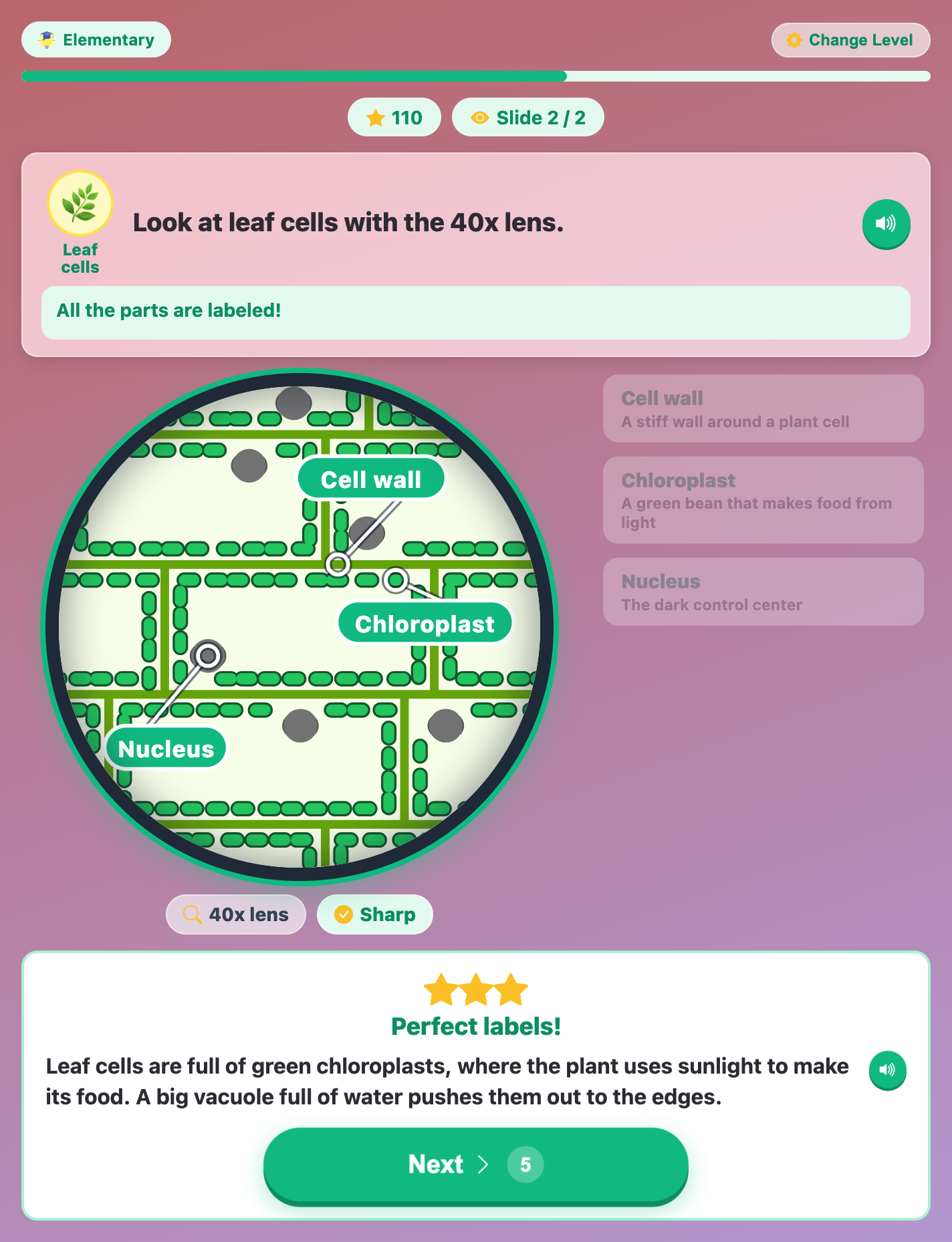
Leaf cells under the 40x lens with Cell wall, Chloroplast and Nucleus labels on their pins
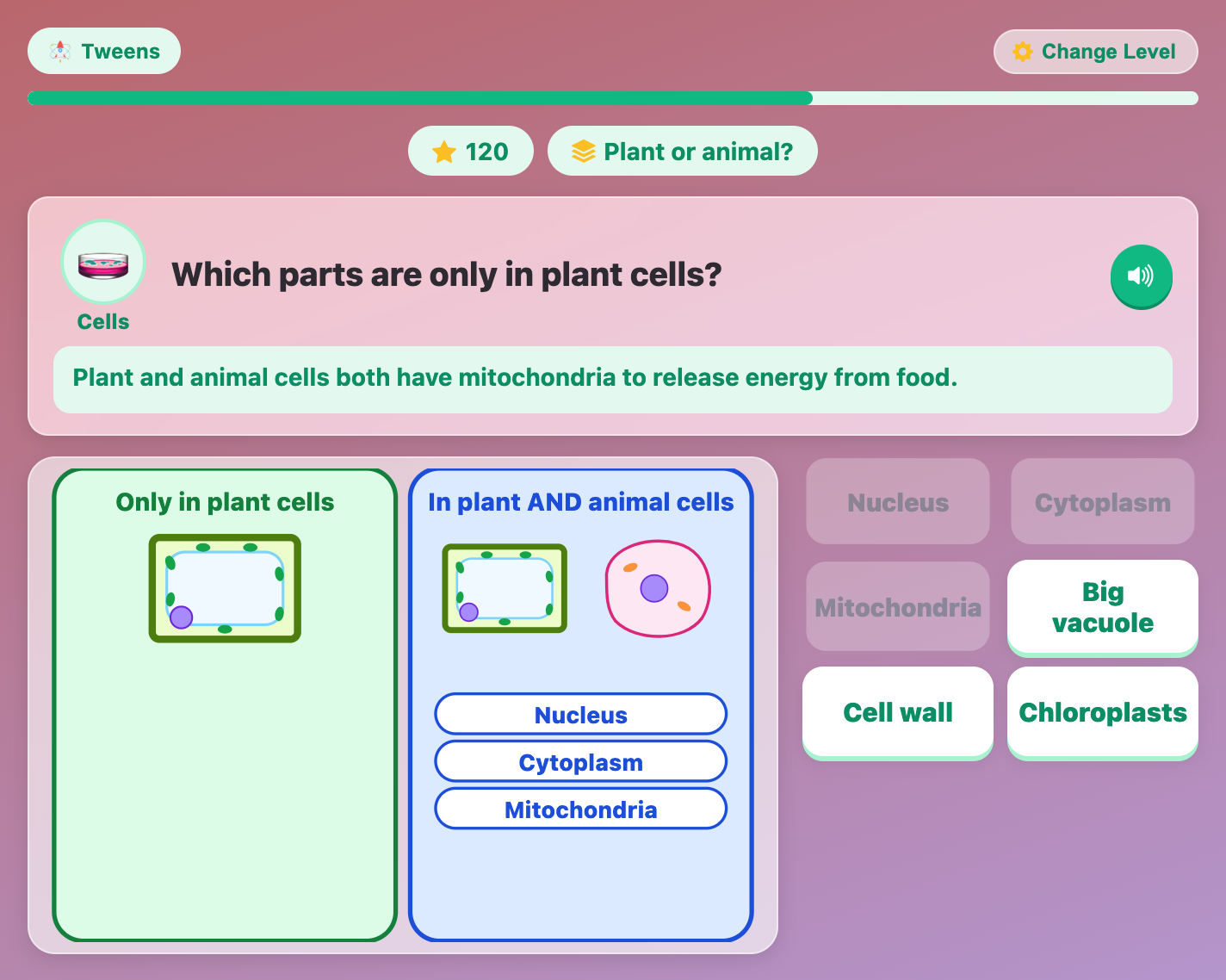
The Plant or animal round in Microscope Mystery for tweens, with cell parts sorted into two boxes
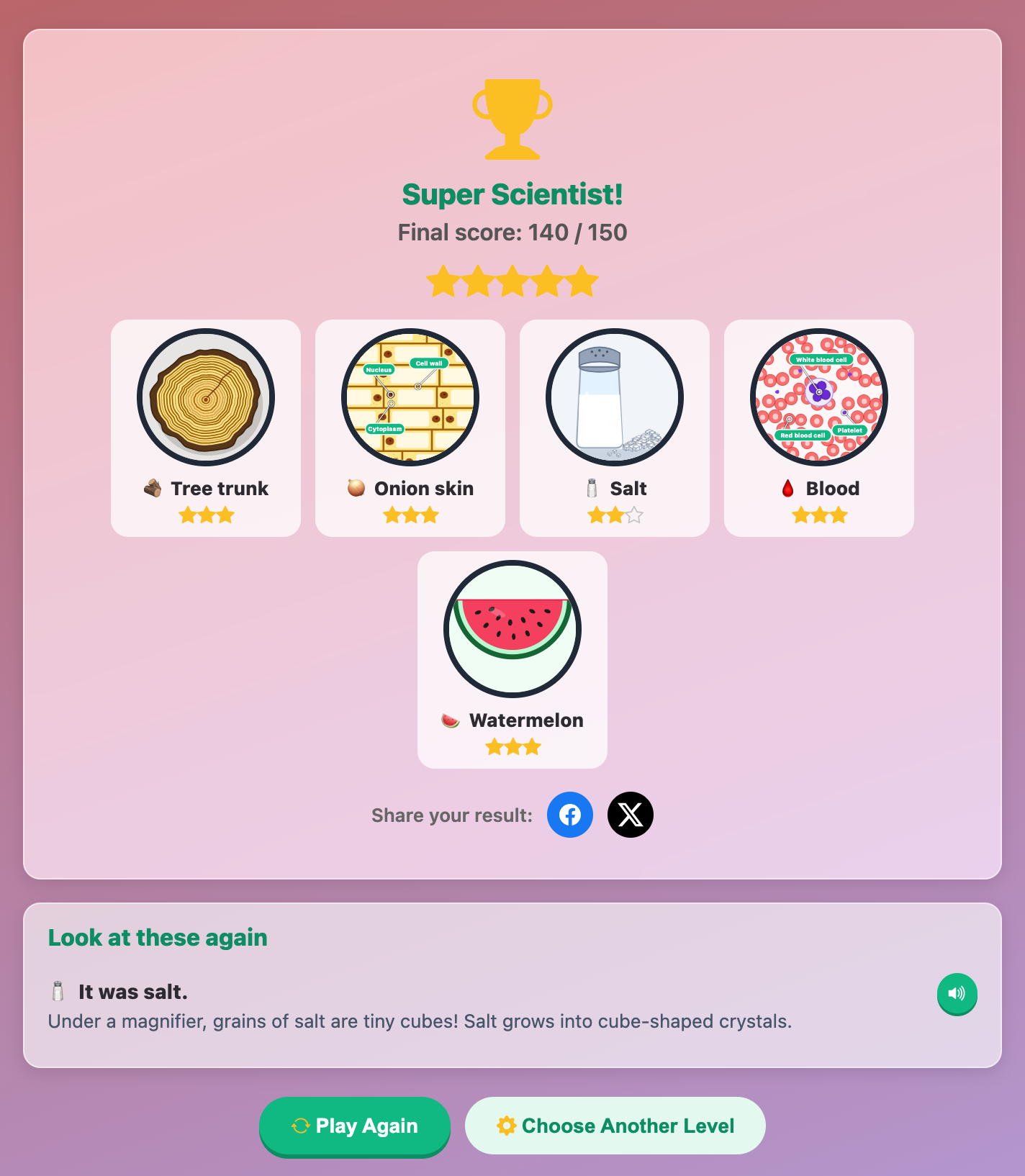
The Super Scientist card with a final score of 140 out of 150 and a gallery of every round
More Science Games
 59.5K plays
4.8
Recycling Sort
Sort everyday items into the Recycle, Compost, or Trash bin before time runs out!
 85.7K plays
4.9
Grow a Plant
Plant seeds in sunny and shady garden beds, then water, feed and protect them day by day. Watch the roots grow underground and harvest sunflowers, tomatoes, carrots and more!
 438.6K plays
4.9
Magnet Experiment
Guess which objects a magnet will pull, then drag the magnet to test every guess. Does gold stick? Does a battery?
 386.9K plays
4.9
Five Senses Match
Decide which of your five senses you would use for each everyday scene before time runs out.
Most Played Games
 1.8M plays
4.9
Color & Draw
A free-drawing canvas with colors and brush sizes to unleash your creativity.
59.5K plays
4.8
Recycling Sort
Sort everyday items into the Recycle, Compost, or Trash bin before time runs out!
 365.8K plays
5.0
Tic-Tac-Toe
Play a game of Tic-Tac-Toe against the computer and see if you can outsmart it.
 274.1K plays
5.0
Sentence Builder
Pick your age level, then tap the shuffled words in the right order to build the sentence.
Comments (40)