
Germ Defender
334.7K playsGerms are marching toward the body: stop them! Build skin walls, sticky mucus traps, hungry white blood cells and antibody makers along the path, and earn energy for every germ you beat. Between waves, pick the healthy habit: washing hands sends fewer germs, a good sleep heals, and a vaccine trains your defenders. Big kids learn how the immune system works and why antibiotics don't work on viruses.
Ah-choo! A sneeze just sent a cloud of germs into the air, and some of them are heading straight for a child's body. Germ Defender for kids is a free science game where you stop them. You build skin walls, sticky mucus traps, hungry white blood cells and antibody makers along a winding blood vessel, and every germ you beat earns energy for more defenders. It works for children from about 2 to 12, and it teaches two things at once: how your body fights germs, and which everyday habits help it win.
Between waves of germs, a healthy habit card pops up with a question. Should you wash your hands before a snack? Will an antibiotic help a cold? Your answer gives you points, and the habit itself helps your body in the next wave. Washing hands sends fewer germs, a good sleep brings hearts back, and a vaccine trains your defenders to spot the flu. You play right here in your browser, with no download and no sign-up.
🦠 Germ Defender for Kids: A Battle Inside the Body
Germ Defender is a tower defense game. That means things walk along a path, and you place helpers beside the path to stop them before they reach the end. Here, the path is a pink blood vessel full of drifting red blood cells. It snakes from the left edge of the screen to a smiling child's face in the bottom right corner.
Next to the vessel there are eleven round pads with a plus sign. That's where most defenders go. On the vessel itself there are two dashed spots, and only a Skin Wall can sit there. The child has 10 hearts. Every germ that reaches the child takes hearts away, and the face changes from a big smile to a flat mouth, and then to a sick face with a thermometer.
The good news: the game never ends early. Even a sick body can get better, so you always play every wave to the end.
🛡️ Meet Your Four Body Defenders
Each defender is a real part of your immune system. Your immune system is the team inside your body that keeps germs out and fights the ones that get in. Each one costs ⚡ energy, shown on its card in the tray under the map.
🧱 Skin Wall (30 energy)
Your skin is a wall that keeps most germs out. In the game, a Skin Wall sits across the blood vessel on a dashed spot. Germs can't walk past it. They stop, pile up and chew on it until it breaks. A broken wall lets them through, but every wall heals itself at the end of the wave.
🟢 Mucus Trap (40 energy)
Mucus is the sticky stuff in your nose and throat. It traps germs, and tiny hairs called cilia sweep it away. In the game, the Mucus Trap is a green blob with a smile. Every germ inside its circle moves at half speed.
⚪ White Blood Cell (50 energy)
White blood cells hunt germs and eat them. Big kids learn their science name too: phagocytes, which means "cells that eat". In the game, a White Blood Cell reaches out and bites a germ about once a second. It always picks the germ in its circle that is closest to the body, so it goes after the most dangerous one first.
🔵 Antibody Maker (60 energy, Elementary and Tweens)
Antibodies are tiny Y-shaped markers that stick to germs. The Antibody Maker shoots them at germs that aren't marked yet. A tagged germ moves slower for 5 seconds and gets eaten twice as fast. The antibodies only do a little harm by themselves, so this defender works best next to White Blood Cells.
⬆️ Make stronger
Tap any defender you have built to see its circle and its fact. A Make stronger button appears, and you can use it once per defender. A stronger White Blood Cell takes bigger, faster bites. A stronger Mucus Trap is stickier and reaches wider. A stronger Antibody Maker shoots faster and farther, and a stronger Skin Wall is thicker. When a defender is fully upgraded, the button says ⭐ Strong!
🧫 Know the Germs on the March
Bacteria are green capsules with wiggly tails. Bacteria are tiny living things. Most are harmless or even helpful, but some make us sick. Each one costs 1 heart if it gets in.
Cold viruses are small, spiky and purple. They are weaker than bacteria but much faster. A virus isn't a cell at all: it can only make more of itself inside your body's cells. Each one costs 1 heart.
Flu viruses (Elementary and Tweens) are big and tough. They need lots of bites and cost 2 hearts each.
The bacteria clump (Tweens, last wave only) is a huge, slow blob of bacteria. It costs 3 hearts if it reaches the body.
The first time a new kind of germ shows up, a banner says "New germ!" and the message box tells you a true fact about it. Germs also get a little tougher with every wave, so a defense that was plenty in wave 1 needs help by wave 4.
🕹️ How to Play Germ Defender on KidWorld
Choose your level. Pick Toddlers, Preschool, Elementary or Tweens. If you haven't picked a level before, the game opens at Elementary. Press Change Level at the top any time to switch.
Pick a defender. Tap a card in the tray, or press the keys 1 to 4. The message box tells you what it does and where it goes. Your pick stays picked, so you can place several in a row.
Place it. Tap a glowing pad beside the vessel. A Skin Wall goes on a dashed spot on the vessel instead. If you don't have enough energy yet, the message box tells you to stop more germs first.
Read the plan for the next wave. The message box lists the germs coming, such as "6 bacteria" or "3 flu viruses, 4 bacteria, 3 cold viruses".
Press Start wave. You can also press Enter. Germs leave the left edge one after another.
Keep defending. You can place and upgrade defenders while the wave is moving. Pause stops everything so you can think (the space bar works too), and Fast makes the wave go twice as fast. At Toddlers and Preschool, you can also tap a germ to squirt soap on it.
Answer the habit card. After each wave except the last, you see how many germs you stopped, then a question with three answers. Tap one, or press 1, 2 or 3. You'll see the right answer, why it's right, and what the habit did for your body. Then press Next wave, or wait for its 8-second countdown.
See your result. After the last wave, the finish card shows your final score, up to 5 stars, how many hearts the body kept, and how many germs you stopped in every wave. Any habit you got wrong is listed under "Look at these again". Press Play Again or Choose Another Level.
Use the page buttons. The buttons around the game make it fullscreen, reload it, and turn the music on or off. Every 🔊 button reads the text out loud.
Germ Defender works with a mouse, with a keyboard, and with your finger on a phone or tablet.
🧼 Healthy Habit Cards: Choices That Change the Next Wave
The habit cards are what make Germ Defender different from other defense games. The card says only "Healthy habit time!" until you answer, so its title can't give the answer away. Then it shows the habit, such as 🧼 Wash your hands or 😴 Rest and sleep.
Here's the kind part: the habit helps your body even if you pick the wrong answer. A right answer adds 10 points to your score. This is what each habit does:
🧼 Wash your hands and 🤧 Cover your sneeze: the next wave has about 30% fewer germs.
😴 Rest and sleep and 🤒 Catching a cold: the body gets 3 hearts back.
🩹 Look after a cut: every Skin Wall gets stronger. If you have no wall yet, you get one for free.
💉 Get a vaccine: flu viruses get a gold ring. Your defenders know them now, so they beat them twice as fast.
🥦 Eat well and 🌡️ A fever: you get 50 extra energy.
💊 Medicine from the doctor (Tweens): you get one dose of antibiotic medicine to use in a wave.
The 🥦 Eat well card shows that healthy food helps your germ fighters. If you liked that card, Healthy Plate Chef, a game about building balanced meals, is a tasty next step.
⭐ Points, Stars and Hearts
Each wave is worth up to 10 points. Stop every germ and you get all 10. Let some in and you get less. A germ that costs more hearts also costs more points, so one flu virus slipping by hurts twice as much as one cold virus. Every right habit answer adds 10 more. The best score is 70 at Toddlers, 90 at Preschool, 110 at Elementary and 130 at Tweens.
After each wave, the habit card shows 1 to 3 stars for that wave: 3 stars means a perfect or nearly perfect wave. On the finish card, 90% of the best score or more earns a gold trophy and 5 stars.
🏆 How to Win at Germ Defender: Smart Moves for Every Wave
These tips go from easy to clever. Each one says what to do and why it works in this game.
1. Build a germ trap at a wall
A Skin Wall alone doesn't beat any germs. It only stops them. But stopped germs stand still, and a germ that stands still is easy to bite. So put White Blood Cells right next to a wall. The germs pile up, and your defenders eat them one by one while they chew.
2. Check the circle before you count on it
Tap a defender you have built to see its circle. With a mouse, you can also point at an empty pad while a defender is picked, and its circle appears before you build. Only germs inside the circle get bitten or slowed. Some pads are close to the wall but just too far away, so look before you trust a spot. The best pads have a circle that covers a corner of the vessel, where germs stay inside it for longer.
3. Slow them down before the biters
Put a Mucus Trap where germs arrive just before your White Blood Cells. Germs at half speed spend twice as long inside the biting circle, so each White Blood Cell gets more bites. This matters most for fast cold viruses, which can zip past a lonely biter.
4. "Make stronger" is a bargain
A new White Blood Cell costs 50 energy. Making one stronger costs only 45, and the stronger one eats more than twice as fast as before. Its circle grows a little too. If your biter sits in a good spot, upgrading it is often better than building a second one somewhere else.
5. Plan for the germs on the list
Read "Next wave" in the message box before you press Start. Lots of cold viruses? Add a Mucus Trap. Flu viruses coming? Make sure an Antibody Maker can reach them, because tagged flu viruses are eaten twice as fast. A big wave of bacteria? Strengthen your walls.
6. Pair antibodies with biters
The Antibody Maker's darts are weak, but the tag they leave is strong. Put an Antibody Maker where its long circle covers the vessel just before your White Blood Cells. The germs get tagged, slow down and then get bitten twice as hard. After the vaccine card, flu viruses already take double damage, so the Antibody Maker aims at the other germs first.
7. Keep spending during the wave
Every germ you stop pays energy: 6 for a bacterium, 5 for a cold virus, 10 for a flu virus and 30 for the clump. You don't have to wait for the wave to end. If energy piles up while germs are still coming, build or upgrade right away.
8. Squirt soap near the body (Toddlers and Preschool)
At the two youngest levels, tapping a germ squirts soap on it. A few squirts beat one germ. Tap the germ that is closest to the child, because that one is about to cost a heart.
9. Use Pause and Fast wisely
Pause when the screen gets busy, so you can choose your next defender calmly. Use Fast only when your defense is clearly winning. It saves time, but everything happens twice as quickly, including germs reaching the body.
10. Never give up on a sick body
Losing hearts doesn't end the game, and later waves still give full points if you stop every germ. The 😴 Rest and sleep card can also bring 3 hearts back. A bad wave 1 can still end with a great score.
🔍 Five Moments, Played Out
Example 1: A toddler's first wave
Wave 1 at Toddlers has 4 bacteria, and you start with 120 energy. The White Blood Cell is already picked, so a toddler only has to tap two glowing pads near the start of the vessel. That's 100 energy, with 20 left over. Press Start, and while the bacteria wiggle along, tap them to squirt soap. A toddler's bacterium only needs about three squirts.
Example 2: An Elementary start that goes wrong, and one that works
Wave 1 at Elementary has 6 bacteria, and you have 130 energy. One idea is a Skin Wall, a Mucus Trap and one White Blood Cell. It looks smart, but one biter is too slow. Three bacteria chew on the wall at once, the wall breaks, and most of the bacteria walk on to the body.
A better start: a Skin Wall on the first dashed spot (30), plus two White Blood Cells on pads whose circles both cover that wall (50 + 50). That spends exactly 130. Now two biters share the work while the germs are stuck, and their rewards pay for a Mucus Trap before wave 2.
Example 3: The flu arrives (Elementary)
After wave 3, the habit card asks: "How does a vaccine help you?" The answer is "It trains your body to know a germ". Right or wrong, your defenders get trained. Wave 4 brings 3 flu viruses, 4 bacteria and 3 cold viruses. The flu viruses now wear a gold ring and take double damage, so your White Blood Cells beat them twice as fast, and your Antibody Makers can focus on the bacteria and cold viruses.
Example 4: The medicine dose (Tweens)
Before wave 4 at Tweens, the card says a doctor found strep throat, which is caused by bacteria. It asks what an antibiotic attacks. The answer is bacteria. You get a 💊 Medicine ×1 button, and wave 4 is the right place for it: 12 bacteria and 2 cold viruses. Don't press it the moment the wave starts. Wait until lots of bacteria are on the vessel, then tap it. Every bacterium on the path is beaten at once, and each virus shows "No effect!", because antibiotics don't work on viruses.
Example 5: Thinking through a habit card
"How long should you scrub your hands with soap?" The answers are "About 20 seconds", "One second" and "Until they look clean". "One second" is too short for soap to work. "Until they look clean" sounds sensible, but germs are far too small to see, so hands can look clean and still have germs on them. The right answer is about 20 seconds, which is as long as singing Happy Birthday twice.
🎒 Which Level Fits Your Child?
Germ Defender for toddlers (ages 2–4)
Four short waves of slow bacteria and cold viruses. Only three defenders are in the tray, the White Blood Cell is picked from the start, and tapping germs squirts soap. The habit cards are simple: wash your hands, sleep and cover your sneeze. When the site's sound is on, the game reads its messages and questions aloud. A grown-up can sit beside them and help with the first few taps.
Germ Defender for preschoolers (ages 4–6)
Five waves with a few more germs that move a little faster. Soap taps still help, and a new card teaches what to do with a scraped knee. Everything is still read aloud with the sound on, so children who can't read yet can play on their own.
Germ Defender for elementary kids (ages 6–10)
Six waves, the Antibody Maker joins the tray, and tough flu viruses arrive from wave 4. There is no soap here, so planning your defenders is what counts. The cards cover hand washing, why cuts matter, vaccines, covering a cough and eating well.
Germ Defender for tweens (ages 10–12)
Seven waves of faster, tougher germs, with 150 energy to start. The facts use real science words like phagocytes, antigens and memory cells. Tweens learn why antibiotics work on bacteria but not on viruses, use a medicine dose in the game, find out what a fever does, and face a giant bacteria clump in the final wave.
💪 What Kids Learn While Saving the Day
The body has layers of protection. Kids see that skin and mucus come first, then white blood cells, then antibodies. When a wall breaks and germs rush in, they understand why a cut needs a bandage.
Germs are real, even when you can't see them. The game keeps saying that germs are too small to see, which is why washing hands matters even when they look clean. To see how tiny things look up close, Microscope Mystery, a zoom-and-guess game with a real-looking microscope, makes a great follow-up.
Good habits have results. Kids watch a washed-hands card take germs out of the next wave, and a good night's sleep bring hearts back. That turns "wash your hands" from a rule into something they understand.
Planning ahead. Reading the next wave and choosing where to spend energy is real problem solving. Kids learn to stop, look at the circles and think before they build.
If your child wants to explore the body more, Heartbeat Lab, an experiment about exercise and your heart, shows another body system at work.
👪 A note for grown-ups
Germ Defender is gentle. The germs are cartoon characters with little faces, nothing is gory, and a sick child only shows a thermometer. The game never ends in failure. The health facts follow common advice: scrub hands with soap for about 20 seconds, sneeze into a tissue or your elbow, and take antibiotics only when a doctor prescribes them. No food is ever called bad, and the game never claims that a food or vitamin cures anything. It's a nice way to start a talk about hand washing or a coming vaccine, but it is not medical advice.
It plays free in the browser, with no download and no sign-up, on computers, tablets and phones.
Ready to guard the body? Pick your level, build your first White Blood Cell and press Start. Germ Defender for kids turns every sneeze, scrape and soapy scrub into a battle you can win. Good luck, defender! 🧼🛡️
🖼️ See the Game in Action
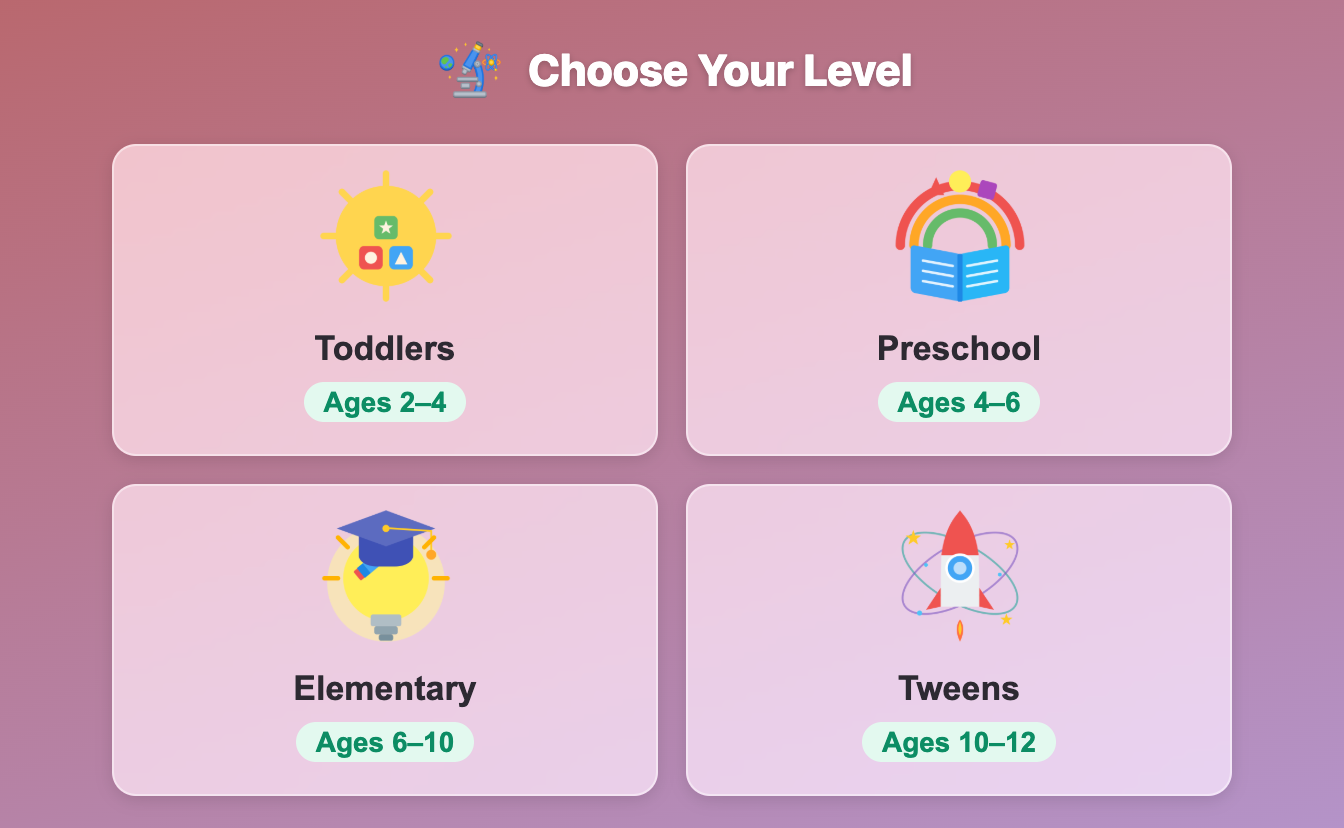
The Choose Your Level screen in Germ Defender, with Toddlers, Preschool, Elementary and Tweens cards
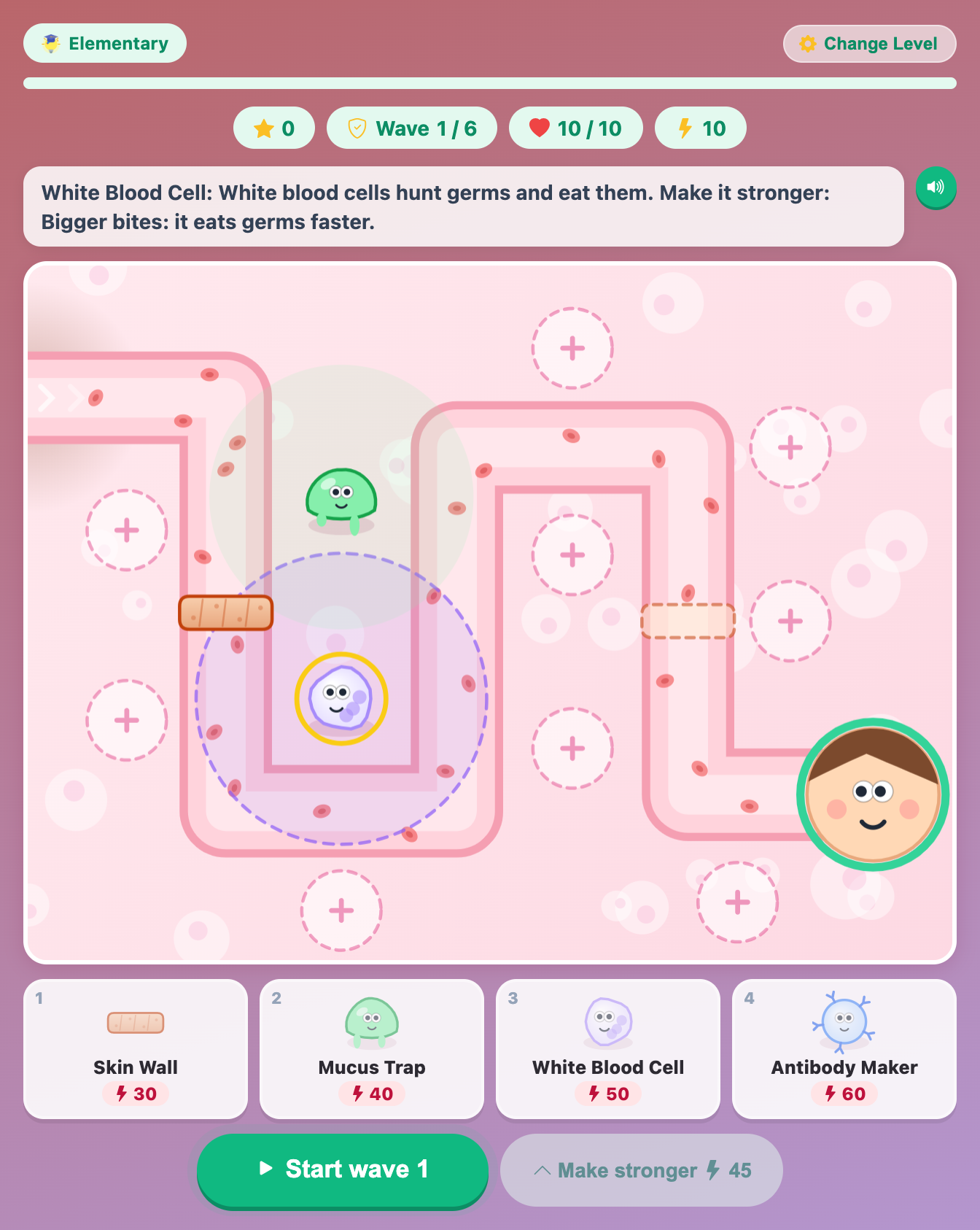
A white blood cell, a mucus trap and a skin wall placed by the blood vessel before wave 1 in Germ Defender for elementary kids
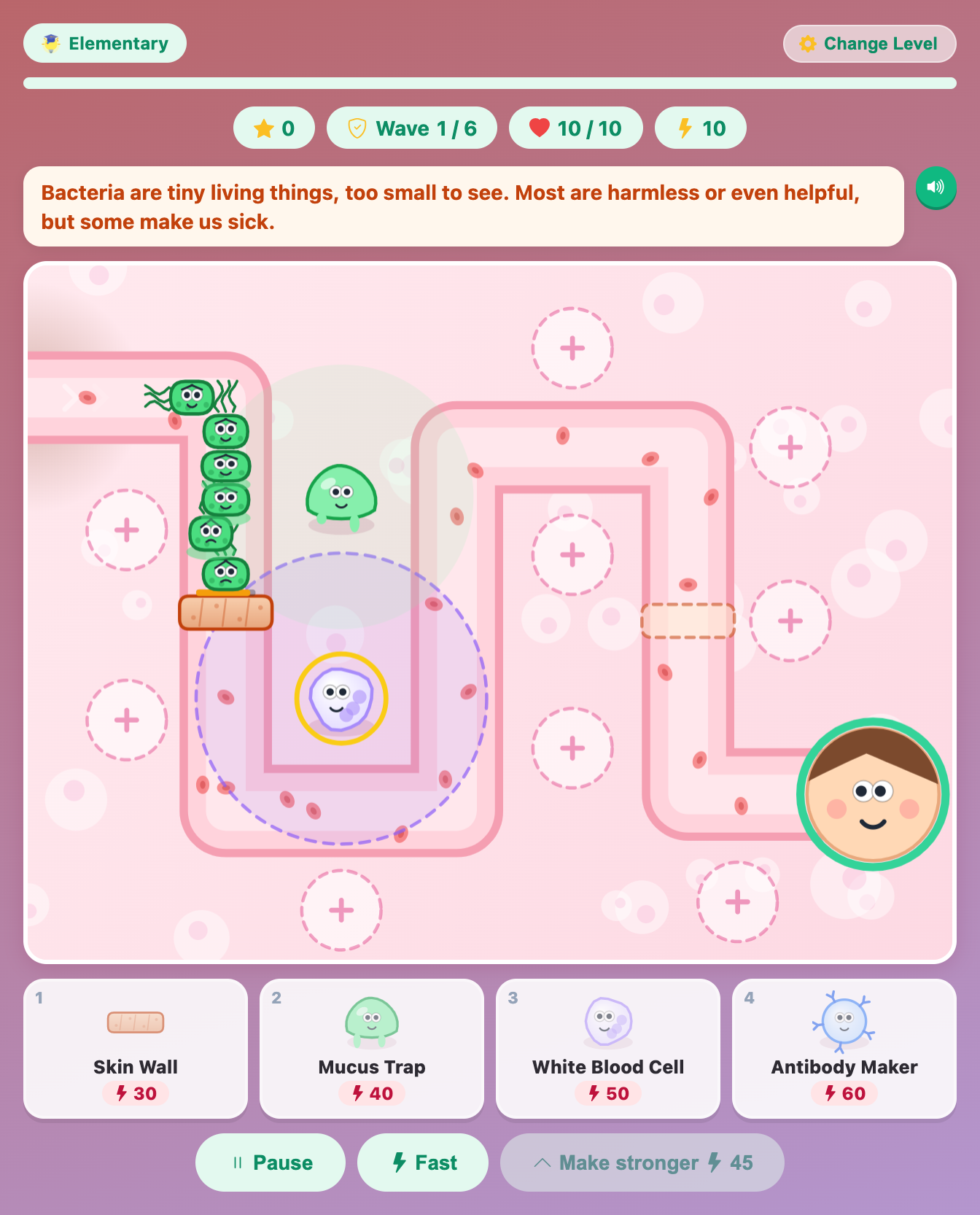
Six green bacteria piled up against a skin wall, chewing on it, in Germ Defender for kids
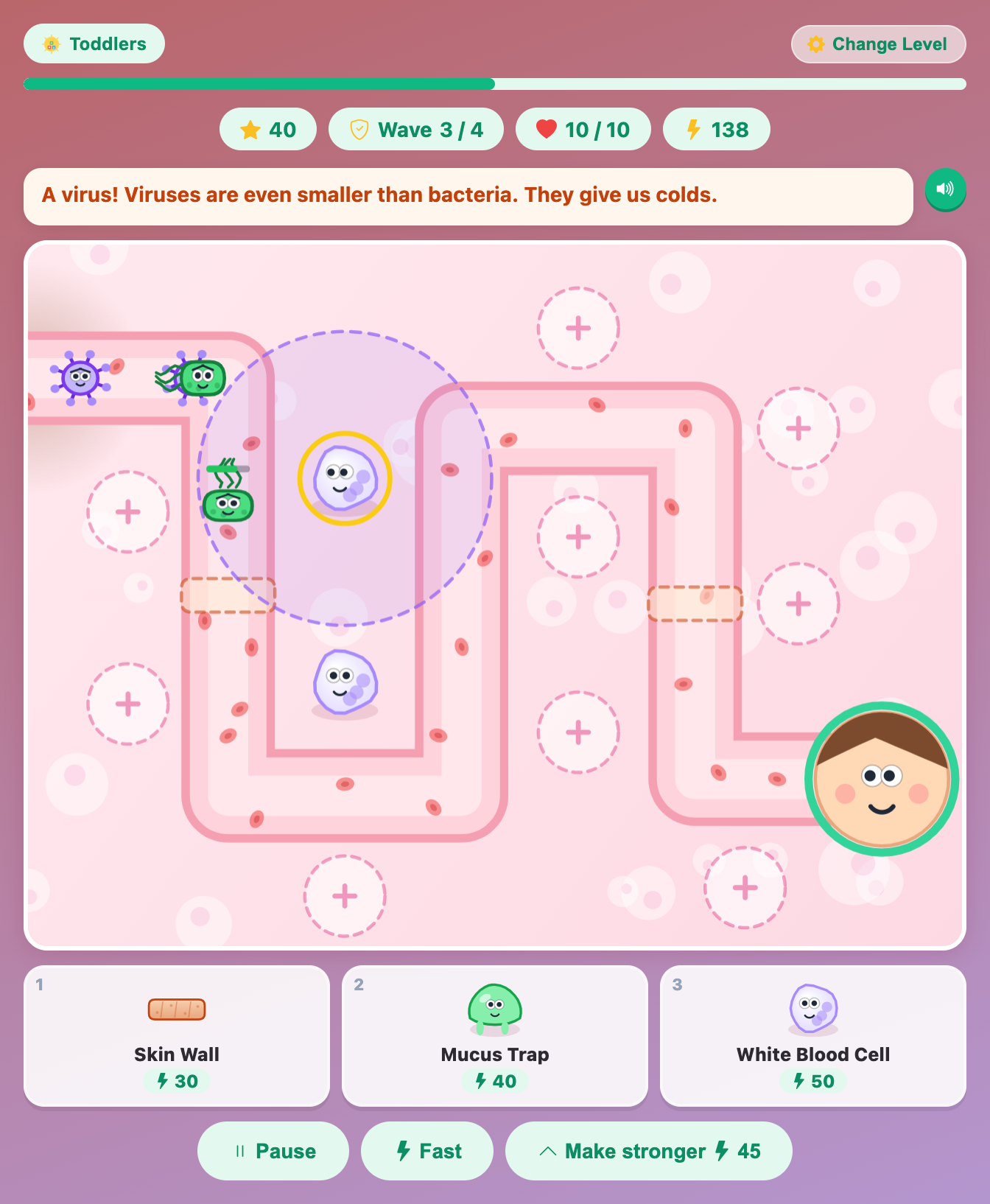
A purple cold virus and green bacteria moving down the blood vessel toward two white blood cells in wave 3
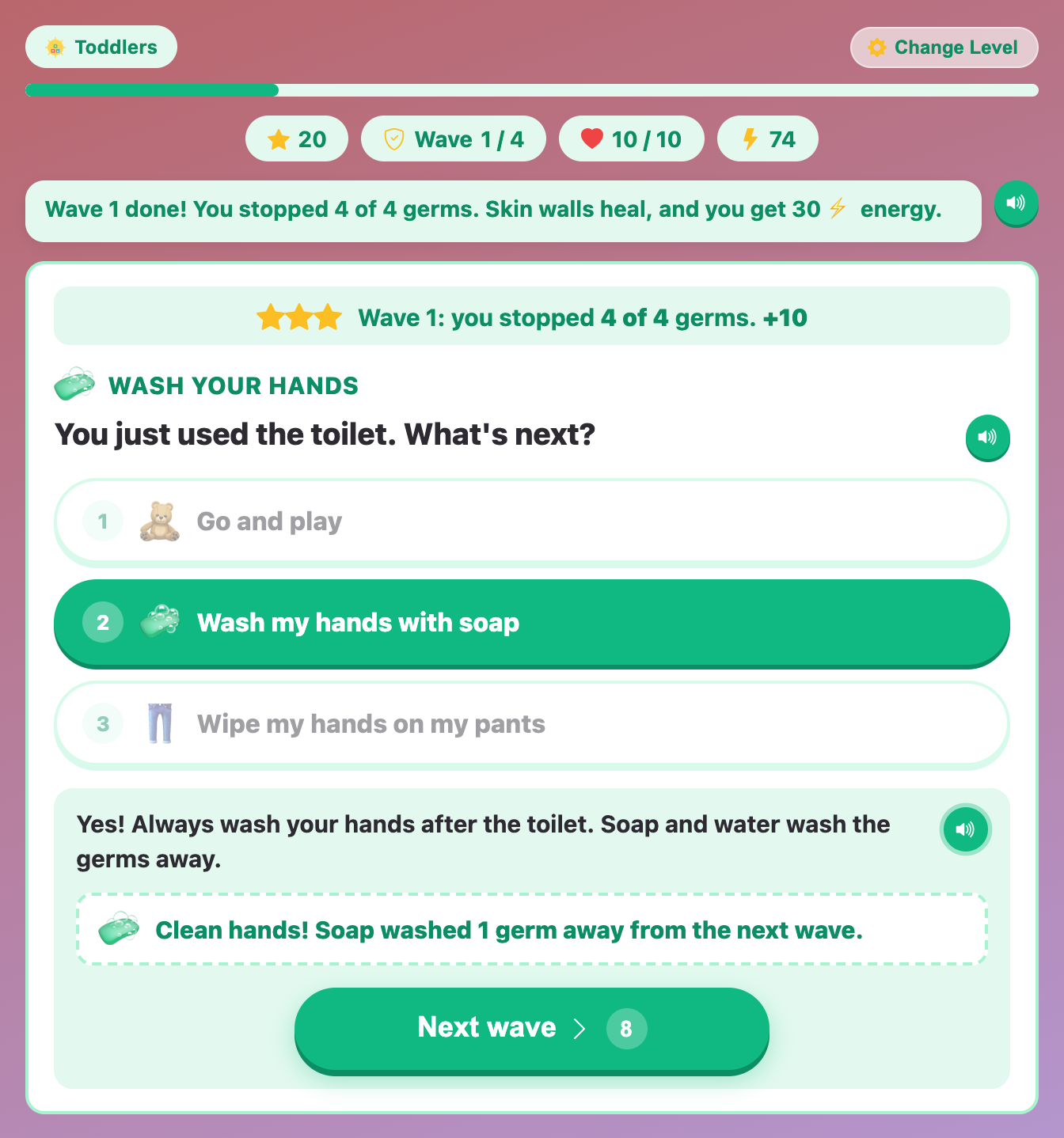
A Wash your hands habit card in Germ Defender for toddlers, with Wash my hands with soap as the right answer
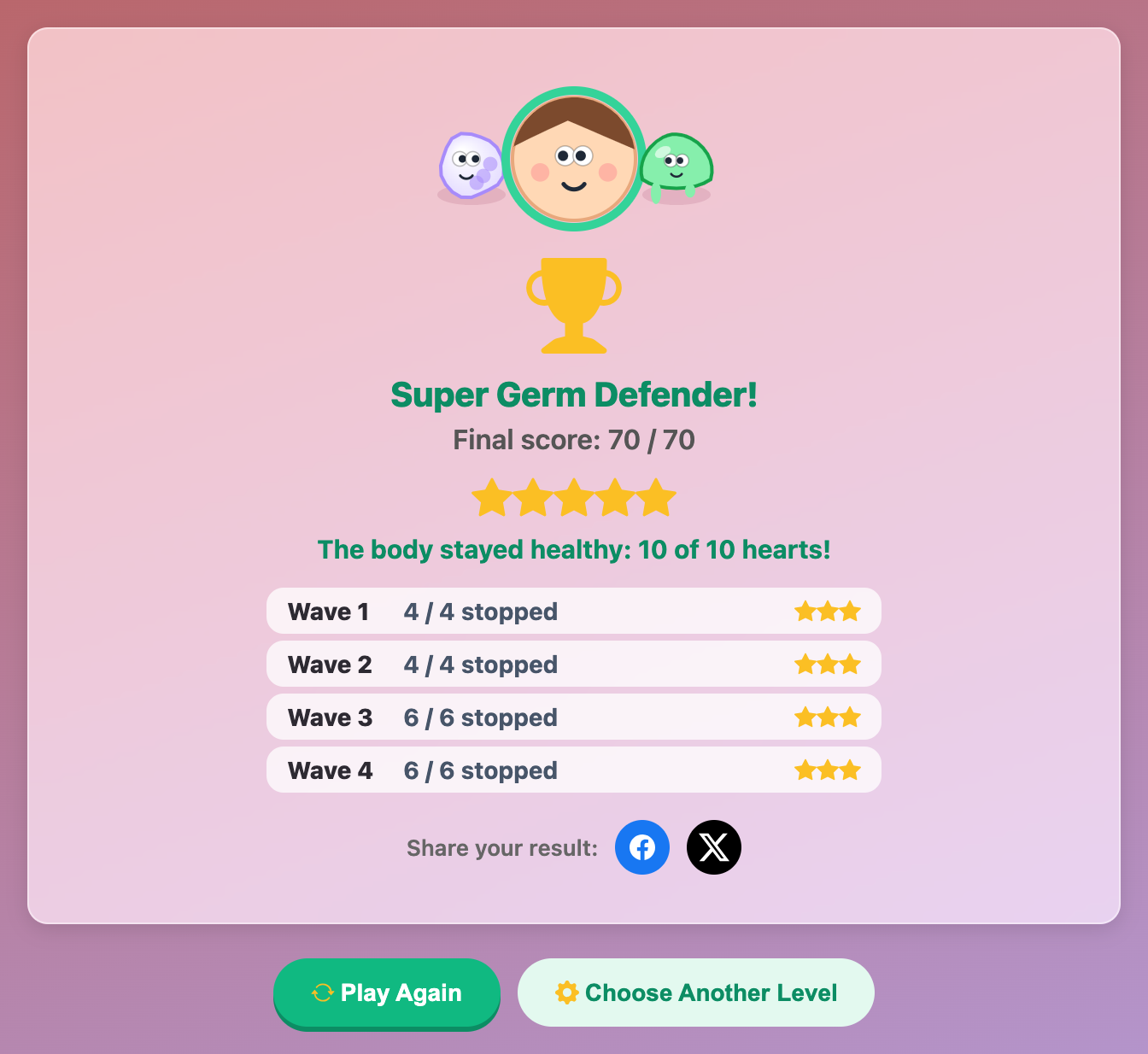
The Super Germ Defender finish card with a score of 70 out of 70, five stars and all four waves stopped
More Science Games
 59.5K plays
4.8
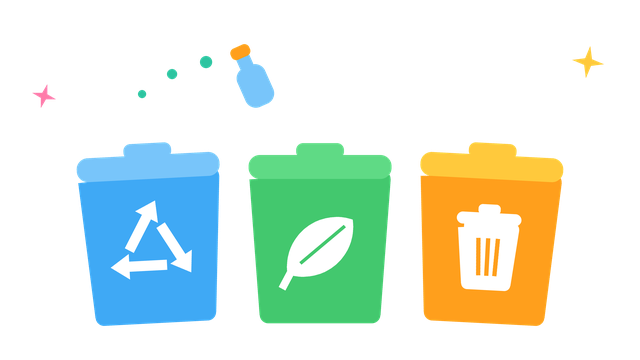
Recycling Sort
Sort everyday items into the Recycle, Compost, or Trash bin before time runs out!
 85.7K plays
4.9
Grow a Plant
Plant seeds in sunny and shady garden beds, then water, feed and protect them day by day. Watch the roots grow underground and harvest sunflowers, tomatoes, carrots and more!
 438.6K plays
4.9
Magnet Experiment
Guess which objects a magnet will pull, then drag the magnet to test every guess. Does gold stick? Does a battery?
 386.9K plays
4.9
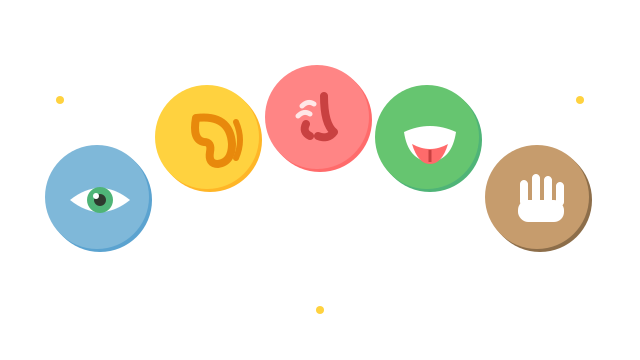
Five Senses Match
Decide which of your five senses you would use for each everyday scene before time runs out.
Most Played Games
 1.8M plays
4.9
Color & Draw
A free-drawing canvas with colors and brush sizes to unleash your creativity.
59.5K plays
4.8
Recycling Sort
Sort everyday items into the Recycle, Compost, or Trash bin before time runs out!
 365.8K plays
5.0
Tic-Tac-Toe
Play a game of Tic-Tac-Toe against the computer and see if you can outsmart it.
 274.1K plays
5.0
Sentence Builder
Pick your age level, then tap the shuffled words in the right order to build the sentence.
Comments (54)