
Heartbeat Lab
113.3K playsBe a scientist and find out how exercise changes your heart and breathing! Send Pip to sleep, on a fast walk, running or jumping rope, predict what will happen, then watch the heart beat and the lungs fill faster or slower while the pulse and breath counters change. Big kids record their results on a bar chart, work out beats a minute from a 15-second pulse count, and follow the blood through the heart and lungs.
Run on the spot for one minute, then press a hand flat on your chest. Thump, thump, thump! Your heart is going much faster than it was a minute ago. Heartbeat Lab for kids is a free science game that turns that feeling into a real experiment. You send a cartoon kid named Pip to sleep, on a fast walk, running or jumping rope, guess what will happen, and then watch Pip’s heart beat and lungs fill faster or slower.
The game is made for children from about age 2 to 12, and it plays right in your web browser. There is nothing to download, and you don’t need an account to play. Little ones answer with a bunny 🐇 for “faster” or a turtle 🐢 for “slower”. Big kids read a bar chart, turn a 15-second pulse count into beats a minute, and guide a drop of blood through the four rooms of the heart.
🧪 A Science Lab Where Pip Is the Experiment
Real scientists don’t just guess. They make a prediction (a guess about what will happen), run a test, measure what really happened, and then check if they were right. Heartbeat Lab gives you that whole job, with Pip as your helper.
Every game starts with Pip sitting in a chair, reading a book. That is the “normal” you compare everything with. Then you test four activities, one at a time, in any order you like: 😴 Sleeping, 🚶 Fast walk, 🏃 Running and 🪢 Jumping rope. Before each test, you say if Pip’s heart and breathing will be faster or slower than sitting. Then Pip does the activity, and the numbers tell you the answer.
Every result lands on a colorful bar chart. By the end, you have a full lab report: five bars, one for each activity, showing how fast Pip’s heart beat. Pip’s numbers change a little every time you play, just like a real person’s would, so no two lab reports are exactly the same.
🫀 What Is Going On Inside Pip?
In the middle of the screen you can see Pip’s heart, sitting in front of two pink lungs. The heart is a strong muscle. With every beat it swells and squeezes, and you can almost hear the “lub-dub”. The lungs puff up each time Pip breathes in. Under them, two counters show beats a minute (how many times the heart beats in one minute) and breaths a minute. A dark pulse monitor draws a green spike for every beat, like the screens in a hospital.
Here is the big idea behind Heartbeat Lab for kids. Your muscles need oxygen, a gas in the air, to do their work. Your lungs take oxygen from the air, and your blood carries it to your muscles. When Pip runs, the leg muscles work hard and need lots of oxygen fast. So the heart pumps faster to send more blood, and Pip breathes faster to take in more air. When Pip sleeps, the body rests and needs less, so the heart and breathing slow down. They never stop, though, because your body always needs some oxygen.
For a boy of about ten like Pip, the game uses real numbers. Asleep, his heart beats about 60 to 68 times a minute. Sitting, it’s about 80 to 88. A fast walk takes it to about 100 to 112, and running or jumping rope pushes it up to about 148 to 164.
🔬 Running an Experiment on KidWorld, Step by Step
Pick your level. The game starts on Elementary. To change it, tap the gear button at the top that says Change Level, then choose Toddlers, Preschool, Elementary or Tweens. The game remembers your choice for next time.
Choose what Pip tests. Four big colored cards sit under the picture: purple Sleeping, blue Fast walk, orange Running and pink Jumping rope. Tap one, or press keys 1 to 4. A card you have already tested turns white with a ✓.
Make your prediction. The game asks, for example, “Pip is going to run. Will Pip’s heart and breathing be faster or slower?” Tap 🐇 Faster or 🐢 Slower, or press 1 or 2. One answer covers both the heart and the breathing, because they always change the same way.
Watch the sped-up minute. Pip goes to bed, walks, runs past trees or skips with a rope. A stopwatch counts from 0:00 to 1:00 in just a few seconds. Keep your eyes on the counters: they climb or fall while the heart beats and the lungs fill.
Count the pulse (Tweens only). In the last 15 seconds of the minute, the heart counter switches to counting beats. Then you are asked how many beats a minute that makes.
See the result. The game tells you what happened and if your guess was right. A new bar grows up on the chart by itself, and a short fact explains why the heart did what it did.
Move on. Tap Next, or press Enter. If you wait, the Next button fills up and counts down from 5, then moves on all by itself. Pip rests until his heart is back to normal before the next test.
Follow the blood and answer questions. After the four tests, Elementary and Tweens players guide blood through the heart. Then every level answers a few questions about the heart and lungs.
Read your lab report. The finish screen says Lab Report Complete! with your score, up to five stars and your blood path stars. You see your final chart, plus a “Look at these again” list of any question you missed, with the right answer and why. Press Play Again for new numbers, or Choose Another Level.
Use the buttons around the game. The 🔊 button in the question box reads the words out loud. Around the game there are buttons for fullscreen, to reload the game and to turn the music on or off.
🩸 The Blood Path: A Puzzle Inside the Heart
Elementary and Tweens players get a special round after the tests. A picture shows the lungs at the top, the heart in the middle and the body at the bottom. A blue drop of blood sits in the body. It has just given its oxygen to Pip’s muscles. Your job is to tap where it goes next, again and again, until it gets back to the body.
As the drop travels, it changes color. It turns red after it visits the lungs, because now it’s full of oxygen. It turns blue again after the body uses that oxygen up. The tubes it travels along stay pale until the blood has passed through them, so the picture won’t give the answer away.
On Elementary, you tap four places: the right side of the heart, the lungs, the left side of the heart, then the body. On Tweens, the heart is split into its four rooms, called chambers. The two top ones are the atria, and the two bottom ones are the ventricles. You tap six places: the right atrium, the right ventricle, the lungs, the left atrium, the left ventricle, then the body.
A wrong tap tells you why it was wrong and gives you a clue. Finish with no mistakes for 3 stars (“Perfect path!”), with one or two mistakes for 2 stars, or with more for 1 star. Each star is worth 10 points.
🏆 Heartbeat Lab for Kids: Think Like a Real Scientist
You can’t lose a test in Heartbeat Lab. Even a wrong guess still lets Pip finish the activity, and you still see the real result. But a smart scientist gets more right, earns more points and learns more. Here is how.
Sitting is your measuring stick
Every prediction asks about faster or slower than sitting. So before you answer, think: is this activity more work than sitting in a chair, or less? Walking, running and jumping rope are all more work, so the answer is Faster. Sleeping is the only test that is less work than sitting. That makes Sleeping the only Slower answer in the whole game.
The heart and the lungs are a team
You never need to wonder if the heart goes one way and the breathing the other. In every test, when Pip’s heart beats faster, Pip breathes faster too. They work together to get oxygen to the muscles. Remember this and the elementary question “When Pip’s heart beat faster, what happened to Pip’s breathing?” becomes easy: it got faster too.
Read the monitor like a doctor
Look at the green line on the dark monitor. Each spike is one heartbeat. When the spikes are far apart, the heart is slow. When they crowd close together, the heart is racing. Watch the lungs too: they puff up and down quicker when Pip runs. This is a great habit, because it lets you see the answer with your own eyes, not just in the numbers.
Guess first, then test
It can be tempting to skip the thinking and tap any button. Try saying your reason out loud first: “Running is hard work, so the heart needs to pump more blood. Faster!” That’s exactly how real scientists work. If you enjoy this guess-then-test way of doing science, Magnet Experiment lets you guess which objects a magnet will pull, then test every guess yourself.
Times four, the doctor’s trick (Tweens)
Doctors and nurses often count a heartbeat for 15 seconds, then multiply by 4. Why 4? Because four lots of 15 seconds make one minute. When the game asks “How many beats a minute is that?”, two of the three answers are traps. One is the count times 2, as if you had counted for 30 seconds. The other is the count times 6, as if you had counted for 10 seconds. Only times 4 is right. A quick way to multiply by 4 in your head is to double the number, then double it again.
Let the chart do the work
The question rounds put Pip’s chart right next to the question. Don’t answer from memory: look! The tallest bar is the fastest heart. The pink row of numbers under the bars shows breaths a minute, and the smallest number there is always Sleeping. For a “how many more” question, find the two bars and take the smaller number away from the bigger one.
Use the drop’s color on the blood path
The color of the drop is your best clue. A blue drop has no oxygen left, so it needs to go somewhere to get more. After a short stop in the heart, that place is the lungs. A red drop is full of oxygen, so it is ready to head out to the body’s muscles. Blood always comes back into a top chamber (an atrium) first, then drops down through a little door to the ventricle under it.
Remember: the heart is facing you
This is the trick that catches the most players. The heart in the picture is drawn the way it would look inside someone standing in front of you. So the heart’s right side is on your left, and its left side is on your right. Hold up your right hand, then imagine a friend facing you doing the same. Their right hand is across from your left! Tapping an empty spot on the picture doesn’t count as a mistake, so take your time and aim carefully.
Check “Look at these again”
When the lab report appears, read every row in “Look at these again”. Each one shows a question you missed, the right answer and a short reason. Then press Play Again. You’ll get new numbers for Pip, and a new mix of questions, so you can see if the lesson stuck.
🧮 Five Lab Problems, Solved Together
Problem 1: The sleep test (Toddlers and up)
The game says “Pip is going to go to sleep. Will Pip’s heart and breathing be faster or slower?” Think about bedtime. Your body is resting, your muscles are not working, and you need only a little oxygen. So the heart can slow down. The answer is 🐢 Slower. In one game we played, Pip’s heart dropped from 84 beats a minute while sitting to 68 asleep.
Problem 2: A 15-second count (Tweens)
Pip runs, and the monitor counts 41 beats in the last 15 seconds. The answers are 164 beats, 246 beats and 82 beats. Here is how to think it through:
A minute has four lots of 15 seconds, so multiply by 4.
Double 41 to get 82. That’s only 30 seconds’ worth, so 82 is a trap.
Double 82 to get 164. That’s the whole minute.
246 is 41 times 6, the 10-second mistake. So the answer is 164 beats.
Problem 3: Which bar wins? (Elementary)
“Which activity made Pip’s heart beat the fastest?” In our game the choices were Running, Fast walk and Sleeping. (Sometimes Jumping rope takes Running’s place, if its bar is the tallest.) Look at the chart: the orange Running bar was far taller than the blue walk bar and the purple sleep bar. Running is hard exercise, and hard exercise makes the heart beat fastest. The answer is Running.
Problem 4: How many more beats? (Tweens)
“How many more beats a minute did Pip’s heart beat jumping rope than sitting?” In our game, the pink Jumping rope bar said 160 and the gray Sitting bar said 84. Take away: 160 − 84 = 76. The other choices were 56 and 96, each 20 away from the real answer. Doing the subtraction carefully, instead of guessing, gets you the 10 points.
Problem 5: The six-stop blood trip (Tweens)
The blue drop starts in the body. Here is a perfect, 3-star path, with the reason for each tap:
Right atrium. Blood from the body comes back to the heart through a big vein, into the top room on the heart’s right side (on your left).
Right ventricle. A valve, a one-way door, opens and the blood drops into the room below.
Lungs. The right ventricle pumps it up to the lungs. It drops off carbon dioxide and picks up oxygen, and turns red.
Left atrium. The red blood comes back into the top room on the heart’s left side (on your right).
Left ventricle. Down through another valve into the strongest room. Its wall is the thickest in the heart.
Body. The left ventricle pumps the blood out through the aorta, a big tube, to all of Pip’s muscles.
📋 How Your Lab Report Is Scored
Every right prediction earns 10 points. On Tweens, every right 15-second count earns 10 more. The blood path gives 10 points for each star, so up to 30. Each right answer in the question rounds is worth 10 points. The best possible score is 50 on Toddlers, 60 on Preschool, 100 on Elementary and 140 on Tweens. Your stars on the finish screen depend on how close you got to the top score.
🎒 Who Is the Lab For? Every Age From 2 to 12
Heartbeat Lab for toddlers (ages 2–4)
Heartbeat Lab for toddlers keeps it simple. There are the same four tests, but each prediction is just a bunny or a turtle. The chart shows bars without any numbers, so the youngest players only compare tall and short. When the site’s sound is on, the game reads each question and result out loud, and there is only one picture question at the end. A parent can make it extra fun by asking “Is your heart fast or slow right now?” after each test.
Heartbeat Lab for preschoolers (ages 4–6)
Heartbeat Lab for preschoolers adds a second picture question, like “Where is your heart?” or “What fills your lungs when you breathe in?” Each answer has a big emoji, so a child who can’t read yet can still pick it. The game still reads aloud by itself, and every test ends with a simple line such as “Pip’s heart and breathing got faster! You were right!” and a short fact.
Heartbeat Lab for elementary kids (ages 6–10)
Heartbeat Lab for elementary kids brings in real numbers. The chart has a number scale and shows each bar’s value, and a row underneath shows breaths a minute. The prediction now says “Compared with sitting”, and the result line shows the change, like “Heart 84 → 164, breathing 18 → 42: both faster.” Then comes the four-stop blood path, a question about Pip’s chart and two questions such as “Why do you breathe faster when you exercise?” or “Where can you feel your pulse?”
Heartbeat Lab for tweens (ages 10–12)
Heartbeat Lab for tweens is the full lab. After each test, you turn a 15-second pulse count into beats a minute. The blood path has all four chambers and six stops. The chart question asks for a subtraction, and the other questions go deeper: which gas muscles make as waste, what heart valves do, which blood vessels carry blood away from the heart, and why a fit person’s resting heart rate is often lower. Tweens who want to learn how the body fights sickness can try Germ Defender, where skin walls, sticky mucus and white blood cells stop marching germs.
🏃 Try the Experiment on Your Own Body
The best part of Heartbeat Lab is that you can repeat it for real. Ask a grown-up to help you with this:
Sit still for a few minutes. Then press two fingers gently on the inside of your wrist, below your thumb, or on the side of your neck. Each little bump is one heartbeat.
Have the grown-up time 15 seconds while you count the bumps. Multiply by 4, just like the game. That is your sitting number.
Now jump, dance or run on the spot for one minute.
Count again for 15 seconds and multiply by 4. Did your heart speed up, like Pip’s? Are you breathing faster too?
Your numbers won’t match Pip’s exactly, and that is fine. Every body is different, and younger children often have faster heartbeats than older ones. What matters is the pattern: more work means a faster heart.
💓 What Kids Learn by Watching a Heart Work
How the body really works. Kids don’t just hear that “exercise makes your heart beat faster”. They watch it happen, beat by beat, and see the reason in the facts after every test. If your child loves seeing what happens inside the body, Food Journey follows a piece of fruit through the mouth, stomach and intestines in the same spirit.
The steps of the science method. Every test is a mini experiment: predict, test, measure, compare. Kids learn that a wrong prediction isn’t a failure. It’s how scientists find out something new.
Reading charts and numbers. Older kids read a bar chart, compare values, subtract to find a difference and multiply a 15-second count by 4. That’s real math used for a real reason.
A reason to move. When a child sees how running gives Pip’s heart a workout, playing outside starts to feel like something good for their body, not just fun.
👪 A note for parents and teachers
Heartbeat Lab is calm, friendly and safe. Pip is always cheerful, the heart has a smiling face, and there is nothing scary, gross or medical-looking beyond a simple pulse monitor. Diagrams show oxygen-poor blood in blue, the usual school color, and the game explains to older kids that real blood is always red. The facts were checked carefully, and every wrong answer is clearly wrong.
The game practices life-science ideas about the heart, lungs and blood, along with predicting, reading a chart and simple multiplication and subtraction. It plays free in the browser on computers, tablets and phones, with no download. Guests can play right away. Logging in saves your child’s stars and progress.
Ready to put on your lab coat? Pick a level, choose Pip’s first test and see what his heart does. Heartbeat Lab for kids is waiting, and Pip is ready to run, walk, jump and snooze for science! 🧪❤️
🖼️ See the Game in Action
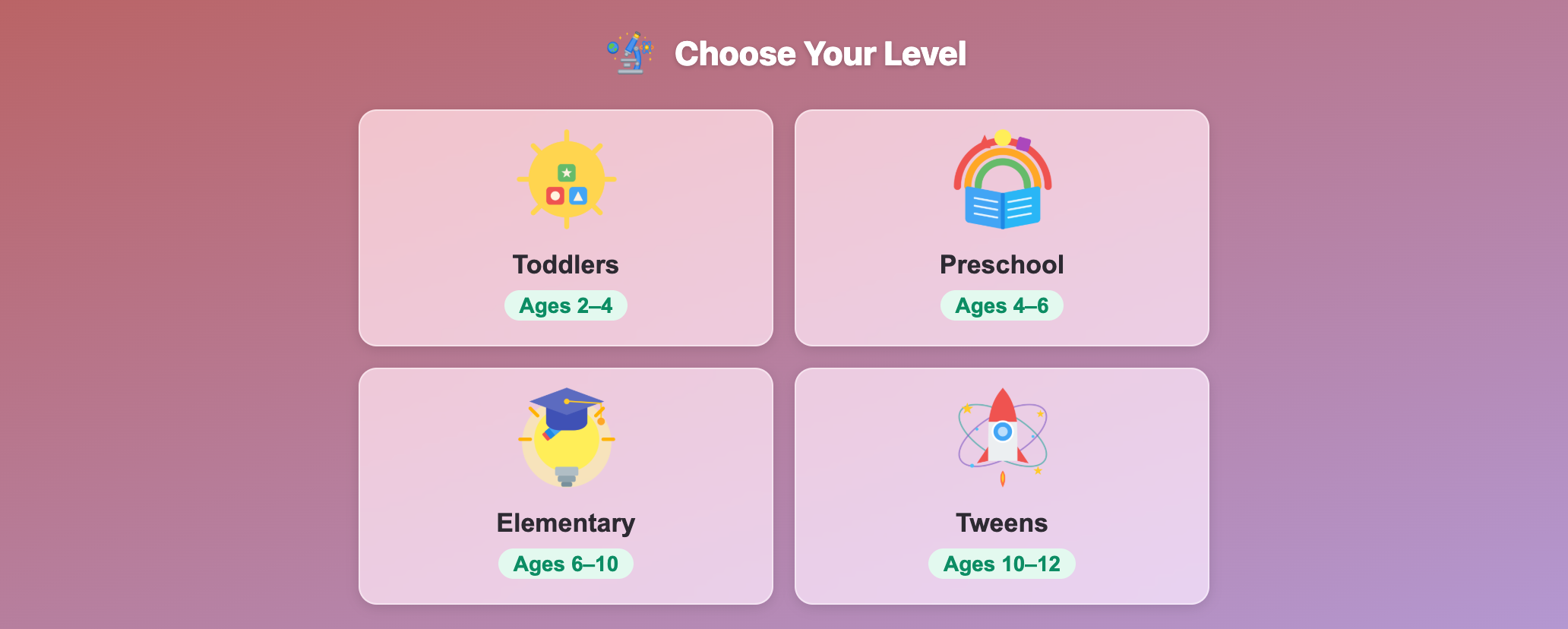
The Choose Your Level screen in Heartbeat Lab for kids, with Toddlers, Preschool, Elementary and Tweens cards
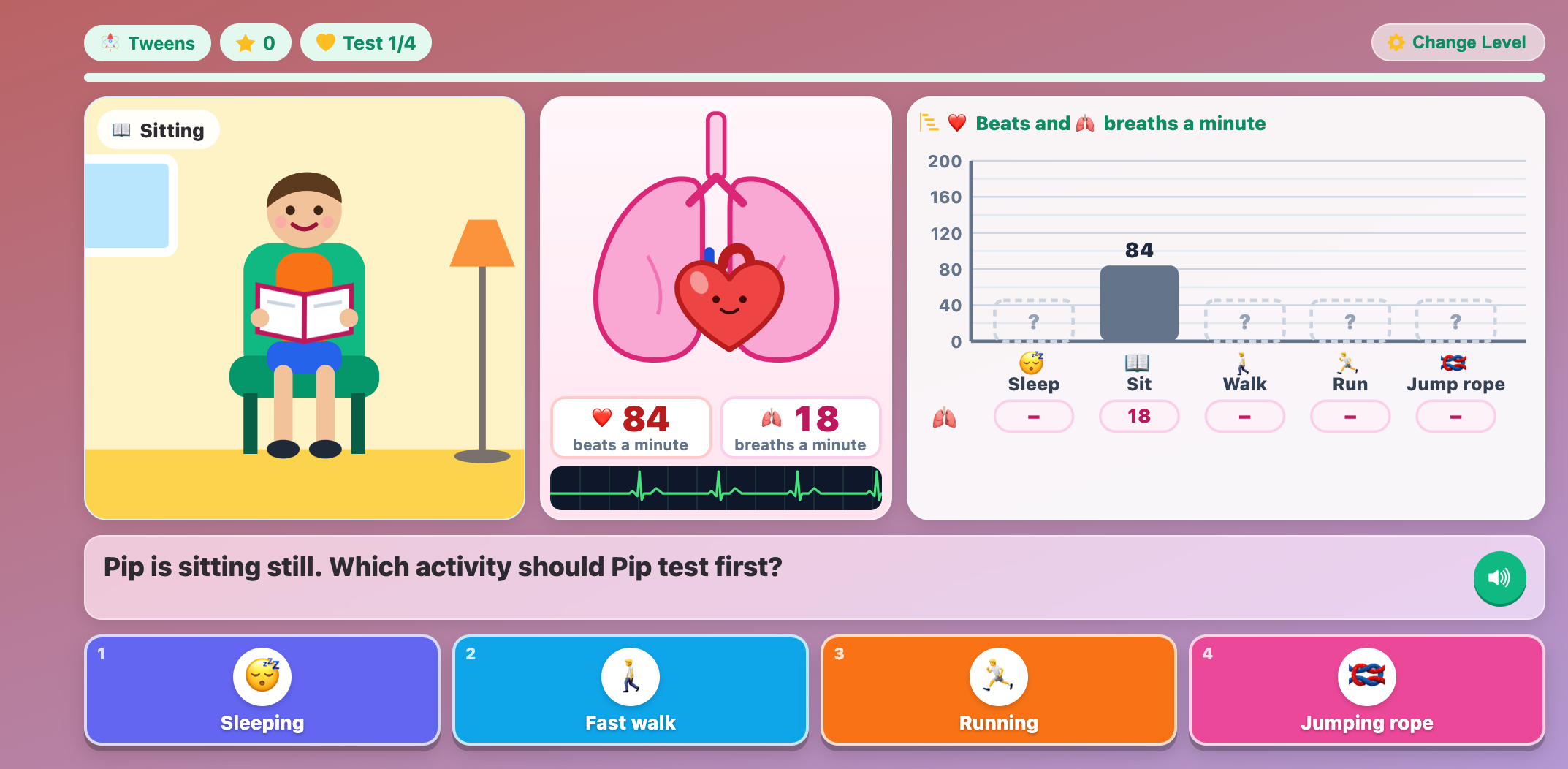
Pip sitting and reading beside the heart, lungs and bar chart, with four colored activity cards to test
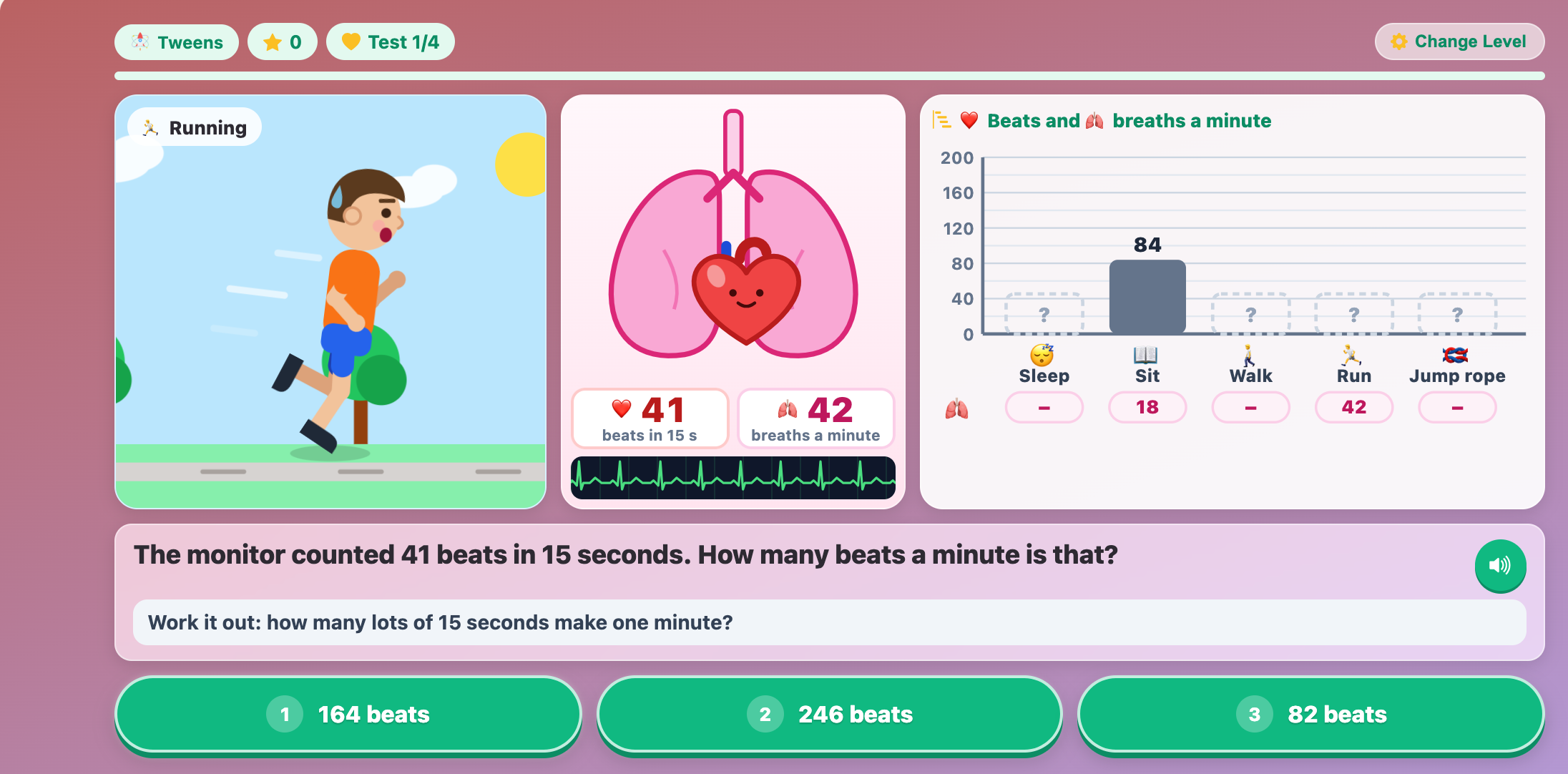
Heartbeat Lab for tweens asking how many beats a minute 41 beats in 15 seconds makes
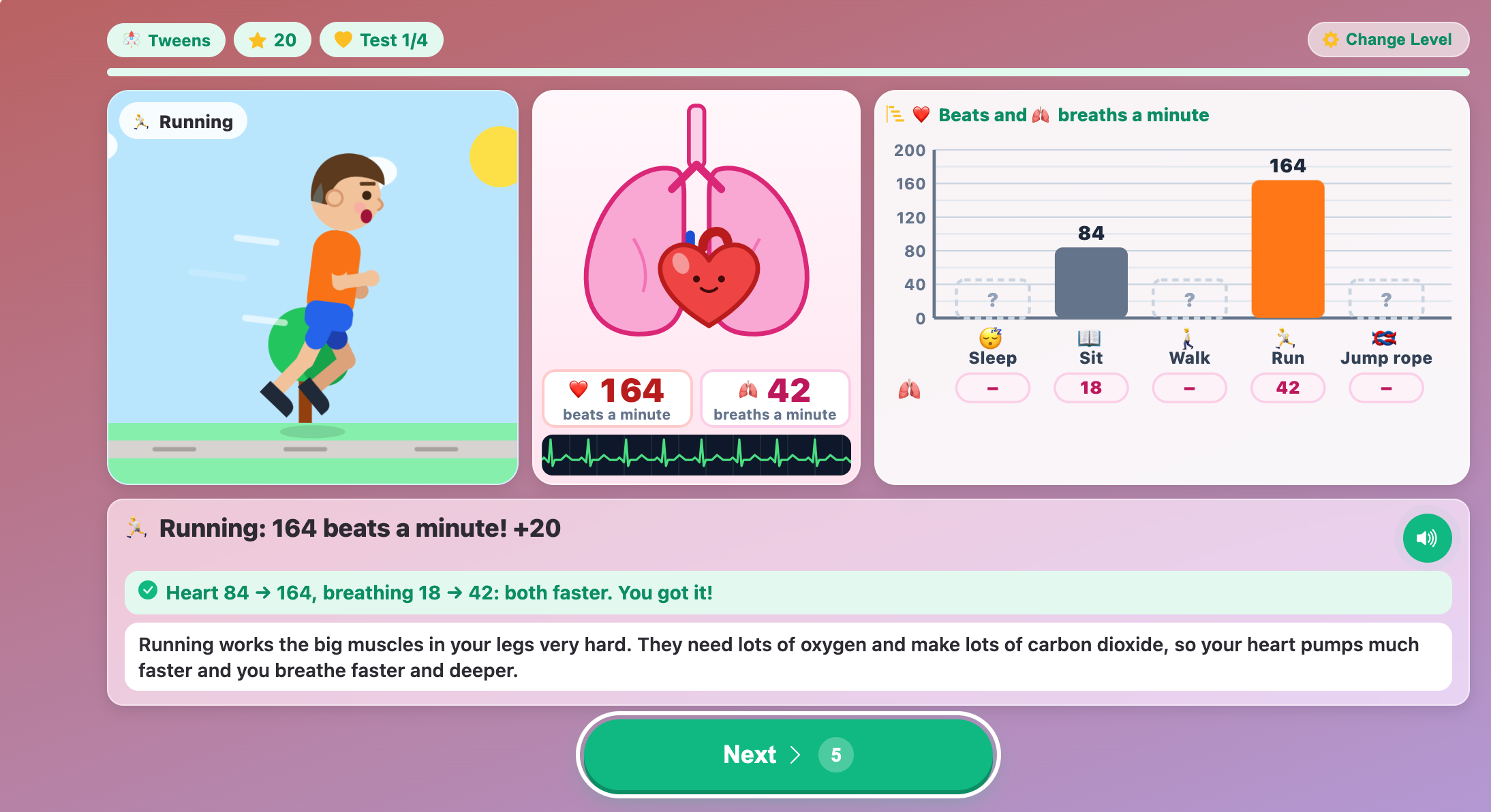
Pip running with the heart at 164 beats a minute and a new orange bar on the chart
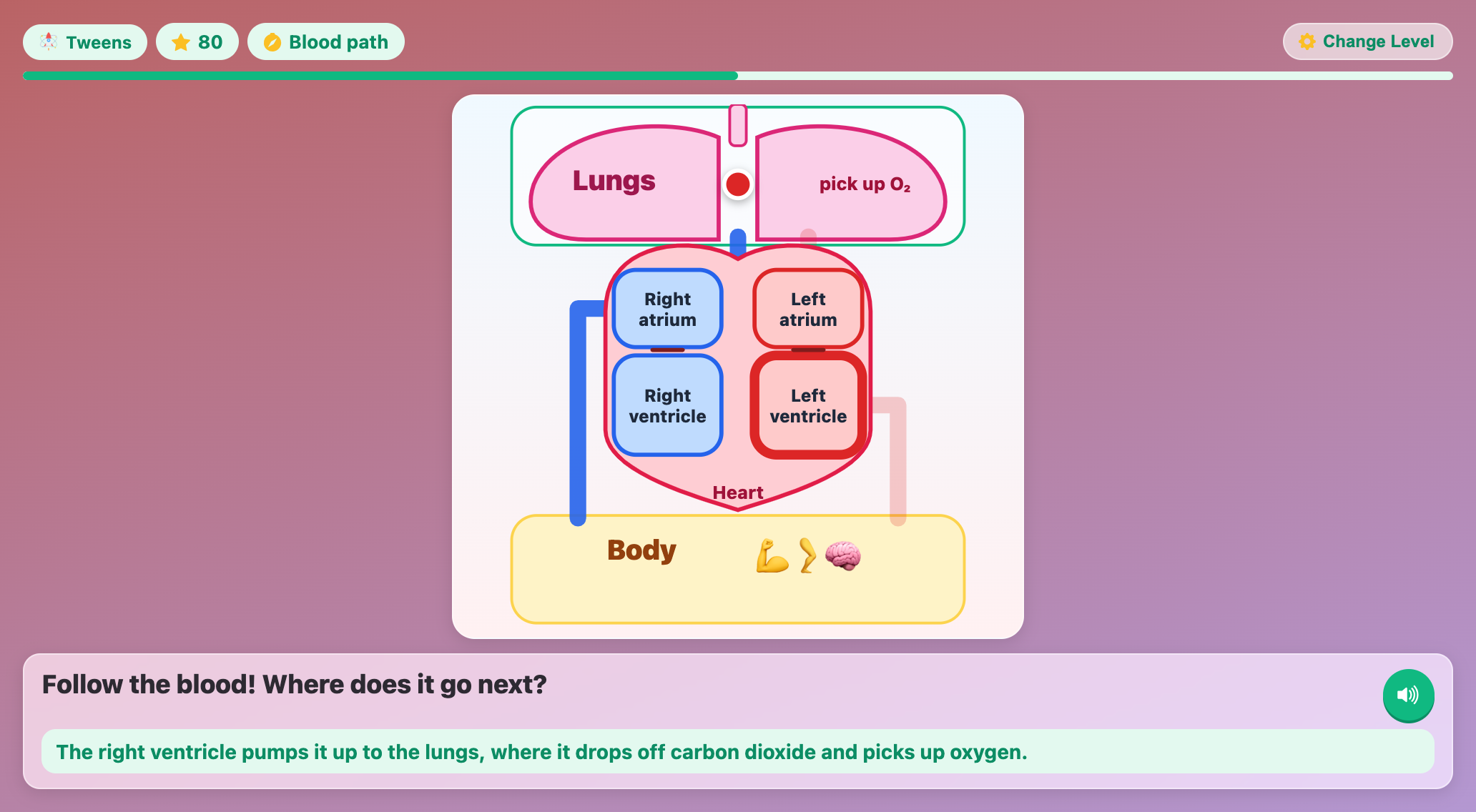
The blood path diagram with a red drop in the lungs between the four heart chambers and the body
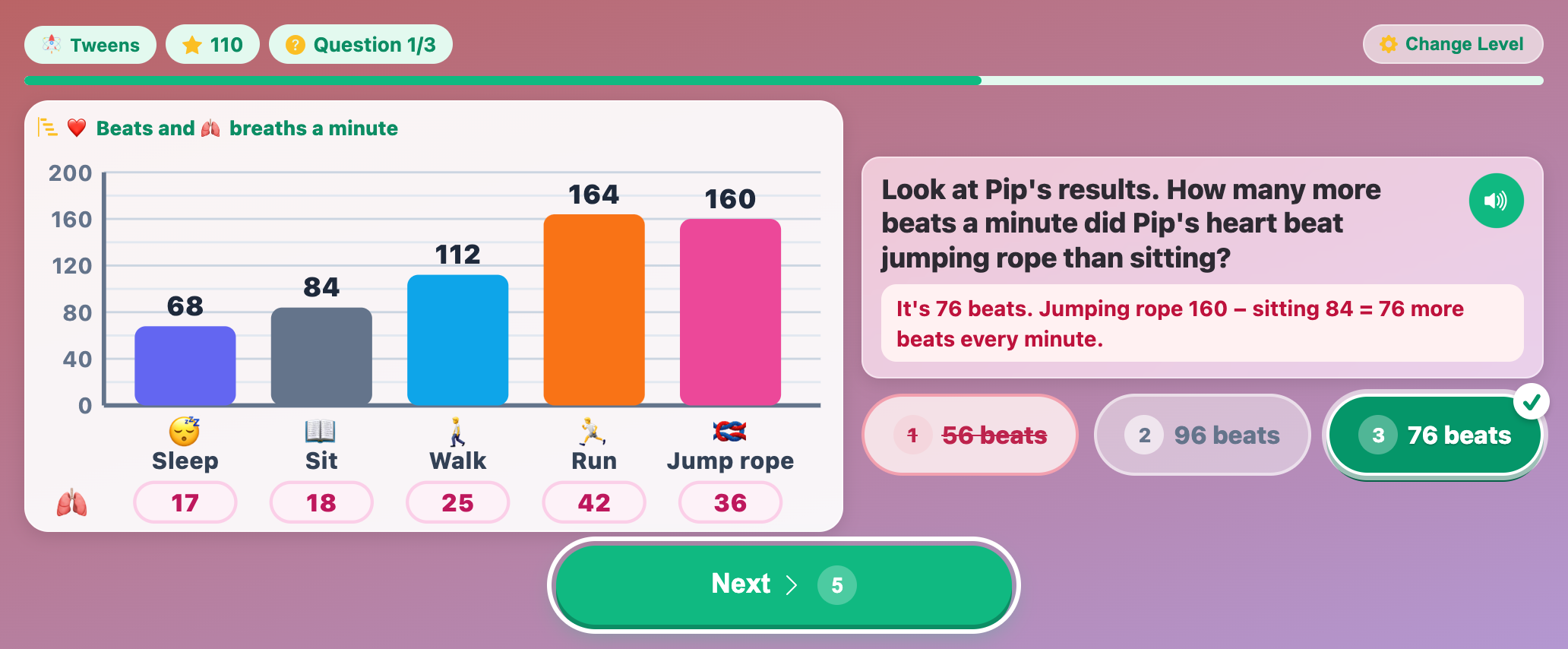
A finished bar chart of Pip's results next to a question about jumping rope versus sitting
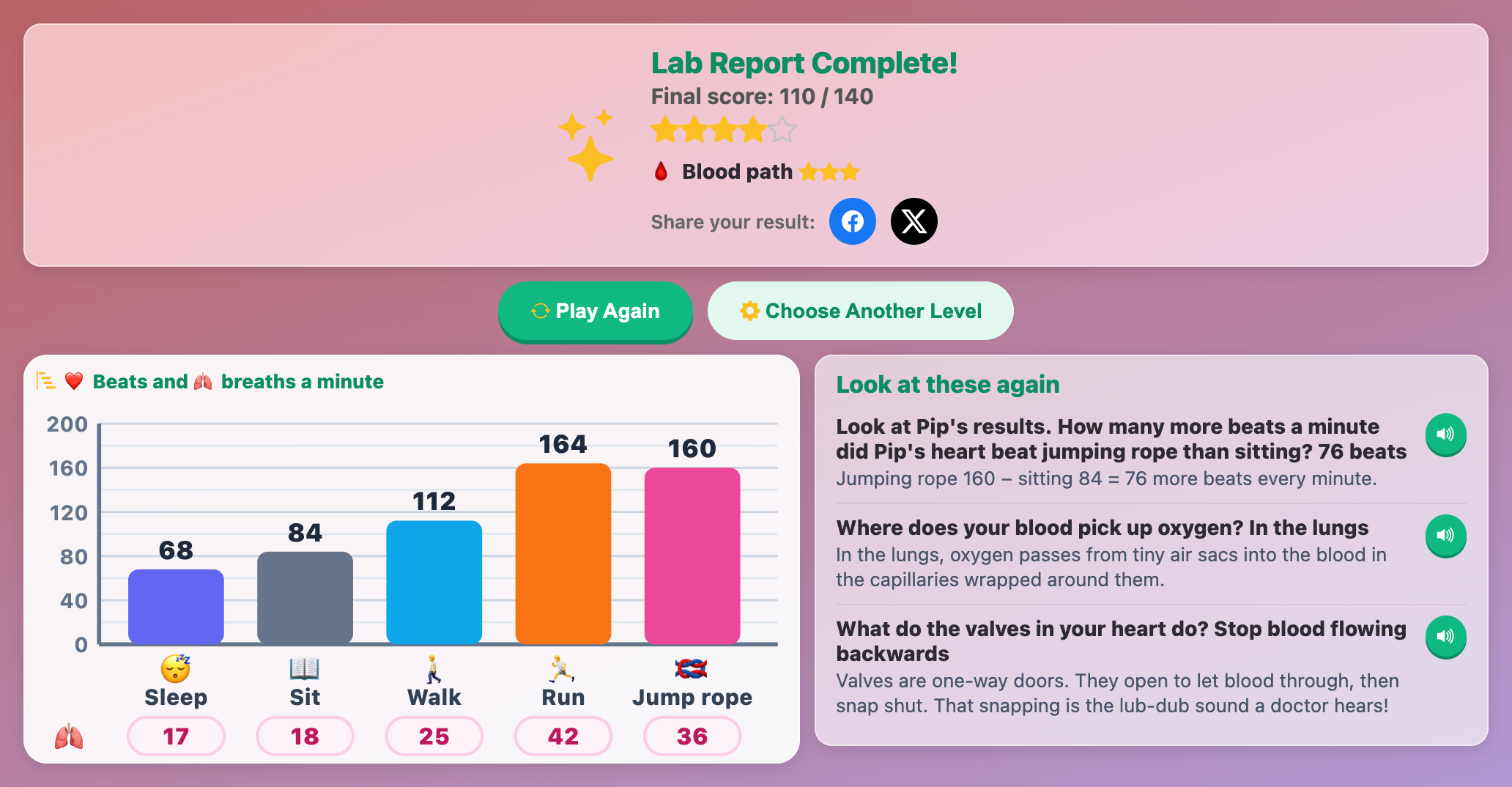
The Lab Report Complete screen with a score of 110 out of 140, blood path stars and a review list
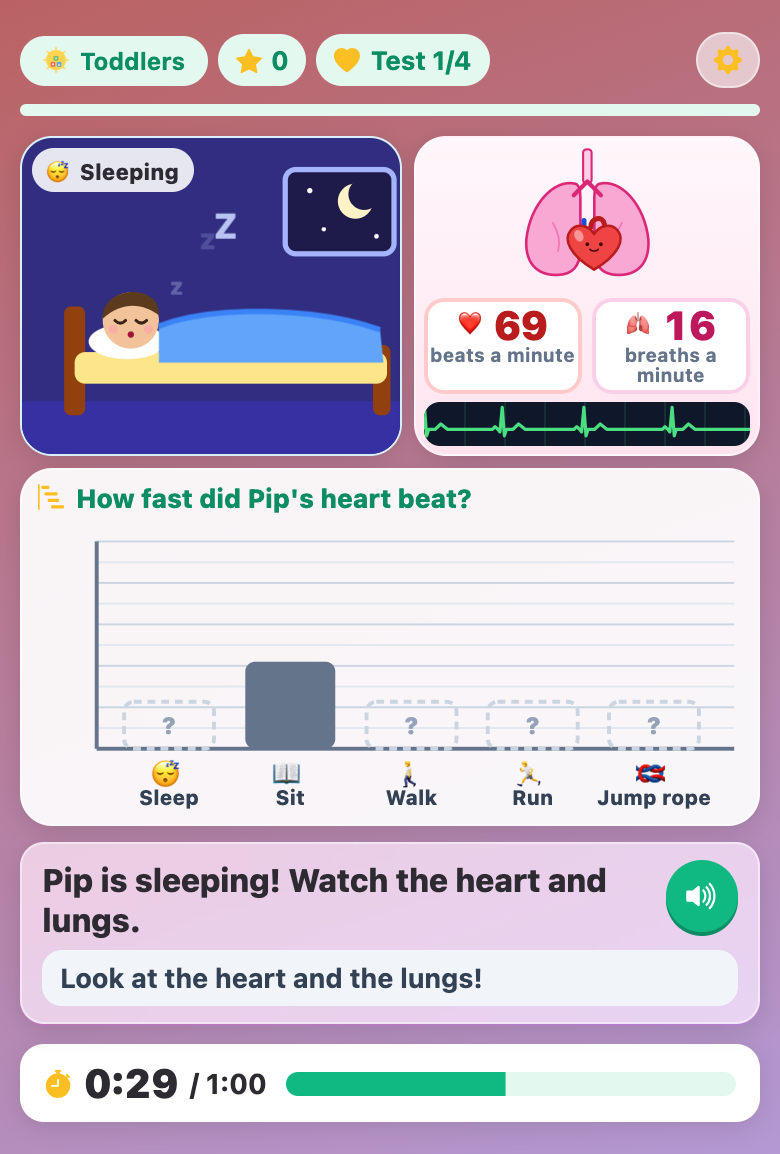
Heartbeat Lab for toddlers on a phone, with Pip asleep in bed and the heart slowing to 69
More Science Games
 59.5K plays
4.8
Recycling Sort
Sort everyday items into the Recycle, Compost, or Trash bin before time runs out!
 85.7K plays
4.9
Grow a Plant
Plant seeds in sunny and shady garden beds, then water, feed and protect them day by day. Watch the roots grow underground and harvest sunflowers, tomatoes, carrots and more!
 438.6K plays
4.9
Magnet Experiment
Guess which objects a magnet will pull, then drag the magnet to test every guess. Does gold stick? Does a battery?
 386.9K plays
4.9
Five Senses Match
Decide which of your five senses you would use for each everyday scene before time runs out.
Most Played Games
 1.8M plays
4.9
Color & Draw
A free-drawing canvas with colors and brush sizes to unleash your creativity.
59.5K plays
4.8
Recycling Sort
Sort everyday items into the Recycle, Compost, or Trash bin before time runs out!
 365.8K plays
5.0
Tic-Tac-Toe
Play a game of Tic-Tac-Toe against the computer and see if you can outsmart it.
 274.1K plays
5.0
Sentence Builder
Pick your age level, then tap the shuffled words in the right order to build the sentence.
Comments (46)