
Flash Dots
48.4K playsQuick, how many dots? A dice face, a ten frame or two groups of dots flash for a moment, then hide. Pick how many you saw, without counting one by one! Every right answer makes the next flash a little faster, and a miss counts the dots out with you. Little ones see 1 to 5, and bigger kids spot "5 and 3 more", full tens and rows of dots.
Flash Dots for kids is a quick-look math game. A picture of dots pops up on a dark board for a second or two, then a big ? card hides it. Your job is to say how many dots you saw, without counting them one by one. It works for little ones who are learning 1 to 5, and for big kids who can spot 4 rows of 9 in a blink.
It feels a bit like a magic trick. The dots vanish, but the number stays in your head! You play it free in your browser, with no download and no sign-up, by tapping the answer buttons on a phone, a tablet or a computer. Every right answer in a row makes the next flash a little faster, so you can watch your eyes get quicker as you play.
👀 Seeing a Number in One Look
Close your eyes and think of a dice showing 5. You don't count the dots, do you? You just know it's 5, because you know its shape: four corners and one in the middle. Grown-ups who teach math call this skill subitizing. It's a long word for a simple idea: seeing how many there are in one look.
Most people can see up to about 4 or 5 loose dots at once. Past that, our eyes need help. The help is groups. A full row of 5, a dice pattern, or a box of 10 lets your brain grab a big chunk at once. Then you put the chunks together: "5 and 3 more make 8."
That is exactly how Flash Dots is built. Every picture with more than 6 dots is made of smaller groups, like dice faces, rows in a frame, or dots on two plates. Loose, messy dots never go above 6, because nobody can see more than that in a flash. So the game never asks for something your eyes can't do. It just shows you how to look in groups.
⚡ How to Play Flash Dots on KidWorld
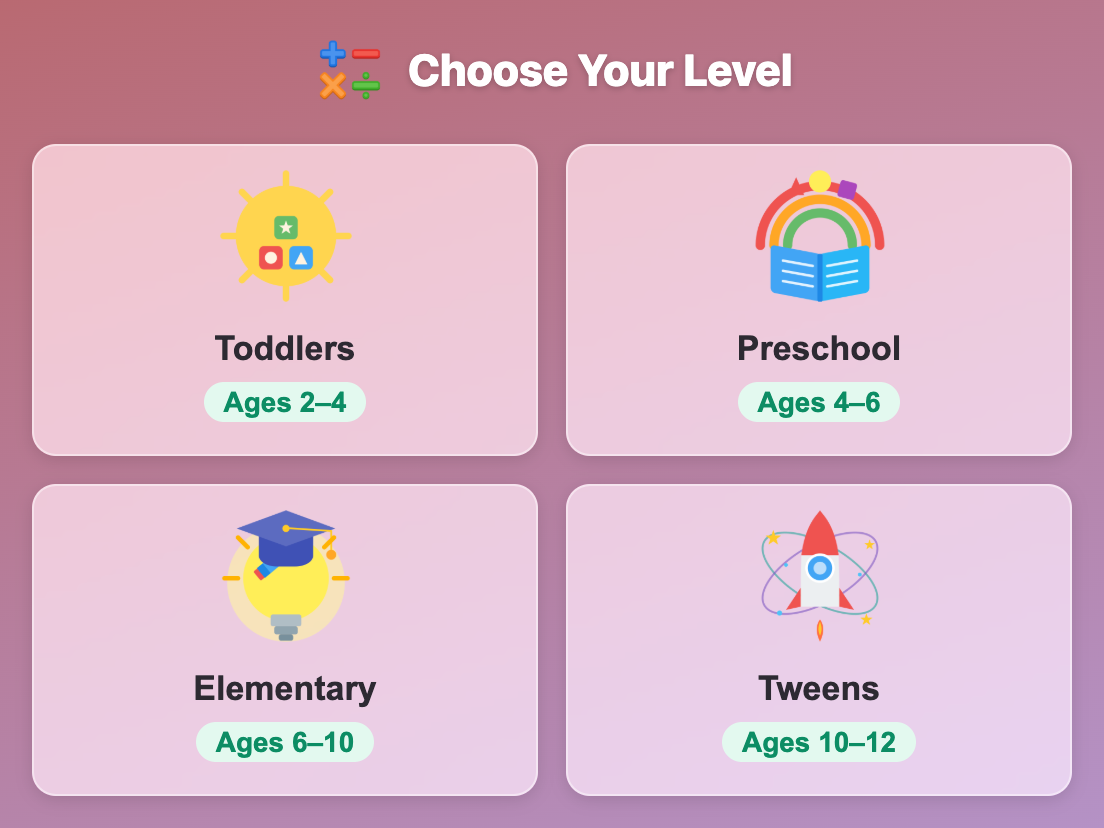
Pick your level. The Choose Your Level screen shows four cards: Toddlers (ages 2–4), Preschool (4–6), Elementary (6–10) and Tweens (10–12). The game remembers your choice. If it starts on the wrong one, tap Change Level at the top right.
Read the top bar. Four little badges show the round (like 1 / 10), your score ⭐, your streak 🔥 (right answers in a row) and the flash time ⚡, which is how long the dots will stay up.
Press Start. A Flash Dots card with a big green Start button sits on the board. The line under the board tells you how to play, and the 🔊 button next to it reads that line out loud.
Get ready for the countdown. "3, 2, 1" and the words "Get ready!" show on the board, so the flash never takes you by surprise.
Watch the flash. The dots appear with a soft camera-flash glow. A yellow time bar at the bottom of the board gets shorter. When it runs out, a striped card with a big ? covers the board, and the dots are gone right away.
Tap your answer. Three or four number buttons sit under the board. You can tap one while the dots are still showing, or after they are covered. On a keyboard you can also type the number.
Need one more look? Peek again. Under the cover, the Peek again button (or the Space bar) shows the same picture one more time, at the same speed. You can only peek once a round, and a right answer after a peek is worth 5 points instead of 10.
See what happened. A right answer lights up every dot and puts the number in a white bubble, with a line like "7 and 8 make 15." A wrong answer turns your button red and makes the right button glow. Then the game counts the dots out with you, so you can see where the number came from.
Move on with Next. A big green Next button fills up while it counts down: 3 seconds after a right answer, 5 seconds after a miss. It goes on by itself, or you can tap it (or press Enter) to go now. It waits while the game is reading aloud, so the voice always finishes first.
Finish all 10 rounds. After round 10, the button says See My Score. The "Flash Dots Done!" card shows your score out of 100, how many rounds you got right, your best streak, your fastest flash, and up to 5 stars. If you missed some, a yellow "Look again at:" line lists those numbers.
Play again or switch. Tap Play Again for 10 new pictures, or Choose Another Level. The buttons above the game turn on fullscreen, reload a fresh game, and switch the music and sounds on or off.
⭐ Points, Streaks and the Shrinking Flash
Each round is worth 10 points for a right answer, 5 points if you used Peek again first, and 0 for a wrong one. Ten rounds means the best score is 100.
The fun twist is the speed. Every right answer in a row trims the flash time a little. On the Elementary level the first flash lasts 1.5 seconds. After one right answer it drops to about 1.3 seconds, and the line under the board adds "⚡ Faster!" It keeps shrinking until it reaches the level's fastest time. One wrong answer sets your streak back to 0, and the slow flash comes back. So a miss is never a disaster. It just gives you more time on the next picture.
Bigger pictures, like two frames or a whole field of rows, get a little extra time on screen, so the game stays fair as the numbers grow. The finish card shows your fastest flash: the shortest flash you got right without peeking. That is a great number to try to beat next time.
Stars on the finish card come from your score: 90 or more earns 5 stars and a trophy, 70 or more earns 4, 50 or more earns 3, and 25 or more earns 2.
🧠 Flash Dots for Kids: How to See Big Numbers Fast
Here is the secret: the winners in Flash Dots don't count faster. They count less. They find the groups, name each group, and add. These tips go from the first easy pictures to the trickiest ones.
Learn the dice faces by heart
Dice are on the Toddlers and Preschool levels, and in dominoes later on. Their shapes never change. 1 is a dot in the middle. 2 is two corners. 3 is a line from corner to corner. 4 is all four corners. 5 is four corners plus the middle. 6 is two lines of 3.
Once you know these shapes, a dice face is not 5 dots any more. It's one picture called "five." That's why the game says "That's the dice pattern for 5" when you get one right.
Use the row of 5 as a ruler
A ten frame is a box with 2 rows of 5 squares, so it holds 10 dots when it's full. Dots always fill the top row first, left to right. That gives you a great shortcut:
If the top row is full, you already have 5. Just add the dots on the bottom row.
If the top row is not full, you have less than 5. Look at the empty squares instead if that's easier.
If both rows are full, it's 10. No looking needed!
Example 1: The top row is full and the bottom row has 2 dots. Think "5 and 2 more make 7." You never counted to 7. You saw 5 and you saw 2.
If you like ten frames, Ten Frame Fill lets you build numbers in a ten frame yourself, with no timer, so the shape becomes easy to read here.
Two groups? Name each one, then add
Dominoes show two dice side by side, one with green dots and one with amber (orange-yellow) dots. On the Elementary level you also see two dashed plates with a few dots on each. The two colors are a hint: see the left group, see the right group, and put them together.
Example 2: The left dice shows a corner-to-corner line (3). The right dice shows four corners and a middle dot (5). Think "3 and 5 make 8." That's the exact picture in our screenshot below, where a wrong tap on 9 makes the game count it out: 1, 2, 3 on the green dice, then 4, 5, 6, 7, 8 on the amber one.
Make a ten when two frames cross 10
On the Elementary and Tweens levels, two ten frames can show up together, a green one on top and a yellow one below. Their total is always more than 10. Here is the fastest way to add them.
Look at the top frame and say its number.
Count how many empty squares it has. That's how many it needs to make 10.
Take that many from the bottom frame in your head. Now you have a full 10.
Add what's left over in the bottom frame.
Example 3: The top frame has 7 dots (3 empty squares). The bottom frame has 8. Move 3 of the 8 up to fill the first frame: now it's 10. 5 are left. 10 and 5 make 15. The game explains it the same way: "3 of the 8 fill the first frame, so 10 and 5 make 15."
Full tens are free points
A full ten frame always means 10, so you only have to look at the frame that isn't full. On the Elementary level a teen picture shows one full frame and one with 1 to 10 more. On the Tweens level you can see up to 3 full frames plus one that is part full.
Example 4: Two full frames and a third frame with 6 dots. Say "10, 20," then add 6: 26. Don't stop at 20, and don't forget one of the full frames. The answer buttons often include 16 here, just to catch that slip.
Rows and equal groups mean times
On the Tweens level (and a few small ones on Elementary), dots come in neat arrays: rows and columns, like eggs in a box. The rows switch colors, green then yellow, so each row stands out. When there are more than 5 columns, there is a little gap after the 5th dot, so each row splits into "5 and some more."
Example 5: 4 rows, and each row is 5 dots, a gap, then 4 more dots. So each row is 9. Four rows of 9 is 4 × 9 = 36. If you don't know 4 × 9 yet, double it twice: 9, 18, then 36.
The dice groups pictures work the same way. You might see 3 dice that all show 5. Skip count: 5, 10, 15. The game writes it as "3 dice of 5: 3 × 5 = 15."
Use the flash wisely
Rest your eyes on the middle of the board during the countdown. From there you can take in the whole picture at once, instead of jumping from corner to corner.
Answer during the flash if you're sure. The buttons work while the dots are still up. A quick tap is fine.
Peek when you're not sure. 5 points for a peek is better than 0 for a guess. Save it for the big pictures.
Read the explanation, even when you get it right. Lines like "5 on top and 2 more make 7" teach the trick for the next picture.
Use the "Look again at" list. If it says 7 and 9, those are the numbers your eyes still have to learn. Play again and watch for them.
🪤 Watch Out for These Sneaky Buttons
The wrong buttons in Flash Dots are not random. They are the slips kids really make with each kind of picture, so each one is a little lesson. Here are the most common ones:
Only one group: on a domino of 4 and 3, a button might say 4 or 3. You saw one dice and forgot the other one.
The empty squares: on a ten frame with 7 dots, a button might say 3. That's how many squares are empty, not how many dots there are.
A lost ten: on a full frame plus 4 more, a button might say 4. The 10 got forgotten. It might also say 24, with one ten too many.
A row too many or too few: on 4 rows of 9, buttons like 27 or 45 are one row off.
Adding instead of times: on 4 rows of 9, a button might say 13, because 4 + 9 is 13. Rows mean times, not plus.
The game is fair about where the right answer sits, too. The buttons always go from smallest to biggest, and the right one is spread evenly across all the spots, so guessing "always the left one" doesn't work. The same answer never comes twice in a row, and the same kind of picture never shows up three times in a row.
🎯 The Right Flash for Every Age
Flash Dots for toddlers (ages 2–4)
This level keeps every answer between 1 and 5. The pictures are dice faces, a single row of 5 boxes, and up to 4 loose dots. The flash starts at 2.2 seconds and never gets shorter than 1.3 seconds. There are only 3 big buttons, and each one shows little dots under its number. A child who can't read numbers yet can still match "three dots" to the button with three dots.
Sit with your child and say the number out loud together after each round. The tip line and the 🔊 button can read things aloud for you. For a calmer start with counting one by one, Monster Snack Counter has kids feed cookies to a monster while each one is counted aloud.
Flash Dots for preschoolers (ages 4–6)
Here the numbers go up to 10. Kids see dice, ten frames, up to 6 loose dots, and dominoes with two dice. There are 4 answer buttons, and the flash starts at 1.7 seconds and can get as short as 0.8 seconds. After a miss, the dots are counted out one at a time, each dot showing its own number. This is the level where "5 and 2 more" starts to click.
Flash Dots for elementary kids (ages 6–10)
This level uses numbers from 5 to 20. This is where groups really matter: dominoes, two plates of dots, ten frames, teens (a full ten and some more), two frames that cross 10, and small arrays of 2 to 4 rows. The flash starts at 1.5 seconds and can drop to 0.65 seconds. After a miss, the game counts in chunks, like "5, then 6, 7," to show the faster way.
Flash Dots for tweens (ages 10–12)
The biggest level goes all the way up to 60. Expect arrays of 3 to 6 rows with up to 10 dots in each row, groups of 2 to 6 dice that all show the same face, up to 3 full tens with extra dots, and two frames to add. The explanations use times signs, like "4 rows of 9: 4 × 9 = 36," so it's great practice for multiplication facts. If those facts need more speed, Math Multiplication Car Race lets you steer a race car into the lane with the right answer.
💡 Why Quick Looks Make Strong Math Brains
Flash Dots may look like a speed game, but it's really a game about number sense: knowing what a number looks like, and how it breaks into parts. Kids who can see 7 as "5 and 2" find adding much easier later. They can already see that 8 + 7 is the same as 10 + 5.
The game makes this happen in small moments. When a domino flashes, you see two groups and join them, which is adding. When a ten frame has 3 empty squares, you see that 7 and 3 make 10. When rows of dots line up, you see why 4 × 9 means "four nines." And because the flash is short, your brain learns to stop counting and start seeing.
It also builds focus. You have to watch closely for a second or two, and the streak rewards you for staying calm. A miss is handled kindly: a short sound, a slow count-out and a friendly explanation, then the slower flash comes back.
A note for parents and teachers: Flash Dots is safe and calm. There is no scary content, no chatting with other players, just dots, numbers and friendly words. It practices subitizing, counting, making 10, adding two groups, tens and ones, and early multiplication with arrays. Each game is only 10 short rounds, which fits nicely into a short practice session. The "Look again at" list on the finish card shows which numbers your child still finds hard.
Ready to train your eagle eyes? Pick your level, press Start, and see how short you can make that flash. Flash Dots for kids turns a quick look into real math power, one blink at a time. ⚡
🖼️ See the Game in Action
The Choose Your Level screen in Flash Dots for kids, with Toddlers, Preschool, Elementary and Tweens cards
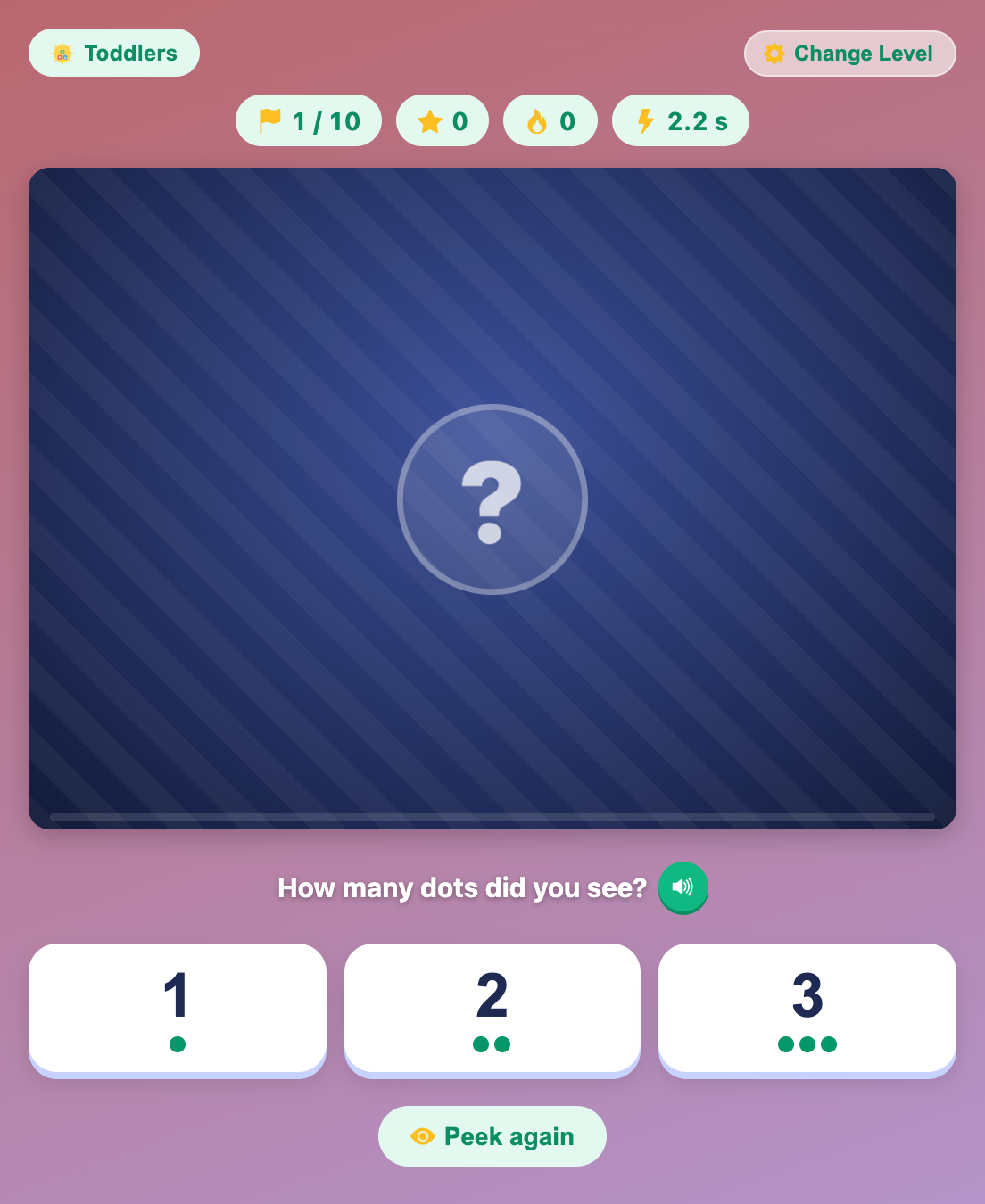
The question mark card hiding the dots in Flash Dots for toddlers, with three answer buttons that also show little dots
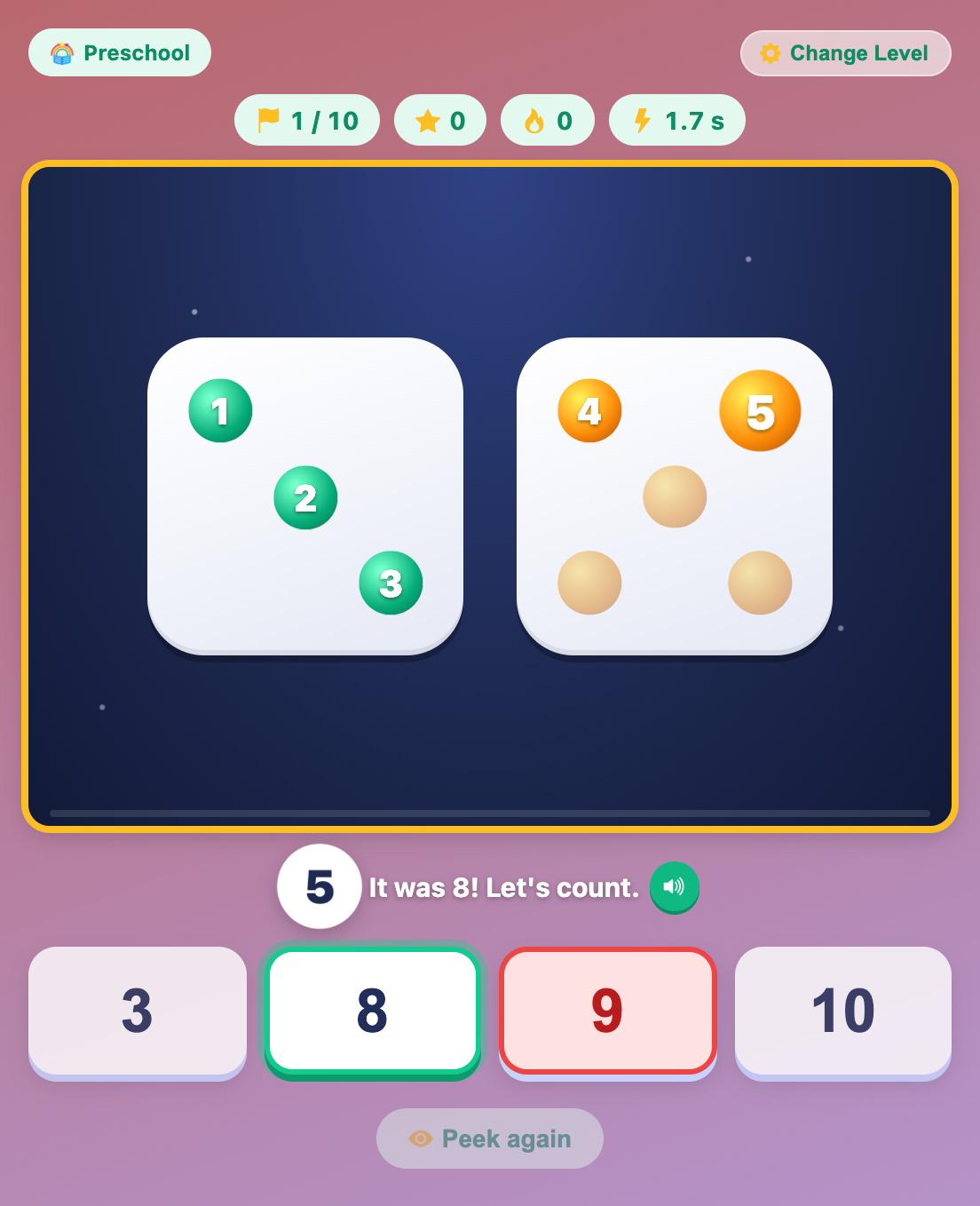
Two dice faces of 3 and 5 being counted out dot by dot after a wrong answer in Flash Dots for preschoolers
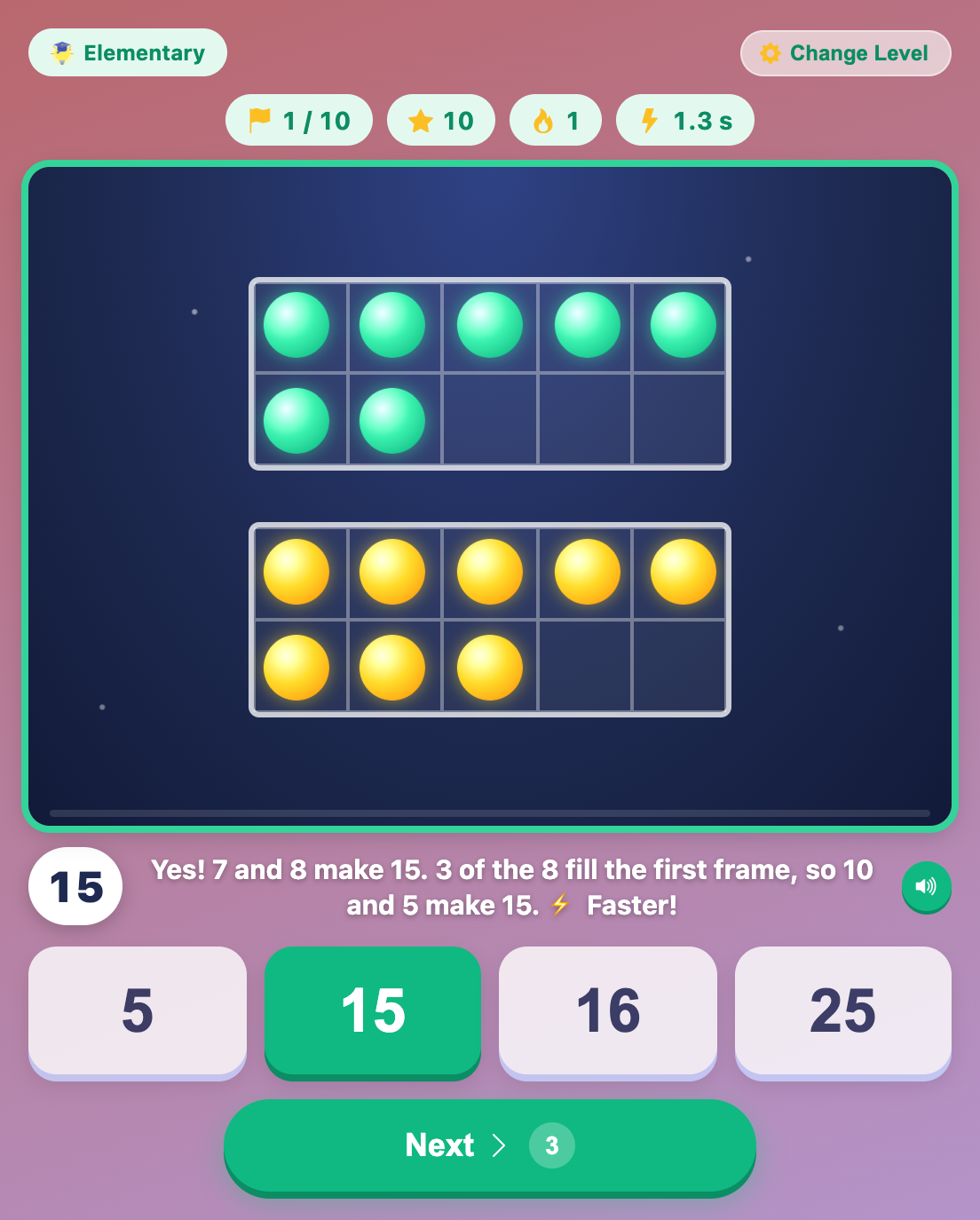
Two ten frames with 7 green and 8 yellow dots, answered right as 15 at the Elementary level
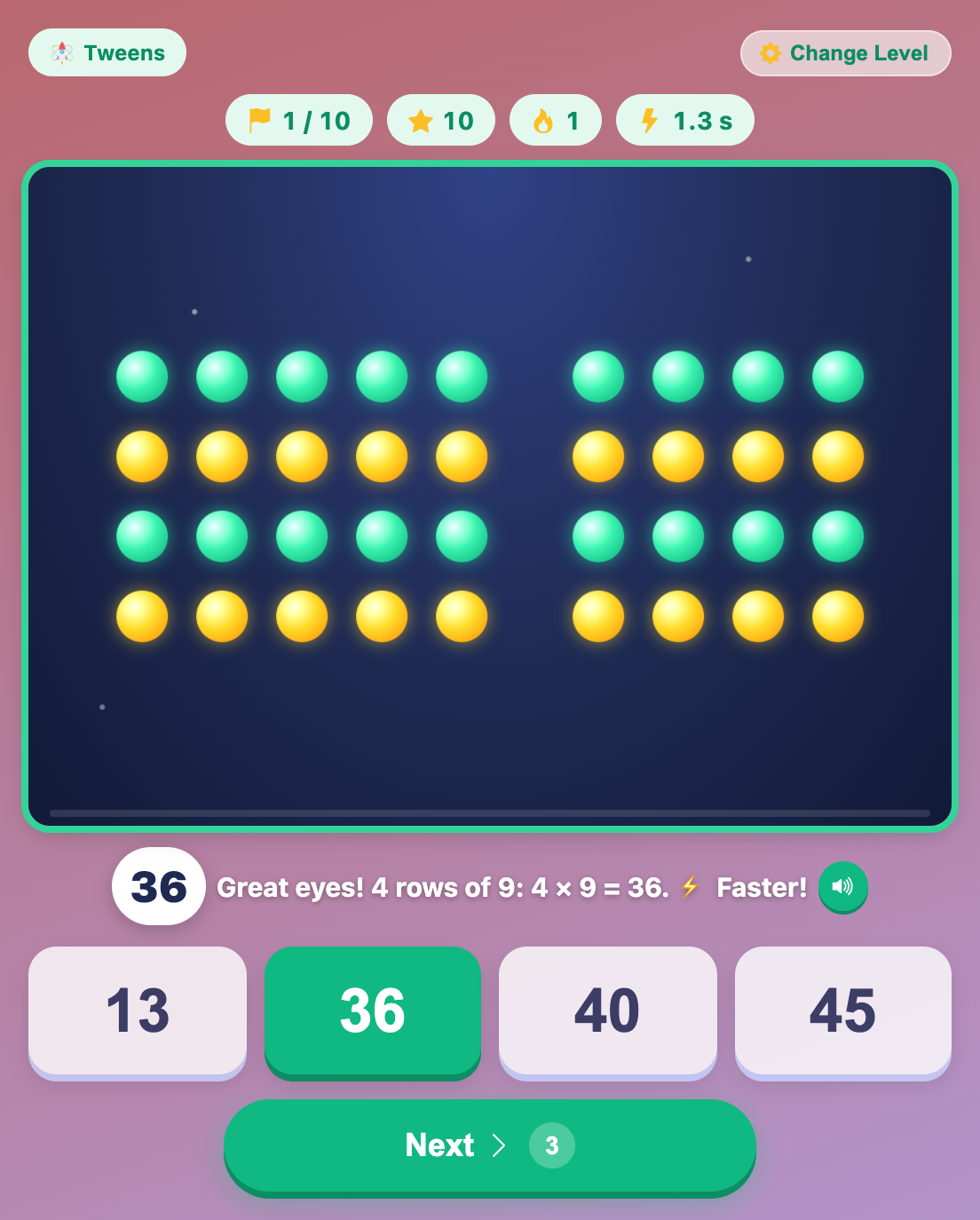
An array of 4 rows of 9 dots solved as 4 times 9 equals 36 in Flash Dots for tweens
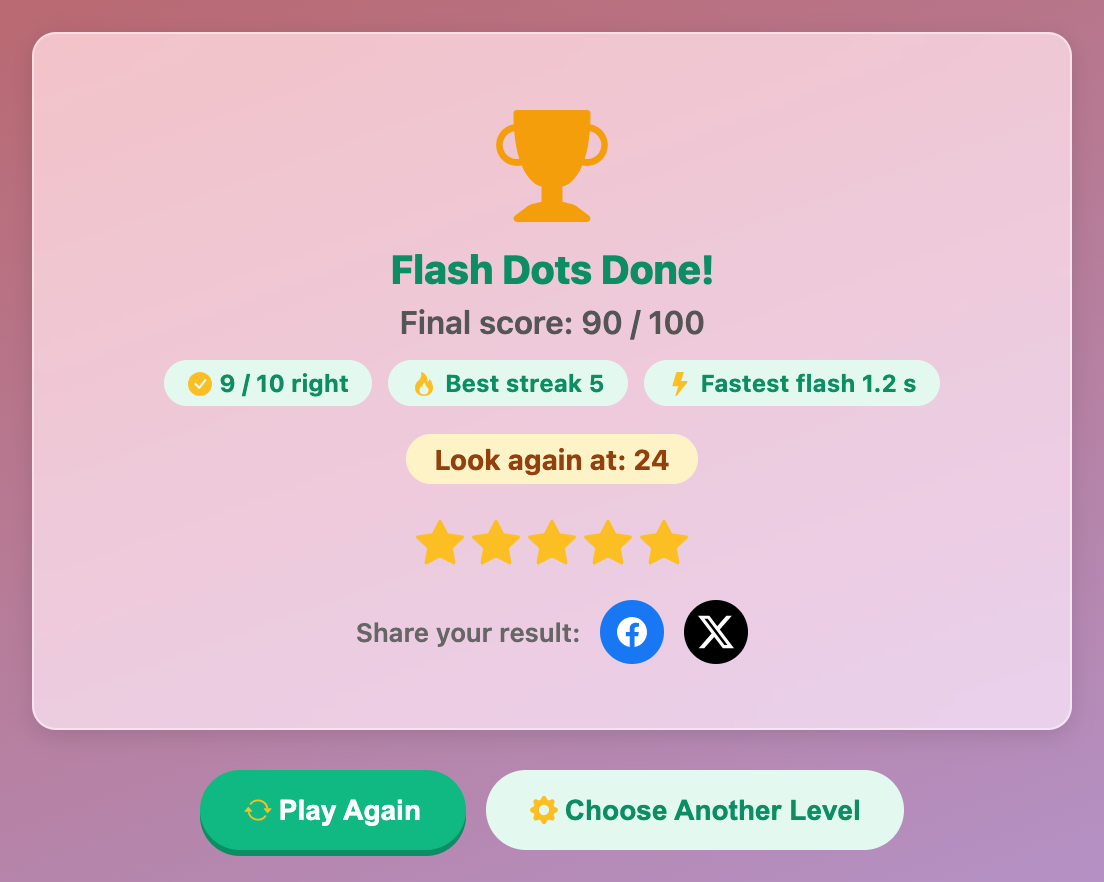
The Flash Dots Done finish card with a trophy, a score of 90 out of 100, best streak and fastest flash
More Math Games
 423.6K plays
4.9
Number Line Frog
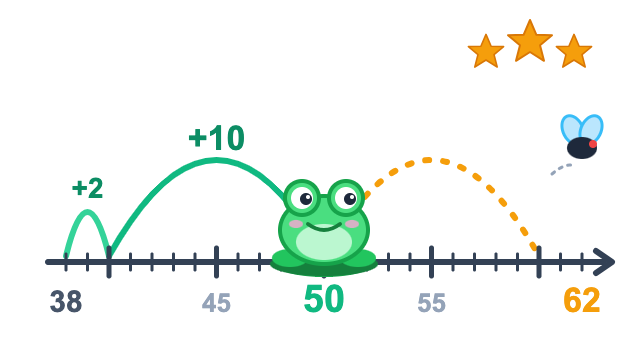
Help the hungry frog catch the fly! Tap hops like +1, +5 and +10 to jump the frog along the number line, and watch each hop draw an arc and build the number sentence. Use as few hops as you can to earn 3 stars. Little ones hop by 1s to a number, bigger kids find sums like 47 + 8 by hopping, and older kids hop across negative numbers, decimals and fractions.
 847.4K plays
5.0
Math Car Race
Pick your age level, then drive your race car through the lane with the right answer — every correct gate makes you faster!
 212.8K plays
4.9
Math Village Builder
Build a village on a blocky island! Solve counting, adding and subtracting, shapes and word problems to earn wood, stone, flowers and diamonds for every house, road, farm and school.
 32.8K plays
5.0
Ten Frame Fill
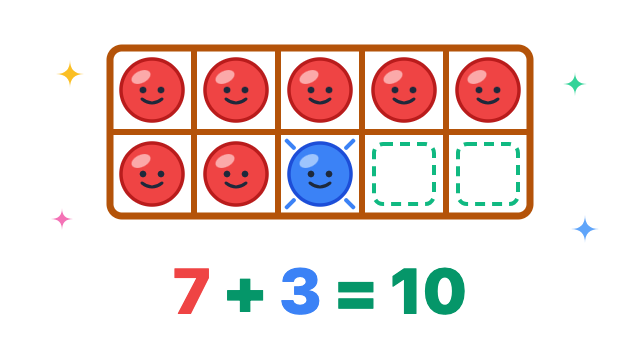
Fill the ten frame with smiley counters! Tap the squares to show a number, then count the empty squares to see how many more make 10. Little ones build numbers up to 10, preschoolers use two frames for teen numbers like 10 + 4 = 14, and older kids fill the top frame first to solve sums like 8 + 5. Every round is a picture, with a friendly voice to read it aloud.
Most Played Games
 518.5K plays
4.9
Math Temple Escape
Help a baby bunny hop away with the Golden Carrot! Bounce along a pastel temple path in 3D, jump logs, slide under flower garlands and dodge smiling mushrooms while cheeky little monkeys chase you. At every gate, hop under the sign with the right answer to zoom ahead. Counting, adding, subtracting, times tables and division for every age.
 273.8K plays
4.9
Math Horse Derby
Saddle up for a math steeplechase! Every fence has a question: answer right to gallop and jump clean, get three in a row for Carrot Power, and race your horse past the pack to the finish. Count, add, subtract, multiply and divide.
 473.7K plays
4.9
Math Addition Moto Race
Pick your age level, then ride your motorbike through the lane with the right addition answer — every correct gate makes you faster!
 1.1M plays
4.9
Math Moto Race
Pick your age level, then ride your motorbike through the lane with the right answer — every correct gate makes you faster!
Comments (20)