
Math Village Builder
212.8K playsBuild a village on a blocky island! Solve counting, adding and subtracting, shapes and word problems to earn wood, stone, flowers and diamonds for every house, road, farm and school.
Four fish, with two crossed out. Four baskets, with ten stars in each. A rectangle 8 centimeters long and 3 centimeters wide. In most math games, these puzzles end with a ✅ and a new question. In Math Village Builder for kids, every one of them turns into something real. Each right answer becomes wood, stone, flowers or diamonds, and those turn into houses, roads, farms and a big brick school on your own blocky island.
You start with nothing but sand, sea and a thin blue stream. You finish with a busy little town where tiny villagers walk the roads and smoke curls up from every chimney. Kids on KidWorld have played Math Village Builder more than 200,000 times, and it holds a rating of 4.8 out of 5 from more than 1,300 ratings. It is part building game and part math practice, and each half makes the other one more fun.
🏝️ Twelve Quests, Four Kinds of Math
The island grows through 12 quests. A quest is one small building job, like "Plant 16 squares of grass on the sand" or "Build 4 houses for your villagers." When you finish a quest, a new piece unlocks. The pieces always unlock in the same order: Grass, Tree, Rock, House, Road, Fence, Farm, Shop, Playground, School, Bridge and Lake.
Most pieces cost a building material. Each material comes from its own kind of math question:
🪵 Wood comes from Numbers. Counting, what comes next, tens and ones, and rounding. Wood builds Houses (2 each), Fences (1) and Bridges (1).
🪨 Stone comes from Add & Subtract. Plus and minus, from tiny picture sums up to three-digit numbers. Stone builds Rocks (1) and Roads (1).
🌸 Flowers come from Shapes & Sizes. Naming shapes, counting sides, finding the biggest, the < and > signs, fractions, and area. Flowers grow Trees (1) and Farms (2).
💎 Diamonds come from Word Problems. Little stories with math hidden inside. They are the hardest, so they build the fanciest pieces: the Shop (1), the Playground (1) and the School (2).
Grass and Lake cost nothing. That means quest 1 is pure building: you paint grass and learn how the island works before any math shows up. The first math question pops up when you plant your first tree.
Here is something special. There is no big list of stored questions. The game makes up every question fresh, using real math rules for your level. It even skips the last 12 questions of each kind, so you won't see the same one again and again. Shapes and rectangles are drawn right on the card, and rectangles are drawn to size on a grid of 1-centimeter squares.
🎮 Your First Visit, Step by Step
Pick your level. The "Choose Your Level" screen shows Toddlers (ages 2–4), Preschool (4–6), Elementary (6–10) and Tweens (10–12). The game remembers your pick. The ⚙️ Change Level button at the top lets you switch, and every level keeps its own island.
Check the quest card. The pink card says "Quest 1 of 12" and what to build. A bar and a counter like "10 / 16" show how close you are. A tiny picture in the corner shows the piece you unlock next.
Read the little chips. Under the quest card, chips count your villagers (4 for every house), your finished quests, and on most levels how many buildings are happy.
Pick a piece from the toolbox. Locked pieces wear a 🔒. A freshly unlocked one gets a "NEW" badge. The small tag on each piece is its price, like 🪵2 on the House.
Tap or drag on the island. Tap a square to place one piece. Press and drag to paint a whole line, which is perfect for grass, roads and fences. If you point at a square with a mouse, it glows white when the piece fits there and red when it doesn't.
Answer when you can't pay. Tap a spot you can't afford, and a question card opens. Its label tells you what's going on, like "Earn Diamonds · Word Problems → Shop." The square you tapped pulses gold while you think. Get it right, and about a second later your piece is built right there.
Earn ahead with the + buttons. The four material buttons under the toolbox show how much you have. A ✓ number shows how many of that kind you answered right. Tap one to answer a question before you need it.
Listen with 🔊. The green speaker button reads the question out loud, in words instead of symbols. "4 − 2" is read as "4 fish, take away 2," and "3/4" is read as "three quarters."
Use the keyboard if you like. Press 1, 2, 3 or 4 to pick an answer and Esc to close the card. Q and E turn the island, Ctrl+Z undoes, and the arrow keys slide the view when you are zoomed in.
Change your mind. ↩️ Undo takes back your last change. The 🧽 Eraser removes a piece or turns grass back into sand. Tap a house, tree, rock, farm, shop or playground again with the same piece to change how it looks.
Look around. The two round arrows turn the island, ➕ and ➖ zoom, and ✋ Move lets you slide around when zoomed in.
Finish your village. Tap 🏁 Finish Village any time. You get a picture of your island, your score out of 100, up to 5 stars, and a list of the math you practiced.
Your island saves itself in your browser after every change. You can close the page and come back tomorrow. To start over, use 🏝️ New Island or the play page's reload button. The page also has buttons for fullscreen and for music and sounds.
🔍 What the Question Cards Really Ask
Every level gets its own kind of math. Here are real questions the game makes, with a way to think each one through.
🪵 Numbers (Wood)
Toddlers see a row of pictures and answer "How many?" The pictures are split into groups of five, like 🍎🍎🍎🍎🍎 🍎🍎, which makes counting easier. Touch each one as you count, and don't count any twice.
Elementary kids get place value. Place value means a digit's worth depends on where it sits. A card might say "4 tens and 7 ones." Four tens is 40, and 7 more is 47. The choices might include 74, which puts the digits in the wrong places, and 11, which just adds 4 and 7. Other cards ask "What is 10 more than 38?" or show a skip-counting pattern like "5, 10, 15, 20, ?"
Tweens round big numbers. Try "Round 347 to the nearest 10." Look at the ones digit: it's 7. Five or more rounds up, so the answer is 350, not 340. Watch out for 300. That is what you'd get if you rounded to the nearest 100 instead.
🪨 Add & Subtract (Stone)
Toddlers and preschoolers often get picture sums. For take-away questions, the game shows all the things and crosses out the ones that go away. With 4 fish and 2 crossed out, you just count the fish that are left: 2.
Elementary kids add and subtract two-digit numbers. They also meet missing-number puzzles like "? + 8 = 23." Think: "What plus 8 makes 23?" A handy trick is to turn it around: 23 − 8 = 15. Then check: 15 + 8 = 23. ✔️
Tweens work with three-digit numbers, like 486 + 237, and with missing numbers in take-away sums too.
🌸 Shapes & Sizes (Flowers)
Toddlers tap the right shape (circle, square, triangle, star or heart), or pick the group with the most ladybugs. Preschoolers count the sides of a drawn triangle or square.
Elementary cards show things like "47 ? 74" with three buttons: < less than, > greater than, and = equal to. Always compare the tens first. 4 tens is less than 7 tens, so 47 < 74. Other cards show numbers made from the same three digits, like 472, 427 and 742, and ask for the biggest or the smallest. Again, start with the hundreds digit.
Tweens get fractions, rectangles and decimals. A fraction is a part of a whole, like 1/4 (one piece of something cut into 4 equal pieces). "Which fraction is the biggest: 1/2, 1/3, 1/5 or 1/8?" Many kids pick 1/8 because 8 is the biggest number. But the more pieces you cut, the smaller each piece gets. Half a pizza is way more than an eighth! So the answer is 1/2.
💎 Word Problems (Diamonds)
These are short stories, so read slowly. On Elementary: "There are 4 baskets. Each basket has 10 ⭐ stars. How many stars are there in all?" The word "each" tells you every basket has the same amount. That means groups, and groups mean times: 4 × 10 = 40. The choices also showed 14 (adding 4 and 10), 50 and 44. Only 40 fits the story.
Tweens get two-step stories and money. For example: "Leo buys 4 packs of stickers with 8 stickers in each pack, then gives away 10. How many stickers does Leo have left?" Step one: 4 × 8 = 32 stickers. Step two: 32 − 10 = 22. If you stop after step one, you'd pick 32, and that answer is waiting there to catch you.
🪤 Trap Answers and How to Dodge Them
Here's a secret about Math Village Builder for kids: the wrong answers aren't random. The game puts the most likely mistakes first. So if you know the common traps, you can spot them. Here are the big five.
Trap 1: The flipped digits
If the answer is 47, you will often see 74 too. They use the same digits, so a quick look can fool you. How to dodge it: say the number out loud in tens and ones. "Forty-seven is 4 tens and 7 ones." Then check the choice matches.
Trap 2: The forgotten carry
Try 38 + 27. Ones first: 8 + 7 = 15. Write the 5 and carry the 1 ten. Tens: 3 + 2 + 1 = 6. The answer is 65. Forget the carried 1, and you get 55. That's why the choices often include an answer that is exactly 10 too small or 10 too big. How to dodge it: guess first. 38 is close to 40 and 27 is close to 30, so the answer should be near 70. 65 is close; 55 is too far away.
Trap 3: Area or perimeter?
A Tweens card shows a rectangle 8 cm long and 3 cm wide and asks for the perimeter, which is the distance all the way around the edge. The choices include 24 cm. But 8 × 3 = 24 is the area, the number of little squares inside. For the perimeter, add all four sides: 8 + 3 + 8 + 3 = 22 cm. If you tap 24, the card turns it red, shows 22 cm in green, and reminds you: "Perimeter = all four sides added up." How to dodge it: area is "inside" and uses ×. Perimeter is "around" and uses +.
Trap 4: Adding when you should take away
"There are 9 frogs. 3 go away. How many frogs are left?" The choices may include 12, which is 9 + 3. How to dodge it: hunt for the action words. "Go away," "left," and "gives away" mean the number gets smaller. "More," "in all" and "altogether" mean it gets bigger.
Trap 5: Stopping halfway
Two-step stories, like Leo's stickers, always offer the halfway answer. How to dodge it: after you get a number, read the question one more time and ask, "Is that what they asked for?"
A few more habits help on every card:
Read all the choices before you tap. Once you know the traps, you can often cross out one or two right away.
Use the drawing. Count the grid squares in a rectangle, or the corners of a shape. A hexagon has 6 corners, so it has 6 sides.
Read the explanation when you miss. Many cards show a helper line, like "Look at the ones digit: 5 or more rounds up" or "20 ÷ 4 = 5, then × 3 = 15." That line is a mini lesson.
Don't try to skip a hard one. If you close a card without answering, the same question waits for you next time. A new question only comes after you answer. So take a breath and work it out.
Slow and right beats fast and wrong. There is no timer. Your math score is about how many you get right compared with how many you answer, not about speed.
🗺️ Planning Your Island Like a Builder
The math is only half the fun. The other half is spending your materials well. One right answer pays a different amount on each level:
Toddlers: 4 wood, 4 stone, 3 flowers or 2 diamonds.
Preschool: 3 wood, 3 stone, 3 flowers or 2 diamonds.
Elementary: 3 wood, 3 stone, 2 flowers or 1 diamond.
Tweens: 2 wood, 2 stone, 2 flowers or 1 diamond.
Count your flowers before you plant
On Elementary, you need 5 trees and 2 farms. That's 5 × 1 + 2 × 2 = 9 flowers. Each Shapes & Sizes answer pays 2 flowers, so 4 right answers give 8. That's one short! You need 5 right answers, and you'll have 1 flower left over for later. Doing this sum first means no surprises.
Earn before a long drag
If you drag a road and run out of stone halfway, the road stops and a message says "Out of 🪨 stone! Answer a question to get more." Nothing is lost, but it breaks your line. Tapping the Stone button a couple of times first lets you draw the whole road in one smooth swipe.
Mistakes are free to fix
Your stock is always "everything you earned, minus what is standing on your island." So when you erase a house or press Undo, its 2 wood come straight back. Moving a piece never costs a new question.
Keep your buildings happy
From Preschool up, buildings show a white thought bubble when they're missing something:
A house wants a 🛣️ road right next door.
A farm wants 💧 fresh water, meaning the stream or a lake, within 2 squares. The salty sea doesn't count!
A shop wants a road next door and 2 houses within 3 squares.
A playground wants a road next door and a house within 3 squares.
The school wants a road next door and 3 houses within 4 squares. It's also a big 2×2 piece, so it needs a free patch of land that size.
From Preschool up, the Road quest counts houses that have a road next door, not road pieces. On Elementary and Tweens, only happy farms, shops, playgrounds and schools count for their quests. So here's a plan that works:
Draw one long main road across the middle of the island.
Line your houses up along it, with every house touching the road.
Paint grass beside the stream and put your farms there.
Leave an empty 2×2 spot by the road, near 3 houses, for the school.
Put the shop and the playground between houses, right on the road.
One more tip: only trees and farms need grass. Houses, roads and the school sit happily on plain sand. And a bridge built out over the sea has to start at the shore.
🧾 Reading Your Score
Your score out of 100 has two halves. Half is for building and half is for math:
Quests, up to 35 points, split across the 12 quests.
Happy buildings, up to 10 points, for the share of buildings with every wish met. On Toddlers, buildings have no wishes, so any building earns all 10.
Variety, up to 5 points, for how many of the 12 kinds of pieces are on your island.
Math, up to 50 points, for the share of questions you answered right.
Here's how it adds up for the finished Elementary village in the pictures below. All 12 quests are done (35 points). Every building is happy (10 points). All 12 kinds of pieces are there (5 points). And 28 of 32 answers were right. The math half is worth 50 points, and 28 out of 32 is 87.5% of it, which rounds to 44 points. In all, that's 94 out of 100.
A score of 90 or more earns 5 stars, 70 or more earns 4, and 50 or more earns 3. Finish all 12 quests and your island is named "Math Master Village!" Finish 6 or more and it's a "Growing Village!"
The result card also shows a score for each kind of math, like "Numbers 8/9" or "Word Problems 4/5." That tells you which kind to practice. Below it are two lists: "⭐ Math you got right," with sums like "37 − 10 = 27," and "🔁 Practice these again," with the ones you missed, like "triangle: 3 sides." After that, tap "Build a New Island" to start fresh, or "Choose Another Level."
🎒 Math Village Builder for Kids, From Age 2 to 12
All four levels share the same 12 quests. The level changes the math, the size of the island, how many choices each card shows, and how strict the building wishes are.
🐣 Toddlers (ages 2–4)
Math Village Builder for toddlers is all about pictures. The questions are counting to 5, adding and taking away within 5, finding a shape, and spotting the biggest group. Cards show just 3 choices, and each question is read out loud by itself when sound is on. The island is the smallest, 16 squares across, and buildings have no wishes, so little ones can build anywhere. A grown-up can read and point while the child taps.
🎨 Preschool (ages 4–6)
Math Village Builder for preschoolers counts up to 10, asks what number comes before or after, and adds and subtracts within 10. It also asks how many sides a triangle or square has. Cards now have 4 choices and are still read aloud automatically. Thought bubbles appear over buildings, but only as friendly hints. A farm far from water still counts for its quest.
📐 Elementary (ages 6–10)
Math Village Builder for elementary kids brings two-digit sums, place value, skip counting, the < and > signs, sides of shapes up to the octagon (8 sides), and times and sharing word problems. The island is 20 squares across, and building wishes now really count. Questions are no longer read out automatically, but the 🔊 button is always there.
🚀 Tweens (ages 10–12)
Math Village Builder for tweens is the big challenge. It has three-digit sums, rounding, the value of a digit in a number like 3,742, fractions, area and perimeter, decimals, two-step stories, and money problems. The island grows to 24 squares across, quests ask for more (24 squares of grass, 8 fences), and each right answer pays the least. Every diamond takes real thinking.
❤️ Why Kids Learn So Much While They Build
Math has a reason. When 4 × 10 = 40 turns into a diamond, and the diamond turns into a shop, the answer matters. Kids want to get it right because they want the shop.
Kids learn from mistakes, not get punished for them. A wrong answer shows the right one and often a helper line. Nothing already earned is taken away.
Real-life math sneaks in. "I need 9 flowers and each answer gives 2" is planning with numbers. So is saving a 2×2 spot for the school.
Kids learn to check their work. Since the wrong choices are the common mistakes, kids learn to slow down, estimate and double-check.
Kids who don't read well yet can still play. The 🔊 button reads every question in plain words, so younger kids can still solve story problems.
A Note for Parents and Teachers
Math Village Builder is calm and safe. There's no timer, no scary content, and no chatting with anyone. It practices counting, place value, addition and subtraction, shapes, comparing, fractions, measuring, and word problems, plus planning and patience. The "Practice these again" list at the end is a ready-made study sheet. Try working through two or three of those sums together after a game. For the youngest players, sitting side by side and reading each card together works best.
Your island is waiting, and every answer you get right is a block for your village. Pick a level, earn your first flowers, and watch your little town grow. Math Village Builder for kids is ready to play right here on KidWorld. Happy building! 🏝️🧮
🖼️ See the Game in Action
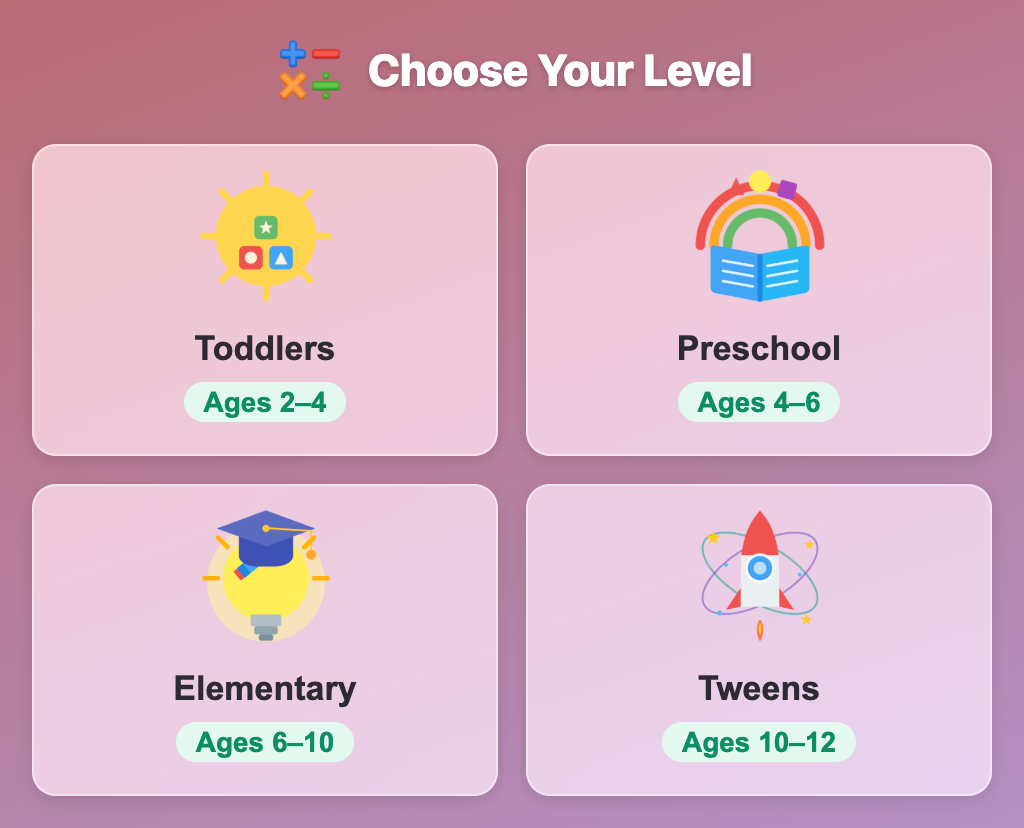
The Choose Your Level screen in Math Village Builder, with Toddlers, Preschool, Elementary and Tweens cards
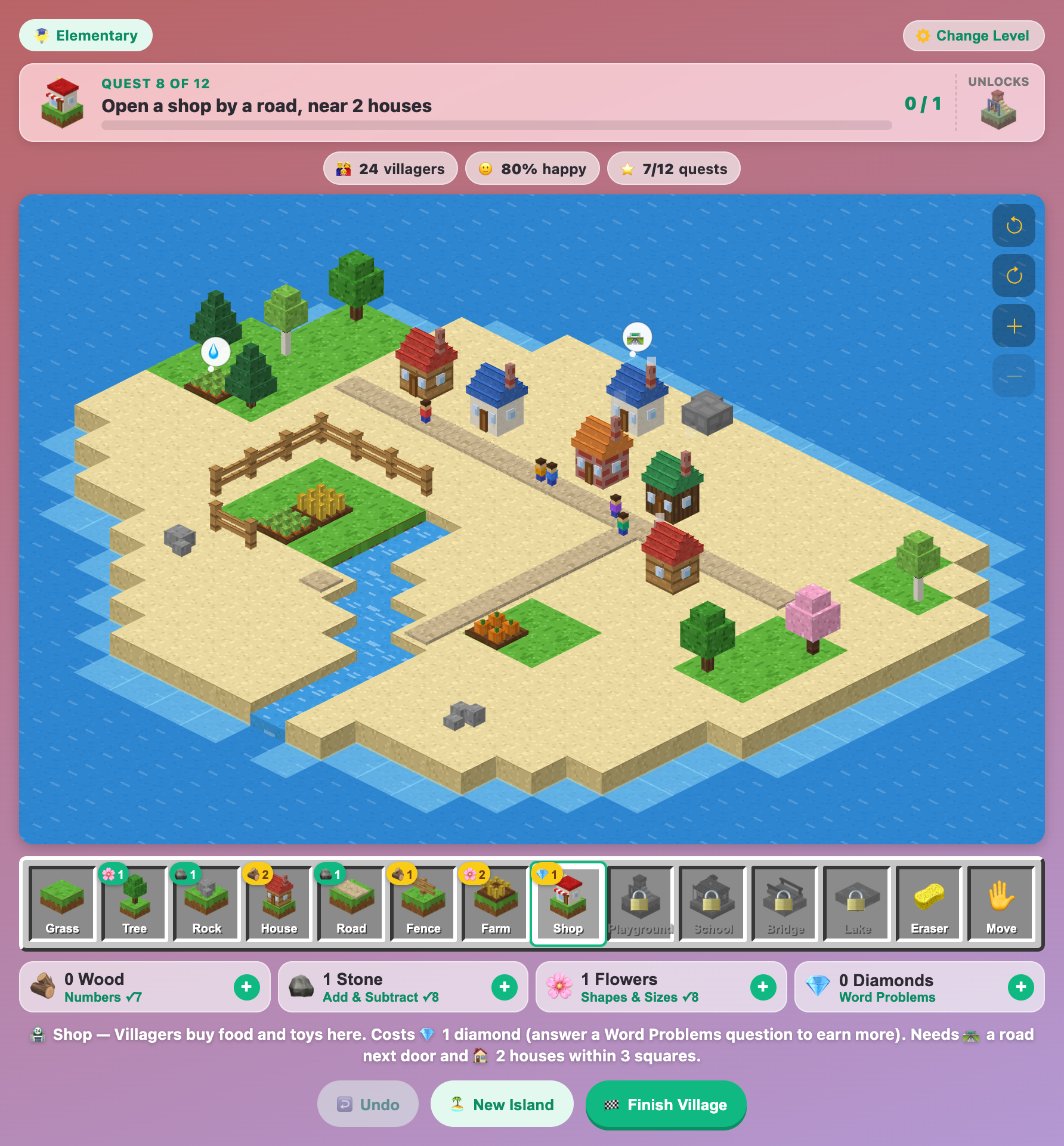
An Elementary island in Math Village Builder for kids on quest 8, with houses, a road, farms and two thought bubbles
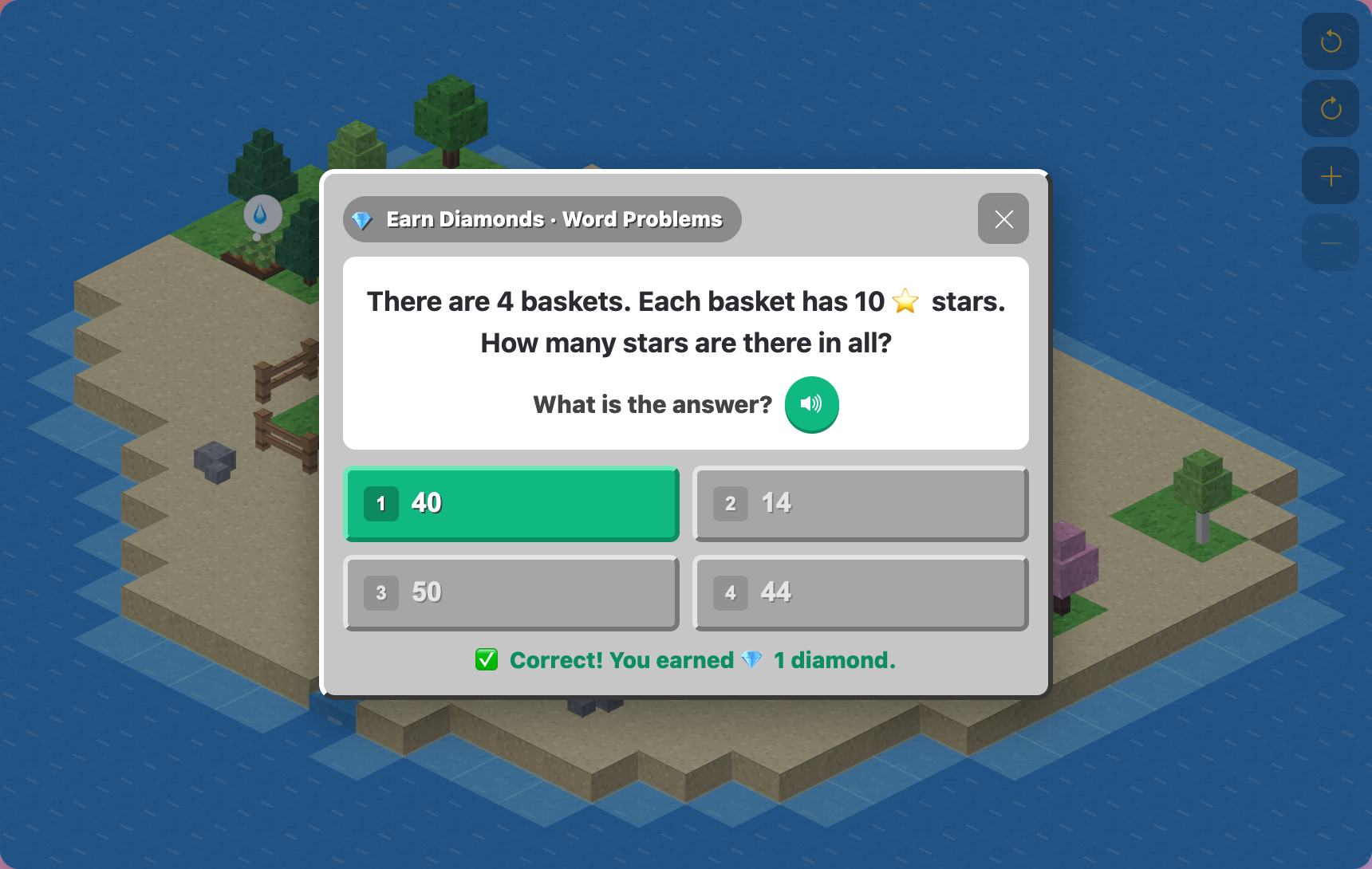
A Word Problems card about 4 baskets of 10 stars, answered right with 40 to earn one diamond
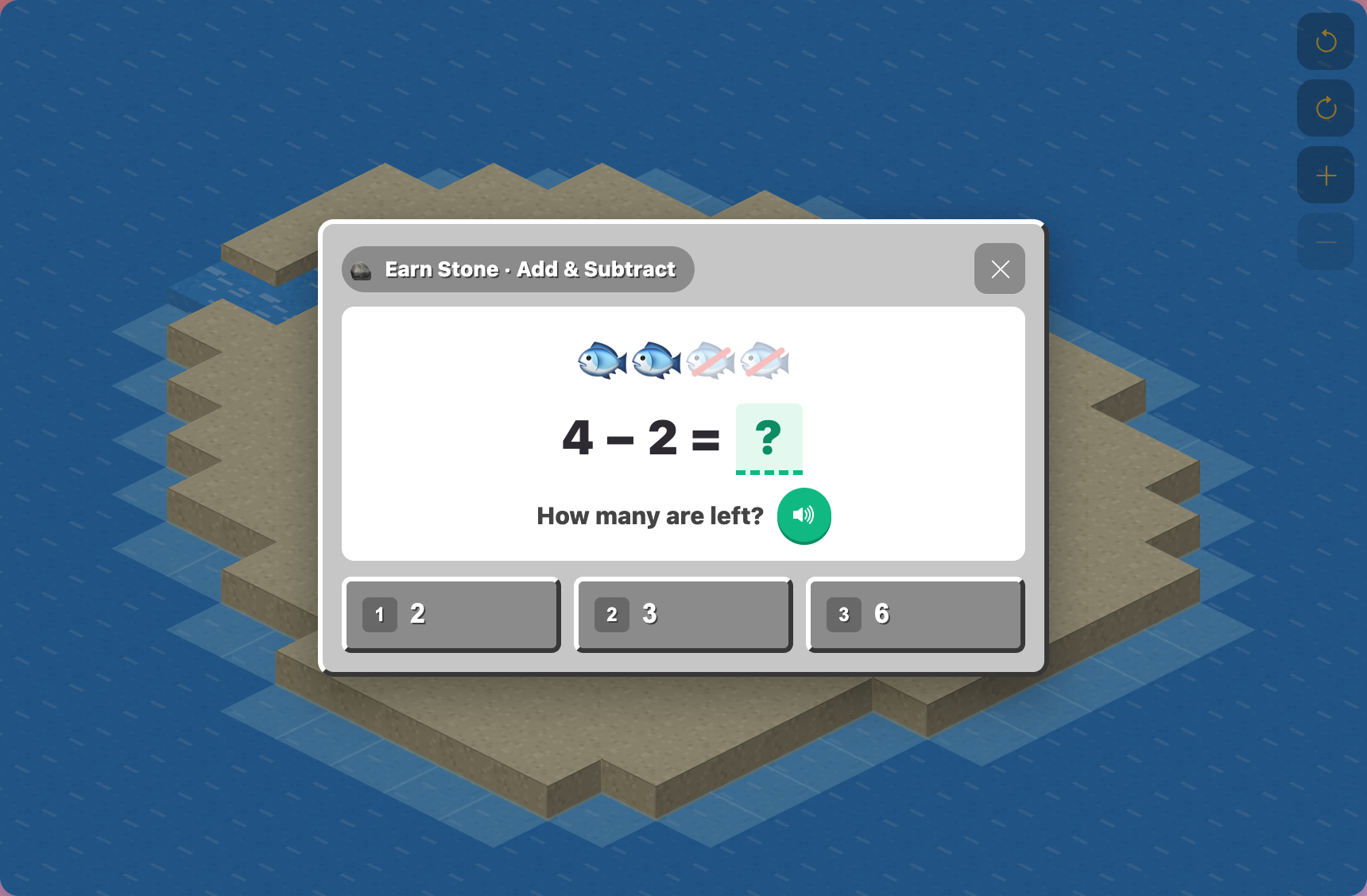
A toddler take-away question showing 4 fish with 2 crossed out, above 4 minus 2 and three answer choices
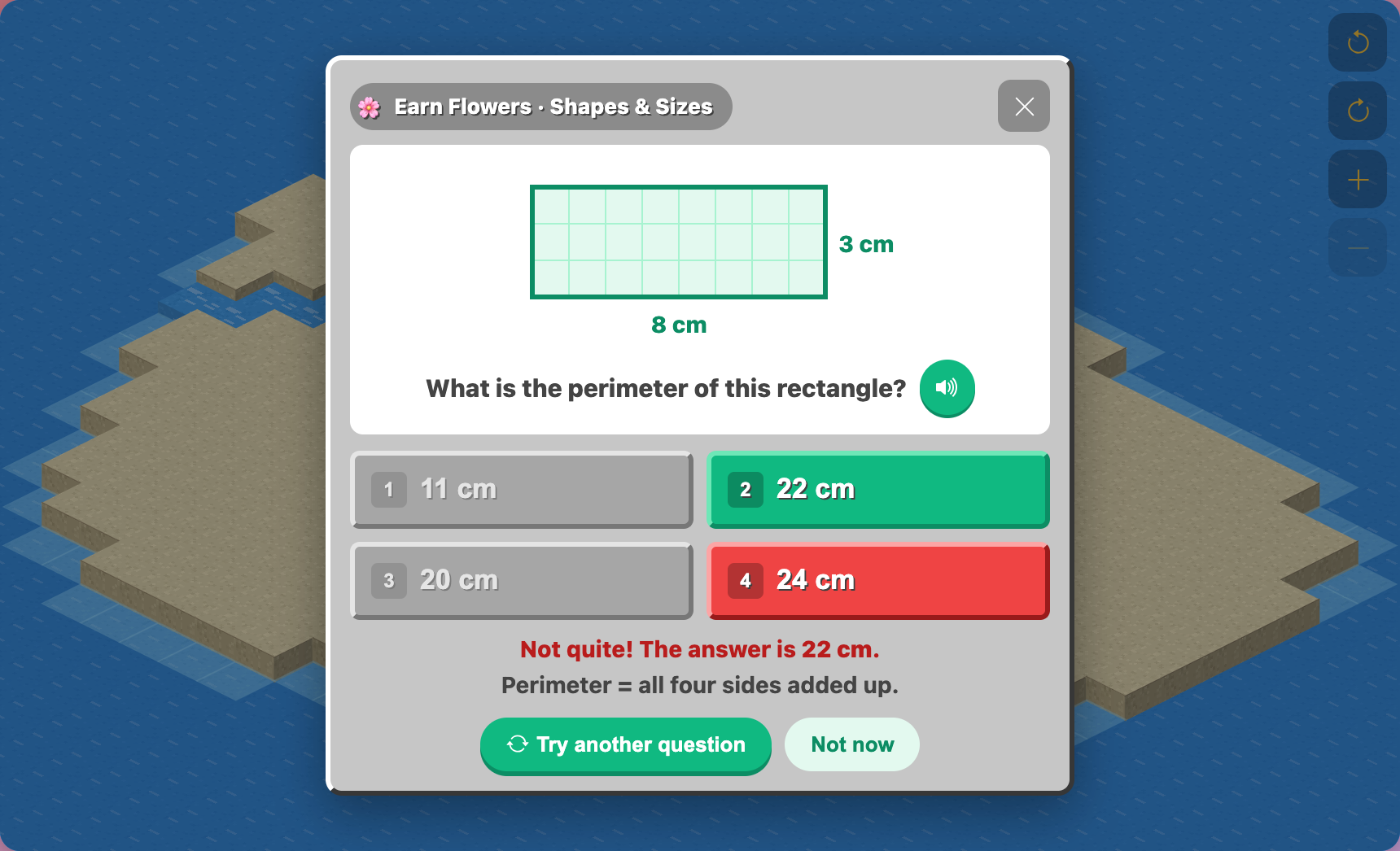
A Math Village Builder for tweens perimeter question on an 8 by 3 cm rectangle, with 24 in red and 22 cm in green
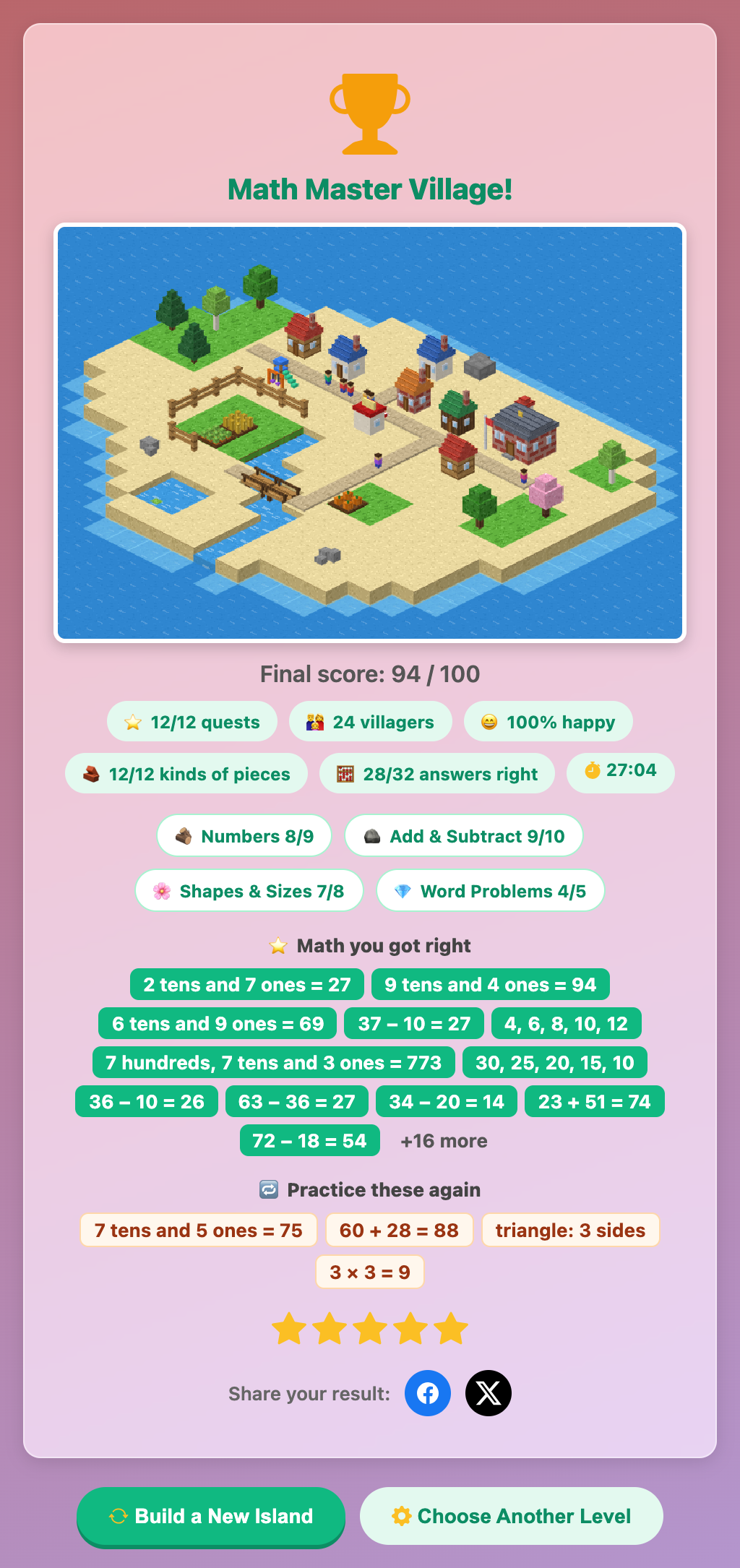
The Math Master Village result card with a picture of the finished island, a score of 94 out of 100 and practice sums
More Math Games
 1.1M plays
5.0
1.1M plays
5.0
Math Moto Race
Pick your age level, then ride your motorbike through the lane with the right answer — every correct gate makes you faster!
 857.5K plays
5.0
857.5K plays
5.0
Addition Quiz
Pick your age level and answer fun multiple-choice addition questions!
 473.7K plays
4.9
473.7K plays
4.9
Math Addition Moto Race
Pick your age level, then ride your motorbike through the lane with the right addition answer — every correct gate makes you faster!
 847.4K plays
4.9
847.4K plays
4.9
Math Car Race
Pick your age level, then drive your race car through the lane with the right answer — every correct gate makes you faster!
Most Played Games
 1.8M plays
5.0
1.8M plays
5.0
Color & Draw
A free-drawing canvas with colors and brush sizes to unleash your creativity.
 59.4K plays
5.0
59.4K plays
5.0
Recycling Sort
Sort everyday items into the Recycle, Compost, or Trash bin before time runs out!
 365.5K plays
4.9
365.5K plays
4.9
Tic-Tac-Toe
Play a game of Tic-Tac-Toe against the computer and see if you can outsmart it.
 1.1M plays
4.9
1.1M plays
4.9
Chess
Play the classic game of chess against the computer or a friend, with FIDE time controls, hints, and undo.
Comments (31)