
Place Value Factory
72.6K playsRun the number factory! Orders roll down the conveyor belt, and you fill each crate with ones cubes, tens rods and hundreds flats. Put in ten cubes and watch them snap together into a rod! Little ones count cubes, preschoolers build numbers like 34, older kids build 243, read crates and break a ten to take away, and tweens work with thousands and decimals.
Help wanted: one factory boss who knows that ten little cubes make one long rod. In Place Value Factory for kids, you fill wooden crates with base-ten blocks to build the number on each order, like 34, 243 or even 2.47. It is a free place value game for children from about 2 to 12, and it shows, with real blocks you can see, why the 2 in 243 is really two hundred.
Orders roll down a conveyor belt one at a time. You tap bins of cubes, rods and flats to fill the crate. When ten blocks pile up in one column, they glow and snap together into one bigger block. Then you press Ship it! and the crate rolls away. You play right in your browser, on a computer, tablet or phone. There is nothing to download, no sign-up, and no clock ticking on any order.
🏭 Place Value Factory for Kids: Every Digit Has a Job
A number like 243 is made of three digits. A digit is one of the signs 0 to 9. Place value means that where a digit sits tells you what it is worth. The 3 on the right means 3 ones. The 4 in the middle means 4 tens. The 2 on the left means 2 hundreds. So 243 is 200 + 40 + 3.
Teachers use wooden or plastic base-ten blocks to show this, and the factory uses the same four shapes:
An orange cube is worth 1. It goes in the Ones column.
A blue rod is ten cubes stuck in a line, so it is worth 10. It goes in the Tens column.
A red flat is ten rods side by side, a square of 100 little cubes. It goes in the Hundreds column.
A big cube is ten flats stacked up, worth 1,000. Only the Tweens level has a Thousands column for it.
The crate is a place value mat: one column for each place, with the biggest blocks on the left, just like the biggest digit sits on the left of a number. Under every column a big digit shows how many blocks are in it. Your job is to make those digits match the order.
The magic rule of the factory is this: a column can only hold 0 to 9 blocks. Put a tenth cube in the Ones column, and all ten cubes glow and snap into one rod in the Tens column. The tip line cheers, "Snap! 10 ones make 1 ten." Ten rods snap into a flat the same way. This is called regrouping, and in the factory you watch it happen right in front of you.
📦 Your First Shift: How to Play Place Value Factory on KidWorld
Pick your level. The first time you play, you start on Elementary. Tap Change Level at the top to see four cards: Toddlers (ages 2–4), Preschool (ages 4–6), Elementary (ages 6–10) and Tweens (ages 10–12). The game remembers your pick next time.
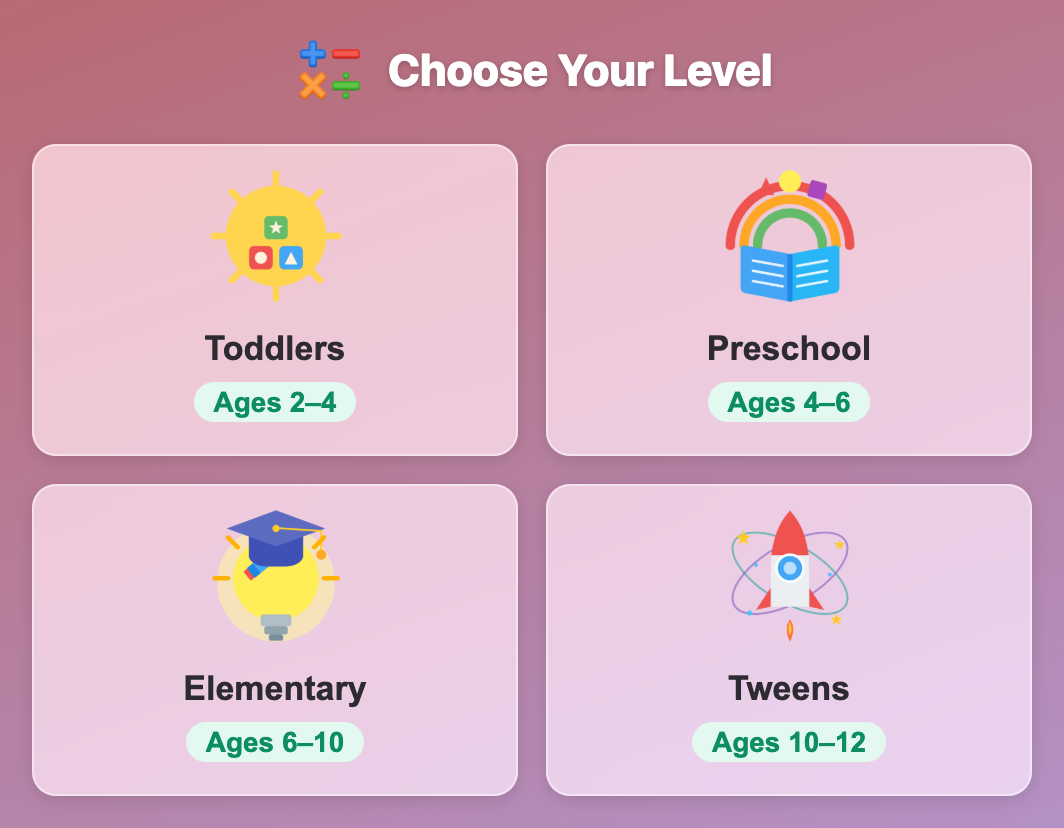
Read the order card. The big number in the middle is the order, for example "Make 418 with the blocks." The flag at the top shows which order you are on (like 1 / 10), and the star counts your points.
Fill the crate. Each column has a bin with a + sign. Tap a bin to drop one block of that kind into its column. You can also drag a block out of a bin and drop it anywhere on the crate. It lands in the right column by itself.
Fix a mistake with −. The red − button under each column takes one block out. If that column is empty, the game cracks open the next bigger block for you and one small block comes out. The Clear button empties the whole crate.
Press Done. When the digits under the crate match the order, press Done. If something is off, the tip says exactly what, such as "You have 3 tens. We need 4 tens. Put in 1 more ten!"
Answer the question orders. Some orders show a full crate and ask, "What number is in this crate?" The digits are hidden behind ? marks. Count the blocks and tap one of the answer buttons.
Take away (Elementary and Tweens). Some orders are take-away sums like 73 − 8. Tap Take to move one block into the "Taken away" tray. Run out of blocks? Tap Break (it has a little hammer) to crack one bigger block into ten smaller ones. When the tray is full, press Done and pick the answer.
Ship it! After each right crate, the card shows the number taken apart, like "732 = 700 + 30 + 2." The green Ship it! button fills up and counts down from 5, then moves on by itself. You can tap it sooner, or press Enter or Space.
See your score. After the last order, the "Orders Shipped!" card shows your score out of 100, how many crates you built on the first try, and up to five stars. Tap Play Again for new orders, or Choose Another Level.
Use the helper buttons. The green 🔊 buttons read the order, the tip and the "How to play" box out loud. The page's own buttons let you go fullscreen, reload the game, or turn the music on and off.
🧰 Foreman Tips: Fill Every Crate Right the First Time
A foreman is the boss of a factory floor. Here is how a good one thinks in Place Value Factory for kids. Each tip says what to do and why it works.
1. Start on the left, with the biggest blocks
Read the order from left to right, and fill the crate the same way. For 418, tap the flat bin 4 times, the rod bin 1 time, then the cube bin 8 times. Working this way keeps your place. You always know which digit you are on, and you never lose count in the middle.
2. A digit is just a number of taps
You do not need 418 taps to make 418! The digit in each place tells you how many taps that column needs. 4 + 1 + 8 is only 13 taps. A 0 means "don't touch this bin at all." When you build 307, the Tens column stays empty, and its digit shows 0.
3. Closed bin? Count by tens
Some orders put a striped "Closed" sign on the biggest bin, like "Make 100. The hundreds bin is closed, so use tens!" These are snap orders. You have to build the big block yourself out of ten smaller ones. Count your rods out loud: 10, 20, 30… up to 100. On the tenth rod, they all snap into one flat. For an order like 135 with the hundreds bin closed, tap 13 rods and 5 cubes. The first ten rods snap into a flat, and 3 rods stay behind.
4. Too many? Don't start over
Tapped one too many cubes and it snapped into a rod? Press − on the Ones column. The game cracks the rod back open, says "Crack! 1 ten opened up, and 1 one came out," and leaves you with 9 cubes. One tap fixes it, so there is no need to press Clear.
5. Read a crate column by column
On a "What number is in this crate?" order, count one column at a time, biggest first. Say the place name as you go: "1 hundred, 4 tens, 6 ones: 146." Don't count every block as one! A crate with 1 flat, 4 rods and 6 cubes has 11 blocks, but it holds 146. If you pick 11, the tip reminds you, "That's how many blocks there are. A rod is worth 10 and a flat is worth 100!"
6. Watch for a column with 10 or more
On Elementary and Tweens, about half of the crates you read are a little bit messy. One column holds 10 to 14 blocks, like 13 rods. A column can only show 0 to 9, so those 13 rods are really 1 hundred and 3 tens. Before you answer, look for any pile that has more than 9, and move ten of them up one place in your head.
7. Know the trick answers
The wrong buttons are not random. Each one is a mistake that kids really make, so learning them helps you dodge them:
Flipped digits: 53 instead of 35. Rods come first, then cubes.
A missing zero: 35 instead of 305. "An empty column still needs a 0!"
The block count: the number of blocks, not what they are worth.
A forgotten carry: 234 instead of 334, when a column held 13 of something.
A moved dot: 24.7 instead of 2.47 in a decimal crate.
A wrong pick is never the end. The button turns gray, the tip explains the slip, and the columns glow one by one from biggest to smallest to help you count again. You keep picking until you find the right one.
8. Take away: check first, then break the closest block
In a take-away, look at the ones before you start. For 73 − 8 there are only 3 cubes, and you need to take 8. That's not enough, so break a ten right away: now you have 6 rods and 13 cubes. Take 8 cubes and 5 are left. The answer is 65. The game is fair about breaking. It only lets you break a block when you really need to. If you try to smash a flat while there are still rods, it says "Break a ten instead: it's closer!"
9. Don't take the small number from the big one
A very common slip in 73 − 8 is to think "8 take away 3 is 5" and answer 75. That flips the sum around. The factory catches it with the tip, "Don't take the small number from the big one! Break a ten, then count what's left." Another slip is to break a ten but forget that the Tens column went down by one. Then the answer comes out 10 too big. Always count what is really left in the crate.
10. First tries are worth points
You get a point for each crate that is right the first time you press Done. You get another point for each answer you pick right on the first try. A take-away order has both, so it is worth 2 points. Your final score is your points out of the most you could get, turned into a score out of 100. So slow down and check the digits under the crate before you press Done. Speed doesn't earn anything here, but care does.
🔧 Five Crates, Packed Step by Step
Crate 1: Toddlers, 12 cubes
The order says "Put 12 cubes in the crate. Watch what 10 cubes do!" The Tens bin says Closed, so only cubes can go in.
Tap the cube bin and count: 1, 2, 3… With the sound on, the game counts along out loud with you.
On cube number 10, all ten glow and snap into one blue rod in the Tens column. "Ten! Ten cubes make one ten."
Keep going: 11, 12. Now the crate shows 1 rod and 2 cubes, and the digits read 1 and 2.
Press Done. Twelve is one ten and two ones!
Crate 2: Preschool, reading 3 rods and 5 cubes
The crate shows 3 blue rods and 5 orange cubes. The question is "What number is in this crate?" and the buttons might show 8, 34, 35 and 53.
Count the rods by tens: 10, 20, 30. That's 3 tens.
Count on with the cubes: 31, 32, 33, 34, 35.
Write the tens digit first, then the ones digit: 35.
Watch out for 53, which puts the digits the wrong way round, and 8, which is just the number of blocks.
Crate 3: Elementary, a crate with 13 rods
The crate holds 2 red flats, 13 blue rods and 4 orange cubes. What number is it?
The Tens column has more than 9 rods. Ten of those rods make 1 hundred.
So move ten rods up in your head: 2 + 1 = 3 hundreds, with 3 rods left.
Now it reads 3 hundreds, 3 tens and 4 ones: 334.
The trick answers are 234 (the extra hundred was forgotten) and 2,134 (the columns were written down just as they stand). When you pick 334, the crate tidies itself up and shows "13 tens = 1 hundred and 3 tens."
Crate 4: Elementary, 304 − 8
This is the hardest take-away on Elementary. There are 3 flats, no rods and 4 cubes, and you need to take away 8 ones.
4 cubes are not enough. Try to break a ten… but the Tens column is empty! The tip says "There are no tens to break. Break a hundred first!"
Break a flat. Now you have 2 flats and 10 rods.
Break a rod. Now you have 2 flats, 9 rods and 14 cubes.
Take 8 cubes. 14 − 8 = 6 cubes are left.
The crate shows 2 hundreds, 9 tens and 6 ones, so the answer is 296.
The order card sums it up: "Break a hundred, then a ten: 2 hundreds, 9 tens and 14 ones. 14 − 8 = 6 ones."
Crate 5: Tweens, 3.25 − 0.7
In decimal orders the blocks change jobs. The flat is now worth 1, a rod is a tenth (one of ten equal parts of 1), and a cube is a hundredth (one of a hundred parts). A dot between the Ones and Tenths columns is the decimal point.
The crate holds 3 flats, 2 rods and 5 cubes: 3.25. The order says "Take away 0.7: that's 7 tenths."
Only 2 rods are there, so break a flat into 10 rods. Now it's 2 flats, 12 rods and 5 cubes.
Take 7 rods. 12 − 7 = 5 rods are left.
The crate reads 2 ones, 5 tenths and 5 hundredths: 2.55.
A sneaky button here is 3.18. That's what you get if you take away 7 cubes (0.07) instead of 7 rods (0.7). Always check which column the order is taking from.
🪜 Place Value Factory at Every Age
Each level has its own orders, its own crate and its own number range. No order repeats in one game, and the same answer never comes twice in a row.
🐣 Toddlers (ages 2–4): ten cubes make a rod
Place Value Factory for toddlers has 8 short orders and a crate with only two columns. Little ones put in 2 to 9 cubes, and faint dashed squares show how many are still to go. Then come orders of 10 to 14 cubes, where the Tens bin is closed and the tenth cube makes the snap happen. When the site's sound is on, the game reads each order and counts every cube out loud. Toddlers are never asked a question with buttons; they only build. A grown-up can count along and point at each cube.
🎨 Preschool (ages 4–6): tens and ones
Place Value Factory for preschoolers has 10 orders with rods and cubes. Kids build numbers from 21 to 59, snap teen numbers from 11 to 19 out of cubes alone, and read crates of 11 to 59. The flipped-digit answer (53 for 35) always shows up in their reading orders, so kids learn early that the tens come first. Orders and tips are read aloud when the sound is on. If your preschooler likes counting on, Number Line Frog lets them hop +1, +5 and +10 along a number line, which fits nicely with tens and ones.
📐 Elementary (ages 6–10): hundreds and breaking a ten
Place Value Factory for elementary kids adds a Hundreds column and 10 orders. Kids build numbers from 100 to 999, make a closed-bin number like 135 out of 13 rods and 5 cubes, and read crates that sometimes hold 10 to 14 of one block. Three take-away orders grow step by step: a two-digit one like 52 − 7, a three-digit one like 463 − 8, and one with no tens, like 304 − 8, where a hundred must be broken first. This is the same "borrowing" that kids meet in written subtraction, shown with blocks. For more practice finding numbers by tens and ones, try Hundred Chart Mystery Picture, where clues like "10 more than 37" color in a hidden picture.
🚀 Tweens (ages 10–12): thousands and decimals
Place Value Factory for tweens is the biggest factory. Whole-number orders use four columns, up to the big Thousands cube, with numbers from 1,000 to 9,999. More than half the orders are decimals with two places after the dot, like 0.82 or 2.47. Tweens build them, read them, snap a whole 1 out of ten tenths, and take away tenths across the decimal point. Seeing that a flat can be 100 in one order and 1 in the next is a big "aha!" about how decimals work.
🌱 What Kids Carry Home from the Factory
Numbers stop being just squiggles. When a child builds 732 out of 7 flats, 3 rods and 2 cubes, the 7 turns into something huge and the 2 into something tiny. That picture is what place value means, and it sticks.
Regrouping makes sense. Many kids learn "carry the one" and "borrow" as magic steps. In the factory they see ten cubes snap into a rod, and a rod crack back into ten cubes. After that, carrying and borrowing are just tidying up the crate.
Mistakes turn into lessons. Every wrong answer button is a real mistake with its own tip. Kids learn why 53 is not 35 and why 305 needs its zero, not just that they were wrong. They can keep trying until they get it, so nobody gets stuck.
Careful beats fast. There is no timer, and points come from getting things right the first time. That gently teaches kids to check their work before they press Done.
A good warm-up for littler hands. For a child who is still learning what ten looks like, Ten Frame Fill is a gentle step before the factory, with two rows of five squares to fill.
For parents and teachers: what's in the game, and is it safe?
Place Value Factory practices place value with base-ten blocks: ones, tens, hundreds and thousands, expanded form (243 = 200 + 40 + 3), regrouping, subtraction with renaming, and decimal tenths and hundredths. The game itself has no chat, no in-game purchases and nothing scary, just a cheerful factory with a conveyor belt. Kids can play without making an account and without downloading anything. It works with a mouse or a finger, so it suits tablets and phones as well as computers. The 🔊 buttons help early readers, and for Toddlers and Preschool the game reads orders aloud when the sound is on.
Ready to clock in? Pick a level, read your first order, and start filling crates. Every crate you ship makes the meaning of each digit a little clearer. Place Value Factory for kids is waiting, and the conveyor belt is already rolling. 🏭📦
🖼️ See the Game in Action
The Choose Your Level screen of Place Value Factory, with four cards from Toddlers ages 2–4 to Tweens ages 10–12
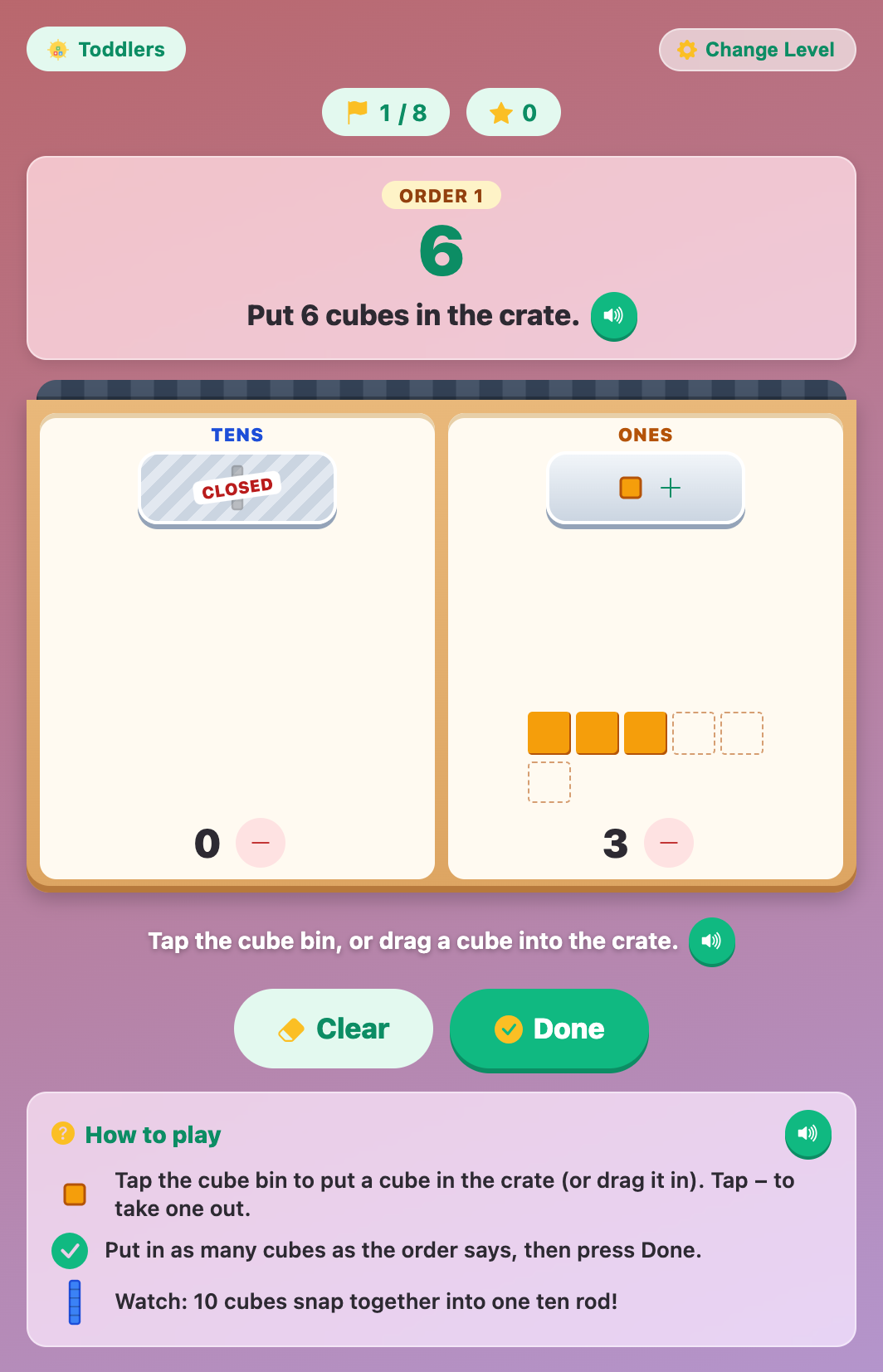
Place Value Factory for toddlers asking for 6 cubes, with 3 orange cubes in the crate and 3 dashed outlines still to fill
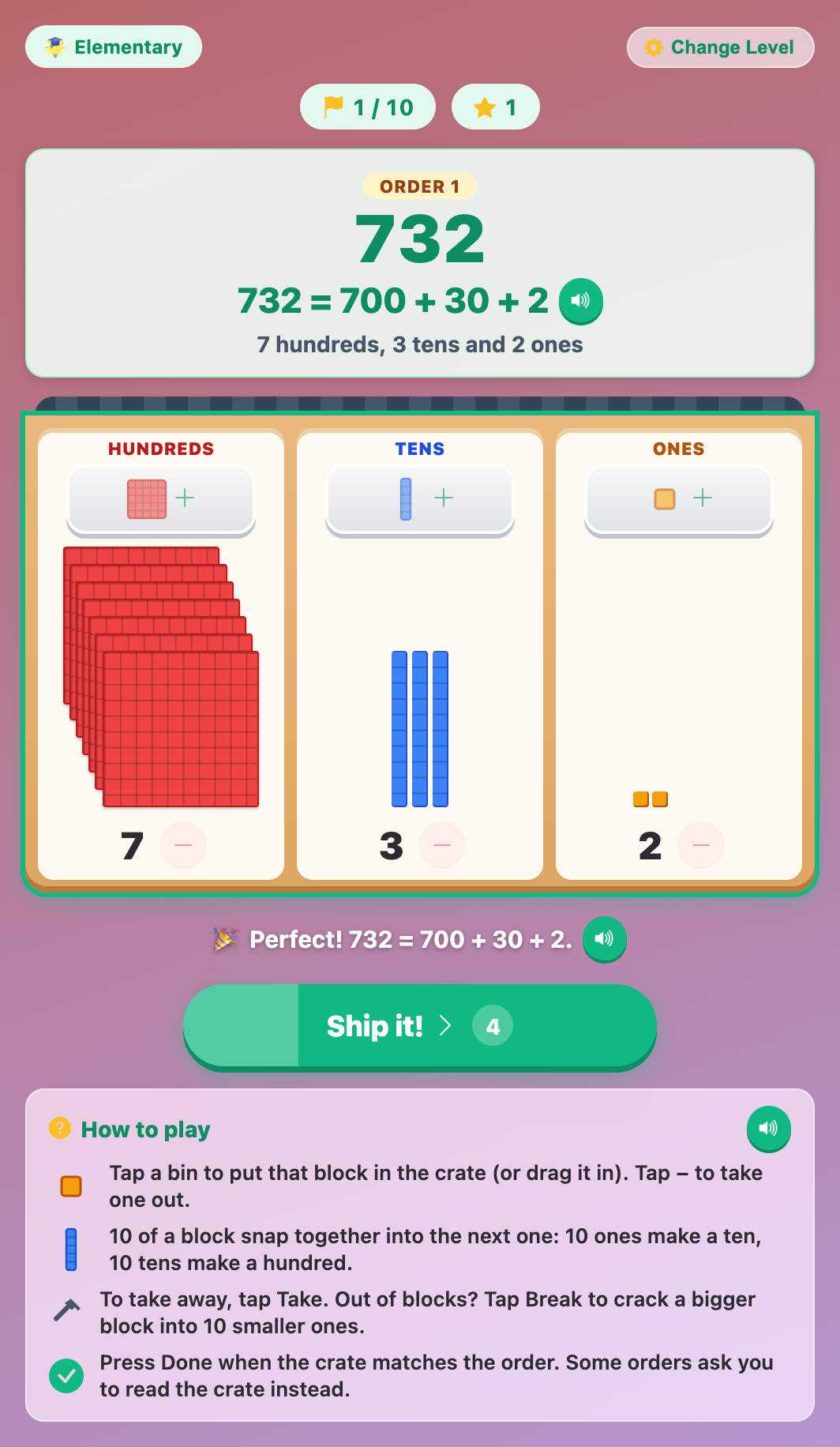
A finished order for 732 with 7 hundreds flats, 3 tens rods and 2 ones cubes, and the line 732 = 700 + 30 + 2
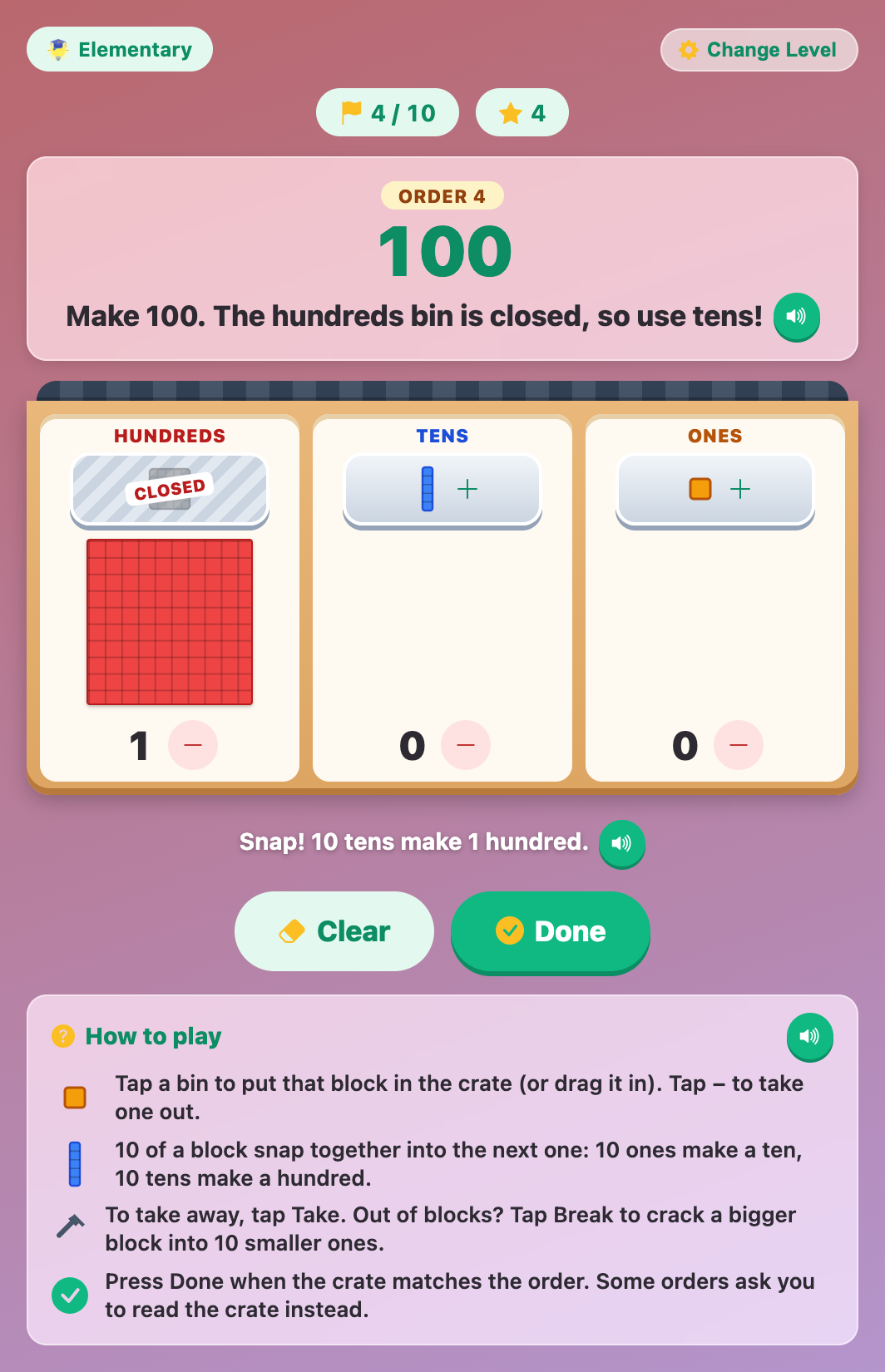
A snap order to make 100 with the hundreds bin closed, right after 10 tens rods snapped into 1 hundreds flat
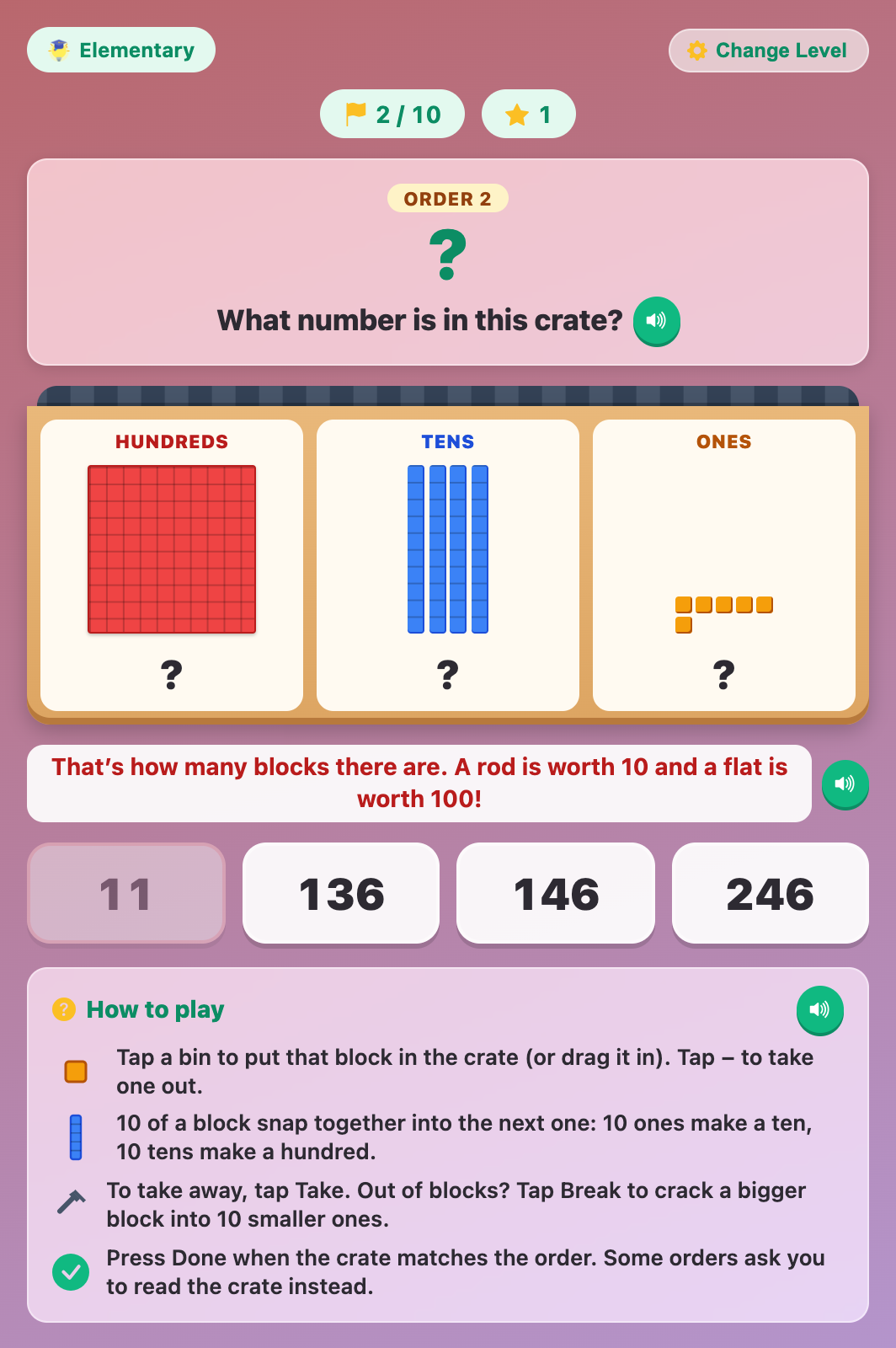
A What number is in this crate? question with 1 flat, 4 rods and 6 cubes, and the wrong answer 11 greyed out
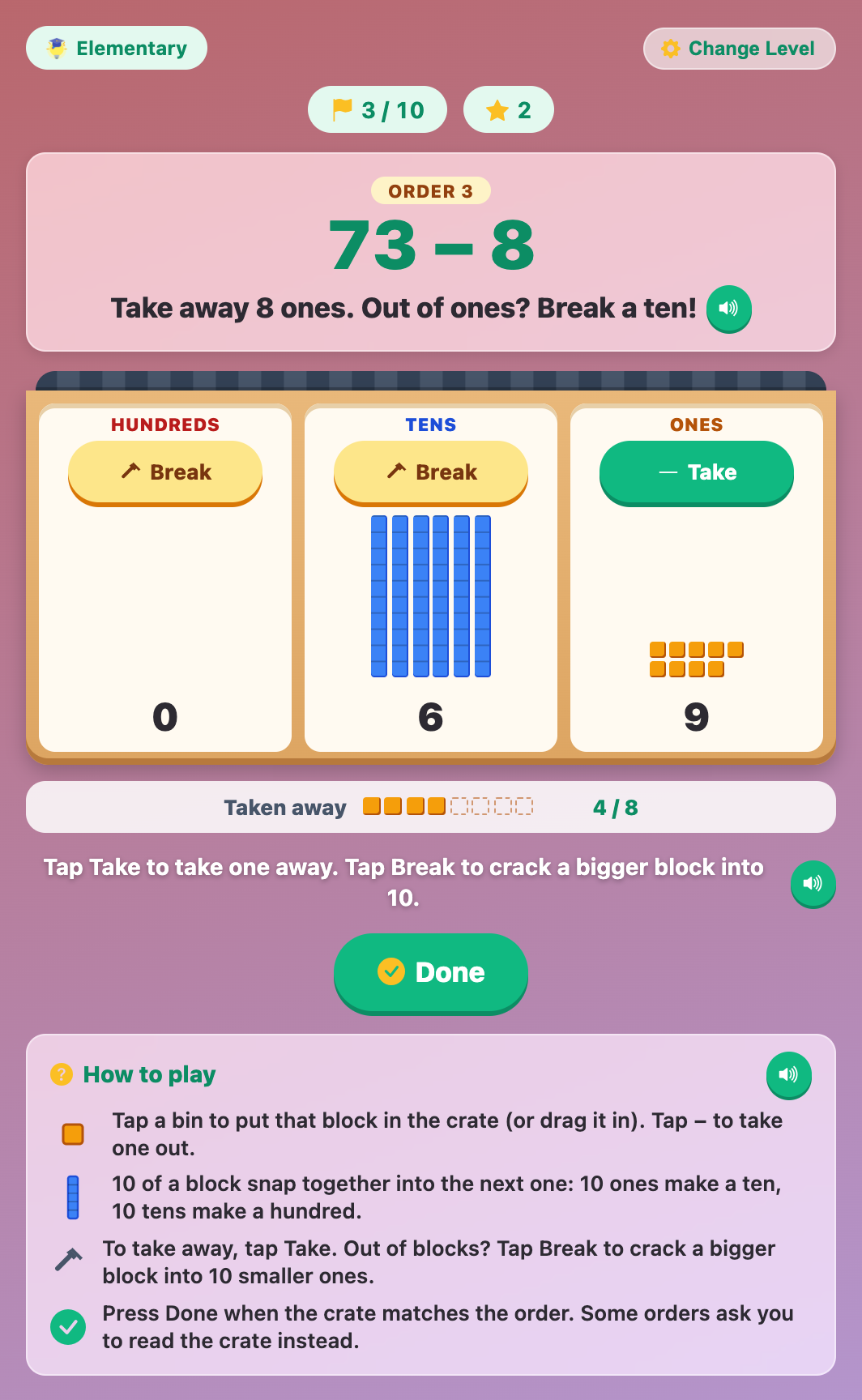
The take-away order 73 − 8 in Place Value Factory for elementary kids, with Break and Take buttons and 4 of 8 cubes taken
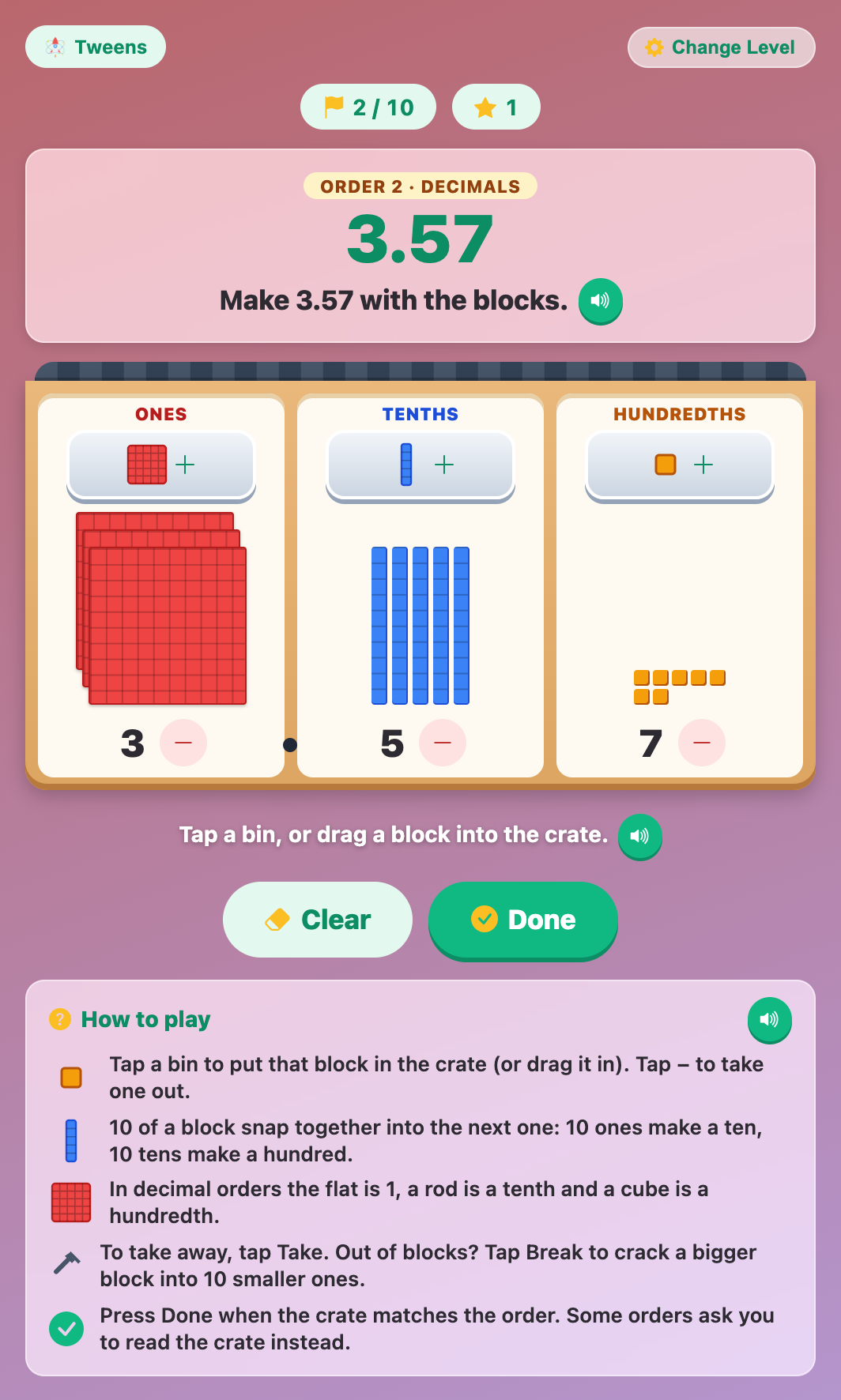
Place Value Factory for tweens building the decimal 3.57 with 3 flats as ones, 5 rods as tenths and 7 cubes as hundredths
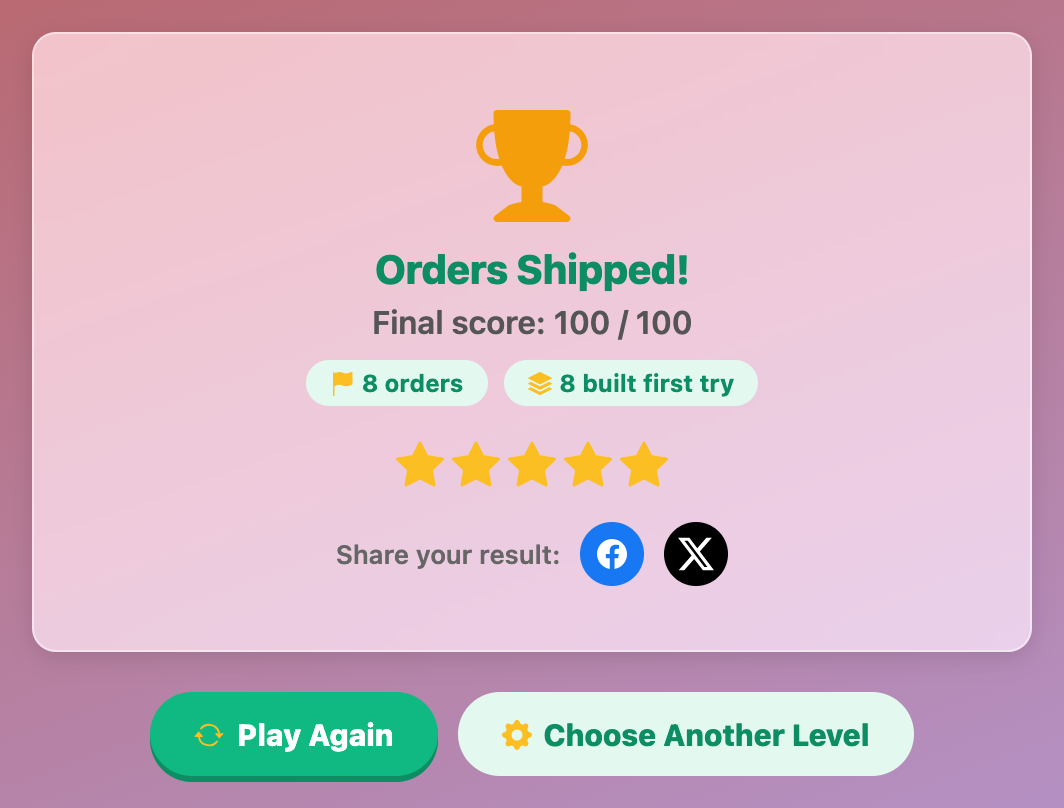
The Orders Shipped! finish card with a gold trophy, a final score of 100 out of 100 and five stars
More Math Games
 212.8K plays
4.9
Math Village Builder
Build a village on a blocky island! Solve counting, adding and subtracting, shapes and word problems to earn wood, stone, flowers and diamonds for every house, road, farm and school.
 283.8K plays
5.0
Math Subtraction Moto Race
Pick your age level, then ride your motorbike through the lane with the right subtraction answer — every correct gate makes you faster!
 88.7K plays
4.9
Word Problem Wizard
Read the short story problem and pick the correct answer.
 857.5K plays
5.0
Addition Quiz
Pick your age level and answer fun multiple-choice addition questions!
Most Played Games
 518.5K plays
4.9
Math Temple Escape
Help a baby bunny hop away with the Golden Carrot! Bounce along a pastel temple path in 3D, jump logs, slide under flower garlands and dodge smiling mushrooms while cheeky little monkeys chase you. At every gate, hop under the sign with the right answer to zoom ahead. Counting, adding, subtracting, times tables and division for every age.
 273.8K plays
4.9
Math Horse Derby
Saddle up for a math steeplechase! Every fence has a question: answer right to gallop and jump clean, get three in a row for Carrot Power, and race your horse past the pack to the finish. Count, add, subtract, multiply and divide.
 473.7K plays
4.9
Math Addition Moto Race
Pick your age level, then ride your motorbike through the lane with the right addition answer — every correct gate makes you faster!
 1.1M plays
4.9
Math Moto Race
Pick your age level, then ride your motorbike through the lane with the right answer — every correct gate makes you faster!
Comments (41)