
Number Line Frog
423.6K playsHelp the hungry frog catch the fly! Tap hops like +1, +5 and +10 to jump the frog along the number line, and watch each hop draw an arc and build the number sentence. Use as few hops as you can to earn 3 stars. Little ones hop by 1s to a number, bigger kids find sums like 47 + 8 by hopping, and older kids hop across negative numbers, decimals and fractions.
26 + 2 + 2 + 10 + 10 = 50. That number sentence was written by a frog, one hop at a time. Number Line Frog for kids is a free math game where you tap hop buttons like +1, +5 and +10 to jump a hungry frog along a number line until it lands on the fly. Every hop draws an arc over the line and adds a piece to the number sentence, so children practice counting on, adding, taking away and jumping by tens, from age 2 up to age 12.
The game runs right in your web browser, with no download and no sign-up. You play it by tapping or clicking big buttons, so it works on a phone, a tablet or a computer. Little ones hop by 1s to a number they can see. Bigger kids solve sums like 47 + 8 by hopping, and tweens hop across negative numbers, decimals and fractions. The fewer hops you use, the more stars you catch along with the fly.
🐸 A Pond, a Line and One Hungry Frog
A number line is a straight line with numbers in order, like the edge of a ruler. Numbers get bigger as you go right and smaller as you go left. In Number Line Frog for kids, the line stretches across a blue pond, and the frog hops from lily pad to lily pad.
The frog sits on its start pad. The fly waits on another pad. Your job is to get the frog to the fly. The catch is that the frog can only make the hops on the buttons, such as +2, +5 or −10. So you have to think: which hops add up to the jump I need?
Many teachers draw sums the same way on paper. They call it an open number line: you mark where you start and draw a curved jump for each step. Number Line Frog draws those curves for you. A hop forward makes a solid arc. A hop back makes a dashed arc. Each arc has its size written on top, so you can see your whole path at the end.
Two kinds of rounds
Hop to a number. The goal says something like “Hop to 50”. The fly sits on 50, and that number has a yellow label under it. You can see exactly where you are going.
Find the hidden fly. The goal is a sum, like “4 + 8 = ?” or “53 − 7 = ?”. The frog starts on the first number, and the fly hides on the answer. You find the answer by making the hops. The fly stays hidden until the frog lands on it (or until it gives itself away as a hint, see tip 7 below).
🕹️ Hop by Hop: Playing on KidWorld
Pick your level. The first time, the game starts on Elementary. Tap Change Level at the top to open the Choose Your Level screen. It has four cards: Toddlers (ages 2–4), Preschool (4–6), Elementary (6–10) and Tweens (10–12). The game remembers the level you pick.
Read the goal card. The white card at the top says what to do, like “Hop to 50” and “The fly is on 50. The frog starts on 26.” From Preschool up, it also asks a challenge question, like “Can you do it in 4 hops?” Tap the green 🔊 button to hear it read out loud.
Check the bar above the card. The 🚩 shows which round you are on (such as 1 / 8). The ⭐ shows the stars you have so far. The 🐸 shows your hops this round, and the 🎯 next to it shows the fewest hops possible.
Tap a hop button. The green row hops forward (+1, +2, +5, +10). The orange row hops back (−1, −2, −5, −10). On the Toddlers level there are just two giant buttons: ◀ Back and Hop ▶. On a computer you can also press the ← and → arrow keys to hop back or forward by the smallest hop.
Watch the sentence grow. After each hop, the line under the pond shows your number sentence so far, like “26 + 2 + 2 = 30”. A green label on the line shows the number the frog is on now.
Don't worry about the edge. If a hop would take the frog off the end of the line, the frog does not jump. The button shakes, the frog shakes its head, and the tip says “Oops! That hop goes off the line. Try another one.” That try is not counted as a hop.
Catch the fly! When the frog lands on the fly's pad, its tongue snaps up the fly. Your stars for the round pop up in the goal card, and the tip shows the full sentence, like “From 26 to 50 is 24. 26 + 24 = 50. 4 hops: the fastest way!”
Go on to the next round. A big green Next button appears and counts down from 5. Tap it, press Enter or Space, or just wait, and the next round starts by itself. The countdown waits while anything is being read aloud. On the last round, the button says See My Score.
See your result. The finish card says All Flies Caught! It shows your final score out of 100, your stars, how many rounds you finished the fastest way, and your total hops, plus 1 to 5 big gold stars. Tap Play Again for new rounds at the same level, or Choose Another Level.
Use the page buttons. Around the game there are buttons to go fullscreen, to start over with the reload button, and to turn the music on or off.
⭐ How Each Round Gives Stars
Every round is worth up to 3 stars, and the stars depend only on how many hops you used:
3 stars if you used the fewest hops possible (the 🎯 number).
2 stars if you used one or two hops more than that.
1 star if you used more. You always get at least 1 star for catching the fly.
A game has 8 rounds, so 24 stars is a perfect game (Toddlers play 6 rounds, so their best is 18). Your score out of 100 comes from the stars you caught out of all the stars there were. Catch every star and you score 100. There is no timer, so you can take as long as you like to think before you tap.
🧠 Number Line Frog for Kids: Smart Hops That Earn 3 Stars
Anyone can reach the fly with lots of +1 hops. The fun part is finding the short way. These tips go from easy to clever.
1. Find the gap before you hop
First ask: how far is the fly from the frog? If the frog is on 26 and the fly is on 50, the gap is 24. Now you are not hopping to 50 anymore. You are just making 24 out of the hop buttons. This one question turns a long line into a small puzzle.
2. Split the gap into tens and ones
24 is 2 tens and 4 ones. Two +10 hops cover the tens. The 4 ones are +2 and +2. That is 4 hops in all, which is exactly what the 🎯 says. On the Elementary level, most gaps can be split this way.
3. Land on a ten when you can
The order of your hops does not change how many you need, but it can make the math much easier. From 26, hop +2 to 28 and +2 to 30 first. Now you are on a ten, and +10, +10 takes you to 40 and 50 without any tricky adding. When the game shows you a fastest way after a round, it picks routes that land on tens like this.
4. Hop past, then come back
This is the biggest secret in the game. To move 8, you could hop +5, +2, +1. That is 3 hops. Or you could hop +10 and then −2. That is only 2 hops! The same trick works for 9: +10, then −1.
On the levels with a +10 button, every jump from 1 to 10 takes at most 2 hops:
1, 2, 5 and 10 take 1 hop each.
3 is +2 +1, and 4 is +2 +2.
6 is +5 +1, and 7 is +5 +2.
8 is +10 −2, and 9 is +10 −1.
If you learn this little list, you can plan almost any round in your head. Hopping past only works if the line has room, so look at where the line ends. If a hop would leave the line, the button just shakes and you can try another way.
5. Use back hops to take away
In a take-away round like “53 − 7 = ?”, the frog moves left, so you need the orange buttons. The same splitting works going back: 7 is −5 and −2. Back hops draw dashed arcs, so you can easily see which way you went.
6. Count your hops before you tap
Look at the 🎯 number first. If it says 2, you know there is a way to do it in only 2 hops, even if you can't see it yet. Plan the whole route in your head, say it out loud (“plus 10, back 2”), and only then start tapping.
7. Let the hint help you
If you have already made as many hops as the 🎯 number and the frog still hasn't reached the fly, the game helps. One hop button glows yellow, and the tip says something like “Hint: try +10!” The glow moves after every hop, so following it is the quickest way to the fly from wherever the frog is now.
In a hidden-fly round, if you use 2 hops more than the fewest, the fly gives itself away: “Psst! The fly is hiding on 55.” Now you can see the answer and hop straight to it.
8. Read the summary after each round
If you took the long way, the tip tells you how many hops you used and shows a fastest route, like “Fastest: +10, −2.” Read it before you press Next. It is the best way to learn the tricks for next time.
✏️ Six Flies, Caught Step by Step
Example 1: Toddlers, Hop to 4
The frog sits on 0, and the goal card says “Hop to 4!” The fly is on 4.
Tap Hop ▶. The frog jumps to 1.
Tap Hop ▶ again: 2, then 3, then 4.
On the fourth hop the frog lands on the fly. Yum!
That is 4 hops, the fewest possible, so it earns 3 stars. If you tap ◀ Back after a hop, the frog goes the wrong way. The tip says “Oops, the fly is the other way! Hop this way.” and the Hop button glows to show the way. If you take extra hops, the tip says “Next time, hop straight there.”
Example 2: Preschool, 4 + 8 = ?
The frog is on 4, and the fly is hiding. The buttons are +1, +2 and +5, and the card asks “Can you do it in 3 hops?”
Split 8 into button sizes: 8 is 5 and 3, and 3 is 2 and 1.
Hop +5 to 9, then +1 to 10. Landing on 10 makes the last step easy.
Hop +2 to 12. The fly pops out! 4 + 8 = 12.
You can't do it in 2 hops here, because no two of 1, 2 and 5 add up to 8.
Example 3: Elementary, Hop to 50 from 26
Find the gap: from 26 to 50 is 24.
Hop +2 to 28 and +2 to 30. Now you are on a ten.
Hop +10 to 40 and +10 to 50. Fly caught!
The tip reads “From 26 to 50 is 24. 26 + 24 = 50. 4 hops: the fastest way!” This kind of round teaches a big idea: the gap between two numbers is the number you add.
Example 4: Elementary, 84 + 8 = ?
The 🎯 says 2. With only forward hops, 8 needs 3 (+5, +2, +1). So use the hop-past trick:
Hop +10 to 94. That is too far, and that's fine!
Hop −2 back to 92. The fly was there. 84 + 8 = 92.
Two hops, 3 stars. The +5, +2, +1 route still catches the fly, but it costs a star.
Example 5: Tweens, Hop to −6 from 3
Here the line runs from −10 to 10. Negative numbers are numbers less than zero. They sit to the left of 0, and −6 is 6 steps left of zero.
Find the gap: 3 steps from 3 down to 0, then 6 more down to −6. That is 9 in all, going left.
9 is “back 10, forward 1”. Hop −10 from 3 to −7.
Hop +1 from −7 to −6. Two hops, and the fly is yours.
Example 6: Tweens, 1¾ + 1¼ = ?
In a quarters round the buttons are +¼, +½ and +1 (and the same going back). A quarter is one of 4 equal parts of a whole.
Hop +¼ from 1¾ to 2. Now you are on a whole number.
Hop +1 from 2 to 3. The fly appears: 1¾ + 1¼ = 3.
This is the “land on a ten” tip again, but with wholes: make a whole first, then the rest is easy.
🎂 Which Pond Fits Your Child?
Number Line Frog for toddlers (ages 2–4)
Toddlers get a short line from 0 to 10 and 6 rounds. They hop by 1s with two big buttons, ◀ Back and Hop ▶. Half the rounds start on 0 and go to a number from 2 to 7. Two start a little further along, and one round hops back. When the site's sound is on, the frog's new number is read aloud after every hop, so it is like counting with a friend. Sit with your child, point at each pad, and count together.
Number Line Frog for preschoolers (ages 4–6)
Preschoolers use a line from 0 to 20 with hops of 1, 2 and 5. In 8 rounds they hop to numbers, add 3 to 9 more, take away 2 to 9, and hop back to a number. Each round can be done in 1 to 3 hops, and the card says how many. If your child still mixes up which of two numbers is bigger, Compare Numbers is a gentle warm-up before this game.
Number Line Frog for elementary kids (ages 6–10)
Elementary players work with numbers up to 100 and hops of 1, 2, 5 and 10. The line zooms in to fit each round, so you only see the part you need. Hop-to rounds are 12 to 24 apart, and every sum crosses a ten, like 47 + 8 going past 50. That is exactly the skill kids need for adding in their heads. To see why a +10 hop is so powerful, try Place Value Factory, where numbers are built from tens rods and ones cubes.
Number Line Frog for tweens (ages 10–12)
Tweens get three new kinds of numbers on the same pond: negative numbers from −20 to 20, decimals from 0 to 5 with hops of 0.1, 0.2, 0.5 and 1, and fractions from 0 to 4. One fraction round uses quarters (¼, ½ and 1), and the other uses thirds (⅓, ⅔ and 1). Sums with negative numbers usually cross zero, and every decimal or fraction sum crosses a whole number. Seeing −6, 2.6 and 1¾ as spots on one line helps them make sense of all three.
💚 What All That Hopping Builds
Numbers get a place to live. When the frog hops from 26 to 30, a child sees that 30 is just a little further along. Numbers stop being only names and start being spots on a path.
Counting on beats counting all. In a sum like 4 + 8, the frog starts on 4. Nobody counts 1, 2, 3, 4 again. That is the habit kids need to add quickly.
Sums turn into distances. The tip after a hop-to round says things like “From 26 to 50 is 24.” Kids learn that a gap between two numbers is an addition or a take-away, which makes missing-number questions much less scary.
Tens make big numbers small. Every round rewards hopping to a ten, then by tens. After a few games, 38 + 24 feels like “2 to 40, then 10, 10, 2.” If your child likes seeing numbers grow in rows of ten, Hundred Chart Mystery Picture lays 1 to 100 out in a grid, a bit like a number line folded into rows.
Planning pays off. The 🎯 number gives a clear target, so kids learn to stop and plan before they tap. Mistakes are safe, too: a hop off the line is not counted, and every wrong turn can be undone with a hop the other way.
A note for parents and teachers
Number Line Frog is a calm, friendly game: a cartoon frog, a blue pond and a fly that gets caught with a quick tongue snap, with nothing scary. It is free and plays in the browser with no download, and guests can play right away. It practices counting on and back, adding and subtracting within 10, 20 and 100, crossing tens, the open number line method many classrooms use, and, for older kids, negative numbers, decimals and fractions. The 🔊 buttons read the goal and the tips aloud, which helps children who are still learning to read.
So find the gap, plan your hops, and help the frog fill its tummy. Number Line Frog for kids is waiting by the pond, and the fly is not going to catch itself! 🐸
🖼️ See the Game in Action
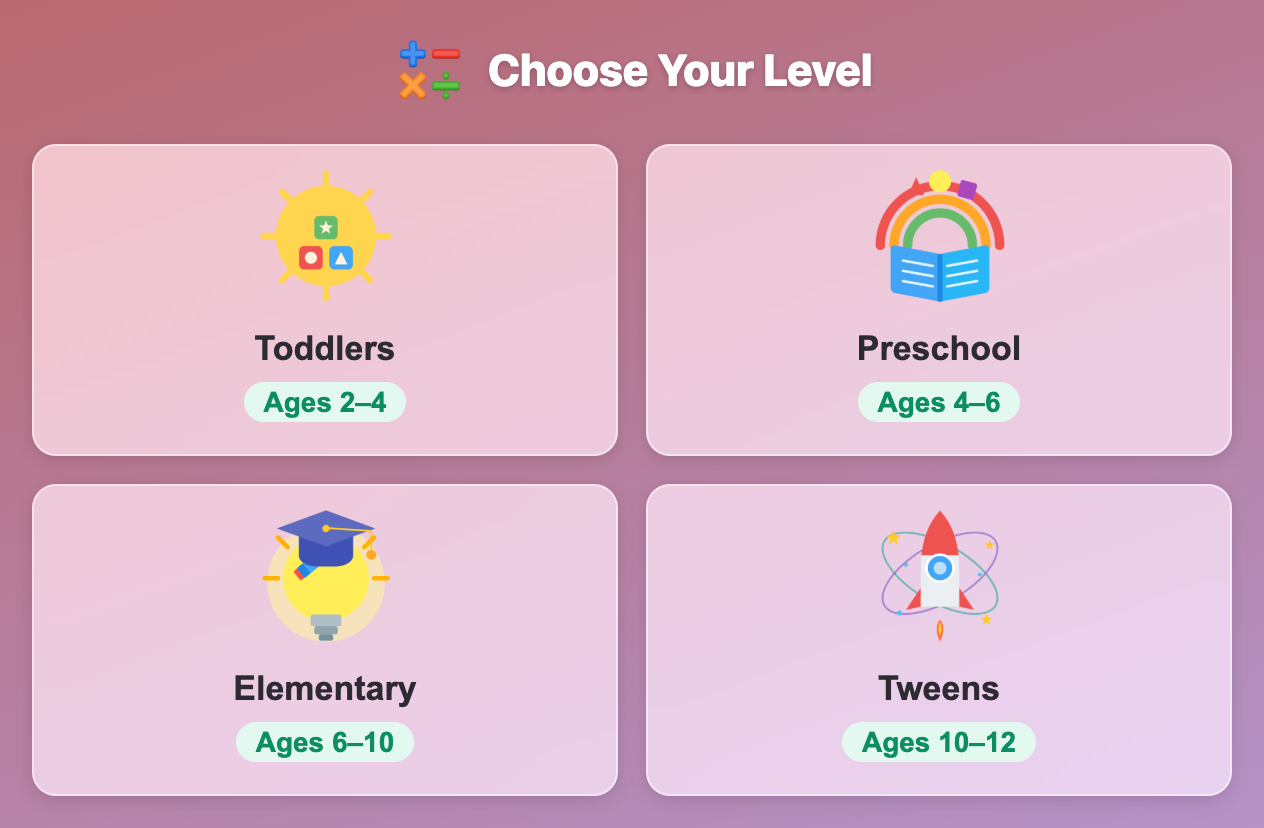
The level picker in Number Line Frog with four cards for Toddlers, Preschool, Elementary and Tweens
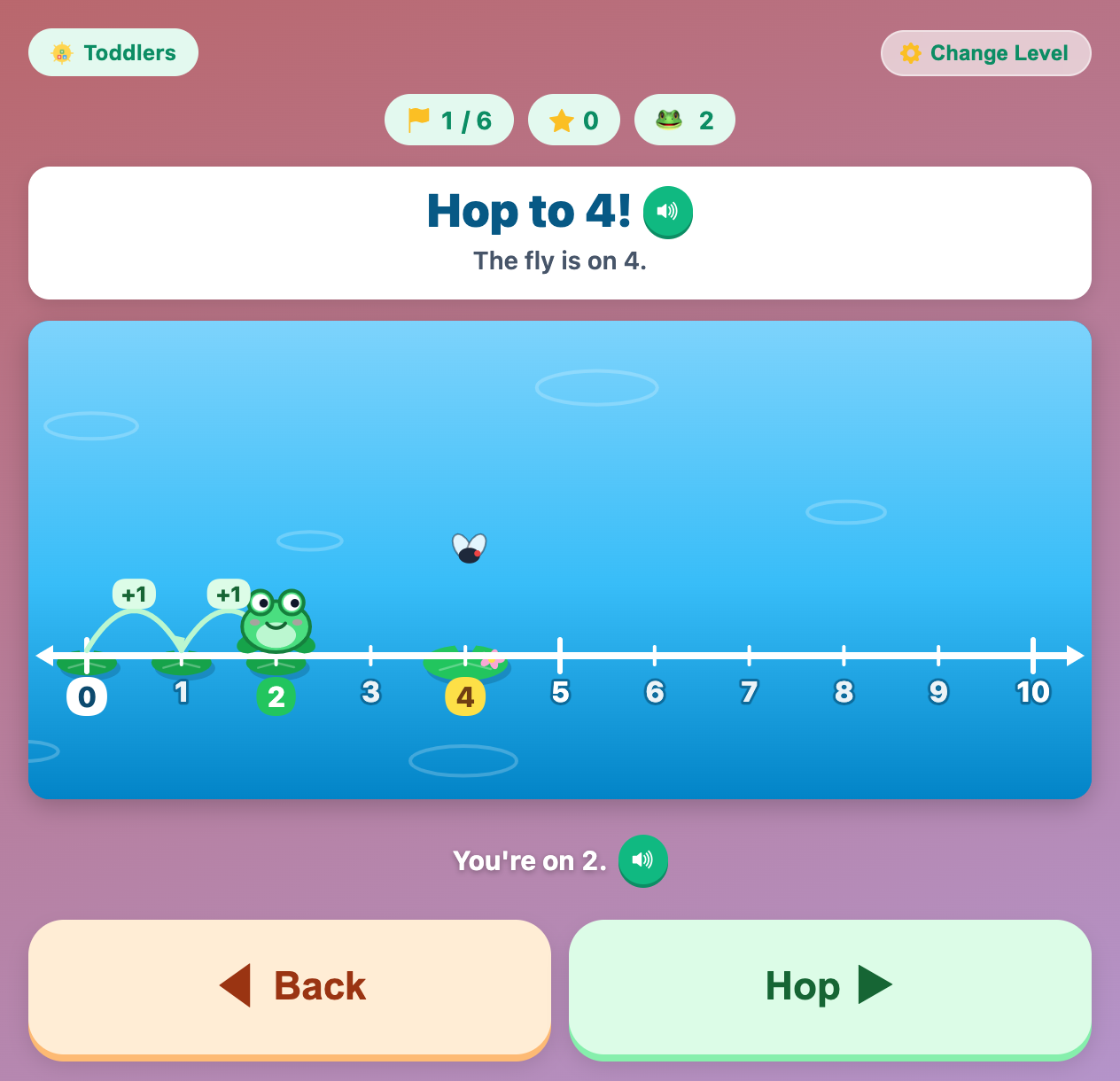
The frog two hops along a 0 to 10 line toward the fly on 4, with big Back and Hop buttons for toddlers
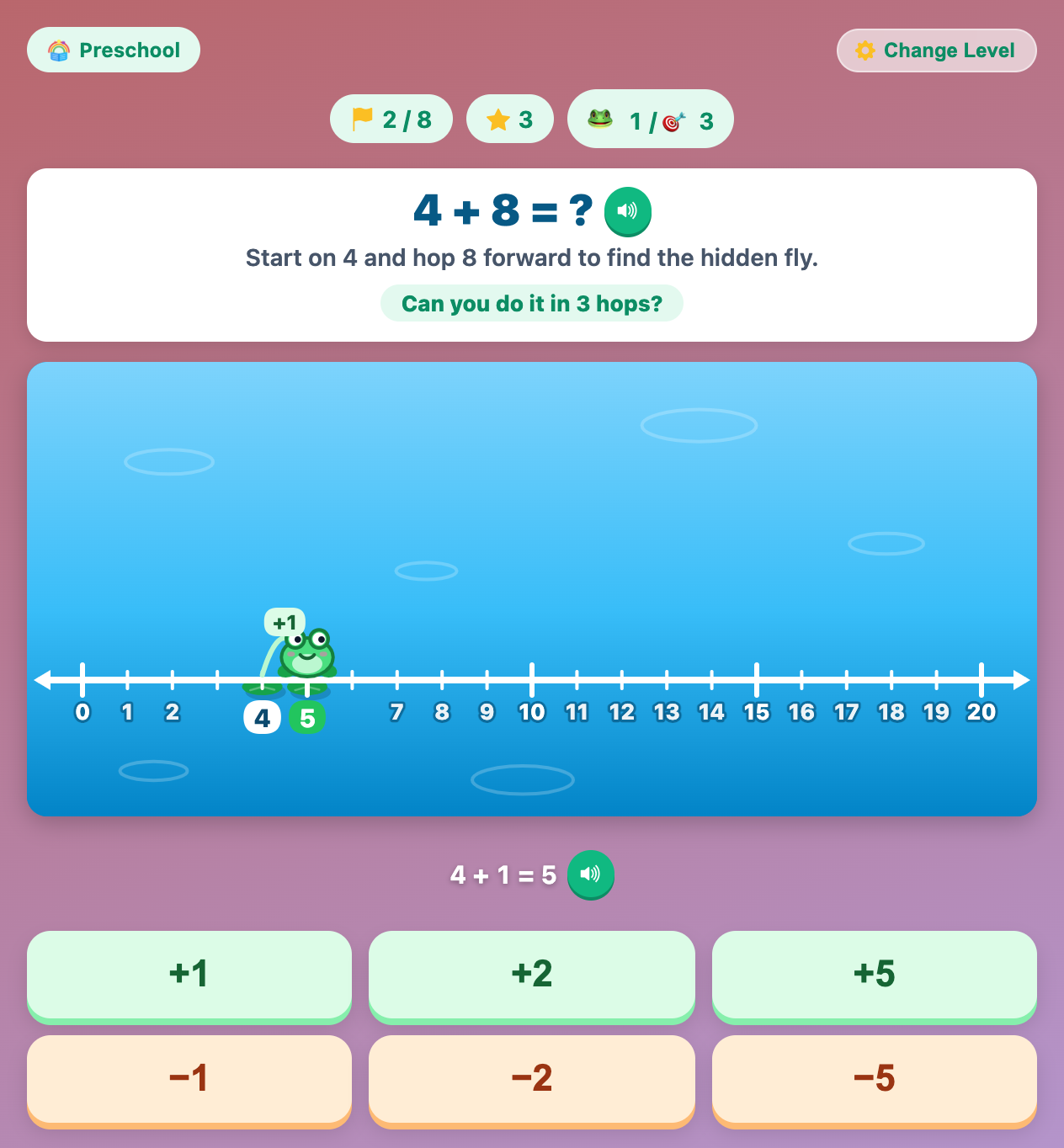
A hidden fly round in Number Line Frog for preschoolers asking 4 + 8 = ? on a 0 to 20 line
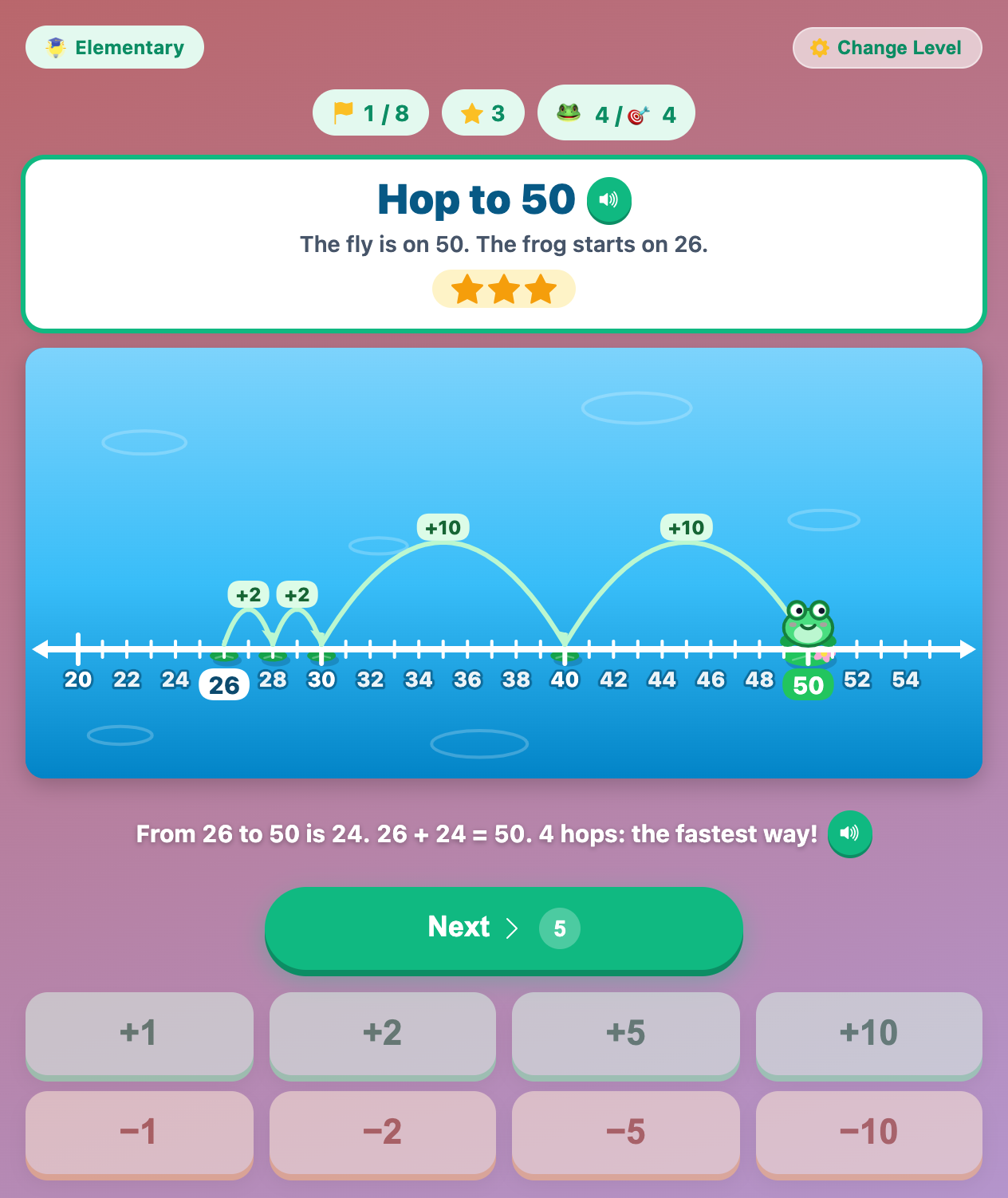
The frog catching the fly on 50 in Number Line Frog for kids, after hops of +2, +2, +10 and +10
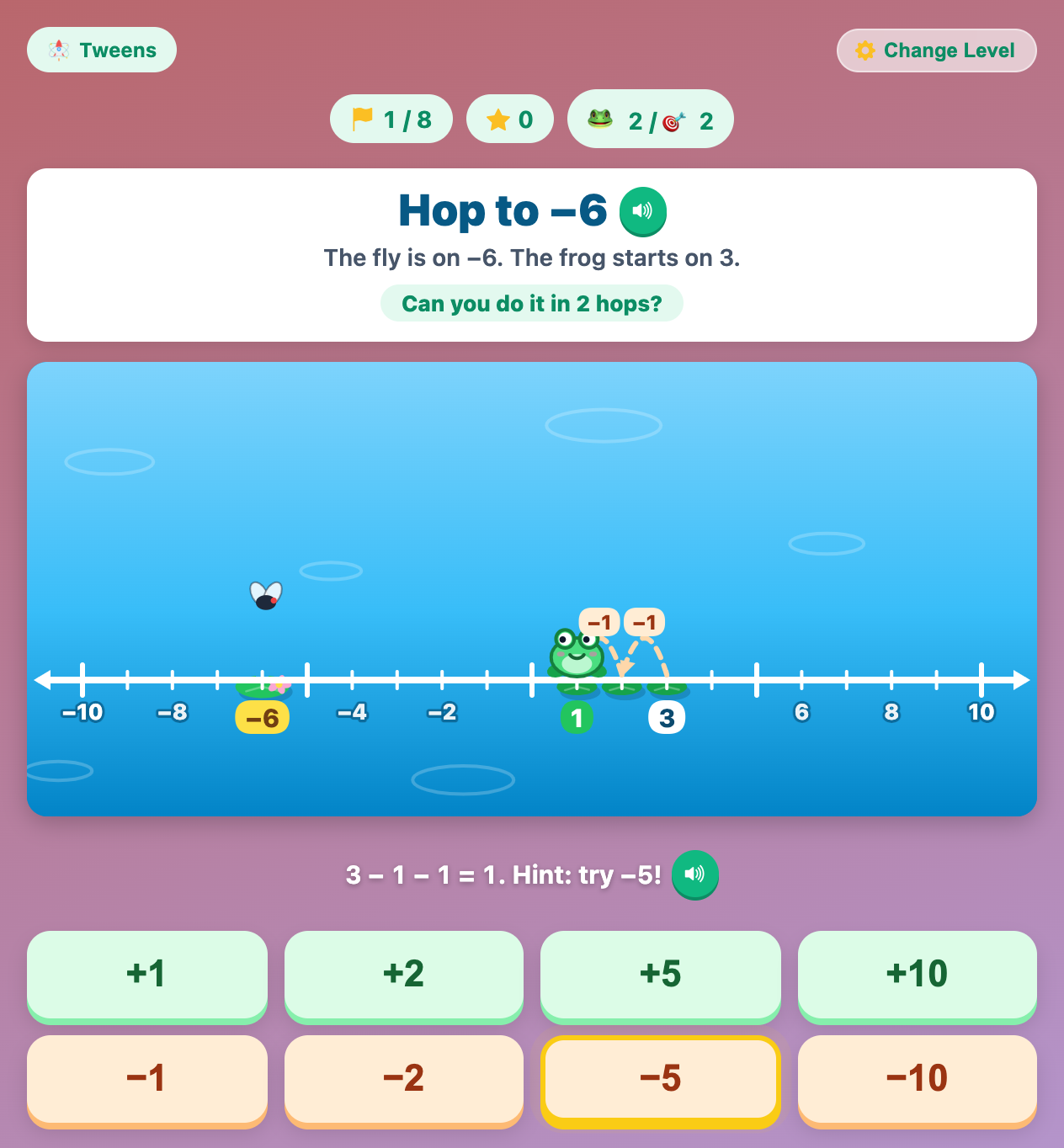
A negative number round in Number Line Frog for tweens, with the −5 button glowing yellow as a hint
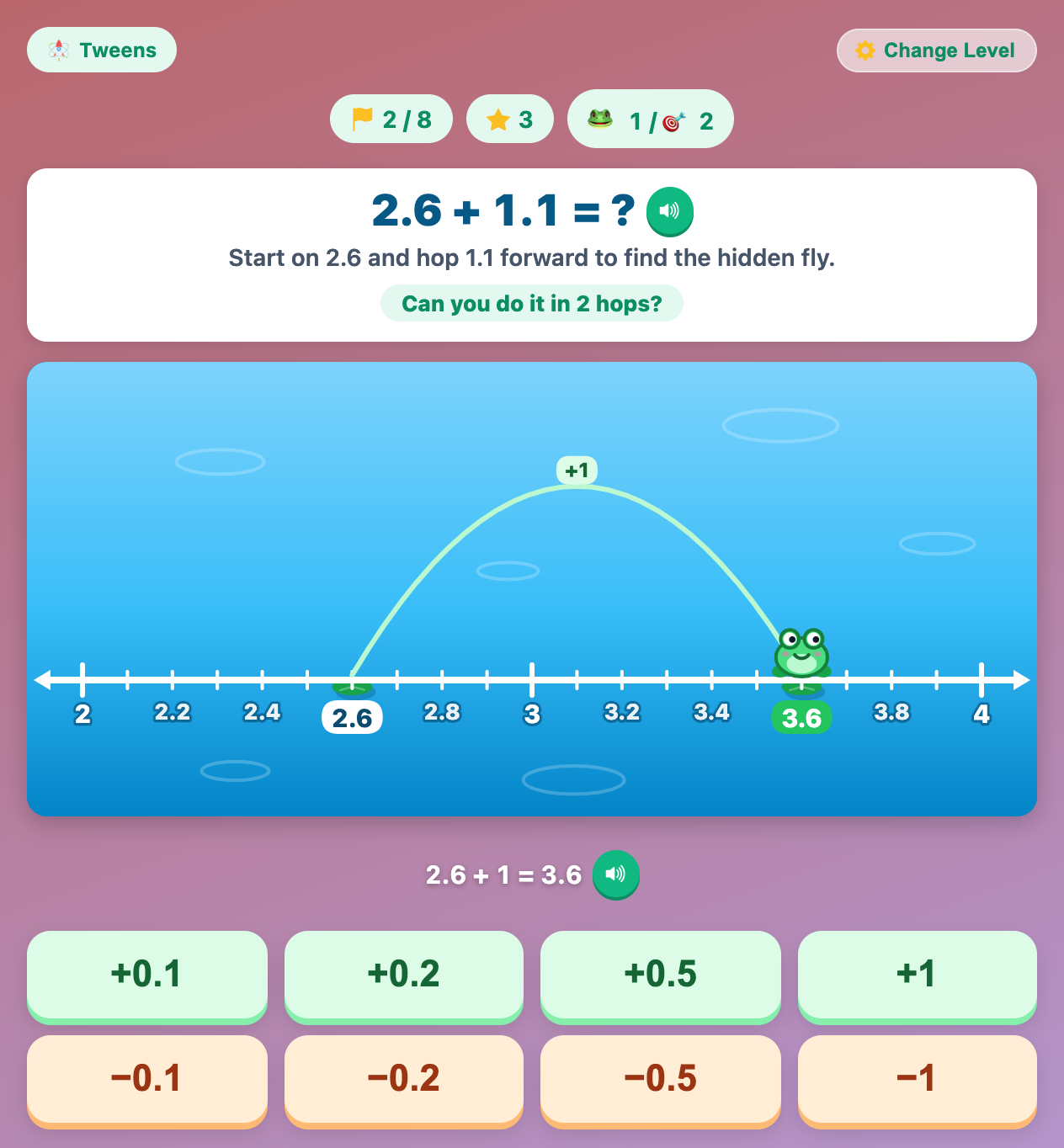
A decimals round asking 2.6 + 1.1 = ?, with a +1 arc from 2.6 to 3.6 on a line from 2 to 4
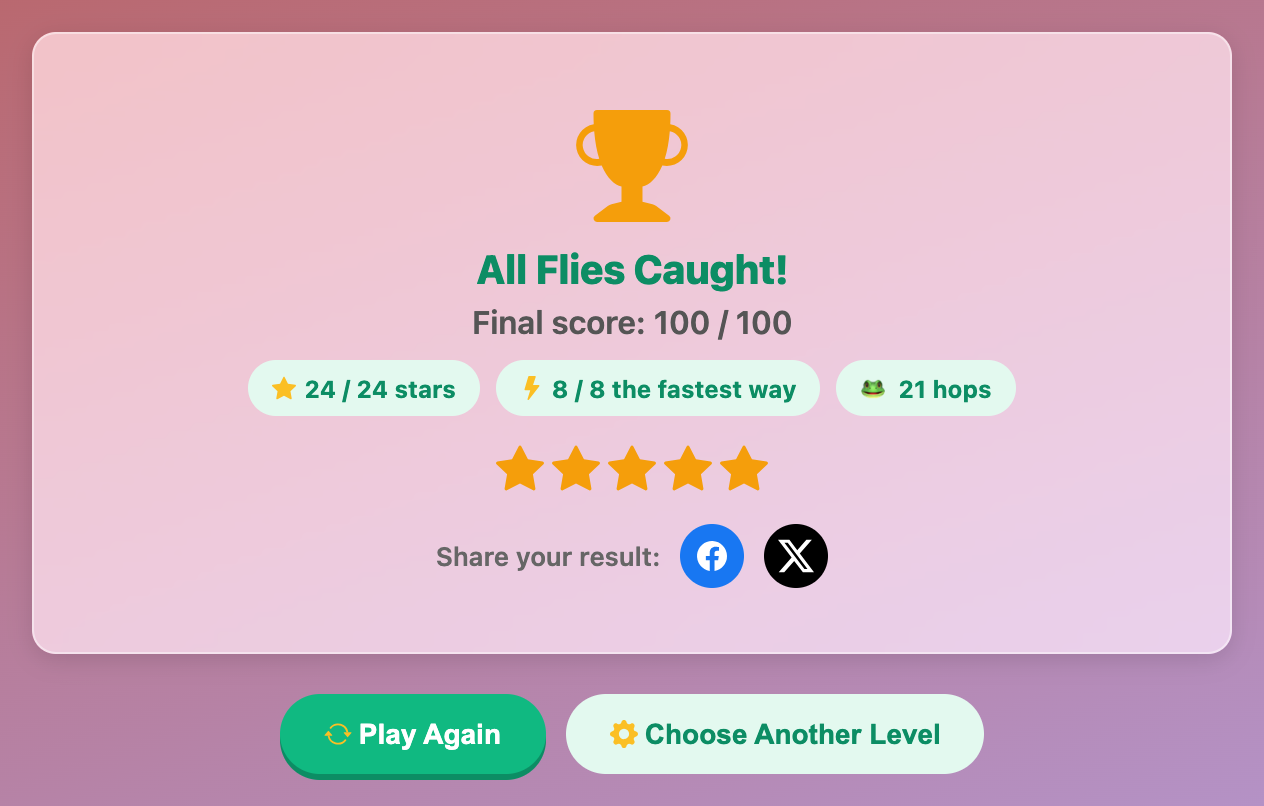
The All Flies Caught finish card with a gold trophy, 24 of 24 stars, Play Again and Choose Another Level
More Math Games
 183.8K plays
4.9
Compare Numbers
Pick the correct sign (> < =) to compare two numbers.
 393.7K plays
5.0
Magic Crossbow: Extra Number
Find the number that breaks the pattern and shoot it with your magic crossbow! In 2 4 6 7 8 10 we count by 2s, so pop the 7 and watch a little frog hop along the fixed pattern. Counting by 1s for little ones, skip-counting up and back by 2s, 5s and 10s, and tricky patterns with two extra numbers for big kids.
 172.7K plays
5.0
Math Multiplication Moto Race
Pick your age level, then ride your motorbike through the lane with the right multiplication answer — every correct gate makes you faster!
 238.4K plays
5.0
Subtraction Quiz
Pick your age level and answer fun multiple-choice subtraction questions!
Most Played Games
 518.5K plays
4.9
Math Temple Escape
Help a baby bunny hop away with the Golden Carrot! Bounce along a pastel temple path in 3D, jump logs, slide under flower garlands and dodge smiling mushrooms while cheeky little monkeys chase you. At every gate, hop under the sign with the right answer to zoom ahead. Counting, adding, subtracting, times tables and division for every age.
 273.8K plays
4.9
Math Horse Derby
Saddle up for a math steeplechase! Every fence has a question: answer right to gallop and jump clean, get three in a row for Carrot Power, and race your horse past the pack to the finish. Count, add, subtract, multiply and divide.
 473.7K plays
4.9
Math Addition Moto Race
Pick your age level, then ride your motorbike through the lane with the right addition answer — every correct gate makes you faster!
 1.1M plays
4.9
Math Moto Race
Pick your age level, then ride your motorbike through the lane with the right answer — every correct gate makes you faster!
Comments (28)