
Compare Numbers
183.7K playsPick the correct sign (> < =) to compare two numbers.
About Compare Numbers Game
Two numbers are standing on a scale, staring each other down, and only you can decide who wins! Is the number on the left bigger? Is the one on the right bigger? Or are they exactly the same, standing perfectly balanced? That's the fun little puzzle at the heart of Compare Numbers — a calm, clever game where you tap the sign — >, <, or = — that makes the number sentence true. No clocks ticking, no pressure — just you, two numbers, and your very own number sense growing stronger with every round.
Kids everywhere love weighing numbers against each other in this game: Compare Numbers has been played more than 100,000 times, and happy players have left thousands of five-star ratings! ⭐⭐⭐⭐⭐
🕹️ How to Play Compare Numbers
Step 1 — Choose your level: Tap the level card that matches you — Toddlers, Preschool, Elementary, or Tweens. Each level uses bigger or smaller numbers depending on your age.
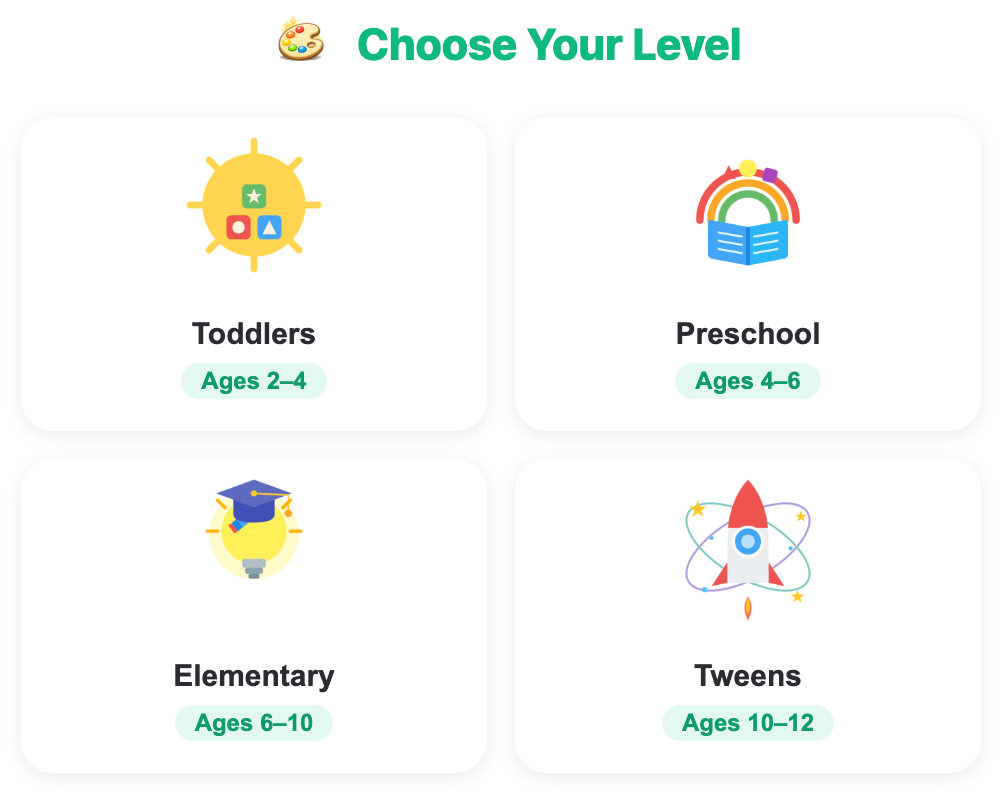
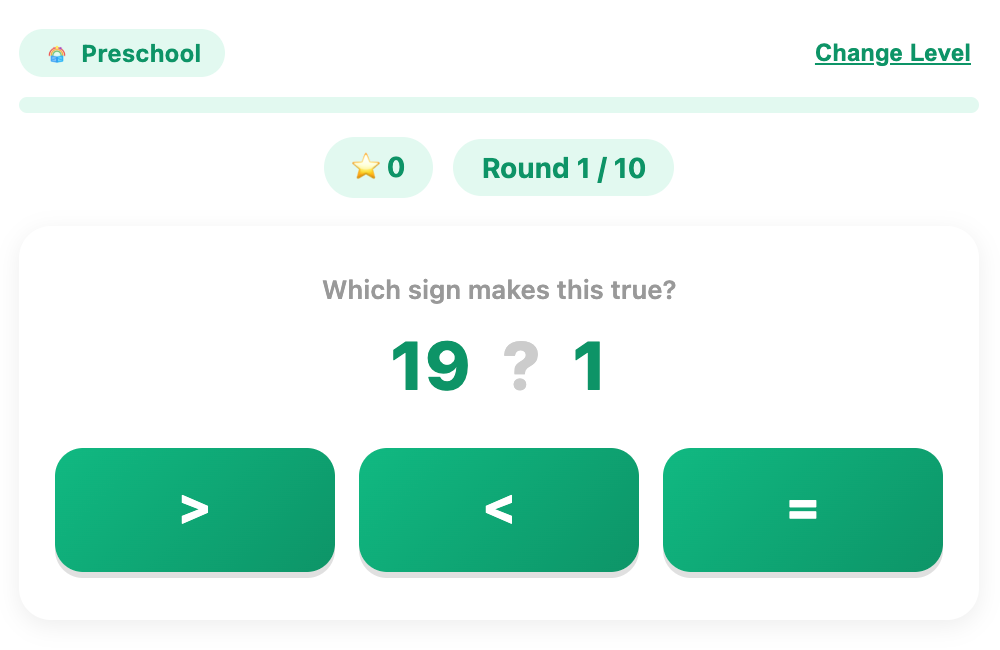
Step 2 — Look at the two numbers: Two numbers appear on your card, with a little question mark sitting between them, waiting for the right sign.
Step 3 — Read the hint: "Which sign makes this true?" is your reminder of exactly what to figure out.
Step 4 — Pick your sign: Three bubbles are shown — > (greater than), < (less than), and = (equal to). Tap the one that correctly compares the two numbers.
Step 5 — Earn your points: Get it right on your very first try and you earn 10 points. If you try again and get it right the second time, you still earn 5 points — every bit of thinking counts!
Step 6 — Keep going: Watch your score and progress bar grow as you move through all 10 rounds.
Step 7 — See your final result: After the last round, your final score, a fun emoji, and your star rating appear — a great way to see how sharp your comparing skills were today!
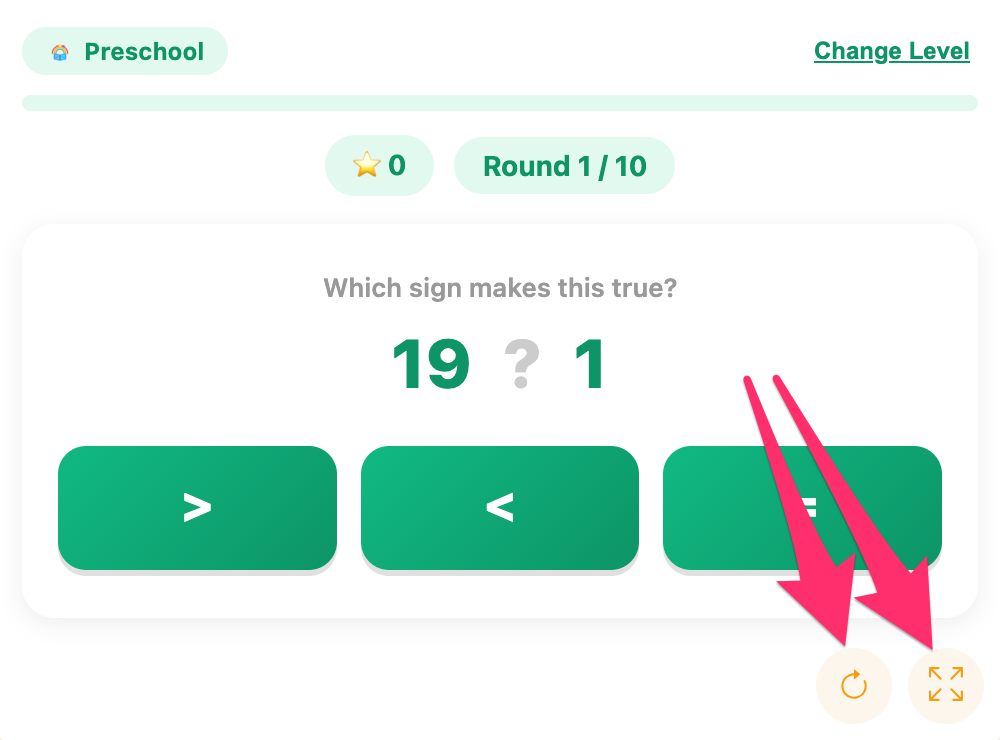
Handy tools: tap Change Level any time you want easier or harder numbers, use the fullscreen button to make the numbers and sign bubbles big and easy to tap, and tap Play Again for ten brand-new number pairs whenever you like.
📏 Know Your Levels
Compare Numbers changes how big its numbers get depending on the level you pick, so it's always just the right challenge for you:
🧸 Toddlers — numbers from 0 up to 10, perfect for first steps in comparing.
🧩 Preschool — numbers from 0 up to 20, just a little bigger to stretch your thinking.
📘 Elementary — numbers from 0 up to 100, great practice for place value.
🚀 Tweens — numbers from 0 up to 200, for players ready for a real number challenge.
And watch closely — sometimes the two numbers really are exactly equal, so the = sign is hiding in the game too, not just > and <!
🧠 Smart Tricks for Comparing Numbers
Comparing numbers is one of the most useful math skills there is, and these tricks make it even easier:
Count the digits first. A number with more digits is almost always bigger — for example, any 3-digit number (like 104) is bigger than any 2-digit number (like 99).
Same number of digits? Compare left to right. Look at the first digit of each number first. Whichever is bigger there usually wins — like 52 vs 47, where 5 beats 4.
Remember what the signs mean. The open, wide side of the sign always faces the bigger number — think of it like a hungry alligator mouth opening toward the bigger snack!
Don't rush past equal numbers. If both numbers look exactly the same, the answer is always = — it's an easy point if you double-check carefully.
Picture a number line. Numbers further to the right on a number line are always bigger — imagining this can help when the numbers are close together.
Practicing this way builds strong number sense — a skill that helps with everything from telling time to counting money to understanding bigger math later on!
📋 Try These 5 Example Questions
Here are 5 example number pairs, just like the ones waiting inside the game. Which sign makes each one true?
4 __ 7 A) > B) < C) = (Answer: B — 4 < 7)
9 __ 9 A) > B) < C) = (Answer: C — 9 = 9)
15 __ 12 A) > B) < C) = (Answer: A — 15 > 12)
48 __ 84 A) > B) < C) = (Answer: B — 48 < 84)
150 __ 99 A) > B) < C) = (Answer: A — 150 > 99)
Every game shuffles brand-new number pairs, so there's always something fresh to compare, and a chance to get even faster at spotting bigger, smaller, and equal!
🌟 Why Compare Numbers is Wonderfully Suited for Kids
Imagine handing your child an invisible balance scale for numbers — one they can use anywhere, anytime, without ever needing a real scale. That's exactly the kind of thinking Compare Numbers quietly builds, one round at a time.
Builds a skill kids use everywhere. Comparing numbers isn't just a math-class idea — it's how we decide who has more candy, which line is shorter, or which price is the better deal.
No pressure, no ticking clock. With no timer racing them, kids can slow down, really look at both numbers, and think it through calmly.
Grows right alongside your child. Small numbers under 10 for toddlers, numbers up to 200 for tweens — the challenge always matches where your child truly is.
Rewards persistence, not just perfection. Even a second-try correct answer earns points, teaching kids that trying again after a mistake is always worth it.
Sharpens focus and attention to detail. Spotting the difference between two close numbers (like 48 and 84!) trains kids to look carefully instead of rushing.
Quick enough for anytime, anywhere. Just ten rounds make it a perfect bite-sized brain break at home, in the car, or between chores.
🖼️ See the Game in Action
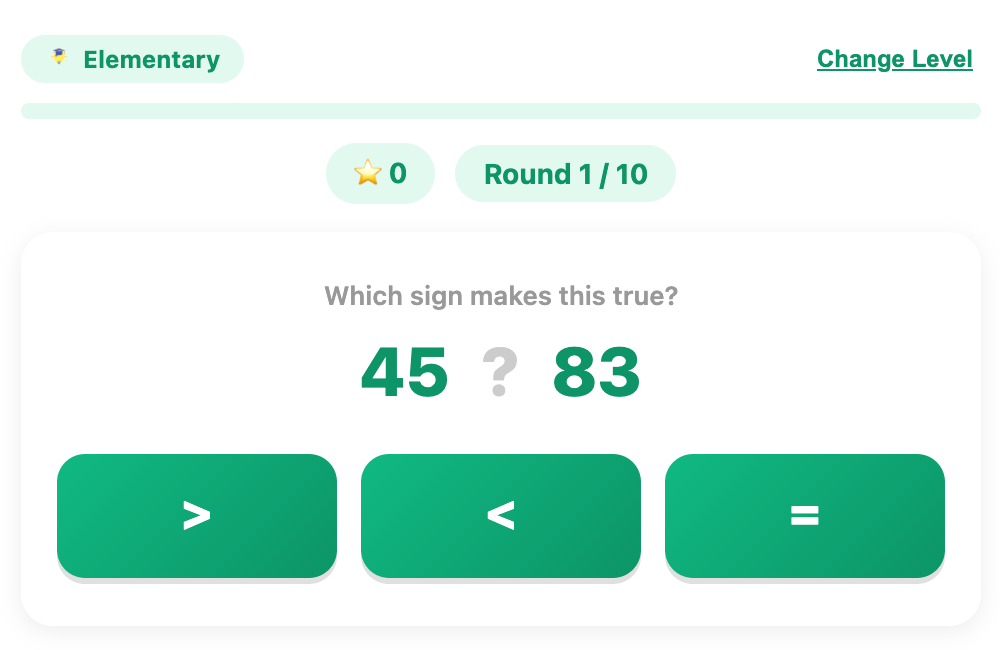
A screenshot about an example round for elementary
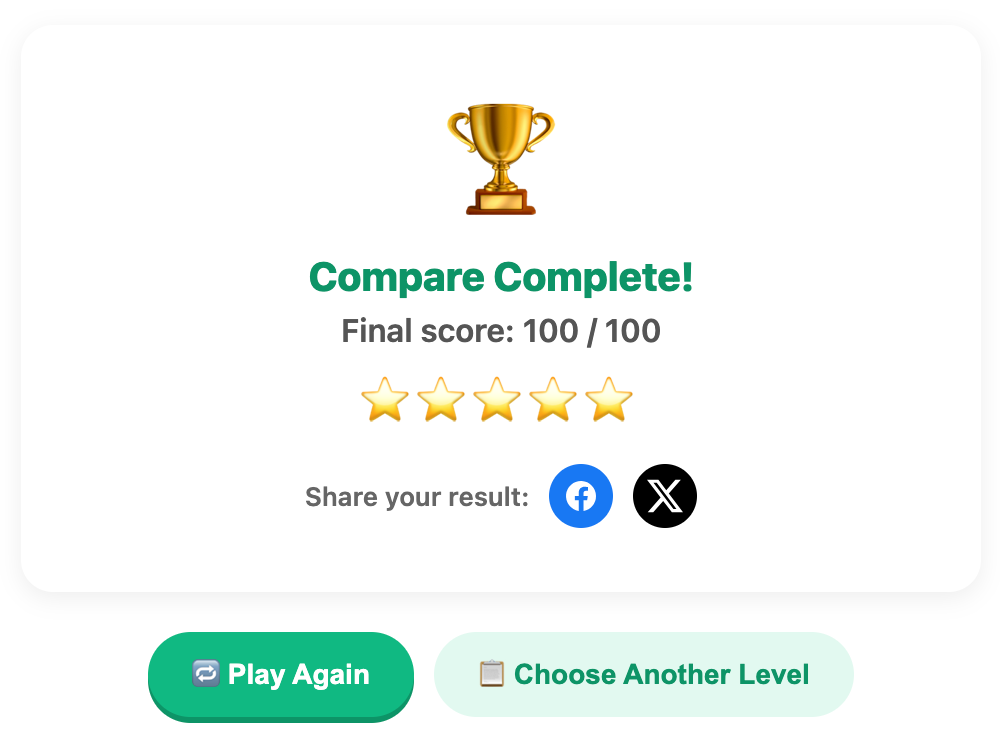
A screenshot when complete a game
More Math Games
 1.1M plays
5.0
1.1M plays
5.0
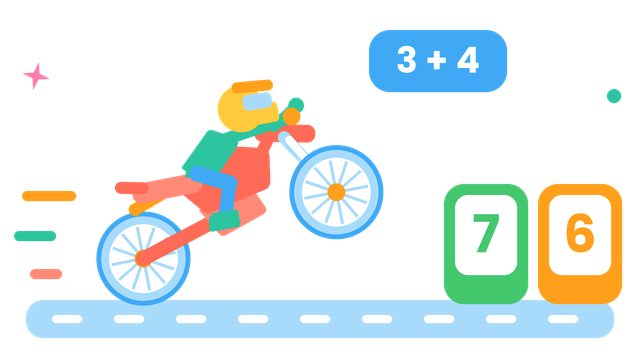
Math Moto Race
Pick your age level, then ride your motorbike through the lane with the right answer — every correct gate makes you faster!
 473.7K plays
4.9
473.7K plays
4.9
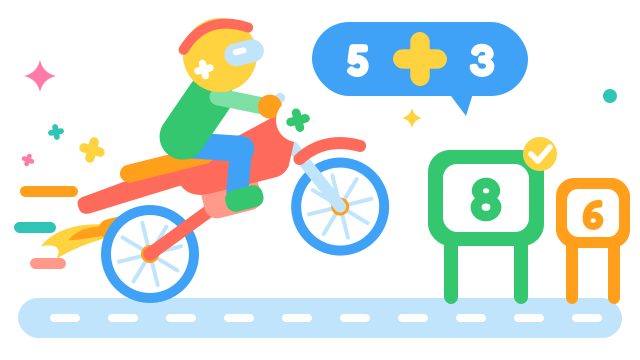
Math Addition Moto Race
Pick your age level, then ride your motorbike through the lane with the right addition answer — every correct gate makes you faster!
 857.5K plays
5.0
857.5K plays
5.0
Addition Quiz
Pick your age level and answer fun multiple-choice addition questions!
 283.8K plays
5.0
283.8K plays
5.0
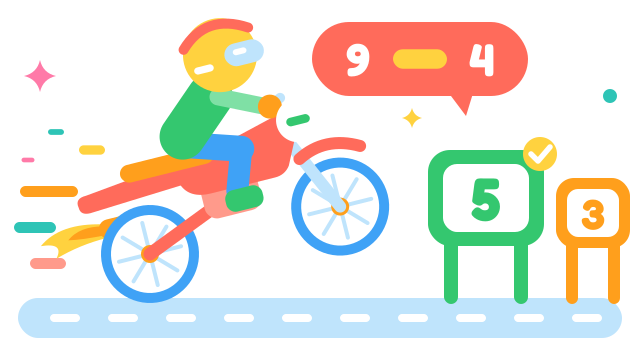
Math Subtraction Moto Race
Pick your age level, then ride your motorbike through the lane with the right subtraction answer — every correct gate makes you faster!
Most Played Games
 1.8M plays
5.0
1.8M plays
5.0
Color & Draw
A free-drawing canvas with colors and brush sizes to unleash your creativity.
 59K plays
5.0
59K plays
5.0
Recycling Sort
Sort everyday items into the Recycle, Compost, or Trash bin before time runs out!
 365.4K plays
4.9
365.4K plays
4.9
Tic-Tac-Toe
Play a game of Tic-Tac-Toe against the computer and see if you can outsmart it.
 1.1M plays
4.9
1.1M plays
4.9
Chess
Play the classic game of chess against the computer or a friend, with FIDE time controls, hints, and undo.
Comments (105)