
Light Mixer
37.5K playsThe show is about to start! Shine red, green and blue spotlights on the little dancer and turn the dimmers until her costume glows in the target color. Light mixes in a surprising way: red and green light make yellow, and all three together make white, while the same paints would make brown. Drag the pools of light around the stage to discover every mix, then compare paint and light side by side. Little artists light up yellow, cyan and magenta; big kids dim the lights to make gold, peach, lavender and more.
What color do you get when you mix red and green? If you're thinking of paint, the answer is a muddy brown. But shine a red light and a green light on the same spot, and you get something that surprises almost everyone: yellow. That surprise is what Light Mixer for kids is all about.
In this game, you are the lighting crew of a little theater. A dancer in a white costume waits on a dark stage. Above her hang three spotlights: one red, one green and one blue. The show needs her costume to glow in a special color, like gold, mint or periwinkle. You slide the pools of light onto her, turn the dimmers up and down, and watch her change color right in front of you. When she matches the target, the crowd can cheer.
🔦 Why Light Mixes Backwards From Paint
Paint and light play by opposite rules. Paint soaks up light. Every color of paint you add soaks up a little more, so mixing lots of paint colors makes the mix darker and darker, until it's brown or nearly black.
Light adds up. Each spotlight brings more light to the stage, so mixing lights makes colors brighter. That's why the three primary colors of light are red, green and blue, not the red, yellow and blue you learned for paint. Mixed together, they make:
Red + green = yellow 🐥
Green + blue = cyan, a bright sky-and-sea blue 🐬
Red + blue = magenta, a bright pinky-purple 💗
Red + green + blue = white ☁️
This isn't just a stage trick. The screen you're reading this on works the same way. Look very closely at a phone or TV, and every dot of color is made of tiny red, green and blue lights. Every color you see on a screen is mixed from those three.
🎭 How to Run the Show on KidWorld
Pick your level. Choose Toddlers, Preschool, Elementary or Tweens. The game remembers your level, and the Change Level button switches it any time.
Look at the target. At the top, the Target circle shows the color you need, with its name and a little picture, like 🌱 Spring green. Next to it, the Dancer circle shows the color she is glowing right now. Tap the 🔊 button to hear the target's name.
Move the lights. Each pool of light has a round knob marked R, G or B. Drag a knob to slide its pool across the stage. Let go near the dancer, and the light snaps right onto her. You can also tap a light's Aim at dancer button, and tap Move away to send it back.
Turn the dimmers. Under each light are − and + buttons with a bar that shows how bright it is. On Preschool and Elementary, a light can be off, half (50%) or full (100%). On Tweens, it goes in quarter steps: 25%, 50%, 75% and 100%. Toddlers have no dimmers at all: a light is simply on the dancer or not.
Watch the meter. On every level but Tweens, a Match bar fills up as you get closer, with marks where you earn 1, 2 and 3 stars. Words under the stage help too: "Closer!", "Further away." or "The dancer is too dark."
Use a hint if you need one. The 💡 Hint button makes one button glow and tells you what to do, like "Shine the blue light on the dancer." or "Turn the red light down." Toddlers have free hints any time. Older levels get 3 per round, and each one costs a few points.
Tap Done. When you're happy, tap Done. If you reach a 98% match, the game finishes the round for you. The result card shows your stars, the recipe next to what you used, and a light-mixing tip. The Next button counts down 5 seconds and then moves on by itself.
Answer the "Light or paint?" rounds. Two of the six rounds are quiz rounds, explained below.
Take your bow. After round 6, the Curtain call! card lists every color you made, your score out of 100, and how many of the level's colors you have lit with 3 stars so far. Tap Play Again for a new show.
You can also play with a keyboard: keys 1 to 3 pick a light, Space aims it at the dancer, the up and down arrows dim it, and Enter means Done. Above the game, the fullscreen button makes the stage bigger, the reload button starts over, and the music button turns the music on or off.
🎨 The "Light or Paint?" Rounds
Rounds 3 and 5 are different. You see two panels side by side: paint blobs on white paper, and spotlights on a dark wall. A question asks what one of them makes, like "Red paint and green paint are mixed together. What color do they make?" You pick one of three colors (or press 1, 2 or 3).
Then both sides mix at once, so you can see the two answers next to each other. Red and green paint turn brown, while red and green light turn yellow. Yellow and blue paint make green, but yellow and blue light make white! A short message explains why each side came out the way it did.
The trick to these rounds is to read the question carefully. Is it asking about paint or light? The same two colors give very different answers.
⭐ Points and Stars
Each of the 4 light rounds earns up to 20 points: 20 for 3 stars, 14 for 2 stars, 8 for 1 star and 2 for trying. Each hint takes away a few points from that round (2 on Preschool, 3 on Elementary and Tweens). Each of the 2 "Light or paint?" rounds earns 10 points for a right answer. That makes 100 points for a perfect show.
Stars come from the match: 65% earns 1 star, 80% earns 2, and 90% earns 3. The game also remembers which colors you have already lit with 3 stars, and gives you new ones first next time.
💡 Stage Crew Secrets for Perfect Matches
Step 1: Find the color family
Before you touch anything, ask: which lights does this color need? Here is a handy guide:
Reds, pinks and roses need lots of red.
Yellows, oranges, golds and browns need red and green, with little or no blue.
Greens and limes need lots of green.
Cyans, teals and aquas need green and blue.
Blues, navies and violets need lots of blue.
Purples and magentas need red and blue.
Shine only the lights from that family first. If a light isn't needed, keep it away from the dancer.
Step 2: Pale colors need all three lights
White is all three lights at full. So any pale, soft color, like periwinkle, light pink, cream, peach or lavender, needs all three lights on. The brightest light gives the color its tint. Periwinkle is a pale blue-purple, so blue is full and red and green are only half.
Step 3: Dark colors need dim lights, not more lights
This is the opposite of paint. With paint, you add black to make a color darker. On a stage there's no black light. To make a darker color, you turn the lights down. Maroon is just a dim red. Navy is a dim blue. Gray is all three lights at half, and the dimmer they are, the darker the gray.
Step 4: Tip the balance with the dimmers
When two lights mix, the brighter one pulls the color toward itself. Red at full and green at full make yellow. Turn green down to half, and the yellow slides toward red and becomes orange. Turn red down instead, and it slides toward green and becomes lime.
Step 5: Use the meter and the words together
After every change, look at the meter. If it jumps up, you're on the right track. If the message says "The dancer is too dark", turn a light up. If it says "The dancer is too bright.", turn one down. If it says "Further away.", undo your last change and try a different light.
Step 6: Save hints for Tweens
On Tweens there's no meter, so trust your eyes: compare the Target circle and the Dancer circle side by side. That's when a hint is most useful. Each hint fixes the light that is furthest off, so following hints always leads to the target.
If you'd like to see the paint side of color mixing up close, try Paint Match Lab, where you add drops of real-looking paint to a jar to match a color. It's fun to play both and notice how the rules flip.
🎬 Six Colors, Lit Step by Step
Yellow on Toddlers
Red and green light make yellow, so tap Aim at dancer under Red.
Tap Aim at dancer under Green. The dancer turns yellow.
Leave Blue where it is. Done, with a perfect match!
Orange on Preschool
Orange is a yellow that leans toward red. Shine red and green on the dancer. She turns yellow. Now tap − under Green once, down to 50%. With more red than green, she glows orange.
Spring green on Elementary
Spring green is a fresh, bright green with a little blue in it. Shine green at 100%. The meter climbs to about 77%, one star. Now aim blue at her and turn it down to 50%. The meter jumps to 100%! The recipe is green 100% + blue 50%.
Periwinkle on Elementary
Periwinkle is pale, so it needs all three lights. It's a blue-purple, so blue is the strongest. Aim all three lights at the dancer, then turn red and green down to 50% and leave blue at 100%.
Brown on Tweens
Brown is really a dark orange. Orange needs more red than green and no blue. Dark means dim. So set red to 50%, green to 25% and keep blue away. The dancer glows a warm brown.
Gold on Tweens
Gold is a rich yellow that leans a little toward orange. Shine red at 100% and green at 75%. Leave blue off the dancer, or the gold turns pale.
🎟️ Light Mixer for Kids of Every Age
Light Mixer for toddlers (ages 2–4)
The simplest show. There are no dimmers: each light is either on the dancer or not. The targets are the big, bright colors (red, green, blue, yellow, cyan, magenta and white), and the lights a target needs sparkle so little ones know which to move. Hints are free and unlimited, and every "Light or paint?" question is about light. With a parent's help, it's a magical first look at how colors can mix.
Light Mixer for preschoolers (ages 4–6)
Off, half and full dimmers arrive, along with new colors like orange, gray, lime and azure blue. The "Light or paint?" rounds now include a paint question too, like red and blue paint making purple. Questions and tips are read aloud when the site's sound is on.
Light Mixer for elementary kids (ages 6–10)
19 target colors, from rose and violet to maroon, navy, olive, teal and salmon pink. Kids learn that dim lights make dark colors and that all three lights make pale ones. The match meter is still there to guide each change.
Light Mixer for tweens (ages 10–12)
The full lighting desk: quarter-step dimmers and harder colors like gold, peach, coral, lavender, indigo, mint, caramel, silver and charcoal gray. There's no match meter, so tweens must judge the color by eye, just like a real stage lighting designer.
🌟 Why a Dark Stage Makes a Bright Classroom
It turns a surprise into understanding. Kids who have mixed paint "know" that red and green make brown. Seeing them make yellow on stage makes them stop and wonder why. The answer, light adds up and paint soaks it up, is real science that explains every screen they look at.
It teaches careful experiments. Change one thing, look, and decide. When the meter says "Closer!", your guess was right. When it says "Further away.", you learn something too. That's how scientists work.
It builds a sharp eye for color. Telling periwinkle from lavender, or gold from plain yellow, trains kids to notice small differences in brightness and tint. To keep training that eye, Odd Shade Out asks you to spot the one tile that's just a little different from the rest.
It connects art and science. Painters use the color wheel, and lighting designers use red, green and blue. Kids who want to see the painter's side can build one in Color Wheel Builder and compare it with what they learned on stage.
For parents: Light Mixer is gentle and safe. There's no timer, nothing scary, and every round ends with a tip, even when the match isn't perfect. It practices color names, cause and effect, careful observation and the science of light, and it's a great one to play together and talk about.
The curtain is up and the dancer is waiting in her white costume. Grab the red, green and blue spotlights, and see what colors you can create in Light Mixer for kids! 🎭
🖼️ See the Game in Action
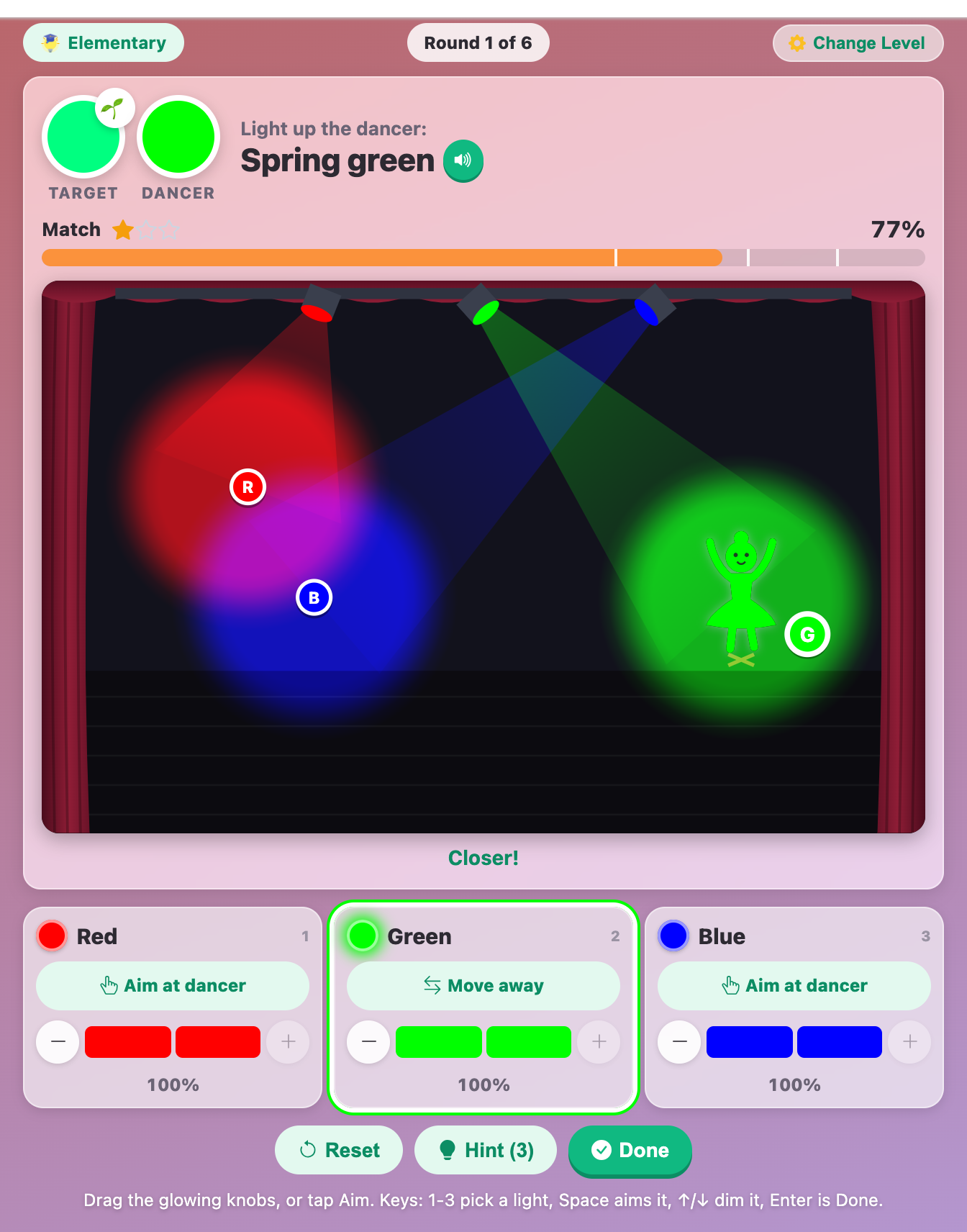
The green spotlight on the dancer while the target is Spring green, with the match meter at 77 percent in Light Mixer for kids
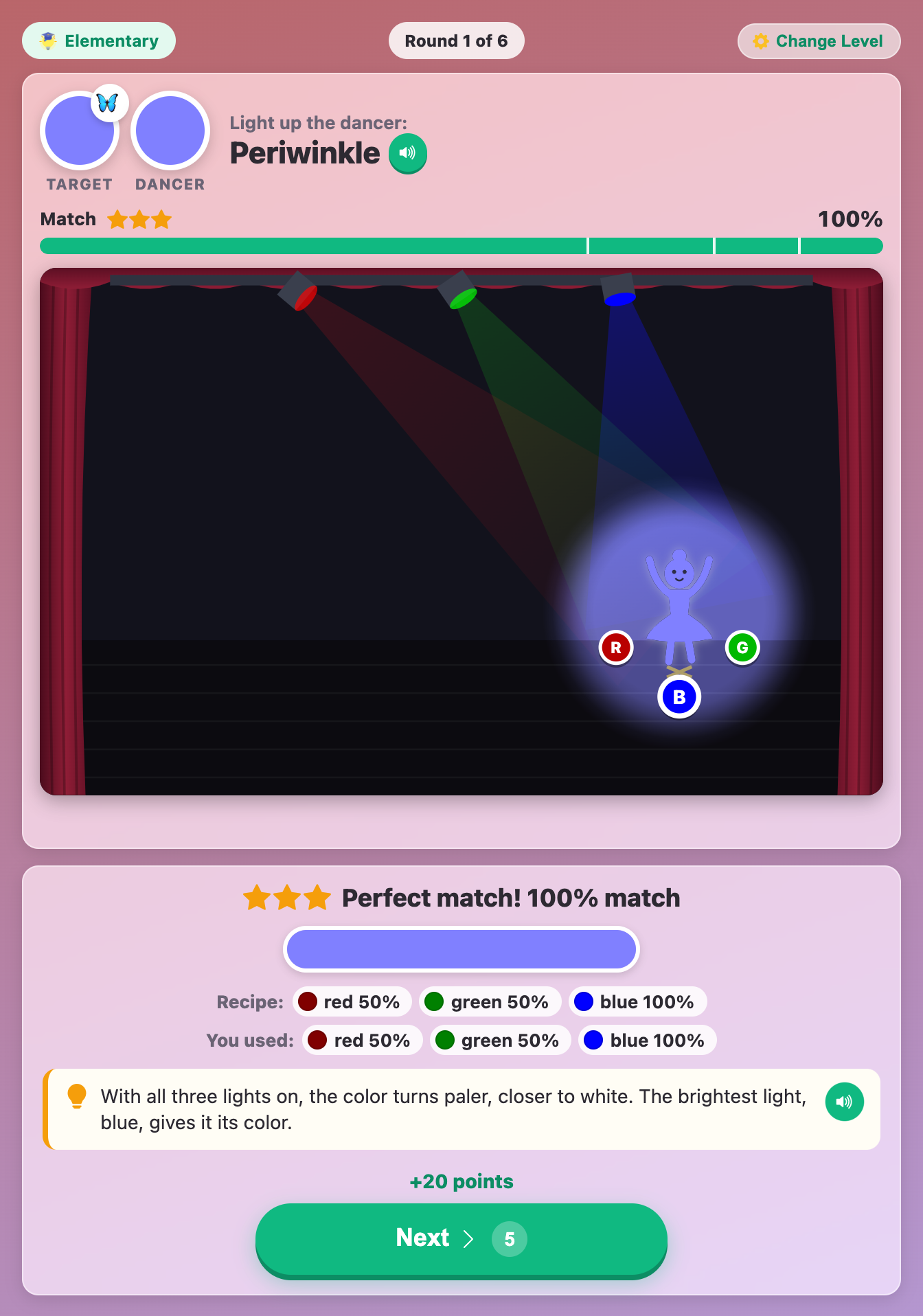
A perfect Periwinkle match, with the recipe red 50 percent, green 50 percent and blue 100 percent under the stage
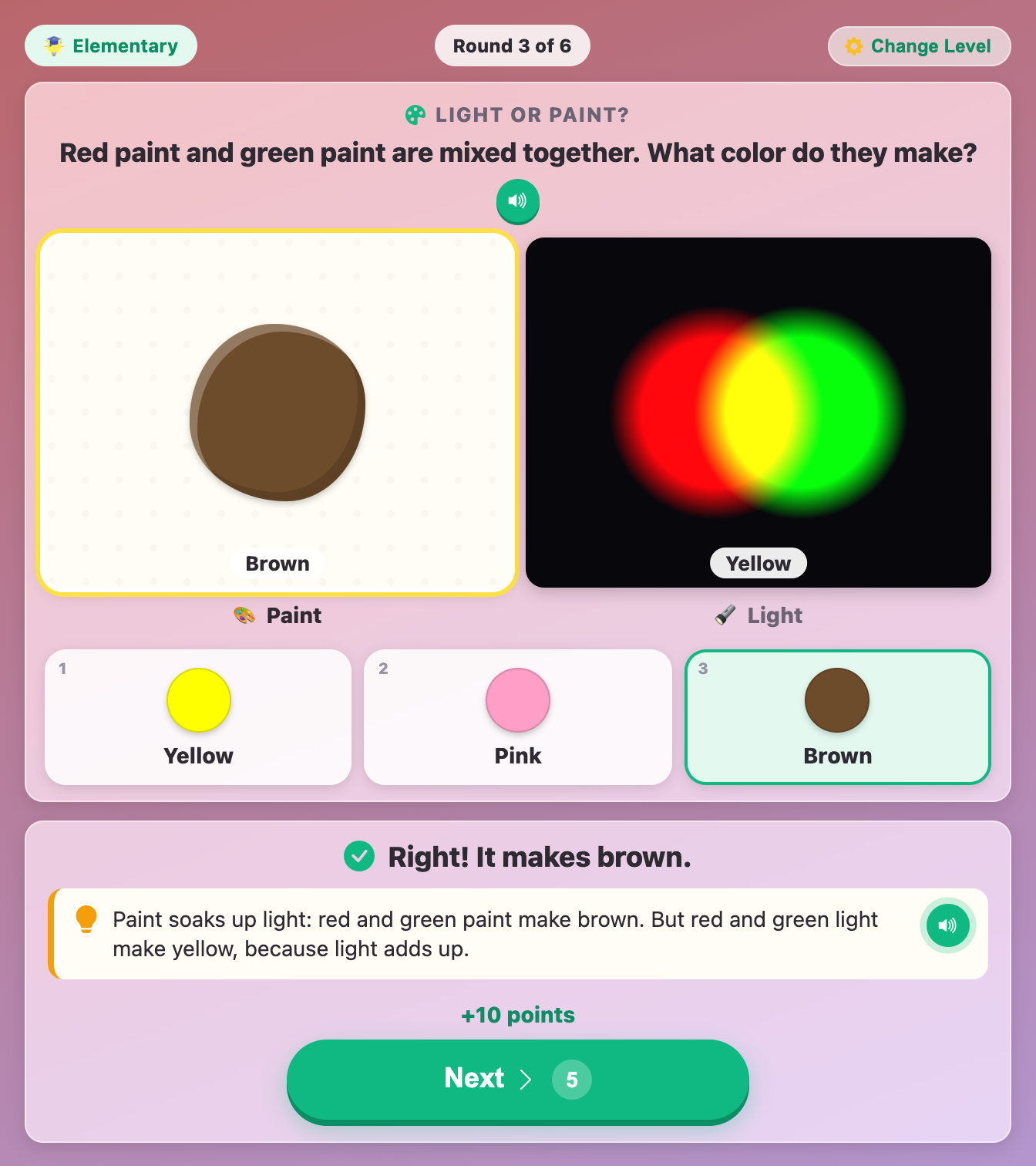
A Light or paint round showing red and green paint making brown, while red and green light make yellow
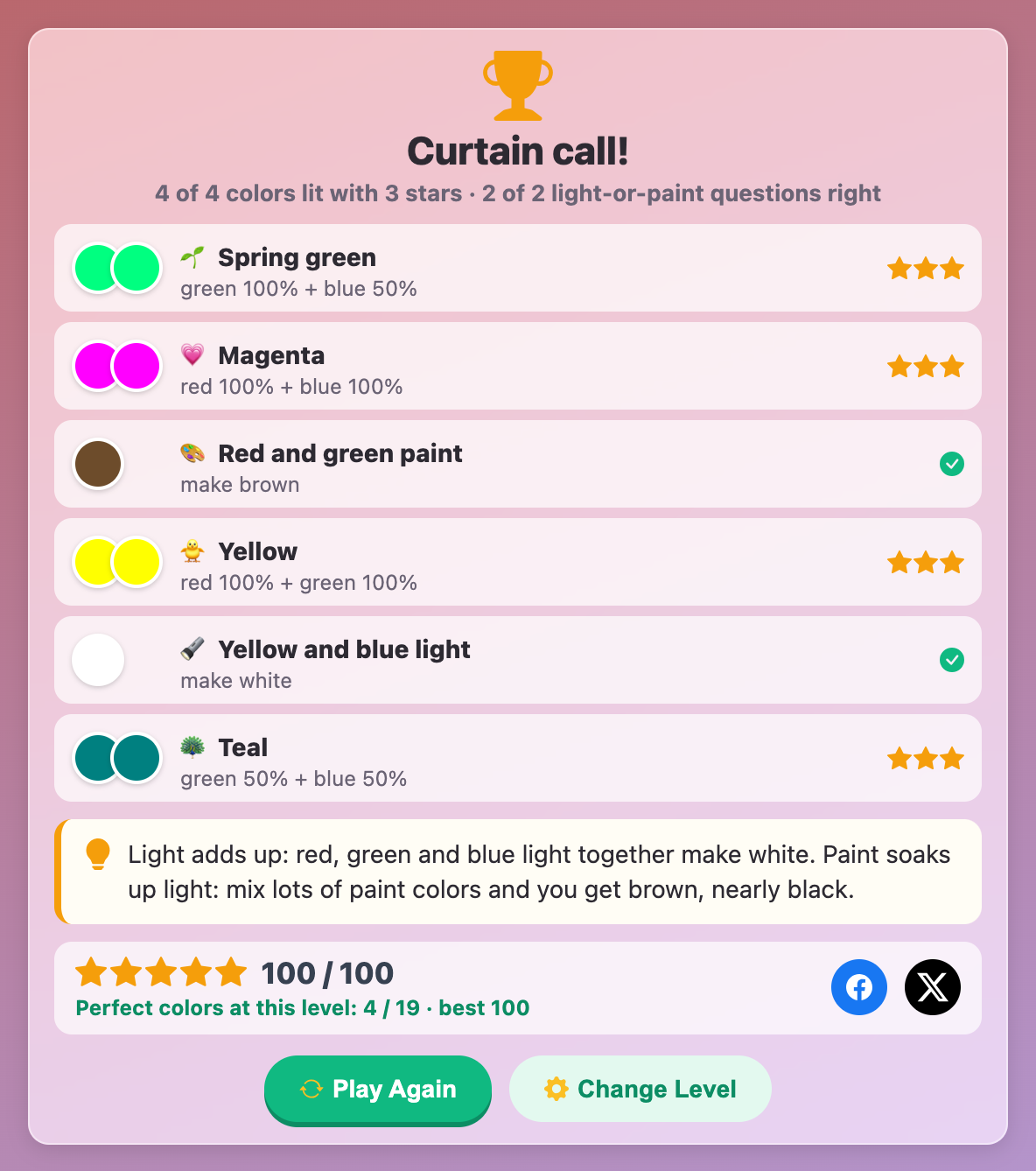
The Curtain call results card listing four colors lit with 3 stars and two right light or paint answers
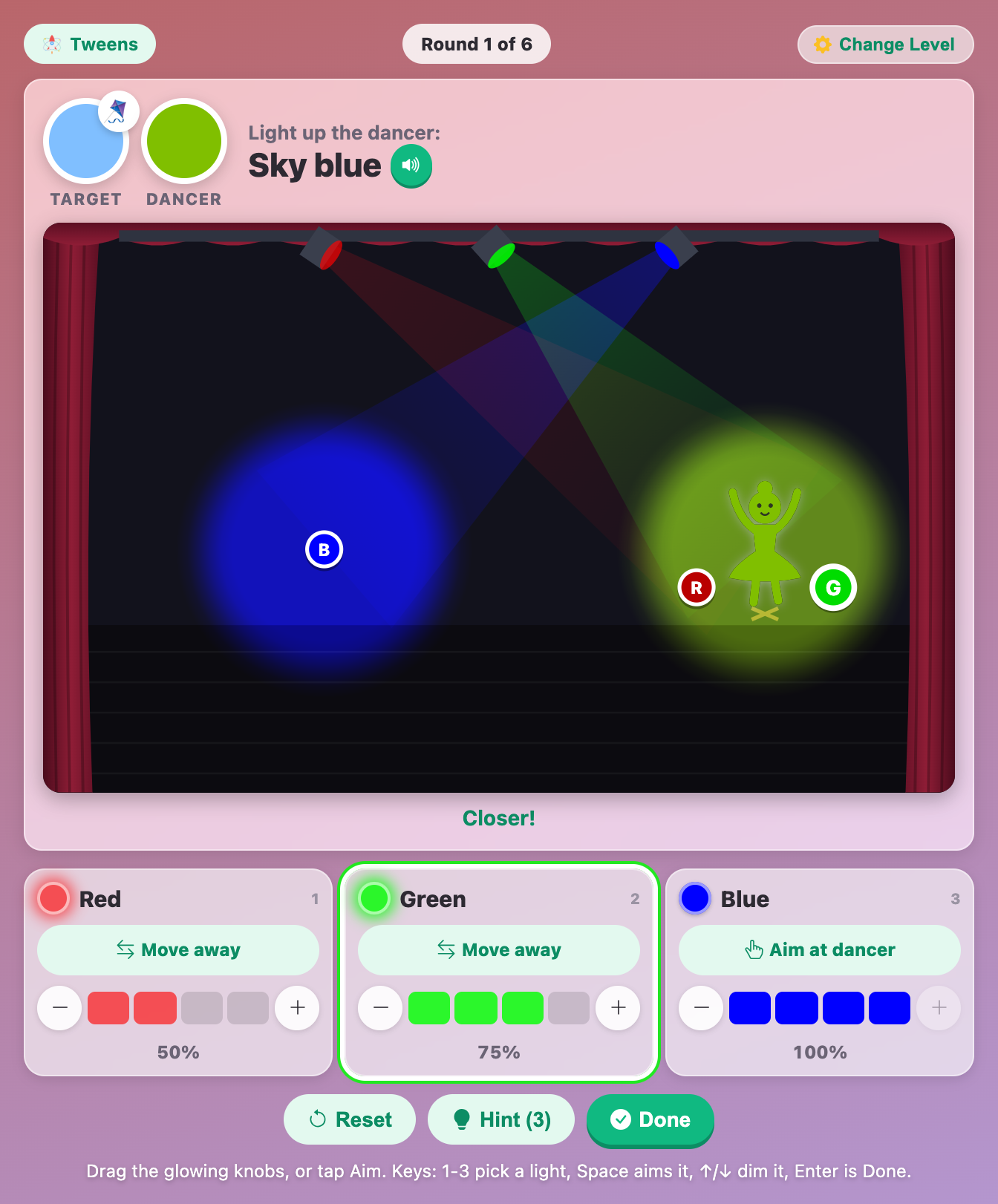
A Sky blue target in Light Mixer for tweens, with dimmers set in quarter steps and no match meter
More Art Games
 1.8M plays
4.9
Color & Draw
A free-drawing canvas with colors and brush sizes to unleash your creativity.
 154.5K plays
5.0
Mood Palette
Decide which color best fits a mood or theme before time runs out.
 584.9K plays
5.0
Tiny World Builder
Start with a tiny empty island and build your own blocky village — plant grass and trees, lay roads, and unlock houses, farms, a school and more!
 174.6K plays
4.9
Color Mixing
Look at two paint colors and pick which color they mix together to make.
Most Played Games
1.8M plays
4.9
Color & Draw
A free-drawing canvas with colors and brush sizes to unleash your creativity.
 59.5K plays
4.8
Recycling Sort
Sort everyday items into the Recycle, Compost, or Trash bin before time runs out!
 365.8K plays
5.0
Tic-Tac-Toe
Play a game of Tic-Tac-Toe against the computer and see if you can outsmart it.
 274.1K plays
5.0
Sentence Builder
Pick your age level, then tap the shuffled words in the right order to build the sentence.
Comments (27)