
Odd Shade Out
132.4K playsAll the colors look the same… or do they? One tile is a little lighter, darker, duller, brighter or a different color from the rest. Tap the odd one out before the clock runs out! Every find makes the next grid bigger and the difference smaller, so your eyes get sharper as you go. Little artists spot big changes on small grids, big kids hunt tiny differences on grids of 64 tiles. Every grid is new, and the result card shows the sharpest difference you found.
Your eyes are sharper detectives than you might think. They can tell apart a huge number of colors, even two that are almost twins. Odd Shade Out for kids puts that power to the test. You get a grid of paint tiles that all look the same, except one. Find it, tap it, and a new grid pops up.
Here is the twist: every time you find one, the next grid gets a little bigger and the odd tile gets a little harder to see. It starts as easy as spotting a dark square among light ones. After many finds, you are hunting for one tile out of 64 that is only a whisper different. You have 60 seconds. How far can your eyes go?
👀 Odd Shade Out for Kids: One Tile Is Not Like the Others
Every grid has one base color and one odd tile. The odd tile is changed in just one way. There are five ways it can be different, and the game shows each with its own little picture:
☀️ Lighter: the odd tile has a bit more light in it, like the same paint with white added.
🌙 Darker: the odd tile is a bit deeper, like the same paint in a shadow.
🎨 New hue: the odd tile is just as light, but it leans toward a different color family. A peach tile might be a little pinker. (Hue is an artist's word for which color family a color belongs to, like red, blue or green. The two youngest levels call this one "New color".)
🌫️ Duller: the odd tile is grayer and quieter, as if a little gray paint was stirred in.
✨ Brighter: the odd tile is bolder and more colorful than the soft tiles around it.
Every grid is brand new. The game makes the colors fresh each time, so you can't memorize the answers. You can only train your eyes. And the same kind of change never shows up three times in a row, so you can't guess what's coming next.
There is a kind secret built into the game, too. Some people see certain reds and greens as almost the same color. Odd Shade Out checks every odd tile so that it is different enough for those players to see as well. Every child can find every tile.
🕹️ Your First Run, Step by Step
Choose your level. The Choose Your Level screen has Toddlers, Preschool, Elementary and Tweens. Each card tells you how the grid grows, like "2×2 up to 4×4 · 60s". The game remembers your pick, and the Change Level button at the top right lets you switch any time.
Get ready. Your first grid waits under a blurry cover with a "Find the odd one out!" card. The clock does not start until you press Start, so take a breath first. Tap 🔊 if you want the rules read out loud.
Tap the odd tile. When you find it, a bubble pops up over it saying what changed, like "🌙 Darker! +5". Then the next grid slides in.
Use the keyboard if you like. Arrow keys move from tile to tile, and Enter or Space taps the one you are on.
Watch the clock bar. It starts at 60 seconds and turns orange in the last 10 seconds. It stops for a moment while each find is celebrated, and it waits if you switch to another tab.
Be careful with wrong taps. A wrong tile shakes. On Preschool and up, it also takes seconds off the clock: 1 second on Preschool, 2 on Elementary and 3 on Tweens. If you tap three wrong tiles within a couple of seconds, the board rests for a moment and says "Slow down! Look closely…".
Use 💡 Hint when you are stuck (Elementary and Tweens). The hint dims most of the board and leaves only one corner lit: half the rows and half the columns. The odd tile is in there!
Read your result card. When time runs out, the last odd tile gets a ring and a bubble, like "This one was darker!". Then the result card shows how many tiles you found, a chip for each kind of change (for example "☀️ Lighter ×1" and "🌙 Darker ×4"), your sharpest find with the two colors side by side, and a color fact you can listen to.
Play again. Play Again starts a new run on the same level. Change Level takes you back to the level cards. The music, fullscreen and reload buttons around the game work the same way they do on every KidWorld game.
⭐ How Finds Turn Into Points and Stars
Each odd tile you find is worth 5 points. If you used a 💡 hint on that grid, it is worth 2 points instead. Your score is saved once, when the clock runs out.
Every level has a goal: 12 finds for Toddlers, 16 for Preschool, 20 for Elementary and 24 for Tweens. Your stars (up to 5) show how close you got to that goal. Reach the goal and the card cheers "Eagle eyes!". Get at least 60 percent of the way there and you will see "Sharp eyes!". The game also remembers your best number of finds for each level, so you can try to beat your own record.
🔍 Tricks for Sharper Eyes
Finding the odd tile is a mix of looking the right way and staying calm. These tricks work with the real rules of the game.
Look at the whole grid first
Don't start at the top-left tile and check every square one by one. Let your eyes go soft and look at the whole board for a second. Your brain is very good at noticing the one thing that doesn't fit. On small grids, the odd tile often "pops out" all by itself.
Then sweep row by row
If nothing pops out, sweep. Look along the top row, then the next row, like reading a book. Compare each tile with the one next to it. Two side-by-side tiles are much easier to compare than two tiles far apart.
Know the five kinds of change
It helps to know what you are hunting for. A darker tile looks heavier. A lighter tile seems to glow a little. A duller tile looks dusty or gray. A brighter tile looks juicier. A new hue looks like it belongs to a different crayon. Check the chips on your result card to see which kinds you find easily and which ones sneak past you.
Squint at light and dark
Painters have a trick: when you squint, colors fade and only light and dark are left. Try it when you think the odd tile is lighter or darker than the rest. The one tile that stays brighter or darker while you squint is your answer.
Don't tap and hope
On the older levels, a guess costs time. On Tweens, three wrong taps cost 9 seconds. That could have been two more finds! And three quick wrong taps lock the board for a moment anyway. It is almost always faster to look for one more second and tap once.
Save your hints for big grids
Elementary players get 3 hints per run and Tweens get 2. A hint makes that find worth 2 points instead of 5, so don't use one on an easy 3×3 grid. Save it for later, when the grid is big and the difference is tiny. On an 8×8 grid, the hint takes you from 64 tiles down to just 16.
Use the edges of the board
Your eyes notice changes best when two colors touch. If you are looking at a big grid, check the tiles along the edges and corners too. People often forget them, and the odd tile can hide anywhere.
🧩 Five Grids to Solve in Your Head
You can't see the colors here, but you can practice the thinking.
1. A Toddlers grid of light blue
Nine light blue tiles sit in a 3×3 grid. One at the bottom is a deeper blue. This is a 🌙 Darker change, and at the Toddlers level it is big and easy. If a toddler waits a few seconds without tapping, the odd tile starts to wiggle to help them.
2. A peach grid on Preschool
Sixteen peach tiles fill a 4×4 grid. None looks lighter or darker. But one, near the middle, looks a little more like strawberry than peach. That is a 🎨 New color change. The trick: when light and dark don't help, ask yourself, "Which one belongs to a different crayon?"
3. Duller or lighter? An Elementary puzzle
A grid of bright orange tiles has one tile that looks a bit "off". Is it lighter? Look again. It isn't closer to white. It is closer to gray, like orange with a little dust on it. That is 🌫️ Duller. Telling duller apart from lighter is one of the best things this level teaches.
4. Using the hint on Tweens
You are 14 finds into a Tweens run, and the grid is now 6×6: 36 purple tiles. You can't find the odd one, so you tap 💡 Hint. Everything goes pale except the top-right corner, a block of 3×3 = 9 tiles. Now you compare just 9 tiles, and one of them is a slightly darker purple. You get 2 points for this find instead of 5, but you didn't waste 10 seconds staring, and you still have 1 hint left for later.
5. Doing the clock math
Say you have 12 seconds left on Tweens and you are not sure which of two tiles is odd. If you guess wrong, you lose 3 seconds and have 9 left. If you look for 2 more seconds and tap the right one, you still have 10 seconds for the next grid. Looking first wins!
🎂 Odd Shade Out for Every Age
Odd Shade Out for toddlers
Toddlers start with a 2×2 grid, and the board never gets bigger than 4×4. The odd tile is only ever lighter or darker, and the difference starts out big. Wrong taps cost no time at all, and if a little one waits about 4 seconds, the odd tile wiggles to show itself. With the site's sound on, the game reads the instructions out loud. It's a gentle first step toward the idea of light and dark.
Odd Shade Out for preschoolers
Preschoolers also start at 2×2, but the grid can grow to 5×5. A third kind of change joins in: 🎨 New color. A wrong tap costs 1 second, and the wiggle helper comes after about 6 seconds. The goal is 16 finds.
Odd Shade Out for elementary kids
Elementary kids start at 3×3 and can reach 7×7, which is 49 tiles. Now the odd tile can also be 🌫️ Duller, and the differences become small. There is no wiggle anymore, but you get 3 💡 hints per run. A wrong tap costs 2 seconds, and the goal is 20 finds.
Odd Shade Out for tweens
Tweens face the full challenge. Grids grow up to 8×8, with 64 tiles. All five kinds of change appear, including ✨ Brighter. By the end, the odd tile is only a tiny step away from the rest. Tweens get 2 hints, lose 3 seconds per wrong tap, and aim for 24 finds. It's a real test for older eyes.
🌈 Why Training Your Eyes Is Good for Kids
It teaches the words artists use. After a few runs, kids know that a color can be lighter or darker (artists call this value), a different hue, or duller or brighter (artists call this intensity). The result card's chips name every change they found, and the color facts explain the words. If your child loves seeing light and dark side by side, Rainbow Hue Sort asks them to put whole rows of tints and shades back in order.
It builds careful attention. The game rewards looking closely, not tapping fast. A wrong tap shakes and costs time, and too many quick guesses make the board say "Slow down!". Kids learn that one careful look beats three wild guesses.
It grows patience under pressure. The clock is ticking, but panic doesn't help. Kids practice staying calm, sweeping the board in order and trusting their eyes.
It is a great warm-up for other "find it" games. Kids who enjoy hunting for tiny changes can try Art Spot the Difference, where a Copycat Painter makes mistakes in a copy of a painting. For a picture puzzle that isn't about color at all, Odd One Out asks which picture doesn't belong in a group.
A note for grown-ups: a run lasts about one minute, so it fits into a short break. There is nothing scary and no lives to lose. Every round is new, so it never gets stale. It practices visual attention, color vocabulary and calm focus, and it is fair for children with red-green color blindness.
Ready to see how sharp your eyes are? Press Start, look closely, and find that one tile that's just a little different. Odd Shade Out for kids turns every minute into a color treasure hunt.
🖼️ See the Game in Action
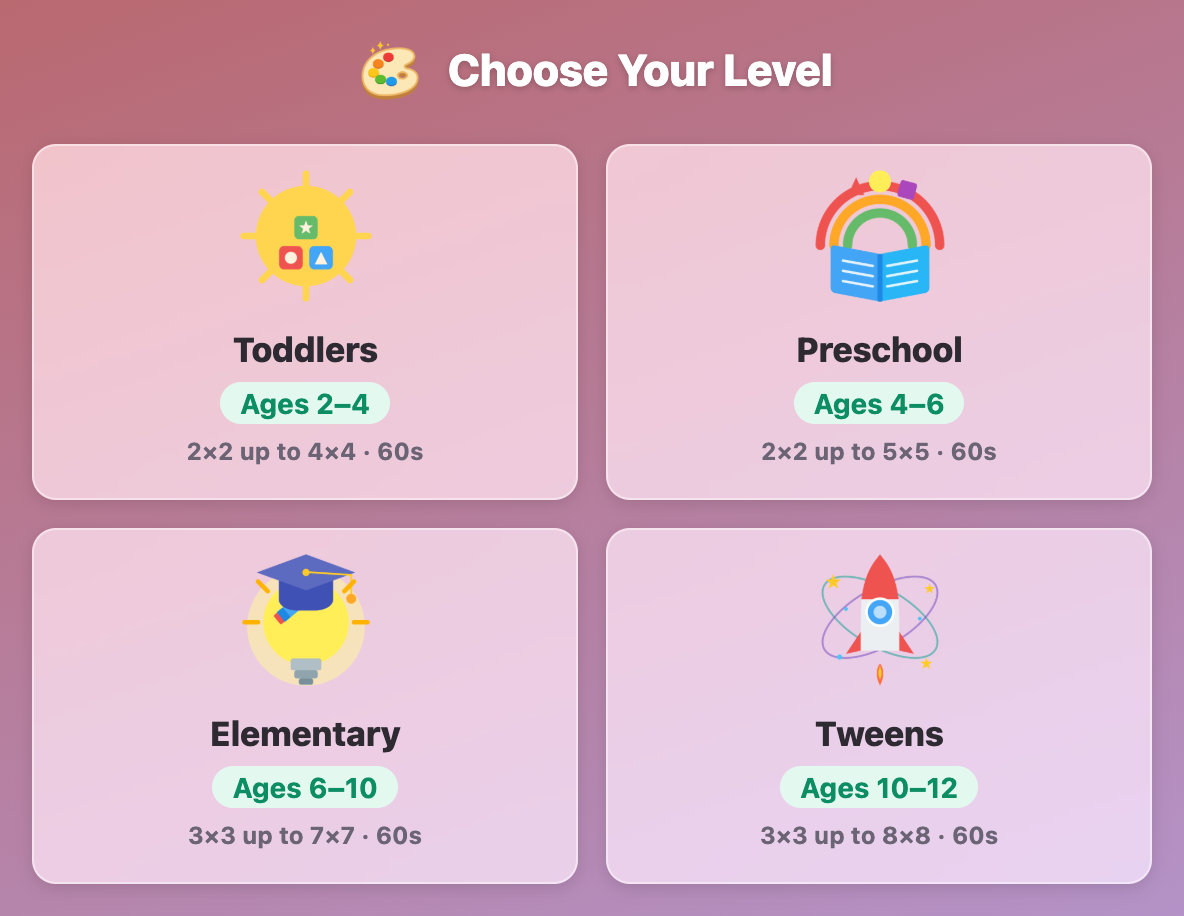
The Choose Your Level screen in Odd Shade Out for kids, with grids from 2x2 up to 8x8 and a 60 second clock
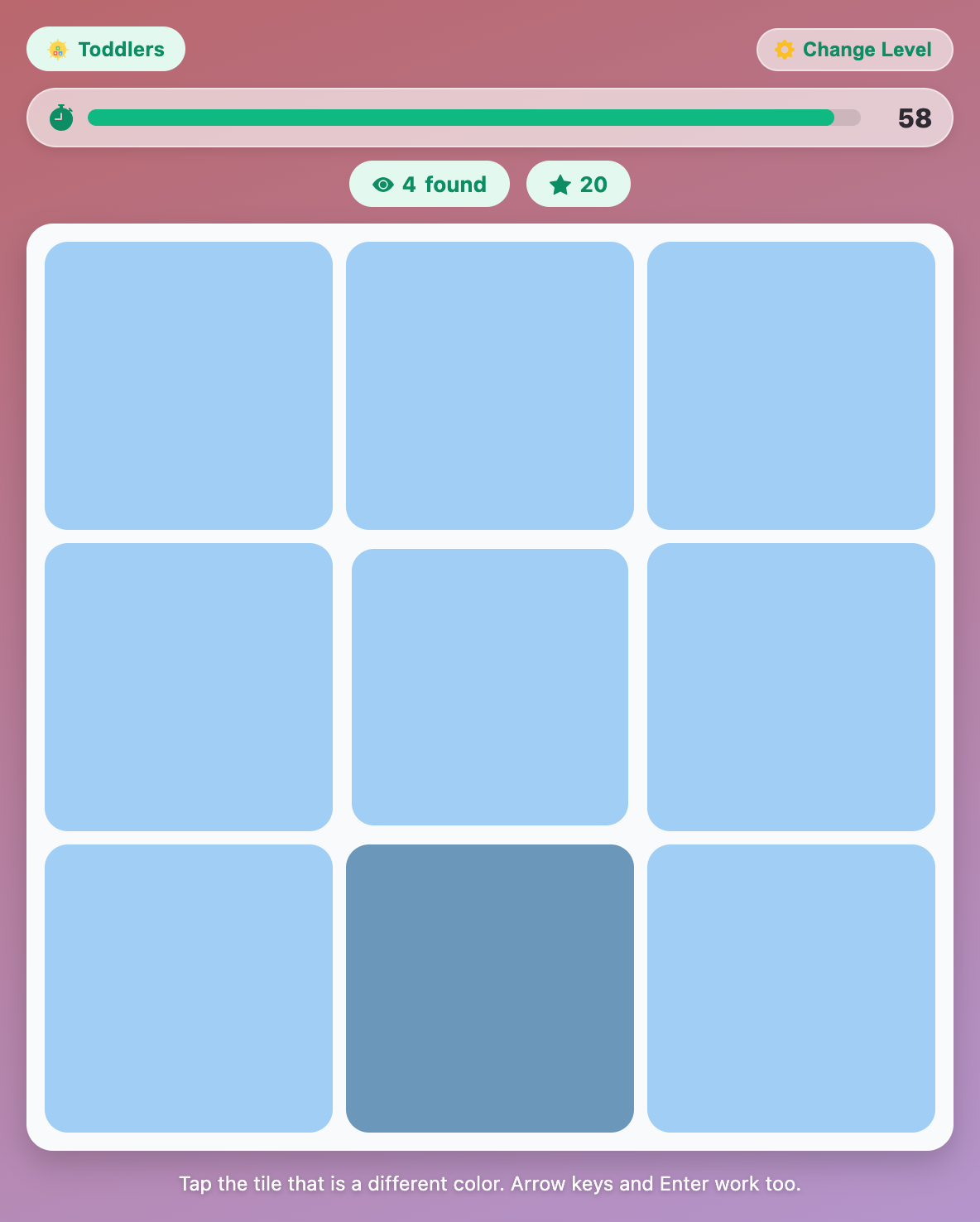
A 3x3 grid of light blue tiles with one darker tile in Odd Shade Out for toddlers, after 4 finds
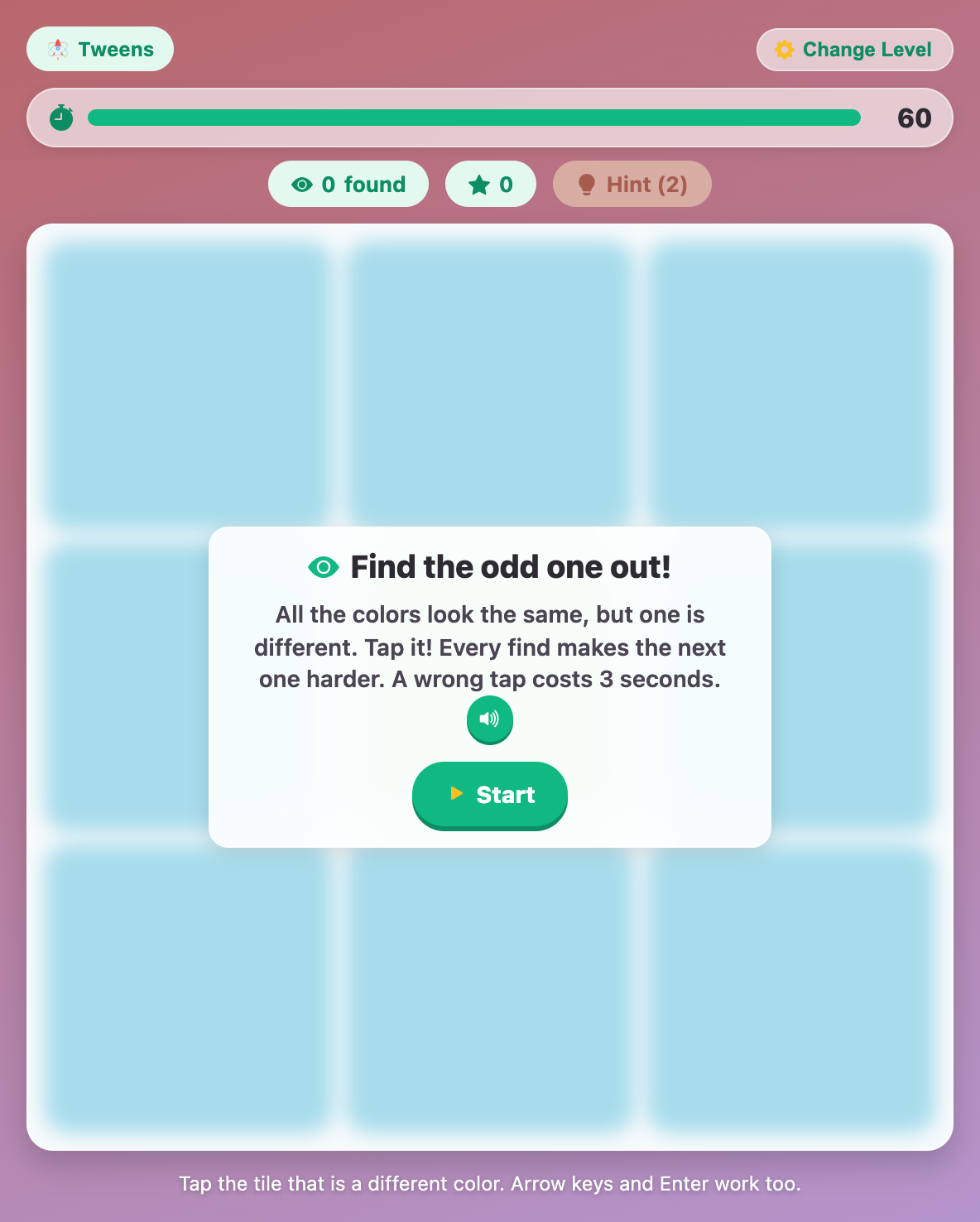
The Find the odd one out start card over a blurred first grid at the Tweens level
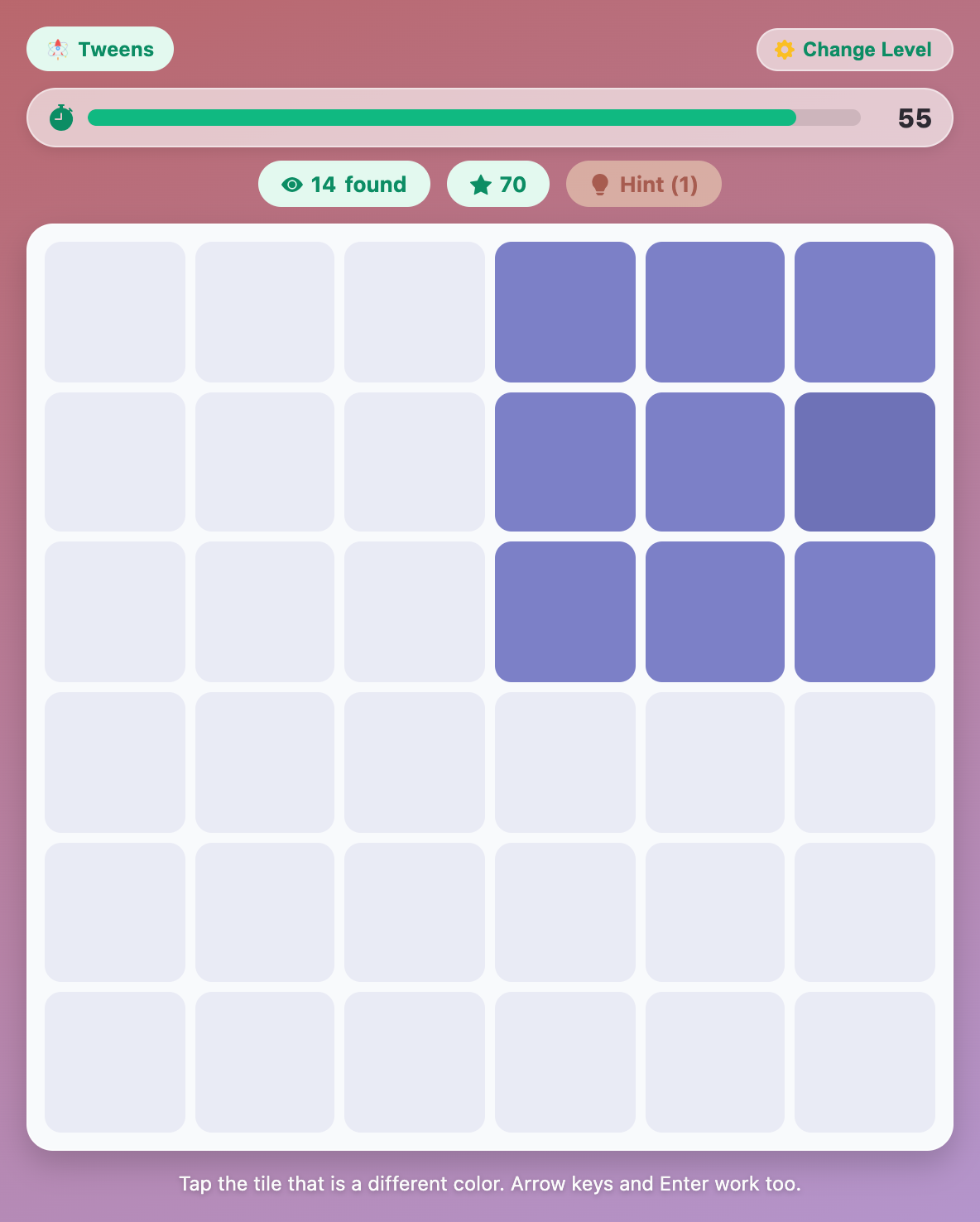
A 6x6 grid of purple tiles in Odd Shade Out for tweens, with the hint lighting only one corner
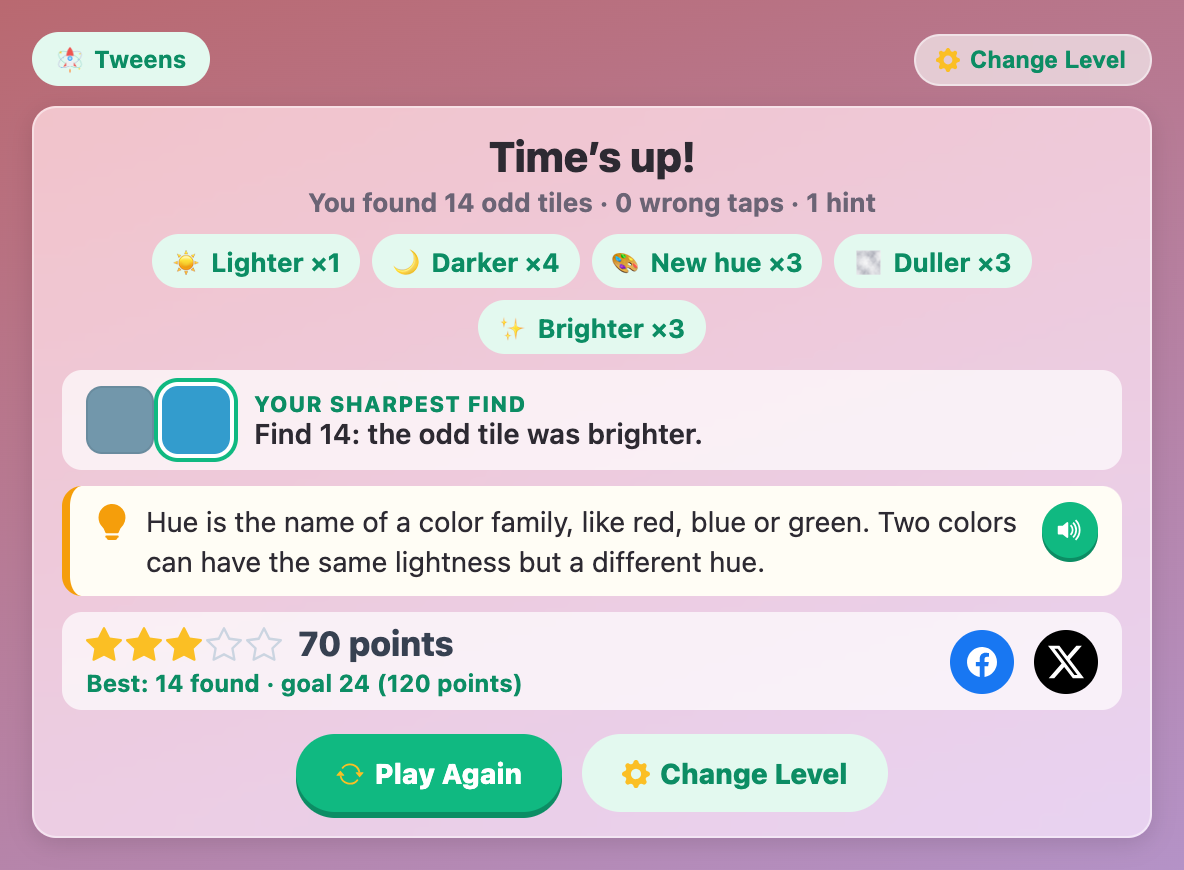
The Odd Shade Out result card with 14 odd tiles found, a chip for each kind of change and the sharpest find
More Art Games
 1.8M plays
4.9
Color & Draw
A free-drawing canvas with colors and brush sizes to unleash your creativity.
 154.5K plays
5.0
Mood Palette
Decide which color best fits a mood or theme before time runs out.
 584.9K plays
5.0
Tiny World Builder
Start with a tiny empty island and build your own blocky village — plant grass and trees, lay roads, and unlock houses, farms, a school and more!
 174.6K plays
4.9
Color Mixing
Look at two paint colors and pick which color they mix together to make.
Most Played Games
1.8M plays
4.9
Color & Draw
A free-drawing canvas with colors and brush sizes to unleash your creativity.
 59.5K plays
4.8
Recycling Sort
Sort everyday items into the Recycle, Compost, or Trash bin before time runs out!
 365.8K plays
5.0
Tic-Tac-Toe
Play a game of Tic-Tac-Toe against the computer and see if you can outsmart it.
 274.1K plays
5.0
Sentence Builder
Pick your age level, then tap the shuffled words in the right order to build the sentence.
Comments (36)