
Color Wheel Builder
97.3K playsBuild a real painter's color wheel, one color at a time! Put red, yellow and blue in their star spots, then mix each new color between the two that make it: red and yellow make orange, yellow and blue make green. Big kids add the in-between colors like red-orange and blue-green. Then the arrow spins: which color is opposite? Which three colors make a triangle? Tap the wheel to answer. Older artists finish by choosing a color scheme and painting a picture with it.
Every painter's studio has one on the wall: a big circle of colors, with red, yellow and blue spaced out around it and all their mixes in between. It is called a color wheel, and it is like a map of how colors are related. In Color Wheel Builder for kids, you don't just look at that map. You make it yourself, one paint pot at a time.
First you place the three colors that start everything. Then you mix the colors that go between them. When your wheel is finished, an arrow in the middle spins and stops on a color, and the game asks you questions you answer by tapping the wheel. Which color is opposite? Which two colors make this one? The oldest players even pick a color plan and paint a whole picture with it.
🎡 What a Painter's Color Wheel Shows
A color wheel puts colors in a circle so that every color sits between the two colors that make it. The one in this game is the painter's wheel, built from red, yellow and blue paint. It has three kinds of colors, and each kind has its own mark on the empty wheel:
★ Primary colors: red, yellow and blue. You can't mix them from other paints. Every other color on the wheel comes from them.
+ Secondary colors: orange, green and violet. Each one is two primaries mixed together. Red and yellow make orange, yellow and blue make green, and red and blue make violet. (Violet is the painter's name for purple, and the younger levels just say purple.)
• Tertiary colors: the six in-between colors, like red-orange and blue-green. Each one is a primary mixed with the secondary right next to it. Its name tells you both paints, with the primary first: red-orange is red + orange.
A 6-color wheel has the primaries and secondaries. A 12-color wheel adds the tertiaries. Artists have used wheels like this for hundreds of years. One fact the game shares is that Isaac Newton drew one of the first color wheels in 1704, by bending the colors of the rainbow into a circle.
🖌️ Playing Color Wheel Builder for Kids on KidWorld
Choose your level. The Choose Your Level screen shows Toddlers and Preschool with a "6-color wheel", and Elementary and Tweens with a "12-color wheel". The Tweens card adds "paint a scheme". The game remembers your level, and the Change Level button at the top right switches it.
Build step by step. Chips at the top show the steps: ★ Primary, + Secondary and, on the 12-color wheel, • Tertiary. You must finish one step before the next. If you tap a spot that belongs to a later step, the game reminds you, for example "First put the primary colors in the ★ spots!".
Place a paint. Tap a paint pot, then tap the empty spot where it belongs. You can also tap the spot first and then the pot, or drag the pot straight onto the wheel. On a keyboard, the number keys 1-6 pick a pot, the arrow keys move between empty spots, and Enter places the paint.
Watch the mixing. When you place a mixed color, two drops fly in from the colors that make it, and a line shows the recipe, like "yellow + orange = yellow-orange".
Answer the questions. Once the wheel is ready, the arrow in the middle spins and points at a color. Read the question, then tap your answer on the wheel. For two-color answers, little dots show "Tap 2" and fill in as you pick. The Clear button lets you start your picks over.
Listen any time. The 🔊 button reads the task or the question out loud. With the site's sound on, the game reads each new task and question by itself, too.
Paint a picture (Tweens). After the last question, tweens choose a color scheme, pick its colors on the wheel and paint a sailboat, a house or a butterfly.
See your finish card. It shows your wheel, your picture (for tweens), the points for each part, up to 5 stars and a color-wheel fact. Play Again builds a fresh wheel, and Change Level goes back to the level cards. The music, fullscreen and reload buttons beside the game work as usual.
🏅 Where Your Points Come From
Building: each spot on the wheel is worth 5 points if you fill it with no mistakes, 3 points after one wrong paint, and 1 point after more. A mistake only costs points for that one spot.
Questions: a right answer on the first try is worth 10 points. If your first answer is wrong, you get a hint and a second try for 5 points. If the second try is wrong too, the game shows the right answer and draws lines over the wheel to explain it, and that question scores 0.
The tweens' picture: picking a correct color scheme earns 10 points (5 after a wrong pick), and finishing the picture earns 10 more.
So the best possible score is 80 for Toddlers, 90 for Preschool, 140 for Elementary and 160 for Tweens. Your score is saved once, at the very end.
🧠 How to Build a Perfect Wheel
Start with the stars
Red, yellow and blue can go in any of the three ★ spots. There is no wrong order! Whichever way you place them, the game builds the rest of your wheel around your choice, and every question is checked against your own wheel.
Look left and right before you mix
For a + spot on the 6-color wheel, look at the two colors touching it. They are the two paints that make it. A + spot between red and yellow needs orange. One between yellow and blue needs green. One between red and blue needs violet.
On the 12-color wheel, look two steps away
On the big wheel, a + spot doesn't touch the primaries. There are • spots in the way. So look two spots to each side, where the ★ colors are. The + spot halfway between red and yellow is still orange.
Read the names of tertiary colors
Tertiary colors are the easiest to place once you know the secret: the name says where it goes. Yellow-green sits between yellow and green. Blue-violet sits between blue and violet. Find the two colors in the name, and the • spot between them is the home.
Don't fall for the decoys
From Preschool up, the first set of pots mixes orange, green and purple (or violet) in with the primaries. Those aren't primaries, because they are mixed from other paints. If you place one in a ★ spot, the game explains it, for example: "Orange isn't a primary color: it's mixed from red and yellow. Try another paint!"
Use the hints when a mix goes wrong
After a wrong paint, the game gives you a clue first, like "Not quite! This spot mixes red and yellow. What do they make?" If you miss again, it tells you the answer and makes the right pot glow. You only lose points on that one spot, so take a breath and try again.
🎯 How to Answer the Wheel Questions
The question tells you what to find, and the wheel itself holds the answer. Here is how to think about each kind.
Opposites: go straight through the middle
The color opposite the arrow's color is straight across the circle, through the center. On a 6-color wheel, that is 3 steps away. On a 12-color wheel, it is 6 steps away. Opposite colors are called complementary colors, and side by side they make each other look brighter.
Mixes: find the parents
"Which two colors mix to make green?" Tap the two colors that green sits between: yellow and blue on a 6-color wheel, or the ★ yellow and ★ blue two spots away on a 12-color wheel. For a tertiary color like red-violet, the answer is right beside it: red and violet.
Neighbors and analogous colors
Neighbors are the two colors touching the arrow's color, one on each side. Tweens get a cousin of this question: "Pick three neighbors", where the arrow's color and two others must sit in a row with no gaps. Here, any three in a row that include the arrow's color are right. Colors side by side like this are called analogous colors, and they look calm together.
Triads: jump in equal steps
A triad is three colors spaced evenly, like the points of a triangle. On the 12-color wheel, jump 4 colors at a time. On the 6-color wheel, jump 2.
Split-complementary: find the opposite, then step aside
This one is for tweens. First find the color opposite the arrow's color. Don't tap it! Instead, tap the two colors on each side of it.
📝 Five Wheel Puzzles, Worked Out
These examples use the standard wheel, with red at the top and the colors going red, red-orange, orange, yellow-orange, yellow, and on around the circle.
Toddlers, building: red, yellow and blue are in place. A glowing + spot sits between red and yellow, and the task asks, "Red and yellow make…? Tap the right paint!" The pots are orange, purple and green. Red and yellow make orange, so tap orange.
Elementary, opposite: the arrow stops on yellow-orange. Count 6 steps around the 12-color wheel: yellow, yellow-green, green, blue-green, blue, blue-violet. The answer is blue-violet.
Elementary, triad: the arrow points at orange. Jump 4: from orange to green, then 4 more to violet. Orange, green and violet make a triad. (Red, yellow and blue are a triad too!)
Tweens, split-complementary: the arrow points at orange. Orange's opposite is blue. The colors on each side of blue are blue-green and blue-violet, so tap those two. The game draws a triangle from orange to both of them.
Tweens, mixing a tertiary: "Which two colors mix to make red-violet?" Its name gives it away: red and violet, the two colors right beside it.
🎨 The Tweens' Final Painting
After the questions, tweens choose a color scheme, a small set of colors that look good together. There are three to pick from:
Complementary: 2 opposite colors, like orange and blue.
Analogous: 3 neighbors in a row, like yellow, yellow-green and green.
Triadic: 3 colors in a triangle, like red, yellow and blue.
Then you tap the colors for your scheme on the wheel. If they don't fit the scheme, the game explains why, for example, "Triadic colors are evenly spaced: 4 steps apart all the way round." Once your scheme is right, tap "Paint my picture". You get a sailboat, a house or a butterfly. Pick one of your colors, then tap each part to paint it. A checklist shows "Paint every part" and "Use all your scheme colors". When both are checked, tap Finish.
A tip for a great picture: give big neighboring parts different colors. A blue sky above blue grass would be hard to tell apart, but a blue sky above yellow grass looks bright and clear.
👧 Color Wheel Builder for Every Age
Color Wheel Builder for toddlers
Toddlers build a 6-color wheel with lots of help. The game picks the next spot and makes it glow, so tapping a paint pot puts it right there. The first pots are only red, yellow and blue. Then come 5 easy questions like "Tap the red one!", with a splat of the color to match. The secondary color is called purple at this level.
Color Wheel Builder for preschoolers
Preschoolers build the 6-color wheel themselves. The first pots include orange, green and purple as decoys, so they learn which colors are primary. Their 6 questions mix "find" questions with "Which two colors mix to make…?" and "Which color is opposite…?".
Color Wheel Builder for elementary kids
Elementary kids build the full 12-color wheel, tertiary colors and all, and meet the word violet. Their 8 questions cover opposites, neighbors, two-color mixes for secondary and tertiary colors, and triads.
Color Wheel Builder for tweens
Tweens build the 12-color wheel and answer 8 harder questions: analogous colors, triads, split-complementary pairs, an opposite and a tertiary mix. Then they choose a color scheme and paint a picture with it, just like a designer planning colors for a poster.
💡 What Kids Learn From Building a Wheel
Mixing makes sense. Instead of memorizing "red and yellow make orange", kids see orange land right between red and yellow, with two drops flying in. The wheel becomes a picture of how mixing works. Kids who want to mix real paint drop by drop can try Paint Match Lab, where a jar mixes colors like real paint.
It builds a sense of order and pattern. Opposites are always halfway round. Triads are always equal jumps. Finding them is a little like counting on a clock face, so color practice turns into pattern practice too.
Kids learn real art words. Primary, secondary, tertiary, complementary, analogous, triad: these are the words art teachers and designers use. The game explains every one in plain language the moment it comes up.
It connects color to feeling. One side of the wheel holds the sunny reds, oranges and yellows. The other holds the cool blues and greens. Warm or Cool? is a fun next step for sorting colors into those two teams. And for more mixing on a game board, Color Crush lets kids make secondary colors by matching paint drops.
A note for grown-ups: a game is one wheel plus 5 to 8 questions (and one picture for tweens), so it fits into a short break. There is no timer, no lives and nothing scary. Mistakes are met with a friendly clue first, and a wrong answer is always explained, with lines drawn right on the wheel. It practices color theory, careful reading and reasoning about patterns.
So grab your paint pots and put red, yellow and blue in their star spots. Your color wheel is waiting to be built, and Color Wheel Builder for kids will show you everything it can do.
🖼️ See the Game in Action
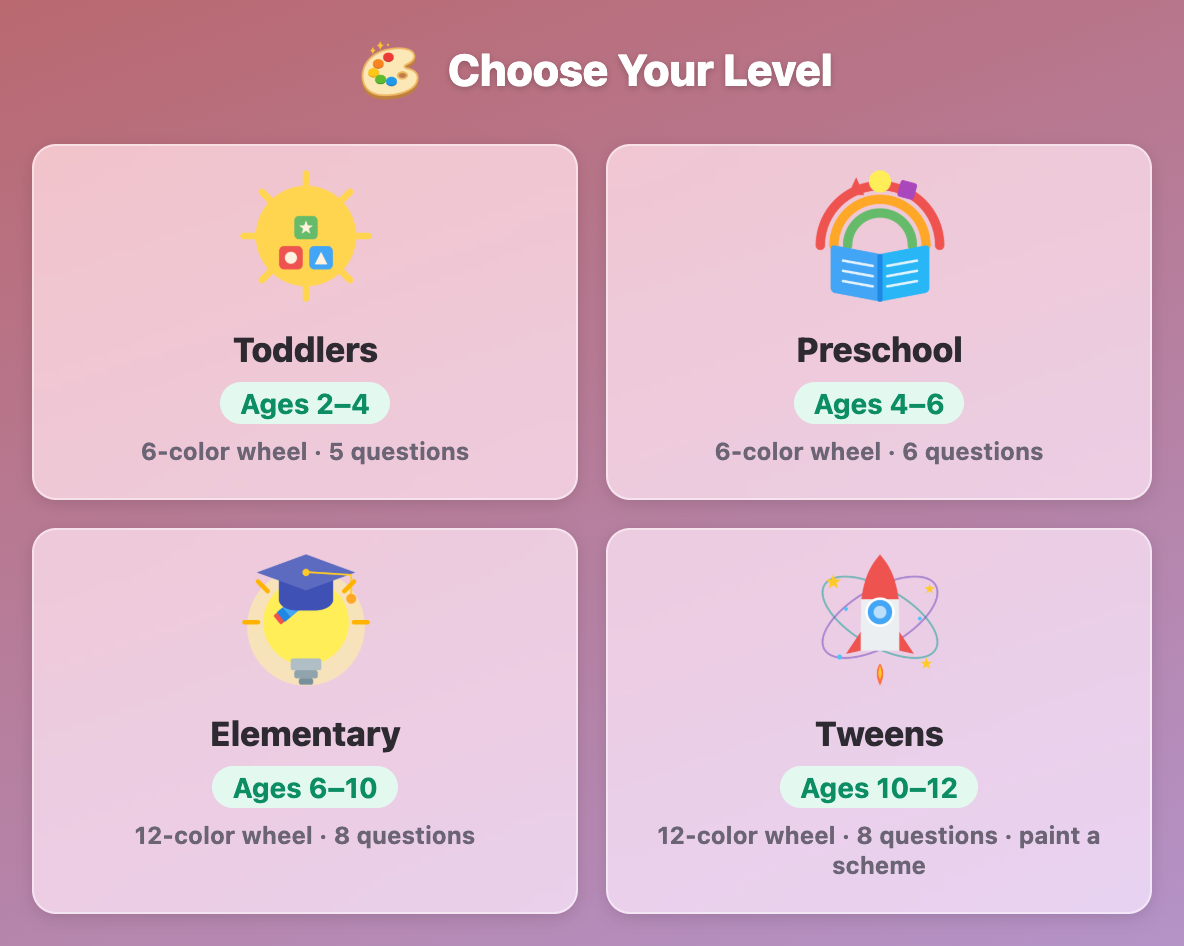
The Choose Your Level screen in Color Wheel Builder for kids, with 6-color and 12-color wheels
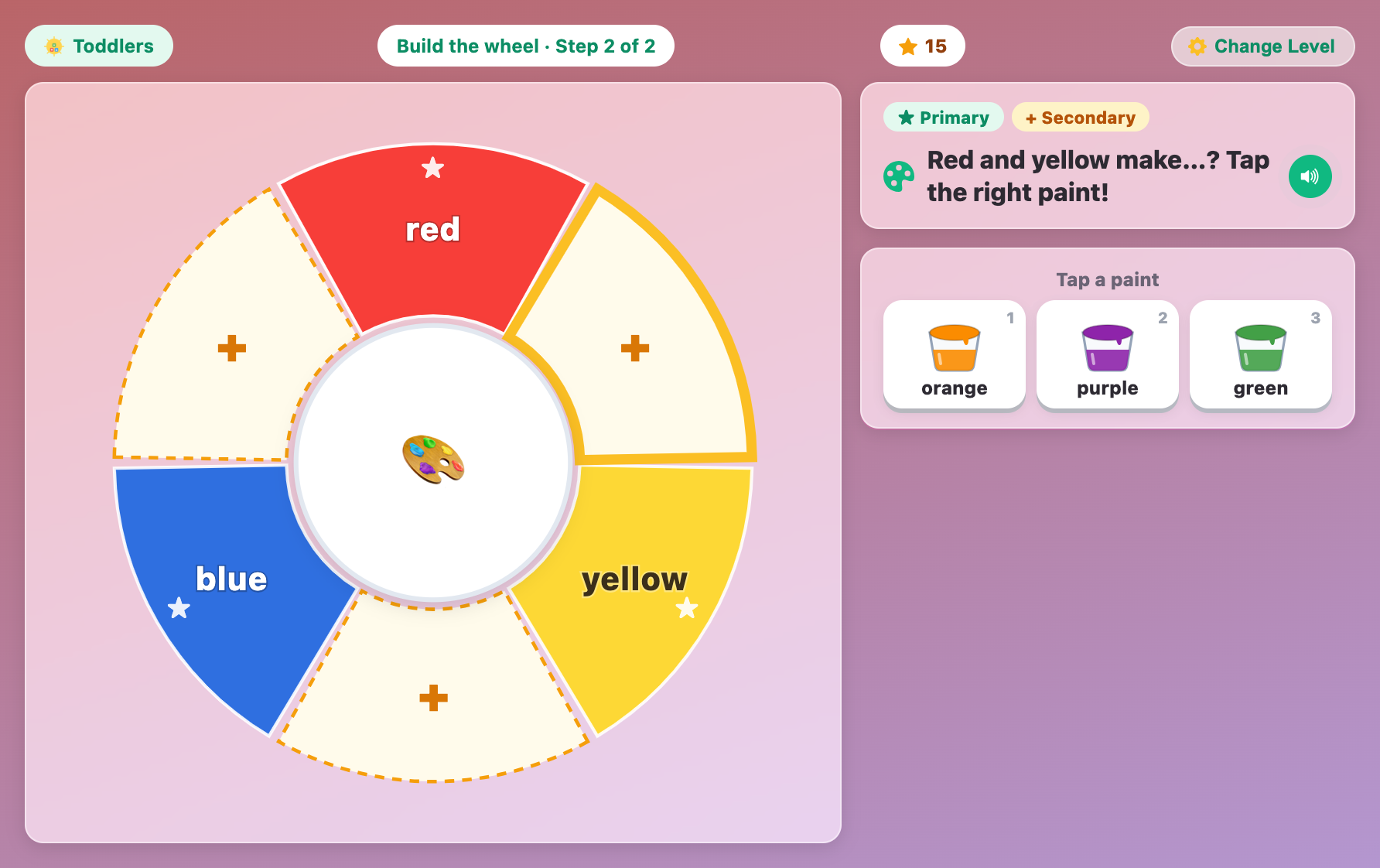
A toddler wheel with red, yellow and blue in place and the task asking what red and yellow make
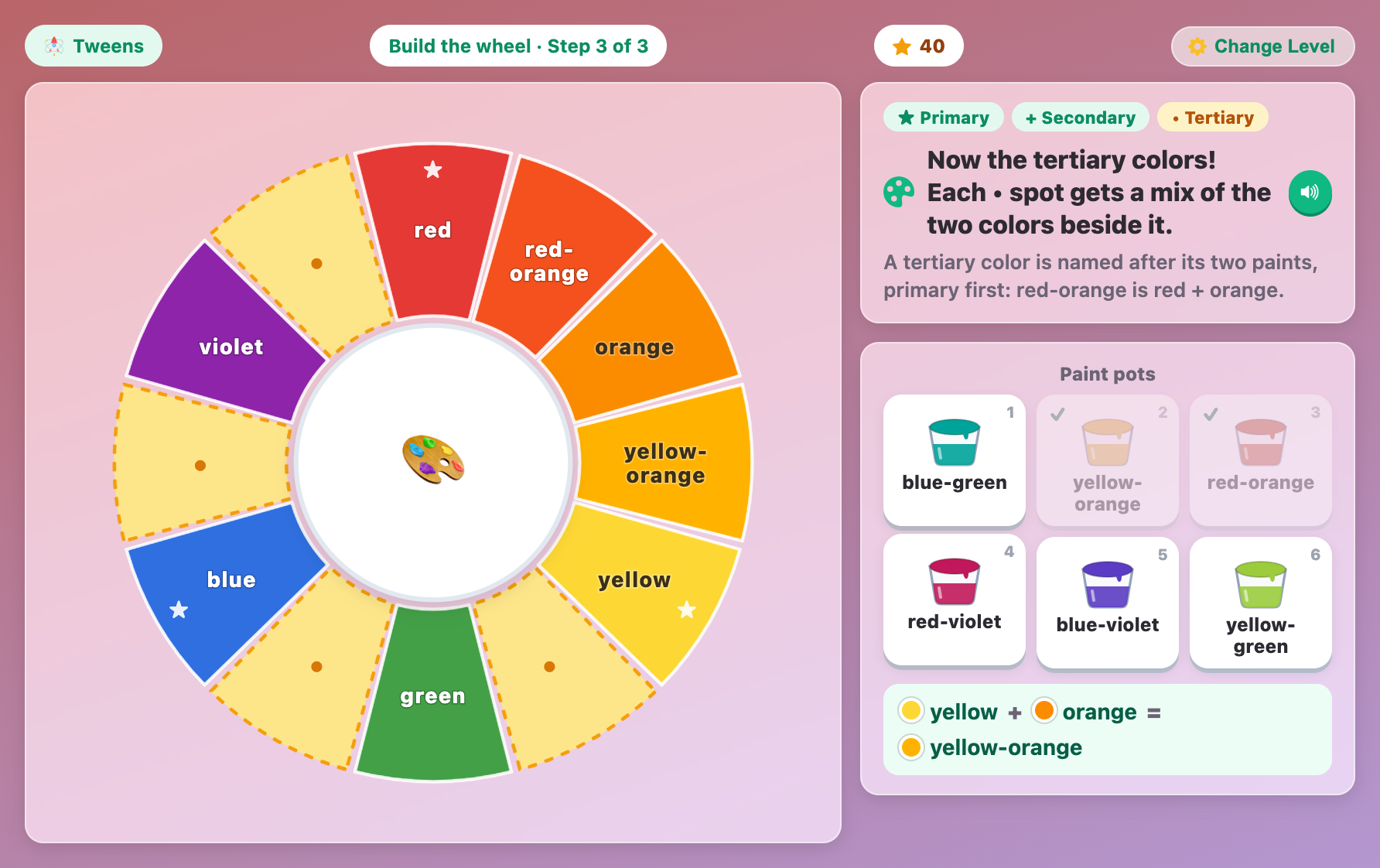
A 12-color wheel half built in Color Wheel Builder for tweens, with yellow plus orange making yellow-orange
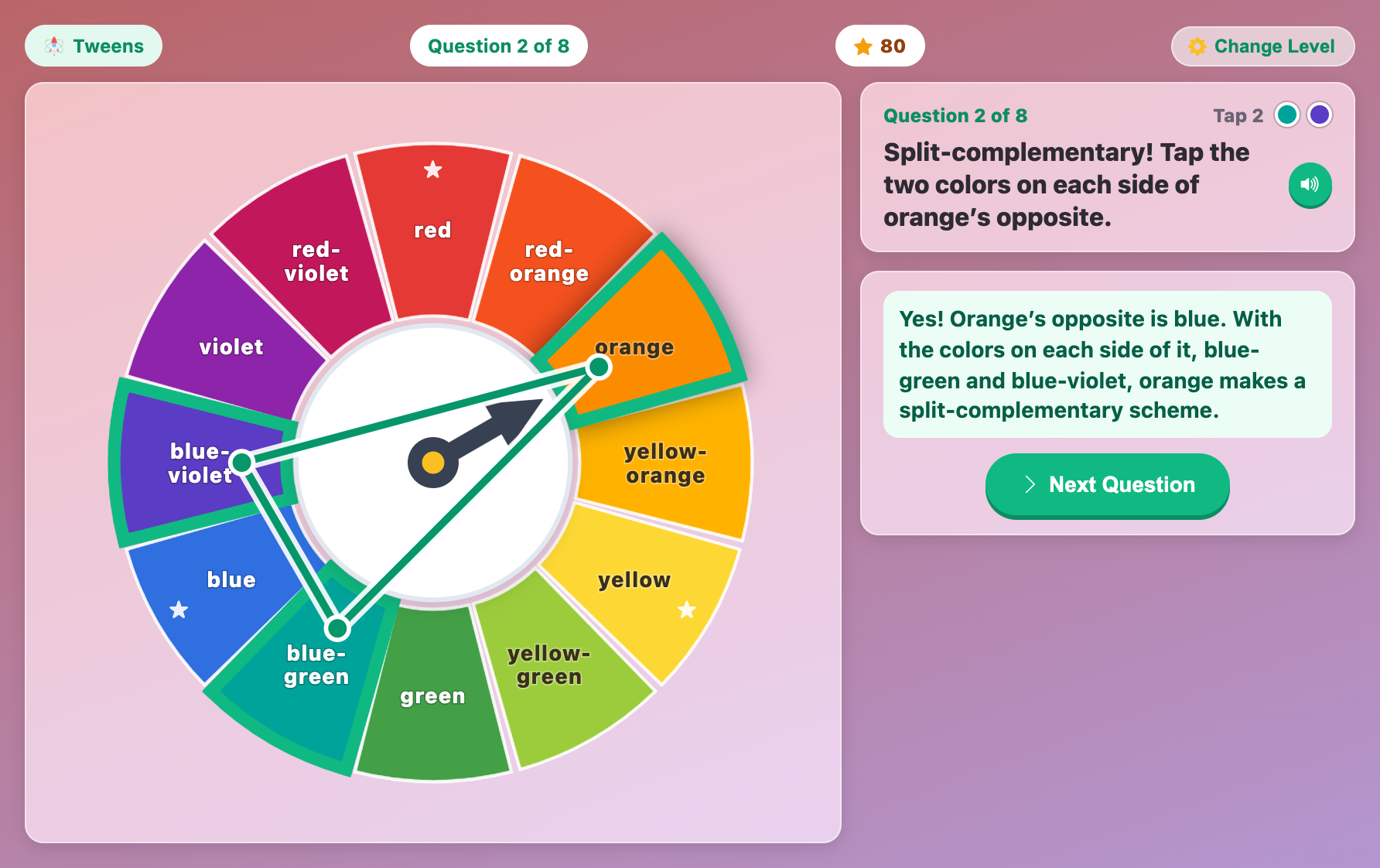
A split-complementary question answered with a triangle from orange to blue-green and blue-violet on the wheel
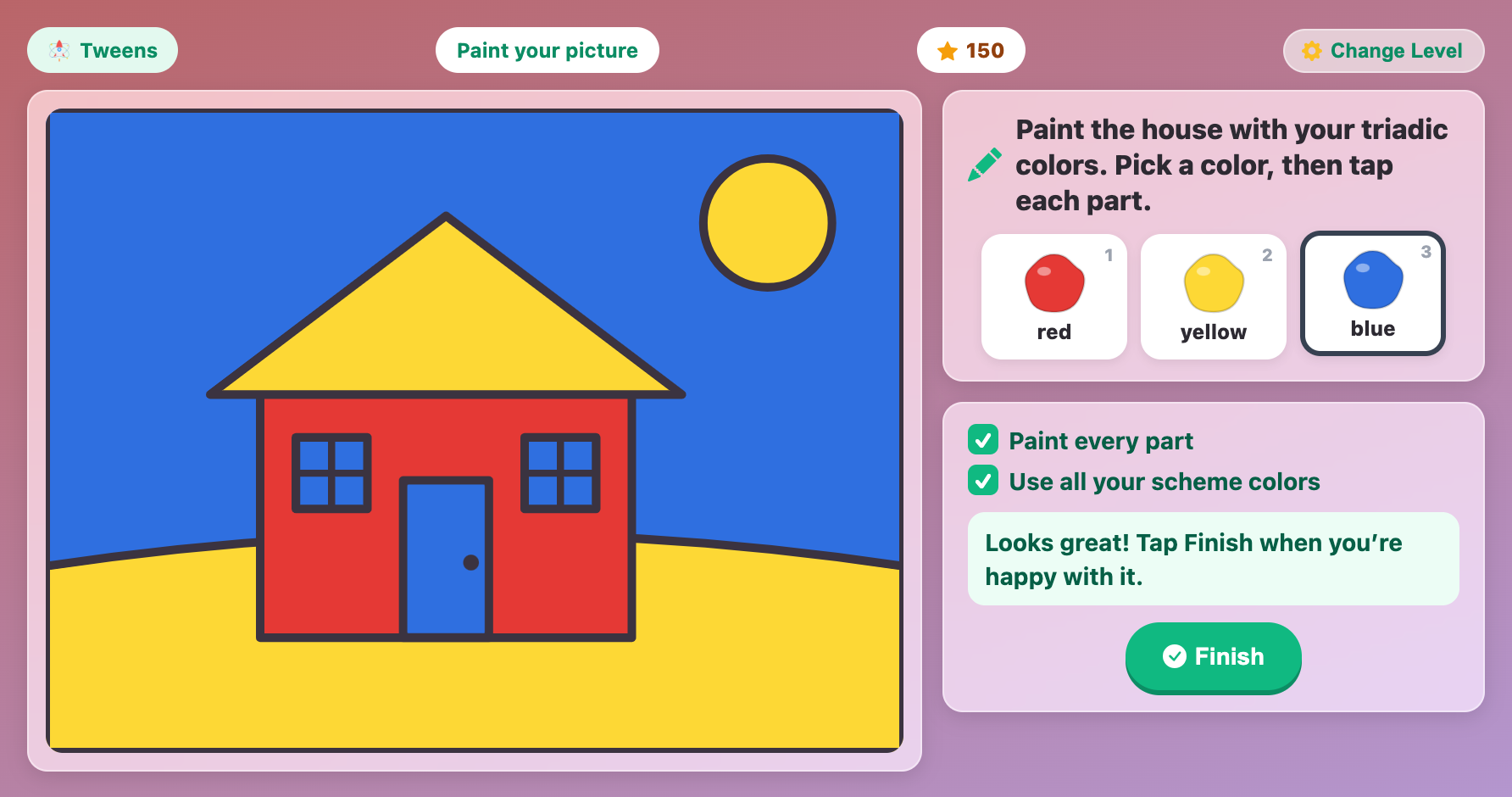
A house painted in the triadic colors red, yellow and blue at the end of Color Wheel Builder for tweens
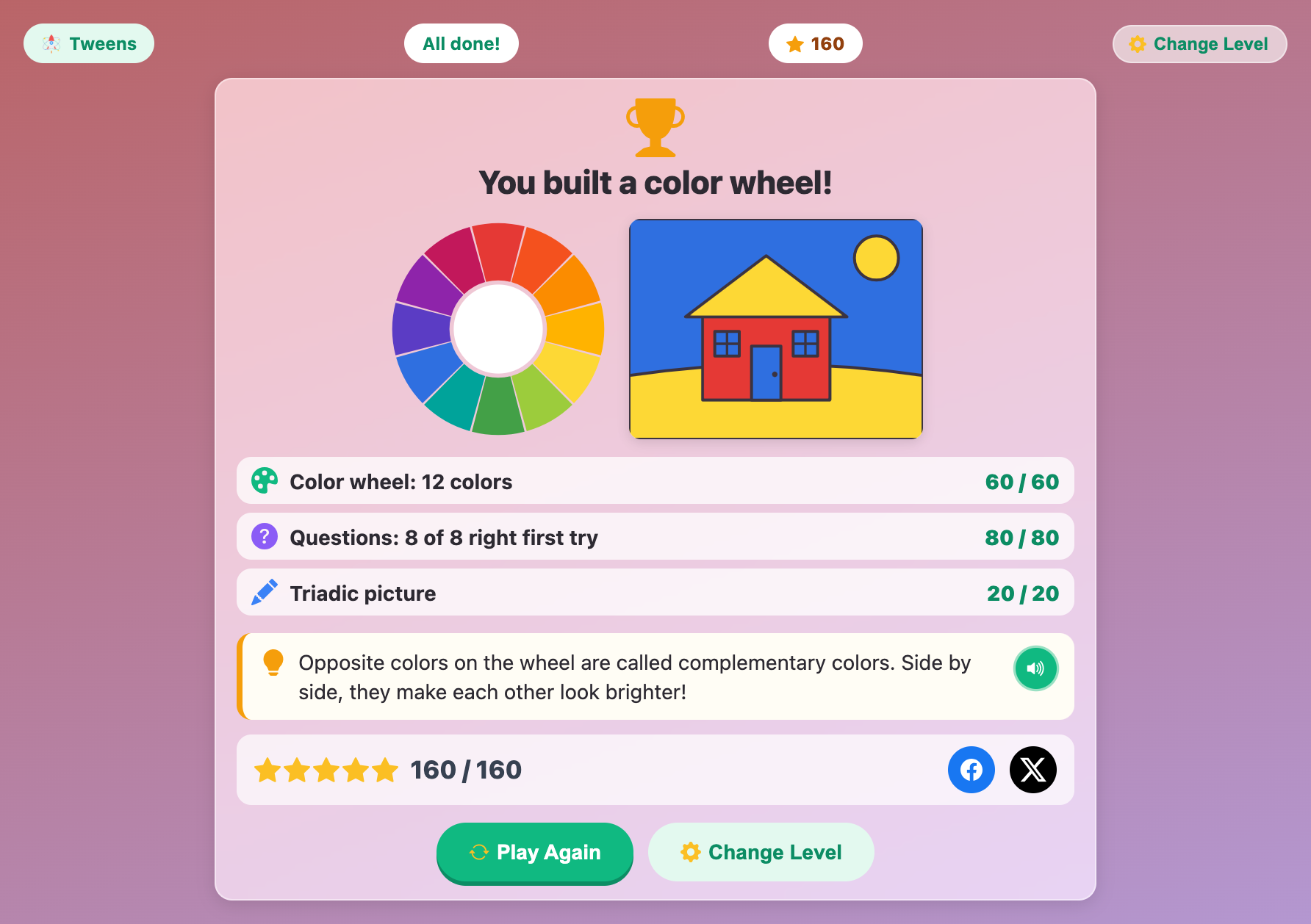
The You built a color wheel finish card with the finished wheel, the painted house and a score of 160 out of 160
More Art Games
 1.8M plays
4.9
Color & Draw
A free-drawing canvas with colors and brush sizes to unleash your creativity.
 154.5K plays
5.0
Mood Palette
Decide which color best fits a mood or theme before time runs out.
 584.9K plays
5.0
Tiny World Builder
Start with a tiny empty island and build your own blocky village — plant grass and trees, lay roads, and unlock houses, farms, a school and more!
 174.6K plays
4.9
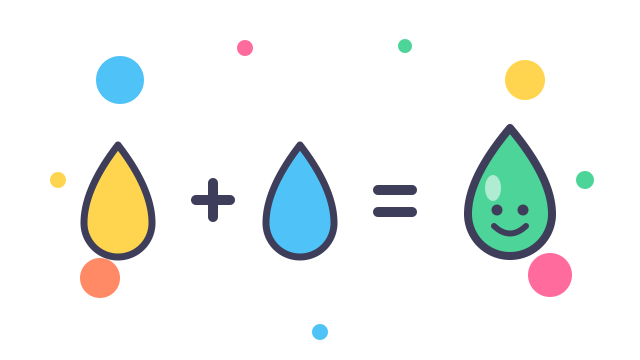
Color Mixing
Look at two paint colors and pick which color they mix together to make.
Most Played Games
1.8M plays
4.9
Color & Draw
A free-drawing canvas with colors and brush sizes to unleash your creativity.
 59.5K plays
4.8
Recycling Sort
Sort everyday items into the Recycle, Compost, or Trash bin before time runs out!
 365.8K plays
5.0
Tic-Tac-Toe
Play a game of Tic-Tac-Toe against the computer and see if you can outsmart it.
 274.1K plays
5.0
Sentence Builder
Pick your age level, then tap the shuffled words in the right order to build the sentence.
Comments (44)