
ScienceCraft
63.5K playsExplore a blocky island in 3D where crafting follows real science! Build a furnace and use its heat to turn sand into glass, clay into bricks and wood into charcoal. Watch ice melt in the sunshine and water freeze on cold nights, answer science questions to mine coal, iron and gold, and build a greenhouse, a windmill and a warm hut.
ScienceCraft for kids is a free 3D block world where crafting follows the rules of real science. You walk around a blocky island, chop trees and dig stone, then build a furnace whose heat turns sand into glass and clay into bricks. Leave water out on a cold night and it freezes. Put ice in the sunshine and it melts. Science questions unlock the shiny ores in the mountain.
It plays right in your browser, on a computer or on a tablet or phone with touch controls, and there's nothing to download and no sign-up. Quests guide you all the way, from chopping your first log to building a glass greenhouse, a windmill and, on the hardest level, a warm hut that keeps the heat in.
🧪 A Block World Where Heat, Cold and Light Really Matter
If you've played a block-building game before, a lot here will feel familiar. There's a forest, a lake, a flat grassy building plot and a tall stone mountain with a snowy top. You dig blocks, collect them in your bag, craft new things and place blocks to build.
What makes ScienceCraft different is that the world follows science, and the game tells you why:
Heat changes materials. A furnace melts sand into glass, bakes soft clay into hard bricks, turns a log into charcoal, and gets iron and gold out of their rock. That last one is called smelting.
Some changes can't be undone. Each furnace recipe comes with a fact, like "Great heat melts sand into runny, glowing glass… It can never turn back into sand!" On the Elementary and Tweens levels, those recipes also carry a "Can't be undone" tag.
Day and night change the temperature. The sun crosses the sky, then night falls with stars and a moon. Ice you place melts into water in the daytime, and water you pour out freezes into ice at night. Melting can be undone: the water freezes again when it gets cold.
High up, it's always cold. On the snowy mountain top, ice and snow never melt, and water freezes even in the day.
Glass lets light in. Sunshine passes through glass, which is why a greenhouse is made of it.
🕹️ Your First Day on the Island: How to Play ScienceCraft on KidWorld
Pick a level. Choose Toddlers, Preschool, Elementary or Tweens. The level picks your science questions and your list of quests. A welcome card then explains the basics, and you can see it again from the ⚙️ menu under "How to play".
Walk and look around. On a computer, walk with W A S D or the arrow keys, drag the screen to look, and press Space to jump. On a touch screen, use the stick to walk and drag the screen to look. Walking into a one-block step hops you up it, so you can climb almost anywhere.
Dig and chop. Pick the pickaxe in the bar at the bottom, then tap or click a block. Hold to keep digging. Trees give logs, the mountain gives stone, the beach gives sand, gray clay lies by the lake, and flowers grow in the meadows.
Craft. Tap 🔲 Craft (or press E) to open the Craft panel. It shows everything in your bag and every recipe, like 1 log → 4 planks, 2 planks → 4 sticks, and 8 stone → 1 furnace. Furnace recipes only work when you stand near your furnace, and each one burns one fuel.
Build. Pick a block in the bar, then tap where you want it. On a computer, right-click builds too. Number keys 1–9 pick a slot.
Unlock ores with science. Coal, iron, gold and diamond ores are locked. Tap one and a question card opens. A right answer breaks the ore open. A wrong answer shows you the right one, and the ore stays locked until you tap it again for a new question.
Follow your quests. The card at the top shows your current quest, like "Freeze water into ice at night (pour a bucket out, wait for night)", with a 🔊 button that reads it out loud. Quests count everything you've done since the world began, so doing a step early never has to be done again.
Skip the clock. The ☀️ Day / 🌙 Night chip shows the time. Tap it to jump ahead to sunset or sunrise, so you don't have to wait. The clock stands still while a card is open.
Finish. Tap 🏁 Finish to see your score, a picture of your island and a "Practice these again" list. If you still have quests left, the button asks "Sure?" first, so you have to tap it twice.
Your world saves itself in your browser, so you can come back to it later. The ⚙️ menu also has Back to start (if you get lost), Change level and New world. And you have the page's fullscreen, reload and music buttons too.
🔥 The Furnace: Your Science Lab
The furnace is the heart of ScienceCraft. Craft it from 8 stone, place it, and stand within a few blocks of it. Then open Craft, and the orange "Heat" recipes come alive:
🪟 Glass: 4 sand + 1 fuel → 4 glass. Heat melts sand, and it cools into see-through glass.
🧱 Bricks: 4 clay + 1 fuel → 4 bricks. Heat dries clay and bakes it hard.
⚫ Charcoal: 1 log + 1 fuel → 2 charcoal. Wood heated with very little air turns into charcoal, which burns hotter than wood.
⚙️ Iron and 🟡 gold: 1 raw iron or raw gold + 1 fuel → 1 bar. Very hot fire melts the metal out of the rock.
Fuel can be charcoal, coal or planks. The game uses them up in that order. Torches are different: they need coal or charcoal, not planks.
🏆 How to Finish Every Quest: Smart Scientist Tips
Tip 1: Gather before you craft
Many quests come in a chain. For example, on the Elementary level you chop logs, make planks, craft a wooden pickaxe, dig stone, craft a stone pickaxe, then build a furnace. Each step needs what the last one made. So when you're out chopping, chop a few extra logs. Logs make planks, planks make sticks and fuel, and you'll need lots of all three.
Tip 2: Use the right pickaxe
On the Elementary and Tweens levels, ores need a strong enough pickaxe. Coal needs at least a wooden pickaxe, iron needs a stone pickaxe, and gold and diamond need an iron pickaxe. To make the iron pickaxe, you first need iron bars, which means mining raw iron and smelting it in the furnace. Toddlers start with a pickaxe and break every block in one tap, so they can skip this part.
Tip 3: Put the furnace where you work
Furnace recipes only work when you stand near the furnace. Place yours on the building plot, close to where you'll build your greenhouse. Then you can heat sand into glass and build with it without long walks back and forth.
Tip 4: Think before you tap an ore
Every ore question counts toward your score, so read the whole question first, and tap 🔊 to hear it if you like. A wrong answer doesn't lose the ore, it just stays locked for another try. Here are a few real questions from the game:
"A compass needle points north because the Earth acts like a…" (Tweens, Forces & Magnets). The choices might be a giant battery, a giant magnet, a giant mirror or a giant lens. A compass needle is a tiny magnet, so the Earth must act like a giant magnet.
"Which is a chemical change?" (Tweens, Changes). Burning wood, melting ice, cutting paper or dissolving sugar? Think about the furnace tags: which one can't be undone? You can't un-burn wood, so burning wood is the chemical change. Melting ice is a physical change, because the water can freeze again.
"What happens to ice in the warm sun?" (Preschool, Changes). It melts into water. You can test it yourself on the island!
"Which one can you see through?" (Toddlers). Picture answers like a 🧱 brick wall, 🪵 wood and 🪟 glass. Glass, of course, the same block you make in the furnace.
Tip 5: Freezing water, step by step
The freeze quest is the one most players get stuck on. Here's how to do it:
Pick the bucket in the bar and tap the lake to fill it. (On Elementary and Tweens, you craft the bucket first from 3 iron.)
Walk back to the plot and tap the top or side of a block to pour the water out.
Tap the ☀️ Day chip to skip to sunset.
Wait a few seconds after night falls. You'll see "Brrr! It got cold enough for the water to freeze into ice."
Pour it out in the open. Under a roof, water freezes much more slowly, because a roof keeps some warmth in.
Tip 6: Melting ice, step by step
For the melt quest, you need a block of ice out in the sunshine. Use the ice you just froze, or dig some from the snowy mountain top. Then wait for daytime and watch it turn back into water. Two things to remember: ice on the mountain top never melts, because it's always cold up there, so bring it down. And ice in the shade still melts, just more slowly, because the air is warm.
Tip 7: Build from the blueprint
Every build quest starts with a short Plan question, like "Plants need sunlight. Which block lets the sun shine in?" Then a see-through blueprint appears on the plot. Its cubes are colored by the material they need: light blue for glass, pink for a flower, tan for wood, orange for "warm" blocks (wood, bricks or stone), and green for any block. Pick the right block, tap a blueprint cube, and it's built right there. If you pick the wrong block, the game says "This spot needs glass." Build from the bottom up, and the blueprint even lets you tap roof cubes from outside.
You don't have to use the blueprint, though. The quest is done as soon as your own blocks make the right shape anywhere on the island, turned any way.
Tip 8: Know the four science builds
🌸 Little greenhouse (every level but Tweens): plant a flower, then put glass on all four sides and one on top. That's 5 glass and 1 flower.
🌿 Big greenhouse (Tweens): a flower ringed with 8 glass and covered with a 3×3 glass roof, 17 glass in all. Make plenty of glass first!
💨 Windmill (Preschool, Elementary, Tweens): a tower 3 high for preschool or 4 high for older kids, with a plus shape of wooden sails on its front. The wind is moving air, and it pushes the sails round.
🏠 Warm hut (Tweens): walls 2 high around one open square, with a door left open and a roof on top, all made of wood, bricks or stone. Thick walls slow heat from escaping, and the roof stops warm air rising away.
Tip 9: How your score adds up
Your score is out of 100. Up to 60 points come from quests, shared equally across your level's list, so every finished quest counts. The other 40 come from science: the share of ore and plan questions you got right. So the best plan is to finish as many quests as you can and to answer carefully.
🎒 ScienceCraft for Kids at Every Age
ScienceCraft for toddlers (ages 2–4)
ScienceCraft for toddlers starts you with a pickaxe and a bucket, and every block breaks with one tap. There are 11 quests, from chopping two logs to building a little greenhouse and freezing water. Questions have 3 picture answers, like "Which one is cold?" with 🧊 ice, 🔥 fire and ☀️ the sun, and the game reads the question and its answers out loud when sound is on. Walking and looking in 3D is hard for small hands, so this level works best with a grown-up driving and the child choosing what to build.
ScienceCraft for preschoolers (ages 4–6)
ScienceCraft for preschoolers has 16 quests. Kids make their own wooden pickaxe, build a furnace and a greenhouse, freeze water and melt ice, mine a little gold, and build a windmill. Questions still have 3 picture answers and are read aloud, with topics like materials, hot and cold, changes and Earth.
ScienceCraft for elementary kids (ages 6–10)
ScienceCraft for elementary kids has 18 quests and real tool rules: you need the right pickaxe for each ore. Kids smelt raw iron into bars, craft a bucket, dig clay and bake bricks, and build a 4-high windmill. Questions have 4 word answers, about materials, forces, Earth and changes, and the furnace recipes show "Can't be undone" tags.
ScienceCraft for tweens (ages 10–12)
ScienceCraft for tweens has 18 harder quests: making charcoal, the big 17-glass greenhouse, the windmill and the warm hut. Questions cover energy, forces and magnets, rocks and Earth, and chemical versus physical changes. Tweens who like this mix of building and thinking can also try MathCraft, the same kind of block island where math puzzles unlock the ores and plan the builds.
🌡️ Why ScienceCraft Is Good for Growing Scientists
Experiments you can do yourself. Kids don't just read that water freezes when it's cold. They pour it out, skip to night, and watch it turn to ice. Then they wait for the sun and watch it melt. That's a real experiment, with a real result. For more about how water moves and changes, Water Cycle Explorer shows evaporation, rain, snow and melting across a whole 3D landscape.
Changes that stay, and changes that don't. Melting ice can be undone, but baked bricks never go soft again. By seeing both, children start to understand the difference between physical and chemical changes long before they learn those words.
Materials have jobs. Glass lets light in for plants. Thick walls keep heat in. Iron makes a stronger pickaxe. Kids learn to pick a material because of what it does, which is how real builders and engineers think. Kids curious about which metals stick to a magnet will enjoy Magnet Experiment, where they guess and then test every object.
Planning and patience. A greenhouse needs glass, glass needs sand and fuel, and fuel needs logs. Following that chain one step at a time is great practice for solving any big job.
A note for parents and teachers
ScienceCraft is free to play in the browser, with no download, no account and no chat with strangers. There are no monsters and no fighting: the island is calm, and nights are just dark and starry. It practices science (heat, materials, melting and freezing, light, forces, magnets, and chemical and physical changes), reading, and step-by-step planning. The questions were written by hand, and each wrong answer is wrong in every fair reading, so kids aren't marked down for a reasonable idea. Because it's a 3D world, very young children will need help with the controls.
So grab your pickaxe, light the furnace, and see what heat can do. ScienceCraft for kids is ready whenever your young scientist is. ⛏️🔥🧊
🖼️ See the Game in Action
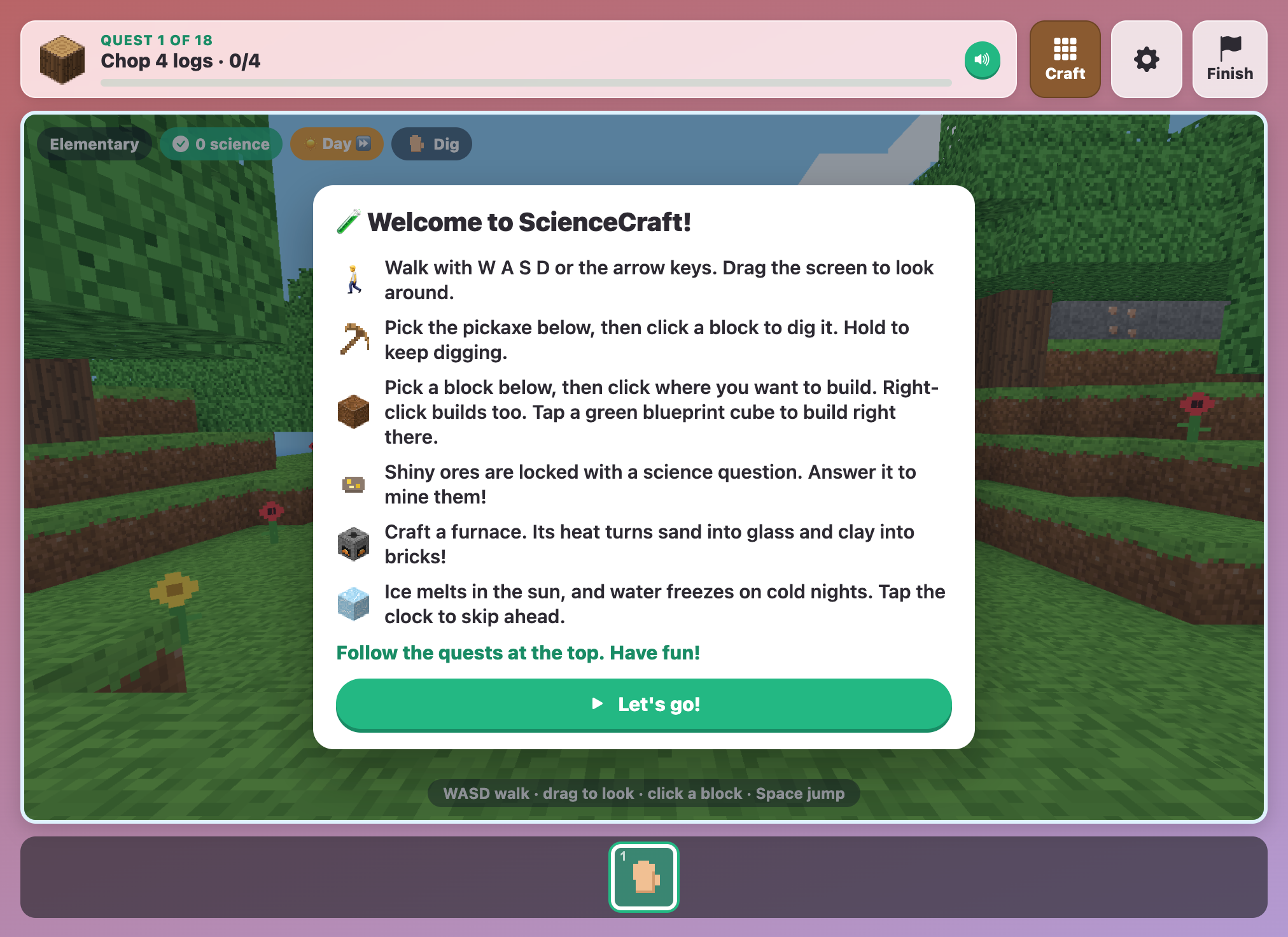
The Welcome to ScienceCraft card explaining how to walk, dig, build, answer ore questions and use the furnace
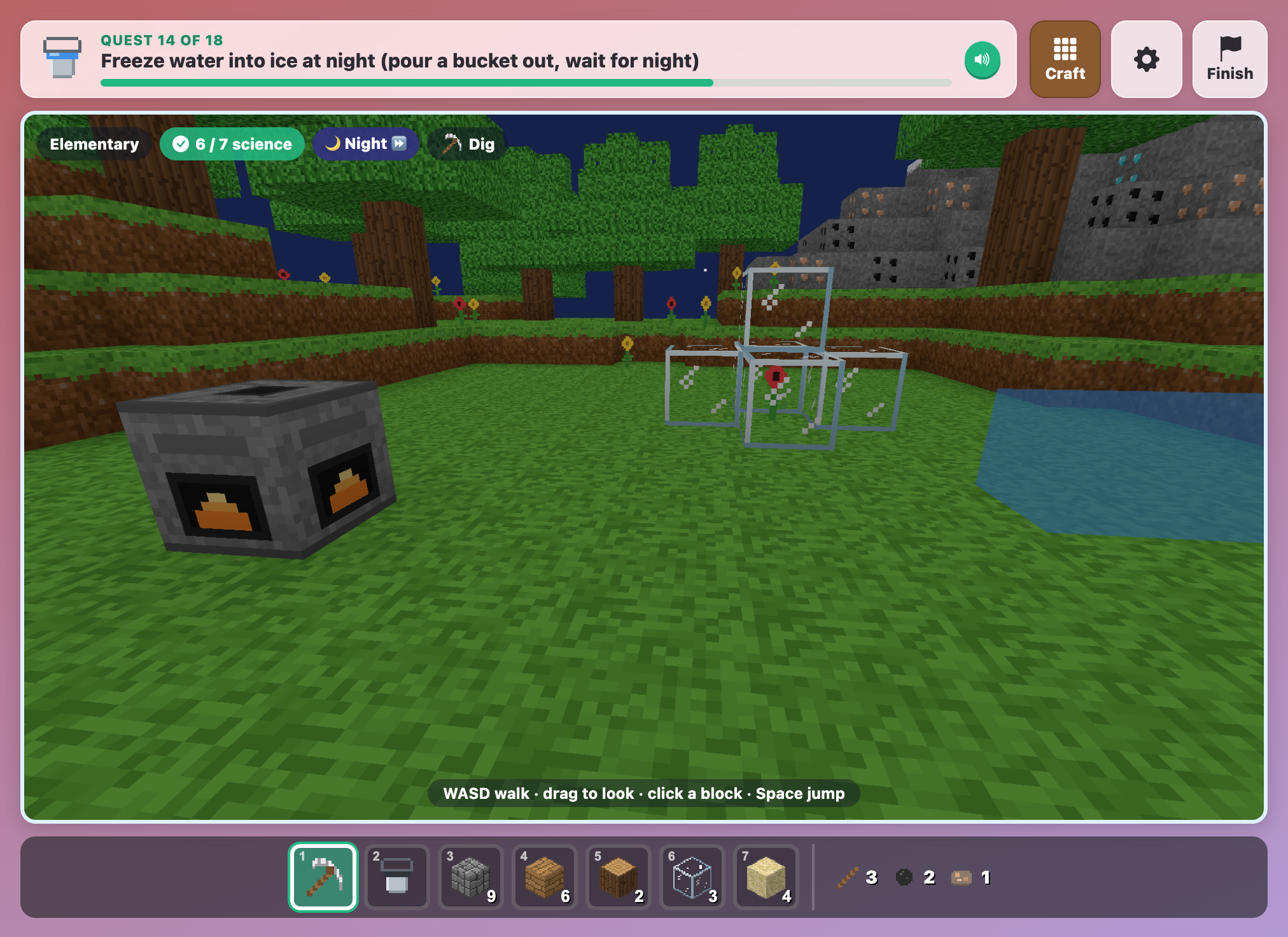
A sunny plot in ScienceCraft for kids with a stone furnace, a little glass greenhouse and poured water
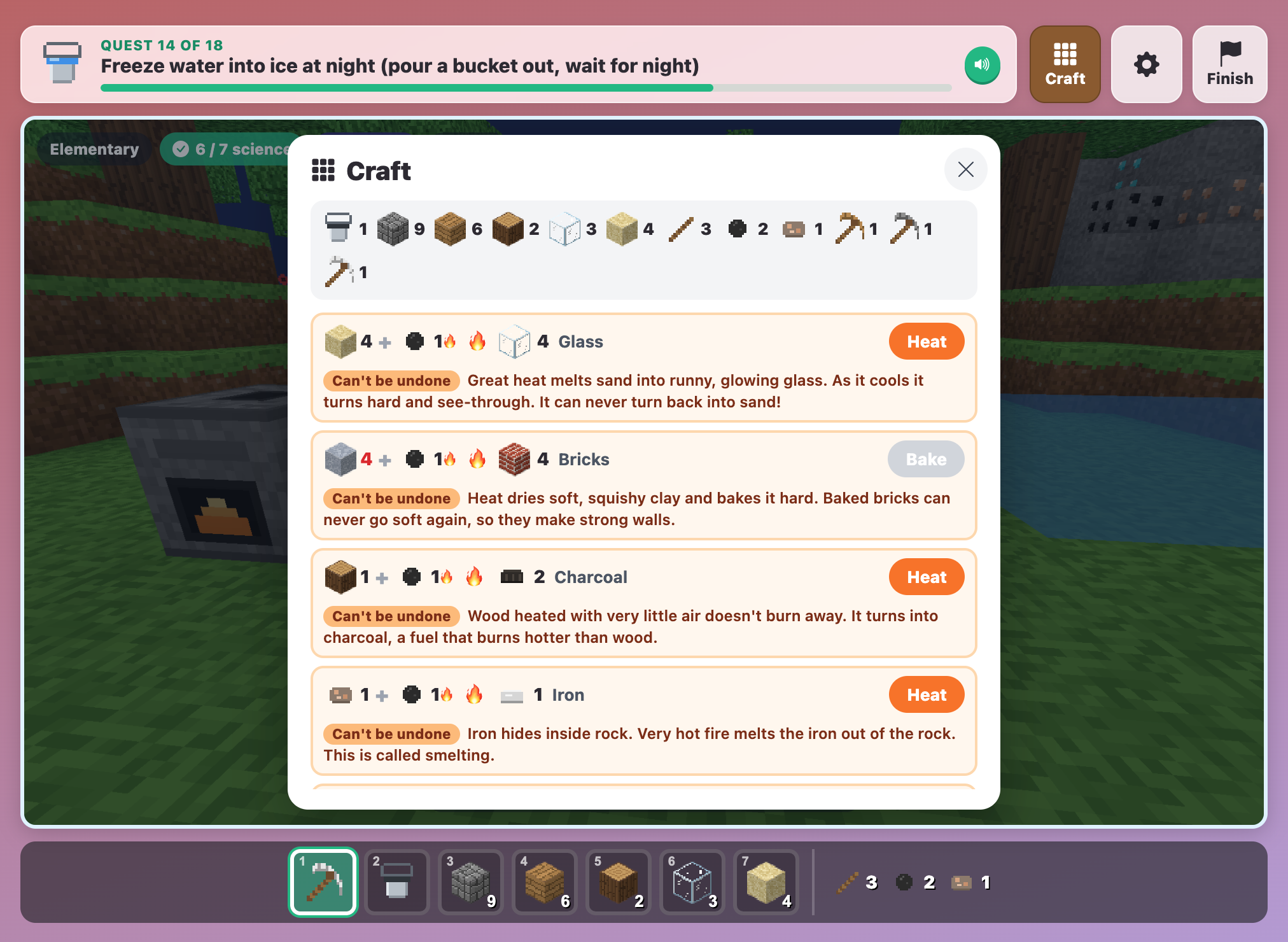
The Craft panel next to a furnace, with glass, bricks, charcoal and iron recipes that each show a science fact
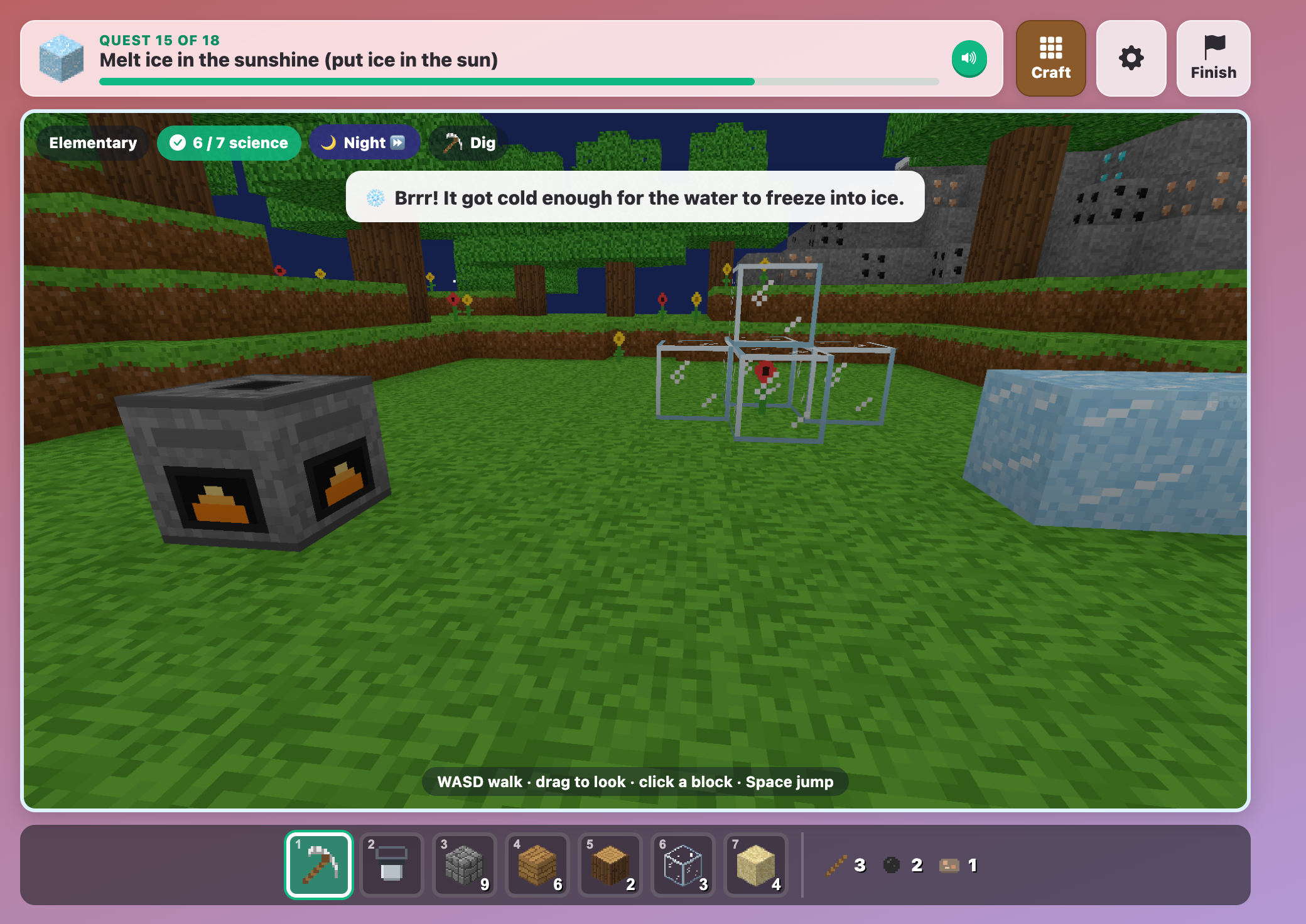
The same ScienceCraft plot at night, with the poured water frozen into a block of ice
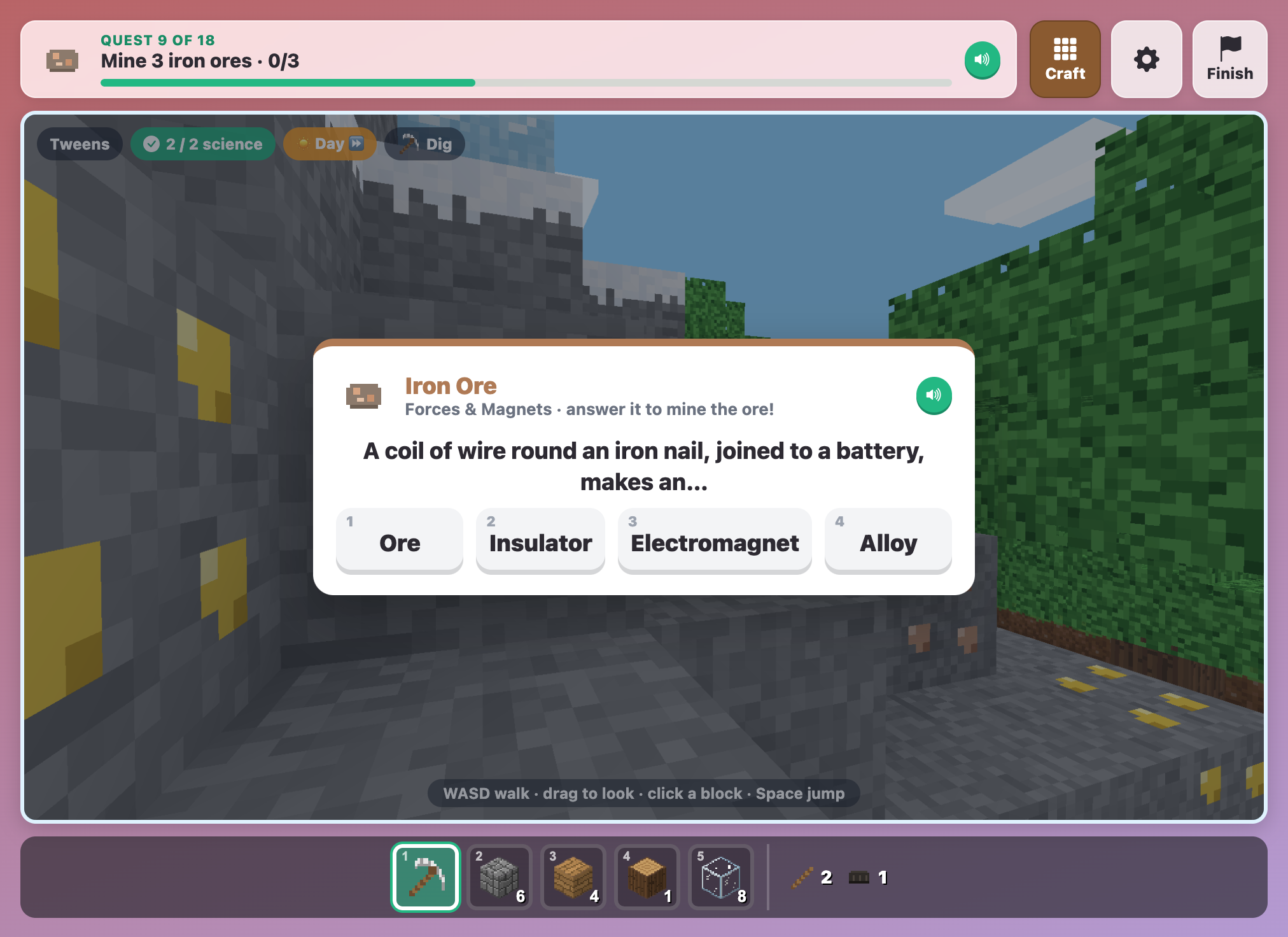
An Iron Ore question card in ScienceCraft for tweens about a coil of wire round an iron nail
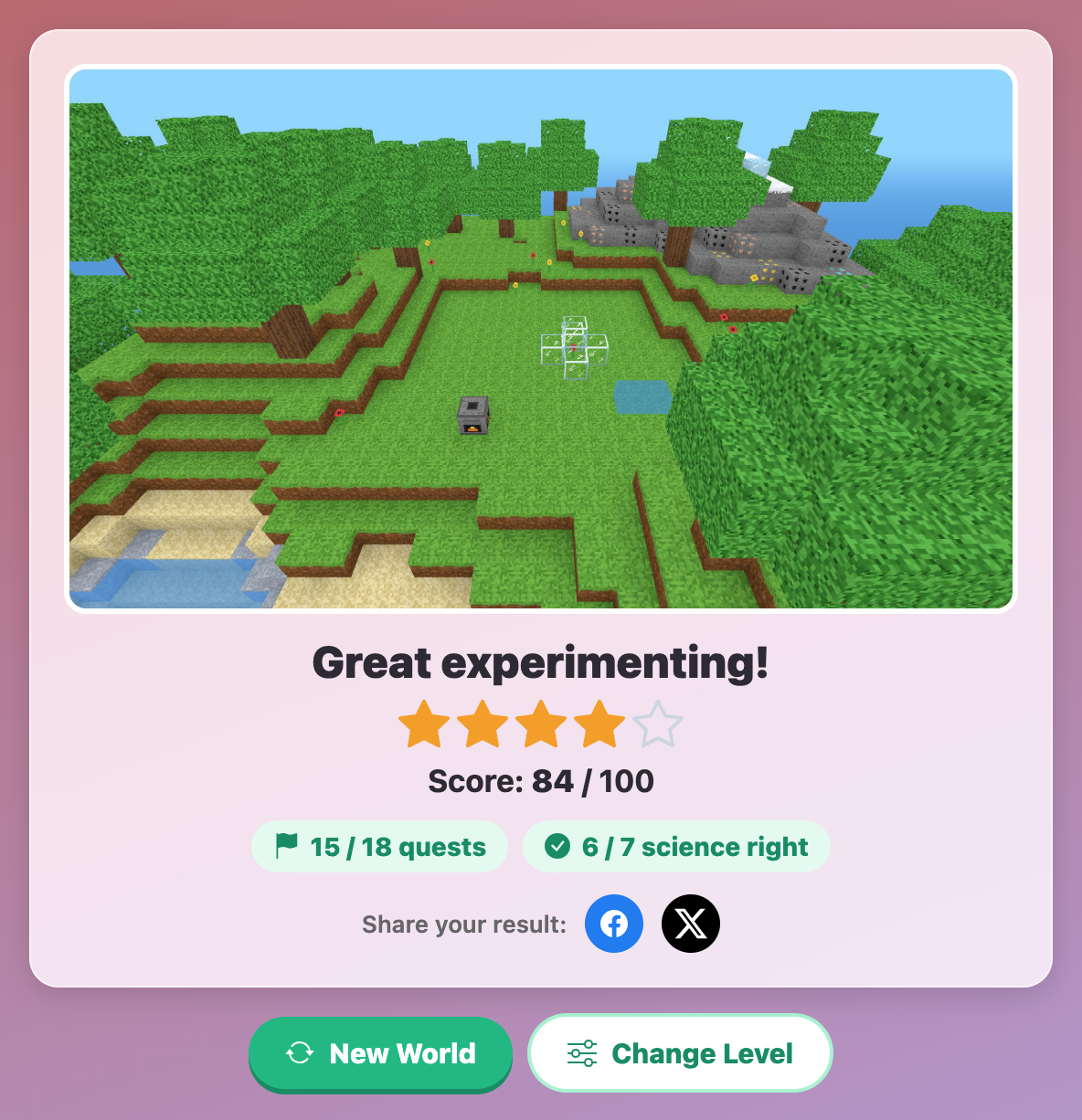
The Great experimenting results card in ScienceCraft with a snapshot of the plot and a score of 84
More Science Games
 59.5K plays
4.8
Recycling Sort
Sort everyday items into the Recycle, Compost, or Trash bin before time runs out!
 85.7K plays
4.9
Grow a Plant
Plant seeds in sunny and shady garden beds, then water, feed and protect them day by day. Watch the roots grow underground and harvest sunflowers, tomatoes, carrots and more!
 438.6K plays
4.9
Magnet Experiment
Guess which objects a magnet will pull, then drag the magnet to test every guess. Does gold stick? Does a battery?
 386.9K plays
4.9
Five Senses Match
Decide which of your five senses you would use for each everyday scene before time runs out.
Most Played Games
 1.8M plays
4.9
Color & Draw
A free-drawing canvas with colors and brush sizes to unleash your creativity.
59.5K plays
4.8
Recycling Sort
Sort everyday items into the Recycle, Compost, or Trash bin before time runs out!
 365.8K plays
5.0
Tic-Tac-Toe
Play a game of Tic-Tac-Toe against the computer and see if you can outsmart it.
 274.1K plays
5.0
Sentence Builder
Pick your age level, then tap the shuffled words in the right order to build the sentence.
Comments (32)