
MathCraft
84.7K playsExplore a blocky island in 3D! Chop trees, dig and craft pickaxes, then solve math puzzles to mine coal, iron, gold and diamonds. Plan your builds by counting blocks, finding area and measuring fences, and complete every quest.
High on the side of a stone mountain, a gold ore is sparkling in the sun. You walk right up to it, pickaxe ready. You tap it. It doesn't break. Instead, a card pops up: 5 × 7 = ? Pick 35, and the ore cracks open, and a shiny gold bar flies into your bag. That is how treasure works in MathCraft for kids: on this island, every ore is locked, and math is the key.
MathCraft is a 3D block world on KidWorld. You walk around a small island, chop trees, dig dirt and stone, craft your own pickaxes and torches, and build towers, floors, walls and fences. Kids have played it more than 80,000 times, and it holds a rating of 4.9 out of 5 from more than 4,000 ratings. This guide shows you how it works, how to finish every quest, and how to get those math cards right the first time.
⛏️ A Block World Where Numbers Open the Mountain
The island is 48 blocks wide and 48 blocks long. Near the start you will see a flat square of grass. That is your building plot, 10 blocks on each side. Around it there is a forest, a blue lake, sandy beaches, and a big stepped mountain of gray stone.
Look closely at the mountain. Some blocks have black spots (coal), some have peachy spots (iron), some have yellow spots (gold), and a few have bright blue spots (diamond). These are ores, which means rocks with something valuable inside. More ores hide deeper underground, but there are always plenty on the mountain's face, close enough to reach on foot.
Your goal is to finish a list of quests. A quest is one small job, like "Chop 4 logs" or "Build a wall 5 long and 3 tall." The quest bar at the top always shows your current job and how far along you are, such as "Quest 1 of 15: Chop 4 logs · 0/4." Finish one, and the next one appears with a happy ⭐ "Quest done!" message.
The quests follow the same order a real crafter would: wood first, then a wooden pickaxe, then stone, a stone pickaxe, coal for torches, iron for an iron pickaxe, and finally gold and diamonds. Build quests are mixed in along the way.
🧭 Your First Day on the Island
Pick your level. The first screen shows four cards: Toddlers (ages 2–4), Preschool (ages 4–6), Elementary (ages 6–10) and Tweens (ages 10–12). Your level picks the math and the quest list. The game remembers it next time.
Read the welcome card. It explains the controls in five short lines. Tap "Let's go!" to start.
Walk and look around. On a computer, walk with W A S D or the arrow keys and press Space to jump. Drag the screen to turn and look up or down. On a tablet or phone, a round joystick appears for walking, plus a jump button. If you walk into a step one block high, you hop up it by yourself.
Dig with the first hotbar slot. The bar at the bottom is your hotbar, a row of things you can hold. Slot 1 is your hand or your best pickaxe. Choose it, then click or tap a block to dig it. Hold your finger or mouse button down to keep digging. A little "+1" floats up each time something goes into your bag.
Build with a block slot. Every kind of block in your bag gets its own hotbar slot. Pick one, then tap the side of a block where you want the new one to go. On a computer, right-click also builds, and the number keys 1 to 9 choose a slot.
Open Craft. The brown Craft button (or the E key) shows your bag and every recipe. A recipe you can make right now has a green Craft button. The recipe your quest needs is marked, and the list scrolls to it for you.
Solve the ore cards. Tap an ore and a math card opens. Tap an answer, or press 1, 2, 3 or 4 on the keyboard. The green 🔊 button reads the question out loud.
Use the menu if you need it. The gear button opens How to play, Back to start (if you get lost), Change level, and New world (tap it twice to start a fresh island).
Tap Finish when you are done. If quests are still left, the button turns into "Sure?" and you tap once more. Then you see your result card: a picture of your building plot, up to five stars, your score out of 100, and how many quests and math questions you got.
Come back any time. Your island saves itself in your browser after every change, one island per level. Close the page, come back tomorrow, and you'll see "Welcome back to your world!" The page's reload button (and Finish) clears the save and starts a brand-new island. The fullscreen button makes the world fill your screen, and the music button turns the background songs and sound effects on or off.
🔒 What Each Ore Asks You
Every ore asks a different kind of math, and the kind depends on your level. Coal is always the easiest. Diamond is always the hardest. Here is the full list from the game.
Toddlers: coal and iron ask you to count pictures, like 🥕🥕🥕. Gold and diamond ask small adding questions up to 5, with pictures on both sides of a plus sign.
Preschool: coal is counting from 3 to 10. Iron is adding up to 10. Gold is taking away, where some pictures are crossed out. Diamond can be adding or taking away.
Elementary: coal is adding two-digit numbers. Iron is subtracting. Gold is multiplying, mostly the 2, 3, 4, 5 and 10 times tables. Diamond is a short word problem.
Tweens: coal is three-digit adding, sometimes with a missing number. Iron is multiplying, mostly up to 12 × 12. Gold is dividing. Diamond is a two-step word problem.
Toddlers and preschoolers get 3 answer buttons. Elementary kids and tweens get 4. A right answer breaks the ore and drops it into your bag. A wrong answer shows you the right one and says "The ore stays locked. Tap it again for a new puzzle!" The ore never goes away, so you can always try again with a fresh question.
For Elementary and Tweens, there is one more rule: the right pickaxe. Coal needs a wooden pickaxe, iron needs a stone pickaxe, and gold and diamond need an iron pickaxe. Tap a gold ore with only a stone pickaxe, and the game tells you it needs an iron one. Toddlers and preschoolers can mine any ore with any pickaxe.
🛠️ Crafting Without Guessing
Crafting means turning things you have into something new. MathCraft has ten recipes, and every one of them is a little math fact. Learn these and you will never be stuck:
Planks: 1 log makes 4 planks.
Sticks: 2 planks make 4 sticks.
Wooden Pickaxe: 3 planks and 2 sticks.
Stone Pickaxe: 3 cobblestone and 2 sticks.
Iron Pickaxe: 3 iron and 2 sticks.
Torches: 1 coal and 1 stick make 4 torches.
Stone Bricks: 4 cobblestone make 4 stone bricks.
Glass: 4 sand and 1 coal make 4 glass blocks.
Gold Block: 3 gold. Diamond Block: 3 diamonds.
Notice the pattern? Every pickaxe needs 3 of the material plus 2 sticks. In the Craft panel, a number shown in red means you don't have enough of that thing yet. Once you own a pickaxe, its button says "Have it," so you can't make a second one by accident.
Better pickaxes also dig faster. Wood takes 3 taps by hand but only 2 with any pickaxe. Stone takes 3 taps with a wooden pickaxe, 2 with a stone one and just 1 with an iron one. Dirt, sand and leaves always break in one tap.
📐 Plan It, Then Build It
Build quests are where MathCraft turns into a measuring game. When one comes up, a green "Plan it" button appears in the quest bar, and a Plan your build card opens. It asks one question: how many blocks will this need?
The shapes are a tower (blocks stacked straight up), a floor (a flat rectangle), a wall (a rectangle standing up), and a square fence (just the edge of a square, with the middle left empty). For toddlers and preschoolers, the card shows a picture of the blocks to count. Elementary kids see a picture for the fence and a hint like "3 × 4 = ?" for the floor. Tweens get the question in words only, so they have to picture it in their heads.
After you answer, right or wrong, a see-through green blueprint appears on your plot. A blueprint is a plan that shows where every block goes. Pick a block from your hotbar and tap the green cubes to fill them in. Start at the bottom, because a block needs something to rest on. For a tall tower, tapping the green cube at the top builds right there, even when it's above your head.
Here is a fun secret: the blueprint is only a helper. The quest checks whether your own placed blocks make the right shape anywhere on the island, facing either way. A wall you build by the lake counts just as much. Blocks that were already part of the island don't count, and neither do torches or flowers. Only blocks you placed yourself.
🏆 Smart Moves for a Master Builder
Get a pickaxe as soon as you can
Without a pickaxe, you can't dig stone at all. The game says "You need a pickaxe to mine stone. Craft one!" So on Preschool, Elementary and Tweens, your first few quests are all about wood: logs, planks, sticks, then the wooden pickaxe. Toddlers start with a wooden pickaxe already in the bag.
Upgrade in order
On Elementary and Tweens, mine 3 cobblestone for a stone pickaxe before you go hunting iron, and get 3 iron before you look for gold. If you climb the mountain to a gold ore too early, you'll only be told you need a better tool. Following the quest list keeps you on the right path.
Doing a job early still counts
Quest counters add up everything you've done since your island began. If you chop 6 logs when the quest only asked for 4, those extra logs are still in your bag. If you dig coal before the coal quest, it counts the moment that quest shows up. You never have to do a step twice.
Fill your bag before you build
A build quest needs blocks in your bag. If you don't have enough, the game says something like "You need 12 blocks. Dig some more!" Dirt is quick to dig, and the stone mountain gives you cobblestone once you have a pickaxe. Collect a few extra before you start.
Slow down on the math
A wrong answer never loses an ore, but it does lower your score. Math is worth 40 of your 100 points, so taking an extra moment to check pays off. If a question is long, tap 🔊 and listen to it.
Climbing out of trouble
Did you dig a hole and fall in? Pick a block, look down, and tap the ground right under your feet. The new block lifts you up on top of it. Do that a few times and you're out. If you wander far away and can't find your plot, choose Back to start in the menu.
🧮 Five Puzzles From the Island, Worked Out
1. Toddlers: how many carrots?
A coal card shows 🥕🥕🥕 and asks "How many 🥕?" with the answers 3, 2 and 4. Point at each carrot with your finger and say the numbers out loud: one, two, three. The last number you say is the answer, 3. Touching each picture once is the best counting trick there is, because you can't skip one or count one twice.
2. Elementary: the gold ore asks 5 × 7
The answers are 28, 35, 30 and 42. Count by fives seven times: 5, 10, 15, 20, 25, 30, 35. Now look at the wrong ones. 28 is 4 × 7, one group too few. 30 is 5 × 6, also one group short. 42 is 6 × 7, one group too many. The game picks wrong answers that are easy mistakes, so counting carefully beats guessing.
3. Elementary: a square fence 4 blocks on each side
The answers are 4, 12, 16 and 14. Many kids say 16, because 4 × 4 = 16. But 16 would fill the whole square, middle and all. A fence is only the edge. Count it in parts:
The top row: 4 blocks.
The bottom row: 4 more blocks. That's 8.
The left side, between the corners: 2 blocks. That's 10.
The right side, between the corners: 2 blocks. The answer is 12.
Tweens build a 5 × 5 fence the same way: 5 + 5 + 3 + 3 = 16. Notice that 4 sides × 5 = 20 is too many, because it counts every corner twice.
4. Tweens: the log-and-planks story
A diamond card might say: "One log makes 4 planks. Leo turns 6 logs into planks and uses 9 of them. How many planks are left?" Do it in two steps. First, 6 logs × 4 planks = 24 planks. Then take away the 9 Leo used: 24 − 9 = 15. Two traps to watch for: 24 (you forgot step two) and 33 (you added instead of taking away). If you want more stories like this, Word Problem Wizard is full of short math stories to practice on.
5. Planning your wood on Tweens
The Tweens list asks you to chop 4 logs, then craft 12 planks, then 8 sticks, then a wooden pickaxe. Will 4 logs be enough? 4 logs make 16 planks. The 8 sticks take 4 planks (2 planks make 4 sticks, so do it twice). That leaves 12. The pickaxe takes 3 more planks and 2 sticks. You end with 9 planks and 6 sticks, so yes, 4 logs are plenty. Working it out first saves a long walk back to the forest.
🎂 MathCraft for Kids at Every Age
🐣 Toddlers (ages 2–4)
MathCraft for toddlers is the gentlest island. You start with a wooden pickaxe, and every block breaks in a single tap. The math is counting up to 5 and tiny picture sums, with 3 big answer buttons, and the questions are read out loud when sound is on. There are 8 quests, including a tower 3 blocks tall and a 2 × 2 floor. Little ones will need a grown-up's help walking around, but tapping ores and counting pictures is all theirs.
🎨 Preschool (ages 4–6)
MathCraft for preschoolers adds real crafting. You chop wood by hand and make your own wooden pickaxe first. The ore cards count from 3 to 10, add up to 10, and take away with crossed-out pictures, still read out loud. The 13 quests add torches, a 5-block tower, a 2 × 3 floor and a wall 4 long and 2 tall.
📐 Elementary (ages 6–10)
MathCraft for elementary kids is the full crafting adventure, with 15 quests. Each ore needs the right pickaxe, and the math covers two-digit adding and subtracting, the times tables, and word problems about towers, chests and coal. The build quests are a 3 × 4 floor, a wall 5 long and 3 tall, and a 4 × 4 square fence. Kids who love the digging and crafting can also try Build My House, where you dig and craft in a side-view block world and then furnish your own home.
🚀 Tweens (ages 10–12)
MathCraft for tweens has the longest list, 16 quests, ending with a gold block. The math gets big: three-digit sums, missing numbers, multiplying, dividing, and two-step stories. Plan questions come in words only, like "a floor 4 blocks wide and 5 blocks long." That's 20 blocks, and you have to see the rectangle in your head to know it.
🌱 What Grows in Your Head While You Dig
Math with a reason. On a worksheet, 5 × 7 is just a question. In MathCraft, it's the thing standing between you and a gold bar. Kids answer because they want what's inside the ore, and that makes the practice stick.
Area and perimeter you can walk around. Kids figure out that a floor fills the whole rectangle, while a fence is only its edge. Then they build both and see the difference with their own eyes.
Planning ahead. Every recipe is a small budget. "I need 3 planks and 2 sticks, and I have 5 planks" is a real plan, made by a kid, for a real goal. If you like this kind of planning, Math Village Builder turns right answers into wood and stone for a whole blocky village.
Learning from mistakes. A wrong answer shows the right one, and the ore waits for you to try again. Nothing is lost for good. At the end, the result card lists the questions you missed under "Practice these again," with the right answers.
Finding your way. Walking a 3D island, remembering where the mountain and the lake are, and turning to face the right block all build a sense of space and direction.
A word for grown-ups
MathCraft is calm and safe. There are no monsters, no falling damage, no timers, and no way to lose your world by accident: New world needs two taps, and the island saves itself in the browser. It practices counting, adding and subtracting, multiplication and division, word problems, and area and perimeter, all matched to your child's level. The score is easy to explain, too. Quests are worth 60 points, shared evenly across the list, and math is worth 40, based on the share of questions answered right. For example, an Elementary player who finishes 12 of 15 quests and gets 18 of 20 questions right scores 48 + 36 = 84, which earns four stars.
Ready to dig? Pick your level, grab a pickaxe, and see how many ores you can unlock. MathCraft for kids is waiting on KidWorld, and the gold on that mountain isn't going to mine itself. Happy crafting! ⛏️💎
🖼️ See the Game in Action
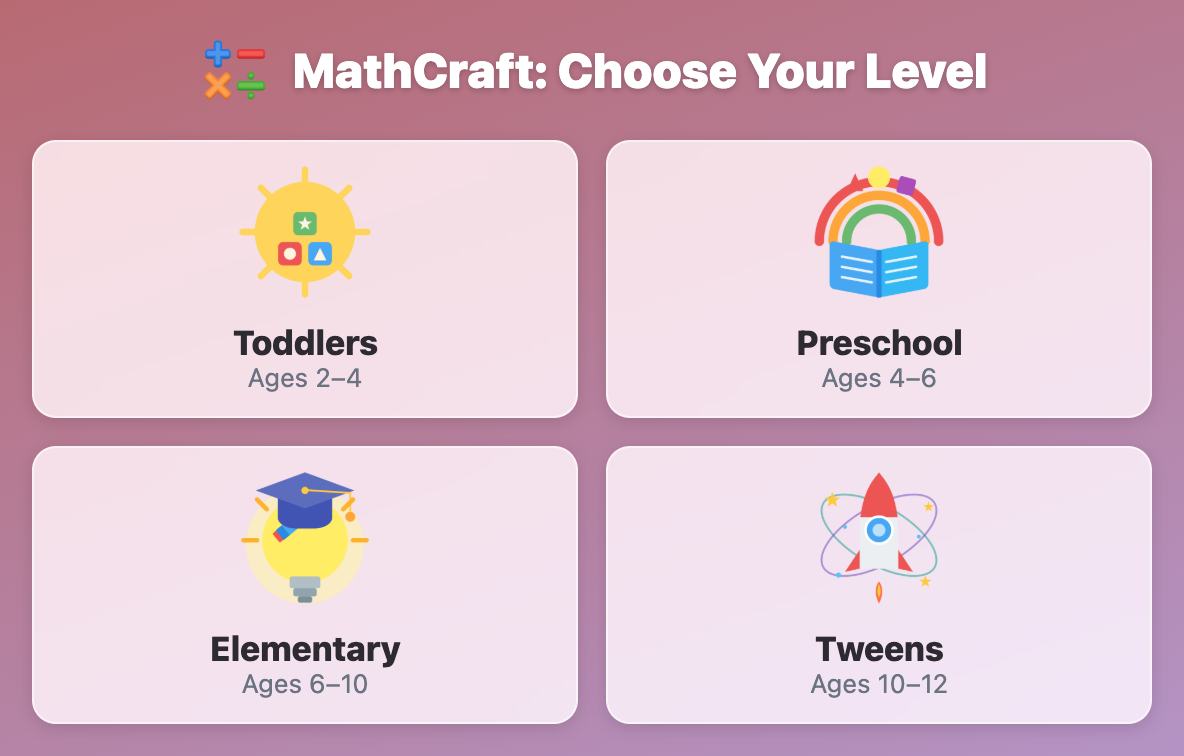
The MathCraft level picker with four cards for Toddlers, Preschool, Elementary and Tweens, ages 2 to 12
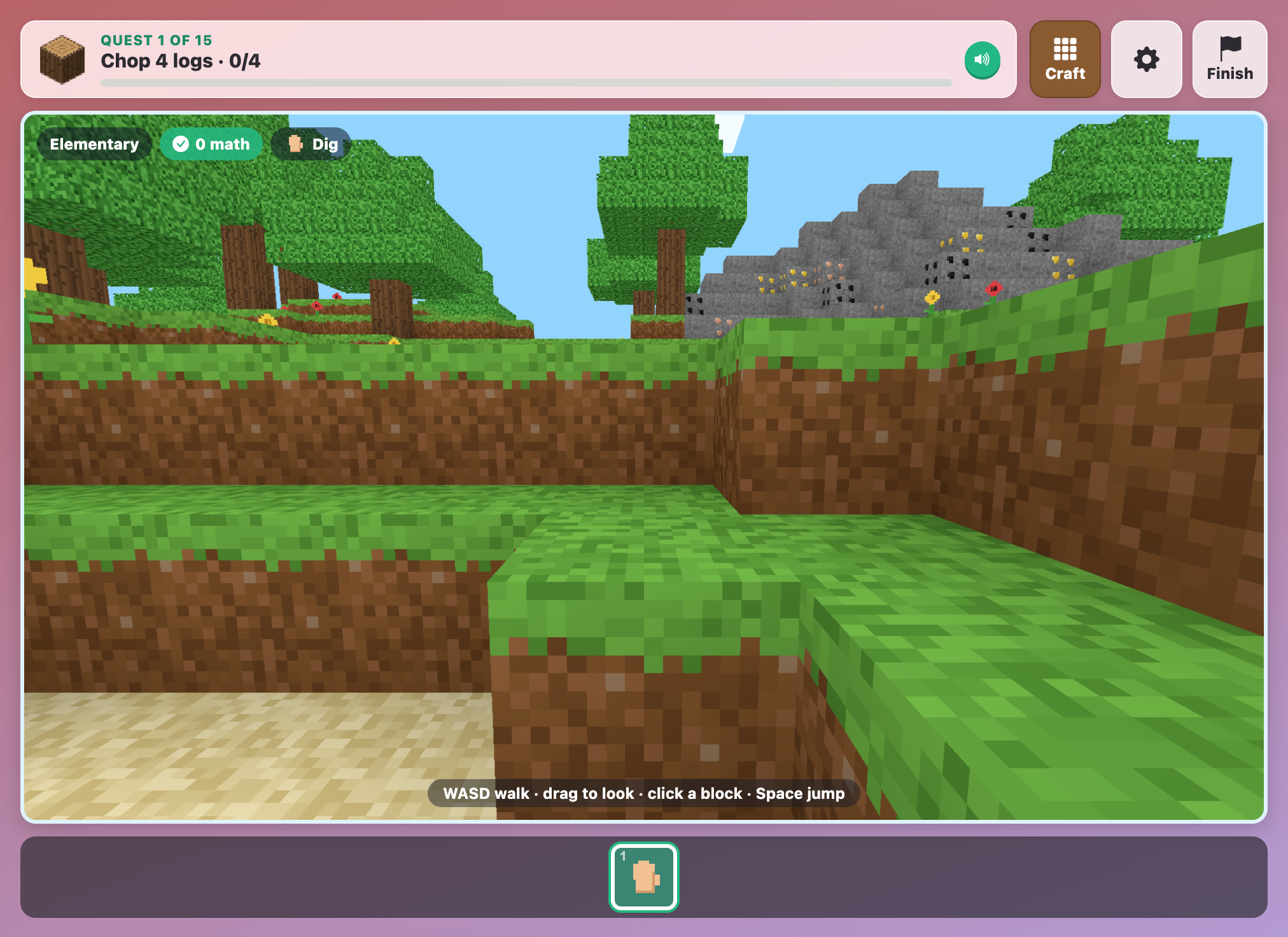
A first-person view of the blocky MathCraft island with trees, grass steps and a stone mountain dotted with ores
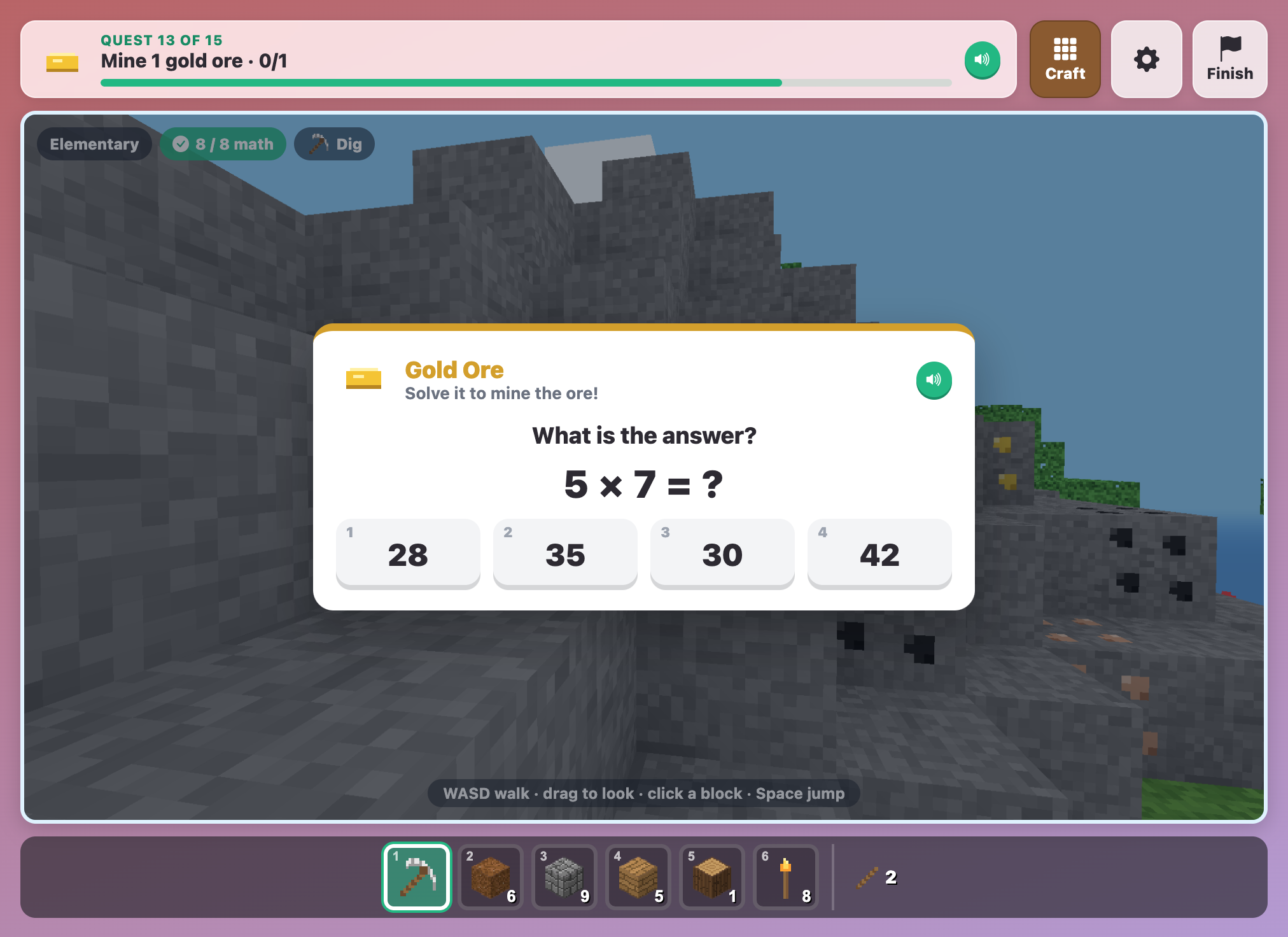
A Gold Ore card in MathCraft for elementary kids asking 5 × 7 with four answer buttons
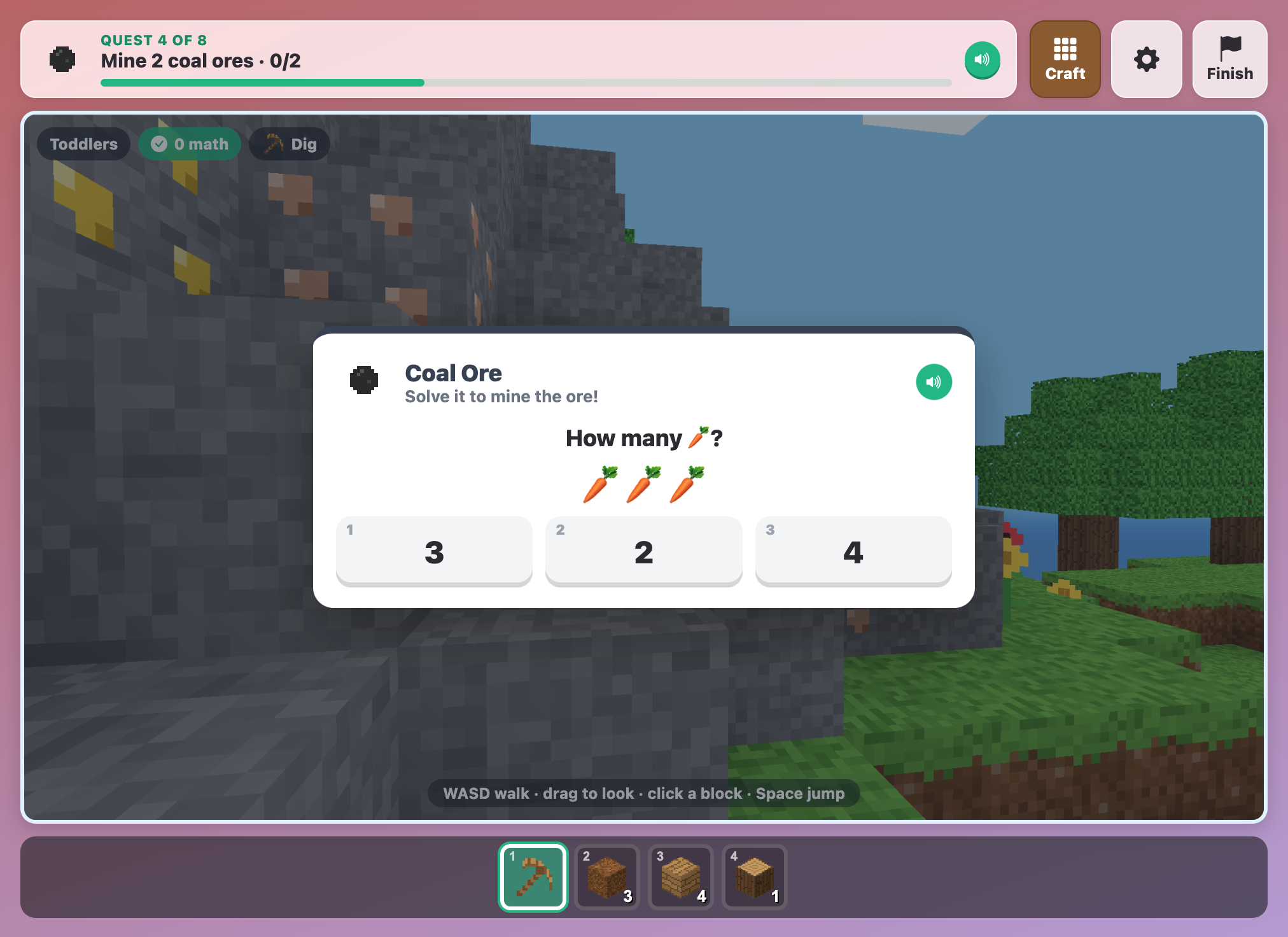
A Coal Ore card in MathCraft for toddlers asking how many carrots, with three carrot pictures and three answers
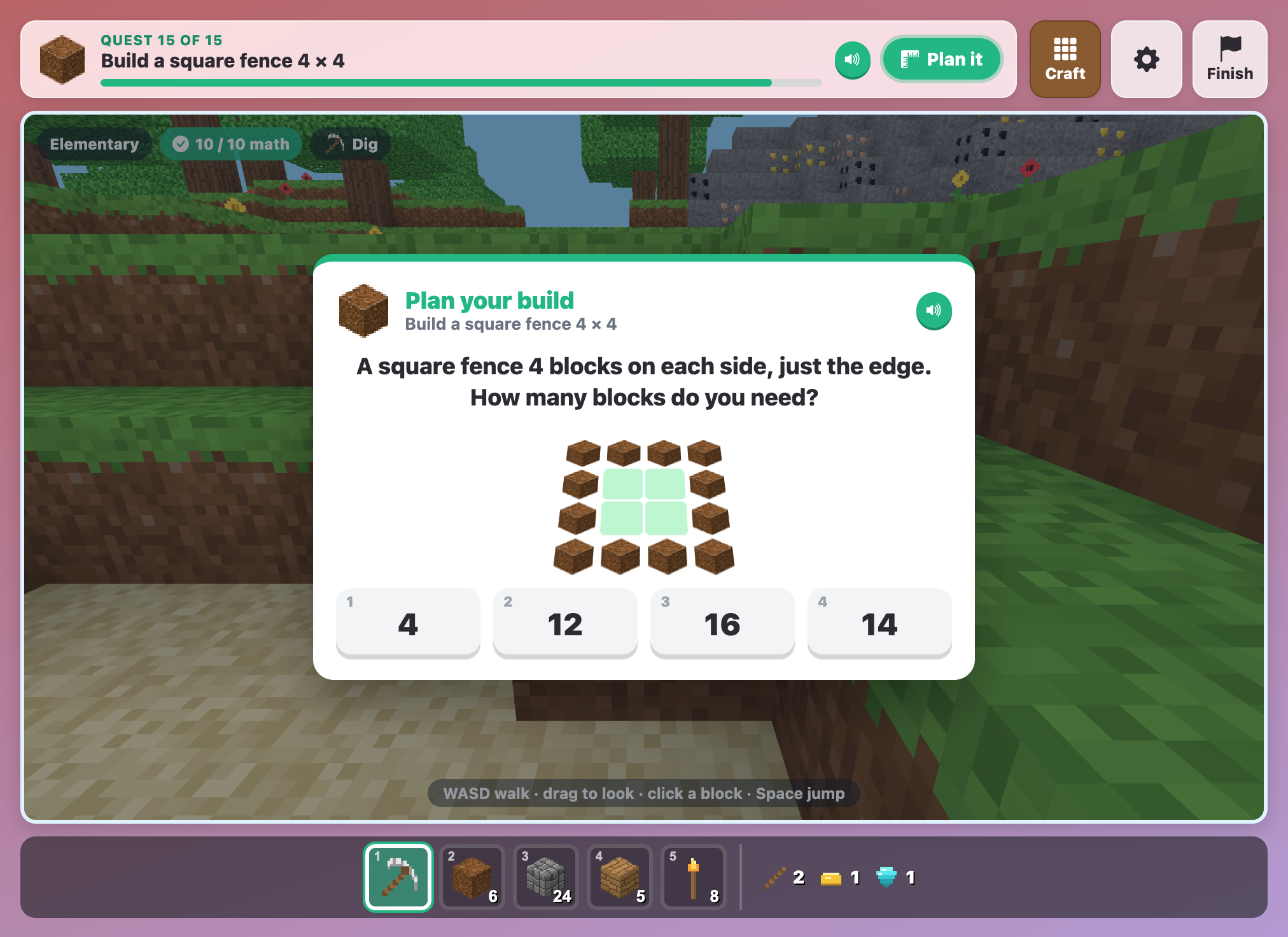
The Plan your build card asking how many blocks a 4 by 4 square fence needs, with a picture of the edge blocks
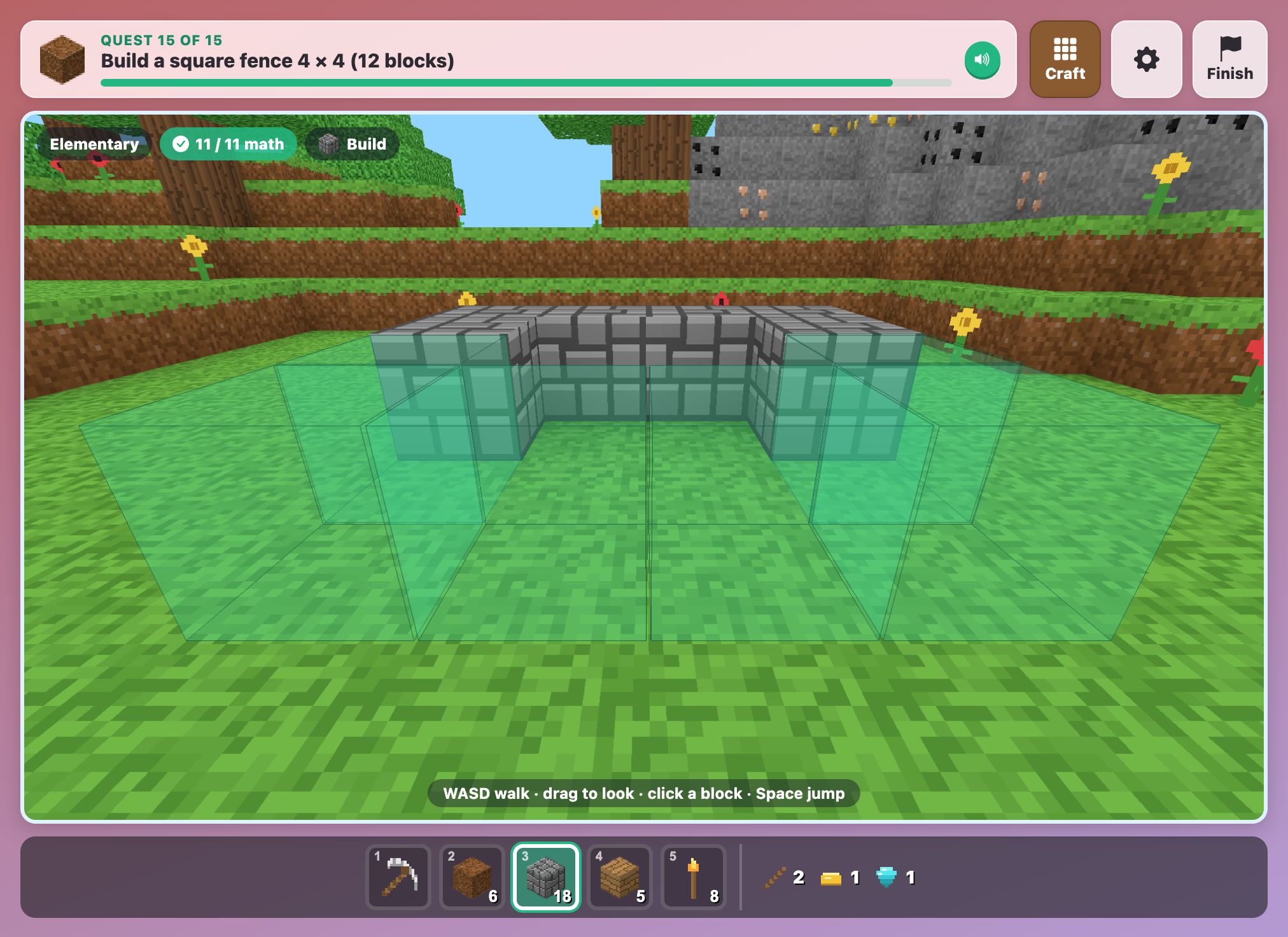
Green see-through blueprint cubes on the grass plot in MathCraft for kids, with half of a stone fence built
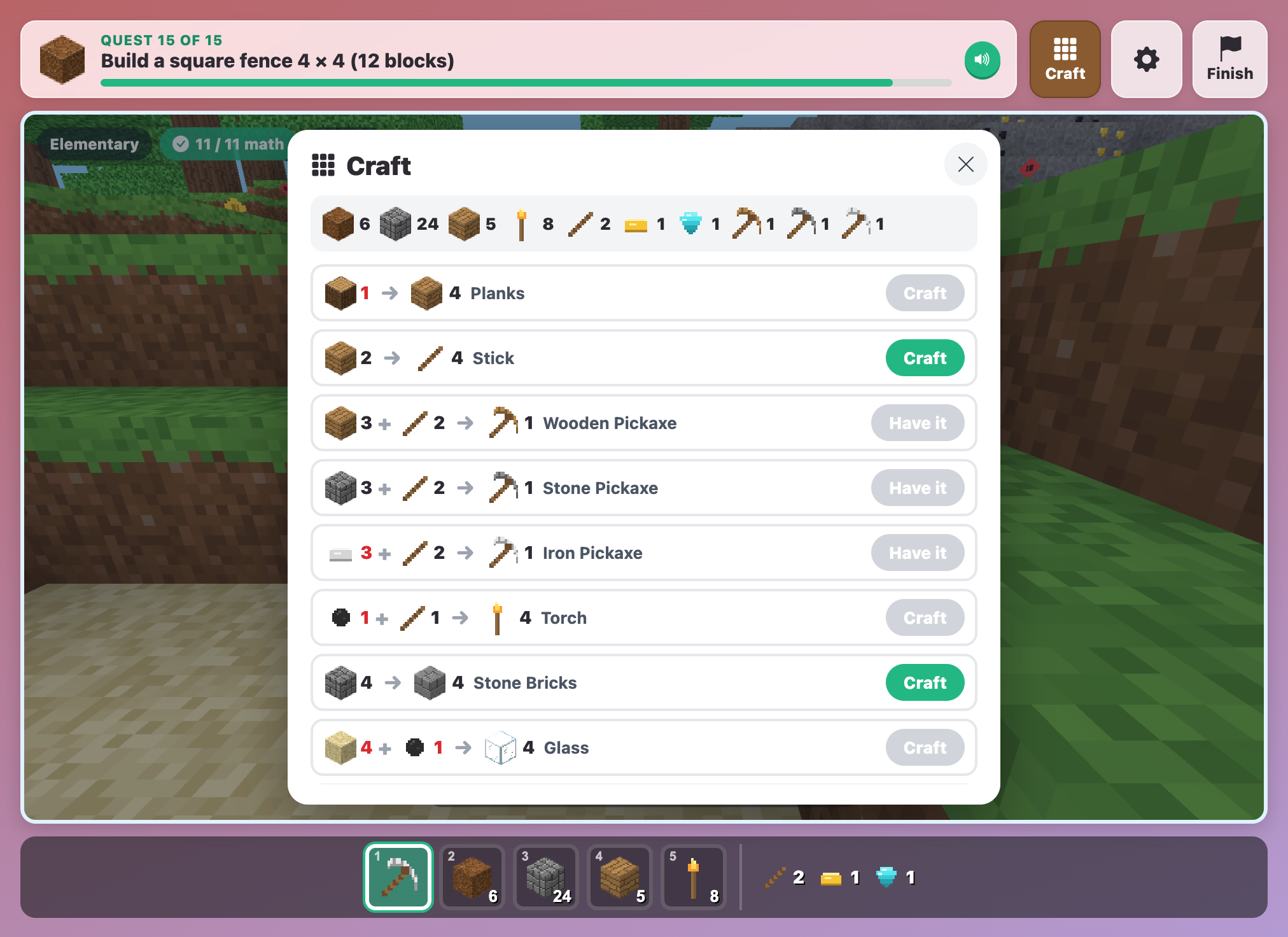
The MathCraft Craft panel showing the bag and recipes for planks, sticks, pickaxes, torches, stone bricks and glass
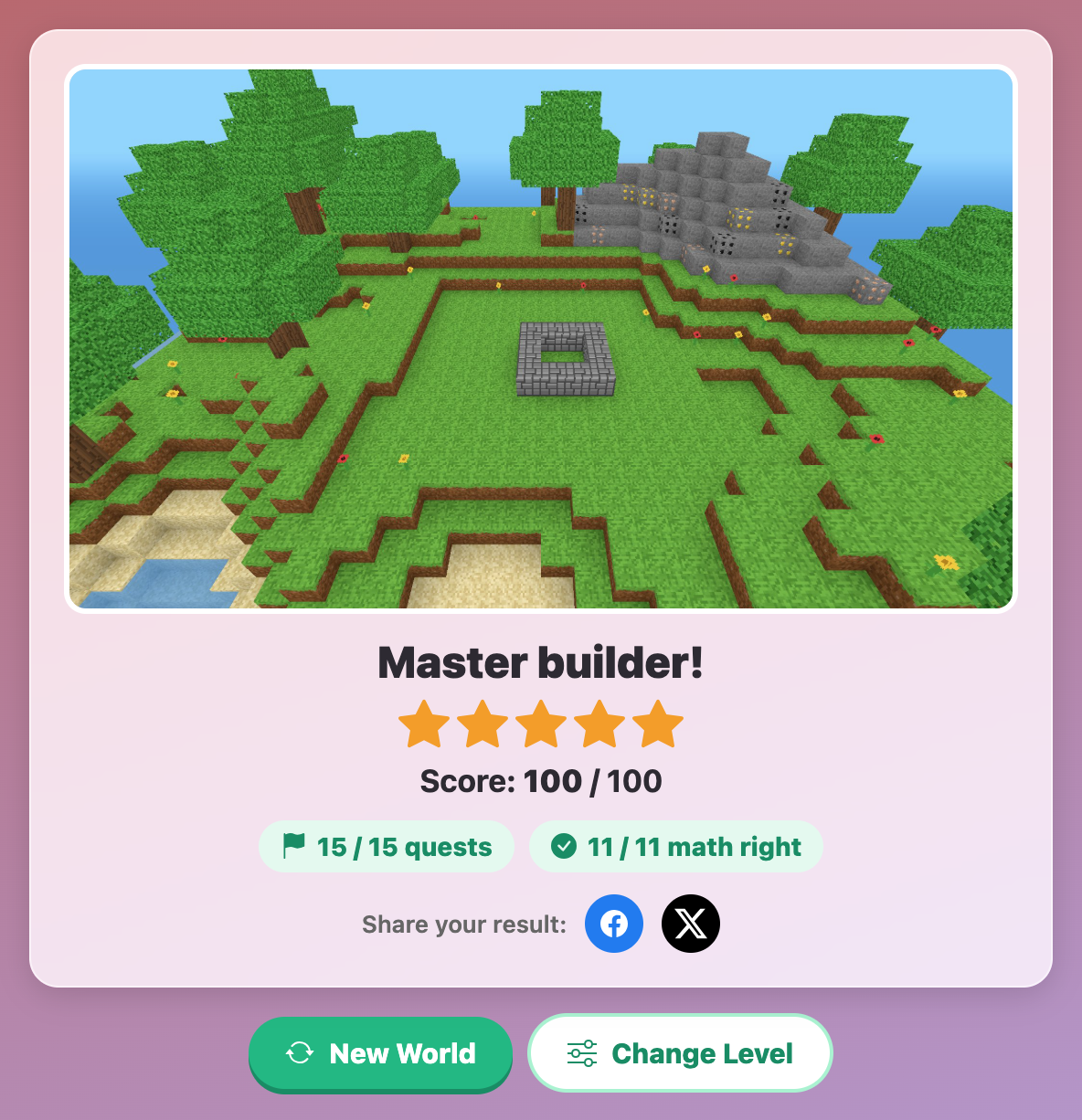
The Master builder result card with a picture of the island, five stars, a score of 100 and 15 of 15 quests
More Math Games
 1.1M plays
5.0
1.1M plays
5.0
Math Moto Race
Pick your age level, then ride your motorbike through the lane with the right answer — every correct gate makes you faster!
 857.5K plays
5.0
857.5K plays
5.0
Addition Quiz
Pick your age level and answer fun multiple-choice addition questions!
 473.7K plays
4.9
473.7K plays
4.9
Math Addition Moto Race
Pick your age level, then ride your motorbike through the lane with the right addition answer — every correct gate makes you faster!
 847.4K plays
4.9
847.4K plays
4.9
Math Car Race
Pick your age level, then drive your race car through the lane with the right answer — every correct gate makes you faster!
Most Played Games
 1.8M plays
5.0
1.8M plays
5.0
Color & Draw
A free-drawing canvas with colors and brush sizes to unleash your creativity.
 59.4K plays
5.0
59.4K plays
5.0
Recycling Sort
Sort everyday items into the Recycle, Compost, or Trash bin before time runs out!
 365.5K plays
4.9
365.5K plays
4.9
Tic-Tac-Toe
Play a game of Tic-Tac-Toe against the computer and see if you can outsmart it.
 1.1M plays
4.9
1.1M plays
4.9
Chess
Play the classic game of chess against the computer or a friend, with FIDE time controls, hints, and undo.
Comments (24)