
Who Owns the Pet?
83.7K playsBe a detective! Read the clues, like "Mia does not have the dog" or "The kid who has the cat wears red," and work out which kid owns which pet. Mark each square with a tick or a cross on the logic grid, and a tick crosses out the rest of its row for you. Bigger puzzles add shirt colors, snacks and toys. Every puzzle has exactly one answer, the clues can be read aloud, and a hint always explains why.
“Mia does not have the dog.” That short sentence is your very first clue! Who Owns the Pet? for kids is a free logic grid puzzle where you read clues like this one and work out which kid owns which pet. You mark a grid with ticks ✔ and crosses ✖ until every kid has the right animal. It plays right in your web browser on a computer, tablet or phone, with nothing to download and no sign-up, and it has four levels for kids from 2 to 12.
Every puzzle is brand new, made by the game the moment you start. Each one has exactly one right answer, and you can always reach it by thinking, never by guessing. Bigger puzzles add shirt colors, snacks and toys, so you might find out that the kid with the frog also eats pizza and wears purple. When the last tick lands, the kid cards hop with joy and the case is closed. 🕵️
🐾 Kids, Pets and One Big Mix-Up
Here is the story. A few kids each have a pet. No two kids have the same pet. But someone mixed up the list, and now nobody remembers who has which one! The clues are all you have.
The kids are Mia, Leo, Ava, Max, Zoe, Sam, Lily and Ben. The pets are a dog 🐶, a cat 🐱, a bunny 🐰, a hamster 🐹, a turtle 🐢, a fish 🐠, a parrot 🦜 and a frog 🐸. Each puzzle picks just a few of them.
On the bigger puzzles, each kid also has one shirt color (red, orange, yellow, green, blue or purple), one snack (cookies, apples, bananas, cupcakes, pizza, donuts, grapes or carrots), or one toy (a ball, kite, teddy bear, robot, yo-yo, drum, train or rocket). The same rule holds for every group: each kid gets a different one.
Puzzles like this are called logic grid puzzles. Logic means using clues and careful thinking to find an answer that must be true. A famous grown-up version, often called the Zebra Puzzle or Einstein’s Riddle, has five houses, five owners and lots of pets, and asks who owns the zebra. It was printed in a magazine back in 1962. Many people say Albert Einstein made it up, but nobody knows for sure. Who Owns the Pet? is the kid-sized version: fewer kids, shorter clues and friendly emoji instead of a wall of words.
🔎 Your Detective Kit: Playing Who Owns the Pet? on KidWorld
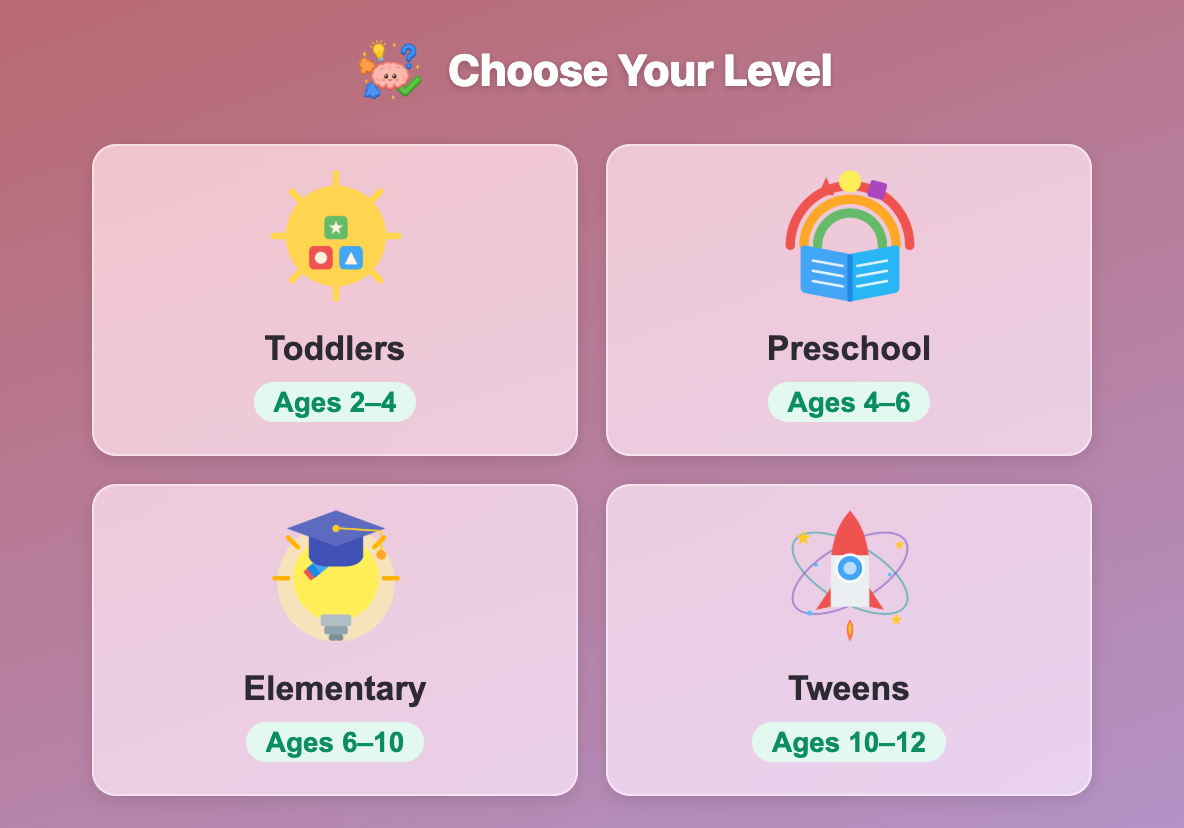
Pick your level. On your first visit the game usually starts on Elementary. Tap Change Level at the top right to see all four cards: Toddlers (ages 2–4), Preschool (ages 4–6), Elementary (ages 6–10) and Tweens (ages 10–12). The game remembers your choice next time.
Read the clues. They sit in a box at the top, numbered 1, 2, 3 and so on. Each kid’s name and each pet come with a little picture, so even early readers can follow along. Tap the 🔊 button on a clue to hear it, or the 🔊 at the top of the box to hear them all.
Look at the grid. The kids are down the left side. The pets are across the top. Each little square means “this kid and this pet.” A tick ✔ in a square means “yes, this is the one.” A cross ✖ means “no, not this one.”
Choose your mark. Under the grid is a switch that says Tap to mark: ✔ Yes | ✖ No. Whatever it is set to goes into the first square you tap. Tap the same square again for the other mark, and once more to make it empty. On a computer, a right-click puts the other mark straight away. On a phone or tablet, press and hold a square for the same trick.
Let the ticks help you. When you put a ✔, the game crosses out the rest of that row and that column for you, in lighter crosses. One kid can only have one pet, and one pet can only belong to one kid, so those squares are all “no.” If you take the ✔ away, its crosses go away too.
Watch for red lines. If a row or column gets two ticks, or crosses in every square, it turns red. That means something went wrong in that line, so look again.
Tick off clues you’ve used. Tap a clue and it gets a line through it. This helps you keep track of what you still need to think about.
Check the kid cards. Below the switch, each kid has a card. When a kid’s row has exactly one tick, their pet’s picture pops into the card.
Use Undo, Clear and Hint. Undo takes back your last step, one at a time. Clear empties the grid. Hint 💡 gives you one helpful step and explains it (more on hints below). The number on the Hint button shows how many you have left for this puzzle.
Finish the puzzle. When every kid has the right pet (and the right color, snack or toy on bigger puzzles), the whole grid fills in and the tip says “You solved it!” A big Next Puzzle button appears and counts down from 5. Tap it, or wait, and the next puzzle begins.
See your result. After the last puzzle, the “Pet Mysteries Solved!” card shows your score, your time, how many puzzles you did, how many hints you used and up to 5 stars. Tap New Puzzles to play again with fresh puzzles, or Choose Another Level.
Use the page buttons. Around the game are buttons to go fullscreen, reload the game and turn the music on or off. The timer starts with your first tap, so you can read the clues first with no rush.
🗝️ The Four Kinds of Clues
Every clue in this game is one of four kinds. Younger levels use only the first two. Learning to read each kind is the first big step to winning.
1. The “yes” clue
“Leo has the cat.” This one tells you the answer right away. Put a ✔ in Leo’s cat square, and the game crosses out the rest for you. These clues are rare, because they make the puzzle too easy!
2. The “no” clue
“Mia does not have the dog.” Put a ✖ in Mia’s dog square. One cross alone doesn’t solve much. But a few crosses together can leave only one empty square in a row, and that square must be the ✔. Most clues in the game are “no” clues.
3. The “or” clue (Elementary and Tweens)
“Mia or Leo has the dog.” Exactly one of them has the dog, but you don’t know which one yet. Still, it tells you something for sure: every other kid does not have the dog. So you can cross out the dog for everyone except Mia and Leo. An “or” clue can also be about things: “Ava plays with the kite or the ball” means Ava does not play with any other toy.
4. The “neither” clue (Tweens)
“Neither Mia nor Leo has the dog.” This is two “no” clues in one. Mia does not have the dog, and Leo does not have the dog either. Put two crosses.
Clues about “the kid who…”
On bigger puzzles, some clues don’t name a kid at all: “The kid who has the cat wears red.” This joins two things together without telling you who it is. These clues are what the extra boxes in the grid are for. You’ll see how to use them in the next part.
🧠 How Do You Solve Who Owns the Pet? for Kids? Seven Detective Moves
Great detectives don’t guess. They use a few simple moves again and again. The step-by-step thinking inside this game uses these same moves, so every puzzle can be solved with them.
Move 1: Put the easy marks in first
Before you think hard, read every clue once and put in every mark you can see right away. A “no” clue is one ✖. A “neither” clue is two ✖. A “yes” clue is one ✔. This takes only a moment, and it often opens up the whole puzzle.
Move 2: Find the last empty square
This is the most important move of all. Look along one row or one column of a box. If every square is crossed out except one, that last square must be a ✔. Why? Because every kid has exactly one pet, and every pet belongs to exactly one kid. When you place that tick, the game crosses out more squares for you, and often another row now has just one square left. One tick can start a chain!
Move 3: Turn “or” clues into crosses
When you read “Mia or Leo has the dog,” don’t wait to know which one. Cross out the dog for every other kid right now. Then, if a later clue says Mia does not have the dog, you know for sure Leo does.
Move 4: Check both directions
It’s easy to only look across the rows. But columns work the same way. Ask “which kid can own the parrot?” as well as “which pet can Lily have?” Sometimes a pet has only one possible owner even when that kid still has two possible pets.
Move 5: Use the linking boxes
On bigger puzzles, the grid has extra boxes below the kid rows. They have no kids in them. They match two things, like toys with pets. This is where “the kid who…” clues go. “The kid who has the cat plays with the kite” is a ✔ where the kite row meets the cat column.
The magic happens when you join boxes together. If Leo has the cat, and the cat goes with the kite, then Leo plays with the kite. That works for “no” too: if Leo has the frog, and the kid with the frog does not play with the train, then Leo does not play with the train. The linking boxes are your notebook, and you don’t have to fill them in to win, but they make big puzzles much easier.
Move 6: Every clue is there for a reason
Here is a secret about this game: it never gives you an extra clue. After it builds a puzzle, it takes away every clue that isn’t needed. So if you are stuck and one clue still has no line through it, that clue is almost certainly the key. Read it again slowly and ask, “What does this tell me that I haven’t used yet?”
Move 7: Let a mistake teach you
If you fill every kid’s row and the answer is wrong, the game doesn’t just say “wrong.” It tells you which clue your answer breaks (“Not quite! Clue 2 doesn’t fit your answer.”), and that clue flashes red. Go back to that clue, find where your grid disagrees with it, and use Undo to step back to that spot.
If you love the feeling of using clues to crack a secret, try Code Breaker, a color code game where every guess gives you new clues. It uses the same careful “what must be true?” thinking.
🐶 Case Files: Five Puzzles Solved Step by Step
Let’s practice with real puzzles of the kind the game makes, from the smallest to a big Tweens case.
Case 1: Two kids, two pets (Toddlers)
Mia and Leo. A dog and a cat. The only clue: “Mia does not have the dog.”
Put a ✖ in Mia’s dog square.
Mia’s row now has one empty square left: the cat. So Mia has the cat. ✔
The cat is taken, so Leo has the dog. The game fills that cross in for you, and Leo’s last square is the dog. ✔
Case closed in three taps! This is Move 2 in its smallest form.
Case 2: Three kids, three pets (Preschool)
Lily, Sam and Zoe have a turtle, a parrot and a bunny. The clues are: 1. Lily does not have the parrot. 2. Lily does not have the bunny. 3. Sam does not have the parrot.
Put in the easy marks first (Move 1): ✖ for Lily and the parrot, ✖ for Lily and the bunny, ✖ for Sam and the parrot.
Lily’s row has only the turtle left. Lily has the turtle. ✔
Now look down the parrot column (Move 4). Lily ✖, Sam ✖. Only Zoe is left, so Zoe has the parrot. ✔
Sam is the only kid left, and the bunny is the only pet left. Sam has the bunny. ✔
This exact puzzle appears in the pictures at the bottom of this page, including what happens when you get it wrong first.
Case 3: An “or” clue (Elementary)
Mia, Leo and Ava have a dog, a fish and a hamster. The clues are: 1. Mia or Leo has the dog. 2. Leo does not have the dog. 3. Ava does not have the fish.
Clue 1 says only Mia or Leo can have the dog, so cross out the dog for Ava (Move 3).
Clue 2 crosses out Leo’s dog. Now the dog column has only Mia left. Mia has the dog. ✔
Clue 3 crosses out Ava’s fish. Ava’s dog is crossed, her fish is crossed, so Ava has the hamster. ✔
Leo gets the last pet, the fish. ✔
Case 4: The linking chain (Elementary)
On a bigger Elementary puzzle, say you have already found that Leo has the frog. Then a clue says: “The kid who has the frog does not play with the train.”
Put a ✖ in the linking box where the train row meets the frog column.
Now join the facts (Move 5). Leo is the frog kid, and the frog kid does not play with the train. So Leo does not play with the train.
Put a ✖ in Leo’s train square in the kid box. That cross might be the one that leaves Leo with only one toy left!
Case 5: A big Tweens case
This is a real Tweens puzzle from the pictures below. Mia, Ava, Leo and Max each have one pet (cat, dog, parrot, fish) and one toy (rocket, kite, robot, yo-yo). The seven clues are:
Mia does not play with the yo-yo.
Ava plays with the robot.
The kid who has the cat plays with the kite or the yo-yo.
The kid who has the fish plays with the kite or the yo-yo.
The kid who has the cat plays with neither the rocket nor the yo-yo.
Neither Ava nor Leo has the dog.
Neither Ava nor Leo has the fish.
Here is one way to crack it:
Join clues 3 and 5. The cat kid plays with the kite or the yo-yo, but not the yo-yo. So the cat kid plays with the kite. Put a ✔ in the linking box where the kite meets the cat.
Now clue 4. The fish kid plays with the kite or the yo-yo. The kite already belongs to the cat kid. So the fish kid plays with the yo-yo.
Find Ava’s pet. Ava plays with the robot (clue 2). So she is not the cat kid (kite) or the fish kid (yo-yo). Clue 6 says she doesn’t have the dog. Only the parrot is left. Ava has the parrot!
Find Leo’s pet. Clues 6 and 7 cross out the dog and the fish for Leo. The parrot is Ava’s. So Leo has the cat, and that means Leo plays with the kite.
Finish with clue 1. Mia and Max are left with the dog and the fish. The fish kid plays with the yo-yo, but Mia does not play with the yo-yo. So Mia has the dog and Max has the fish and the yo-yo. Mia gets the last toy, the rocket.
Did you notice? Every single clue was used, just as Move 6 promised.
💡 Hints That Explain Themselves
Stuck? Tap Hint. Each puzzle comes with 2 hints on Toddlers and Preschool and 3 on Elementary and Tweens. A hint is never a random answer. It works like a kind teacher:
First, it fixes mistakes. If one of your ticks is wrong, the hint takes it away and says which clue it breaks. Then it checks your crosses the same way.
If all your marks are right, it fills in the next square you could work out yourself, and says why. For example: “Clue 2 says: Mia or Leo has the dog. So Ava does not have the dog.” Or: “Every other pet is crossed out for Leo, so Leo has the cat.”
It shows you where. The new square glows for a moment, and if the hint came from a clue, that clue lights up too.
The best way to use a hint is to read its reason out loud and say “oh, I see!” Next time you will spot that move yourself.
⭐ How Your Score Is Counted
Each puzzle is worth 10 points. A hint costs 2 points. A full answer that breaks a clue costs 1 point (trying the same wrong answer again doesn’t cost extra). A puzzle never drops below 4 points, so you always get something for finishing.
Toddlers, Preschool and Elementary have 3 puzzles each, so the best score is 30. Tweens has 2 bigger puzzles, so the best score is 20. Score 90% or more for 5 stars and a trophy. Finish with no hints and no slips, and the card shows a special “Perfect: no hints, no slips!” badge.
To keep your score high: put in every easy mark first, tick off clues as you use them, and look closely at any red line before you fill in the last row. Taking your time costs nothing. The clock is just for fun, and it doesn’t change your points.
🎂 A Mystery Size for Every Age
The game has four levels, and each one changes how many kids there are, how many groups of things they have, and which kinds of clues show up.
Who Owns the Pet? for toddlers (ages 2–4)
Three tiny puzzles with just two kids and two pets. The clues are only “yes” and “no” clues, and the switch starts on ✔, because little ones mostly want to say “yes, this one!” When the sound is on, the game reads the goal and every clue out loud at the start. A grown-up can sit beside the child, point at the pictures and ask, “If Mia doesn’t have the dog, which pet is left?”
Who Owns the Pet? for preschoolers (ages 4–6)
Three puzzles with three kids and three pets, still with only “yes” and “no” clues. Two or three clues are usually enough. This is the perfect level for learning Move 2, the last empty square. Kids who enjoy hearing clues and guessing the answer might also love Riddle Rush, a game of short read-aloud riddles.
Who Owns the Pet? for elementary kids (ages 6–10)
The first puzzle has three kids and three pets. The next two add a second group, like shirt colors, snacks or toys, and that brings the linking boxes. “Or” clues join in, and a bigger puzzle usually has five or six clues. The switch starts on ✖, because crossing things out is the real work in these puzzles.
Who Owns the Pet? for tweens (ages 10–12)
Two big cases. The first has four kids with pets plus one more group. The second has four kids with pets plus two more groups, which means three kid boxes and three linking boxes, with around 10 to 12 clues. All four clue kinds appear, including “neither.” This is a true logic grid puzzle, the kind found in puzzle books for grown-ups. Tweens who want another grid where clues around the edge tell the story can try City Skyline, a puzzle about building towers of different heights.
💛 What Grows While Kids Match Pets
Careful reading. One little word changes everything. “Mia has the dog” and “Mia does not have the dog” look almost the same, but they mean opposite things. Kids learn to read every word of a sentence, not just the names.
Thinking in steps. When Lily can’t have the parrot or the bunny, she must have the turtle. That is real logic: if this and this are true, then that must be true. It’s the same kind of thinking kids later use in math, science and coding.
Keeping track. The grid teaches kids to write down what they know instead of holding it all in their heads. Ticking off used clues is a good habit for homework too.
Learning from mistakes. When a clue flashes red, there is no scolding. The game points to the clue and lets the child look again. Hints always explain their reason, so a hint teaches instead of just giving the answer.
Patience and pride. A big Tweens puzzle can take a while. When the last tick lands and every kid card fills in, a child knows they figured it out all by themselves.
👪 For parents and teachers
Who Owns the Pet? for kids is a calm, friendly puzzle. There is nothing scary, no fighting and no chat with strangers. The only characters are cartoon kids and cute pets. It practices reading for meaning, logical thinking (deduction), working memory and organized note-taking. Every puzzle has exactly one answer that can be found without guessing, so a child is never stuck on an unfair puzzle. The 🔊 buttons let children who are still learning to read play along. It is free and runs in the browser, with nothing to install and no account needed. It also makes a lovely shared activity: one person reads the clues while the other marks the grid.
Ready to crack your first case? Put on your detective hat 🕵️, pick a level and start reading the clues. Who Owns the Pet? for kids has a fresh mystery waiting every single time you play, and every one of them can be solved. Who has the bunny? Only you can find out!
🖼️ See the Game in Action
The Choose Your Level screen in Who Owns the Pet for kids, with Toddlers, Preschool, Elementary and Tweens cards
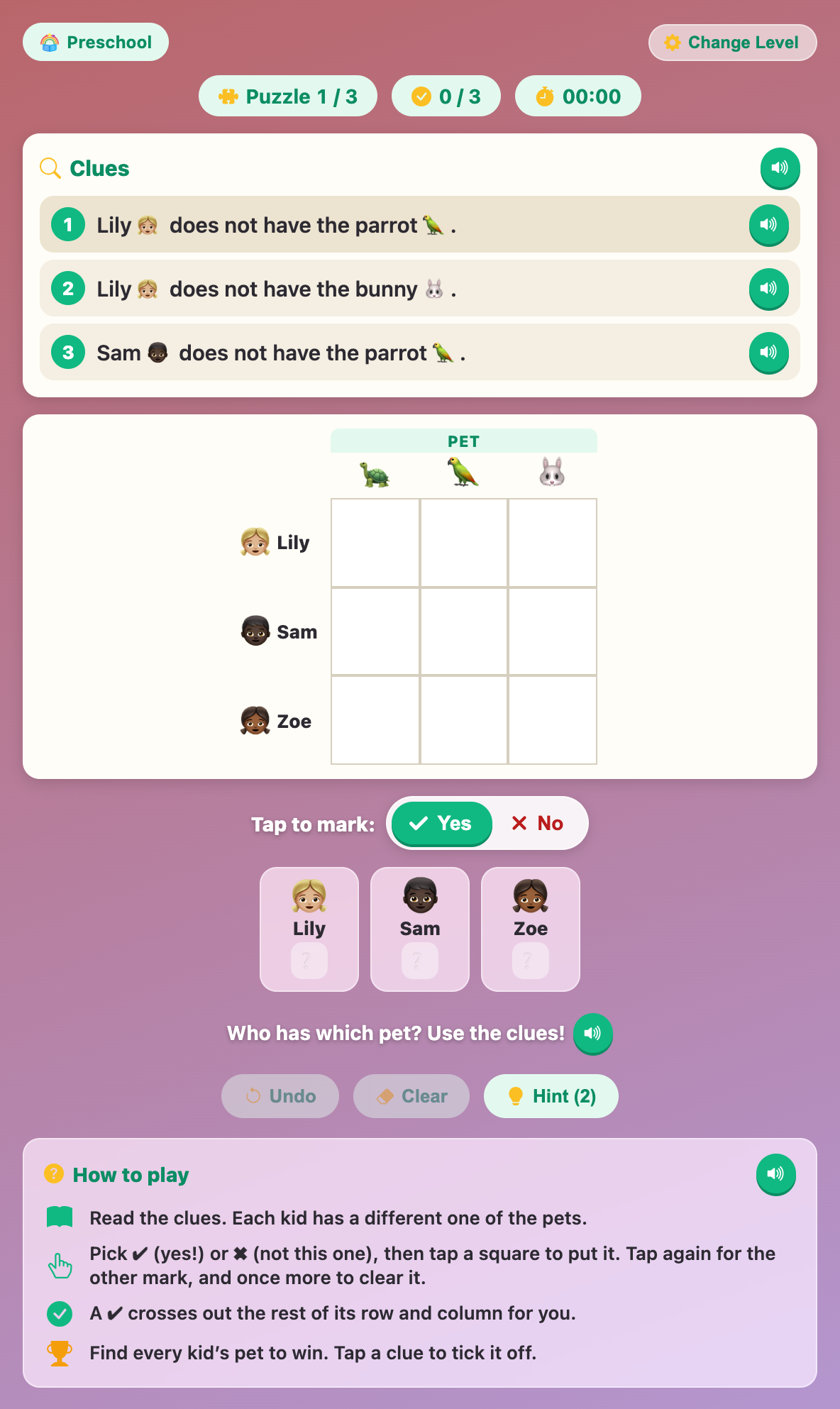
A new Preschool puzzle in Who Owns the Pet with three clues about Lily, Sam and Zoe and an empty pet grid
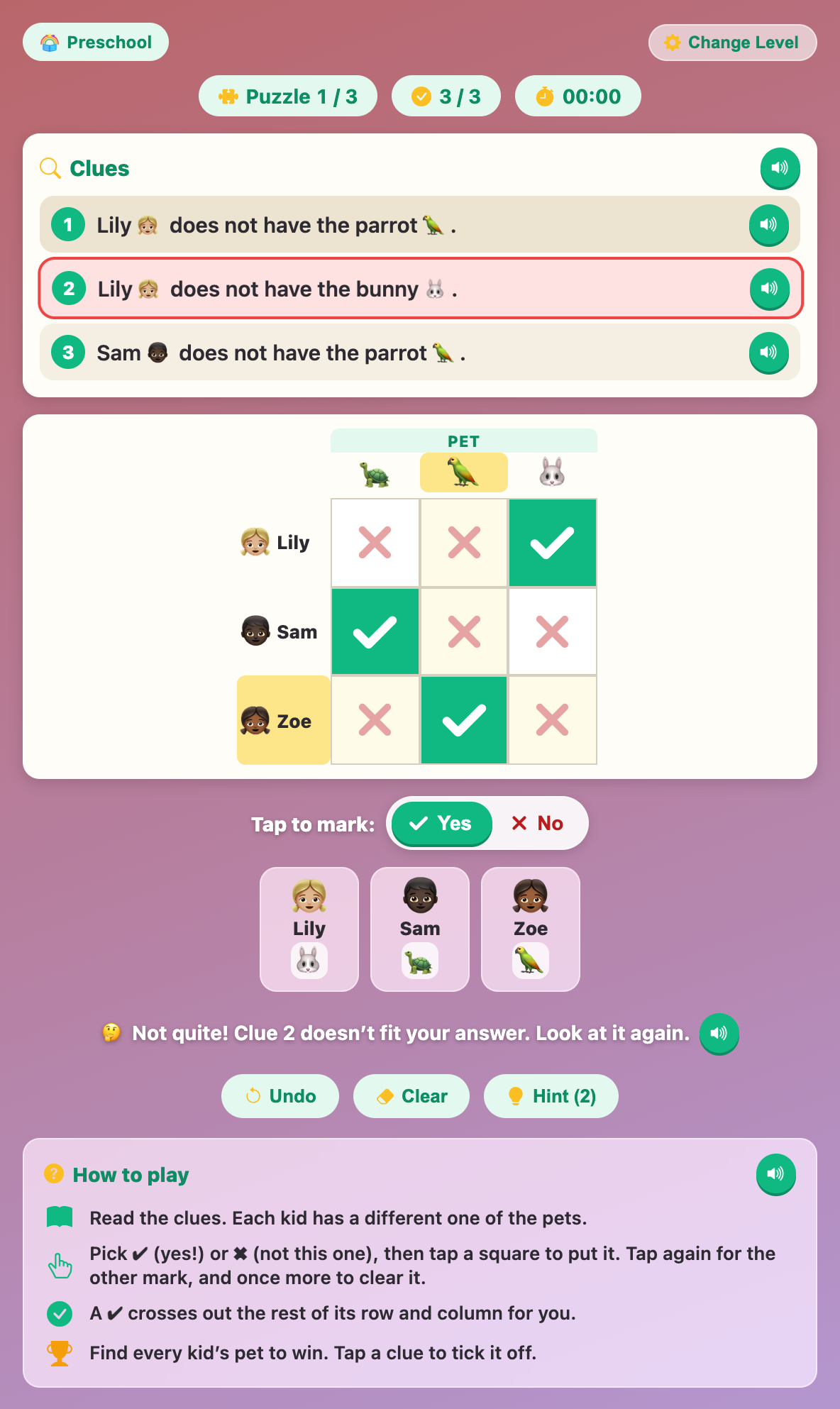
A wrong answer in Who Owns the Pet for preschoolers, with clue 2 glowing red and a Not quite tip
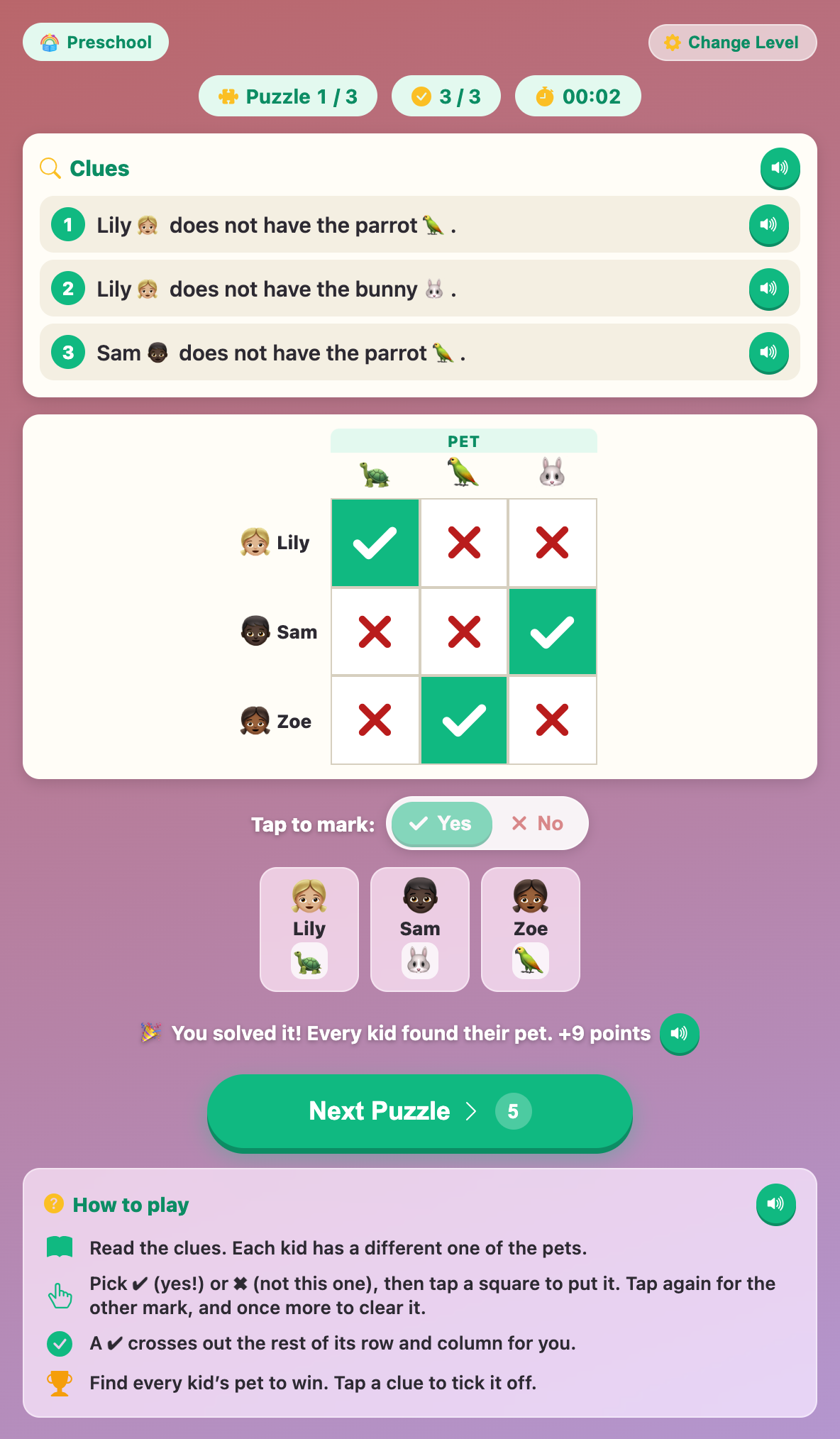
A solved Preschool puzzle in Who Owns the Pet with green ticks, filled kid cards and the Next Puzzle button
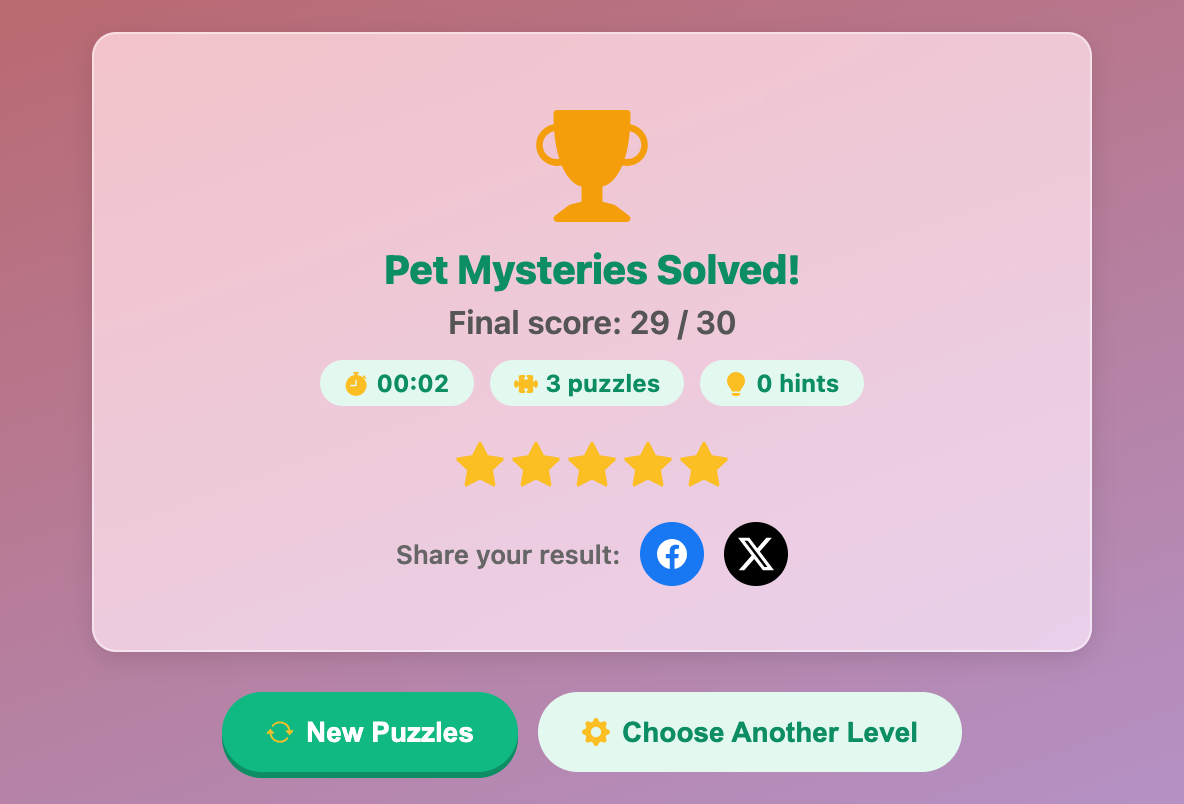
The Pet Mysteries Solved finish card with a gold trophy, a final score of 29 out of 30 and five stars
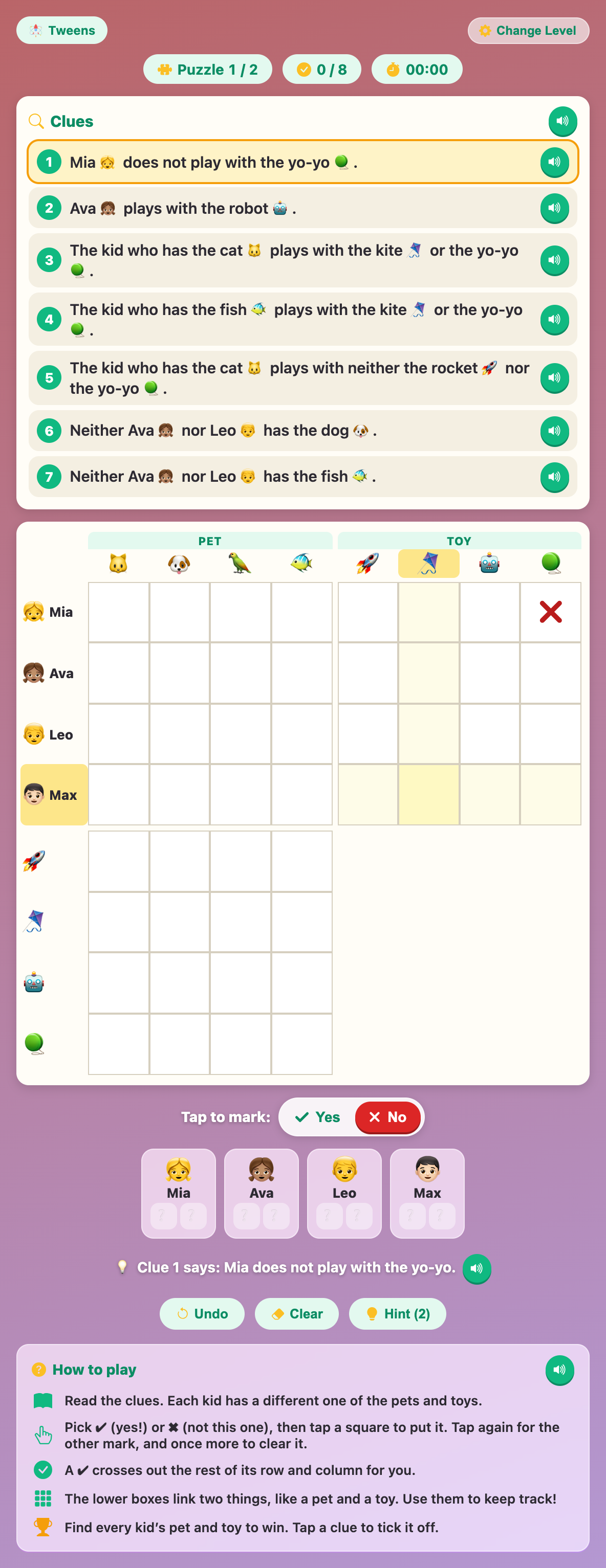
A Tweens logic grid in Who Owns the Pet with seven clues about pets and toys and a hint lighting up clue 1
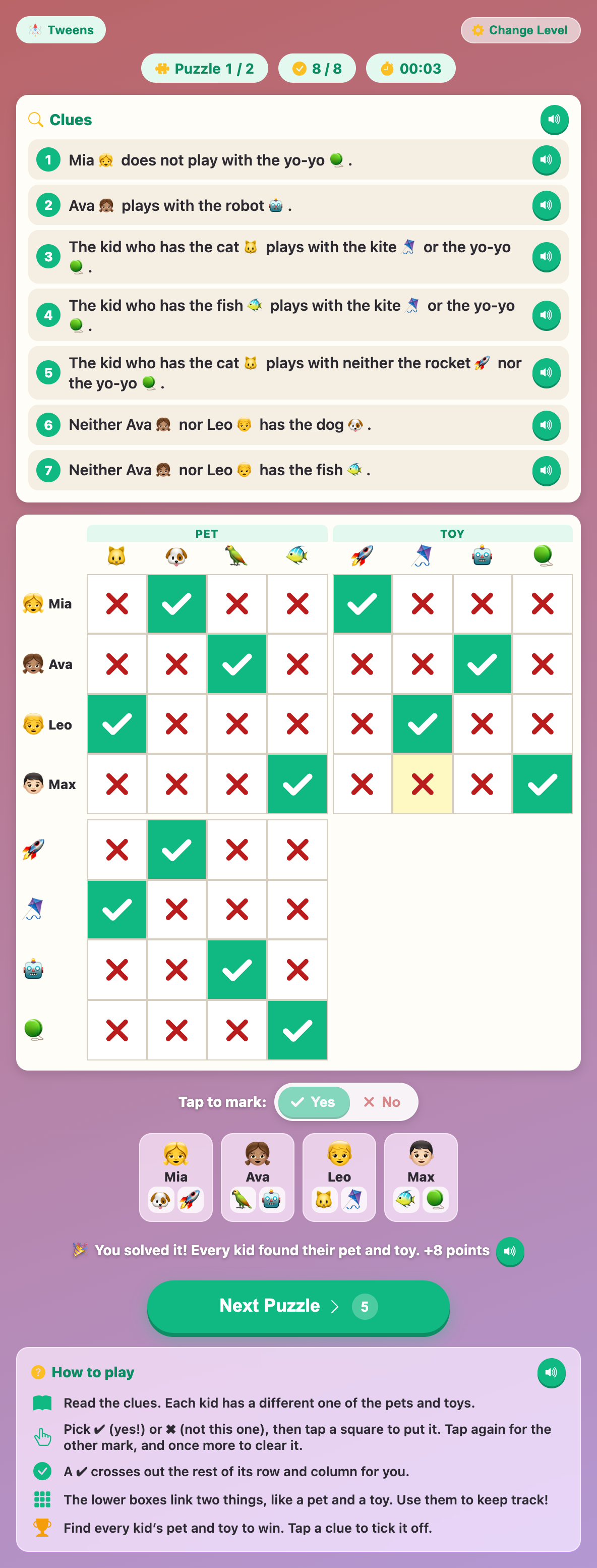
A solved puzzle in Who Owns the Pet for tweens, with every pet and toy box filled with ticks and crosses
More Mind Games
 786.5K plays
5.0
Tangram
Drag, rotate, and flip the seven tangram pieces to build silhouettes like a house, a boat, and a fish.
 271.7K plays
5.0
Code Breaker
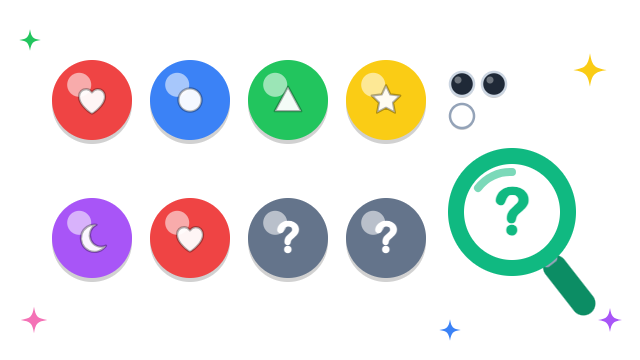
Crack the secret color code! Fill a row with colored pegs and press Check, and the clues tell you which colors are right and which are in the wrong spot. Use every clue to work out the code in as few guesses as you can. Little players get a clue on every peg, older ones get the classic black and white pegs, and in 2 Players mode you can hide a code for a friend to crack.
 863.6K plays
4.9
Jigsaw Puzzle
Drag interlocking pieces into place to assemble colorful pictures.
 568.7K plays
4.9
Connect Four
Drop your pieces and be the first to connect four in a row against the computer or a friend.
Most Played Games
 366.4K plays
5.0
Tic-Tac-Toe
Play a game of Tic-Tac-Toe against the computer and see if you can outsmart it.
 1.1M plays
4.9
Chess
Play classic chess in 2D or 3D against the computer or a friend, with FIDE time controls, hints, and undo.
 263.8K plays
4.9
Category Sort
Decide whether each picture is an animal, food, toy, or vehicle before time runs out.
 117.1K plays
5.0
Magic Crossbow: Pattern Breaker
Red, blue, red, blue, blue... wait! Find the one that breaks the pattern and shoot it with your magic crossbow. Pop out the extra item or swap the wrong one, and the pattern is fixed. Simple two-color patterns for little ones, long tricky patterns with two breakers for big kids.
Comments (23)