
Estimation Jar
21.4K playsHow many jelly beans are in the jar? Watch the jar fill up, take a quick look before the glass gets foggy, and make your best guess. Then count the beans out in groups of 10 to see how close you got. The closer your guess, the more stars you earn! Little ones find which jar has more, bigger kids guess jars of up to 100 and estimate sums like 48 + 31, and older kids use a small jar as a guide, measure a snake in cm and round big numbers.
Don’t count the jelly beans. Well, not one by one! Estimation Jar for kids is a free math game where a glass jar fills up with candy, and you guess how many are inside before the glass gets foggy. Then the game counts every bean out in groups of 10, so you see right away how close you got.
It is made for children from about 2 to 12. Little ones pick which jar has more. Bigger kids slide to a guess for jars of up to 260, measure a wiggly snake, and round numbers like 414 + 128. It plays in your web browser, with nothing to download and no sign-up, and it works with a mouse, a keyboard or a finger on a phone or tablet.
🫙 Estimation Jar for Kids: Guess First, Count Second
To estimate means to make a smart guess about how many, how long or how much, without counting everything. Grown-ups do it all the time. How many apples fill this bag? Is there enough juice for everyone? About how much will two toys cost together?
Estimation Jar turns that skill into a game. Every round shows you something to guess: a jar of jelly beans, marbles, gumballs or buttons, two jars side by side, or a long green snake. You never get the same kind of treat twice in a row, so each jar feels new.
The goal is not to be exactly right. The goal is to be close. A guess of 96 when the real answer is 105 still wins all 3 stars! That makes the game feel friendly. You can be brave, make a guess, and learn from the count-out at the end.
👀 One Round, From Pour to Count
Here is how a game of Estimation Jar works on KidWorld, screen by screen.
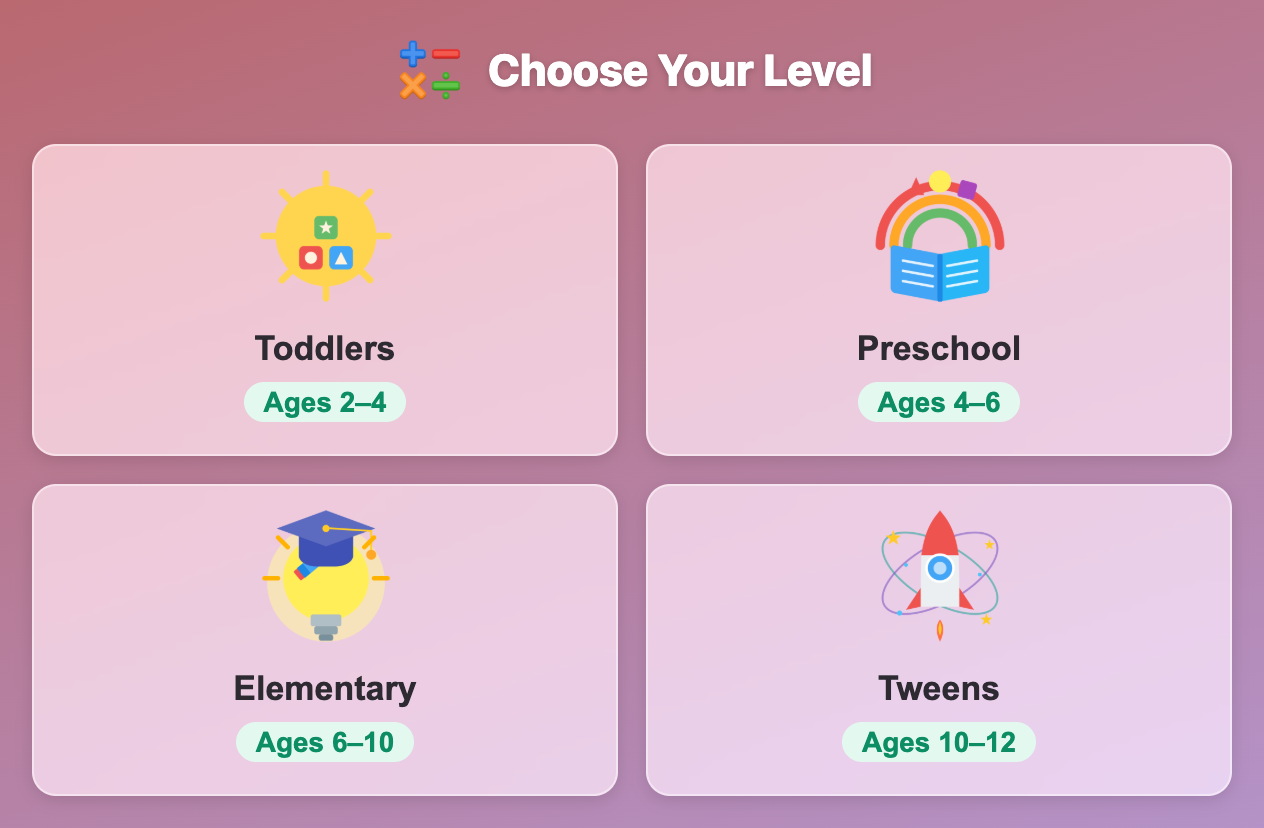
Pick your level. The game opens on the level you used last time, or on Elementary the first time you visit. Press ⚙️ Change Level at the top right to see all four cards: Toddlers, Preschool, Elementary and Tweens. Toddlers play 6 rounds; every other level plays 8.
Read the goal card. The white card at the top says what to do, like “How many gumballs?” or “Which jar has more?”. Tap the green 🔊 button beside it and the game reads it out loud.
Watch the jar fill. Treats pour in from the top for about 2 seconds. The answer buttons wake up when the jar is full.
Look fast before the fog. From Preschool on, an orange bar runs across the top of the board. When it runs out, the glass fogs up. The beans blur away, but a colored band still shows how full the jar is. You get 5 seconds to look in Preschool, 3.5 in Elementary and 3 in Tweens. Toddlers’ jars never fog. You can answer before the fog comes, too.
Make your guess. On button rounds, tap the number (or the jar) you think is right. On slider rounds, drag the slider, tap − or +, or just type the number on your keyboard. Then press Guess! or Enter. The arrow keys nudge your guess by 1.
Watch the count-out. The jar shrinks into the corner and the beans fly out into tall rods of 10, with a running count at the top. Every 10 rods get a green box labeled 100. Toddlers count one bean at a time into a ten frame instead. On slider rounds, a number line then shows “Real” in green above and “You” in orange below, with the gap between them.
Collect your stars. Up to 3 stars pop into the goal card. The line under the board explains the answer, like “There are 133 gumballs: 1 hundred, 3 tens and 3 ones.”
Press Next. The big green Next button counts down from 6 and moves on by itself, so you can also just wait. On the last round it says “See My Score”.
See your finish card. “Estimation Star!” shows your final score out of 100, your stars, how many “great guesses” (3-star rounds) you made, any 🎯 bullseyes (exactly right guesses), and 1 to 5 big stars. Press Play Again for new jars, or Choose Another Level.
Use the page buttons. The floating buttons beside the game turn on fullscreen, reload the game, and switch the music on or off.
⭐ How Close Is Close Enough?
Every round is worth up to 3 stars. How you earn them depends on the kind of round.
Slider rounds (Elementary and Tweens): 3 stars if your guess is within about 10% of the real answer, 2 stars within 20%, and 1 star within 35%. For a jar of 80, that means 72 to 88 gets 3 stars, 64 to 96 gets 2 stars, and 52 to 108 still gets 1 star.
Number buttons: 3 stars for the closest number, and 1 star for the button right next to it. So a “close miss” still counts for something.
Which jar has more?: 3 stars for the fuller jar, 0 for the other one.
Your final score is all your stars compared to the most you could get. On Toddlers, 10 stars out of 18 makes a score of 56. On the other levels, 24 stars is a perfect 100.
🧠 How to Become a Super Guesser in Estimation Jar for Kids
Good guessers are not lucky. They use tricks! Here are the ones that really work in this game, from easy to clever.
1. Look at how high, not at each bean
You only get a few seconds before the fog. That is not enough time to count 100 beans. So don’t try! Instead, notice how high the beans reach in the jar. Is it a quarter full? Half full? Almost to the lid? The fog keeps a colored band showing that height, so the height is the clue that stays with you.
2. Learn your jar
Here is a secret: on each level, every jar is the same size, and every bean is the same size, all game long. So “half full” always means about the same number. On Elementary, a full jar holds about 130 beans, so half full is about 65. On Tweens, a full jar holds about 280, so half full is about 140. After a round or two, your eyes start to know the jar.
3. Use the small jar like a measuring cup
In some rounds, a small jar sits next to the big one, with a number sticker: 10 on Elementary, 20 or 25 on Tweens. Both jars have the same width and the same beans. So look at how tall the small jar’s pile is. Then ask: how many of those piles would stack up to the big jar’s pile? If about 4 fit, and the small jar has 25, your guess is about 4 × 25 = 100.
4. Walk the stick along the snake
In snake rounds, you get a measuring tool at the top: a stick of 5 blocks (Elementary) or a ruler bar of 10 cm (Tweens). The size of the stick on screen changes every round, so you can’t remember it from last time. Instead, imagine picking up the stick and laying it along the snake, again and again, from the tail to the head. Count the jumps, then multiply. And don’t count the snake’s yellow spots! They don’t match the blocks or the centimeters.
5. Round first, then add
In the two-jar sums, the stickers show the real numbers, like 57 + 31. The goal card tells you to round each number first. To round means to swap a number for the nearest easy number, like the nearest ten. 57 is closer to 60 than to 50, so it becomes 60. 31 becomes 30. Now 60 + 30 = 90 is easy to do in your head. If rounding is still new for you, Rounding Roller Coaster lets you watch a cart roll to the nearest ten or hundred.
6. Don’t chase the middle of the slider
The number at the right end of the slider changes every round. Sometimes the answer is near the middle, and sometimes it’s much further left. So don’t just slide to the middle! Make your guess from the jar first, then slide to that number. Typing the number is often the fastest way.
7. Learn from the number line
After each slider round, look at where “You” and “Real” landed. Was your guess too small? Lots of people guess too low on big jars. If you keep landing on the left, push your next guess up a bit. This little check is how real estimating skill grows.
🍬 Five Jars, Thought Through Out Loud
Here is how a good guesser thinks, round by round. These are real kinds of rounds from the game.
Buttons in two jars, red or blue? (Toddlers)
The red jar has buttons stacked three rows high. The blue jar has just one row on the bottom. You don’t need to count. The red pile is taller, so tap the Red jar button (or the red jar itself). Then the game rings each button as it counts them, and puts a crown on the fuller jar. On this level, the bigger jar always has at least twice as many, so a quick look is enough. Once “which is more?” feels easy, Compare Numbers asks the same question with written numbers and the > and < signs.
17 jelly beans and three buttons (Preschool)
The jar is under half full, and the buttons are far apart. On Preschool, the right button is the count rounded to 5. You don’t need the exact number, just the closest one. If the beans look like “more than 10, but not 20 yet”, pick 15. The game then says: “There are 17, and 15 is the closest.” Each number button also has a tiny jar filled to match. Compare those little jars with the big one for an extra clue!
A big jar next to a jar of 25 (Tweens)
The small jar’s 25 jelly beans make a short pile, about two rows high. The big jar’s pile is roughly four of those piles tall. So: 4 × 25 = 100. Slide to about 100 and press Guess! In one real round, the jar held 105 beans and a guess of 96 earned all 3 stars, because 9 away is less than 10% of 105. The game added: “That’s about 4 small jars of 25.”
A snake and a 10 cm ruler bar (Tweens)
Lay the ruler bar along the snake in your mind. It fits about 6 times, with a bit of snake left over. That is 60 cm and a bit more, so guess 65 or 70. In one game the snake was 67 cm long, and 70 was just 3 away: 3 stars! When you answer, the game lays real 10 cm bars along the snake from its tail, then single centimeters, so you can see exactly how many fit.
414 + 128, with four buttons (Tweens)
Round each jar to the nearest hundred. 414 is close to 400. 128 is close to 100, not 200, because 28 is less than 50. So 400 + 100 = 500. Tap 500. The exact answer is 542, and the game shows both, so you can see your estimate was close but not exact. That is the whole idea! Tweens also get a take-away round, like 712 − 286. Round to 700 − 300 and you get about 400.
🚫 Guessing Traps to Skip
Counting one by one. You will run out of time before the fog. Look at the height instead.
Forgetting the small jar. When there is a jar of 10, 20 or 25, it is your best helper. Use it every time.
Rounding the wrong way. 128 rounds to 100, and 286 rounds to 300. For hundreds, look at the tens digit: 0 to 4 rounds down, 5 to 9 rounds up.
Guessing too low on full jars. Jars hold more than they seem to. If the number line keeps showing “You” on the left, guess bigger.
Rushing past the count-out. The rods of 10 show how the answer is built. Watching them is how your next guess gets better.
🎒 Which Jar Fits Which Child?
Every level asks a different kind of question, so the game grows along with your child.
Toddlers (ages 2 to 4). Estimation Jar for toddlers keeps things tiny: 2 to 10 treats, no fog, and plenty of time. Rounds take turns between “Which jar has more?” and “How many?” with three number buttons, where the right one is the exact count. The beans are counted one by one into a ten frame, a box of 10 squares in two rows. A parent can count along out loud.
Preschool (ages 4 to 6). Estimation Jar for preschoolers brings in the fog, with a gentle 5 seconds to look. Jars hold about 8 to 30 treats, and the right button is the count rounded to 5. This is where children learn that “about 15” is a good answer. Kids who enjoy these quick looks can also try Flash Dots, where groups of dots flash for a moment and you say how many without counting.
Elementary (ages 6 to 10). Estimation Jar for elementary kids swaps the buttons for a slider. Jars hold 20 to 110, there is a helper jar of 10, snakes are 8 to 30 blocks long, and the sums use numbers from 12 to 88, rounded to the nearest ten. It fits right in with the place value and rounding work kids meet in school.
Tweens (ages 10 to 12). Estimation Jar for tweens is the hardest: only 3 seconds to look, jars of 60 to 260, helper jars of 20 or 25, snakes from 20 to 90 cm, and three-digit sums and differences rounded to the nearest hundred.
🌍 Why Guessing Well Is a Real-Life Superpower
Estimating is one of the math skills people use most outside school. It is how you check if an answer makes sense. If you add 414 + 128 on paper and get 5,420, a quick estimate of “about 500” tells you something went wrong.
In Estimation Jar, that skill grows in small, happy steps. When the fog comes, you learn to trust a quick look. When the small jar of 25 sits next to the big one, you learn to measure with something you already know. When the beans line up in rods of 10, you see that 133 really is 1 hundred, 3 tens and 3 ones. And when your orange “You” lands next to the green “Real”, you learn that being close is something to be proud of.
For grown-ups: is it safe, and what does it teach?
Estimation Jar is gentle and calm. There are no scary sounds or pictures, no chat, and nothing to buy. A wrong guess just says “Good try!” and shows the real answer. It practices estimating amounts, comparing “more” and “less”, counting in tens and hundreds, measuring with a unit, and rounding to the nearest ten or hundred. The 🔊 buttons read the questions and answers aloud, and on Toddlers and Preschool they also read them on their own when the sound is on, so pre-readers can play too.
Ready to fill a jar? Pick a level, take a quick look, and make your bravest guess. Estimation Jar for kids is waiting, and every count-out makes you a little bit better at guessing. 🍬
🖼️ See the Game in Action
The Choose Your Level screen in Estimation Jar for kids, with Toddlers, Preschool, Elementary and Tweens cards
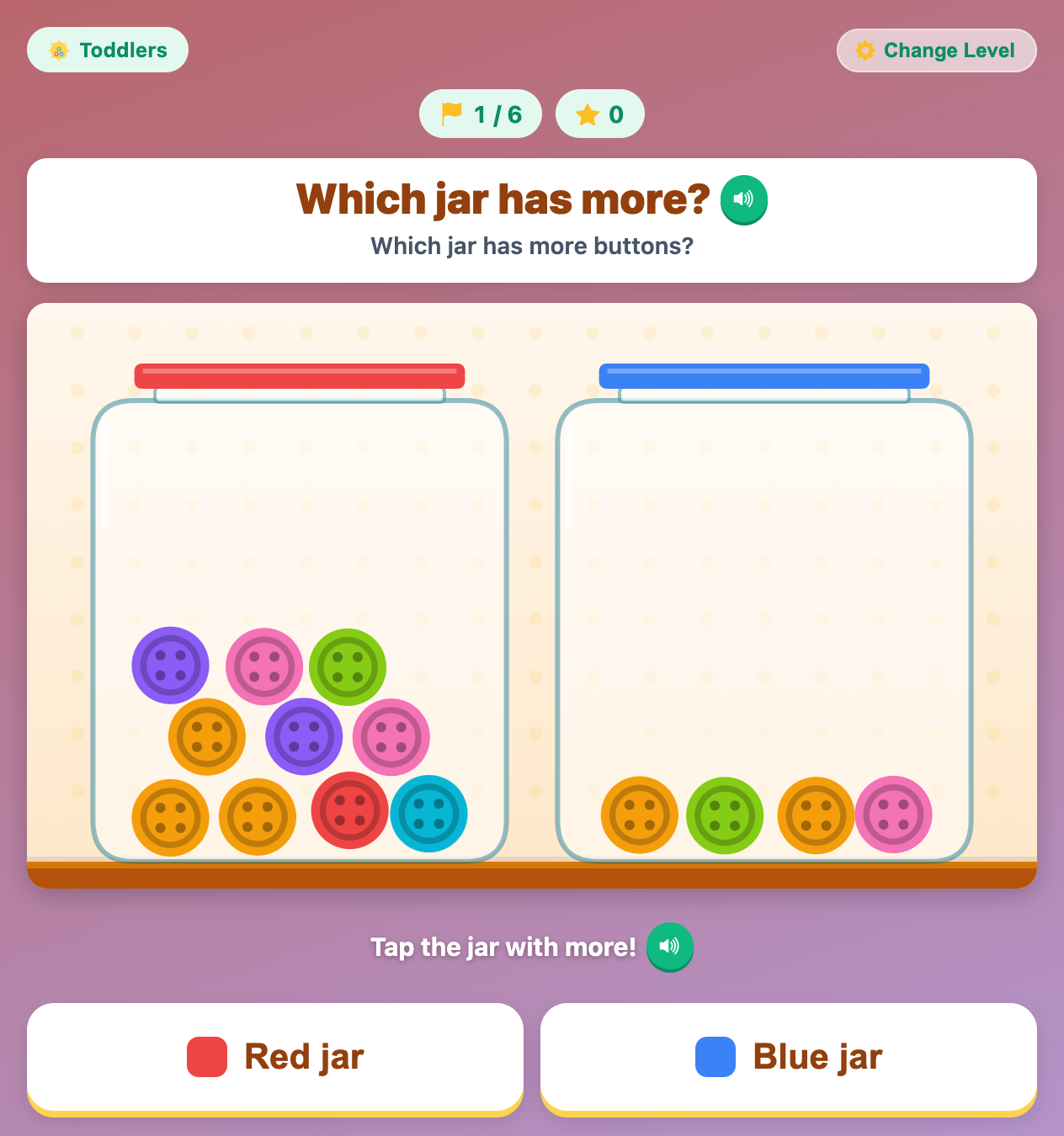
A red jar and a blue jar of colorful buttons asking which jar has more, in Estimation Jar for toddlers
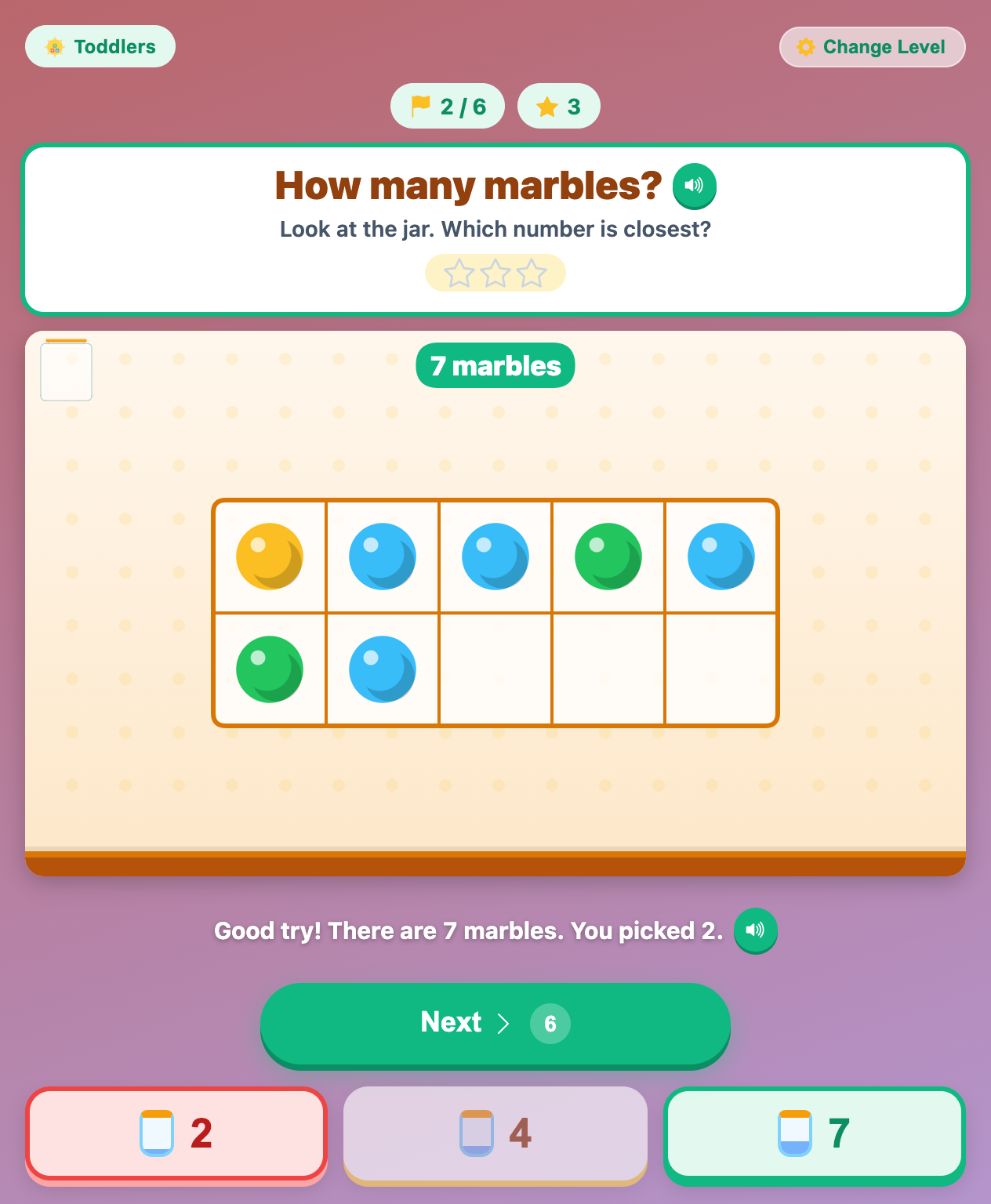
7 marbles counted into a ten frame after a toddler round, with the right answer 7 glowing green
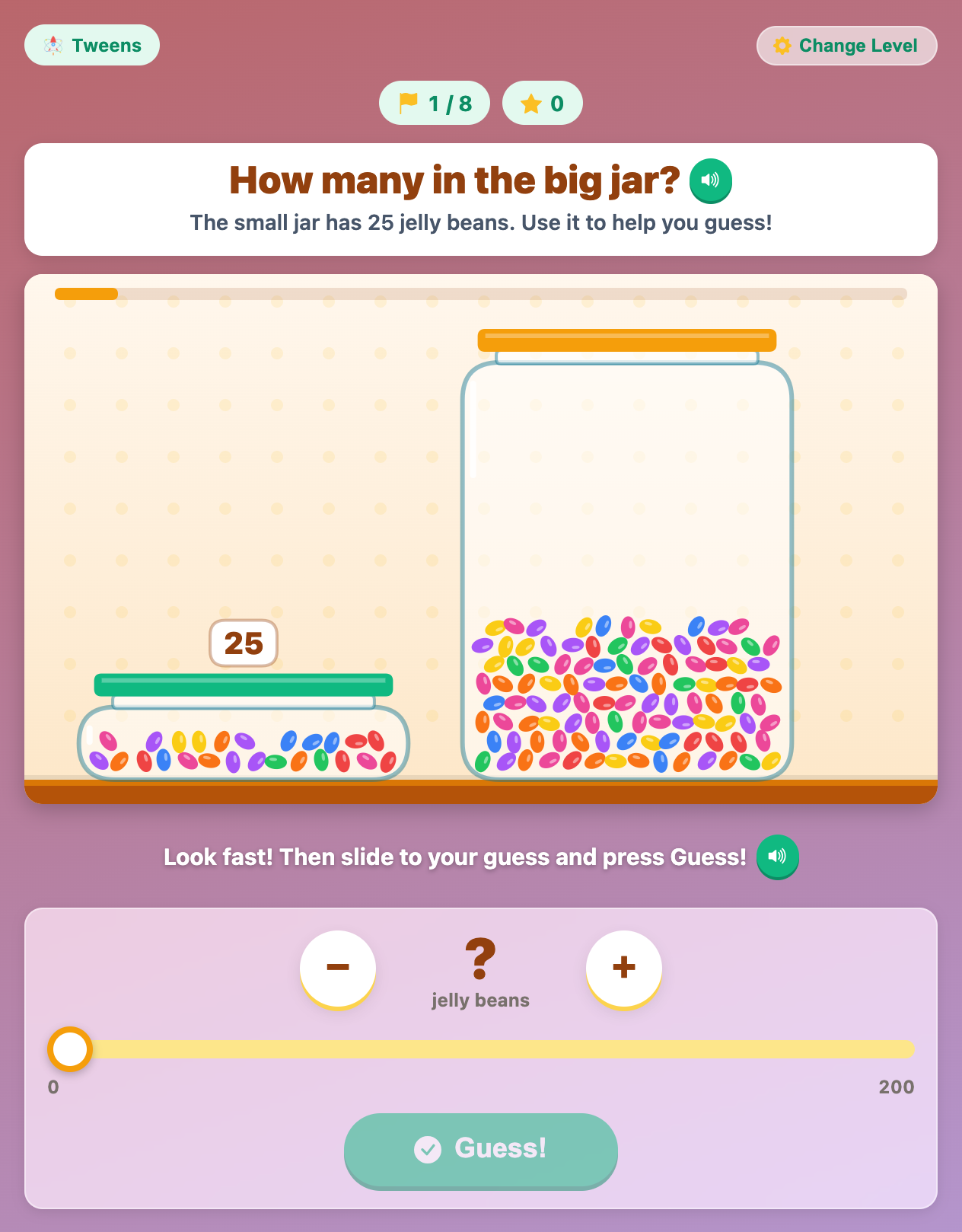
A big jar of jelly beans beside a small jar of 25 in Estimation Jar for tweens, with the guess slider below
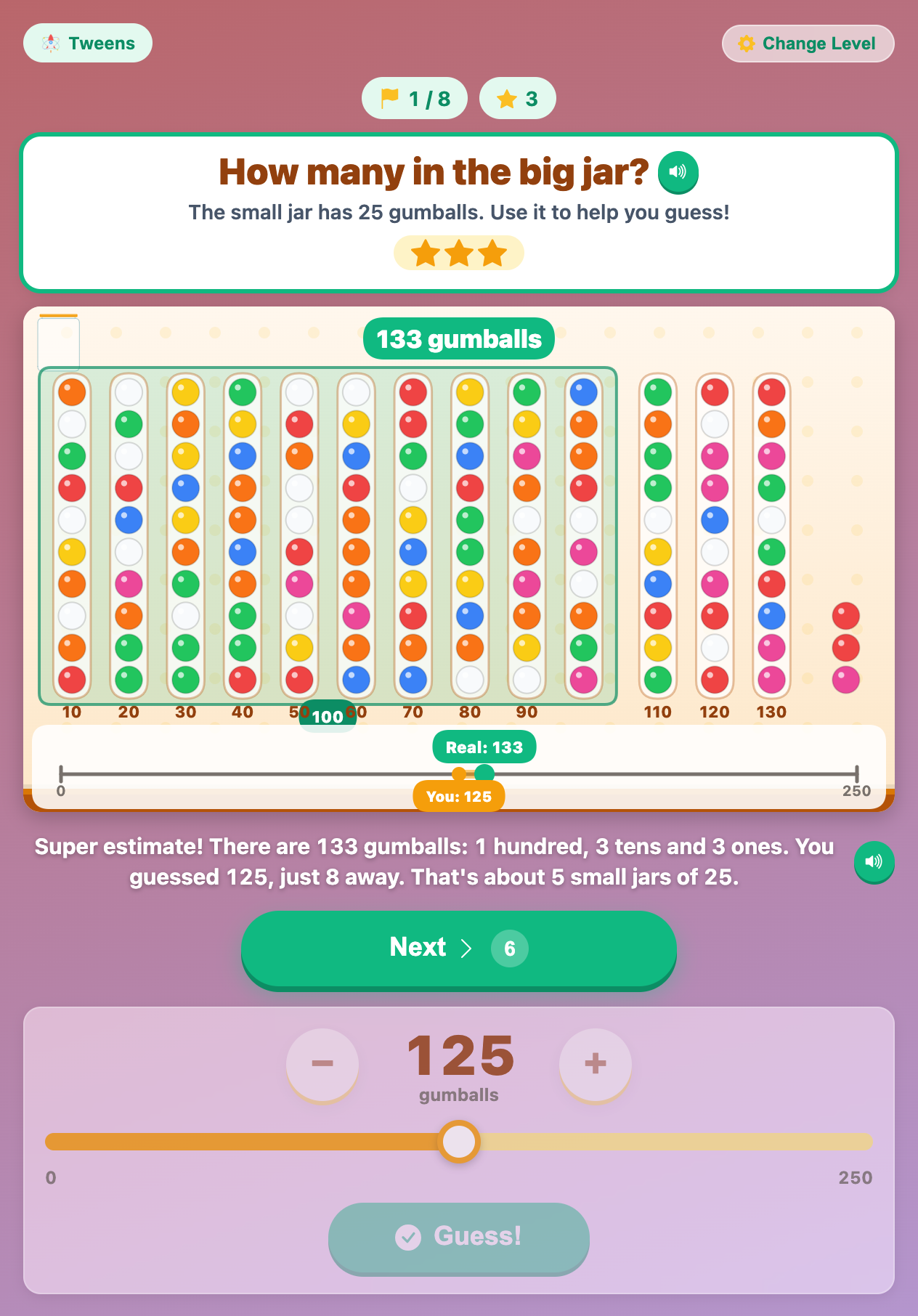
133 gumballs counted out in rods of 10 with a green box for 100, and a number line showing a guess of 125
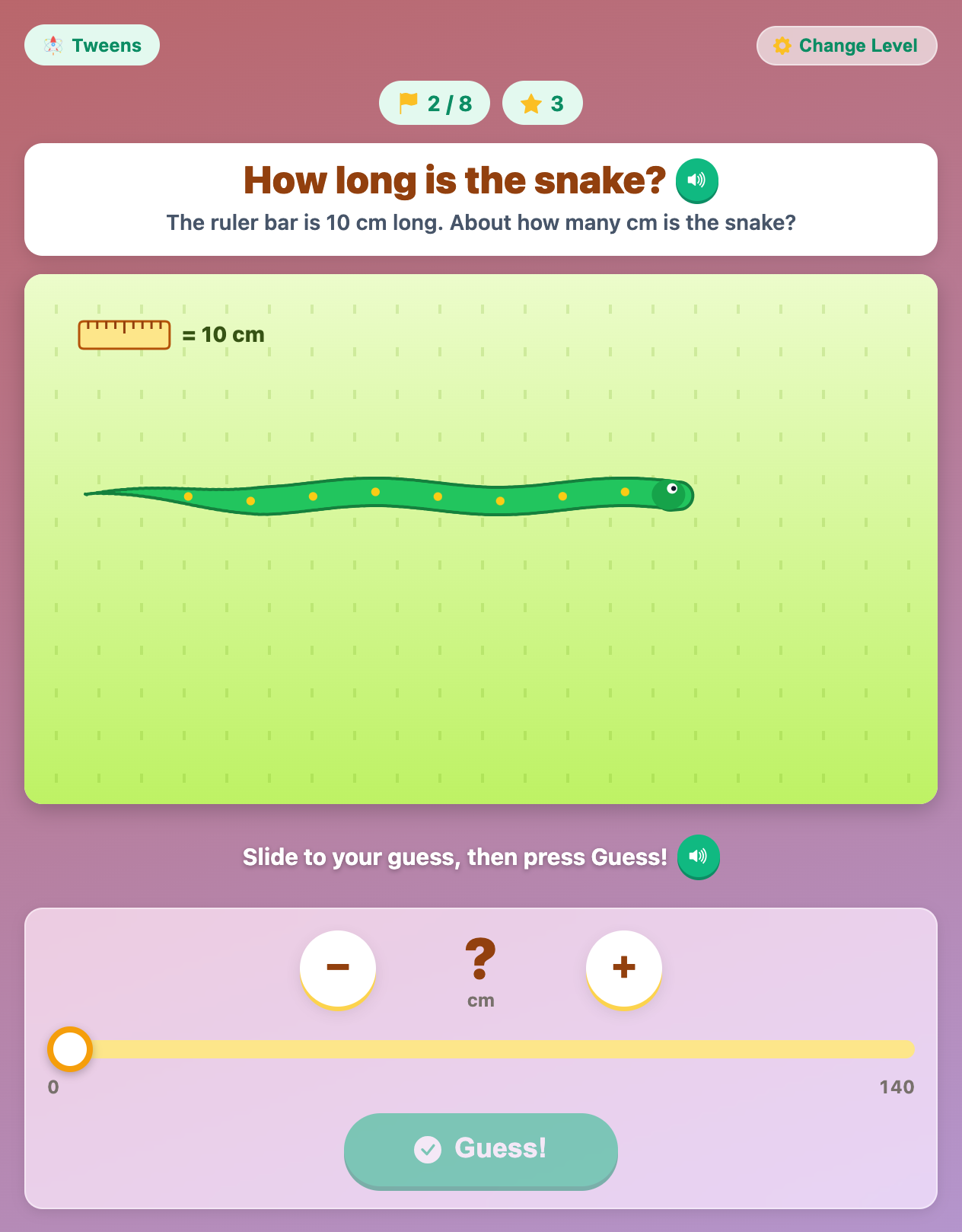
A green snake next to a 10 cm ruler bar with the question how long is the snake, at the Tweens level
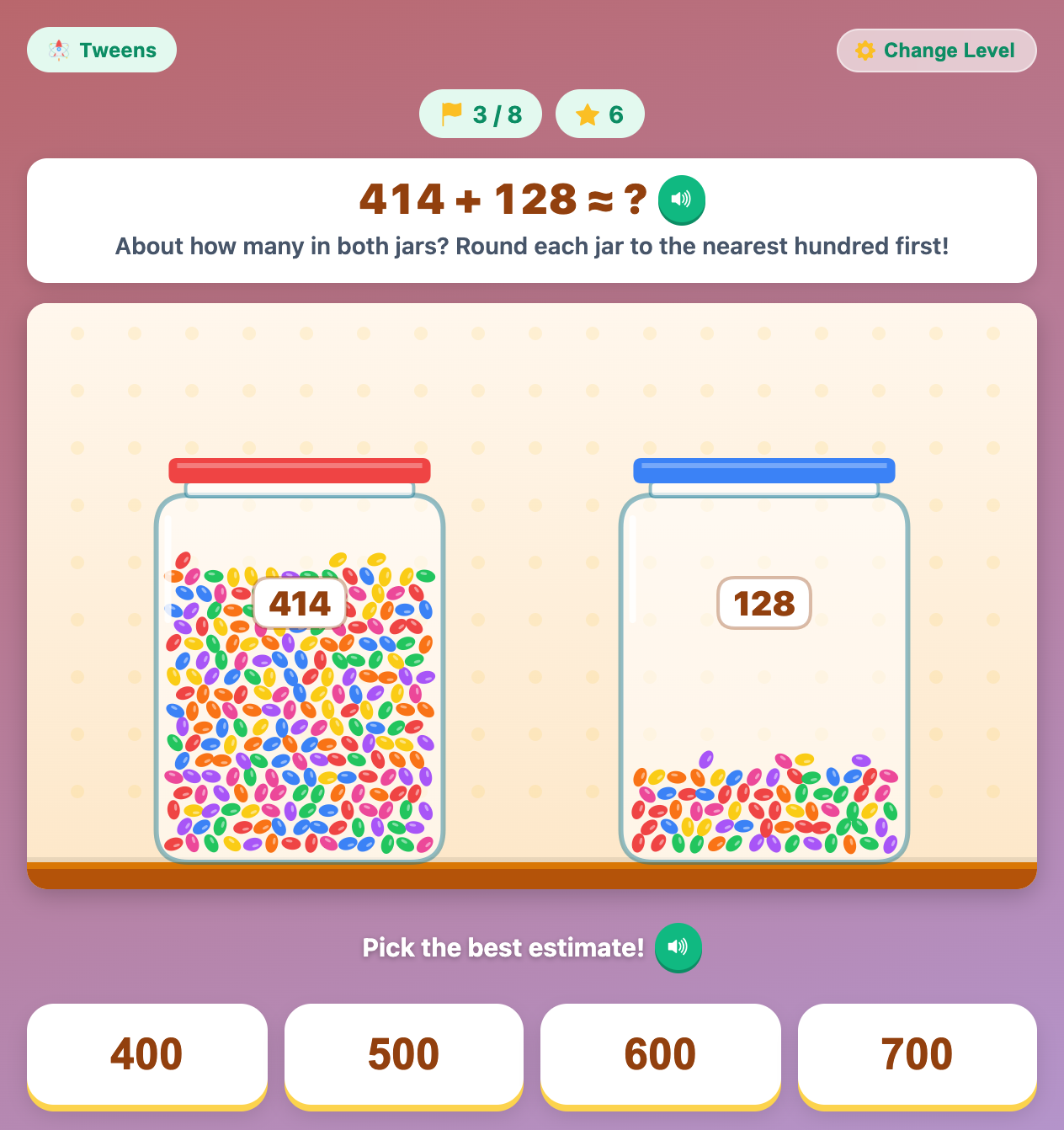
A red jar labeled 414 and a blue jar labeled 128, with answer buttons 400, 500, 600 and 700
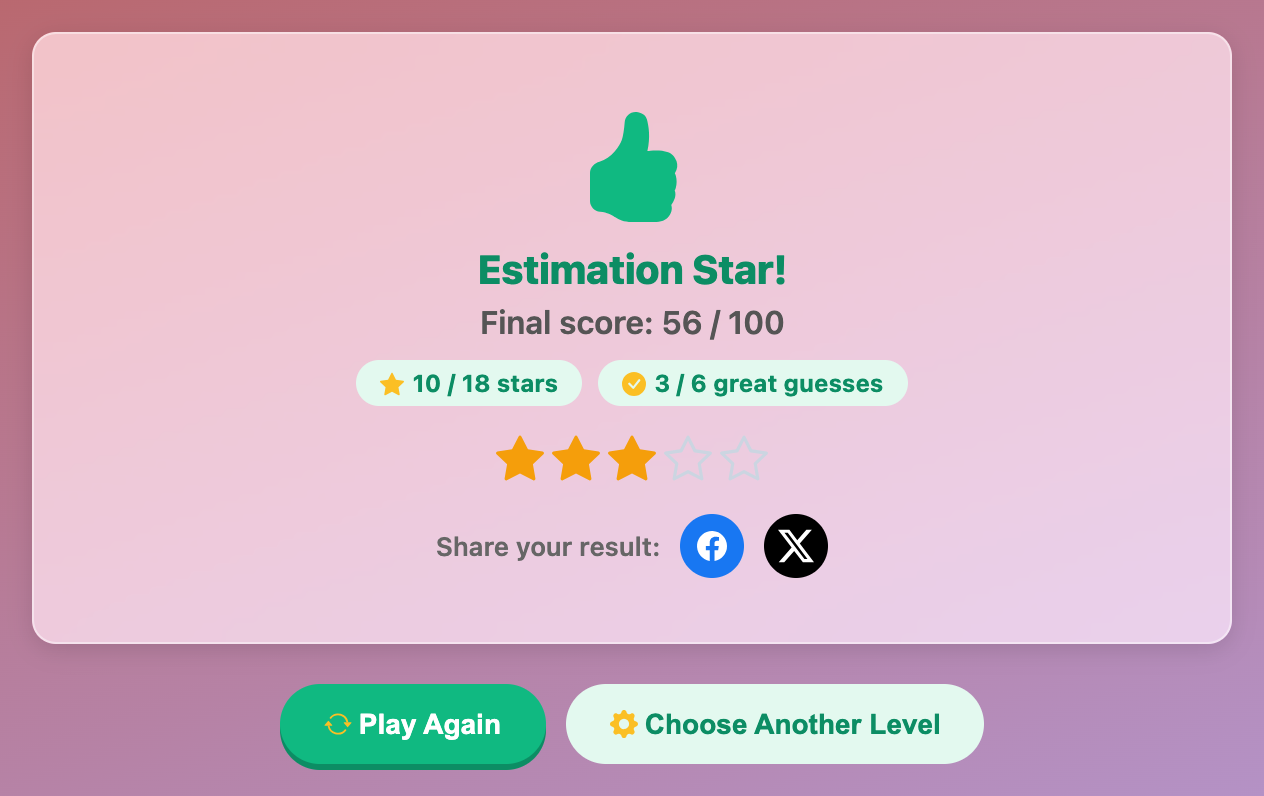
The Estimation Star finish card with a final score of 56 out of 100, 10 of 18 stars and 3 great guesses
More Math Games
 72.6K plays
4.9
Place Value Factory
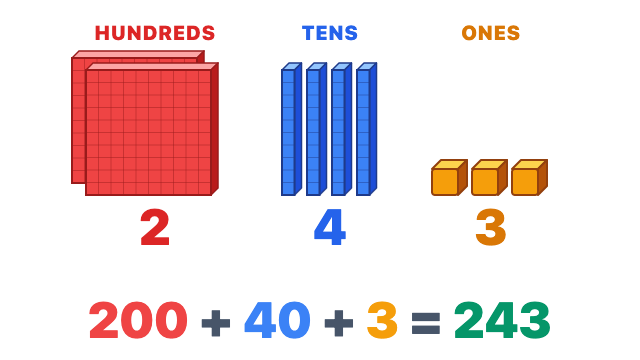
Run the number factory! Orders roll down the conveyor belt, and you fill each crate with ones cubes, tens rods and hundreds flats. Put in ten cubes and watch them snap together into a rod! Little ones count cubes, preschoolers build numbers like 34, older kids build 243, read crates and break a ten to take away, and tweens work with thousands and decimals.
 423.6K plays
4.9
Number Line Frog
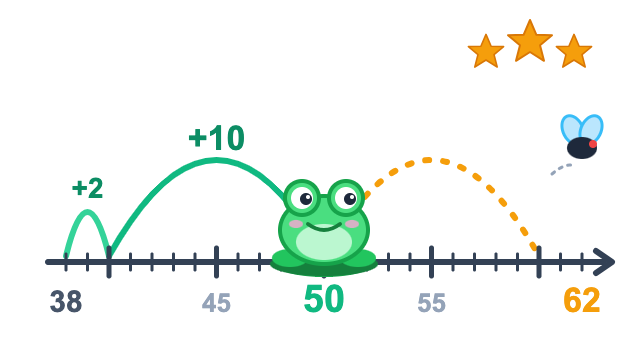
Help the hungry frog catch the fly! Tap hops like +1, +5 and +10 to jump the frog along the number line, and watch each hop draw an arc and build the number sentence. Use as few hops as you can to earn 3 stars. Little ones hop by 1s to a number, bigger kids find sums like 47 + 8 by hopping, and older kids hop across negative numbers, decimals and fractions.
 437.4K plays
5.0
Magic Crossbow: Odd or Even Hunt
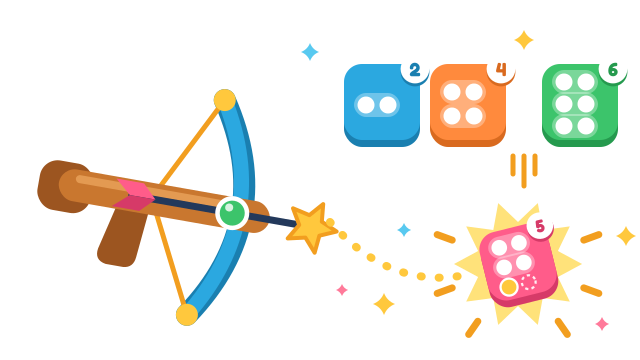
Hunt down every odd number (or every even one) with your magic crossbow! Little ones count dots in pairs to spot the one left over, bigger kids check the last digit of two-digit numbers, and big kids work out sums and times facts like 7+8 and 6×5 before deciding if the answer is odd or even.
 118.3K plays
4.9
Hundred Chart Mystery Picture
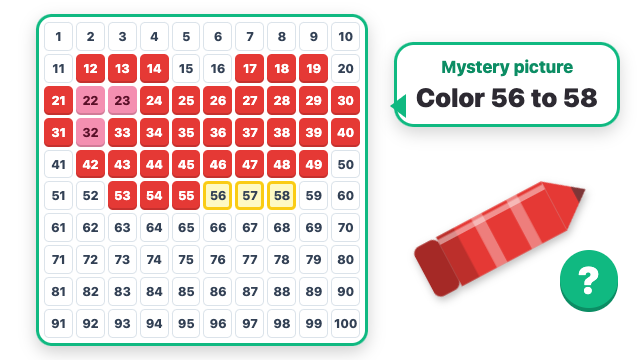
Find the numbers, color the squares and discover the hidden picture! Each clue names squares on a 1 to 100 chart, like "Color 34 to 38", "Color 10 more than 37" or "Color 6 × 7". Every right square fills with its crayon color, and when the last clue is done the numbers fade away to show a rocket, a cat, a sailboat or another mystery picture. Little ones find numbers on a 1 to 25 chart, and bigger kids count by tens, find even numbers and work out multiples.
Most Played Games
 518.5K plays
4.9
Math Temple Escape
Help a baby bunny hop away with the Golden Carrot! Bounce along a pastel temple path in 3D, jump logs, slide under flower garlands and dodge smiling mushrooms while cheeky little monkeys chase you. At every gate, hop under the sign with the right answer to zoom ahead. Counting, adding, subtracting, times tables and division for every age.
 273.8K plays
4.9
Math Horse Derby
Saddle up for a math steeplechase! Every fence has a question: answer right to gallop and jump clean, get three in a row for Carrot Power, and race your horse past the pack to the finish. Count, add, subtract, multiply and divide.
 473.7K plays
4.9
Math Addition Moto Race
Pick your age level, then ride your motorbike through the lane with the right addition answer — every correct gate makes you faster!
 1.1M plays
4.9
Math Moto Race
Pick your age level, then ride your motorbike through the lane with the right answer — every correct gate makes you faster!
Comments (30)