
Masterpiece Slider
112.9K playsSlide the tiles to fix a famous painting! The Starry Night, the Mona Lisa, The Great Wave and more are cut into tiles and mixed up, with one tile missing. Slide them back into place, then guess who painted it for bonus stars and read the museum label to learn one amazing fact. Small kids slide 8 tiles with numbers to help, big kids take on 15.
One square of the Mona Lisa is missing. It isn't lost. It's hiding in the bottom-right corner, and it only comes back when every other tile of the painting is home again. That empty square is the secret of Masterpiece Slider for kids: a sliding puzzle made from 20 of the most famous paintings in the world.
The game cuts a real painting into tiles, takes one tile away, and mixes up the rest. You slide the tiles into the gap, one at a time, until The Starry Night swirls again or The Great Wave crashes in the right place. Then comes a bonus question, "Who painted it?", and a museum label with one amazing fact. Little kids slide 5 or 8 big tiles with numbers to help. Big kids take on 15 tiles with no numbers at all.
🖼️ A Famous Painting in a Box of Tiles
A sliding puzzle is a tray of tiles with one empty space. You can't lift a tile out. You can only push a tile that touches the empty space into it. That's the only move there is! Each push makes a new empty space somewhere else, so every slide changes what you can do next.
The classic version, the "15 puzzle", has been around for about 150 years. It used numbers from 1 to 15. On KidWorld, the tiles are pieces of real paintings instead. They are public-domain pictures from Wikimedia Commons, a big free library of images. Public domain means the paintings are so old that anyone may share them.
You will meet works by 14 different artists, from Leonardo da Vinci and Vincent van Gogh to Katsushika Hokusai, Claude Monet, Piet Mondrian and Paul Klee. Some are swirly, some are dotty, some are made of squares and stripes. Each one makes a very different puzzle.
🕹️ Sliding Your First Painting, Step by Step
Pick your level. The Choose Your Level screen shows four cards. Each card says how big the board is: Toddlers 2×3 with 5 tiles, Preschool 3×3 with 8 tiles, Elementary 3×4 with 11 tiles, and Tweens 4×4 with 15 tiles. The game remembers your choice, and the Change Level button at the top lets you switch any time.

Meet the painting. The painting's title sits above the board, next to a tiny picture of the finished painting. Tap that little picture to see it big. Tap anywhere (or press Escape) to close it again. You can peek as often as you like, and it costs nothing.
Slide a tile. Tap any tile that touches the dark empty square, and it slides in. A tile that doesn't touch the gap just gives a little wiggle, and no move is counted. On a computer, the arrow keys work too: ← slides the tile on the right of the gap to the left, ↑ slides the tile below the gap up, and so on.
Watch your moves and time. Two bubbles above the board count your moves and show a stopwatch. Only the moves count for your score. The stopwatch is just for fun, so there's no need to rush.
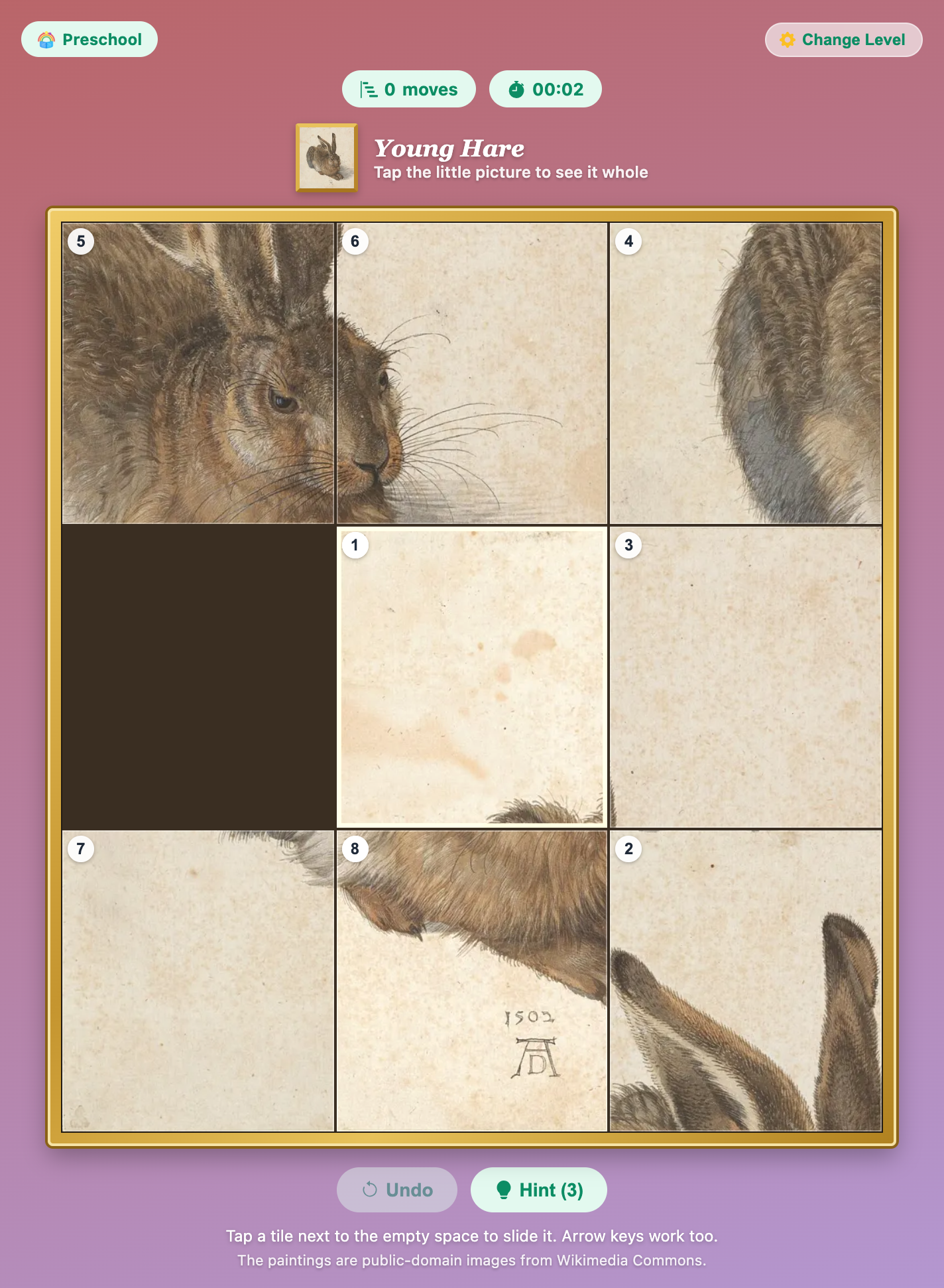
Use Undo and Hint. Undo takes back your last slide, as many times as you want, and it also takes that move off your count. Hint makes one tile glow: the one to slide next. You get 5 hints on Toddlers, 4 on Preschool and 3 on Elementary and Tweens.
Use the number badges (little kids). On Toddlers and Preschool, every tile has a small number in its corner. Tile 1 goes top-left, then 2, 3 and so on, in reading order. On Elementary and Tweens there are no numbers, so the painting itself is your only guide.
Finish the painting. When the last tile clicks home, the whole painting fades in over the tiles, missing corner and all, inside a gold frame.
Answer "Who painted it?" Three artist names appear. Tap one, or press 1, 2 or 3. The right artist earns a +10 bonus. Either way, the museum label then appears with the title, the artist, the year, a fun fact and the museum where the painting hangs. Tap 🔊 to hear the question or the label read aloud.
Check your stars and keep going. You see your score out of 40, up to 5 stars, and how many of the 20 paintings you have fixed. Next Painting picks one you haven't fixed yet. The music, reload and fullscreen buttons on the page work the whole time. Reload starts a fresh board.
⭐ How Your 40 Points Are Counted
Every board is mixed up by a set number of random slides: 20 on Toddlers, 35 on Preschool, 55 on Elementary and 80 on Tweens. That number is the board's par, the target number of moves.
Moves: finish in par moves or fewer and you get the full 30 points. Take more moves and the points shrink. For example, 70 moves on a par of 35 gives 15 points, half of 30.
Hints: each hint takes away 5 points.
Artist: naming the right artist adds 10 points.
So 40 is a perfect score. 36 or more earns 5 stars, 28 or more earns 4, 20 or more earns 3, and 10 or more earns 2. Good news: the random mixing often wanders around, so a smart player can finish in fewer moves than par.
🧠 Slider Tricks That Really Work
Pushing tiles around at random can take forever. These tricks turn a messy board into a plan.
Fix the top row first, and then forget about it
Start with the top row and build it from left to right. Once it is done, never touch it again. Now you have a smaller puzzle below it. Do the same with the next row. Save the last two rows for the end and solve them together, a column at a time from the left.
Why does this work? Every row you finish shrinks the puzzle. A 4×4 board with its top row done is really just a 3×4 board, and that's the Elementary size!
Move the gap, not the tile
Here is the big secret: you never really move a tile where you want it. You move the empty space around it. To push a tile one step to the left, the gap has to get to its left side first. Before each move, ask yourself, "Where does the gap need to be?"
Look at the picture, not just the colors
On the older levels there are no numbers. So use the painting. A tile with sky belongs near the top. A tile with grass, snow or a floor belongs near the bottom. A tile with half a face or half a hat needs its other half right next to it. Peek at the little picture whenever you aren't sure where a tile goes.
Undo is free, hints are not
If you slide the wrong tile, press Undo. It takes the move back and takes it off your count, so a mistake costs you nothing. A hint costs 5 points. Keep your hints for the moments when you are truly stuck, like the very last two tiles.
Hints always lead home
A hint doesn't guess. The game remembers every slide made since the painting was whole, and the glowing tile is always the one that undoes the newest of those slides. Follow the hints and you walk backwards along that trail until the painting is fixed. That's why following hints never takes more than par moves.
🧩 Let's Solve Some Together
Example 1: The corner trick for the end of a row
On a Preschool board, the top row needs tiles 1, 2 and 3. Tile 1 is home. Tiles 2 and 3 are tricky, because 3 has to go in the corner. If you put 2 in place first, there's no room to bring 3 in without knocking 2 out again.
Put tile 2 in the top-right corner, the spot where 3 belongs.
Put tile 3 right under it.
Bring the empty space to the top-middle square.
Slide 2 left. Now the corner is empty. Slide 3 up. The row is done!
The same trick finishes a 4-tile row on Tweens. Place 1 and 2, put 3 in the corner with 4 under it, then slide 3 left and 4 up.
Example 2: Reading a picture with no numbers
On an Elementary board of Hunters in the Snow, the 11 tiles have no numbers. Before you move anything, sort them in your head. Tiles with the pale green-gray sky and the far-away mountains go in the top row. Tiles with the frozen ponds and the tiny skaters go in the middle. Tiles with the hunters, their dogs and the snowy hill go at the bottom. Now you know which row each tile is heading for, and the job feels much smaller.
Example 3: Woman with a Parasol, one hint, 35 points
Here is a real game on Preschool. The board was mixed with 35 slides, so par was 35. The player used one hint to get going and finished in 23 moves.
23 moves is fewer than par, so the moves earn the full 30 points.
One hint takes away 5. That leaves 25.
The player picked Claude Monet, the right artist: +10. Total: 35 out of 40.
35 is 4 stars. Without that one hint, it would have been 40 and 5 stars. That's the hint lesson in numbers!
Example 4: Guessing the artist like a detective
Even if you don't know the painting, the finished picture gives clues. Is it made of thousands of tiny dots? That's Georges Seurat. Thick, swirly brush strokes? Vincent van Gogh. Only straight black lines and red, yellow and blue blocks? Piet Mondrian. A face made of fruit and vegetables? Giuseppe Arcimboldo. A giant wave or a red mountain with a flat Japanese look? Katsushika Hokusai.
Example 5: The merry-go-round finish
On a Preschool board, once the top row (1, 2, 3) and the left column (4 and 7) are home, only a little 2×2 square is left: tiles 5, 6 and 8 plus the gap. Don't slide back and forth between two tiles. Instead, keep sliding the tiles round the square in the same direction, like a merry-go-round. Every board in this game can be solved, so after a few turns, 5, 6 and 8 click into place together.
🎯 Masterpiece Slider for Kids of Every Age
🐣 Masterpiece Slider for toddlers (ages 2–4)
The Toddlers board has just 2 rows and 3 columns, or 3 rows and 2 columns for a tall painting. That's only 5 tiles, each with a big number badge. The board is mixed with only 20 slides, and there are 5 hints. When the sound is on, the game reads the "Who painted it?" question and the museum label aloud. A grown-up can sit with the child, point at the numbers and count "1, 2, 3" together.
🎨 Masterpiece Slider for preschoolers (ages 4–6)
The Preschool level uses a 3×3 board with 8 numbered tiles, which is the real start of the game. The numbers and the reading-order rule (1 top-left, then across) give little hands a clear goal. With 4 hints and free Undo, nobody gets stuck for long. The question and label are read aloud too, so non-readers still learn who painted it.
📚 Masterpiece Slider for elementary kids (ages 6–10)
The Elementary level takes the numbers away. The board grows to 3 rows and 4 columns with 11 tiles, mixed with 55 slides, and there are 3 hints. Now kids have to read the painting itself: the sky, the horizon, the edges. It's a great level for practicing the row-by-row plan and the corner trick.
🚀 Masterpiece Slider for tweens (ages 10–12)
The Tweens level is the full classic: a 4×4 board with 15 tiles, 80 mixing slides and only 3 hints. Paintings like Children's Games by Pieter Bruegel are packed with tiny people, so every tile looks busy. Beating par here takes a real plan. Tweens who love the numbered version can also try the classic Sliding Puzzle, which has the old-school 15 numbered tiles.
🌟 What a Sliding Painting Teaches
Thinking ahead. Every slide changes where the gap is. Kids soon learn to stop and think "if I move this, what can I move next?" That's planning, one small step at a time.
Patience that pays off. Some tiles have to go the wrong way for a moment before they can go the right way, like in the corner trick. Kids learn that a step back can be part of moving forward.
Looking closely at art. To place a tile with no number, you have to really look: where the sky ends, where the hat brim curves, which way the brush strokes swirl. By the end, kids know these paintings better than many grown-ups do.
Real art history, one fact at a time. Each museum label teaches one true, kid-sized fact: Van Gogh painted his starry sky from memory, Rousseau never visited a jungle, and Bruegel hid about 80 games in one picture. If your child wants more, Masterpiece Jigsaw uses the same 20 paintings as drag-and-drop jigsaw puzzles.
A note for grown-ups
Masterpiece Slider is calm and safe. There is no countdown, no lives to lose, no chat and nothing scary. The paintings were chosen to be right for children. It practices planning, spatial thinking, patience and attention to detail, and it introduces famous artists in a friendly way. Progress (which paintings are fixed, and which artists were named) is saved in your browser, not in an account. Kids who enjoy naming the artists can test what they've learned in the Art Masterpiece Quiz.
So pick a level, find that missing corner, and start sliding. Twenty masterpieces are waiting to be fixed in Masterpiece Slider for kids. How many can you name?
🖼️ See the Game in Action
The Choose Your Level screen in Masterpiece Slider for kids, from Toddlers with 5 tiles to Tweens with 15 tiles
A scrambled Young Hare by Albrecht Dürer at the Preschool level, with number badges and tile 1 glowing as a hint
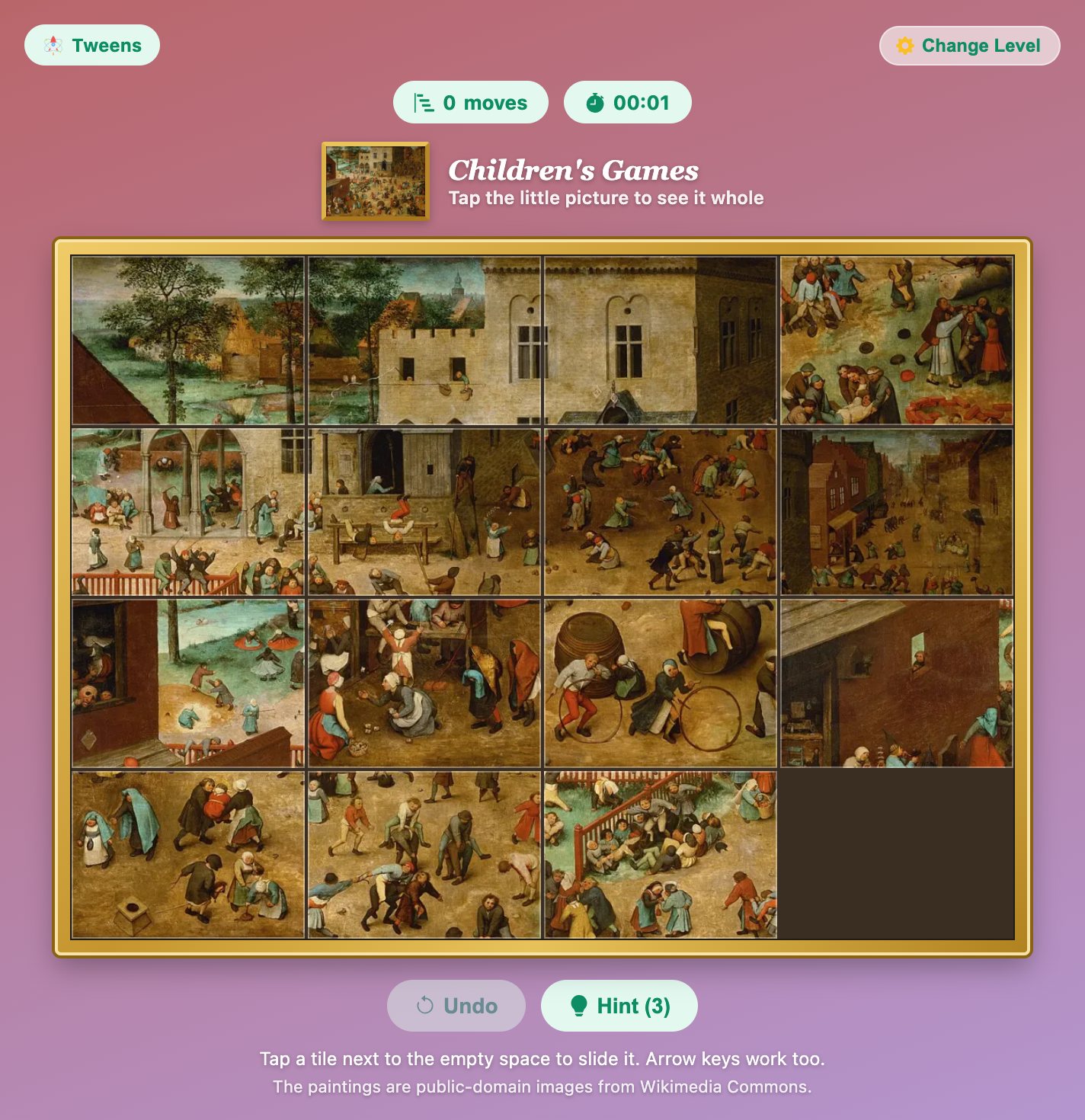
Children’s Games by Pieter Bruegel cut into 15 mixed-up tiles in Masterpiece Slider for tweens
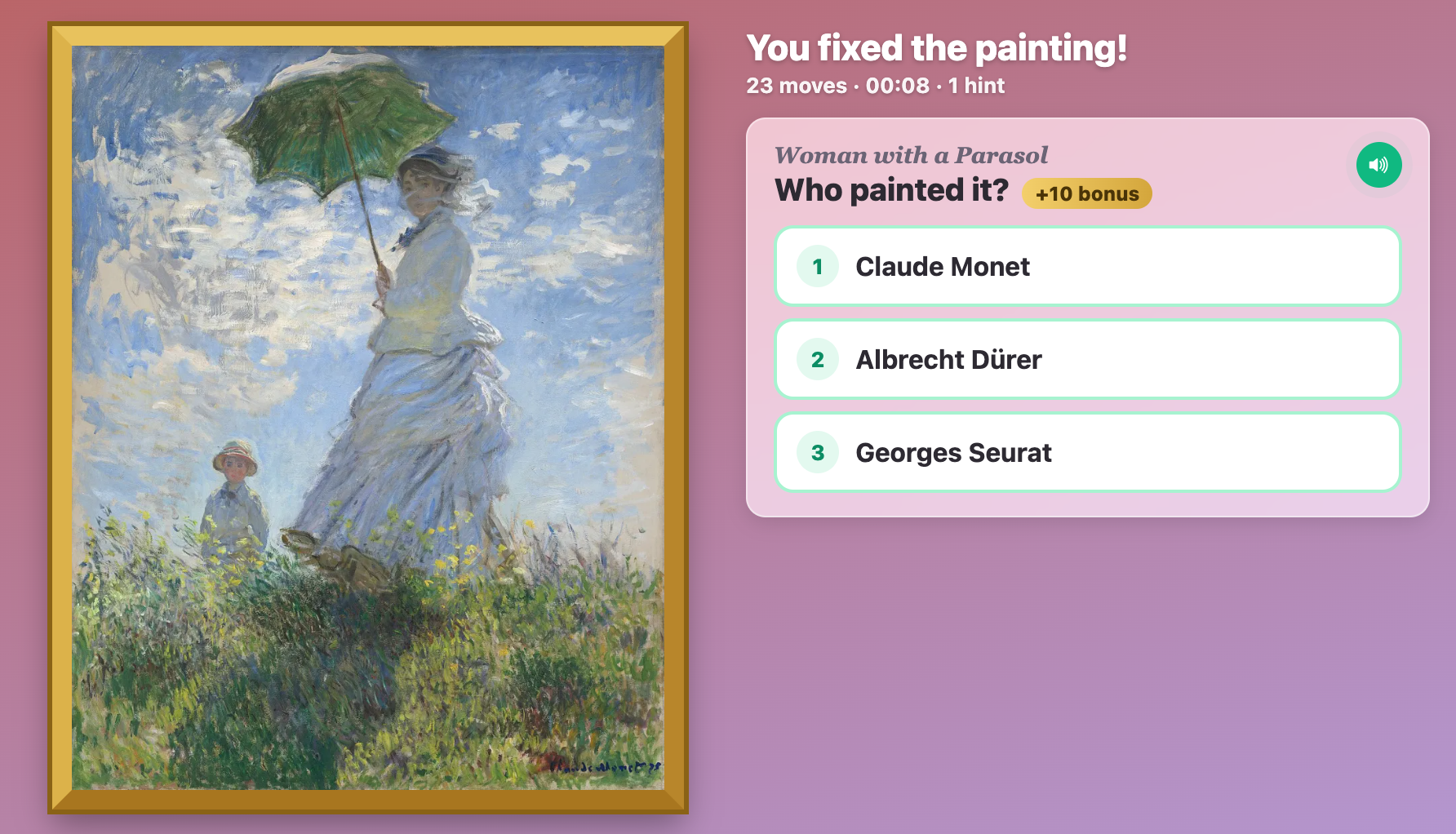
The fixed Woman with a Parasol in a gold frame, with a Who painted it? question and three artist choices
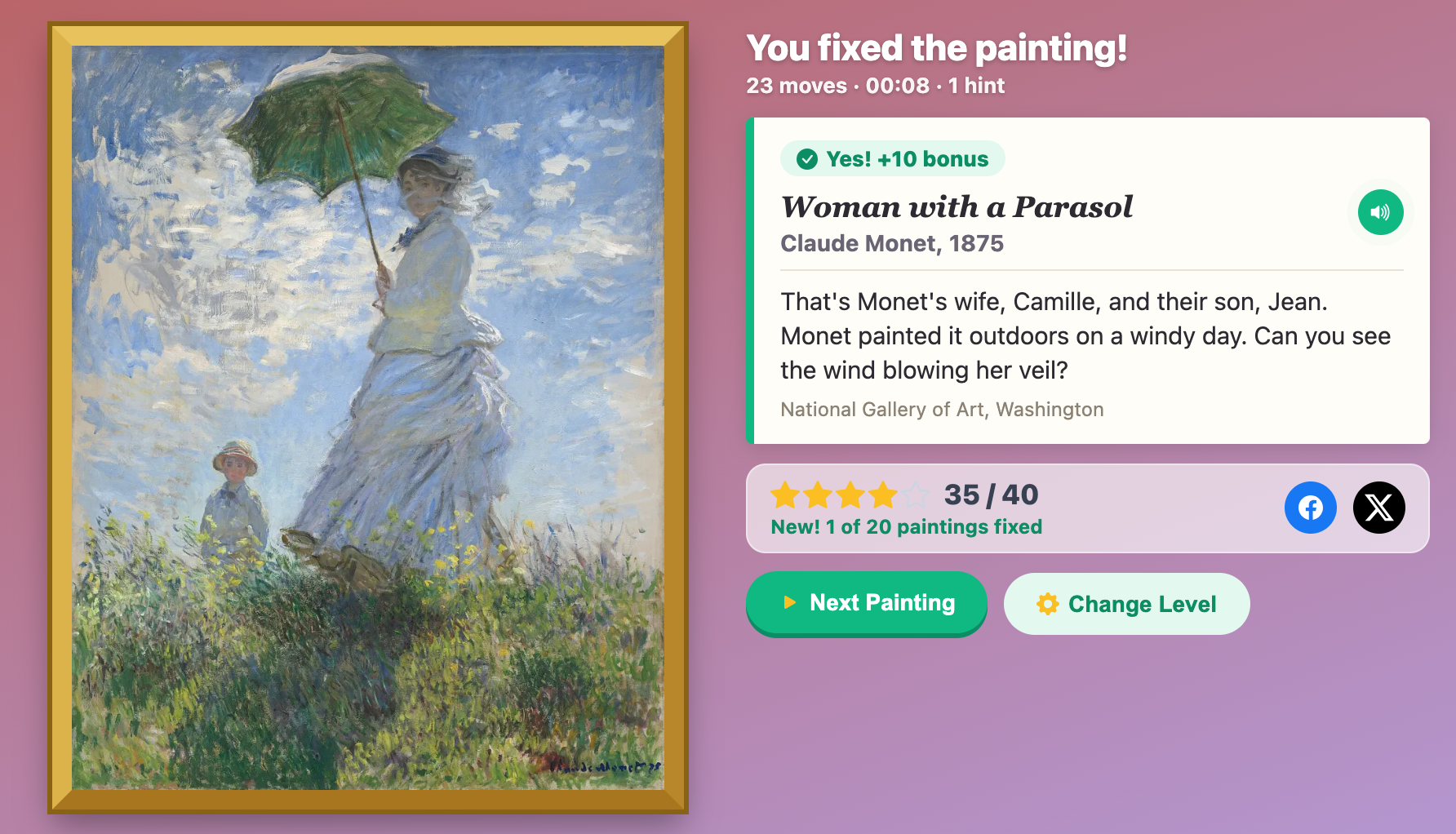
The museum label for Woman with a Parasol by Claude Monet, with a 35 out of 40 score and four stars
More Art Games
 1.8M plays
4.9
Color & Draw
A free-drawing canvas with colors and brush sizes to unleash your creativity.
 154.5K plays
5.0
Mood Palette
Decide which color best fits a mood or theme before time runs out.
 584.9K plays
5.0
Tiny World Builder
Start with a tiny empty island and build your own blocky village — plant grass and trees, lay roads, and unlock houses, farms, a school and more!
 174.6K plays
4.9
Color Mixing
Look at two paint colors and pick which color they mix together to make.
Most Played Games
1.8M plays
4.9
Color & Draw
A free-drawing canvas with colors and brush sizes to unleash your creativity.
 59.5K plays
4.8
Recycling Sort
Sort everyday items into the Recycle, Compost, or Trash bin before time runs out!
 365.8K plays
5.0
Tic-Tac-Toe
Play a game of Tic-Tac-Toe against the computer and see if you can outsmart it.
 274.1K plays
5.0
Sentence Builder
Pick your age level, then tap the shuffled words in the right order to build the sentence.
Comments (18)