
Science Moto Race
97.3K playsPick your racer and ride your scooter through the lane with the right science answer! Choose a bunny, kitty, panda or frog, pick your science (animals, my body, weather, plants, space, matter, living things, Earth or energy), then race three rivals down a winding road. Every right answer makes you faster, and every wrong one lets a rival pass you.
Science Moto Race for kids is a free scooter race where science facts are the fuel. You ride a cute animal on a scooter down a winding road, and ten times a race a gate rolls up with a science question and one answer on each sign. Ride through the lane with the right answer, and your scooter speeds up. Miss it, and a rival zooms past.
The questions cover animals, your body, weather, plants, space, matter, living things, Earth and energy, and they grow with your child across four age levels, from "Which animal says moo?" for toddlers to "A ball held high above the ground has stored…" for tweens. It runs in the browser on computers, tablets and phones, with no download and no sign-up.
🛵 Science Moto Race for Kids: Ten Gates on One Winding Road
Every race is one road from the start line to the checkered flag. You ride against three other racers, and between you and the flag stand ten gates. A gate is a big pink bridge across the road with a sign hanging over each lane. Each sign holds one answer, and a white plate at the top of the screen holds the question.
Your job is simple to say and fun to do: read the question, find the right sign, and steer into the lane under it before the gate stops. The game then checks which lane you are in. That is the whole rule. Speed, boosting and braking only change how the race looks on the way. Your answers decide where you finish.
🚪 The gate that rides along with you
Words on a far-away sign are hard to read, so the gates in this game move. When your scooter gets close, the gate starts rolling on golden rails just ahead of you, at your own speed, for about ten seconds. The signs stay big and steady while you read. Then the gate stops at its real spot, you ride under it, and the answer is checked.
The road under a rolling gate is kept straight and flat, so the words never bounce around on a hill or swing round a bend.
🧪 The science on the signs
On the setup screen you can choose Mixed for a bit of everything, or one topic to practice. The topics depend on the level:
Toddlers: 🐾 Animals, 👀 My Body, 🌦️ Weather.
Preschool: the same three, plus 🌱 Plants.
Elementary: 🐾 Animals, 🌱 Plants, 🪐 Space, 🧊 Matter.
Tweens: 🔬 Living Things, 🪐 Space, 🌋 Earth, ⚡ Energy.
Toddlers and preschoolers see three lanes with a picture above each word, like 🐄 Cow or ☀️ The sun, so a child who can't read yet can still pick by picture. Elementary kids and tweens get four lanes and word answers, some of them a few words long.
🧭 Setting Up and Riding Your First Race
Pick your level, racer and science. The setup screen has three steps: 1. Pick your level (Toddlers, Preschool, Elementary or Tweens), 2. Pick your racer (Bunny, Kitty, Panda or Froggy, each on a scooter of their own color) and 3. Pick your science. The three racers you don't pick become your rivals. The game remembers your choices for next time.
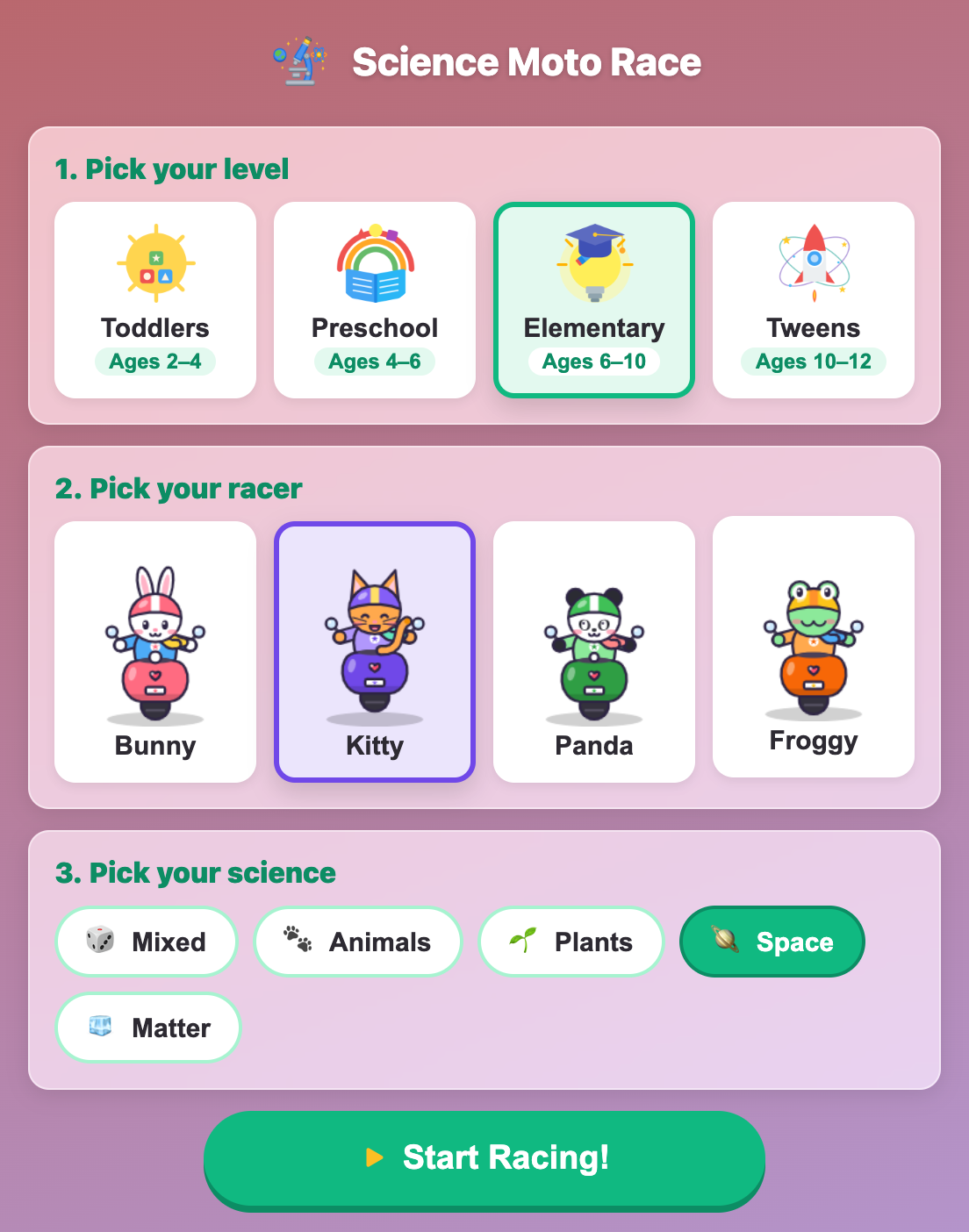
Tap Start Racing! A countdown goes 3, 2, 1, GO!, and everyone rolls off the line. The first gate comes sooner than the others, so get ready to read straight away.
Steer. Hold the ← and → arrow keys (or A and D), tap the green arrow buttons under the road, or press and hold the road beside your scooter. Even faster: press 1, 2, 3 or 4 to ride straight to that lane, counting from the left.
Watch for the gold frame. The sign over the lane you are riding in gets a gold edge. If the gold edge is on your answer, you're set.
Listen if you like. When the site's sound is on, each question is read aloud as its gate starts rolling. You can also tap the question plate (or its 🔊) to hear it again. For toddlers and preschoolers, the answers are read out too, from left to right.
Use Boost and Brake. Hold ↑ or the yellow Boost button to go faster, and hold ↓ or the red Brake button to slow down. Press Space, or the Pause button, to stop the race and take a break.
Keep an eye on the numbers. Above the road you see your points and which gate you're on (like Gate 3 / 10). On the road you see your place (like 2nd of 4) and your speed.
Cross the flag. After the tenth gate there is a short dash to the finish. Then a result card shows your medal, your gates right and your score. Tap Race Again for the same setup, or Change Setup to try a new racer, level or topic. The page's own buttons turn the music on or off, make the game fullscreen, or reload it.
⚙️ What a Right Answer Does, and What a Wrong One Does
A right answer makes your scooter cruise a little faster for the rest of the race, tops up your boost tank, sends up a shower of sparkles, and puts a happy face on your racer. The plate shows the right answer in green.
A wrong answer makes your scooter wobble and slow down, and your cruising speed drops a step. The plate still shows the right answer, so you learn it before the next gate.
The place you finish in follows one clear rule:
0 wrong answers: you finish 1st.
1 wrong: 2nd.
2 wrong: 3rd.
3 or more wrong: 4th.
Your rivals don't answer questions. They ride ahead of you at the start, and as the gates go by they slowly settle into the places your answers have earned. That's why holding Boost the whole race won't steal a win, and braking to read won't cost you one. Being careful really pays off here.
🏁 Riding Tips From the Science Lab
1. Read the question first, the signs second
It's tempting to look at the signs and grab the word you know. But the question decides what's right. "Which planet is the hottest?" and "Which planet is closest to the Sun?" have different answers. Read the plate all the way to the end, then look at the signs.
2. Slow down when the words get long
The rolling gate keeps pace with you, so when you hold Brake, the gate slows down too and you get more time to read. This matters most for tweens, whose answers can be as long as "Potential energy" or "The ozone layer". There is no penalty for braking. Your place only depends on your answers.
3. Spend boost on the empty road
Your boost tank holds about three seconds of boost and refills slowly on its own, plus a big top-up every time you answer right. Boosting while a gate is rolling just makes the gate roll faster and gives you less reading time. Use boost on the open road between gates, when there is nothing to read. Boost turns off once the last question is done.
4. Use the number keys for a clean lane change
Pressing 1 to 4 sends your scooter to the middle of that lane on its own. That's safer than steering by hand when you are busy reading, because you can't drift onto the line between two lanes.
5. Stay on the purple road
If you steer off the edge onto the grass, your scooter slows to less than half its speed and boost won't work. The game gently steers you back, but it's quicker never to leave the road.
6. Think about what the thing is made of, or what it does
Many science questions can be solved by thinking, not just remembering. "Which material carries electricity well?" Wires are made of metal, and only one sign is a metal. "Which tool makes small things look bigger?" Think about what a ruler, a scale and a thermometer each measure. The one left over must be right.
7. Watch out for look-alike words
Science words can sound alike. An astronaut travels into space, but an astronomer studies the sky. A seed germinates when it sprouts, but water evaporates. When two signs start the same way, slow down and read the whole word.
8. Practice one topic before you mix
If Space questions keep tripping you up, choose Space on the setup screen and race only Space gates for a while. Once you finish 1st, switch back to Mixed. The Practice these again list on the result card shows every question you missed, with its answer, so you know exactly what to work on.
🔬 From Turtles to Copper: Real Gates, Worked Out
Toddlers: "Which animal has a shell on its back?"
Three picture signs: 🐢 Turtle, 🐶 Dog and 🐦 Bird. Look at each picture and ask, "Can it hide inside a shell?" A dog has fur and a bird has feathers. Only the turtle carries its house on its back. Ride to the turtle!
Preschool: "What makes a puddle dry up?"
The signs might show ☀️ The sun, 🌙 The moon and 🌈 The rainbow. Think about when puddles disappear: on a hot, sunny day. The sun warms the water and it slowly goes up into the air. The moon and the rainbow don't make anything warm, so the sun is the answer.
Elementary: "How long does Earth take to go around the Sun once?"
Four signs: One week, One hour, One day and One year. Here's a clue: one trip around the Sun takes us through all four seasons, from summer to winter and back. That can't happen in a week. The trick is One day, because one day is how long Earth takes to spin around once. Going around the Sun takes One year.
Elementary: "Ice is water in which state?"
The choices are Solid, Liquid, Gas and Plasma. A state is the form something is in. Ice keeps its own shape, and you can hold it in your hand. Things that keep their shape are solids. Water you pour is a liquid, and steam is a gas.
Tweens: "Which material carries electricity well?"
Wood, Copper, Rubber and Plastic. Look at a phone charger cable: the outside is soft plastic or rubber, so it's safe to touch. The inside is shiny metal wire, usually copper. Plastic, rubber and wood are what we use to stop electricity. Copper is the one that carries it.
Tweens: "A ball held high above the ground has stored…"
Potential energy, Kinetic energy, Sound energy or Electrical energy. The ball isn't moving yet, so it doesn't have kinetic energy (the energy of moving). But if you let go, it will fall. That energy waiting to happen is potential energy, the stored kind.
🎯 Science Moto Race for Toddlers, Preschoolers, Elementary Kids and Tweens
🐣 Science Moto Race for toddlers (ages 2–4)
Toddlers answer questions about animal sounds, body parts and the weather, with three big picture signs per gate and the gentlest, slowest road. Questions and answers are read aloud when sound is on. A grown-up can press the number keys while the child points at the answer, and both of you cheer when the sparkles fly.
🌈 Science Moto Race for preschoolers (ages 4–6)
Preschoolers add Plants and harder questions, like "What does a plant need to grow?" or "Which sense tells you a lemon is sour?" There are still three lanes with pictures and read-aloud answers, so early readers can match the words they hear to the words they see.
📚 Science Moto Race for elementary kids (ages 6–10)
Elementary riders get four lanes, word-only answers and the topics schools teach in these years: animal groups, plant parts, the planets and the states of matter. The road is a little faster, and the choices are closer together, so careful reading counts.
🚀 Science Moto Race for tweens (ages 10–12)
Tweens race the fastest road with questions about cells, DNA, rocks, the atmosphere, forces and energy. Answers can be several words long, so the Brake button becomes a real tool. It's a quick, fun way to review before a science test.
⭐ Medals, Points and Stars
Each right gate is worth 10 points, so a perfect race scores 100. Your medal shows your place, and the stars on the result card come from your score: 90 or more earns 5 stars, 70 or more earns 4, 50 or more earns 3, 25 or more earns 2, and every finished race earns at least 1. If you have a KidWorld account, your points are added to your stars and progress. You can also play as a guest.
🌱 What Kids Learn Between the Start and the Flag
Real science facts, again and again. Each level has a large bank of hand-written questions, so kids meet the same ideas in new ways across many races.
Reading with a purpose. The answer is right there on the sign, but only if you read the question carefully first.
Calm under a little pressure. Kids learn that slowing down to think is smart, because the game rewards right answers, not rushing.
Learning from mistakes. Every wrong answer shows the right one at once, and the practice list keeps it for after the race.
If your child loves this race, English Moto Race has the same scooters with spelling, rhyme and grammar gates.
For the same science questions on a running path above the clouds, try Science Temple Escape.
🧑🔧 For parents and teachers
Science Moto Race has no crashes, no scary moments and nothing to buy. The racers are smiling animals, the road has a rainbow and flowers with faces, and a wrong answer only means a little wobble. Every wrong option was chosen so it is wrong in every reading of the question, so children never get marked wrong for a fair answer. A race takes about five minutes, which fits nicely into a short break.
Helmets on, racers! Pick your animal, pick your science, and see if you can win Science Moto Race for kids with all ten gates right. Prefer four wheels? Science Car Race asks the same kind of questions from a go-kart. 🛵🏁
🖼️ See the Game in Action
The Science Moto Race setup screen with the Elementary level, Kitty the racer and the Space topic picked
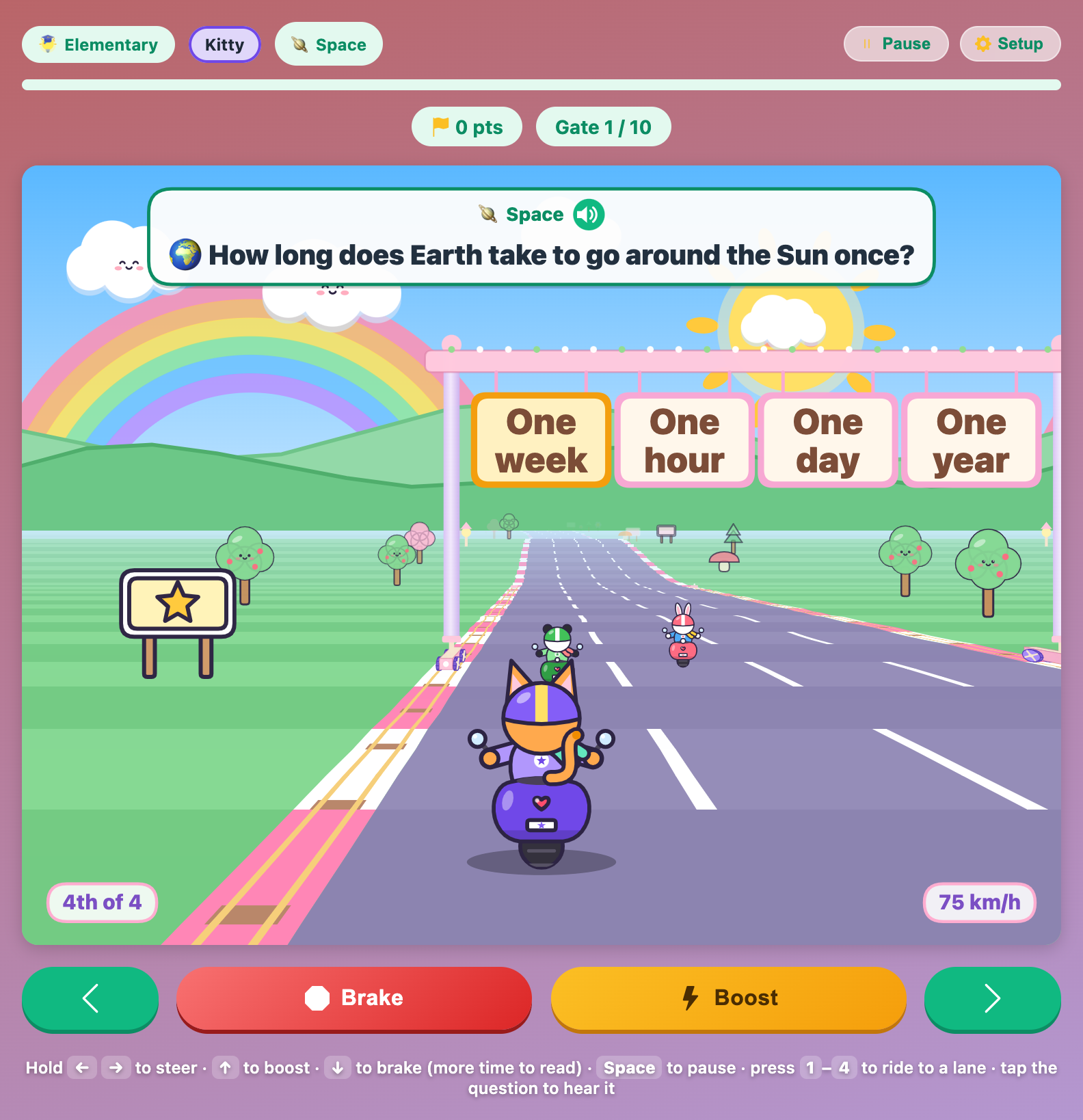
Kitty riding toward a sliding gate that asks how long Earth takes to go around the Sun in Science Moto Race for kids
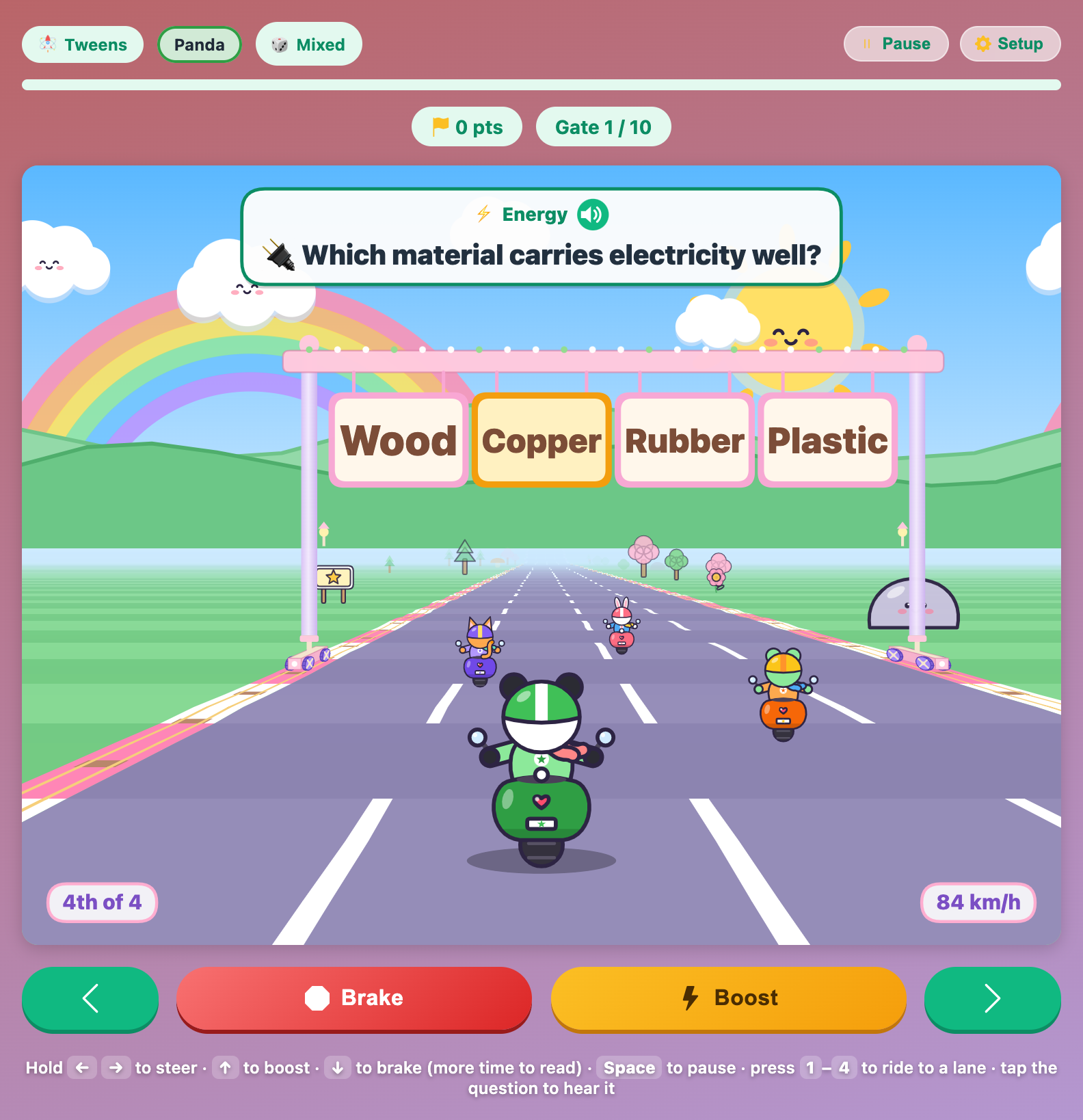
Panda on a scooter under a tweens gate asking which material carries electricity well, with Copper in a gold frame
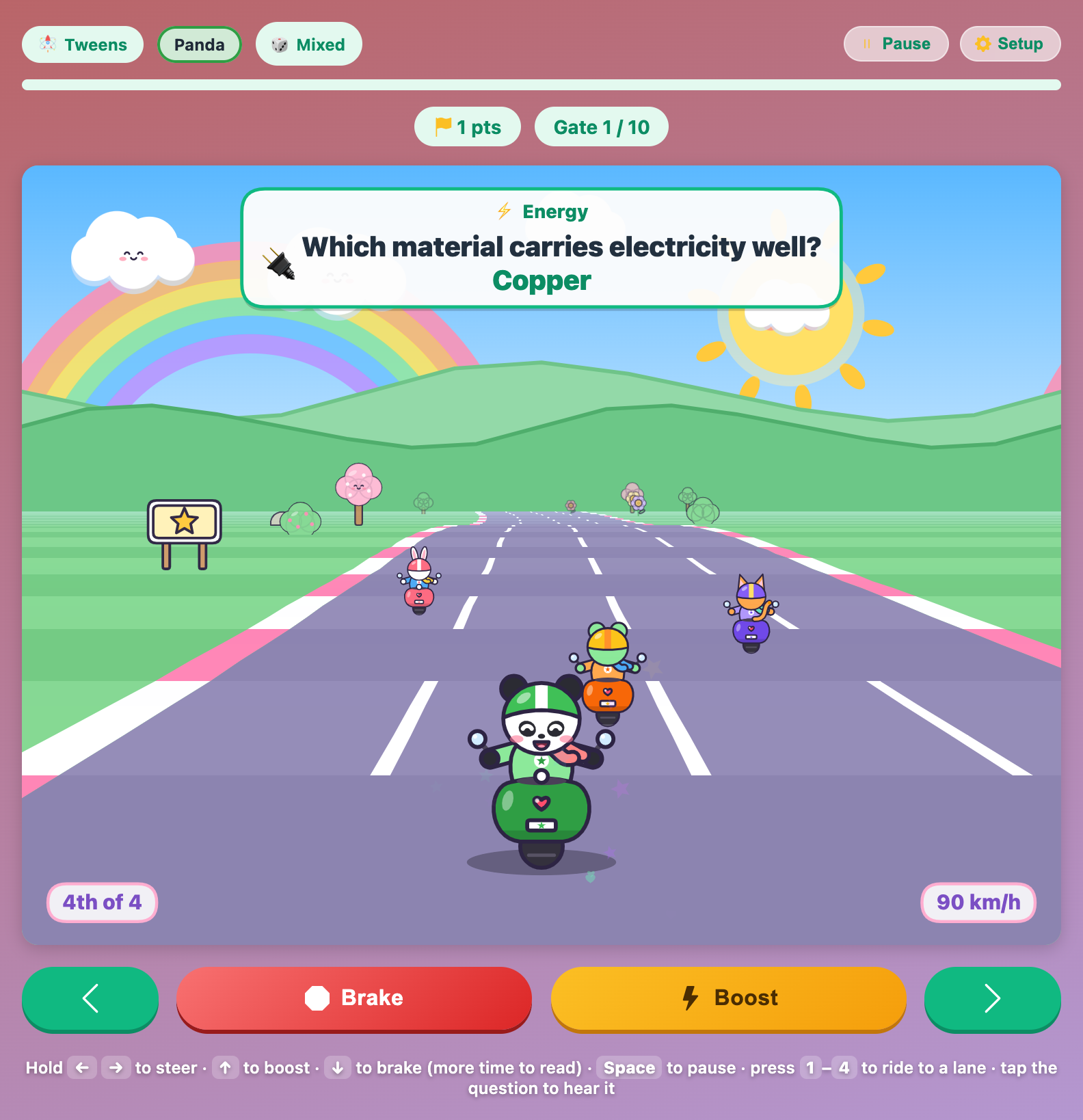
The question plate showing Copper in green after Panda rode through the right lane in Science Moto Race for tweens
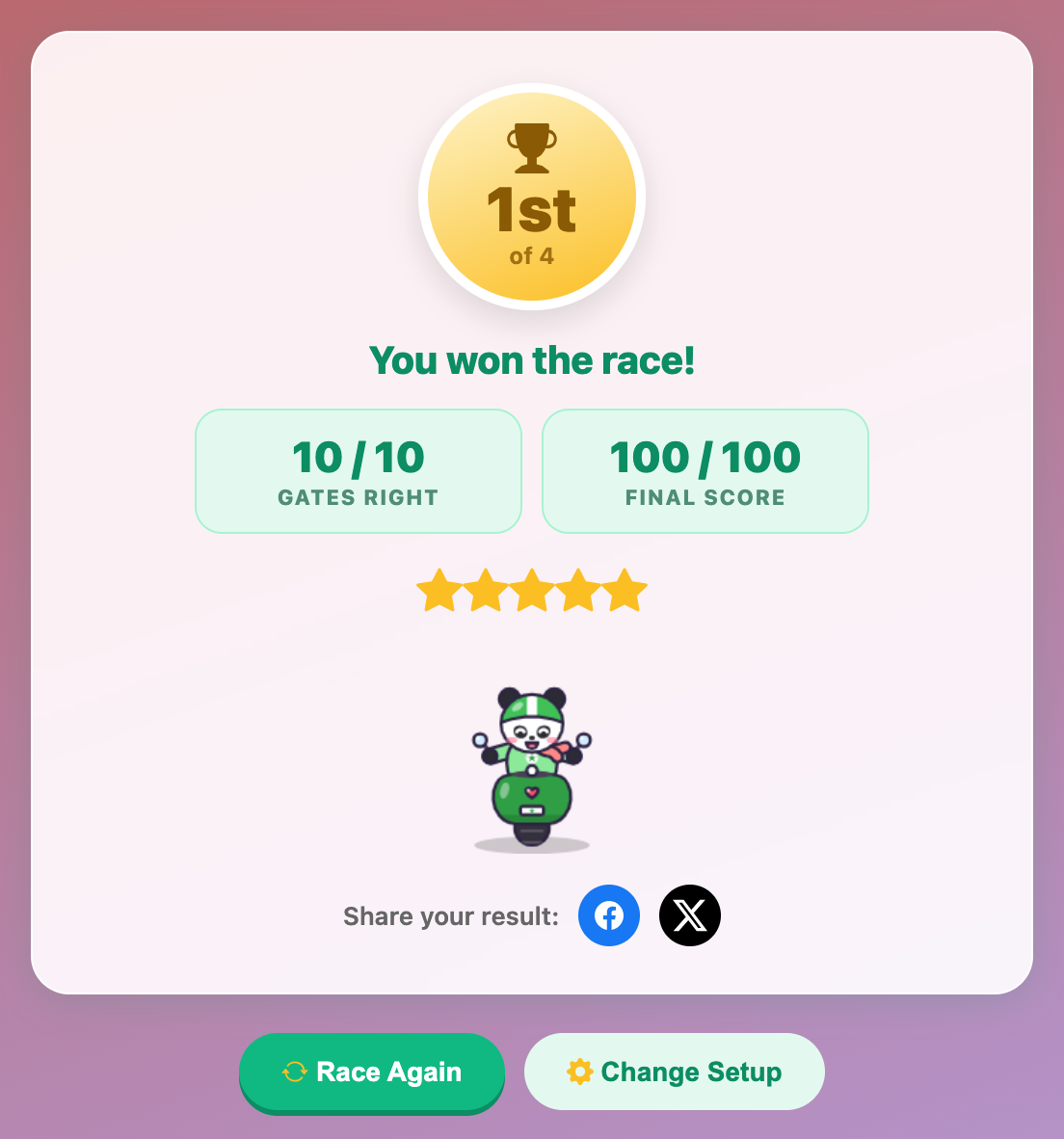
The Science Moto Race result card with a gold 1st of 4 medal, 10 of 10 gates right and 100 points
More Science Games
 59.5K plays
4.8
Recycling Sort
Sort everyday items into the Recycle, Compost, or Trash bin before time runs out!
 85.7K plays
4.9
Grow a Plant
Plant seeds in sunny and shady garden beds, then water, feed and protect them day by day. Watch the roots grow underground and harvest sunflowers, tomatoes, carrots and more!
 438.6K plays
4.9
Magnet Experiment
Guess which objects a magnet will pull, then drag the magnet to test every guess. Does gold stick? Does a battery?
 386.9K plays
4.9
Five Senses Match
Decide which of your five senses you would use for each everyday scene before time runs out.
Most Played Games
 1.8M plays
4.9
Color & Draw
A free-drawing canvas with colors and brush sizes to unleash your creativity.
59.5K plays
4.8
Recycling Sort
Sort everyday items into the Recycle, Compost, or Trash bin before time runs out!
 365.8K plays
5.0
Tic-Tac-Toe
Play a game of Tic-Tac-Toe against the computer and see if you can outsmart it.
 274.1K plays
5.0
Sentence Builder
Pick your age level, then tap the shuffled words in the right order to build the sentence.
Comments (46)