
Number Bond Rockets
626.3K playsFuel up the rocket and count down to blast-off! The rocket needs exactly 10 fuel, one booster already has 7, so which tank fills it up? Pick the right one and watch the gauge fill to the top, then 3, 2, 1, blast off! Too little fuel and the rocket sputters, too much and it spills over. Little ones make 5, preschoolers make 10, and older kids make 20, 100 and even 1000.
A rocket can't fly on half a tank, and it can't fly on too much fuel either. In Number Bond Rockets for kids, you fill each rocket with exactly the right amount. The rocket needs 10 fuel, one booster already holds 7, so which tank do you pick? It is a free number bonds game for children from about 2 to 12, and it practices the "how many more make it?" kind of math: bonds of 5 and 10 for little ones, and bonds of 20, 100 and even 1000 for big kids.
Pick the right tank and the fuel gauge fills to the very top. Then the big numbers count down, 3, 2, 1, and the rocket blasts off to the Moon, to Saturn or to visit an alien friend. Pick a wrong tank and the rocket shows you what went wrong: it sputters when the fuel is too little and spills over when it is too much. You play right in your browser, on a computer, tablet or phone. There is nothing to download, no sign-up, and no clock.
🚀 Number Bond Rockets for Kids: The Rocket Is the Math
A number bond is a number split into two parts. The big number is called the whole. The two smaller numbers are the parts. Put the parts back together and you get the whole again. For example, 7 and 3 are the parts of 10, because 7 + 3 = 10.
In school, a number bond is often drawn as three circles joined by lines: the whole on top and the two parts below. Look closely at the rocket in this game. It is that same picture! The round window on the rocket, called the porthole, shows the whole. Two thin bars run from the porthole down to the two side boosters. Those boosters are the parts.
The porthole shows how much fuel the rocket needs, like 10.
The orange booster shows the part you already have, like 7.
The dashed booster is empty. It shows a blinking ?. That is the part you must find.
Next to the rocket stands a tall fuel gauge. It shows the same thing in squares. The orange squares at the bottom are the fuel you already have. The empty squares above them are the fuel you still need. The card at the top says it two ways, as a sum like 7 + ? = 10 and in words, "7 and how many make 10?"
Finding the missing part is the same as a take-away sum: 10 − 7 = 3. So every rocket you fuel is quiet practice for both adding and subtracting.
🛠️ Launch Day, Step by Step
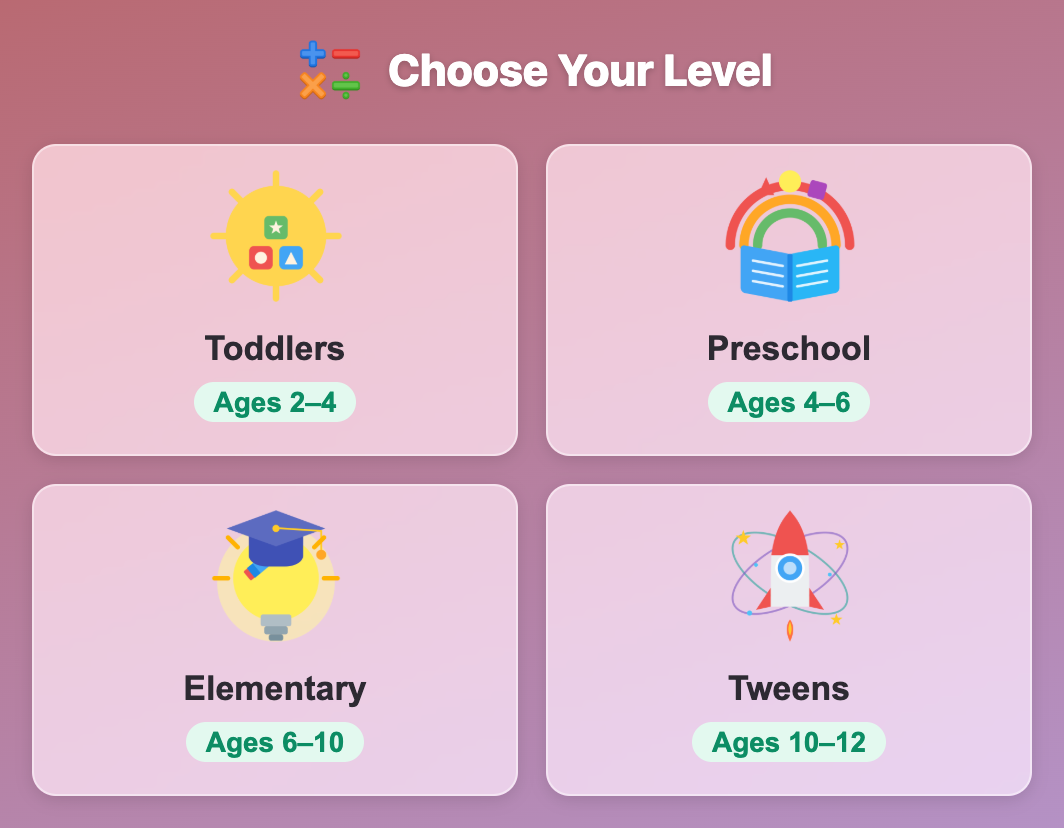
Pick your level. The Choose Your Level screen has four cards: Toddlers (ages 2–4), Preschool (ages 4–6), Elementary (ages 6–10) and Tweens (ages 10–12). If the game opens straight into a rocket, tap Change Level at the top right to see this screen.
Read the rocket. Look at the number in the porthole, then at the orange booster. The card says the question, like "6 and how many make 10?" The flag at the top shows which rocket you are on, like 1 / 10.
Tap a fuel tank. Blue fuel tanks sit in a row under the sky, always in order from smallest to biggest. Toddlers get 3 tanks, and each one also shows its number as little fuel drops you can count. Every other level gets 4 tanks.
Watch the fuel go in. If your tank is wrong, it turns grey, and its fuel pours into the gauge for a moment so you can see the mistake. Then the fuel drains away and you try another tank. You can keep trying until the rocket is full.
Blast off! The right tank turns green. The gauge glows green all the way to the top, and the card shows the whole sentence, like "Full tank! 6 and 4 make 10." Then comes the countdown, 3, 2, 1, "Blast off!", and the rocket flies up out of the sky in a cloud of smoke.
Fly the next rocket. A Next Rocket button appears. It slowly fills up and counts down from 5, then moves on by itself. Tap it, or press Enter or Space, to go sooner. Each rocket has a new color and a new trip: the Moon 🌙, Saturn 🪐, the stars ⭐, a comet ☄️, a space station 🛰️ or an alien friend 👽.
Use the 🔊 buttons. One sits beside the question and one beside the tip. Tap them to hear the words read aloud. When the site's sound is on, the game can also read the questions and tips by itself, and say the countdown with you.
See your score. After the last rocket, the button says See My Score. The All Rockets Launched! card shows how many rockets flew, how many you fuelled on the first try, your score out of 100 and up to 5 gold stars. Then pick Play Again or Choose Another Level.
Use the page buttons. The buttons around the game make it fullscreen, reload it for a fresh start, or turn the music on and off.
How the stars are counted
The ⭐ next to the flag counts the rockets you fuelled with the very first tank you tapped. A rocket you fix on the second try still flies, but it doesn't add a star. Your final score is the share of first-try rockets, out of 100. Fuel 9 of 10 rockets first try and you get 90, which earns all 5 gold stars. On the Toddlers level there are 8 rockets, so 7 of 8 gives 88 and 4 stars.
💨 Sputter or Spill? Reading a Wrong Tank
A wrong tank is not a dead end in this game. It is a clue! Watch the rocket and the gauge, because they tell you which way to go.
Not enough fuel: the rocket sputters
The rocket shakes, its flame flickers, and little puffs of smoke pop out. The empty part of the gauge glows, so you can see the gap that is still missing. The empty booster turns red with your number in it. The tip says something like "Not enough fuel! 14 + 5 = 19. We need 20." That means the right tank is bigger than the one you tapped.
Too much fuel: the rocket spills over
The rocket wobbles, the extra fuel shows as red stripes, and a red badge pops up over the gauge, like "+2 too much!" The tip says "Too much fuel!" and shows the sum. That means the right tank is smaller. The badge even tells you how much smaller.
Special tips for sneaky mistakes
Some wrong tanks are mistakes that real kids make a lot, so the game has a special tip for each one:
"Count the empty squares!" for small bonds up to 10.
"That only makes 10: add another 10!" when you made 10 but the rocket needs 20.
"Count in tens!" when you picked 7 but needed 70.
A new ten tip for big kids, like "9 + 1 make a new ten, so you need only 4 more tens."
🧑🚀 Mission Control Tips: Fuel Every Rocket on the First Try
These tips go from the easiest to the cleverest. Each one works with the real rockets, tanks and gauges in Number Bond Rockets for kids, at the level where you need it.
1. Read the porthole, then the booster
Always start with the two numbers you know. The porthole is the whole, and the orange booster is one part. Say it in your head: "The rocket needs 10. It has 6." Now the question is clear: how far is 6 from 10?
2. Count the empty squares
On the small bonds, every square in the gauge is worth 1. The orange squares are the fuel you have. The empty squares are exactly the fuel you need. So you don't have to do any sum at all. Just count the empty squares, and tap the tank with that number. This is the best trick for little ones.
3. Watch out for the copycat tank
On the bonds up to 10, one of the tanks often shows the same number as the orange booster. If the rocket needs 5 and has 2, a tank with 2 may be there too. It's easy to tap the number you just looked at, but 2 + 2 is only 4. Check the gauge before you tap.
4. Learn the pairs that make 10
There are only nine pairs that make 10: 1 and 9, 2 and 8, 3 and 7, 4 and 6, 5 and 5, and the same pairs turned around. Learn them like a song, and every preschool rocket becomes quick. They also help with all the bigger bonds below. If you want more practice with 10, Ten Frame Fill lets you tap counters into a frame of 10 squares and count the empty ones.
5. For 20, fill up to 10 first
On the Elementary level, the gauge for 20 has two columns of 10, side by side. If the part is smaller than 10, first find what fills the first column. Then add the whole second column, which is 10 more. So for 4 + ? = 20, think "4 + 6 = 10, then 10 more", and the answer is 16. After you fuel the rocket, the card shows this path under the sum, like "4 + 6 = 10, then 10 + 10 = 20."
If the part is bigger than 10, the first column is already full. Only look at the second column, and count its empty squares.
6. Don't stop at 10 when you need 20
One tank in a bond of 20 is a trap: it only makes 10. With 2 + ? = 20, the tank 8 is right there, because 2 and 8 is a pair you know. But 2 + 8 = 10, and the rocket needs 20. Ask yourself: "Did I fill both columns?"
7. For 100 in tens, think in tens and keep the zero
Every other Elementary rocket needs 100, and the parts are whole tens, like 30. Here the gauge has one column of 10 squares, and each square is worth 10. So 30 is 3 squares. You need 7 more squares, and 7 squares are 70. A tank with 7 on it is waiting to catch kids who forget the zero.
8. The 9 and 10 trick for 100
On the Tweens level, the parts are numbers like 37 or 59. Here is a neat trick. The ones digits must add up to 10, and the tens digits must add up to 9. Why 9 and not 10? Because the ones make a new ten, and that ten is carried over to the tens.
So for 37 + ? = 100: the ones are 7 + 3 = 10, and the tens are 3 + 6 = 9. The answer is 63. Check: 37 + 63 = 100. ✓
The game always puts in one tank where both digits make 10, like 73 for 37. It looks right, but it is 10 too much, because the new ten was counted twice. If you see the "+10 too much!" badge, that's what happened.
9. The 9 and 10 trick for 1000
The other Tweens rockets need 1000, with parts in tens, like 370. The same trick works one place to the left. The tens digits add up to 10, and the hundreds digits add up to 9. For 370, that's 7 + 3 = 10 tens and 3 + 6 = 9 hundreds, so the answer is 630. The trap tank here is 730, which is 100 too much.
10. Or hop to the next round number
Some kids like hops better than digit tricks, and that works too. Hop from the part up to the next ten (or hundred), then hop to the whole. For 59 + ? = 100: 59 + 1 = 60, then 60 + 40 = 100. Add the hops: 1 + 40 = 41. The card shows hops like these after most big rockets, so you can check how you did it. If hopping along numbers is fun for you, Number Line Frog turns hops of +1, +5 and +10 into real frog jumps.
11. Let the tank order help you
The tanks always go from smallest on the left to biggest on the right. So if a tank gives "not enough fuel", the answer is somewhere to its right. If it gives "too much fuel", look to its left. This won't fix a first try, but it helps you find the answer fast on the second.
12. Take your time on the first tap
There is no clock while you choose. The stars only count first tries, not speed. So stop, count, check, and then tap. And when the rocket is fuelled, read the sentence on the card before the Next button moves on. It's a tiny lesson, and it's free!
🔢 Five Launches, Worked Out Together
Here are five real kinds of rockets from the game, one step at a time.
Launch 1: Toddlers, 1 + ? = 3
The porthole says 3, and the orange booster says 1. The gauge has 3 big squares: 1 is orange and 2 are empty. The tanks are 1, 2 and 3, with fuel drops under each number.
Count the empty squares: one, two. That's 2.
Find the tank with 2 drops on it, and tap it.
The gauge fills up, the card says "Full tank! 1 and 2 make 3.", and the rocket counts down to the Moon.
What if you tap 3? The booster turns red with a 3, the gauge gets red stripes, and a "+1 too much!" badge pops up. The tip says "Too much fuel! 1 + 3 = 4. That's more than 3." Now you know to pick a smaller tank.
Launch 2: Preschool, 6 + ? = 10
The gauge is one tall column of 10. Six squares are orange. You might see the tanks 3, 4, 5 and 6.
Count the empty squares: 4. Or remember the pair: 6 and 4 make 10.
Tap 4, and the rocket is full.
The 6 is the copycat tank: 6 + 6 = 12, so it would spill 2 too much. The 3 is just short: 6 + 3 = 9, and the tip says "Count the empty squares!"
Launch 3: Elementary, 2 + ? = 20
The gauge has two columns of 10. In the first column, 2 squares are orange. The second column is empty.
Fill the first column: 2 + 8 = 10.
Fill the second column: 10 more.
Add them: 8 + 10 = 18. Tap 18.
The tank 8 is the trap here. Tap it and the rocket sputters while the second column glows. The tip says "Not enough fuel! 2 + 8 = 10. We need 20. That only makes 10: add another 10!" When you pick 18, the card shows "2 + 18 = 20" with "2 + 8 = 10, then 10 + 10 = 20" under it.
Launch 4: Elementary, 30 + ? = 100
This gauge has 10 squares, and each square is 10. Three squares are orange.
Think in tens: 30 is 3 tens.
3 tens and 7 tens make 10 tens, which is 100.
7 tens is 70. Tap 70, not 7!
If you tap 7, the tip says "Not enough fuel! 30 + 7 = 37. We need 100. Count in tens!"
Launch 5: Tweens, ? + 59 = 100, then 370 + ? = 1000
For the first one, the orange booster is on the right with 59, and the "?" booster is on the left. The tanks could be 31, 40, 41 and 51.
Ones first: 9 + 1 = 10. So the ones digit is 1.
Then tens: 5 + 4 = 9. So the tens digit is 4.
The answer is 41. Check with hops: 59 + 1 = 60, then 60 + 40 = 100. ✓
The 51 is the "both digits make 10" trap. It spills over with "+10 too much!", and the tip explains: "Too much fuel! 59 + 51 = 110. 9 + 1 make a new ten, so you need only 4 more tens."
Now 370 + ? = 1000. Tens: 7 + 3 = 10. Hundreds: 3 + 6 = 9. The answer is 630. Pick 730 and you get "Too much fuel! 370 + 730 = 1100. 70 + 30 make a new hundred, so you need only 6 more hundreds." After the right tank, the card shows "370 + 30 = 400, then 400 + 600 = 1000."
🌍 Which Mission Fits Your Child?
Every level uses the same rocket and gauge, but the numbers grow a lot from one level to the next. Here is what each one asks.
Number Bond Rockets for toddlers (ages 2–4)
The youngest level has 8 rockets with tiny bonds: one bond of 3, three bonds of 4 and four bonds of 5. The empty booster is always on the right, so the picture stays the same each time. There are only 3 tanks, and each shows its number as fuel drops, too. The gauge has one big square for each unit, so a child who can count to 5 can just count the empty squares. A grown-up can point at the squares and count out loud together.
Number Bond Rockets for preschoolers (ages 4–6)
This level starts with two warm-up bonds of 5, then moves to eight bonds of 10. The gauge becomes one column of 10, and there are 4 tanks. Now the empty booster can be on either side, so the sum may read "? + 7 = 10". This is the level for learning the pairs that make 10, which is one of the most useful facts in all of early math.
Number Bond Rockets for elementary kids (ages 6–10)
Here the rockets take turns between bonds of 20 and bonds of 100 in tens, 10 rockets in all. The 20s use a gauge of two columns of 10, like a double ten frame, so kids see why 13 + 7 = 20. The 100s use whole tens like 30 + 70, which shows that the pairs of 10 work for tens, too. Grown-ups who want more take-away practice can also try the Subtraction Quiz, since every missing part here is really a subtraction.
Number Bond Rockets for tweens (ages 10–12)
The top level mixes bonds of 100 with any two-digit part, like 37 + 63, and bonds of 1000 in tens, like 370 + 630. The gauge fills smoothly here, and its 10 squares are only marks to help you guess. This level is all about mental math: making a new ten, making a new hundred, and not counting that ten twice. It's a great warm-up for adding money, finding change, and bigger take-away sums.
🌟 What a Full Tank Teaches
It shows that numbers come apart and go back together. When the orange squares and the blue squares fill the same gauge, kids see that 7 and 3 really are 10. It isn't just a fact to remember. It's a picture.
It joins adding and taking away. "7 and how many make 10?" is the same question as "10 take away 7". Kids who fuel lots of rockets find subtraction much easier, because they already know the parts.
It turns mistakes into clues. A sputtering rocket says "more", and a spilling rocket says "less". The "+2 too much!" badge even says how much less. Kids learn to check their answer and fix it, without feeling bad. Nobody loses, and every rocket flies in the end.
It builds number sense for big numbers. The hop hints under each big rocket, like "59 + 1 = 60, then 60 + 40 = 100", show a smart way to think, not just the answer. Over 10 rockets, kids start to use the same hops in their heads.
It rewards careful thinking. Stars come from first tries, not from speed. With no clock, kids learn that stopping to count is the winning move.
For parents and teachers: is it safe, and what does it practice?
Number Bond Rockets is free and plays in the browser, with no download and no sign-up. Nothing in it is scary: rockets fly to friendly places, and a wrong answer only makes a puff of smoke. There is no timer while your child chooses. It practices number bonds (also called missing addends or "make 10" facts) to 3, 4, 5, 10, 20, 100 and 1000, counting on, subtraction as the missing part, and making a new ten or hundred. The 🔊 buttons read the words aloud, so children who are still learning to read can play, too.
Ready for launch? Pick your level, find the missing part, and send every rocket into space. Number Bond Rockets for kids is waiting on the launch pad, so start the countdown! 🚀
🖼️ See the Game in Action
The Choose Your Level screen in Number Bond Rockets for kids, with Toddlers, Preschool, Elementary and Tweens cards
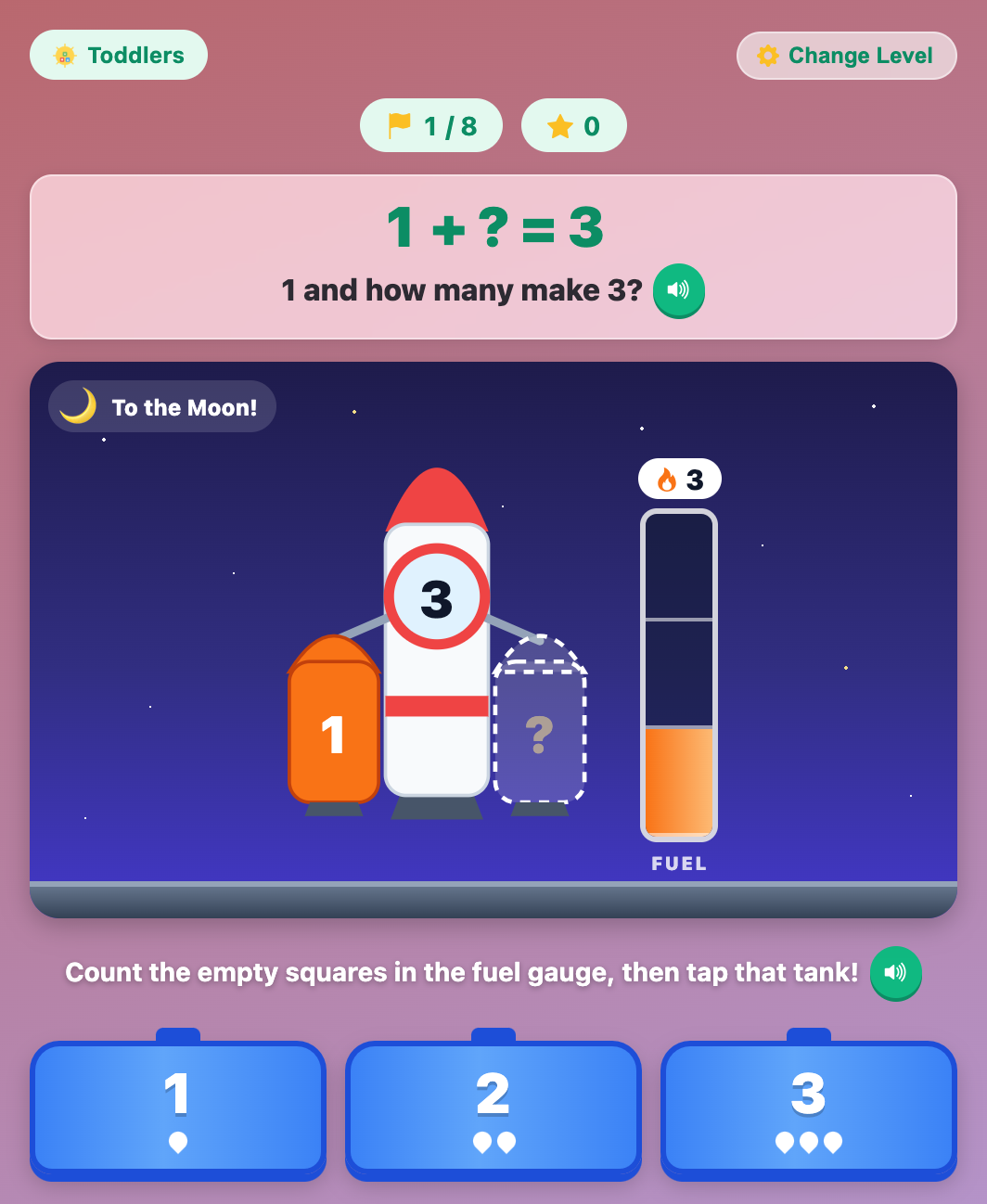
A Number Bond Rockets for toddlers round where the rocket needs 3 fuel, one booster holds 1 and three tanks show fuel drops
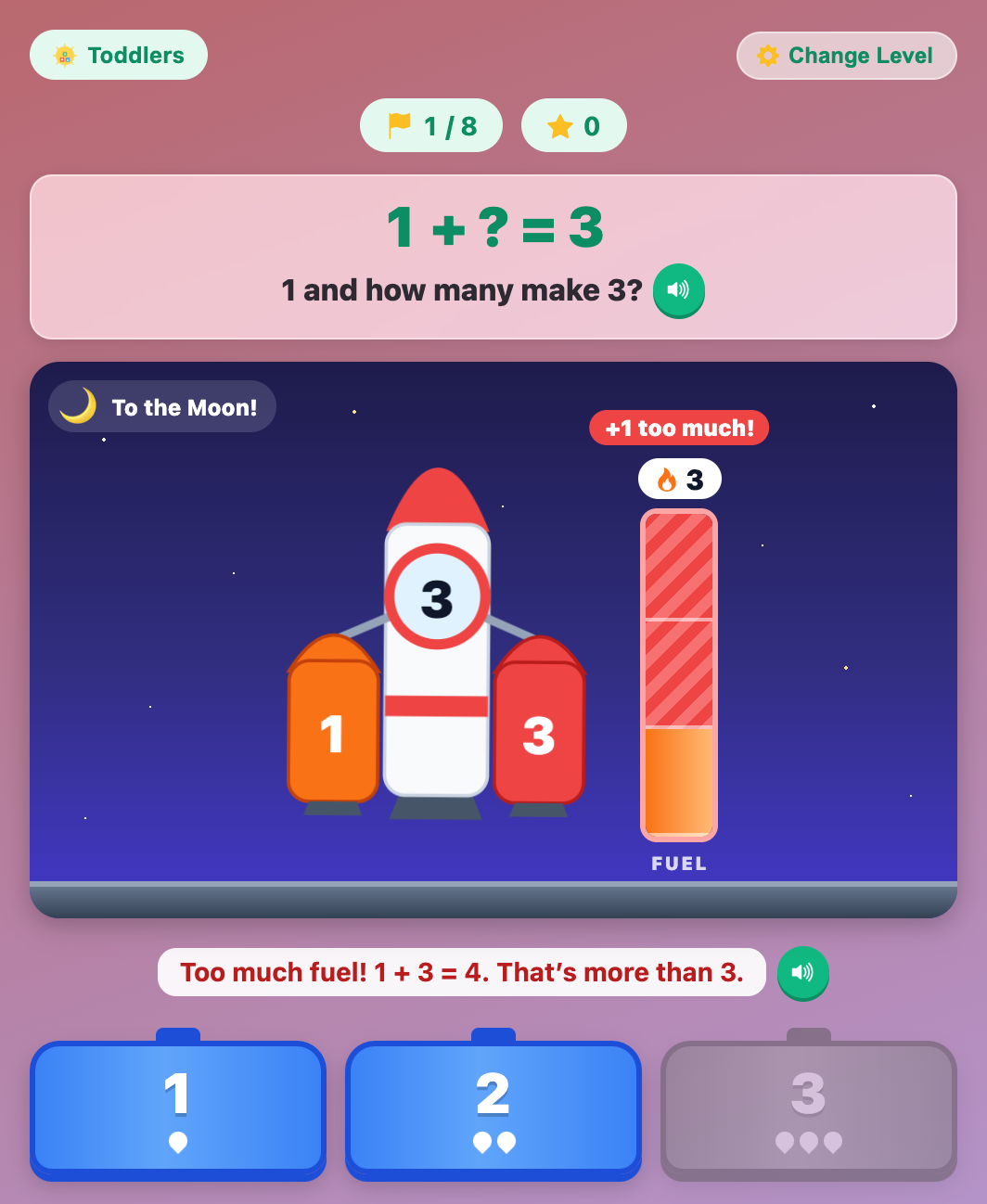
A wrong tank in Number Bond Rockets, with the empty booster turned red with a 3 and a +1 too much! badge over the striped fuel gauge
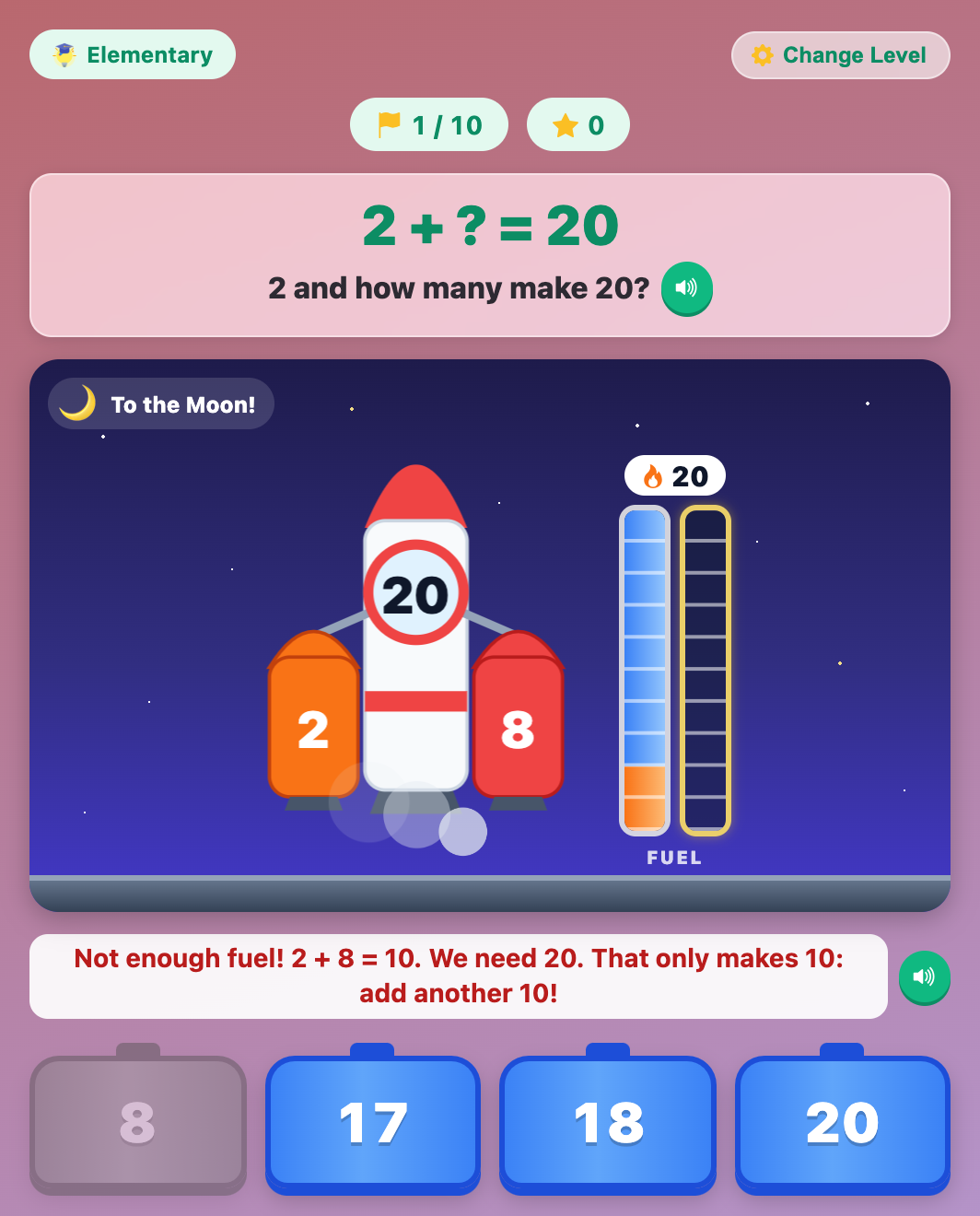
A bond of 20 in Number Bond Rockets where tank 8 only makes 10, so the rocket sputters smoke and the second gauge column glows
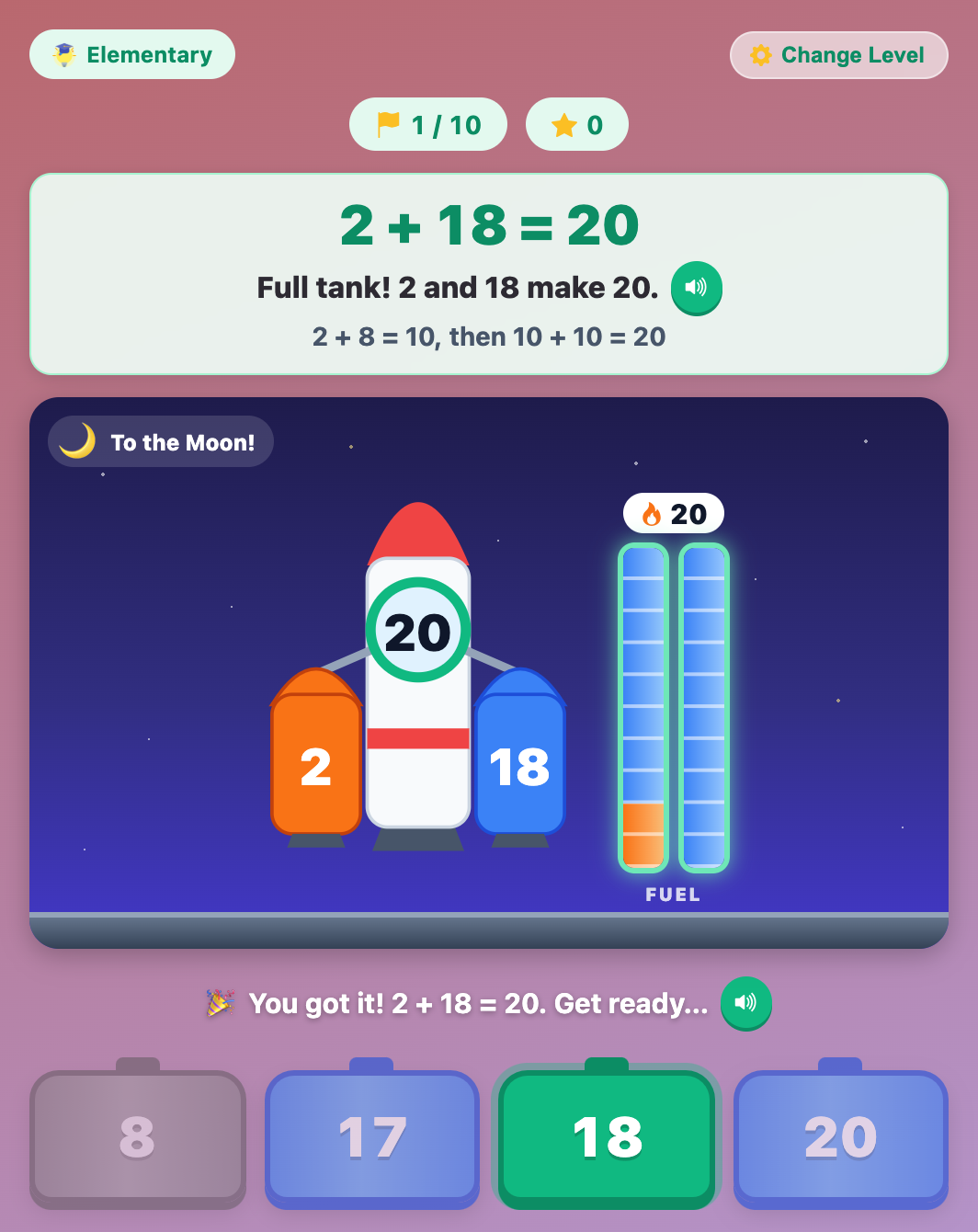
A fuelled rocket in Number Bond Rockets for elementary kids showing 2 + 18 = 20 and the hint 2 + 8 = 10, then 10 + 10 = 20
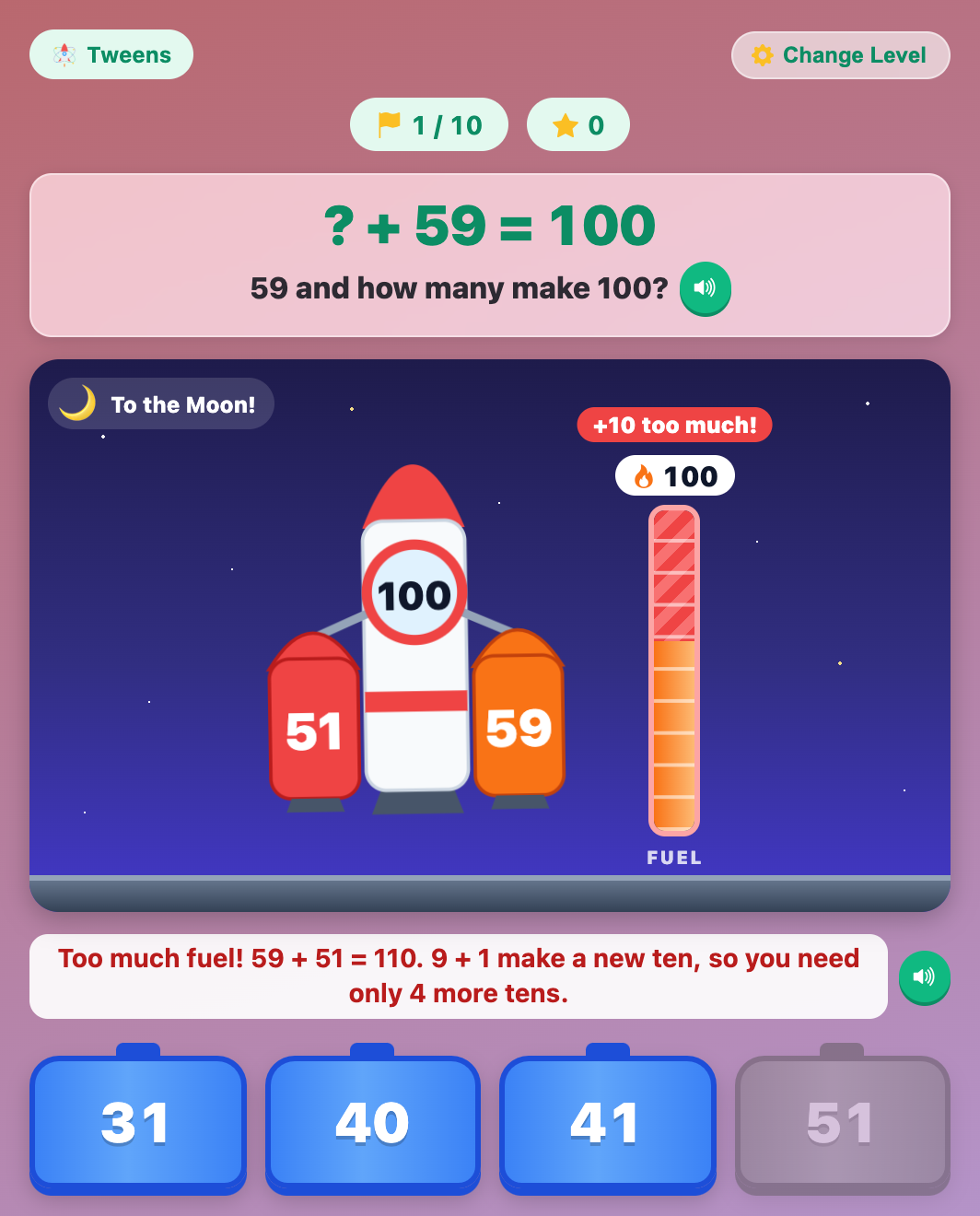
A Number Bond Rockets for tweens bond of 100 where tank 51 spills 10 too much and the tip explains the new ten
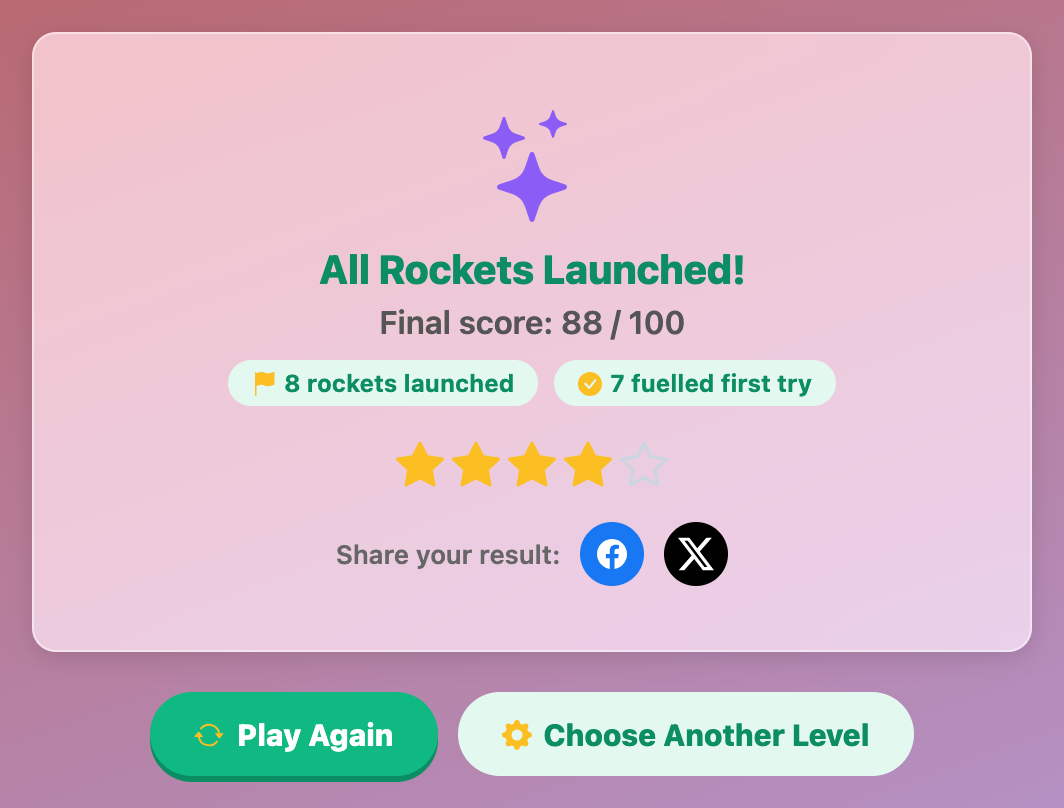
The All Rockets Launched! card in Number Bond Rockets with a final score of 88, four gold stars and a Play Again button
More Math Games
 32.8K plays
5.0
Ten Frame Fill
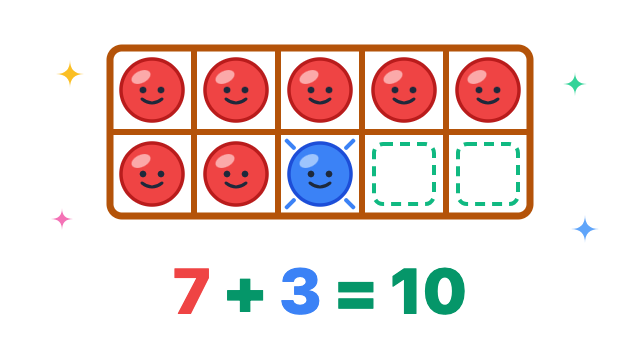
Fill the ten frame with smiley counters! Tap the squares to show a number, then count the empty squares to see how many more make 10. Little ones build numbers up to 10, preschoolers use two frames for teen numbers like 10 + 4 = 14, and older kids fill the top frame first to solve sums like 8 + 5. Every round is a picture, with a friendly voice to read it aloud.
 172.7K plays
5.0
Math Multiplication Moto Race
Pick your age level, then ride your motorbike through the lane with the right multiplication answer — every correct gate makes you faster!
 57.4K plays
5.0
Monster Snack Counter
Feed the hungry monsters! Each monster holds up a number, and you tap or drag cookies into its mouth one by one while they are counted aloud. Stop at just the right number and tap All done: too few and it is still hungry, one too many and it gets a funny tummy ache. Little ones count numbers and dots, and bigger kids feed "1 more than 3", "2 fewer than 6" and little sums like 4 + 3.
 21.4K plays
4.9
Estimation Jar
How many jelly beans are in the jar? Watch the jar fill up, take a quick look before the glass gets foggy, and make your best guess. Then count the beans out in groups of 10 to see how close you got. The closer your guess, the more stars you earn! Little ones find which jar has more, bigger kids guess jars of up to 100 and estimate sums like 48 + 31, and older kids use a small jar as a guide, measure a snake in cm and round big numbers.
Most Played Games
 518.5K plays
4.9
Math Temple Escape
Help a baby bunny hop away with the Golden Carrot! Bounce along a pastel temple path in 3D, jump logs, slide under flower garlands and dodge smiling mushrooms while cheeky little monkeys chase you. At every gate, hop under the sign with the right answer to zoom ahead. Counting, adding, subtracting, times tables and division for every age.
 273.8K plays
4.9
Math Horse Derby
Saddle up for a math steeplechase! Every fence has a question: answer right to gallop and jump clean, get three in a row for Carrot Power, and race your horse past the pack to the finish. Count, add, subtract, multiply and divide.
 473.7K plays
4.9
Math Addition Moto Race
Pick your age level, then ride your motorbike through the lane with the right addition answer — every correct gate makes you faster!
 847.4K plays
5.0
Math Car Race
Pick your age level, then drive your race car through the lane with the right answer — every correct gate makes you faster!
Comments (50)