
English Temple Escape
352.5K playsHelp a baby bunny hop away with the Golden Carrot! Bounce along a pastel temple path in 3D, jump logs, slide under flower garlands and dodge smiling mushrooms while cheeky little monkeys chase you. At every word gate, hop under the sign with the right answer to zoom ahead. Find first letters, read picture words, spot rhymes, and pick the right spelling, opposite and grammar.
Only one of these three words is spelled right: every, evrey, everey. Now imagine they are painted on three wooden signs, swinging over a pastel stone path high above the clouds. A baby bunny is hopping toward them with a shiny Golden Carrot in its paw. Behind it, a troop of giggling baby monkeys is getting closer. You have a few seconds to steer the bunny under the right sign. Welcome to English Temple Escape for kids!
This 3D running game turns reading into a getaway. Every gate on the path asks an English question, and the right answer gives your bunny a burst of speed. Between gates you jump logs, splash over streams, duck under flower garlands and dodge big smiling mushrooms. Kids have played it more than 350,000 times, and it holds a perfect 5 out of 5 rating from nearly 2,000 ratings.
🥕 One Bunny, One Golden Carrot and a Lot of Words
The story is simple. A baby bunny found the Golden Carrot inside an old temple. The temple's baby monkeys want it back, so they chase the bunny all the way along a path that floats over a sea of clouds. If the bunny reaches the temple exit, a doorway under a rainbow, it escapes. If the monkeys catch it, they crowd round it with big grins, and the bunny's ears droop. Nobody gets hurt. It is a game of chase.
In English Temple Escape for kids, the path has three lanes: left, middle and right. Think of them like three slides at a playground, side by side. Your bunny can hop from lane to lane at any time. At each word gate, one sign hangs over each lane, so every lane is one answer. To answer, you don't press a button. You just run under the sign you choose.
The questions come in six kinds. Which ones you get depends on your level:
🔤 Letters: a picture and a word with its first letter missing, like 🕸️ _eb. Pick the missing letter.
🖼️ Words: a picture, like 🐱. Pick the word that names it.
🎵 Rhymes: a word, like bell → ?. Pick the word that ends with the same sound.
✏️ Spelling: a sentence with a gap. Pick the one spelling that is right.
🔄 Opposites: a word, like hot ↔ ?. Pick the word that means the very other thing.
📝 Grammar: a sentence with a gap. Pick the word that makes the sentence correct.
🧺 Getting Ready to Run on KidWorld
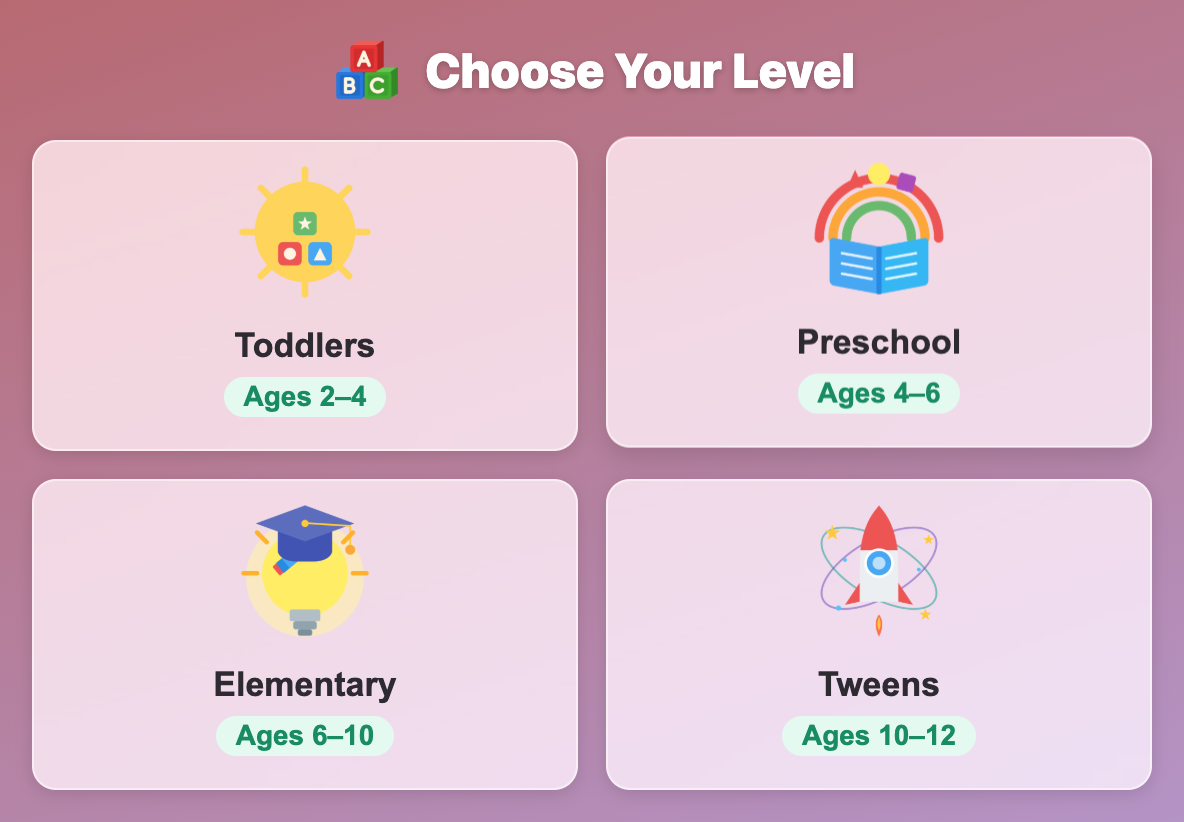
Pick your level. Tap Change Level to see four cards: Toddlers (ages 2–4), Preschool (ages 4–6), Elementary (ages 6–10) and Tweens (ages 10–12). Your level picks the kinds of questions and how tricky the path is. KidWorld remembers it for next time.
Choose your bunny. Under 1. Pick your bunny there are four baby bunnies: Snowy (white with a blue scarf), Cocoa (brown with a pink bow), Pebble (gray with a yellow scarf) and Peach (peachy with a purple scarf). The one you pick bounces and waves.
Choose your English. Under 2. Pick your English, tap 🎲 Mixed for a bit of everything, or one topic like ✏️ Spelling to practice just that. Your bunny and topic are saved in your browser.
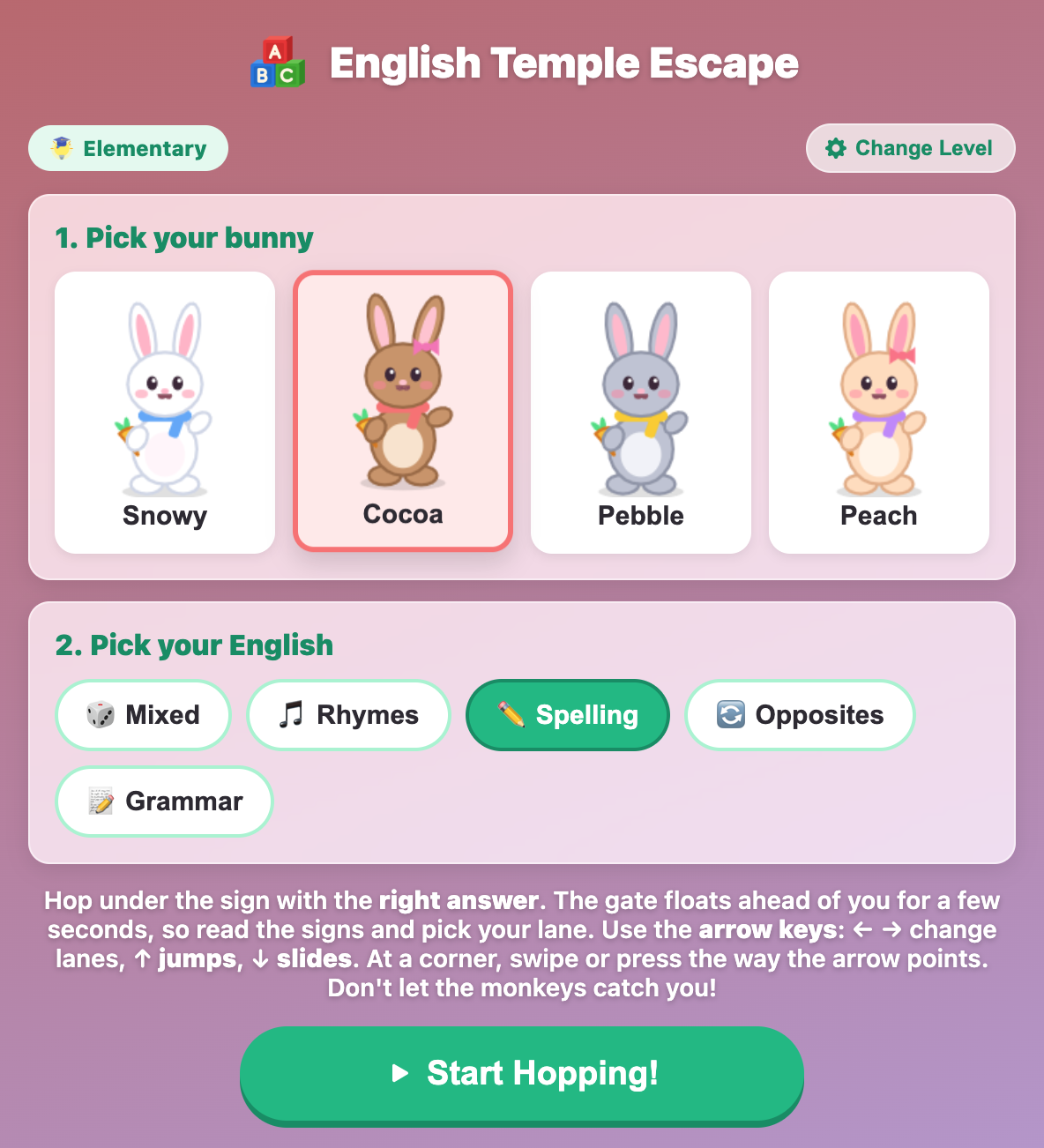
Tap Start Hopping! Your bunny turns to face you and waves while the countdown says 3, 2, 1. At HOP! it spins round and off it goes.
Steer on a computer. Press ← and → (or A and D) to change lanes. Press ↑, W or the space bar to jump, and ↓ or S to slide. The number keys 1, 2 and 3 send your bunny straight to the left, middle or right lane.
Steer on a tablet or phone. Swipe left or right to change lanes, up to jump and down to slide. You can also tap the scene: a tap on the left or right side moves you that way, and a tap in the middle jumps. Under the scene there is a pad with ⬅, Jump, Slide and ➡ buttons. (Slide only shows up on levels that have garlands to duck under.)
Listen to the question. The question sits on a white plate across the top of the scene. Tap the plate, or its 🔊, to hear it read aloud. For Toddlers and Preschool, each new question is read out by itself when the site's sound is on.
Watch the top corners. The 🚩 counter shows how many gates you have passed, like 0/12. The 🥕 counter shows your carrots. The row of little 🐒 faces on the right shows how close the monkeys are.
Take a break. Tap Pause, or press P or Esc. The game also pauses by itself if you switch tabs. Tap the big ▶ to keep running. The Setup button takes you back to pick a new bunny or topic.
See your result. At the end you get a score out of 100, up to five ⭐ stars, and a list called Practice these again. Then choose Run Again, Change Bunny or Topic or Change Level.
Use the page buttons. The fullscreen button makes the temple fill the whole screen. The reload button starts a fresh run, and the music button turns the running music on or off.
🚦 How a Word Gate Works
Each gate is a tall arch with three signs hanging from its top bar. A gate does something special: when your bunny gets close, the gate floats along ahead of you for about six seconds. It glides on two golden rails at the sides of the path, with little wheels rolling under its pillars. That gives you time to read the signs while they are big and close. Then the gate stops, and your bunny runs right under it.
The sign over the lane your bunny is in has a gold edge. That is your answer right now. If the gold edge is on the wrong word, change lanes before the gate stops. The path in front of a gate is always kept clear, so there are no logs or mushrooms to worry about while you read.
When you pass under a sign, the gap on the plate fills in. A right answer turns the plate's border green, pops up a cheer like Hop hop! or Correct!, and gives your bunny a burst of speed. Get three right in a row and you see Super speed!: an even bigger boost. A small 🔥 number on the plate's corner counts your streak. A wrong answer turns the border red and shows the right word in green, so you learn it on the spot.
🌿 What Stands in the Bunny's Way
Between gates, the path has things to get past. Each one needs its own move:
🪵 Mushroom-topped logs: lie across all three lanes. Jump over them. Bumping one says Oopsie!
🍄 Big smiling mushrooms: stand in one lane, or in two lanes on the older levels. They are too tall to jump, so move to a free lane. Hitting one says Bump!
🌸 Flower-garland branches: hang across the path at head height. Slide under them. Hitting one says Boing!
💧 Lily-pad streams: cross the path. Jump over them, or you hear Splash!
➡️ Corners: the path turns left or right, and a flowery arrow sign shows the way. On the two youngest levels the bunny turns by itself. On Elementary and Tweens, a Turn! sign pops up and you swipe or press the way the arrow points.
🥕 Carrots: float in lines along the path, high over logs and streams, and low under garlands. Run through them to collect them.
A bump makes your bunny stumble and slow down for a moment. It also throws away any speed boost from your last right answer. Right after a bump, your bunny is safe from a second bump for about a second, so one mistake never turns into two.
🐒 The Monkeys Behind You
The little monkey faces in the top-right corner are a danger meter. That means they show how close the troop is. Three things light up one more monkey: a wrong answer at a gate, bumping into something, and missing a corner. When every face is lit, you see The monkeys are coming! One more slip after that, and they catch you.
The good news is that monkeys also fall back. Every right answer turns one monkey face off again. Running cleanly for a while turns one off too: 7 seconds without a slip on Toddlers and Preschool, and 6 seconds on Elementary and Tweens. So a run is never lost after one bad moment. Keep calm, keep reading, and the troop drops back.
How many slips you can make depends on your level. Toddlers have four monkey faces, Preschool and Elementary have three, and Tweens only two. Tweens also run faster and meet more things between gates, so they need sharp eyes.
🏆 How to Escape More Often: Tips from Easy to Clever
1. Read first, then move
When a gate starts to float ahead of you, the path is clear. There is nothing to jump, so put all your attention on the words. Read the question, read all three signs, then change lanes. Moving first and reading second is how most wrong answers happen.
2. Trust the gold edge
Before the gate stops, look for the sign with the gold edge. If it sits over your answer, you are ready. If not, one tap or one key press fixes it. On a keyboard, the number keys are the fastest way: 1 for the left sign, 2 for the middle, 3 for the right.
3. A right answer is worth more than a fast one
There is no prize for changing lanes early, as long as you are in the right lane when the gate stops. But a right answer turns off a monkey and speeds you up, and a wrong one lights up a monkey. So it is always worth the extra second to check.
4. Look for the trap
The wrong signs are chosen to look a lot like the right one. In Letters, you might see b and d, or w and v, which have similar shapes. In Words, a 🐱 might come with car (same first letter) and hat (same ending). If two signs look almost the same, slow down and compare them letter by letter. Good news for little listeners: letters that can make the same first sound, like c and k, or g and j, are never put up as wrong answers, so a child who hears the sound right is never tricked by it.
5. Listen when your eyes are busy
Tap the question plate to hear it. For Spelling, the voice says the word and then the whole sentence, just like a spelling test. That is a big help when two spellings look close. For Words questions, the voice only says Which word matches the picture?, so you still do the reading yourself.
6. Build a streak for Super speed
Every third right answer in a row gives a bigger boost. A long streak gets you to the rainbow sooner, and it keeps the monkey faces dark. But remember: a bump throws away your boost. So after a big streak, watch the path extra carefully.
7. Know your moves by heart
Logs and streams: jump. Garlands: slide. Mushrooms: change lanes. Never try to jump a mushroom, because it is taller than your bunny can hop. If you jump too early for a garland, press slide while you are still in the air. Your bunny drops down fast and slides as soon as it lands.
8. Get ready for corners
On Elementary and Tweens, a missed corner lights up a monkey. When you see the arrow sign far ahead, get ready. Press or swipe the way it points as soon as Turn! appears. Your bunny keeps its lane round the corner. If you press 1, 2 or 3 while the Turn! sign is up, the bunny moves to that lane right after it turns.
9. Let the carrots guide you
Carrot lines tell you what is coming. Over a log or a stream, the carrots arch up high, so following them means jumping. Under a garland they sit low, so you slide to grab them. And there is never a carrot inside a mushroom, so a gap in a carrot line is a warning: change lanes!
10. Practice one topic at a time
If one kind of question keeps catching you, pick just that topic on the setup screen for a few runs. Grammar is a good one to drill. To practice grammar without any running at all, Grammar Fixer, where you spot the grammar mistake and tap the word that fixes it, is a calm next step.
🔎 Six Gates, Thought Through Out Loud
Toddlers: 🕸️ _eb
The plate shows a spider web and _eb. The signs say w, v and n.
Say the picture's name slowly: “wwweb.”
The first sound is “www,” like in water.
v looks a bit like w, but it only has one point at the bottom. w has two.
Hop under w. The plate now says web.
Toddlers: 🐱 and three words
The picture is a cat. The signs might say car, cat and hat. Car starts the same way, and hat ends the same way. Only cat matches both the start and the end, so that is the sign to pick. A grown-up can point at each letter while your child sounds it out.
Preschool: bell → ?
The plate shows 🔔 bell. The signs might show pictures with words: 🐚 shell, 🐝 bee and 🧦 sock. Bee starts like bell, which is the trap. But a rhyme is about the end of a word. Say them together: “bell, shell.” They end with the same “ell.” Pick shell.
Elementary: I brush my teeth ___ day.
The signs say every, evrey and everey. Clap the word: “ev-ery.” Now check each sign. Evrey swaps the r and the e at the end. Everey adds an extra e. Only every has the letters in the right order. If you are not sure, tap the plate and listen to the sentence.
Elementary: hot ↔ ?
The signs might say warm, cold and sunny. Warm and sunny are close to hot. They are friends of the word, not its opposite. Ask yourself, “What is the very other end?” The answer is cold.
Tweens: We were ___ tired to keep walking.
The signs might say too, to and two. All three sound the same, so you can't pick by ear. Think about meaning. Two is the number 2. To shows where you are going, like “to school.” Too means “very” or “also.” Here the sentence means “very tired,” so it is too.
🎯 English Temple Escape for Kids, Age by Age
English Temple Escape for toddlers (ages 2–4)
This is the gentlest run. There are 8 gates, and only Letters and Words questions, each with a picture. The bunny runs slowly, gates are far apart, and the only things in the way are logs and mushrooms. Corners turn by themselves, and the meter has four monkey faces, so there is lots of room for slips. Each question is read aloud when the sound is on. Small children usually play best on a parent's lap, with the grown-up swiping or pressing the keys while the child calls out the letter. If first letters are the big favorite, Alphabet Pop, where you pop the bubble with the letter a picture starts with, practices the same skill with no chase at all.
English Temple Escape for preschoolers (ages 4–6)
Preschool has 10 gates and adds Rhymes. The rhyme signs show a picture above each word, so a child who can't read every word yet can still pick by sound. Flower garlands join the path, so the Slide move comes in. Corners still turn by themselves, questions are still read aloud, and the meter has three monkey faces.
English Temple Escape for elementary kids (ages 6–10)
This level is a real reading workout. There are 12 gates with Rhymes (words only, no pictures), Spelling, Opposites and Grammar. Lily-pad streams appear, mushrooms can block two lanes at once, and you steer round corners yourself. Questions are no longer read out by themselves, but the 🔊 on the plate always works.
English Temple Escape for tweens (ages 10–12)
Tweens get the fastest and hardest run: 14 gates, more obstacles between them, and only two monkey faces before a catch. The words get harder too. Spelling asks about tricky words like necessary, separate and rhythm. Grammar asks about pairs that sound alike, like their, there and they're. Opposites use bigger words, like ancient ↔ modern.
📊 What Your Result Card Means
Your score is out of 100, and it comes from three parts:
Up to 60 points for right answers. Get every gate right and you earn all 60. Get half right and you earn 30.
25 points for escaping. Reach the rainbow doorway before the monkeys catch you.
Up to 15 points for carrots. You don't need every carrot. Collect about 6 out of every 10 on the path and you get all 15.
Stars follow the score: 90 or more earns five ⭐, 70 earns four, 50 earns three, and 25 earns two. The card also shows how many gates you got right, your carrots, your best streak and how long the run took. Any question you missed goes into Practice these again, with its answer. For Spelling and Grammar, you see the whole sentence written the right way. That list is a perfect warm-up for your next run.
💡 Why a Word Chase Is Great for Growing Readers
It makes reading quick and real. At a gate, a child reads three words, compares them and makes a choice, all in a few seconds. That is the same skill they use to read a sign, a menu or a book title.
It teaches careful looking. The wrong answers are look-alikes on purpose: evrey next to every, b next to d. Kids learn to check every letter instead of guessing from the shape.
It mixes sound and print. Hearing the question while seeing it helps kids connect the sound of a word with its letters. Rhymes train the ear, and first letters train the start of reading.
It turns mistakes into lessons. A wrong answer shows the right word in green right away, and the practice list keeps it for later. One slip never ends the run, because the next right answer pushes the monkeys back.
It builds calm focus. Kids learn to read first and move second, to stay calm when the monkeys get close, and to plan a jump, a slide or a lane change ahead of time.
A note for parents
English Temple Escape for kids is safe and gentle. There is no chat in the game and nothing scary. The monkeys are cute and only giggle, and being caught simply ends the run. The game practices first letters, picture words, rhymes, spelling, opposites and grammar, along with focus and quick hands. A run takes about two to five minutes, which makes it a nice short reading break.
The Golden Carrot is shining and the rainbow door is waiting. Pick your bunny, pick your words, and see if you can stay ahead of those giggling monkeys. If you love this chase, the same bunny and the same monkeys also run through Math Temple Escape, where every gate asks a math question instead. Have fun playing English Temple Escape for kids! 🐰🥕
🖼️ See the Game in Action
Four age cards on the English Temple Escape level screen, from Toddlers ages 2 to 4 up to Tweens ages 10 to 12
The English Temple Escape setup at Elementary, with Cocoa the brown bunny picked and the Spelling topic chosen
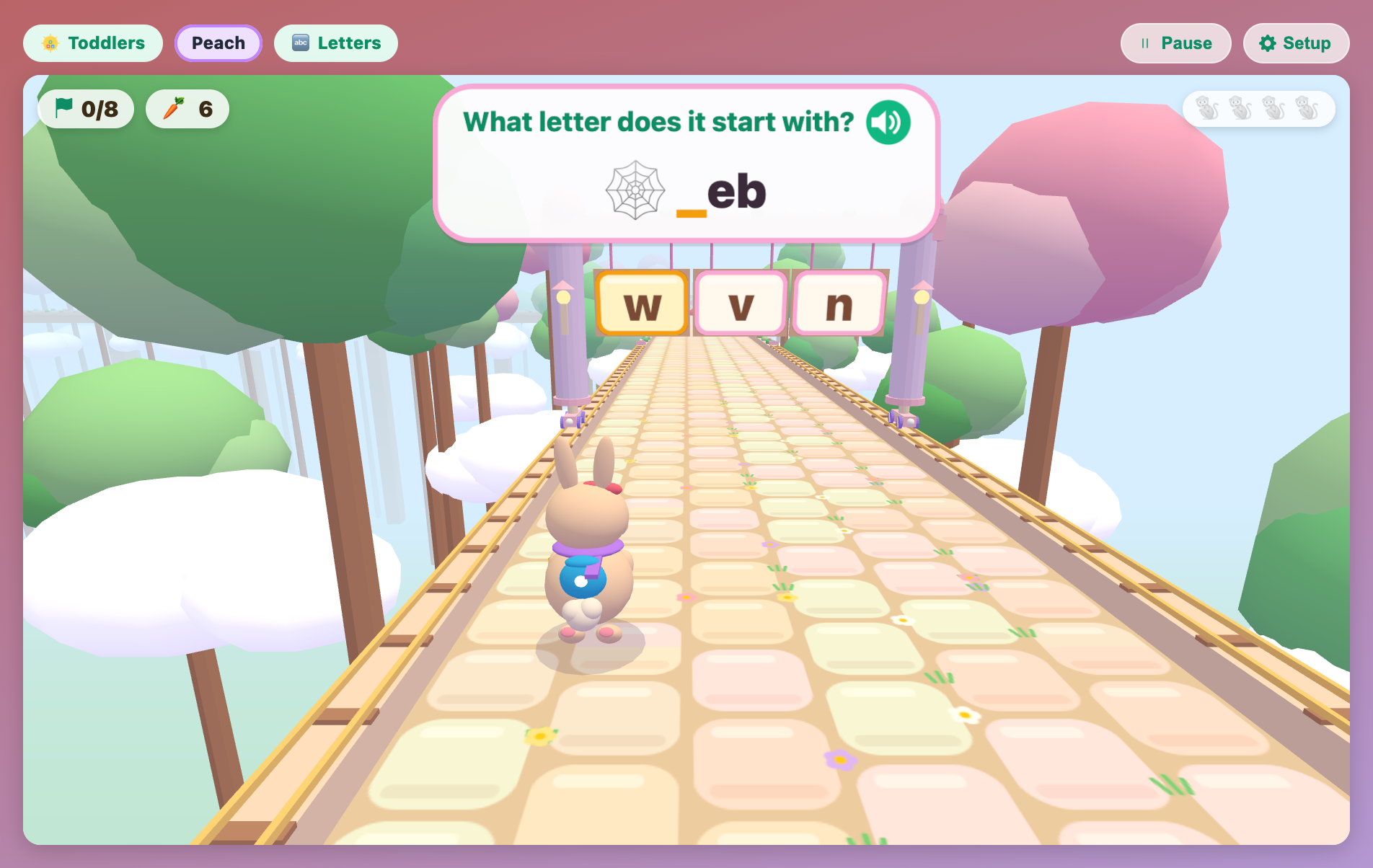
A peach bunny hopping toward a word gate with w, v and n signs under a spider web picture and _eb
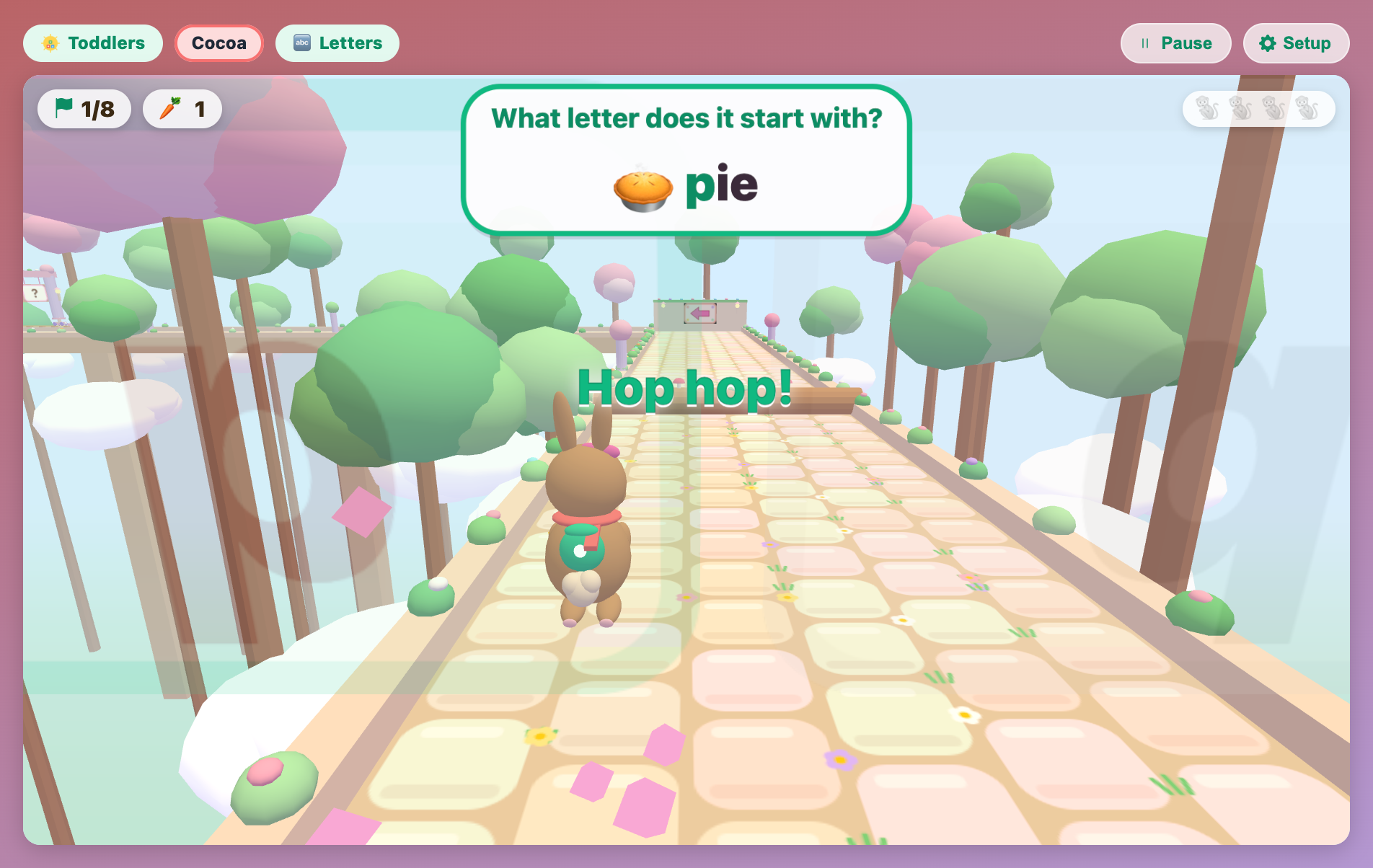
A brown bunny hopping on after a right answer, with the plate showing pie in green and a Hop hop cheer
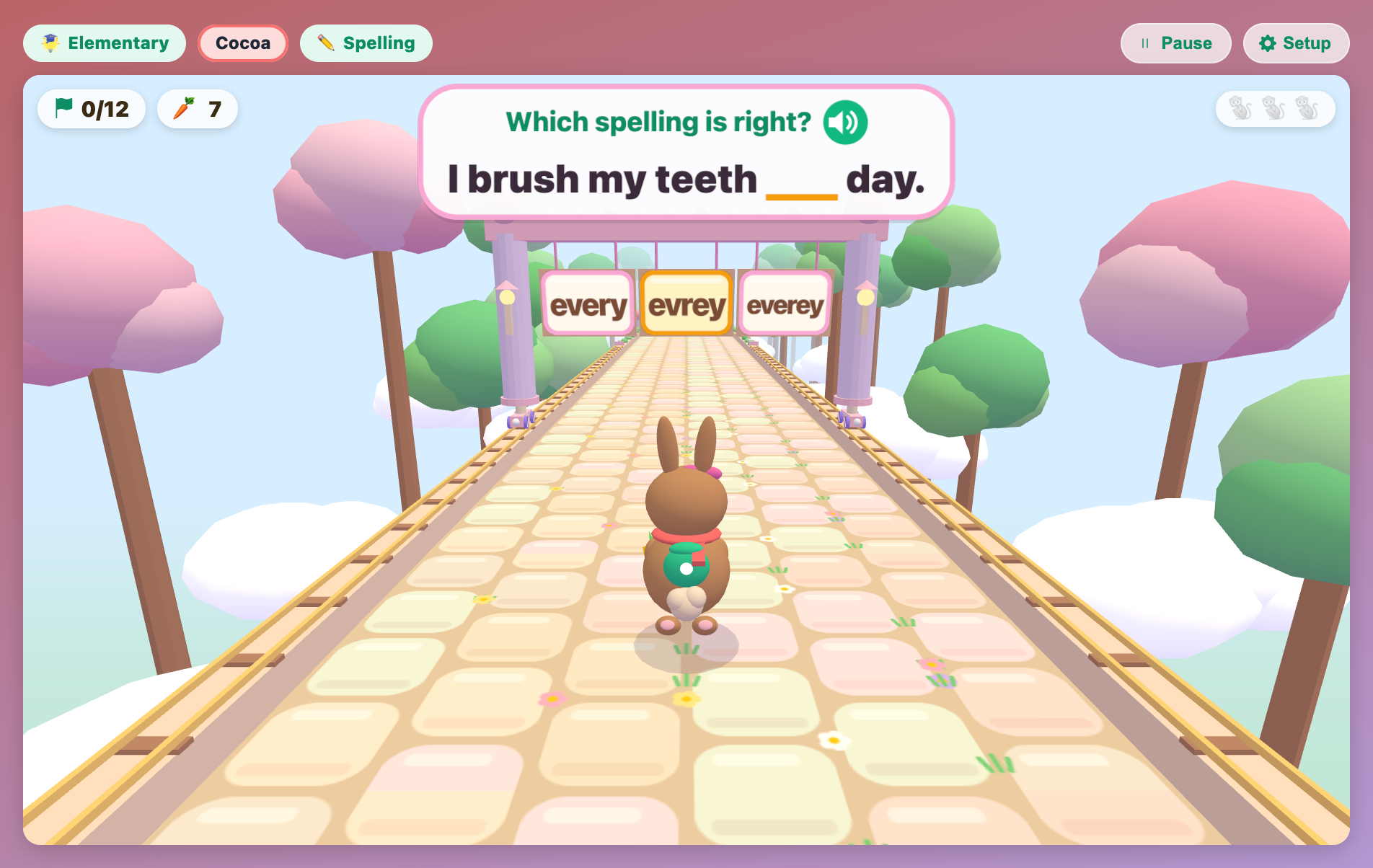
A spelling gate in English Temple Escape for elementary kids with every, evrey and everey signs over three lanes
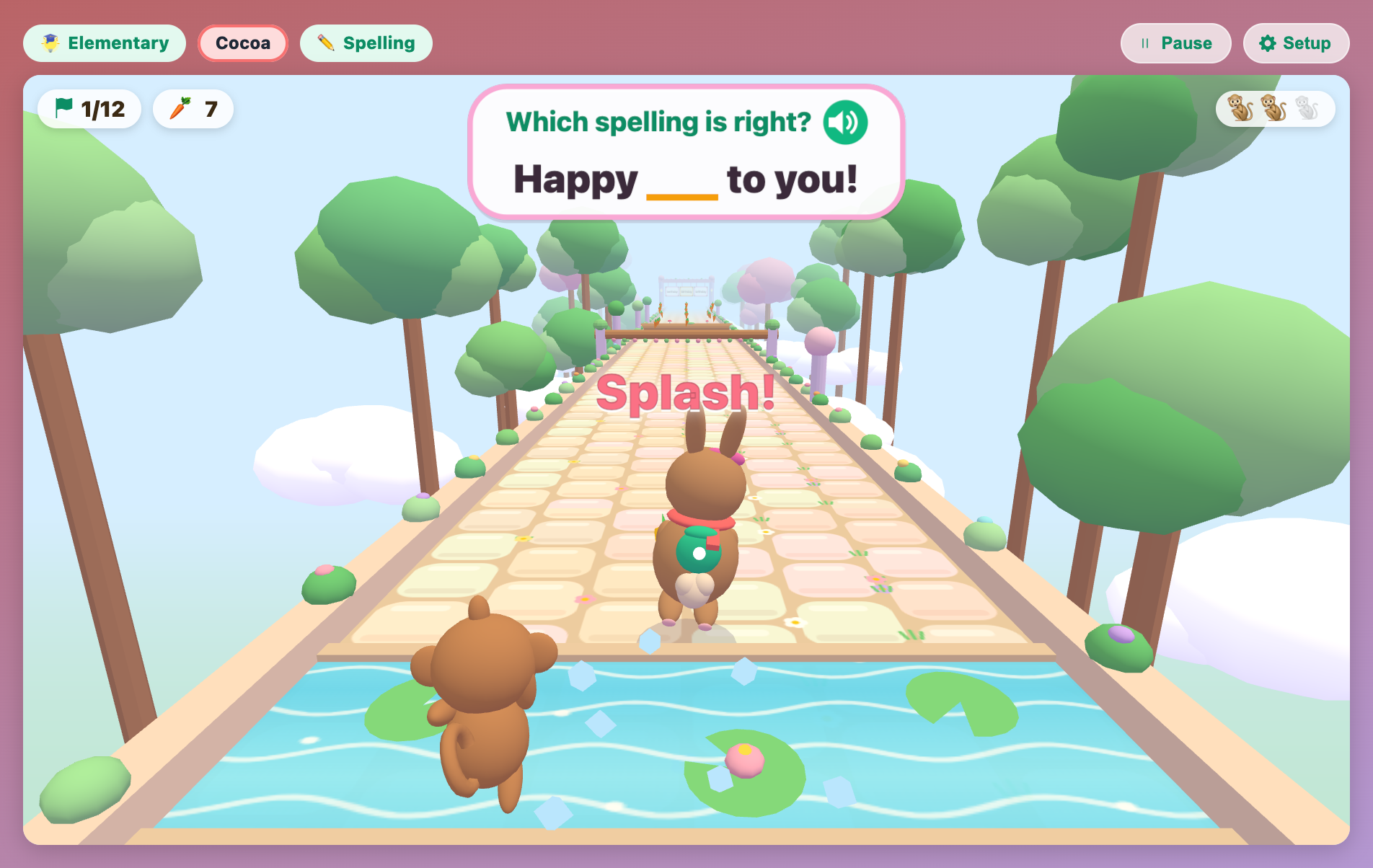
A bunny that just splashed through a lily-pad stream, with a Splash message and a baby monkey right behind
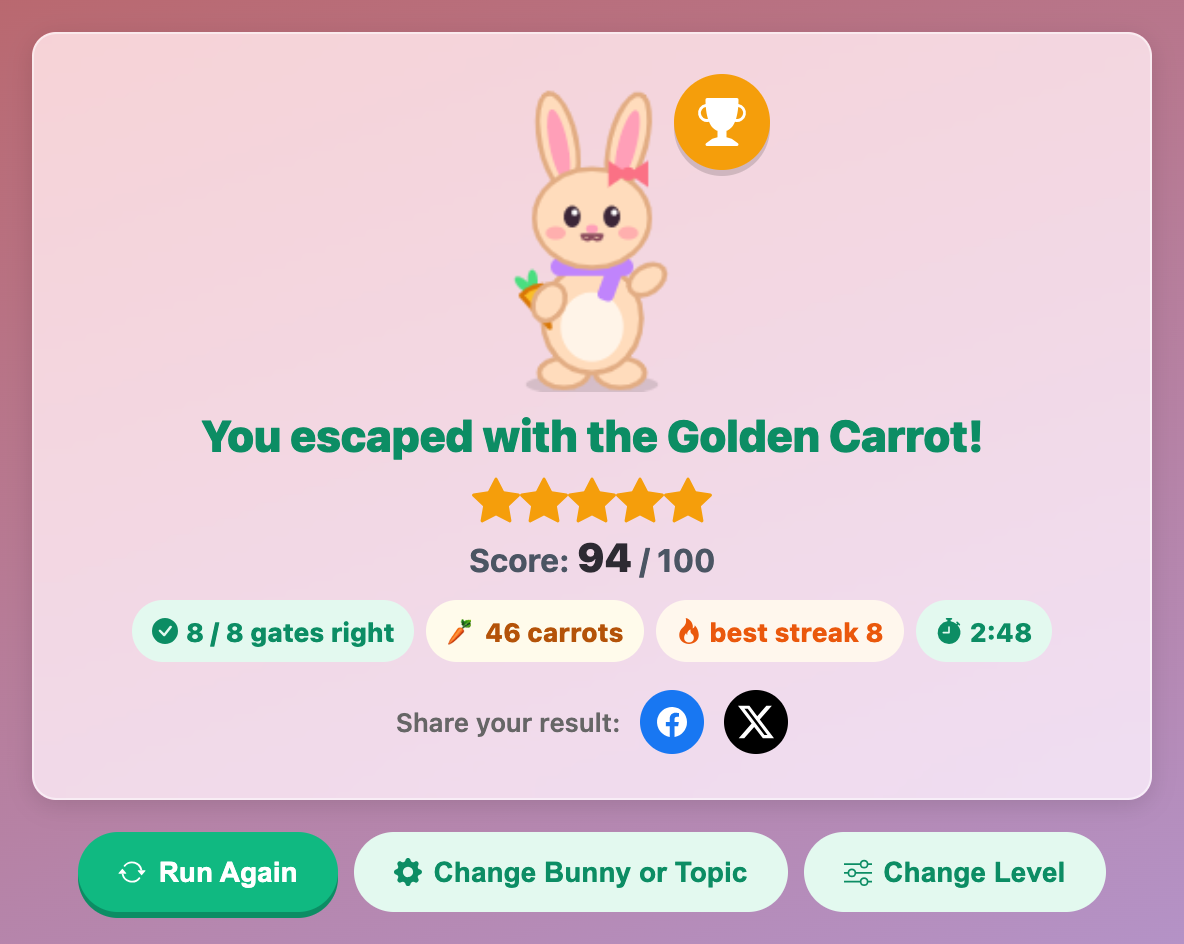
The result card in English Temple Escape after a toddler escape, with five stars, 94 points, 8 of 8 gates and 46 carrots
More English Games
 435.5K plays
4.9
435.5K plays
4.9
Sight Word Pop
Read the target word and pop the matching bubble before the timer runs out.
 273.8K plays
4.9
273.8K plays
4.9
Sentence Builder
Pick your age level, then tap the shuffled words in the right order to build the sentence.
 235.5K plays
5.0
235.5K plays
5.0
Alphabet Pop
Pop the bubble with the letter that a picture and word starts with.
 2.1M plays
5.0
2.1M plays
5.0
Word Search
Find all the hidden words in the letter grid before time runs out.
Most Played Games
 1.8M plays
5.0
1.8M plays
5.0
Color & Draw
A free-drawing canvas with colors and brush sizes to unleash your creativity.
 59.4K plays
5.0
59.4K plays
5.0
Recycling Sort
Sort everyday items into the Recycle, Compost, or Trash bin before time runs out!
 365.5K plays
4.9
365.5K plays
4.9
Tic-Tac-Toe
Play a game of Tic-Tac-Toe against the computer and see if you can outsmart it.
 1.1M plays
4.9
1.1M plays
4.9
Chess
Play the classic game of chess against the computer or a friend, with FIDE time controls, hints, and undo.
Comments (50)