
Stained Glass Window
96.4K playsMake your own stained glass window! Pick a color of glass and tap each piece between the dark lead lines to fill it: a sunrise, a rose window, a butterfly, an apple tree, a bluebird or a sparkling gem mosaic. Little artists color the picture, and big kids take on real design challenges: make both sides match like a mirror, use only warm or cool colors, or make sure no two pieces that touch share a color. Then let the sun in and watch your window glow and paint the floor with colored light.
Hold a red candy wrapper up to a sunny window, and the light that comes through turns red. Old churches and castles do the same trick on a giant scale. Their windows are made of hundreds of little pieces of colored glass, and when the sun shines in, the floor fills with colored light. In Stained Glass Window for kids, you get to make one of those windows yourself.
You pick a color of glass and tap each piece of the window to fill it. Dark lines hold the pieces together, just like the lead strips in a real window. Every window comes with a short list of goals, like "Make the sun yellow" or "No two pieces that touch can be the same color". When you are done, you tap Let the sun in! The room goes dim, your glass starts to glow, and your colors spill across the floor.
🪟 A Window You Color Piece by Piece
Stained glass is a very old art. Glass makers mix metals into hot glass to color it. A little gold makes red, and cobalt makes blue. Then an artist cuts each piece by hand and fits it into strips of lead, a soft gray metal, like a puzzle. Some windows in old churches are more than 800 years old, and the sun still shines through them today.
On KidWorld, the cutting is already done for you. Your job is the fun part: choosing the colors. There are seven hand-made windows to discover:
🌅 Sunrise: a sun with rays, hills and the sea.
🌹 Rose Window: a big round window whose pieces spread out like flower petals.
⭐ Star Window: a bright star in a round window.
🌳 Apple Tree: leaves, a trunk and red apples against the sky.
🦋 Butterfly: wings, spots and a body in the middle.
🌼 Daisy: petals, a yellow middle, a stem and leaves.
🐦 Bluebird: a bird on a branch, with a sun, clouds and grass.
Older players also get the 💎 Gem Mosaic. It is a round window full of gem-shaped pieces around a middle medallion. The game builds a brand-new mosaic every time, so you never see the same one twice. The same windows also get more pieces as the levels go up: a toddler's window has big, simple pieces, while a tween's window can have more than 30.
🖌️ How to Play Stained Glass Window on KidWorld
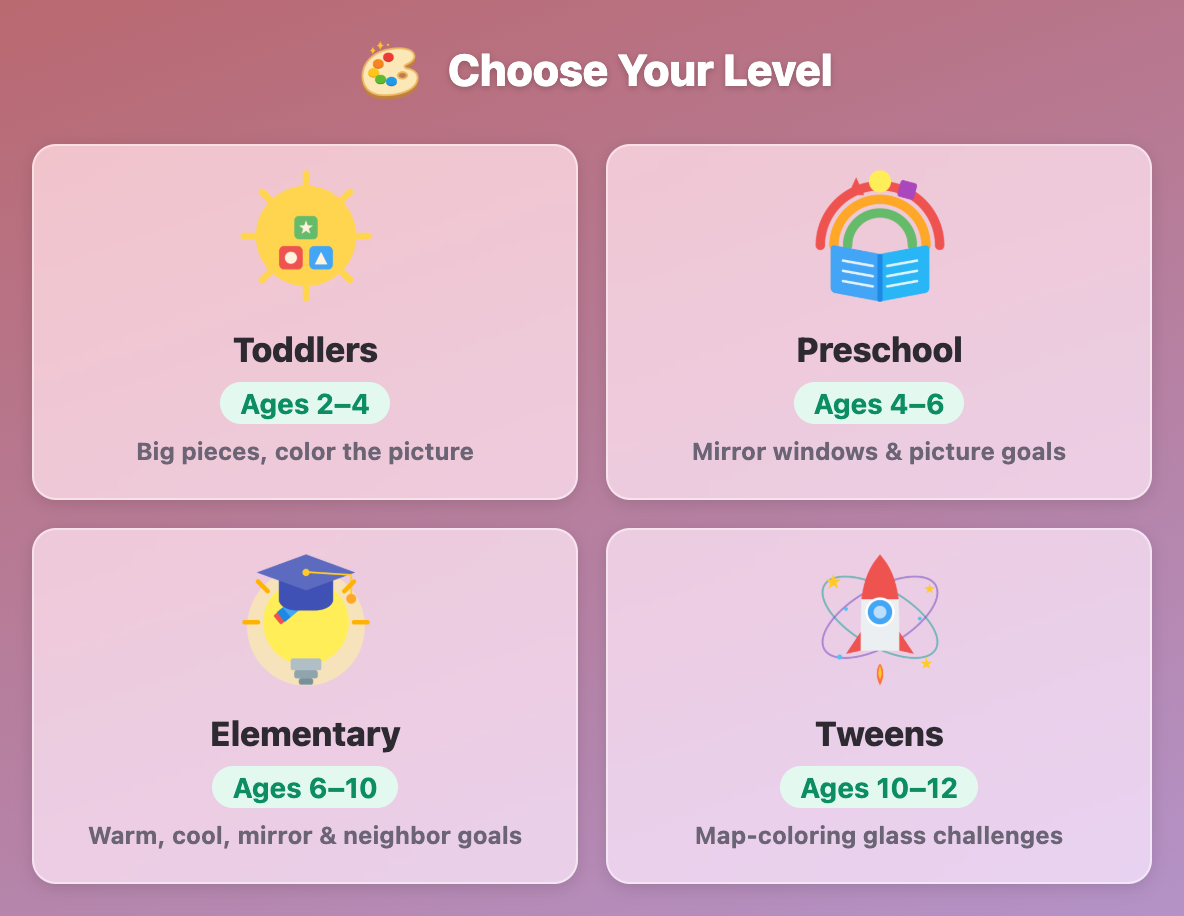
Pick your level. Choose Toddlers, Preschool, Elementary or Tweens. The game remembers your choice, and you can switch any time with the Change Level button.
Read your goals. The Goals card lists what this window needs. The first goal is always "Fill every piece with glass". Each goal shows how far along you are, like 4/6, and turns green with a check when it's done. A red ✗ means something is breaking it. Tap the 🔊 button to hear the goals read aloud.
Pick a glass color. Tap a color in the palette. Toddlers get 7 colors, preschoolers get 9, and older kids get 11, adding teal and clear glass. On a keyboard, the number keys 1 to 9 and 0 pick colors too.
Tap a piece to fill it. The piece pops into its new color. Tap it again with a different color to change it. Pick take out (or press E) to empty a piece, and use Undo (or Ctrl+Z) to go back one step.
Ask for a hint if you're stuck. The 💡 Hint button picks a color for you and makes a piece glow, with a tip like "Try red glass here." Toddlers have as many free hints as they want. Older levels get a few, and each one costs a few points.
Let the sun in! When every piece is full, tap the big orange button. If a piece is still empty, it glows so you can find it. If a goal isn't finished yet, the button changes to Light it up anyway, so you can tap again or keep working.
See your result. You get up to 3 stars, a score out of 100, and a fun fact about stained glass. Then choose Next Window, open My Gallery or change your level.
Visit My Gallery. Every window you finish hangs in your gallery, glowing, so you can look back at your last 12 windows.
Your window in progress is saved as you go, so you can come back to it later. The Reload button above the game starts a fresh window instead. Next to it are the fullscreen button, for a bigger window, and the music button, to turn the music on or off.
⭐ Where the Points Come From
Filling every piece earns 40 points. The other 60 points are shared between the window's design goals. If a window has two design goals, each one is worth 30. Every hint you use takes a few points away: 3 on Preschool and 5 on Elementary and Tweens. Hints are free on Toddlers.
A score of 90 or more earns 3 stars, 70 or more earns 2, and 40 or more earns 1. So the way to a 3-star window is simple: finish every goal, and save your hints for when you really need them.
Here's good news: the game only gives you goals it has already checked can all be met together on that window. If your goals feel impossible, there is always a way. You just haven't found it yet!
🔍 Glass Artist Secrets for a Perfect Window
Some goals are easy, and some are real puzzles. These tips will help with every kind.
Do the picture goals first
Goals like "Make the sun yellow" or "Make the trunk brown" tell you the color of certain pieces. Those pieces have no choice, so fill them first. Then the rest of the window has to fit around them, and you won't have to repaint anything later.
Learn the warm and cool colors
Some goals say "Use only warm colors" or "Warm colors in the middle, cool colors around the edge". In this game, the warm colors are red, orange and yellow, the colors of fire and sunshine. The cool colors are green, teal, light blue and blue, the colors of leaves, water and sky. Purple, pink, brown and clear count as neither, so keep them out of these goals. If you want more practice sorting colors, Warm or Cool? lets you drag things and paint colors into a sunny Warm bin or a frosty Cool bin.
Mirror windows: always paint in pairs
"Make both sides match, like a mirror" means the left half and the right half must be twins. When this goal is on, a dashed line runs down the middle of the window. Every piece on the left has a twin in the same spot on the right. The easy habit is this: as soon as you paint a piece, paint its twin the same color. On Preschool, the game helps by making the twin pulse and saying "Now color its mirror twin too!" Kids who enjoy mirror pictures can also try Symmetry Match, where you pick the half that completes a picture.
For "no two touching", start with the busiest piece
The hardest goal says "No two pieces that touch can be the same color". Pieces only count as touching when they share a stretch of lead line. If they only meet at one tiny corner, that's fine.
The trick is to start with the piece that touches the most other pieces. That's often the center of a round window or the sun in a sunrise. Give it a color first. Then work outward, one ring at a time. The game's own hints work the same way: they suggest pieces next to ones you have already filled.
A row of pieces only needs two colors
Pieces lined up in a row, like the rays of a sun or the petals around a circle, can take turns: purple, yellow, purple, yellow. Two colors are enough for a straight row. A ring that closes into a circle is different. If it has an odd number of pieces, the first and last pieces will meet, so you'll need a third color for one of them.
When there are only 3 or 4 colors allowed
On Tweens, some windows say "Use only 3 colors in all" or "Use only 4 colors in all" on top of the no-touching rule. Decide on your colors before you start, and stick to them. If you use one color too many, the goal turns red, and a hint will tell you which color to swap out.
Look for the "!" marks
On Elementary, a little red "!" appears on any piece that breaks a goal. Two touching pieces of the same color both get one. A warm color in a cool spot gets one too. Fix the marked pieces, and the goal turns green.
Use hints wisely
A hint does one of three things. It can point at a broken goal ("These two pieces touch, and both are blue. Change one of them."). It can suggest a color for an empty piece. Or it can tell you "This piece makes the rest too hard", which means an earlier color is blocking the solution. If you're down to your last hint, save it for that last kind of moment, when nothing seems to fit.
🧩 Four Windows, Solved Step by Step
Toddlers: the Star Window
The goals are "Use at least 3 different colors" and "Make the star yellow". The window has 6 pieces: the star and the 5 pieces around it.
Tap yellow, then tap the star. One goal done!
Tap red and fill two pieces around the star.
Tap orange and fill another piece. That makes 3 colors.
Fill the last pieces with any color you like, then tap Let the sun in! for 100 points and 3 stars.
Preschool: a mirror Butterfly
The goals are "Make both sides match, like a mirror" and "Make the body purple". Start with the body down the middle. It sits right on the mirror line, so it is its own twin. Paint it purple. Now paint the top of the left wing pink. The matching piece on the right wing pulses, so paint it pink too. Keep going in pairs until every wing piece has its twin.
Elementary: warm in the middle, cool around the edge
A Gem Mosaic might say "Warm colors in the middle, cool colors around the edge" and "No two pieces that touch can be the same color". The middle medallion is cut into slices like a pie. Take turns with red, orange and yellow around it, so no two slices side by side match. Then fill the outer gems with green, teal, light blue and blue. Each outer gem touches several others, so before you tap, look at its neighbors and pick a cool color none of them has.
Tweens: a Sunrise with only 3 colors
The goals are "No two pieces that touch can be the same color" and "Use only 3 colors in all". Pick your three colors first, maybe purple, yellow and teal. Start in the middle, with the sun and the ring around it. Then let the big rays take turns with two colors, one ray after another, and check that no ray matches the ring piece it touches. Fill the hills and sea last, checking each piece's neighbors before you tap. If a goal turns red, read its message: it tells you exactly which pieces clash.
👨👩👧 Stained Glass Window for Kids of Every Age
Stained Glass Window for toddlers (ages 2–4)
Big pieces and simple pictures, like a star or an apple tree. The goals are easy: use at least 3 colors, plus one picture goal such as "Make the sun yellow". Hints are free and unlimited, and the goals are read aloud. A parent can sit beside a toddler and name each color as they tap it.
Stained Glass Window for preschoolers (ages 4–6)
More pieces, 9 colors and the Rose Window join the set. Many windows have a mirror goal, and the twin piece pulses to show where the matching color goes. It's a gentle first lesson in symmetry.
Stained Glass Window for elementary kids (ages 6–10)
Now the goals become design challenges: warm or cool colors only, warm in the middle and cool at the edge, mirrors, and no touching pieces the same color. The Gem Mosaic appears, and red "!" marks show which pieces break a goal.
Stained Glass Window for tweens (ages 10–12)
The most detailed windows, often with more than 30 pieces, and real map-coloring puzzles. Can you color the whole window so no neighbors match, using only 3 or 4 colors? There are no "!" marks and only 2 hints, so you plan ahead and check your own work.
✨ What Little Glass Artists Learn
Colors with a reason. When a goal asks for warm colors in the middle, kids learn that colors have feelings: warm colors feel bright and sunny, cool colors feel calm. Artists use that on purpose, and now so can your child.
Mirror thinking. Painting a butterfly's wings in pairs builds an eye for symmetry, the balance you see in faces, flowers and buildings.
Planning ahead. The no-touching puzzles are a kids' version of a famous math question about coloring maps. A child who paints the busiest piece first and works outward is learning to plan before acting, and to fix a mistake without starting over.
Careful, gentle tapping. Little ones practice matching a color name to a color and tapping inside a shape, a great warm-up for coloring on paper. Kids who love filling pictures with color can also try Color by Number, where each number tells you which color to use.
For parents: Stained Glass Window is calm and creative, with no timer, no scary content and nothing to lose. A finished window always earns praise, and the fun facts on the result screen teach a little real art history. It practices color names, warm and cool colors, symmetry, logic and patience.
So pick your first glass color, fill the pieces, and get ready for the best moment: tapping Let the sun in! and watching your colors glow. Stained Glass Window for kids is waiting for its next artist, and that's you! 🌈
🖼️ See the Game in Action
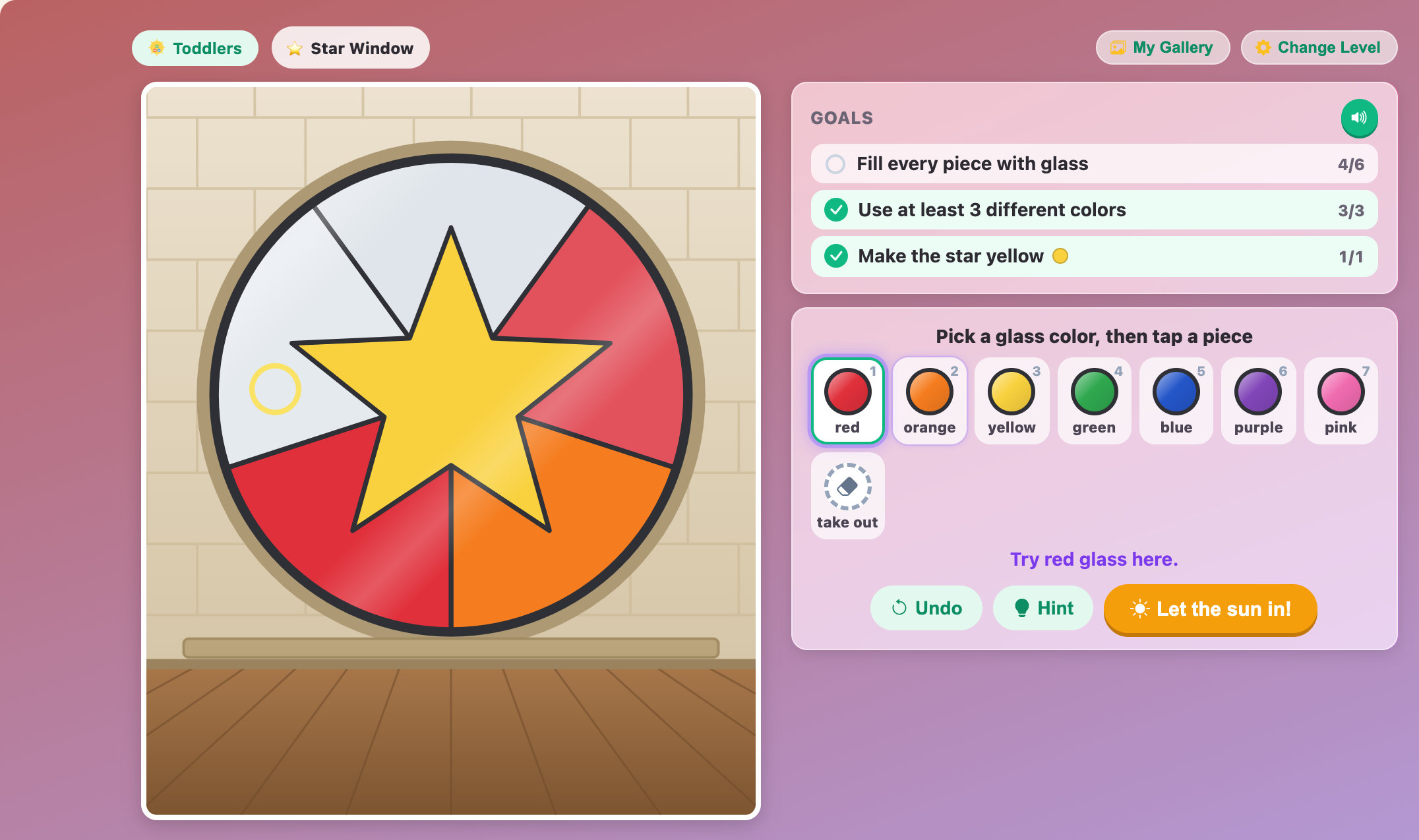
A Star Window at the Toddlers level with a yellow star, red and orange glass, and a hint ring on an empty white piece
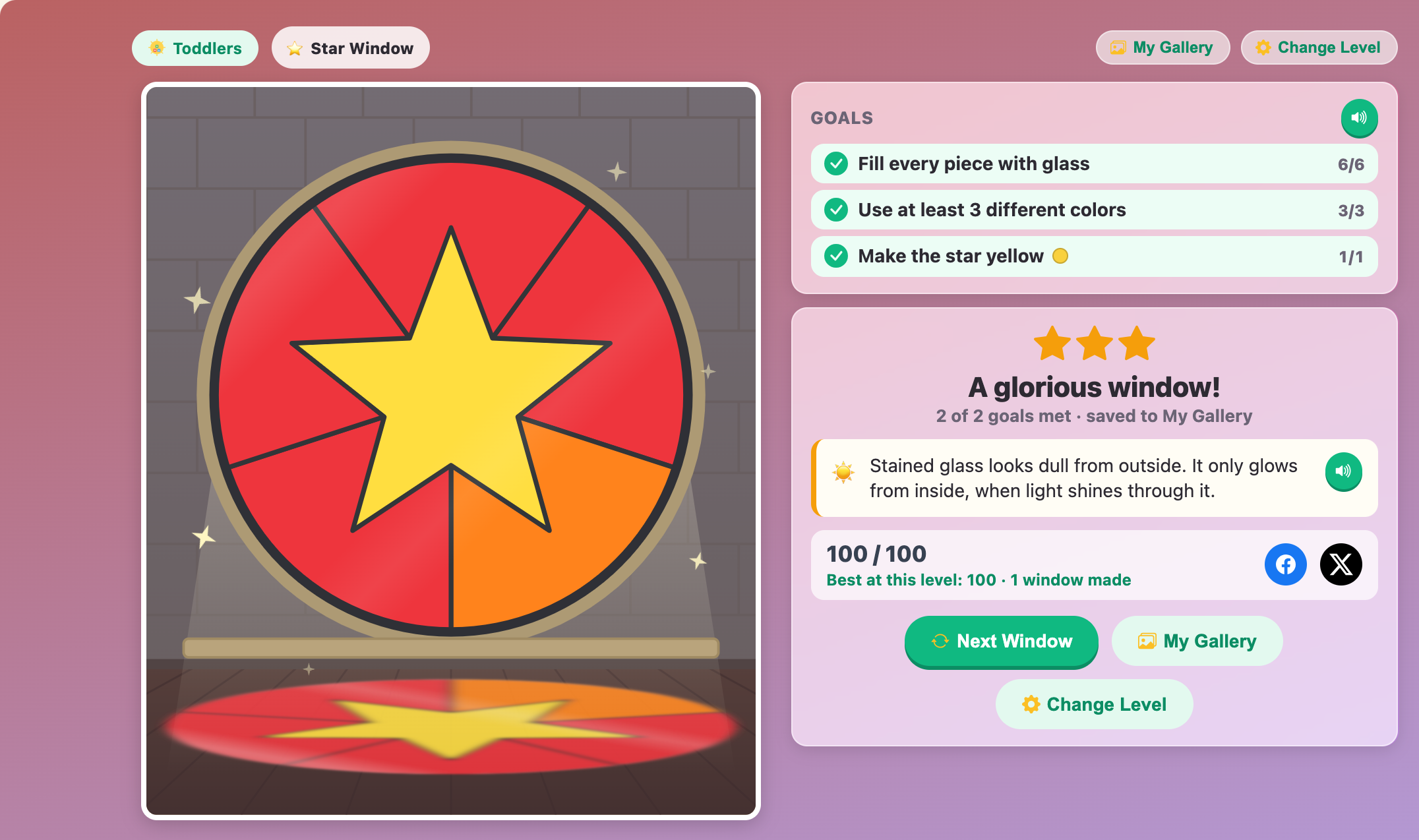
The finished Star Window glowing in the sun and casting red, orange and yellow light on the floor, with 3 stars
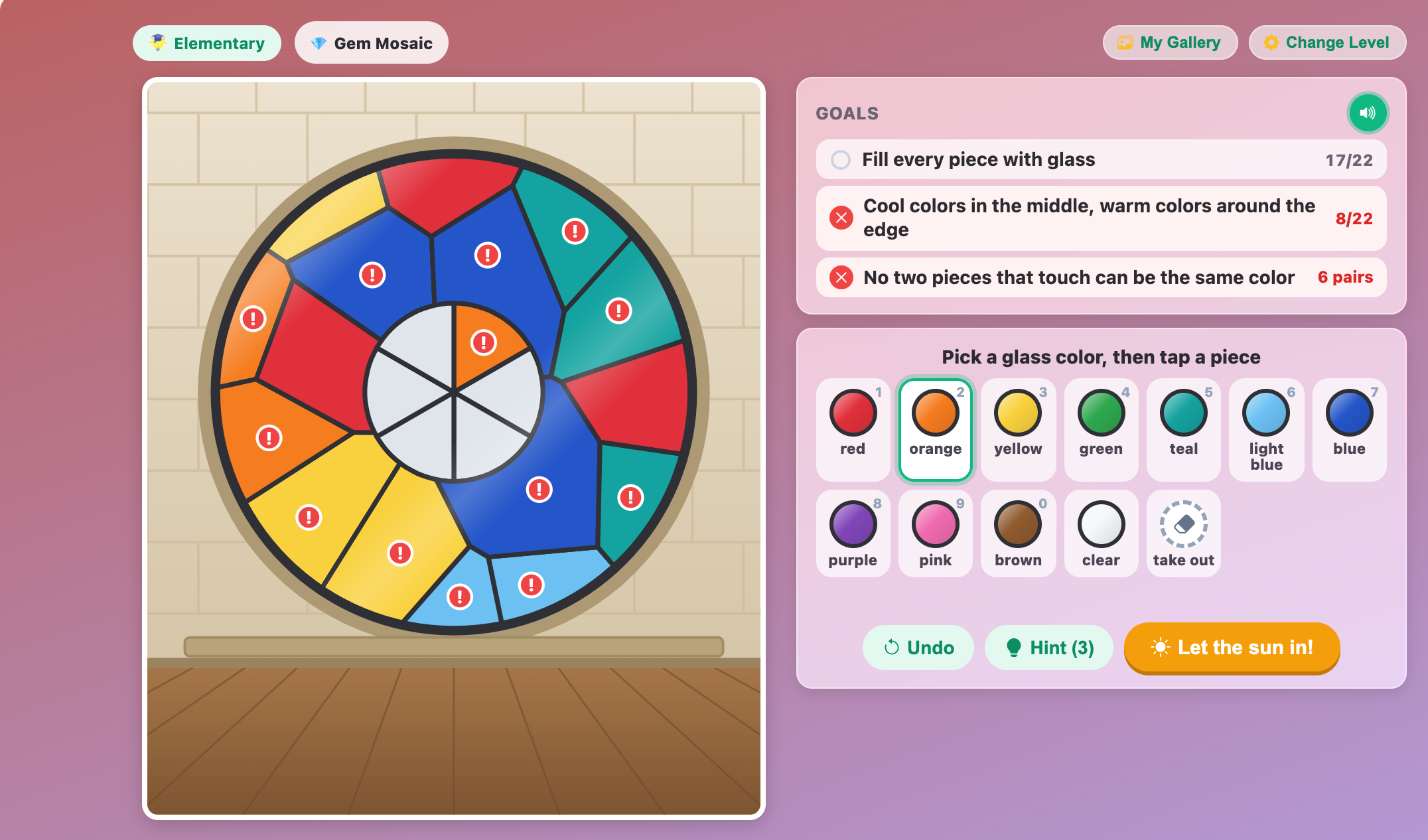
A Gem Mosaic in Stained Glass Window for elementary kids, with red warning marks on pieces that break the goals
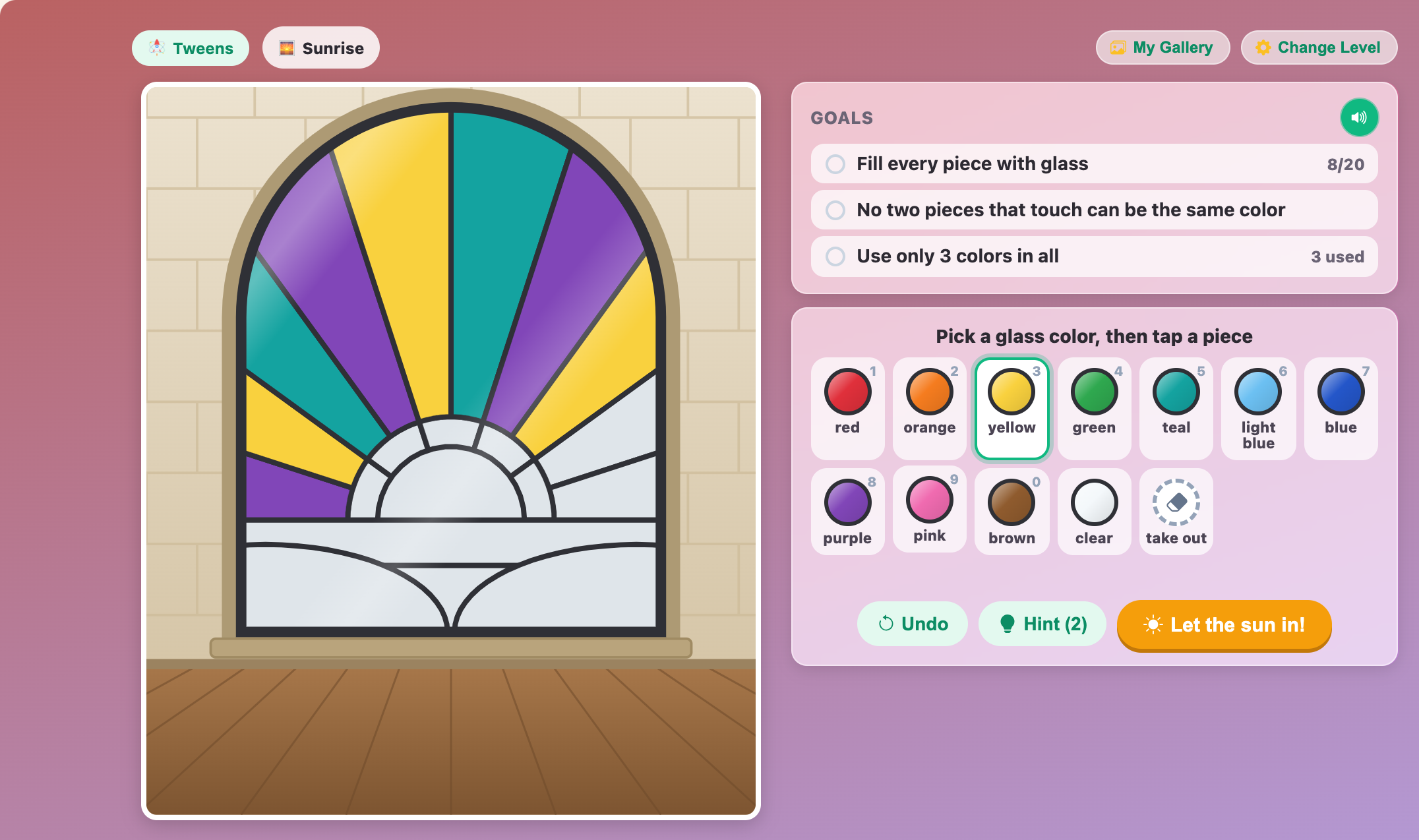
A half-filled Sunrise window in purple, yellow and teal, with the Use only 3 colors goal for tweens
More Art Games
 1.8M plays
4.9
Color & Draw
A free-drawing canvas with colors and brush sizes to unleash your creativity.
 154.5K plays
5.0
Mood Palette
Decide which color best fits a mood or theme before time runs out.
 584.9K plays
5.0
Tiny World Builder
Start with a tiny empty island and build your own blocky village — plant grass and trees, lay roads, and unlock houses, farms, a school and more!
 174.6K plays
4.9
Color Mixing
Look at two paint colors and pick which color they mix together to make.
Most Played Games
1.8M plays
4.9
Color & Draw
A free-drawing canvas with colors and brush sizes to unleash your creativity.
 59.6K plays
4.8
Recycling Sort
Sort everyday items into the Recycle, Compost, or Trash bin before time runs out!
 365.8K plays
5.0
Tic-Tac-Toe
Play a game of Tic-Tac-Toe against the computer and see if you can outsmart it.
 274.1K plays
5.0
Sentence Builder
Pick your age level, then tap the shuffled words in the right order to build the sentence.
Comments (41)