
Science Kart Circuit
21.3K playsRace a cute go-kart round a 3D track and steer into the lane with the right science answer! Pick a puppy, fox, bear or chick, choose a track, and race laps against three rivals. Every gate asks a science question: which animal says moo, what a plant needs to grow, which planet is closest to the Sun. A right answer fires a Turbo boost, and three in a row make you a Super Star. Learn about animals, your body, weather, plants, space, matter, Earth and energy while you collect stars and zoom over boost pads.
The shiniest thing in this race can't be bought, found or bumped into. You earn it by getting three science questions right in a row. Science Kart Circuit for kids is a free 3D go-kart race where you drive laps of a looping track, and twice every lap a gate asks a science question with four answer signs. Steer into the lane under the right answer to fire a Turbo boost, and string three together to become a glittering Super Star.
The questions cover animals, the body, weather, plants, space, matter, living things, Earth and energy, at four levels from toddlers to tweens. The game runs in the browser on computers, tablets and phones with nothing to download and no sign-up, as long as the browser can show 3D graphics (almost every modern one can).
🌟 Science Kart Circuit for Kids: Science on a Looping 3D Track
Most racing games go from a start line to a finish line far away. A circuit is different: it's a closed loop, so you drive around and around and cross the same line once per lap. In Science Kart Circuit, four chubby karts race on a road four lanes wide, through hills, trees and fluffy clouds, all in 3D. The camera sits just behind your kart, and a little map in the corner shows where you are on the loop.
You can pick one of three tracks:
🌼 Flower Meadow: a bright, green loop with flowers and round trees.
🦆 Duck Lake: the road curves around a real lake, with ducks floating in the middle.
🏔️ Snowy Peaks: a twisty loop past pine trees and snowy mountains.
The track only changes the scenery and the shape of the bends. The questions, laps and rules are the same on all three, so choose the one you like looking at most.
🛠️ Before the Lights Go Green: Setting Up a Race
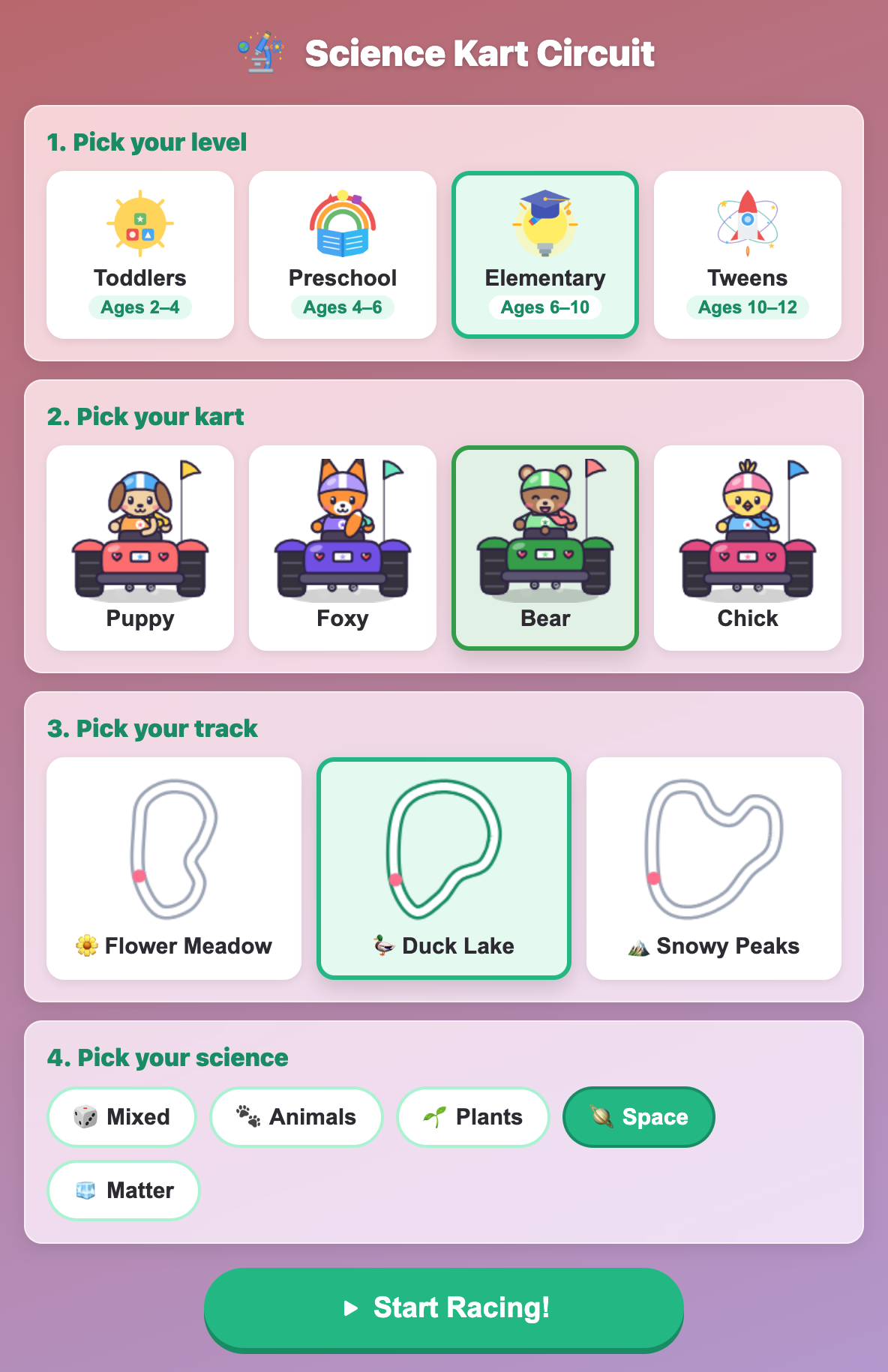
Fill in four quick choices. The setup screen asks you to 1. Pick your level, 2. Pick your kart (Puppy, Foxy, Bear or Chick), 3. Pick your track, and 4. Pick your science (Mixed, or one topic for your level). Then tap Start Racing!. Your choices are remembered for next time.
Read the first question at the start line. The first gate and its question are already up while the drivers wait under the KidWorld Kart Cup banner, so you can start thinking during the countdown.
Steer. Hold ← and → (or A and D), hold the green arrow buttons under the scene, or on a touch screen hold the left or right half of the scene. When you let go, your kart gently slides into the middle of its lane. You can also press 1, 2, 3 or 4 to drive straight to that lane.
Brake and boost. Hold ↓ or Brake to slow down and get more time to read. Hold ↑ or Boost to use your boost tank. The colored fill inside the Boost button shows how much is left.
Pause any time. Press P, Space or Esc, or tap the Pause button. The Setup button takes you back to the setup screen.
Hear the question. When the site's sound is on, each question is read aloud as its gate starts gliding. Tap the question plate to hear it again. Toddlers and preschoolers also hear all four answers, from left to right.
Watch the bottom of the scene. It shows your place (like 2nd), your lap (like Lap 2/3), which question you're on (like 3/6) and how many gold stars you've collected.
Cross the line on your last lap. The camera swings around to your driver's face, and the result card appears. Choose Race Again or Change Setup. The play page's music, fullscreen and reload buttons work at every step.
🔁 What Happens on Every Lap
Each lap has two answer gates, and between them you just drive for about 20 seconds. That free stretch is where you collect gold ⭐ stars, roll over arrow-shaped boost pads, and, on the Elementary and Tweens levels, steer around sticky mud puddles. There is never mud under a gate.
Then the next gate appears down the road with four signs, one per lane, and the question shows on a plate across the top of the screen. When you get close, the gate starts gliding along on golden rails just ahead of your kart, for about ten seconds. The sign over your lane has a gold rim. Finally the gate stops at its real spot, you drive under it, and the game checks your lane.
How many questions you get depends on the level:
Toddlers: 2 laps, 4 questions, about two and a half minutes.
Preschool and Elementary: 3 laps, 6 questions, under four minutes.
Tweens: 4 laps, 8 questions, about five minutes.
⚡ Turbo, Super Star and Sputter
A right answer fires a Turbo: your kart jumps forward, your boost tank fills up a good chunk, and the plate says Right! Turbo! with the answer in green.
Three right answers in a row make you a Super Star. You get an even bigger burst of speed, and for five seconds your kart flashes rainbow colors and drives straight through mud, grass and bumps without slowing down.
A wrong answer makes your kart sputter and slow down for a moment, and your streak starts again from zero. The plate says Oops! Here is the answer: and shows the right one, so you learn it before the next gate.
🥇 How Your Place and Points Are Decided
The three rival karts don't answer questions. Their speed follows yours, so boosting, braking or bumping into the grass never changes the standings. The only thing that does is how many gates you get wrong:
0 or 1 wrong: you win the KidWorld Kart Cup and finish 1st.
2 wrong: 2nd place.
3 wrong: 3rd place.
4 or more wrong: 4th place. On the Tweens level, with its 8 questions, you stay 3rd with 4 wrong and drop to 4th at 5.
Your score is out of 100 and has three parts:
Up to 60 points for the share of gates you answered right.
30, 22, 15 or 8 points for finishing 1st, 2nd, 3rd or 4th.
Up to 10 points for gold stars. Collecting half of the stars on the track already earns all 10.
In our own Elementary test race on Duck Lake, Bear got 4 of 6 questions right and collected 20 stars. That was 40 points for answers, 22 for 2nd place and 7 for stars, a score of 69. The result card also shows the best streak and the race time, plus a Practice these again list with every missed question and its answer.
🧠 Racing Smarter Round the Circuit
1. Treat your streak like treasure
A Super Star only comes after three right answers in a row. When you have two in a row, the next gate is the important one. Slow down, read every sign, and make sure before you steer.
2. Read under the gliding gate, not before it
The gate glides along close to your kart because that's when the signs are biggest and easiest to read. Hold Brake while it glides, and the gate keeps pace with you, giving you extra reading time. Boosting during a glide does the opposite and ends it sooner.
3. Spend boost on the free stretch
The 20 seconds between gates are the best time to boost. Use it to reach a row of stars or to fly over a boost pad. A right answer refills the tank, so you'll have more by the next free stretch.
4. Collect stars, but don't chase every one
Since half of the track's stars already gives you all 10 star points, there is no need to swerve wildly for each one. Pick up the stars in your lane and the next lane over, and stay calm.
5. Stay away from the edges
Driving onto the grass slows your kart a lot, and a soft cushion wall stops you from going farther. On the older levels the bends push your kart outward a little, so steer slightly toward the inside on a curve. On the youngest levels the kart keeps itself in its lane, so little drivers can focus on the questions.
6. Read the "Oops!" answer out loud
After a wrong answer, the right one stays on the plate for a moment. Say it out loud. Hearing yourself say "Venus is the hottest planet" helps it stick much better than just seeing it.
🪐 Six Gates From the Circuit, Thought Through
Toddlers on Flower Meadow: "Which animal says neigh?"
Four picture signs: 🐴 Horse, 🐔 Chicken, 🐱 Cat and 🐄 Cow. Make each sound together: the chicken clucks, the cat says meow, the cow says moo. Only the horse says "neigh". Steer to the horse's lane, or press its number.
Elementary: "A person who travels into space is called an…"
Architect, Astronaut, Astronomer or Athlete. Three of them start with "A-s-t" or "A-r", so read slowly! An astronomer studies the stars from Earth, an architect designs buildings, and an athlete plays sports. The one who actually rides a rocket into space is an astronaut. Getting this right gave our Bear a Turbo.
Elementary: "Who was the first person to walk on the Moon?"
Thomas Edison, Isaac Newton, Neil Armstrong or Albert Einstein. All four are famous, but only one was an astronaut. Edison worked on inventions like the light bulb, and Newton and Einstein were scientists who explained gravity and space. Neil Armstrong stepped onto the Moon in 1969.
Elementary: "How many planets are in our solar system?"
The signs say 7, 8, 9 and 10. Some grown-ups learned "9" at school, because Pluto used to count as a planet. Today scientists call Pluto a dwarf planet, so the answer is 8: Mercury, Venus, Earth, Mars, Jupiter, Saturn, Uranus and Neptune.
Elementary: "Which planet is the hottest?"
Venus, Mercury, Earth or Neptune. Most people guess Mercury, because it's closest to the Sun. That's the trap, and it caught our test driver too! Venus is covered in thick clouds that trap heat like a blanket, so it's even hotter than Mercury. This question ended up on our Practice these again list.
Tweens: "Which planet spins tipped over on its side?"
Uranus, Mars, Earth or Mercury. Most planets spin like a top that stands nearly straight up. Uranus is tipped so far over that it rolls around the Sun on its side. Scientists think something very big may have crashed into it long ago.
🎈 Science Kart Circuit for Every Driver
🌞 Science Kart Circuit for toddlers (ages 2–4)
Two laps, four questions, the slowest karts and the strongest lane help. Answers have big pictures, like 🐴 Horse, and everything can be read aloud. There's no mud and no drifting in the bends. A grown-up can press the number keys while the child picks the picture.
🌈 Science Kart Circuit for preschoolers (ages 4–6)
Three laps and six questions about animals, the body, weather and plants, still with pictures and read-aloud answers. The kart drifts a tiny bit in bends, which is a gentle first steering lesson.
💡 Science Kart Circuit for elementary kids (ages 6–10)
Six questions about animals, plants, space and matter, with word-only answers. Mud puddles appear between the gates, and the karts are faster, so kids practice reading carefully while still keeping an eye on the road.
🚀 Science Kart Circuit for tweens (ages 10–12)
Four laps, eight questions on living things, space, Earth and energy, the fastest karts and the least lane help. It's a fun way to review science vocabulary like potential energy, sedimentary rock and the ozone layer.
💚 Why This Race Is Good for Young Scientists
A race gives every question a reason to matter. Kids slow down and read carefully, not because a teacher told them to, but because they want the Super Star. And because the right answer always shows on the plate, every mistake turns into a fact learned.
Careful reading. Answers like Astronaut and Astronomer look alike, so kids learn to read every letter.
Thinking, not just remembering. Many questions can be solved by reasoning, like counting legs or thinking about what an organ does.
Focus and steering. Watching the road while reading builds attention and hand-eye control.
Kind feedback. A wrong answer is a short sputter, never a crash.
If your child loves the circuit, English Kart Circuit uses the same karts and tracks with reading and grammar gates.
For calm science practice with no driving at all, Science Quiz asks questions at your child's age level, one at a time.
🧰 For parents and teachers
Science Kart Circuit has no crashes, no scary scenes and nothing to buy. The drivers are smiling animals, and the questions were written by hand so that every wrong option is wrong in every fair reading. A race takes between two and a half and five minutes, depending on the level.
Ready, set, science! Pick a kart, choose a track and race for the KidWorld Kart Cup in Science Kart Circuit for kids. And if you want a quick warm-up before your next race, True or False? asks you to decide whether each science sentence is true or false. 🏎️⭐
🖼️ See the Game in Action
The Science Kart Circuit setup screen with Elementary, Bear, the Duck Lake track and the Space topic picked
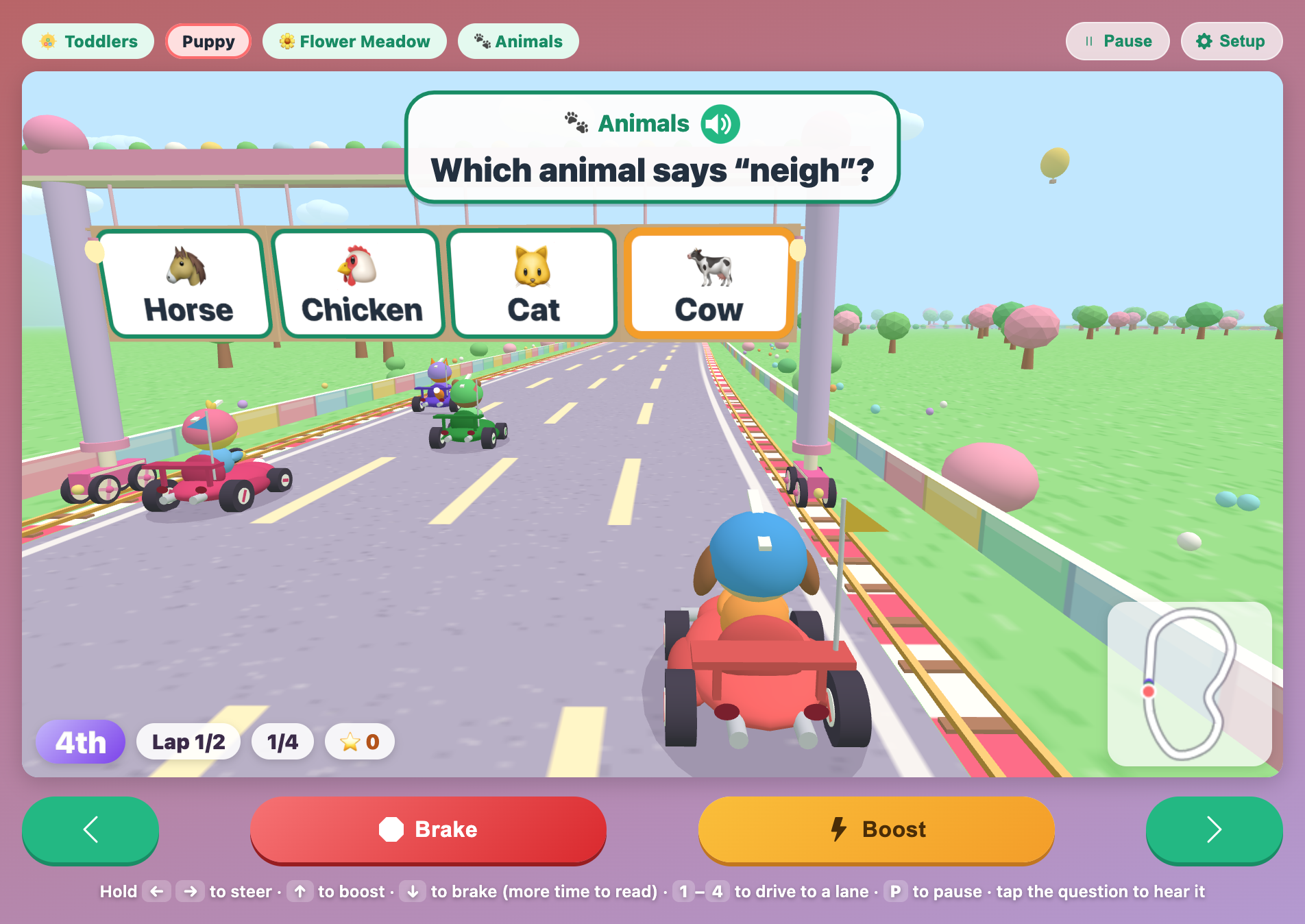
Puppy racing on Flower Meadow toward a toddler gate asking which animal says neigh, with Horse, Chicken, Cat and Cow pictures
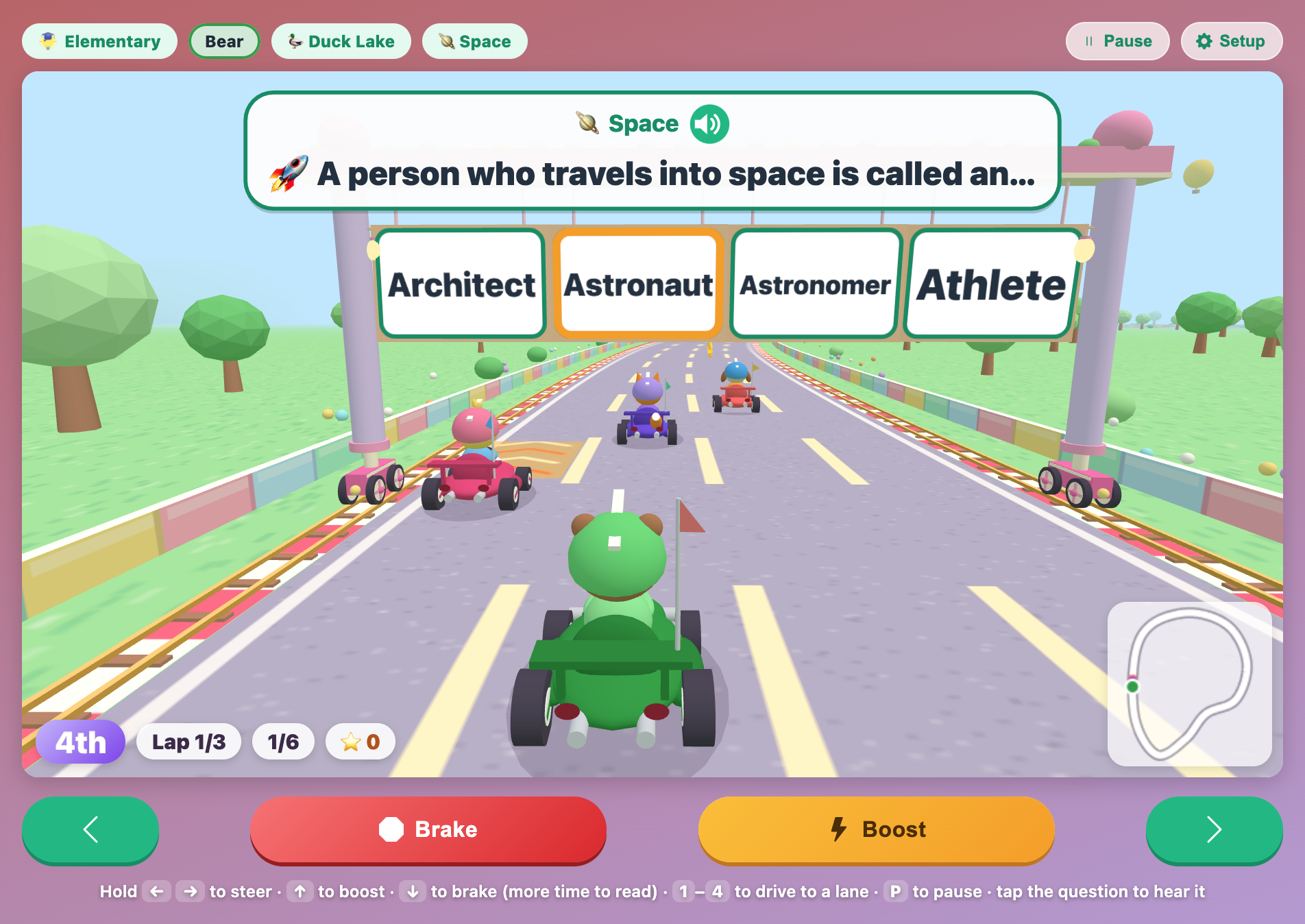
Bear in a green go-kart driving under four signs for the question a person who travels into space is called
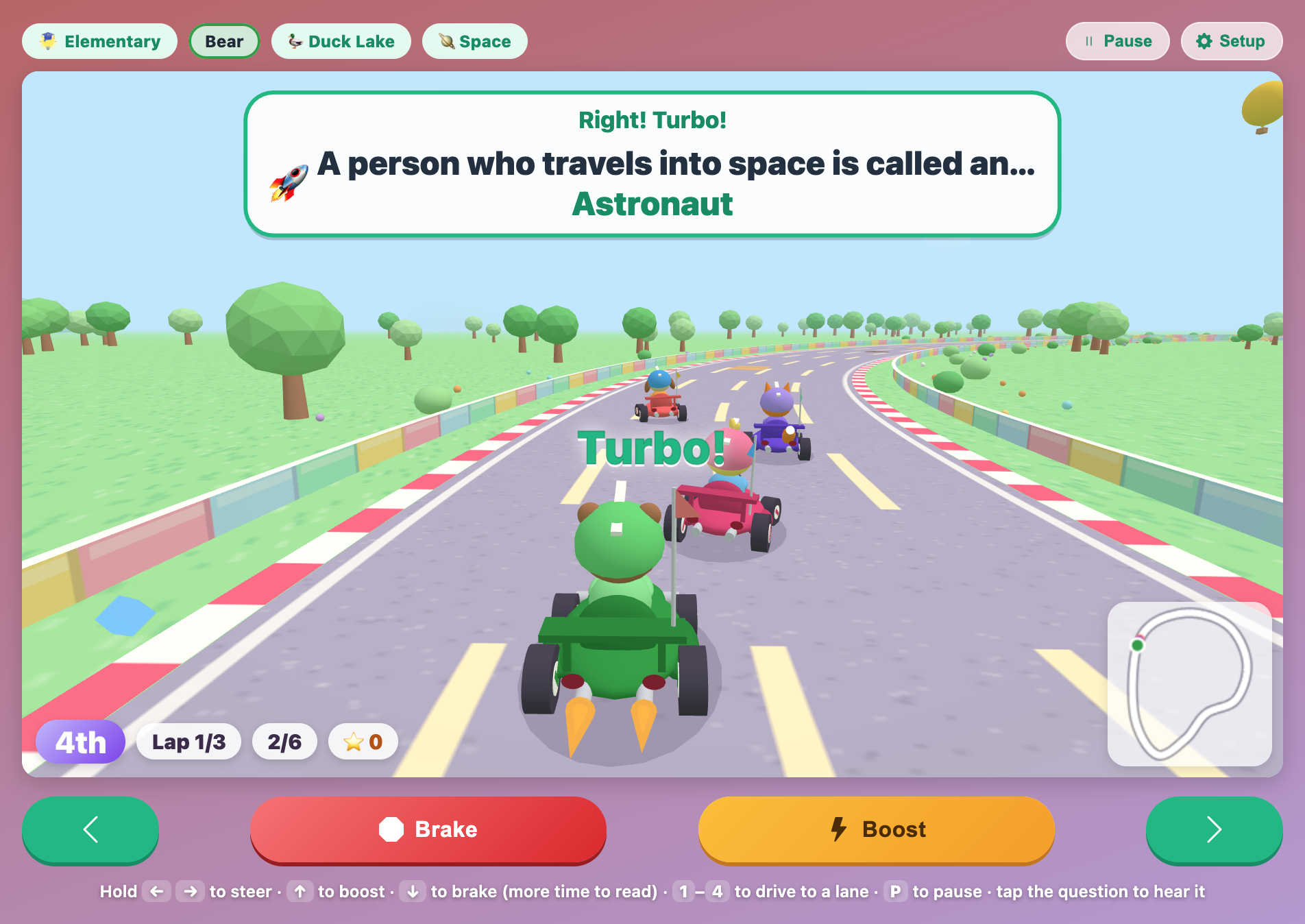
Bear's kart blasting off with a Turbo after the right answer, Astronaut, shows in green on the question plate
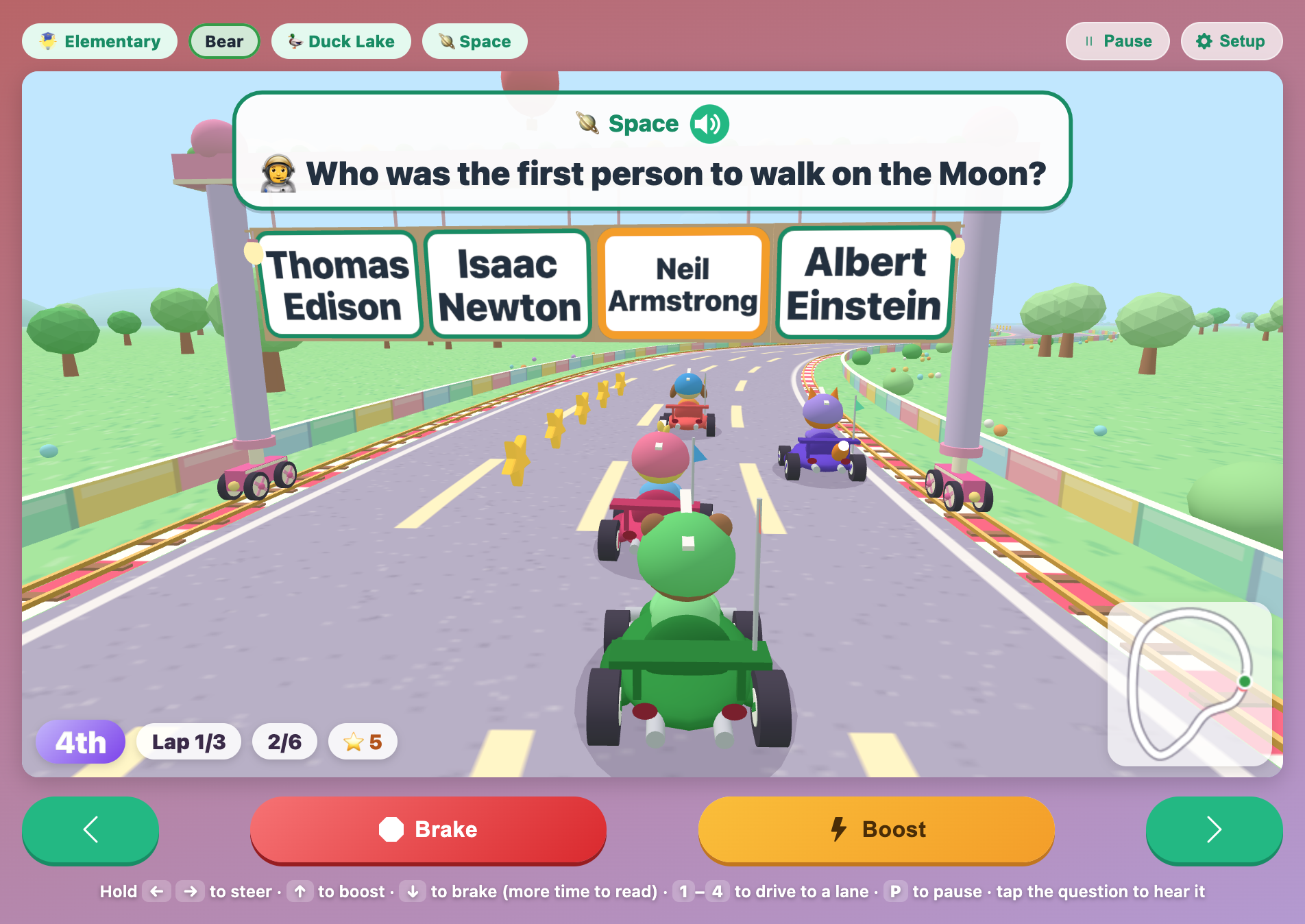
A gate on Duck Lake asking who first walked on the Moon, with Neil Armstrong in a gold frame in Science Kart Circuit for kids
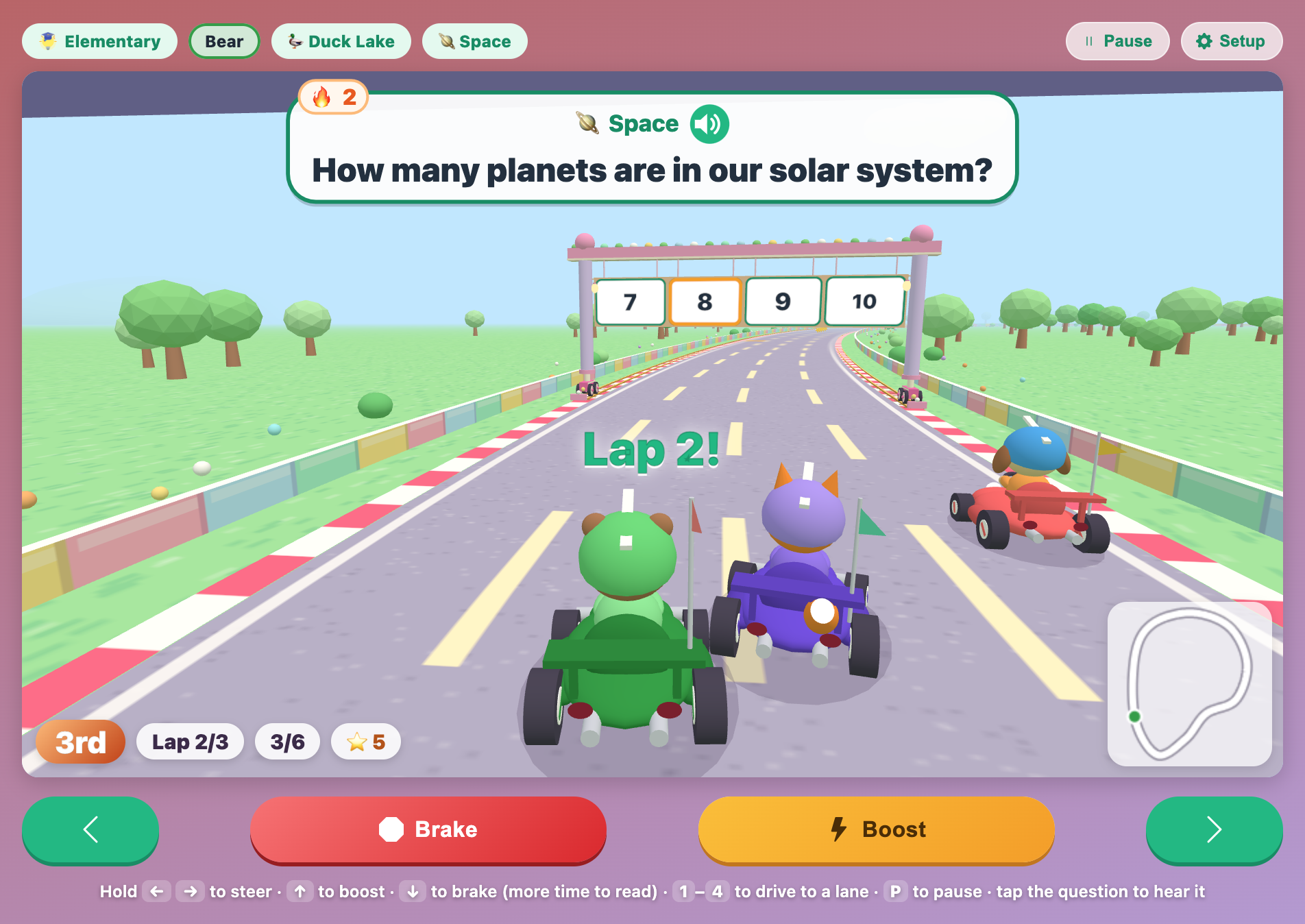
The Lap 2 sign popping up as the next gate asks how many planets are in our solar system, with signs 7, 8, 9 and 10
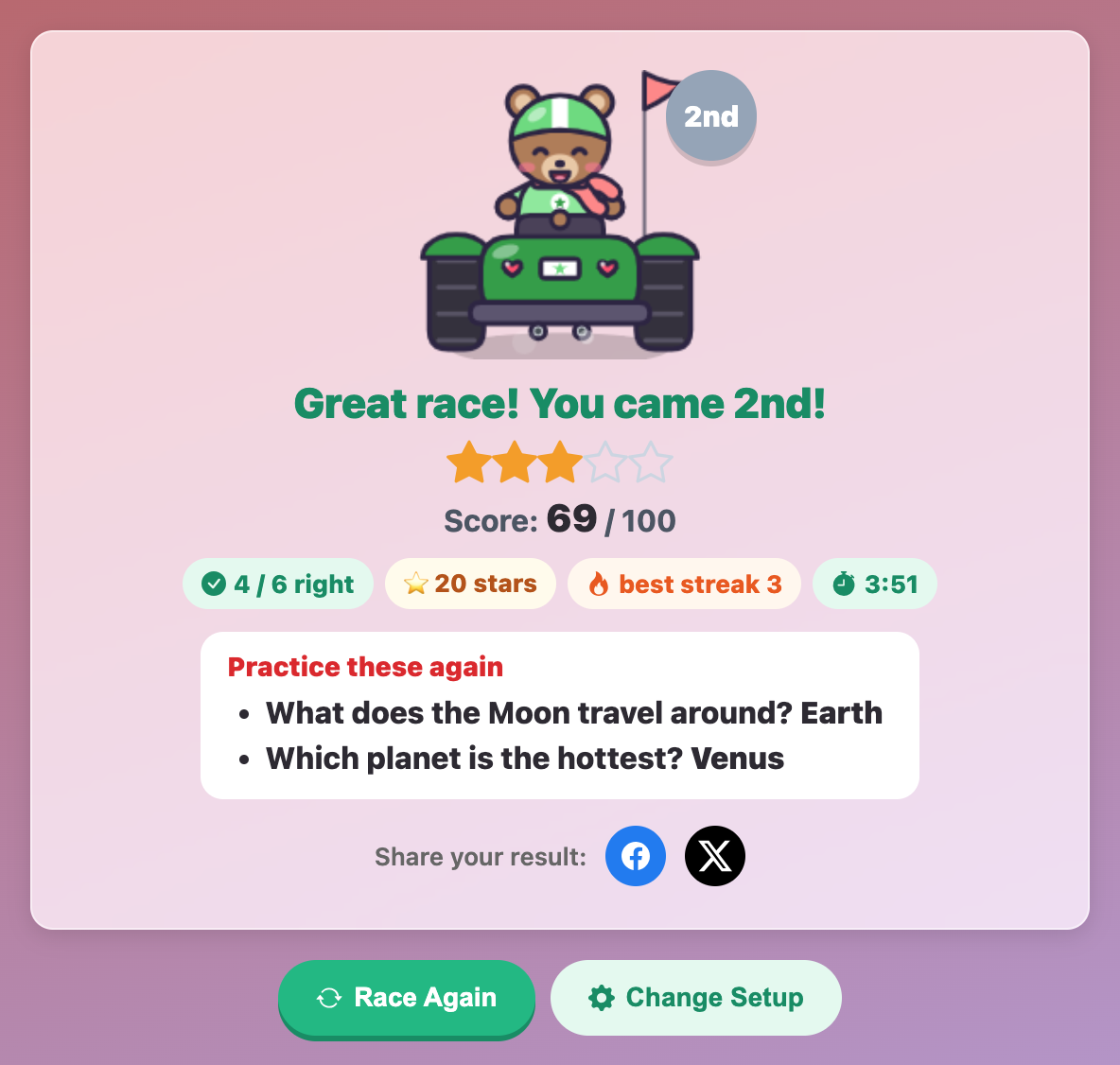
The Science Kart Circuit result card with Bear in 2nd place, 69 points, 4 of 6 right, 20 stars and a practice list
More Science Games
 59.5K plays
4.8
Recycling Sort
Sort everyday items into the Recycle, Compost, or Trash bin before time runs out!
 85.7K plays
4.9
Grow a Plant
Plant seeds in sunny and shady garden beds, then water, feed and protect them day by day. Watch the roots grow underground and harvest sunflowers, tomatoes, carrots and more!
 438.6K plays
4.9
Magnet Experiment
Guess which objects a magnet will pull, then drag the magnet to test every guess. Does gold stick? Does a battery?
 386.9K plays
4.9
Five Senses Match
Decide which of your five senses you would use for each everyday scene before time runs out.
Most Played Games
 1.8M plays
4.9
Color & Draw
A free-drawing canvas with colors and brush sizes to unleash your creativity.
59.5K plays
4.8
Recycling Sort
Sort everyday items into the Recycle, Compost, or Trash bin before time runs out!
 365.8K plays
5.0
Tic-Tac-Toe
Play a game of Tic-Tac-Toe against the computer and see if you can outsmart it.
 274.1K plays
5.0
Sentence Builder
Pick your age level, then tap the shuffled words in the right order to build the sentence.
Comments (21)