
Word Safari
352.5K playsGo on a word safari! Explore a busy farm, kitchen, park, beach or classroom: tap anything to see and hear its name. Then the hunt begins: find the cow, the red apple or the small pig. Older explorers read trickier clues like the tallest tree, something cold, or the cat under the table. Every find goes into your safari journal.
A farm, a kitchen, a park, a beach and a classroom: five busy places, packed with 96 things to name. Word Safari for kids is a free English vocabulary game on KidWorld. First you tap around a picture to hear what everything is called. Then the hunt starts, and you find what the clue asks for: the cow, the red apple, the smallest pig, or the cat under the table.
It is made for children from about 2 to 12. Little ones learn simple names like cake and tractor. Older kids read clues with colors, sizes, place words and riddles. It plays right in your browser, on a computer, tablet or phone, with nothing to download and no sign-up. Every thing you find goes into your own safari journal, so you can see all the words you spotted.
🔭 Word Safari for Kids: Look First, Then Hunt
A safari is a trip to look for animals in the wild. In this game, your safari is a trip to look for words. Each picture is a scene, and every cow, cup, crab and crayon in it is a button you can tap.
Every scene has two parts:
Explore. You tap things to learn their names. A white name tag pops up over the thing, it bounces, and the game says its name out loud. No points, no mistakes. Just looking and listening.
Find. Now a clue card asks you to find something, like “Find the duck in the pond!” Tap it in the picture. Find it on your very first tap, and you earn a star.
So the game teaches a word first, and then asks you to use it. That is how kids learn new words in real life too: you hear the word, you see the thing, and then you go looking for it.
🗺️ The Five Places You Can Visit
Each game picks scenes at random, so you never know where your safari will start. Here is what waits in each place. The younger levels see fewer things, and the older levels see the busy, full picture.
🚜 The farm
A red barn, a tractor, a cow, a sheep, a horse and three pigs of different sizes. A chicken stands with her little chick. Look closely, and you will spot a cat on the fence and another cat hiding in a basket, with only its head poking out. One duck swims in the pond and another waits next to the bucket. On the Tweens level, two tiny mice join in.
🍳 The kitchen
Three cups sit on a shelf, from big to small. A cake, a red apple, some bread, a green apple and an ice cream sit on the table. There is a pot of honey, a clock on the wall and a dog on the floor. Older players will find three cats: one under the table, one on the chair, and one next to the dog.
🌳 The park
A cloud, a kite, a rainbow and a balloon float above three trees: a tall one, a middle-sized one and a short one. There is a bench with a bird on it and a dog under it, a bike, a scooter, a skateboard and a ball. On the Tweens level, two butterflies flutter near a flower.
🏖️ The beach
Three sailboats float on the sea, with a fish and a whale nearby. On the sand you will find a palm tree, a beach umbrella, a sandcastle, a bucket and a rock. Crabs and shells hide all over the place. There is an ice cream, a sun hat and sunglasses, and on the Tweens level a flip-flop too.
🏫 The classroom
A green board with A B C on it, a clock, a globe and three books (red, blue and green) on a shelf. On the desk you will see an apple, three pencils of different lengths and a pair of scissors. A backpack sits on the floor, a crayon lies in the corner, and three teddy bears are hiding in different spots.
🧭 Your Safari, Step by Step
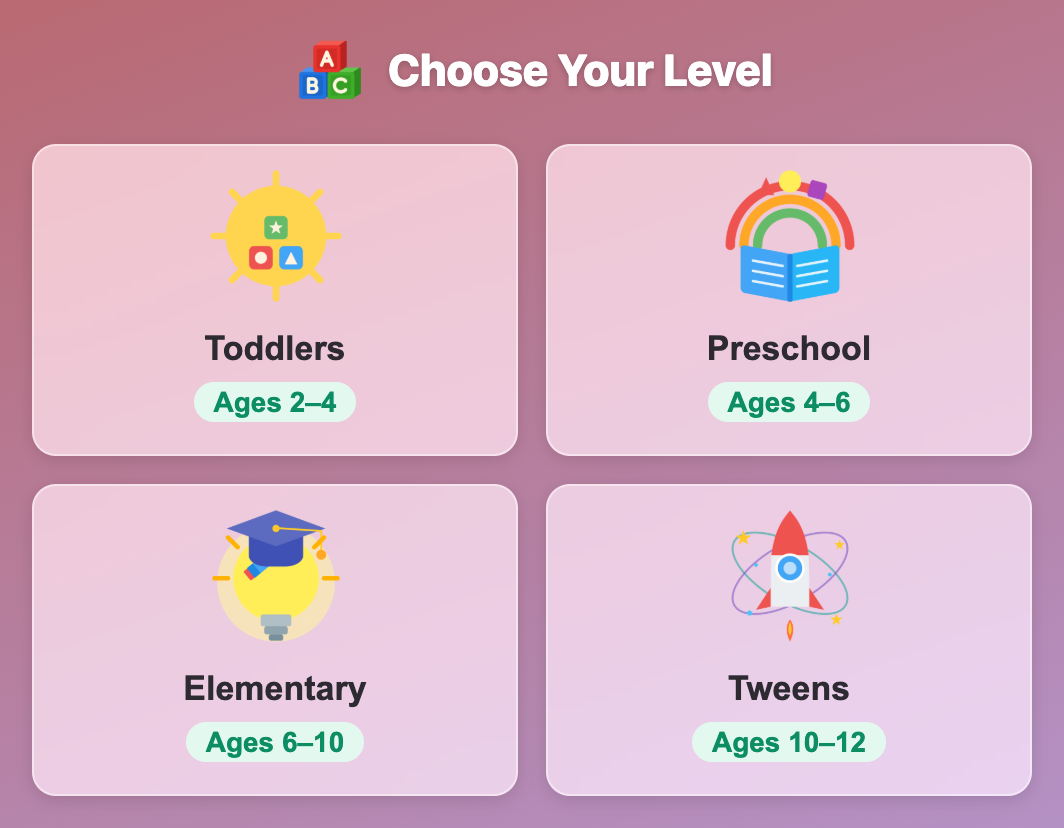
Pick your level. The level picker shows four cards: Toddlers (ages 2–4), Preschool (ages 4–6), Elementary (ages 6–10) and Tweens (ages 10–12). Tap the one that fits you. The game remembers it, and the Change Level button at the top lets you switch at any time.
Read the top bar. The compass shows which scene you are on (like 1 / 3). The magnifying glass shows which clue you are on (like 4 / 6). The star shows how many things you found on the first tap.
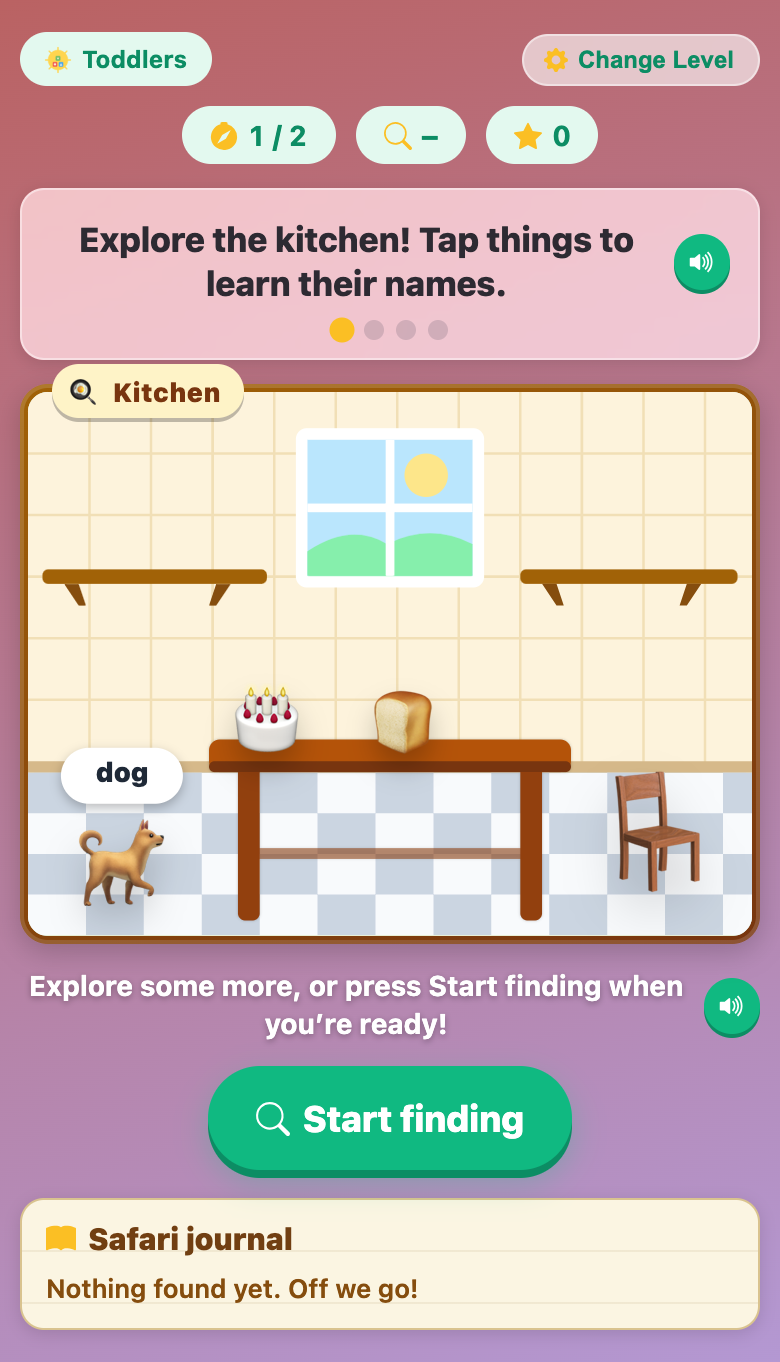
Explore the scene. The card says “Explore the farm! Tap things to learn their names.” Tap anything you like. Its name shows up and you hear it. Only one name shows at a time, so the picture never gets covered up.
Press Start finding. The green button wakes up once you have tapped a few different things: 3 on Toddlers, 4 on Preschool, 3 on Elementary and 2 on Tweens. Until then, the button counts for you, like 2 / 4. You can keep exploring for as long as you like before you press it.
Read the clue and tap the answer. The card says something like “Find the bird on the bench!” The dots under it show how many clues are left in this scene. Tap the 🔊 button next to the card to hear the clue read aloud.
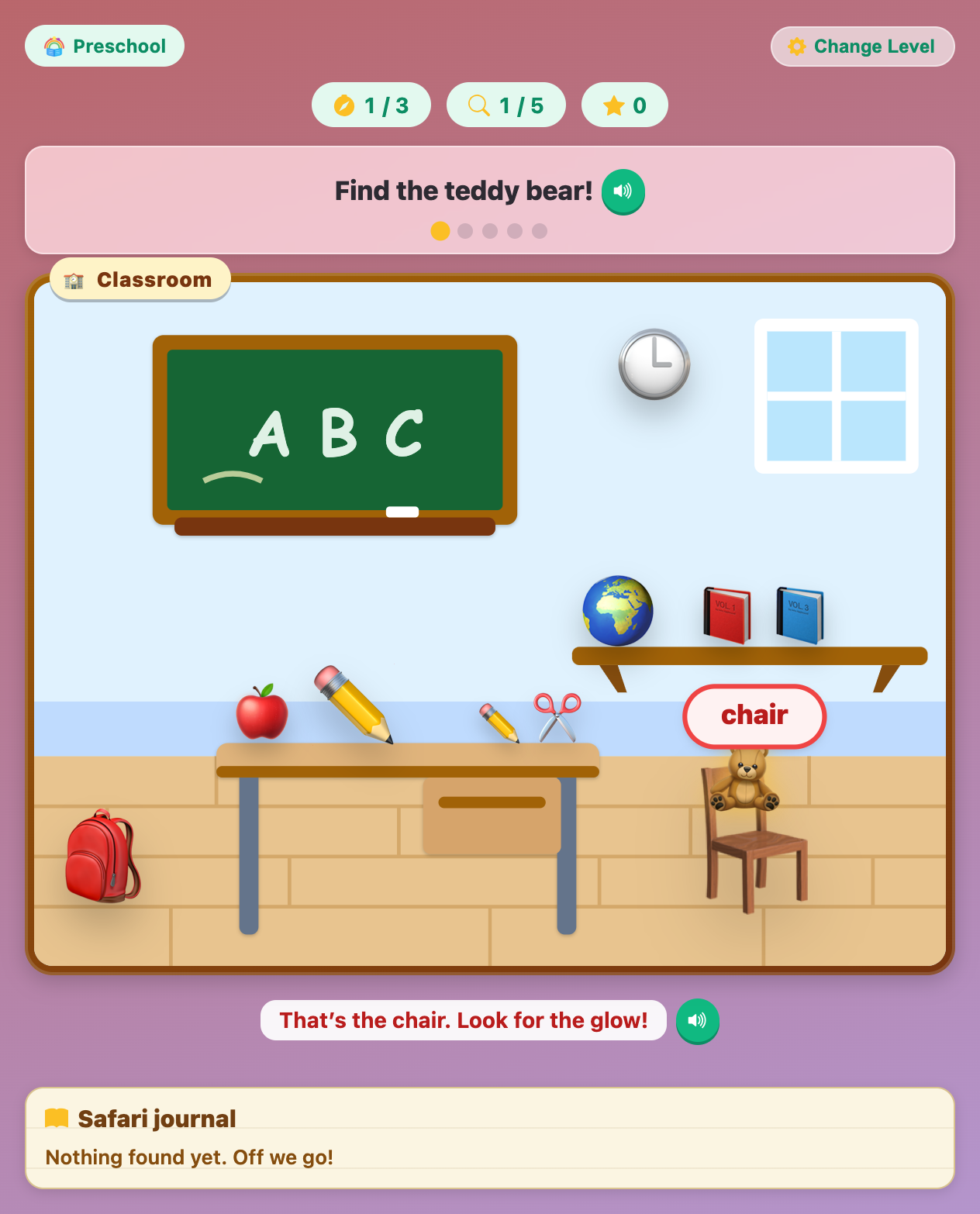
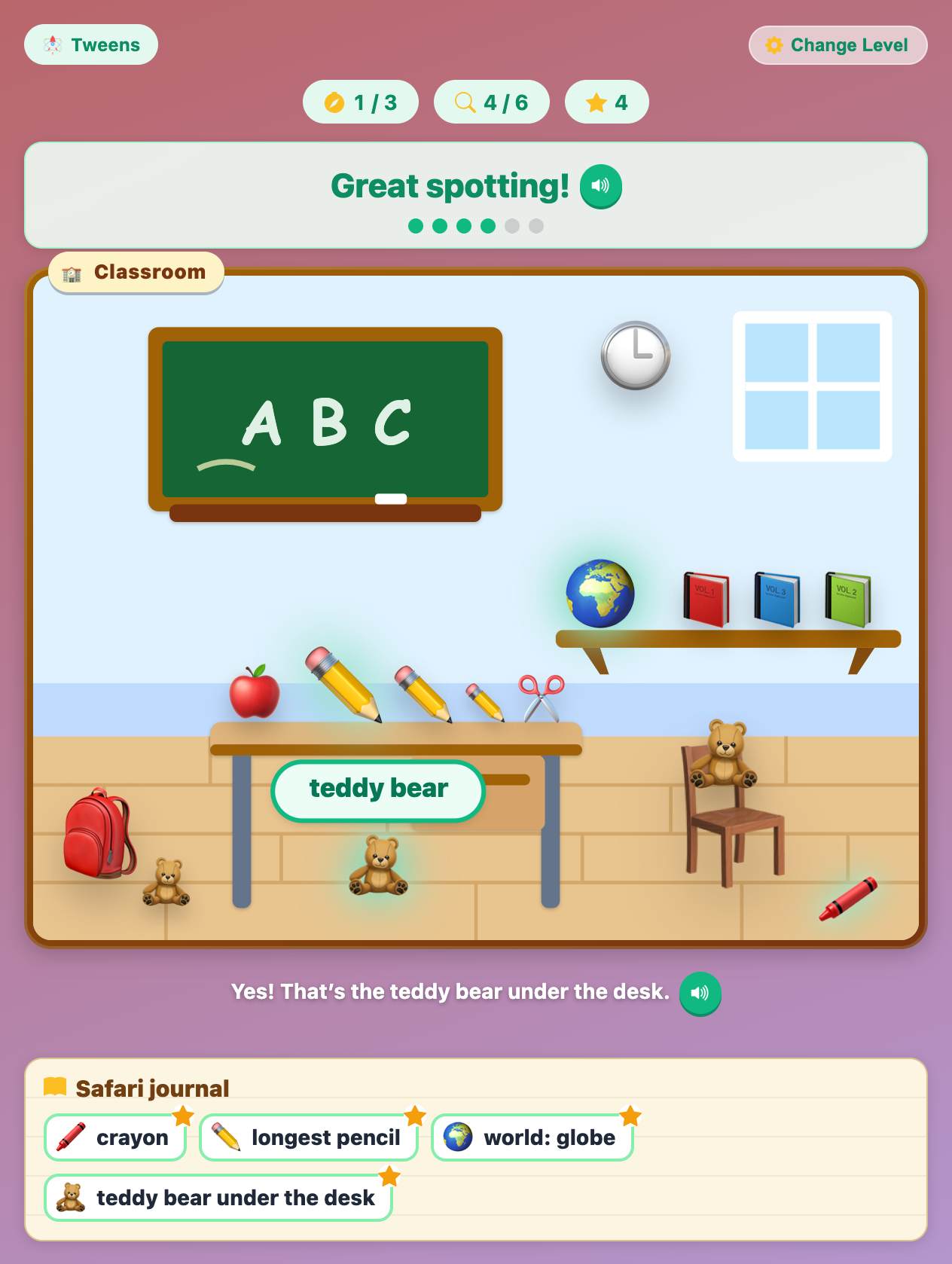
Watch what happens. A right tap makes the thing glow green and shows its name. The card cheers “Great spotting!” if it was your first tap. A wrong tap makes the thing shake, and its name shows in red, like “That’s the pig. Try again!”
Follow the glow if you are stuck. After a wrong tap on Toddlers, or two wrong taps on the other levels, the right answer glows gold and bobs up and down. After three wrong taps, the game shows you the answer (“Here it is: the cow.”) and moves on to the next clue.
Check your safari journal. Under the scene, every find gets its own little tag with a picture, like “cat in the basket” or “cold: ice cream”. A gold star on the tag means you found it on the first tap. Tap a tag to hear it again.
Move to the next place. When a scene is done, the card says “Scene complete!” and the tip tells you how you did, like “Farm explored! 5 of 6 found on the first tap.” The Next scene button counts down from 5 and then moves on by itself, or you can tap it (or press Enter or Space). While you wait, you can still tap things to hear their names.
See your score. After the last scene, press See My Score. The finish card shows your score, your stars and your whole journal. Press Play Again for new scenes and clues, or Choose Another Level.
Use the page buttons. Next to the game, the KidWorld page has a music button to turn the music on or off, a reload button to start fresh, and a fullscreen button to make the scene big.
It works with a mouse or a finger, so it plays well on tablets and phones. Small things, like the tiny cup or the mouse, get a bigger tap spot than their picture, so little fingers can still hit them.
🧩 What Do the Clues Ask?
There are five kinds of clues. Each level gets its own mix, and in every scene they go from easiest to hardest.
Naming clues: “Find the tractor!”
The simplest clue. Just one thing in the picture has that name, so you only need to know the word. Toddlers get only these: four in each scene. Preschool gets three per scene, and the bigger kids get one.
Looking clues: “Find the red apple!”
Now there are two or more of the same thing, and a color or a size word picks the right one. You might see the red apple and the green apple, the red book and the blue book, or the big pig and the small pig. Words like big and small, tall and short, and long and short show up on the Preschool level.
Biggest and smallest clues: “Find the tallest tree!”
From Elementary up, there are three of a thing, not two: three pigs, three cups, three trees, three boats, three pencils. The clue asks for the biggest or smallest, the tallest or shortest, or the longest or shortest one. Words that end in -est mean “the most”, so you have to compare all three.
Place clues: “Find the cat under the table!”
These clues use place words that tell you where something is. Elementary uses on, under, in and next to. Tweens add the harder ones: behind, in front of, between and above. There are always two or more of the thing, so the place word is the only way to tell which one is right.
Riddle clues: “Find something cold!”
Here the clue does not say the name at all. It describes the thing, and you work out what it is. Elementary gets clues like something hot, something soft, something white and fluffy, something that tells the time, or a baby chicken. Tweens get trickier riddles: the animal that gives us wool, something sweet and sticky, something you cut paper with, something that shows the whole world, something you see after the rain, and the biggest animal in the sea.
Some riddles have more than one right answer. For “something you can ride” in the park, the bike, the scooter and the skateboard are all correct!
🐾 Tracker Tips: How to Find It on the First Tap
A good tracker is a safari explorer who reads clues and spots things fast. Only first-tap finds earn a star, so these tips are all about getting it right the first time.
Explore more than you have to
The Start finding button only needs a few taps, but you can explore longer. Exploring costs nothing. Every name you hear now is a name you will know when a clue asks for it. If you are new to a scene, try tapping everything once before you start finding.
Say the clue out loud
Read the clue, or tap 🔊 to hear it, and then say it yourself. “The cat… under… the table.” Saying it slowly helps you notice the important words, like a color or a place word, before your finger moves.
Find the word part, then the clue part
Most clues have two parts: a thing and a detail. In “the small cup”, the thing is cup and the detail is small. First find every cup in the picture. Then use the detail to pick one. This way you never tap a cup that only looks right at first.
Compare all three before you tap
For a biggest or smallest clue, there are always exactly three. Look at all three side by side. The middle-sized one is the trap: it can look big next to the small one, and small next to the big one. Only tap when you have checked the other two.
Look for things that are peeking
Some things hide behind or inside other things. The farm cat in the basket shows only its head. The beach shell in the bucket shows only its top. The mouse behind the bucket is mostly hidden. If you cannot see the thing the clue asks for, look at the edges of baskets, buckets, tables and benches.
Know your place words
On means sitting on top, touching it (the bird on the bench).
Above means higher up, but not touching (the butterfly above the flower).
Under means lower down, with the thing over it (the dog under the bench).
In means inside it (the duck in the pond).
Next to means right beside it (the cat next to the dog).
Behind means at the back, partly hidden. In front of means closer to you.
Between means in the middle of two other things (the apple between the cake and the bread).
For riddles, think “what do I know about it?”
Ask yourself what the thing feels like, what it does, or where it comes from. Cold? Ice cream. Tells the time? A clock. Wool? That comes from sheep. If more than one thing could fit, like any of the three teddy bears for “something soft”, any of them is right.
Learn from a wrong tap
A wrong tap is not the end. The red name tag tells you what you tapped. If there are two of the same thing, it even tells you which one, like “That cat is on the fence.” Now you know the other cat is the one you need. Use that clue for your next tap.
Don’t tap twice in a hurry
After a find, the game pauses for a moment before the next clue. Taps in that pause are ignored, so there is no need to rush. Wait for the new clue on the card, read it, then tap.
🐘 Six Clues, Tracked Down Together
Here is how a good tracker thinks through real clues from the game.
Clue 1: “Find the cow!” (Toddlers, the farm)
On Toddlers, the farm has just seven things: the sun, a tractor, a cow, a sheep, a pig, a chicken and a dog.
During exploring, you tapped the cow and heard “cow”.
The cow is the big black-and-white animal on the left. Tap it.
It glows green, and “cow” goes into your journal with a gold star. If you tap the sheep by mistake, the cow starts to glow straight away, because Toddlers get help after just one wrong tap.
Clue 2: “Find the small cup!” (Preschool, the kitchen)
Find the word part first: cup. There are two cups on the left shelf.
Now the detail: small. One cup is big. The other is tiny.
Tap the tiny one. The tip says “This cup is smaller than the other one.”
Clue 3: “Find the cat in the basket!” (Elementary, the farm)
There are two cats on this farm. One sits on the fence at the back.
The clue says in the basket. Look at the basket near the bottom of the picture.
Only the cat’s head pokes out of the basket. Tap the head.
If you had tapped the other cat, the tip would say “That cat is on the fence.” That tells you to look for the second one.
Clue 4: “Find something you can ride!” (Elementary, the park)
This is a riddle, so there is no name in it. Think: what do people sit on and move with?
The park has a bike, a scooter and a skateboard. All three are right!
Tap the one you see first. The tip says “You can ride it!”
Clue 5: “Find the butterfly above the flower!” (Tweens, the park)
There are two butterflies near the flower in the bottom left corner.
One sits right on the flower, touching it. That one is on the flower.
The other is higher up, in the air. That one is above the flower. Tap it.
Clue 6: “Find the book between the other two books!” (Tweens, the classroom)
On the shelf, three books stand in a row: red, blue and green.
Between means in the middle. Which book has one book on each side?
The blue one. Tap it. The tip says “It sits between the red book and the green book,” and your journal gets a tag that says “book in the middle”.
⭐ How the Score and Stars Work
You get one point for every thing you find on your first tap. A thing you find after a wrong tap still goes into your journal, but it has no gold star and no point.
Your score is out of 100. It is the share of clues you got on the first tap. For example, Tweens has 3 scenes with 6 clues each, so 18 clues in all. Get 15 of them on the first tap, and your score is 83. Every finished game scores at least 10, so nobody leaves with zero.
The finish card is called Safari Star! It shows the number of scenes, how many you found on the first tap (like “18 of 18 on the first tap”), and up to five stars:
5 stars and a trophy for 90 or more
4 stars for 70 or more
3 stars for 50 or more
2 stars for 25 or more
1 star for every other score
Below the stars is your whole safari journal, with every word you found in this game.
🎒 Which Level Is Right for My Child?
All four levels use the same five places. What changes is how many things are in the picture and how hard the clues are.
Word Safari for toddlers (ages 2–4)
This level keeps each scene calm, with only 5 to 7 big, easy things, like a cow, a cake, a ball or a crab. A game is 2 scenes, with 4 naming clues in each. The answer starts to glow after just one wrong tap, so little ones are never stuck. A grown-up can sit beside them, say each name together, and point at the picture before the child taps.
Word Safari for preschoolers (ages 4–6)
Here, each scene has up to 15 things. A game is 3 scenes with 5 clues each. Most are naming clues, plus looking clues with colors (the red apple, the blue book) and sizes (the big pig, the small pig). It is a good way to practice color words and opposites like big and small or tall and short.
Word Safari for elementary kids (ages 6–10)
This level brings in up to 19 things per scene and all five kinds of clues. Each scene has 6 clues: a biggest or smallest, a riddle, two place clues with on, under, in or next to, and a couple of naming or color clues. Kids now have to read the whole clue, not just spot a word. If your child likes comparing words like big and small, Opposites Seesaw is a fun way to practice more pairs of opposites.
Word Safari for tweens (ages 10–12)
The top level has the busiest pictures, with up to 21 things and lots of look-alikes. Each scene has 6 clues, and three of them are place clues, now with behind, in front of, between and above. The riddles get harder too, like the animal that gives us wool. Hidden things, like the mouse behind the bucket, make tweens look really closely. It is also a great level for older kids who are still learning English.
🌍 Big Learning in a Busy Picture
Word Safari for kids looks like a game of spotting things, but it quietly teaches a lot of English.
New words, linked to pictures. When you tap the honey pot and hear “honey”, the word sticks to the picture in your head. The journal lets you hear every found word again.
Describing words. Colors and sizes, plus -est words like tallest and smallest, are words kids use every day to explain what they mean.
Place words. On, under, behind and between are hard for young learners. Here, the picture shows exactly what each one means: the dog really is under the bench.
Careful reading. “The cat on the chair” and “the cat under the table” share almost every word. Kids learn to read to the end of the sentence before they act.
Thinking and guessing smartly. Riddles like “something you see after the rain” ask kids to use what they already know about the world.
Learning from mistakes. A wrong tap tells you what you tapped, and the glow helps you find the right answer. Nobody is told off, and every child gets to the end.
Children who are just starting with English, or who can’t read yet, can also try Listen & Tap, where a parrot says a word and you tap the picture you hear.
For parents and teachers
Word Safari is calm and friendly. There is no timer, no lives and nothing scary: just farm animals, food, toys and sunny places. Wrong taps never end the game, and the game shows the answer after three tries, so a child never gets stuck. There is no chat and no sign-up, and it runs in the browser on computers, tablets and phones.
It practices everyday nouns, colors, size words, comparing words (big, bigger, biggest), place words (prepositions) and simple riddles. That makes it useful for early vocabulary at home, for English learners, and as a quick warm-up in class. A nice idea: after a game, open the finished journal together and ask your child to use each word in a sentence.
Your binoculars are ready, and five busy places are waiting. Pick your level, explore every corner, and see how many words you can find on the first tap. Start Word Safari for kids now, and when you are done, try hunting for hidden words in a grid with Word Search. Happy tracking! 🦒
🖼️ See the Game in Action
The Word Safari level picker with four cards: Toddlers ages 2–4, Preschool 4–6, Elementary 6–10 and Tweens 10–12
A phone view of Word Safari for toddlers, exploring a simple kitchen where the tapped dog shows its name
A preschool classroom clue asking for the teddy bear, with the chair named in red and the teddy bear glowing gold
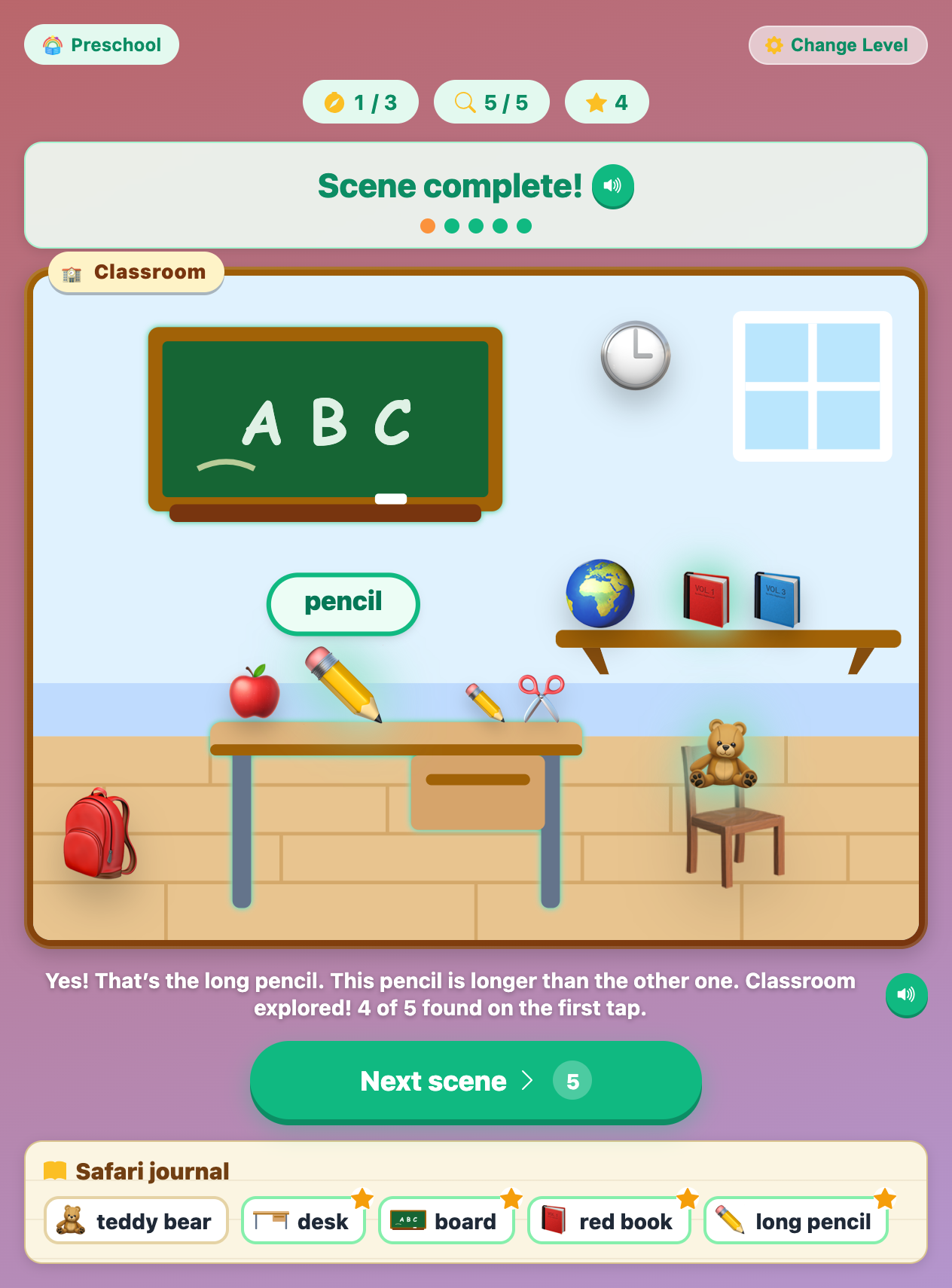
A finished classroom scene in Word Safari for kids, with the Next scene button counting down and five journal finds
The teddy bear under the desk found with a green glow among three teddy bears in Word Safari for tweens
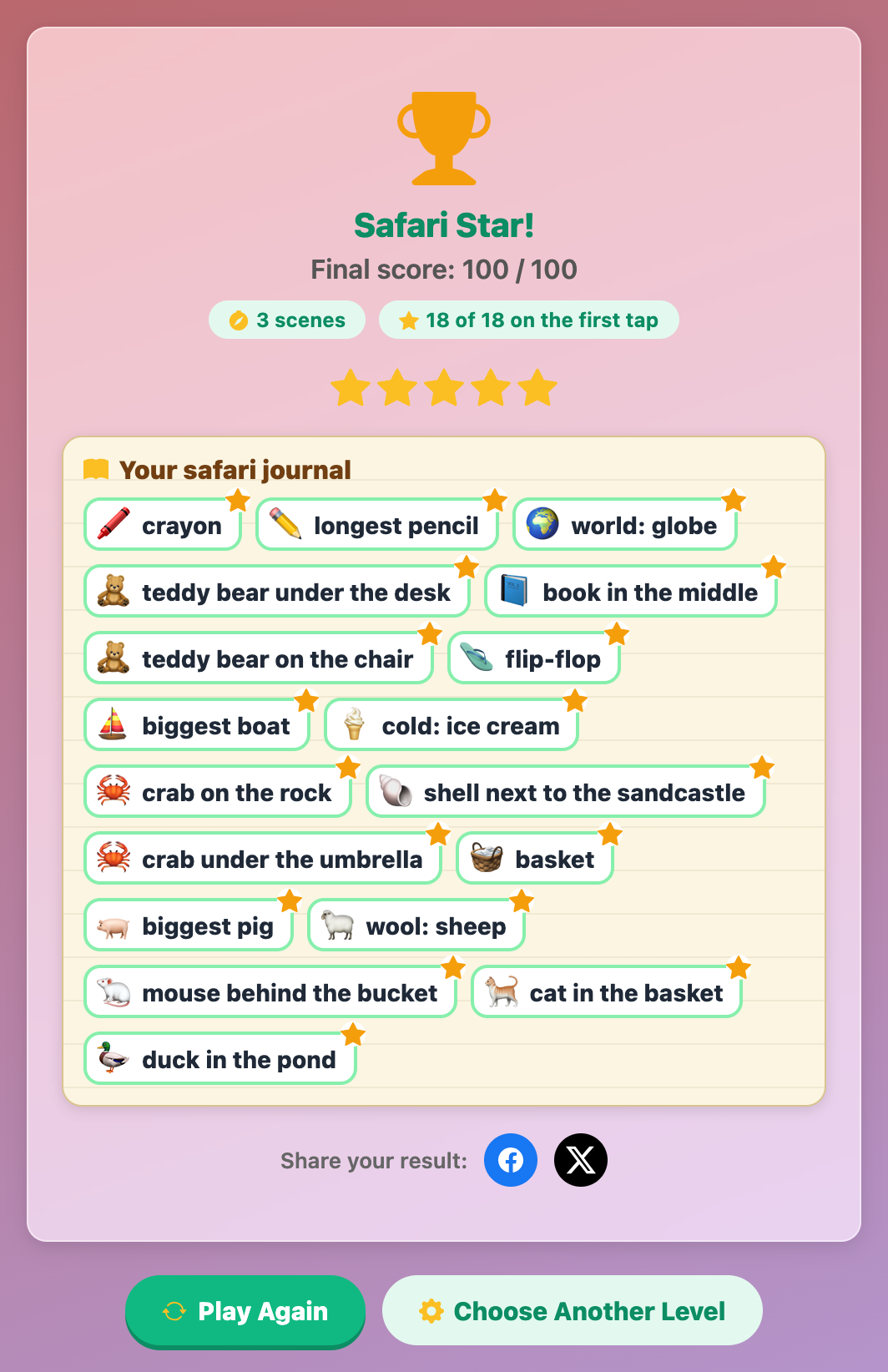
The Safari Star finish card with a score of 100 out of 100, five stars and a journal of 18 finds
More English Games
 102.9K plays
5.0
Dino English Dash
Pick your dinosaur and race to the finish! Every right answer makes your dino dash ahead, three in a row lets out a big ROAR, and a wrong answer makes it trip. Find first letters, read picture words, spot rhymes, and pick the right spelling, opposite and grammar to beat the pack.
 85.8K plays
5.0
Story Sequencing
Pick your age level, then drag or tap the mixed-up picture cards into the order the story happens and check your answer.
 105.4K plays
4.9
English Kart Circuit
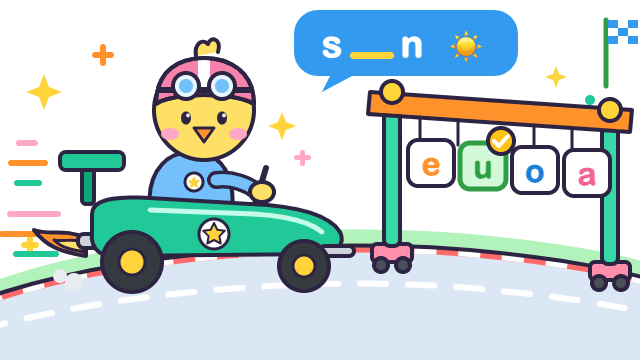
Race a cute go-kart round a 3D track! Read the question at the top, steer into the lane with the right answer and drive under its sign for a Turbo boost; three in a row makes you a Super Star. Hold Boost to zoom or Brake for more time to read. Pick Puppy, Foxy, Bear or Chick, collect stars and dodge the mud. Letters and picture words for little ones, then rhymes, spelling, opposites and grammar.
 435.6K plays
4.8
Sight Word Pop
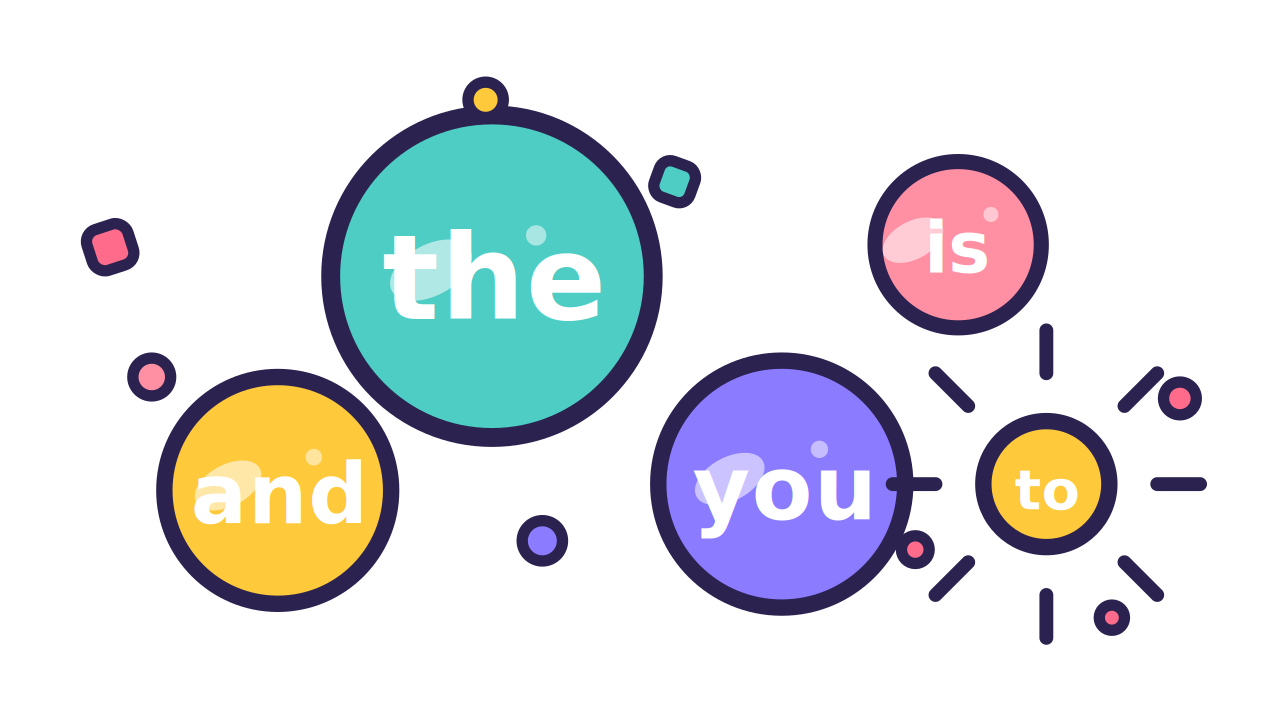
Read the target word and pop the matching bubble before the timer runs out.
Most Played Games
 274.1K plays
5.0
Sentence Builder
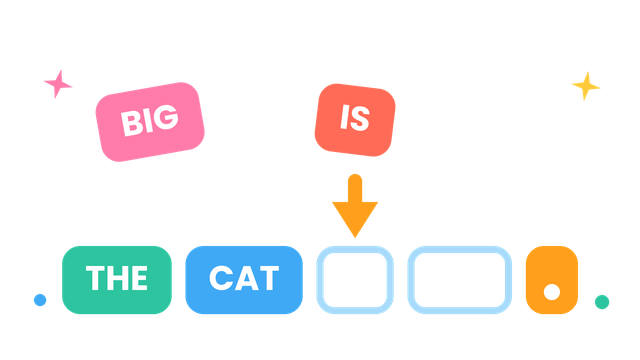
Pick your age level, then tap the shuffled words in the right order to build the sentence.
 717K plays
4.9
Word Crush
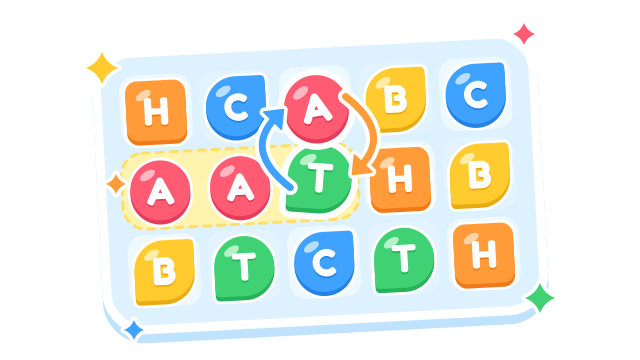
Swap the candy letters to line up 3 in a row and crush them! Every letter you crush fills in a word, like cat, hat and bat. Make rockets, bombs and rainbows, and spell every word before your moves run out.
 314.9K plays
4.9
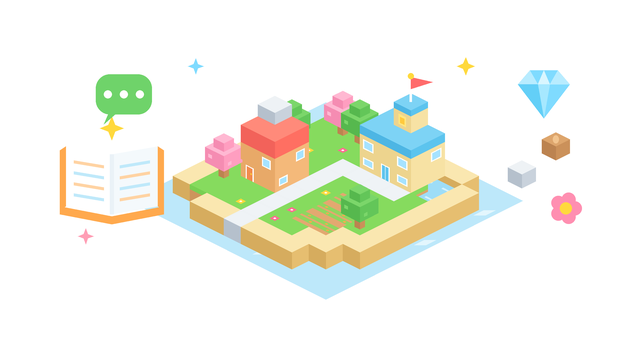
English Village Builder
Build a village on a blocky island! Answer vocabulary, spelling, word-meaning and grammar questions to earn wood, stone, flowers and diamonds for every house, road, farm and school.
 235.5K plays
4.9
Alphabet Pop
Pop the bubble with the letter that a picture and word starts with.
Comments (26)