
Opposites Seesaw
53.4K playsBalance the seesaw with opposites! A word sits on one end: tap or drag its opposite onto the other end and watch the seesaw level out. Hot goes with cold, big with small. Little ones match picture pairs, older kids dodge tricky look-alikes like warm, and tweens build opposites with un-, dis-, im-, il- and ir-. Every balanced pair goes into your album.
A seesaw only sits flat when both ends match. Opposites Seesaw for kids is a free English game on KidWorld that turns that idea into word practice. A word sits on one end of a green seesaw, like hot 🔥, and that end is stuck down low. You put its opposite on the empty end, like cold 🧊, and the seesaw springs level with a cheer.
An opposite is a word that means the other end of something: big and small, up and down, happy and sad. The game has four levels for ages 2 to 12. Little ones match picture pairs with emoji. Older kids must dodge tricky words that only look like the answer, and tweens build opposites with word beginnings like un-, dis-, im-, il- and ir-. It all runs in your web browser, with no download and no sign-up.
⚖️ Why Opposites Belong on a Seesaw
Think about a real seesaw at the park. If only one kid sits on it, that side drops to the ground. It needs a partner on the other end to balance.
Opposite words work the same way. Day alone is only half the story. Put night on the other side, and you have a full pair. Grown-ups call opposites antonyms. In this game, think of them as seesaw partners.
In this game, every round is one seesaw. The word on the left end is orange. The right end has a dashed seat with a big ? on it. Your job is to find the one block that makes the seesaw balance.
The right block lands on the seat in green. The plank swings level, gives a little wobble, a "Balanced!" sign pops up and emoji confetti flies.
A wrong block lands in red with its word crossed out. The seesaw tips the wrong way, and "Oh no, it doesn't balance!" shows up. Then the wrong block slides off, the right block glows yellow on the grass, and it hops onto the seat so the seesaw can balance after all.
Every pair you finish goes into your pair album under the seesaw, like "🔥 hot ⇄ cold 🧊". Pairs you balanced on the first try get a green check mark.
🧩 Pictures, Words and Word Beginnings: The Three Kinds of Rounds
Picture rounds (Toddlers and Preschool)
Each block shows an emoji over its word: 🐘 big, 🐭 small, 🐆 fast, 🐢 slow, 🍭 sweet, 🍋 sour. Every block also has its own 🔊 button, so a child who can't read yet can hear each word first. Pressing 🔊 never picks the block by mistake.
Word rounds (Elementary)
Now there are no pictures, just four word blocks. Here is the tricky part: three of them are almost right. For hot, the blocks are cold, warm, sunny and red. Warm, sunny and red all go with hot, so they sit on the same side of the seesaw. Only cold is the true opposite.
Word-beginning rounds (Tweens)
Half of the Tweens rounds show a word like possible and four beginnings, called prefixes. A prefix is a small piece you stick on the front of a word to change its meaning. The blocks say things like un-, dis-, in-, im-, il- and ir-. When you choose one, the whole new word appears on the seesaw, with your prefix in purple: impossible. Only one prefix makes a real word. The other half of the Tweens rounds are harder word pairs, like generous and selfish.
🛝 How to Play Opposites Seesaw on KidWorld
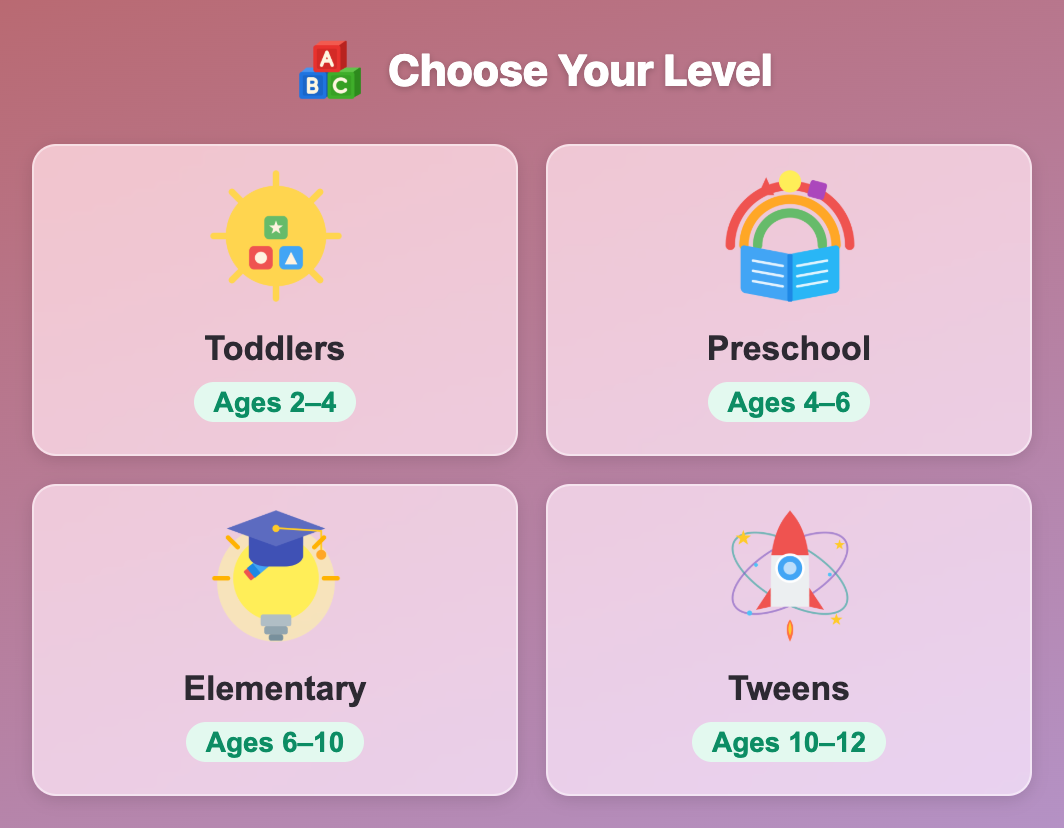
Pick your level. The Choose Your Level screen shows four cards: Toddlers (ages 2–4), Preschool (ages 4–6), Elementary (ages 6–10) and Tweens (ages 10–12). The game remembers your level, so next time it starts right away. Press Change Level at the top to switch.
Read or hear the question. The pink card at the top asks "What is the opposite of …?" Press its 🔊 to hear it. With the site's sound on, the game reads each question out loud by itself, a little slower for younger levels.
Tap a block, or drag it. Tap a block on the grass to put it on the seesaw. Or press and drag it up onto the seesaw. When you are over the seesaw, the dashed ? seat turns yellow. Let go there to choose it. Let go anywhere else, and the block snaps back to the grass.
Use a keyboard if you like. Press Tab to move between blocks, and Enter or Space to choose one.
Watch the seesaw. Level means right. Tipped the wrong way means try to remember the right pair for next time. You get one answer each round, so think before you tap.
Read the tip. Under the seesaw, a tip tells you what happened, like "Warm is not the opposite of hot. The opposite of hot is cold." It has its own 🔊 too.
Press Next. The Next button fills up and counts down from 5, then moves on by itself. It waits while the game is still talking. You can press it, or Enter or Space, to go on sooner. On the last round it says See My Score.
See your finish card. It shows your score out of 100, how many pairs you balanced on the first try, up to five ⭐ stars and your whole pair album. Then choose Play Again for new words, or Choose Another Level.
Around the game you will also find buttons for full screen, reloading the game, and turning the music and sound on or off. Background music plays while you balance. The game works with a mouse, a keyboard, or a finger on a phone or tablet.
🎯 Balancing Tricks for Opposites Seesaw for Kids
There is no clock in this game. Nobody is rushing you. But you only get one try per round, and only first tries earn points. These tricks help you get it right the first time.
1. Say the sentence out loud
Say "The opposite of ___ is ___" with each block. "The opposite of fast is slow" sounds right. "The opposite of fast is loud" sounds silly. Your ears often know the answer before your brain does. Press the 🔊 buttons if you want to hear the words first.
2. Ask "What is it about?"
This trick is gold on the picture levels. Every pair is about one thing: size, feelings, taste, sounds, day and night. In a picture round, the wrong blocks are always about different things from the word on the seesaw. So if the word is sweet (a taste), look for the only block that is also a taste. That is sour 🍋. The game never puts two words about the same thing in as a trick.
3. Cross out the "same team" words
On Elementary and Tweens, the wrong blocks are on the same team as the word. They mean nearly the same thing, or they go along with it. For fast, the block quick means just the same as fast. For happy, glad is a happy word too. Find these teammates first and ignore them. The block that is left on the other team is your answer.
4. Use the "not" test
An opposite usually means "not that at all". Ask: is warm "not hot at all"? No, warm is a little bit hot. Is cold "not hot at all"? Yes! The block that passes the "not" test balances the seesaw.
5. Put both words in one sentence
Try "The soup is hot, not ___." or "My room is clean, not ___." Then read it with each block. "My room is clean, not dirty" makes sense. "My room is clean, not shiny" does not, because shiny things are often clean too.
6. Learn the prefix spelling rules
On the Tweens level, in-, im-, il- and ir- all mean "not". The trick is which one fits. The game teaches the rule in its tips:
im- comes before words that start with b, m or p: impossible, impolite, impatient, imperfect, immature.
il- comes before words that start with l, so you get a double l: illegal, illogical, illegible.
ir- comes before words that start with r, so you get a double r: irregular, irresponsible, irrelevant.
in- is the plain one for other words: incorrect, incomplete, invisible, inactive, inexpensive.
So look at the first letter of the word on the seesaw. It tells you which "not" prefix to pick.
7. Un- or dis-? Listen to the whole word
The game loves to put un- and dis- side by side, because they are easy to mix up. Both can mean "not". Here, the best trick is your ear. Say each whole word. Is it "unagree" or "disagree"? Is it "unhappy" or "dishappy"? The real word just sounds right. Words to remember: unhappy, unfair, untidy, unsafe, unlock, and disagree, dislike, disappear, disobey, disconnect.
8. Drag when you are not sure
A tap chooses a block right away. A drag gives you a moment to think. You can hold the block above the seesaw, read it once more, and if you change your mind, let it go on the grass. It snaps back home and nothing is counted.
9. Turn your album into a study list
Every pair you play goes into the pair album, even the ones you missed. Pairs without a green check are the ones to practice. Tap any album pair to hear both words read together, like "Hot, cold." Saying them a few times makes them stick.
If you like spotting opposites fast, Dino English Dash has opposites questions too, mixed into a dinosaur race where every right answer makes your dino run.
🔎 Six Seesaws, Solved Step by Step
Example 1: Preschool, the opposite of cry 😭
The blocks are ✅ yes, 📢 loud and 😂 laugh.
What is cry about? It is a feeling. You cry when you are sad.
Yes is about answers. Loud is about sounds. Only laugh is about feelings.
Laugh is what you do when you are happy, the other end of cry. Tap laugh, and the seesaw balances!
Example 2: Preschool, the opposite of sweet 🍭
The blocks are 🍋 sour, ⬅️ left and 📢 loud. Sweet is a taste, like candy. Left is a direction and loud is a sound. Sour is a taste, the face-scrunching taste of a lemon. That's the opposite. If you pick left by mistake, the seesaw tips, left slides off, and sour hops on with a glow.
Example 3: Elementary, the opposite of fast
The blocks are quick, far, slow and loud.
Same-team check: quick means the same as fast. Cross it out.
What is fast about? How quickly something moves. Far is about distance and loud is about sound.
The "not" test: slow means "not fast at all". Slow balances it. 🐢
Example 4: Elementary, the opposite of day
The blocks are night, sun, morning and light. Sun, morning and light all belong to the daytime, so they are on day's team. Night is when the day is over. Pick night.
Example 5: Tweens, the opposite of expensive
The blocks are il-, ir-, im- and in-.
Look at the first letter: e. It is not b, m, p, l or r.
So im-, il- and ir- don't fit. The plain "not" prefix is in-.
Inexpensive means not expensive, or cheap. The tip says: Inexpensive means not expensive. In- means “not”.
Example 6: Tweens, the opposite of generous
The blocks are selfish, kind, giving and wealthy. A generous person loves to share. Kind and giving are on the same team as generous. Wealthy means rich, and a rich person can share or not, so it is not the opposite. A selfish person wants to keep everything. That is the other end of the seesaw.
⭐ How Your Points and Stars Add Up
You get one point ⭐ for every round you balance on the first try. The counter at the top shows your points next to the round number, like "2 / 6".
At the end, your score is your points out of all the rounds, turned into a number out of 100. If you balance 5 of the 6 Preschool pairs, you score 83. If you balance 6 of 8 Elementary pairs, you score 75. Even a tough game scores at least 10.
The stars follow your score: 90 or more gets all five stars and a trophy, 70 or more gets four, 50 or more gets three, 25 or more gets two, and anything less still gets one. Every time you press Play Again, you get a new mix of words, and no pair is asked twice in one game.
👧 Opposites Seesaw for Kids from 2 to 12
🐣 Opposites Seesaw for toddlers (ages 2–4)
The Toddlers level has 5 rounds and only 2 picture blocks, so there is always a 50/50 chance. It uses the very first opposites children learn: big and small, hot and cold, happy and sad, up and down, day and night, fast and slow, open and closed, stop and go, yes and no. A grown-up can sit close, press the 🔊 on each block and say the pair together. Toddlers love tapping and watching the seesaw jump level.
🎨 Opposites Seesaw for preschoolers (ages 4–6)
Preschool has 6 rounds and 3 picture blocks. It adds new pairs like loud and quiet, awake and asleep, young and old, black and white, hard and soft, sweet and sour, heavy and light, left and right, laugh and cry, and wet and dry. The "What is it about?" trick works really well here. Kids who love learning new names for things can also explore a farm or a beach in Word Safari.
📚 Opposites Seesaw for elementary kids (ages 6–10)
Elementary has 8 rounds with 4 word blocks and no pictures, so the child reads every word. The pairs grow too: early and late, push and pull, buy and sell, remember and forget, thick and thin, above and below. The wrong blocks are look-alike words, so this level teaches kids to think about what words really mean, not just to guess.
🚀 Opposites Seesaw for tweens (ages 10–12)
Tweens get 8 rounds that take turns: a prefix round, then a hard pair, then a prefix round again. The prefix rounds cover un-, dis-, in-, im-, il- and ir-, and the game tries to use a different prefix each time. The hard pairs are big-kid words: ancient and modern, temporary and permanent, transparent and opaque, vertical and horizontal, guilty and innocent, praise and criticize. It's great practice before writing essays or spelling tests.
🌈 What Balancing Opposites Does for a Growing Reader
It doubles your words. Each time you learn an opposite, you learn two words, not one. When shallow balances deep, you know both ends of the pool.
It teaches careful thinking. The trap words make you slow down. When warm tips the seesaw, you learn that "close to" is not the same as "opposite of". That is a big idea for reading and writing.
It shows how words are built. The prefix rounds show that a word like irregular is really ir + regular. Once you see that, long words stop looking scary, and spelling them gets easier.
It helps you describe things. Good writers compare: "The old house was dark, but the new one was bright." Knowing opposites gives you those words. If you want to practice choosing just the right word inside a sentence, try Complete the Sentence next.
Mistakes feel safe. A wrong answer never ends the game. The right block hops on, the tip explains, and you move on. Kids learn the answer right at the moment they need it.
A note for parents and teachers
Opposites Seesaw is calm and friendly. There is no timer, nothing scary, and the pictures are cheerful emoji. There is no chat and no sign-up, and it plays right in the browser. It practices antonyms (opposite words), vocabulary, reading for meaning and, on the Tweens level, the spelling rules for un-, dis-, in-, im-, il- and ir-. The 🔊 buttons and the read-aloud make it work for children who are still learning to read. The pair album on the finish card is a handy list to talk about together after the game.
Ready to find the perfect partner for every word? Pick your level, look at the word on the low end, and give it its opposite. Opposites Seesaw for kids is waiting to balance, one happy pair at a time. ⚖️
🖼️ See the Game in Action
The Choose Your Level screen in Opposites Seesaw for kids, with Toddlers, Preschool, Elementary and Tweens cards
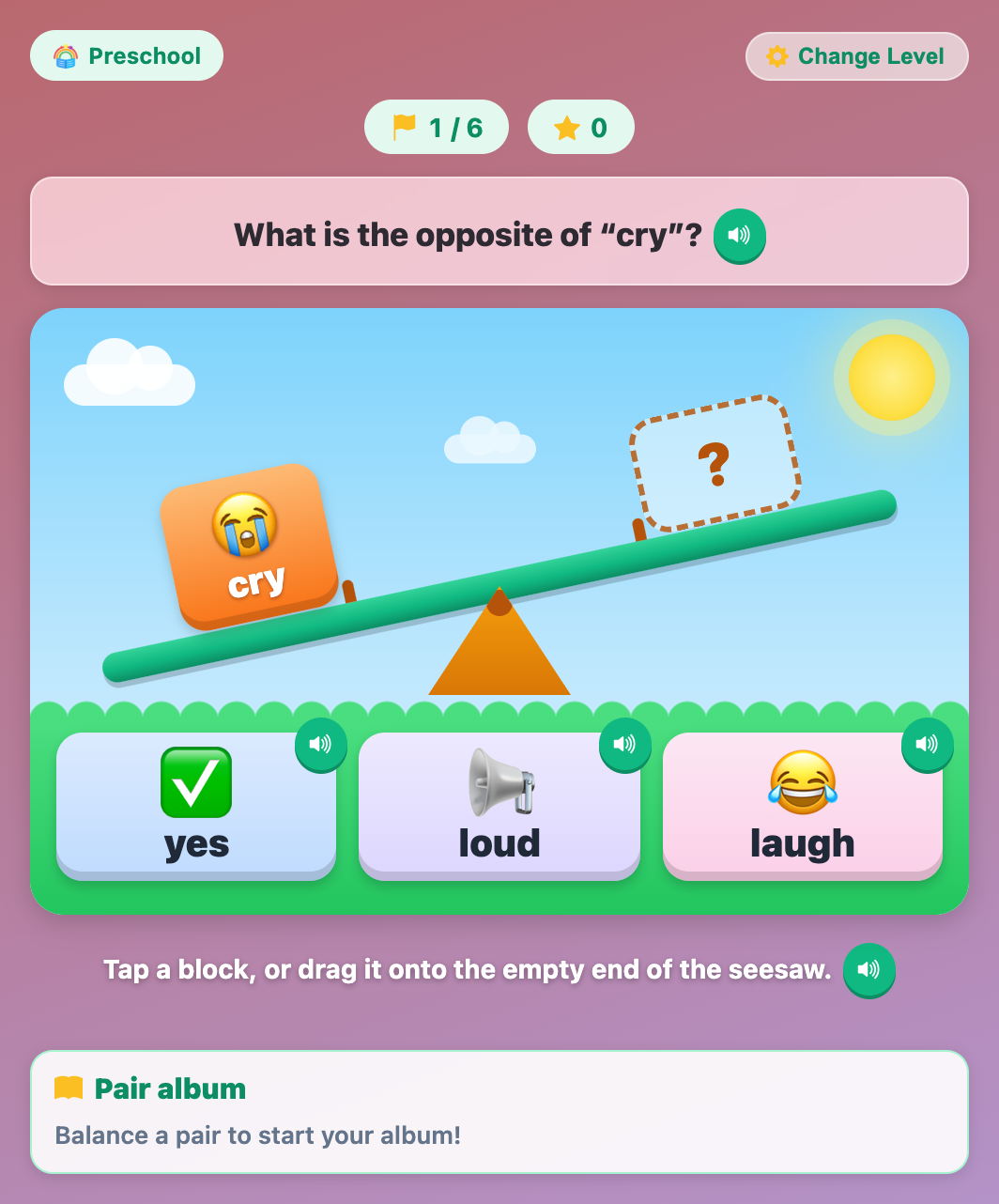
A Preschool round asking for the opposite of cry, with yes, loud and laugh picture blocks on the grass
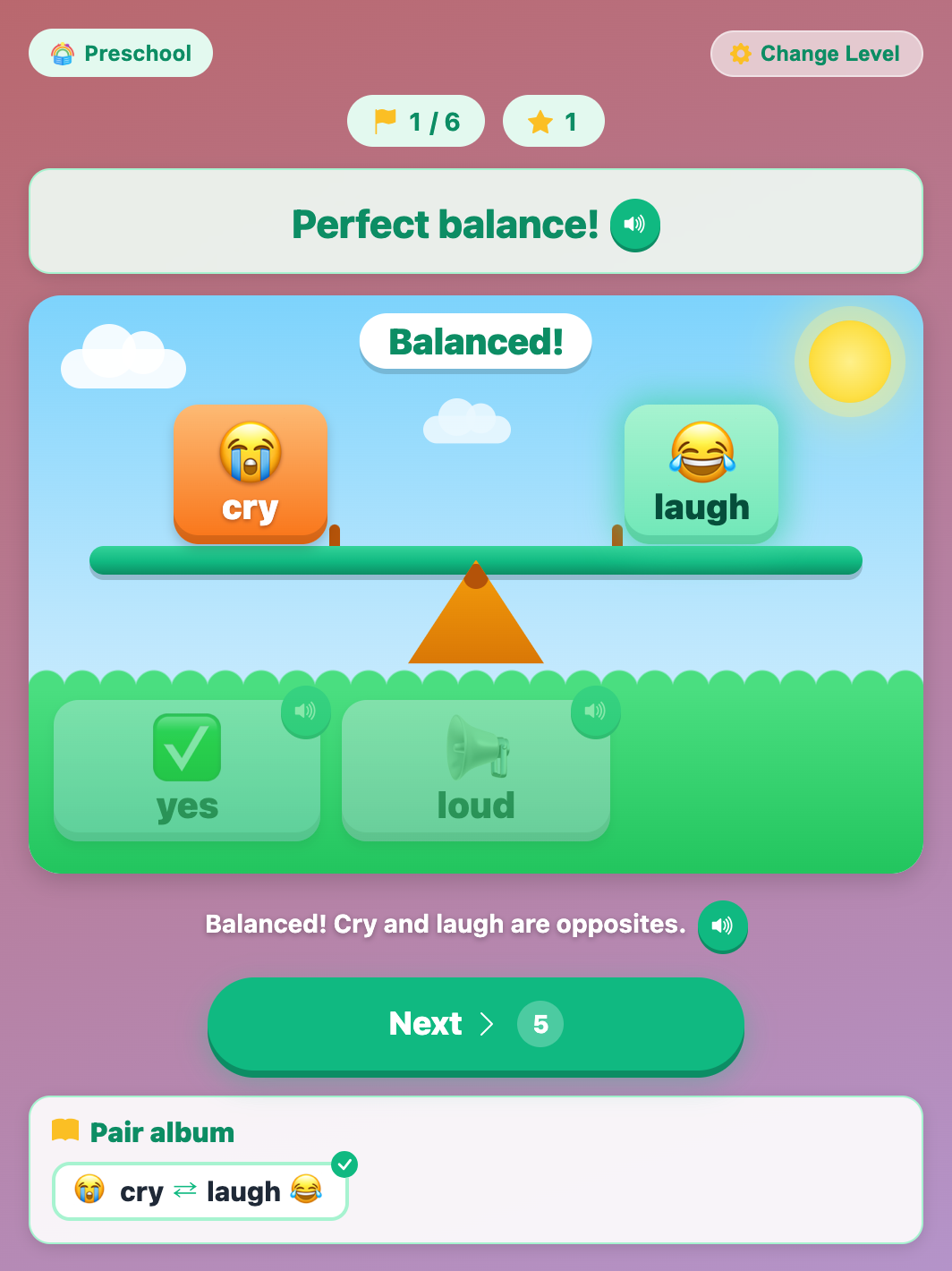
The seesaw balanced with cry and laugh on its ends, a Balanced! sign and the first pair in the album
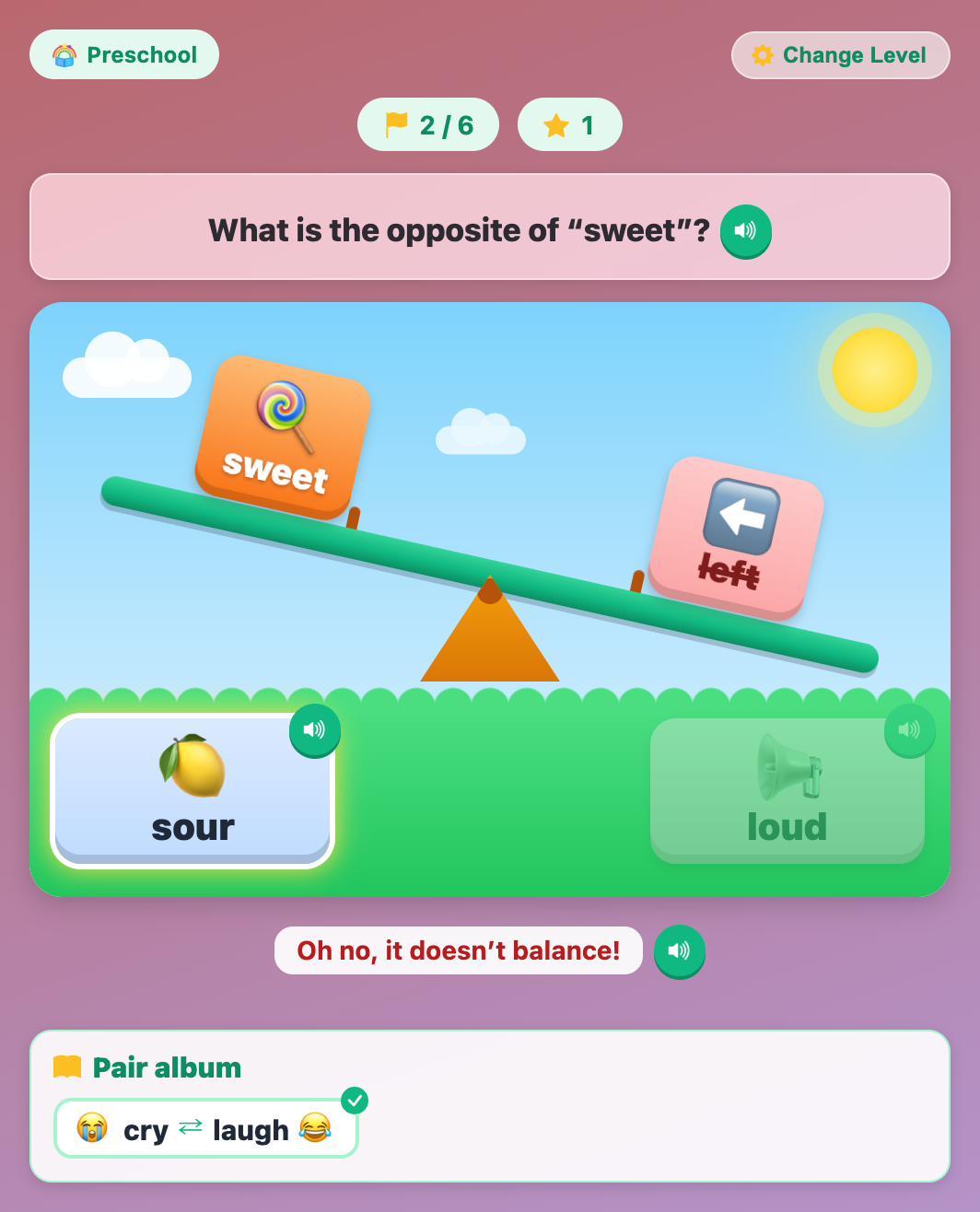
A wrong left block tipping the seesaw the other way while the sour lemon block glows on the grass
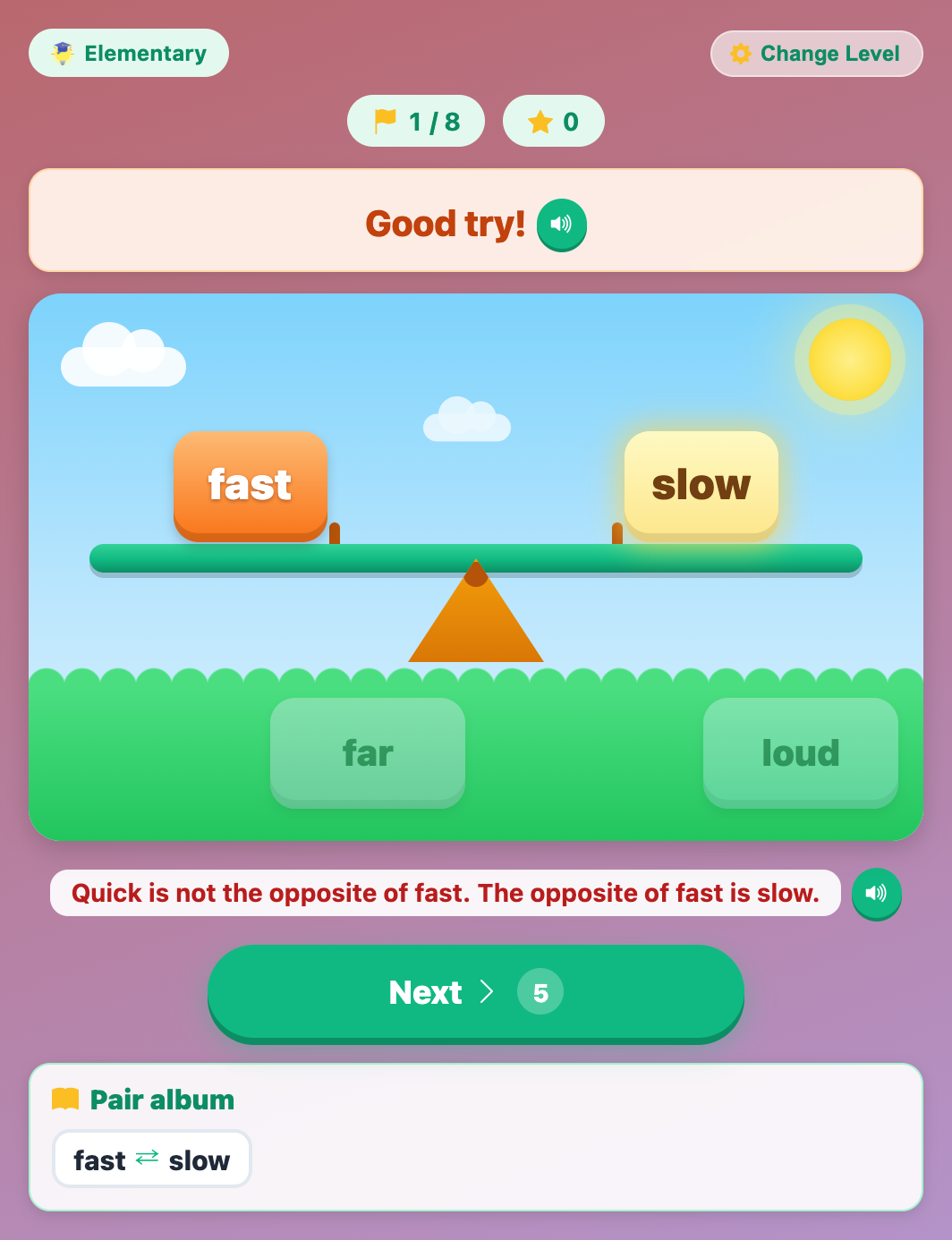
Opposites Seesaw for elementary kids after quick was picked for fast, with slow on the seesaw and a tip below
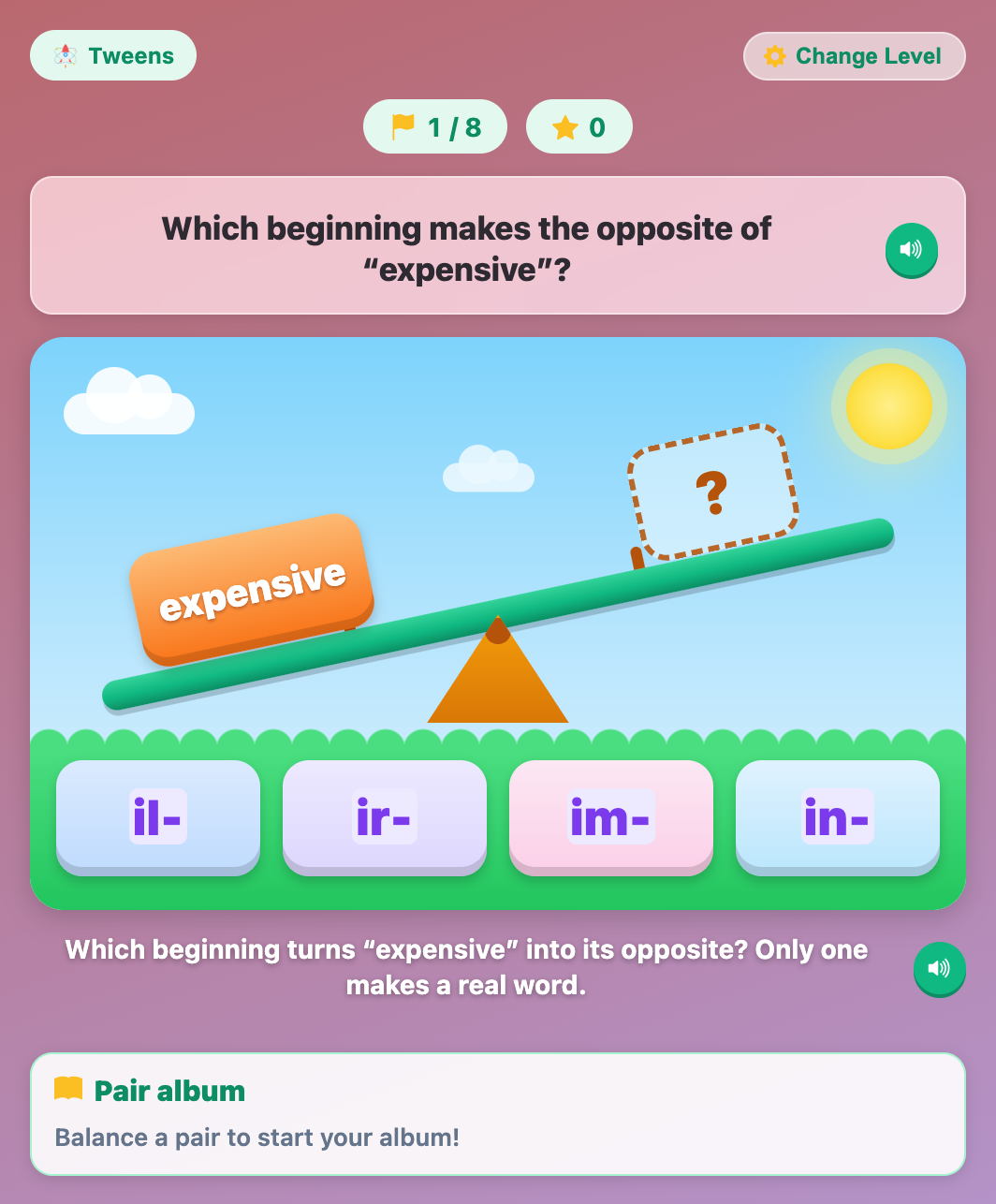
Opposites Seesaw for tweens asking which beginning makes the opposite of expensive, with il-, ir-, im- and in- blocks
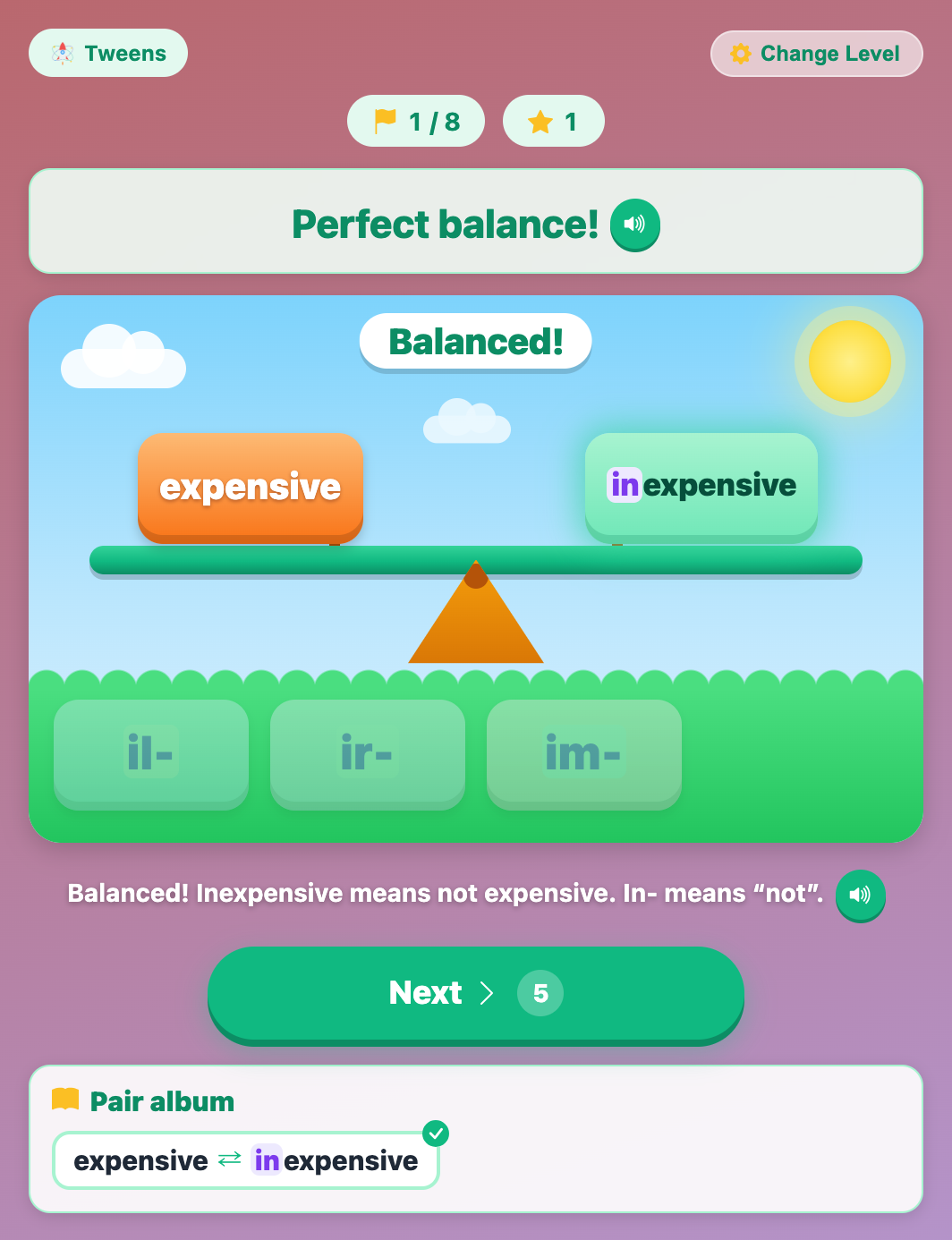
Expensive and inexpensive balancing the seesaw on the Tweens level, with the tip explaining that in- means not
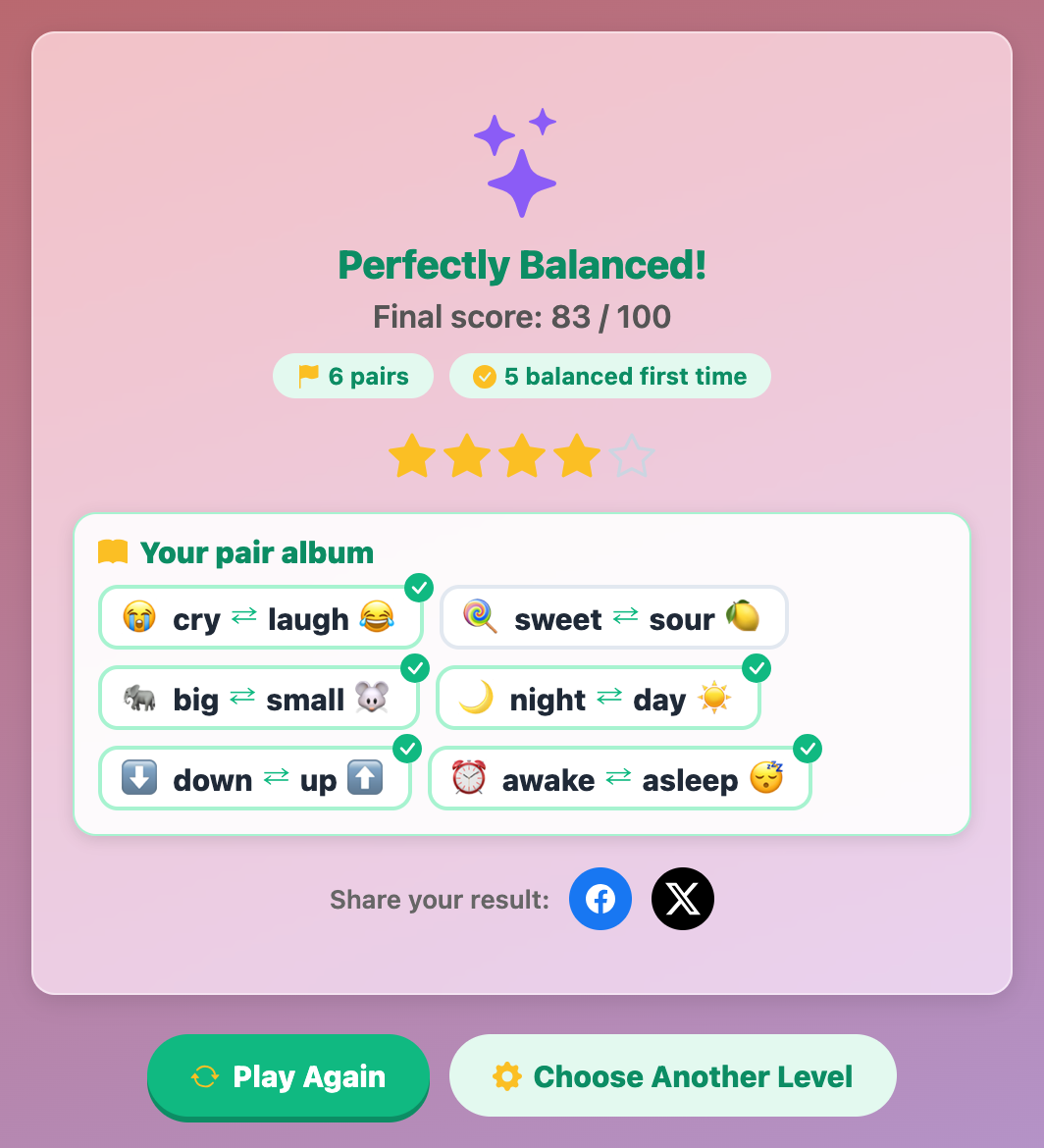
The Perfectly Balanced! finish card with a score of 83, four stars and a pair album of six opposites
More English Games
 102.9K plays
5.0
Dino English Dash
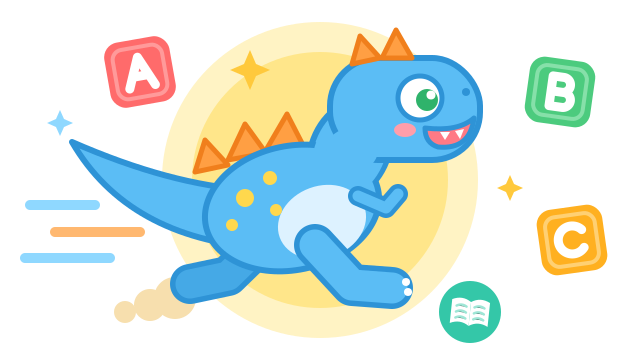
Pick your dinosaur and race to the finish! Every right answer makes your dino dash ahead, three in a row lets out a big ROAR, and a wrong answer makes it trip. Find first letters, read picture words, spot rhymes, and pick the right spelling, opposite and grammar to beat the pack.
 86.4K plays
5.0
Magic Crossbow: Rhyme Hunt
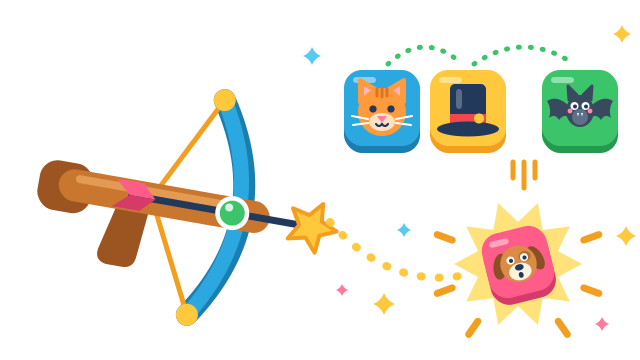
Cat, hat, dog, bat: which one doesn't rhyme? Listen to the ends of the words and shoot the odd one out with your magic crossbow! Picture rhymes for little ones, then sneaky words that look alike but sound different, like shoe and toe or love and stove.
 458.5K plays
5.0
English Quiz
Pick your age level and answer fun multiple-choice English questions, some with audio!
 11.8K plays
4.9
Magic E Wand
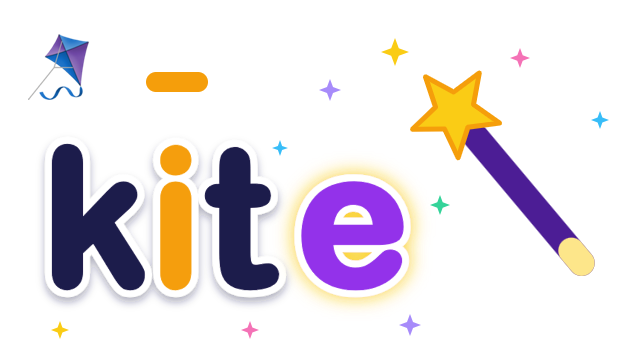
Wave the magic wand and watch words change! Put a magic e on the end of cap and it turns into cape, kit becomes kite, and tub becomes tube. Little ones tap the wand and find the picture they hear, preschoolers match words to pictures, and older kids decide which words need the magic e to fit a picture or a sentence.
Most Played Games
 274.1K plays
5.0
Sentence Builder
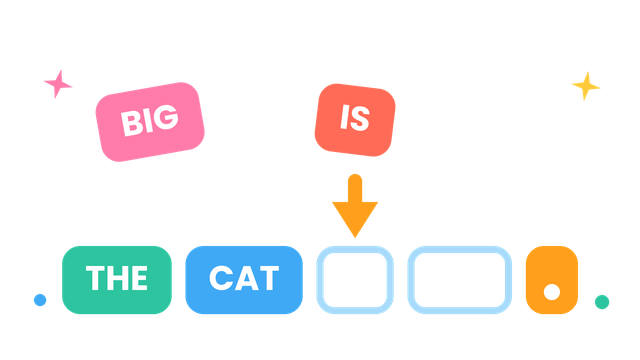
Pick your age level, then tap the shuffled words in the right order to build the sentence.
 435.6K plays
4.8
Sight Word Pop
Read the target word and pop the matching bubble before the timer runs out.
 717K plays
4.9
Word Crush
Swap the candy letters to line up 3 in a row and crush them! Every letter you crush fills in a word, like cat, hat and bat. Make rockets, bombs and rainbows, and spell every word before your moves run out.
 314.9K plays
4.9
English Village Builder
Build a village on a blocky island! Answer vocabulary, spelling, word-meaning and grammar questions to earn wood, stone, flowers and diamonds for every house, road, farm and school.
Comments (46)