
Letter Tracing Trail
982.8K playsEvery letter is a garden path! Put your finger on the little ladybug and walk it along the path, following the arrows and the numbered dots, to write the letter the right way. Flowers grow behind the ladybug as it goes, but if it leaves the path it has to start that line again. Finish a letter and a picture pops up: B is for ball! Little ones trace big capital letters, preschoolers trace small letters and short words like cat and sun, and older kids trace longer words.
B is for ball. I is for ice cream. X is in fox! Those little picture cards are the prize at the end of every walk in Letter Tracing Trail for kids, a free letter tracing game for ages 2 to 12. You put your finger on a red ladybug and walk it along a garden path shaped like a letter, so you write that letter the right way: from the right starting dot, in the right direction, one line after another.
Flowers pop open behind the ladybug as it goes. Little ones trace big capital letters. Preschoolers move on to small letters and short words like cat and sun, and older kids trace whole words like zebra and piano. It all runs in your web browser, with nothing to download and no sign-up. A finger works on a phone or tablet, and a mouse works on a computer. There is no clock, so nobody has to rush.
🐞 Letter Tracing Trail for Kids: Handwriting in a Garden
Good handwriting is not only about how a letter looks at the end. It is also about how you make it. Where does your pencil start? Which way does it go? Which line comes first? Kids who learn this early write faster and neater, and they mix up letters like b and d less often.
In this game, the path answers all three questions for you. A green dot with a number shows where each line starts. Brown arrows (little V shapes) and glowing orange dots point the way. A gold star waits at the end of the line. The ladybug walks only forward along the path, so the letter always comes out in the right order.
Behind the path you will see handwriting lines, just like on school paper. A white line runs across the top. A dashed line runs through the middle; that is where small letters like a, n and o begin. A reddish line at the bottom is the baseline, where letters sit. Letters with tails, like g, j, p, q and y, get one more dashed line below, so you can see the tail hang down.
As you trace, a green vine grows along the path, and every little way a flower opens, in that round’s color taking turns with yellow. Finish the letter and the whole vine glows, the ladybug does a happy bounce, and a picture card pops up under the garden. The card links the letter to a word: “A is for apple” 🍎, “M is for moon” 🌙, “Q is for queen” 👸. For a word, the card shows its picture and spells it out, like “v - a - n” with a little van 🚐.
🌷 Your Walk Through the Garden, Screen by Screen
Pick your level. The Choose Your Level screen has four cards: Toddlers (ages 2–4), Preschool (ages 4–6), Elementary (ages 6–10) and Tweens (ages 10–12). The very first time, the game may jump straight into Elementary words. Press ⚙️ Change Level at the top right to see all four cards. The game remembers your choice for next time.
Read the goal card. The white card says what to trace, like “Trace B” or “Trace small g”. Under it, a short line tells you how many lines the letter has: “3 lines: dot 1, 2 and then 3. Follow the arrows!” For a word it says “One letter at a time, from dot 1.” Press the green 🔊 button to hear it read aloud.
Check the three bubbles. The flag shows the round (like 2 / 5), the star shows your stars so far, and the 🌸 shows how many flowers you have grown.
Put your finger on the ladybug. Press right on the ladybug, then slide. If you press somewhere else, the ladybug gives a little shake and the tip under the garden says “Put your finger on the ladybug to start!”
Follow the arrows to the gold star. The ladybug walks wherever your finger goes, as long as your finger stays on the sandy path. Flowers grow behind it.
Go from dot to dot. When one line is done, the ladybug hops to the next green dot and the tip says “Great! Now trace line 2, from dot 2.” Lines still to come look faint until it is their turn. In a word, the ladybug hops to the next letter instead: “Great! Now trace the “a”.”
Rest whenever you like. You can lift your finger in the middle of a line. The ladybug waits right there, the tip says “Keep going! Put your finger back on the ladybug.”, and a little yellow dot runs ahead along the path to show which way to go.
Stay on the path. If your finger slides too far off, that is a bump. The flowers on that line disappear, the ladybug walks back to the start of the line, and the tip says “Oops! Stay on the path. Try line 2 again.” Only that one line starts over. Lines you already finished keep their flowers.
No touch screen? Use the keys. Each press of the → or ↓ arrow key walks the ladybug a short way along the path. The keys can never cause a bump.
Meet the picture card. When the letter or word is done, you see the round’s stars on the goal card and the picture card underneath. Press its 🔊 to hear it: “B! B is for ball.”
Press Next. The big green Next button counts down from 5 and then moves on by itself. It waits while something is being read aloud. You can press it sooner, or press Enter or Space. On the last round it says See My Score.
Read your finish card. “All Letters Traced!” (or “All Words Traced!”) shows your score out of 100, your stars, how many rounds stayed on the path, how many flowers you grew, and up to 5 big stars. Press Play Again for new letters or words, or Choose Another Level.
Use the buttons around the game. Fullscreen makes the garden fill your screen, Reload starts a fresh game, and the music button turns the background music on or off.
When the site’s sound is on, the game can also read the goal aloud as each round starts, say the next step after each line, and read the picture card. The voice always says letter names, so a small a is read as “the small letter A”, never as the word “a”.
⭐ Do Mistakes Cost a Lot? How Stars Work
Not much! Every round starts with 3 stars:
The first bump in a round takes away 1 star.
The third bump in the same round takes away 1 more.
You always keep at least 1 star for every letter or word you finish.
So a second bump costs nothing extra. Bumping five or six times still leaves you 1 star. Lifting your finger to rest never costs anything, and neither do the arrow keys.
Your score compares your stars with the most you could get, as a number out of 100. Preschool has 6 rounds (4 letters and 2 words), so the most is 18 stars. Here is how that works out:
No bumps at all: 18 stars, a score of 100 and a gold trophy.
One bump in one round: 17 stars, a score of 94. That still earns the trophy and all 5 big stars.
Three bumps in one round: that round keeps only 1 star, so you get 16 stars and a score of 89. That is just under the trophy line, so you get 4 big stars.
The flowers don’t change your score. They are there to make the garden pretty and to show how far you walked.
✍️ Which Way Does Each Letter Go?
The paths follow “ball and stick” print handwriting, the kind many schools teach first. The big rule is simple: start at the top, and go from left to right. Lines going down start at the top. Lines going across start on the left. Knowing the family a letter belongs to helps you guess the path before you even start.
Capitals you trace in one go
C, G, J, L, O, S, U, V, W and Z are each one line, with no lifting. C, G, O and S curl to the left first, the way a pencil naturally goes round. L goes down and then across the bottom. V and W go down and up, down and up, with sharp points at the bottom. Z goes across the top, slants down to the left, then goes across the bottom. G ends with a short bar pointing in.
Capitals made of a few lines
Stick first, then the rest: B, D, E, F, H, K, M, N, P, R and T all start with a line straight down on the left (or, for T, down the middle). Then come the bumps or bars.
Bars from top to bottom: E has 4 lines: down, then the top bar, the middle bar and the bottom bar. F is the same without the bottom bar. I is a stick down the middle, then the top bar and the bottom bar.
One long zigzag: after the stick, M and N finish in a single line. M goes down to the middle point, up again and down the right side.
Slants: A is two slants from the top point, then the bar across. X is two slants that cross. Y is a short left arm, then the right arm and down to the bottom.
Circle, then tail: Q is the O circle, then a little tail at the bottom right.
Small letters that start with a circle
a, d, g and q all start with a “circle back”. It starts at the top right of the circle, goes up and over to the left, down and round the bottom, and back up to where it started. Then comes a stick down the right side: short for a, tall for d, and hanging below the line for g and q.
Small letters that start with a stick
b and p are the opposite: first the stick, then a “circle forward” that bulges to the right. h, n, m and r are a stick, then one or two humps (round bridges) over to the right. m has two humps, so it has 3 lines. r stops after a short hump.
Little letters with a dot, a bar or a tail
i and j end with their dot. In this game the dot is a very short line: put your finger on the ladybug above the stick and pull down just a tiny bit. f and t save their bar for last (f starts with its hook and stick in one line). e is the odd one out: it starts with a line straight across the middle, then curls up, over and round. g, j, p, q and y all hang their tail down to the dashed line below the baseline.
🌸 Smart Ways to Keep Every Flower
These tips go from easy to clever. Each one helps you finish more rounds with all 3 stars.
1. Aim for the ladybug, not the path
A press only works on the ladybug itself. If you press farther along the path, the ladybug just shakes. Put the middle of your fingertip right on its red back, then slide.
2. Walk in the middle of the sand
The path is sand with a white edge. There is a little extra room past the edge, but not much. If you keep your finger in the middle, a small wobble won’t matter. On Toddlers the path is widest and has the most extra room. On Tweens it is the thinnest in the game.
3. Look ahead at the orange dots
Your finger hides the path right under it. So don’t look at your finger. Look a little ahead, at the next arrow and the glowing orange dots. Your hand will follow your eyes, the same way you look down the road when you ride a bike.
4. Slow down at the sharp points
Most bumps happen at corners: the bottom of V and W, the points of M, N and Z, or where A’s slant meets the bar. Slow down as you reach the corner, turn, and then speed up again. Fast fingers tend to fly straight past a corner and off the path.
5. Can’t skip ahead? That’s on purpose
The ladybug only walks forward, a little at a time. If you jump your finger far ahead to the gold star, the ladybug can’t follow, and it counts as leaving the path. Walk the whole line, even the boring straight parts.
6. Lift your finger before it slips
Is your arm tired, or is your finger near the edge? Lift it! Lifting is free. The ladybug waits, and the little yellow dot shows you which way to go. Then put your finger back on the ladybug and keep walking. A lift costs nothing, but a slip costs a star.
7. Use the line order to tell b from d
This trick helps with the two letters kids mix up most. For b, the stick comes first, then the circle: “bat, then ball”. For d, the circle comes first, then the stick: “drum, then drumstick”. The game makes you trace them in exactly that order, so your hand learns the difference too.
8. After the first bump, take it extra slow
Remember the star rule: the first bump costs a star, the second costs nothing, and the third costs another. So after one bump, don’t give up on the round. Slow way down and you still keep 2 stars.
9. In a word, finish one letter at a time
A word’s later letters show up faint, and their numbered dots stay hidden until the ladybug gets there. Don’t worry about the whole word at once. Read it on the goal card, then think only about the letter you are on. Each new letter starts back at dot 1.
10. Rest your hand when you use a mouse
A mouse is harder to steer than a finger. Rest the side of your hand on the table and move the mouse slowly with your fingers. On a computer, you can also tap the → key to walk the ladybug, which is a great way to learn a tricky letter’s path before trying it by hand.
🔤 Let’s Trace Together: B, a, i, cat and zebra
Capital B, the three-line letter (Toddlers)
The goal card says “Trace B” and “3 lines: dot 1, 2 and then 3.”
Line 1: put your finger on the ladybug at dot 1, at the top left. Walk straight down to the baseline.
Line 2: the ladybug hops back to the top of the stick. Go across a little, round the small top bump, and back to the middle of the stick.
Line 3: from the middle, go out and round the bigger bottom bump, and back to the bottom of the stick.
The vine glows, and the card says “B is for ball” with a soccer ball ⚽.
Notice that the bottom bump is bigger than the top one. If you go too wide on the top bump, slow down. It turns back sooner than you think.
Small a, circle first (Preschool)
Line 1 starts at the top right of the circle, just under the dashed middle line. Go up and over to the left, down round the bottom, and up the right side back to the start.
Line 2: the ladybug hops to the top of the right side. Walk straight down to the baseline.
The card says “a is for apple” 🍎.
A common slip is starting the circle downward, the way a clock’s hands go. The arrows show the other way: up and to the left first. Follow them, and your a will look right on paper too.
Small i, where the dot is a tiny line (Preschool)
Line 1: walk down from the dashed middle line to the baseline.
Line 2: the ladybug hops up above the stick. Press it and pull down just a tiny bit. That little line is the dot.
The card says “i is for ice cream” 🍦.
The word cat, letter by letter (Preschool)
The goal card says “Trace “cat”.” First comes c: one curl, starting at the top right and going round to the left.
The tip says “Great! Now trace the “a”.” Trace the circle back, then the stick.
Then the “t”: walk down the stick first, then the bar across, from left to right.
The card shows a cat 🐱 and spells it: “c - a - t”. The 🔊 reads “C, A, T. Cat!”
The word zebra, on the thinnest path (Tweens)
z is one zigzag line: across the middle line, a slant down to the left, then across the baseline.
e is one line too: straight across its middle, then up, over and round.
b is the tall stick, then the circle forward.
r is a short stick, then a short hump.
a is the circle back, then the stick.
The card shows a zebra 🦓 and spells “z - e - b - r - a”.
The path on Tweens is thin, and zebra has two sharp turns in the z. Take the z slowly, and save your speed for the straight sticks of b and r.
👧 What Age Is Letter Tracing Trail For?
Every level uses the same garden and the same ladybug. What changes is what you trace and how wide the path is. No letter or word comes back twice in the same game.
Ages 2–4: big capital letters
Letter Tracing Trail for toddlers is 5 capital letters, picked at random from A to Z. The path is the widest in the game, with the most room for a wobbly finger. Sit next to your child, press 🔊 to hear the goal, and say the picture card together: “D! D is for dog.” For children just learning the order of the alphabet, Alphabet Train is a gentle next stop, where they drag the missing letters into the train cars.
Ages 4–6: small letters and first words
In Letter Tracing Trail for preschoolers, you trace 4 small letters, then 2 short three-letter words, like cat, sun, pig, bus, map or web. Every word has a short vowel sound in the middle, the first words many kids learn to read. The path is a little narrower. Small letters are where b and d mix-ups begin, so tip 7 really helps here. If your child is still matching big letters to small ones, Letter Twins pairs each big letter with its little twin.
Ages 6–10: three- and four-letter words
Letter Tracing Trail for elementary kids has 2 three-letter words, then 3 four-letter words, like fish, frog, cake, kite, drum and crab. The path gets thinner again, so a steady hand matters more. This is a good level for kids who can read short words but whose handwriting still goes the wrong way round, and for kids learning English as a new language.
Ages 10–12: five-letter words
Letter Tracing Trail for tweens has 5 five-letter words, like apple, house, zebra, pizza, robot and piano. The path is the thinnest in the game, so a score of 100 is a real challenge. It is great for older kids who want neater handwriting, and fun for a big brother or sister to try before helping a younger one.
🌻 What Your Child Learns on the Path
Where letters start. Every round begins at a green dot. After a few games, kids stop starting an O at the bottom or an E at the right, because the ladybug never does.
Which way they go. The arrows only point one way, and the ladybug only walks forward. That builds the top-to-bottom, left-to-right habit that makes writing faster later.
How letters sit on the lines. Small letters start at the dashed middle line, tall ones reach the top, and g, j, p, q and y hang below. Seeing that again and again makes letters on real paper look even.
Letter sounds. The picture cards link each letter to a word that starts with its sound: “F is for fish”, “R is for rabbit”. And X teaches a small surprise: it hides at the end of fox.
Spelling, one letter at a time. In the word levels, you trace c, then a, then t, and the card spells it back. Your hand and your eyes learn the word together.
A steady hand and patience. Staying inside the sand, slowing down at corners, and resting before a slip are the same skills a pencil needs.
For grown-ups: is it safe, and what does it teach?
Letter Tracing Trail is a calm game. There is no timer, nothing scary, and no chat. A mistake only means walking one line again, and every finished letter keeps at least 1 star. It runs free in the browser with nothing to install and no account needed. It practices letter formation (where each letter starts and which way it goes), capital and small letters, beginning sounds, and spelling short words. For best results, follow it up with a pencil: ask your child to write the letter they just traced on paper, starting at the same dot.
Ready to grow a garden of letters? Pick your level, put your finger on the ladybug, and fill every path with flowers in Letter Tracing Trail for kids. And if you enjoy tracing, Number Tracing Trail works the same way with numbers, with a little car driving along roads shaped like digits.
🖼️ See the Game in Action
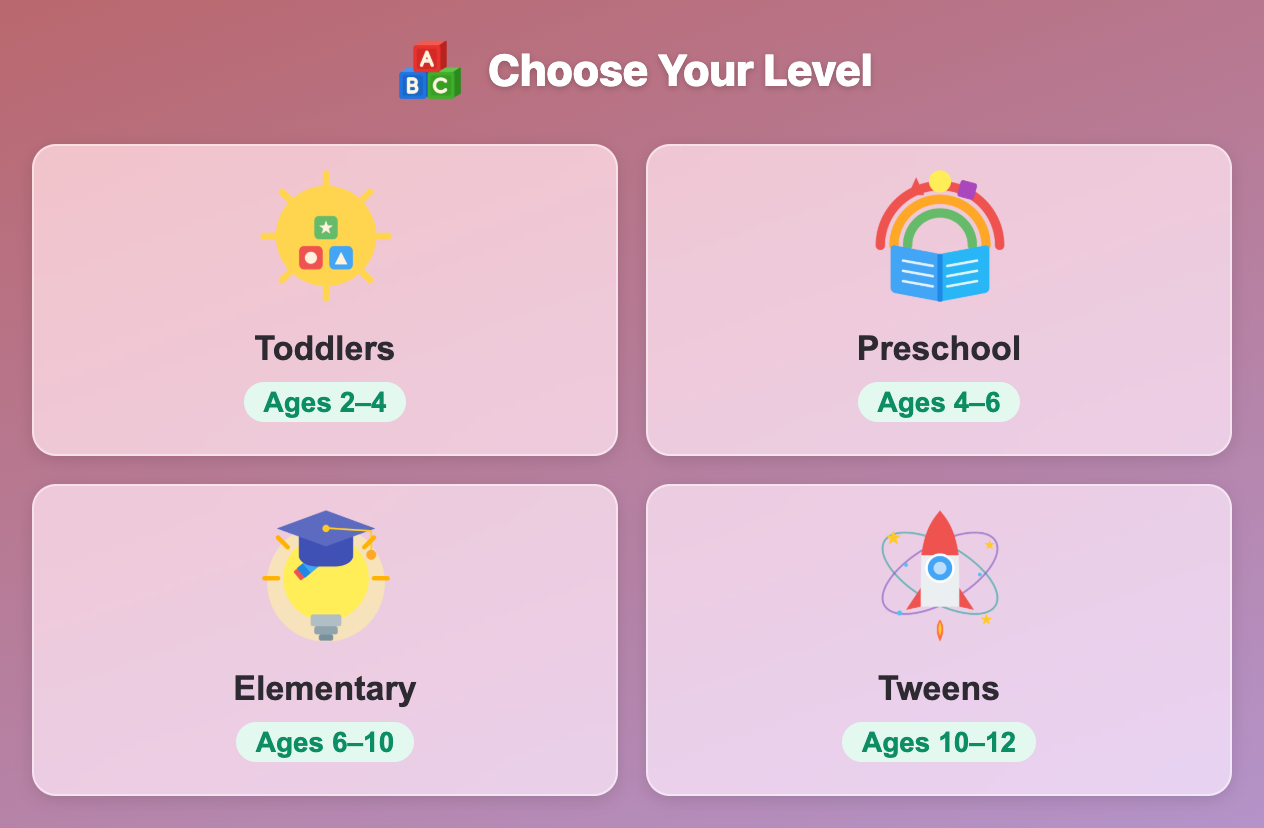
The Choose Your Level screen in Letter Tracing Trail for kids, with Toddlers, Preschool, Elementary and Tweens cards
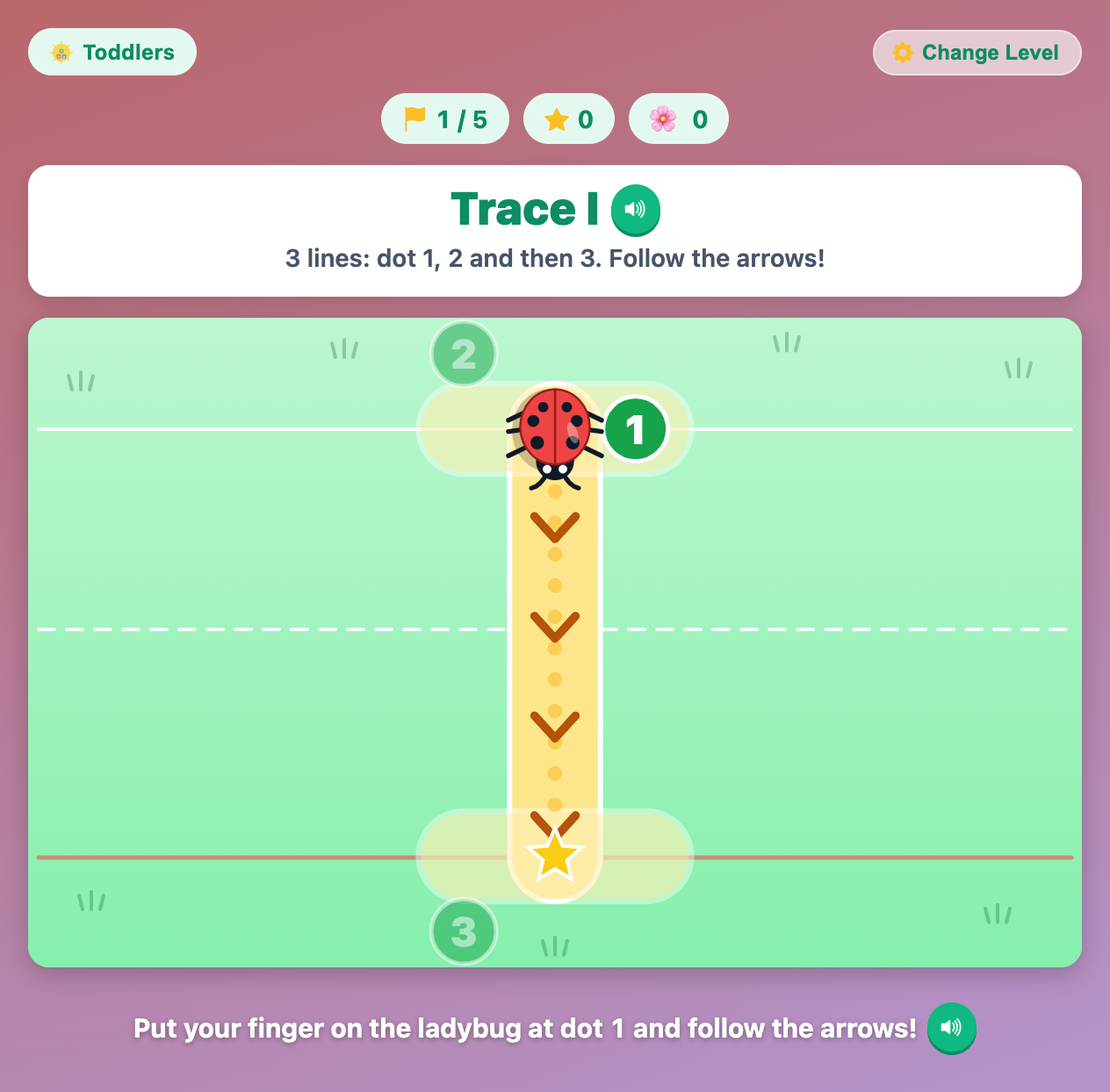
A capital I garden path with the ladybug waiting at green dot 1, brown arrows pointing down and a gold star at the end
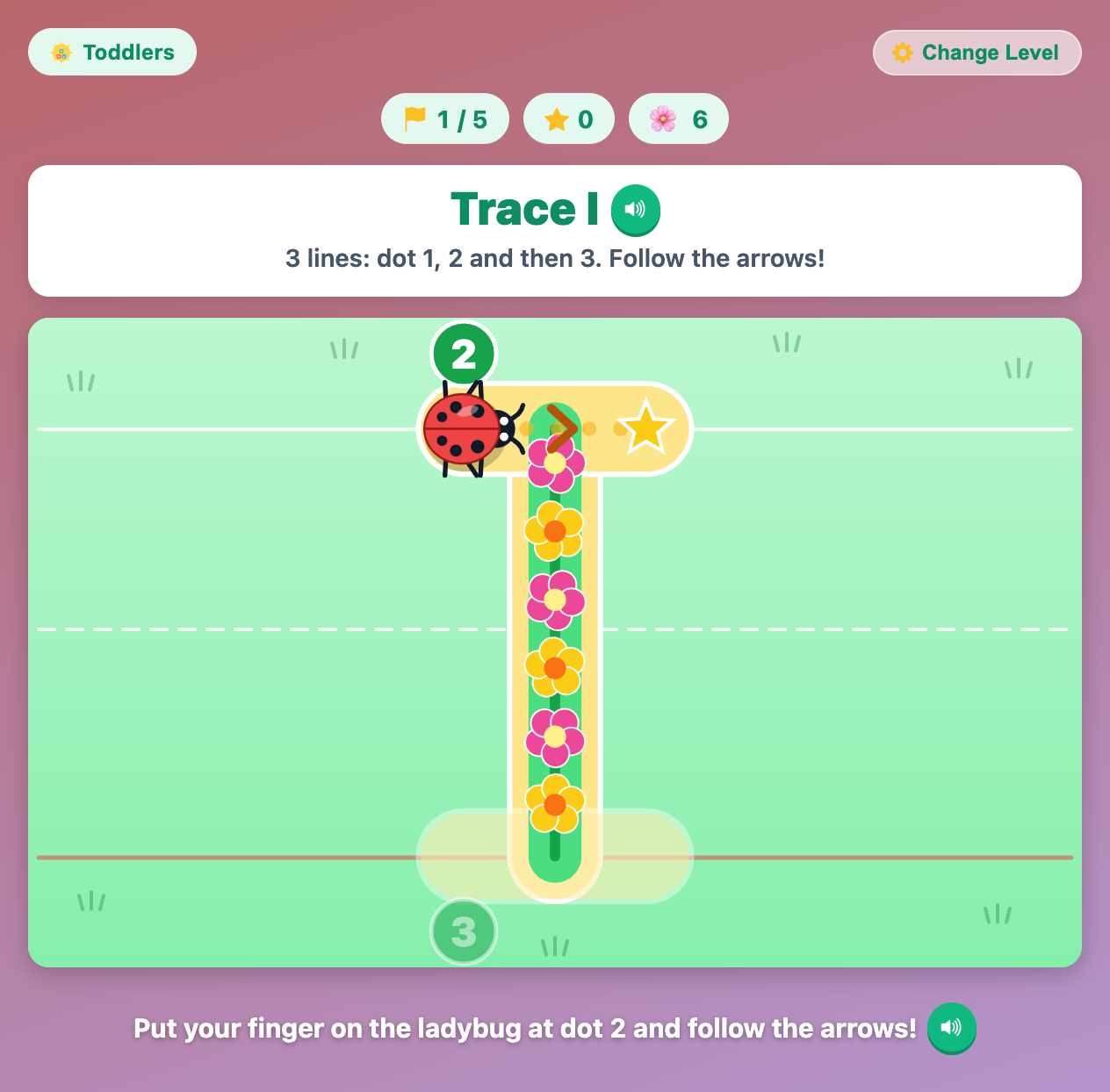
The down line of a capital I covered in pink and yellow flowers while the ladybug starts the top bar at dot 2
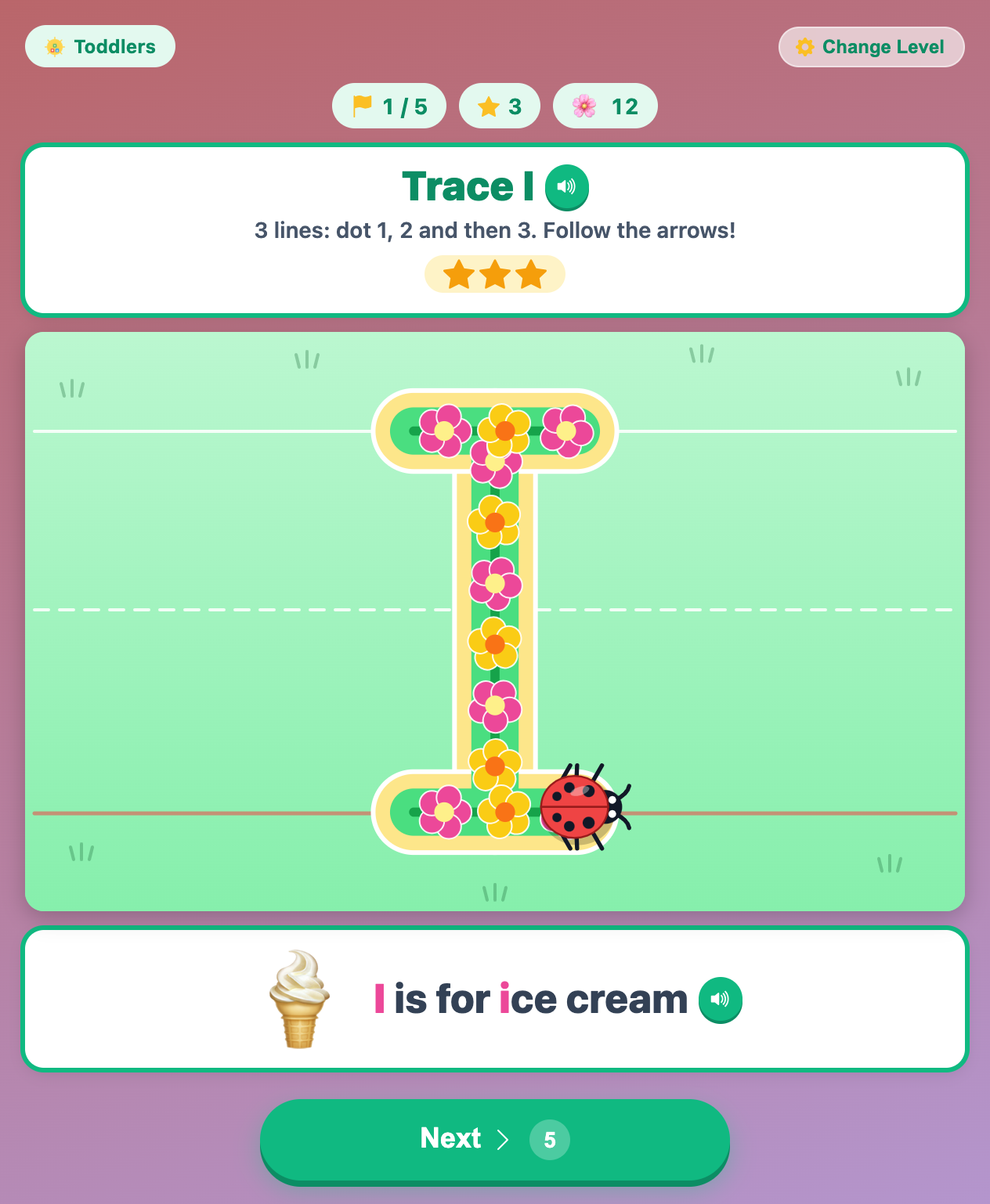
A fully traced capital I filled with flowers, three gold stars and the card I is for ice cream with an ice cream cone
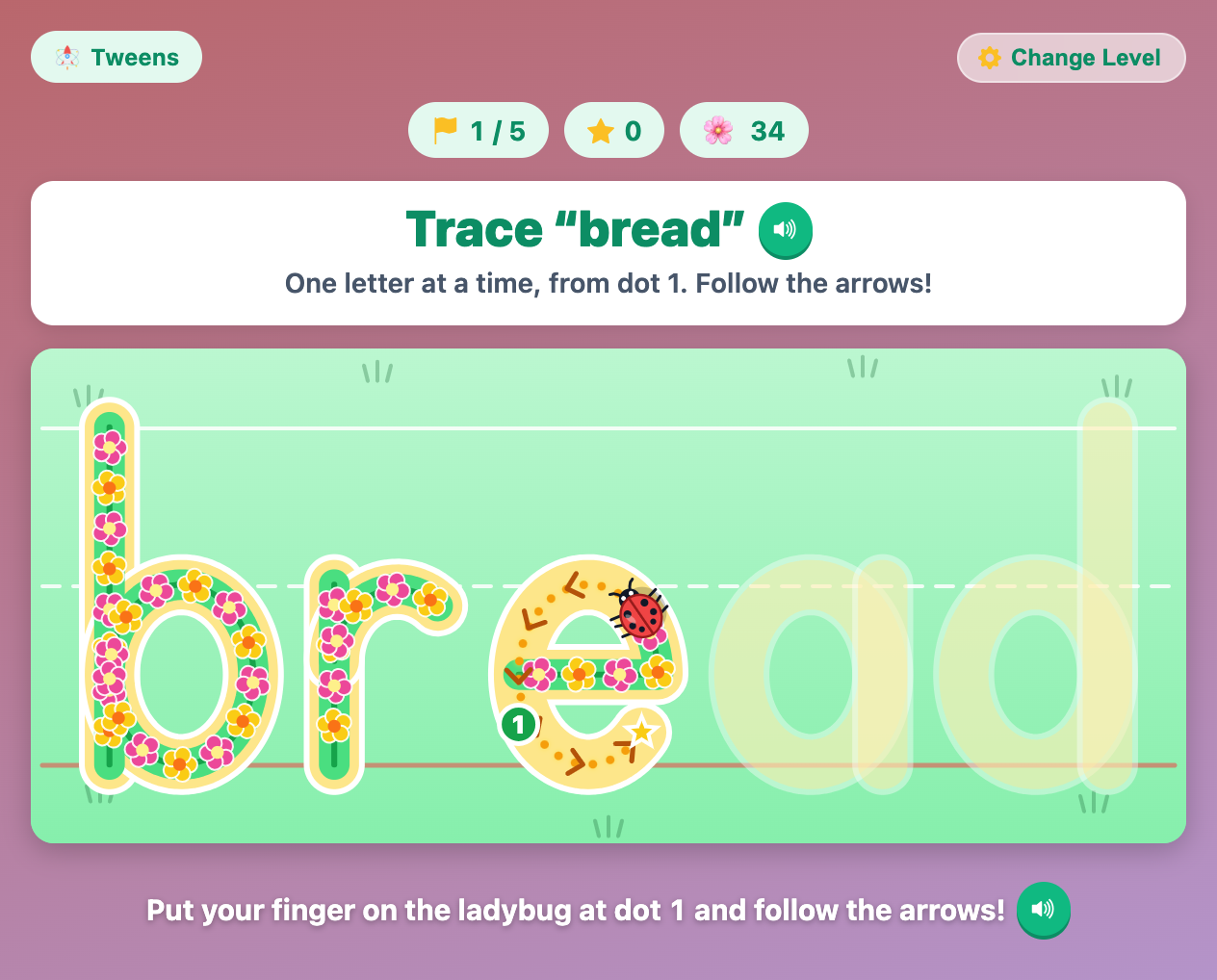
Letter Tracing Trail for tweens with the word bread, b and r full of flowers and the ladybug curling round the e
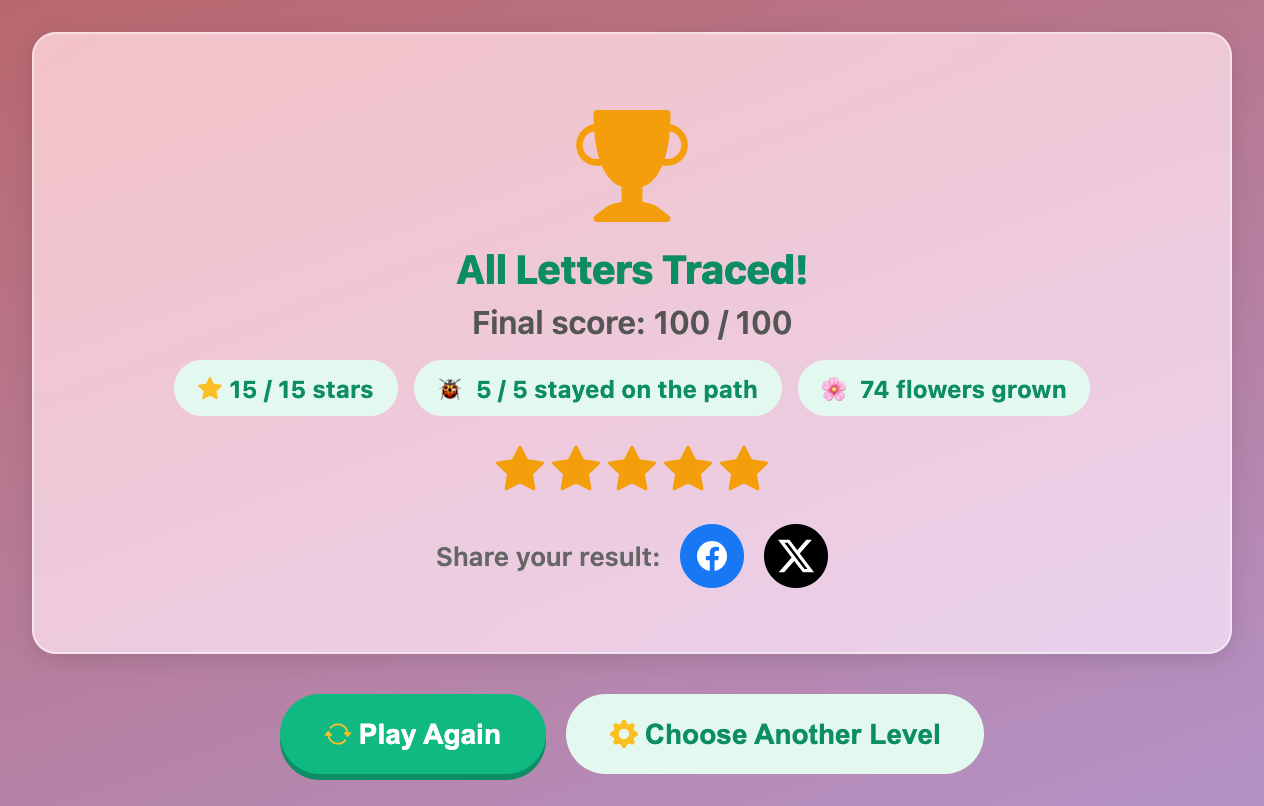
The All Letters Traced finish card with a gold trophy, a score of 100, 15 stars, 74 flowers grown and five big stars
More English Games
 743K plays
5.0
Word Scramble
Unscramble the shuffled letters to spell the word shown by the picture clue.
 154.9K plays
5.0
Magic Crossbow: Extra Word
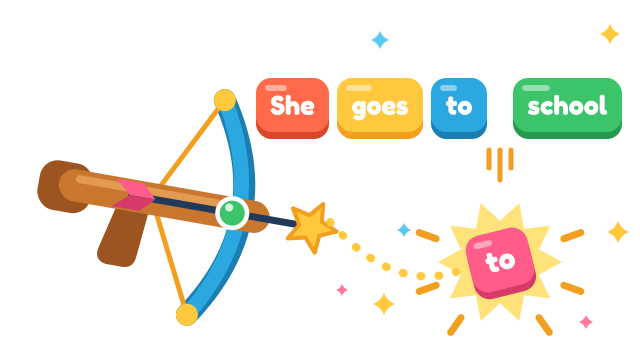
Read the sentence, find the word that doesn't belong, and shoot it with your magic crossbow! Pop the extra "to" out of "She goes to to school" and the sentence is fixed. Short picture sentences for little ones, real grammar slips and two sneaky extra words for big kids.
 27.3K plays
4.9
Syllable Drum
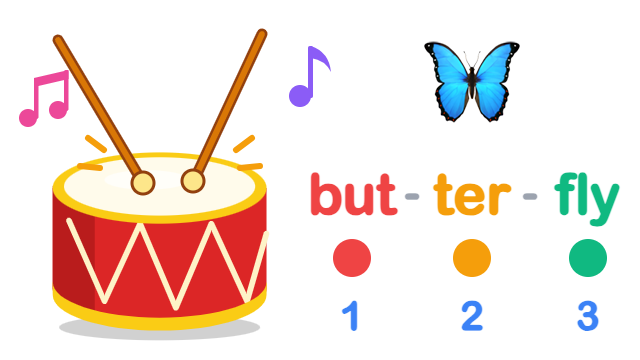
Boom, boom, boom! Tap the big drum once for every beat in a word, and watch but-ter-fly split into three bright parts. Little ones drum short words like duck and apple, preschoolers count up to three beats, and older kids sort words into syllable baskets and hunt for the word with the right number of beats, all the way up to hip-po-pot-a-mus.
 458.5K plays
5.0
English Quiz
Pick your age level and answer fun multiple-choice English questions, some with audio!
Most Played Games
 274.1K plays
5.0
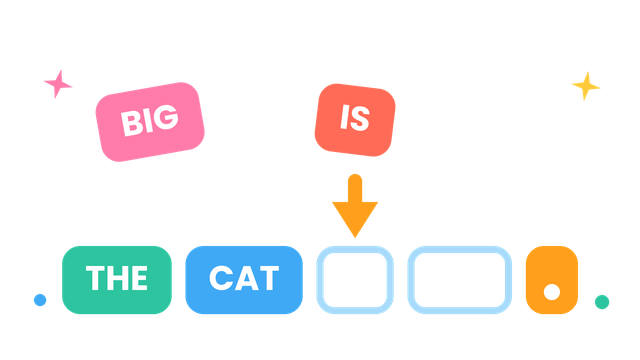
Sentence Builder
Pick your age level, then tap the shuffled words in the right order to build the sentence.
 435.6K plays
4.8
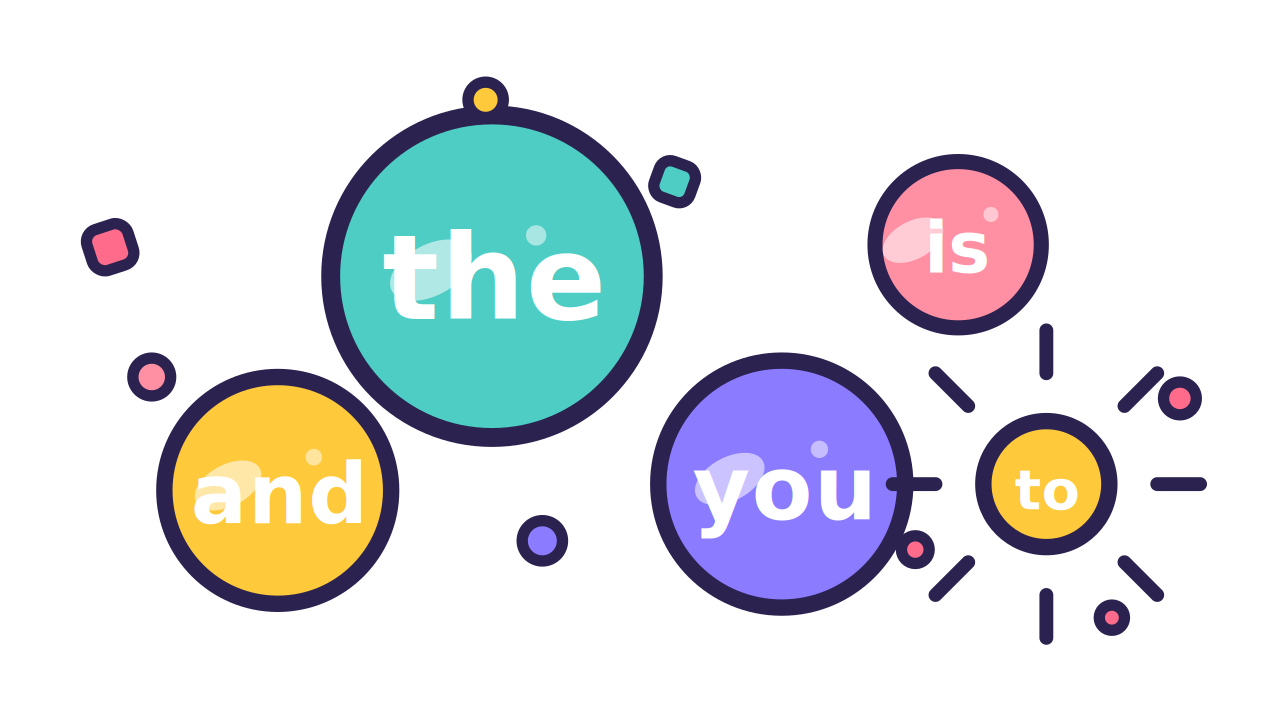
Sight Word Pop
Read the target word and pop the matching bubble before the timer runs out.
 717K plays
4.9
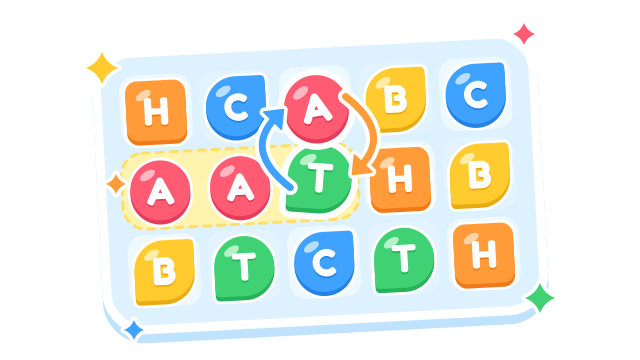
Word Crush
Swap the candy letters to line up 3 in a row and crush them! Every letter you crush fills in a word, like cat, hat and bat. Make rockets, bombs and rainbows, and spell every word before your moves run out.
 314.9K plays
4.9
English Village Builder
Build a village on a blocky island! Answer vocabulary, spelling, word-meaning and grammar questions to earn wood, stone, flowers and diamonds for every house, road, farm and school.
Comments (40)